Transcript
0:04 >> You're listening to Autumn on the Air, the weekly podcast that brings you conversations about the impact of research commercialization and the people who make it happen. Join us for interviews with patent and licensing professionals, innovators, entrepreneurs, and tech transfer leaders on the issues and trends that matter most. Keep listening for an inside track on the people, IP policies, and politics changing our world. >> Welcome to Autumn on the Air.
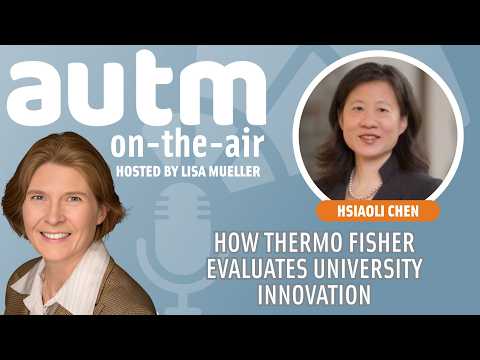
0:36 If you work in technology transfer, you spend a lot of time thinking about industry partnerships, how companies evaluate academic discoveries, how deals come together, and how relationships evolve over time. Today, we're looking at those questions from the perspective of a company that many of you likely interact with. My guest is Shaolee Chen, senior manager of corporate innovation partnerships at Thermo Fisher Scientific. Shaolee is a trained biomedical researcher with nearly 20 years of experience in business development, technology scouting, and licensing across the life sciences and pharmaceutical industries in both the US and Europe.
1:20 She earned her PhD in biological structure at the University of Washington School of Medicine and has been a certified licensing professional since the early days of the program. In her role at Thermo Fisher, she works directly with companies, startups, and tech transfer offices to identify emerging technologies and build partnerships that bring new tools and capabilities into the broader research ecosystem. Welcome to the podcast, Shaolee. So excited to have you here on the Air.
1:52 >> Thank you. Thank you for inviting me joining the podcast. >> Well, very excited to have you here and I thought I would start the podcast off by asking you a little bit about your career journey because I know you started your career in academic research before you moved into business development and licensing. So, share with us a little bit if you wouldn't mind, what pulled you from the lab into the technology commercialization side of science?
2:19 >> Absolutely. So, like I you mentioned, I was at the academic researcher before after I completed my post-doctoral fellowship at University Washington. At the time, I moved to Munich, Germany working a startup company and doing biomedical research, particular congestive heart failure. I joined it as a kind of a group leader, try to identify leads to treat congestive heart failure. And during that time, it was a small company and the CEO kindly asked me whether I would explore the from the business development licensing part of the business.
3:05 That was not I originally planned to do. I was given the opportunity and I was curious about how would that turn out. So, that's why I took the opportunity that was, you know, over 20 plus years ago. And since then, I've been really enjoying doing licensing in and out and also partnership business development. And it's just a very different type of partnerships we have been doing today with some official back then, it's more like a biopharma licensing, that sort of partnership. But I I really enjoyed it and that's why I continue this technology transfer business development journey since then.
3:52 >> So, how do you think being a researcher has shaped how you interact with inventors and tech transfer teams today? >> I I think that definitely have a plus impact cuz I I since I was a researcher myself, I really appreciate the detail and the efforts the inventors they have to put in to make you know, something meaningful, tangible to share with the broader world. So, because of that, when I look at the opportunities technologies offer to me today, I I really like to understand more the science part, scientific part, right? So, how how does that happen and how what kind of experiments have been validated, performed to bring the technology to the stage. So, I think that appreciation because of my scientific background, that helps tremendously of today what I do.
4:51 >> I would say so. It sounds like it's really been instrumental and you know, many of our listeners have interacted with Thermo Fisher at some point given the breadth and the depth of the products that it offers. From your perspective, how does Thermo Fisher think about its partnerships with universities and tech transfer offices? >> Well, first of all, we really appreciate all, you know, all the researchers from the university or research institutions, those are our customers. So, really appreciate they continue wanting to work with Thermo Fisher using Thermo Fisher's products. And because of that layer of engagement, so a lot of interactions that we have through the tech transfer offices is actually by intro by introduction by the researchers themselves. Sometimes they will reach out to us directly, sometimes through the tech transfer offices, they reach out to us. So, we we understand that layer of partnership. So, nat- naturally, a lot of technologies are early-stage technologies because that's how it is.
6:02 And since that is, you know, we always open to evaluate early-stage technologies. And because of the engagement from the tech transfer office, it's also vice versa, right? Sometimes we need to reach out to a tech key opinion leader, KOL, and we'll through the tech transfer office to introduce us to the right KOLs in a particular field. So, I think there are multiple layers of of potential partnerships that we view the interaction with the tech transfer office.
6:36 >> Definitely. And I want to go back to something you mentioned about emerging technologies cuz I know that's a big part of the work that you do is identifying those emerging technologies. When you're evaluating a new opportunity that comes from a university, is there something that signals or or gives you a sense that a technology is worth taking a closer look at? And if so, what are those things? >> Yes, that's a excellent question. because some of our products are so broad, it could range from the instruments to reagents to software and many different things.
7:15 And it is right, it's sometimes very overwhelming amount of opportunities coming in. But what will be really catch our eyes, it would be if the opportunity we already benchmark a particular type of products we offer. So, for example, will be we receive an invention disclosure or a tech flyer from let's say, you know, University of Oregon. That's where I am, in Eugene, Oregon, just as an example. And it would say, "Oh, we have a discovery resemble or benchmark or better than one of our fluorescent detection reagents."
8:00 And sometimes even have the name of that product, right? Because the researchers, they probably when they develop something, they use that particular product or benchmark their comparison experiments with that product. And that sort of indication in the technology flyer, that would be, of course, a very helpful that we immediately would say, "Yeah, sure, we know how this works and which group would be the most appropriate group to evaluate this technology to facilitate the whole, you know, evaluation process."
8:36 >> So, as you know, tech transfer professionals often sit between inventors and industry partners. Given your experience, what helps bridge the gap between academic discovery and something that industry can realistically adopt or perhaps even develop further? >> So, like we talked about earlier, this is most of the technology are early stage technologies. We understand that. So, if they are some validation, downstream validation required, even if the professors or the inventors couldn't do it, if they lay out what additional experiments are required, right? So, that would be already give us some guidance. If we take it on at this stage, what additional development efforts we need. So, I think that would be a a kind of good estimate or guidance to have before we decided this is the right stage, the right time we jump in to secure the technology.
9:39 >> It makes a lot of sense and, you know, as you well know too, licensing conversations look very different depending on the type of company involved and Thermo Fisher, as you mentioned, is huge global company, lots of different products. what does a productive licensing conversation with a university look like from your perspective? >> Right. So, again, Thermo Fisher, the type of technology we do the expectation is this is our more technology driven, so it's not really to the whole drug development, you know, such a early that that whole long process, right? The technology normally we license between 12 to 24 months after we sign agreement, the product could be on the market. Versus if it's a biopharma, that sort of license, you would have probably, you know 5 to 10 years.
10:35 >> A long runway. >> Exactly. So, because of that, I think the expectation of the value, the size of the license is proportionally is not a huge investment like a drug disco- a drug development process. I think that mindset kind of keep help to keep the expectation in the same area, that we don't negotiate from far far apart. So, that that helps a lot. And also, other thing is because of the technologies that we develop, a lot of time there are multiple technologies together. So, we would need some sort of royalty management or reduction mechanism to better attribute the contribution of each technologies in order make sense for us to put the final product out there.
11:32 So, I think that that is kind of expectation from the university side. If they could understand that, that will help tremend- tremendously for us to move forward the negotiation. And the other thing is important, but it's not the last important, is the contract template thing. A lot of university have their own template, and some official as we understand probably we have big company, we do so many licenses, and we have our own template. So, the the contract negotiation a lot of time, you know, if either party are a little bit more flexible to review or willing to look at the other party's template, that helps tremendously, too.
12:19 >> Yeah, flexibility and not being necessarily married to your particular template, cuz I've run into those problems, too. Sometimes certain institutions are very stuck or inflexible might be a better word on their templates. So, it's their template or no other way, which can obviously create friction and other issues, as well. Now, you've really had a global career there at Thermo Fisher working across the US and European ecosystems. Have you noticed a a difference in how universities approach these industry partnerships in in different regions?
12:55 >> Yes, absolutely. The time when I work in Germany back then, that was in addition to different type of deals we do then some official, but also interact with different different universities. Although I some official now, we still continue work with a lot of European university, as well. I think the main difference is the universities in Europe, the professors, they have more more directing or guidance then how they want the technologies to copy commercialize. Some of the territories, I think even today, like Sweden or maybe part of New Zealand. I'm not 100% sure, but Sweden for sure. That the universities, the professors own the patent, right? The professor have a stronger stronger say on how he or she want to commercialize the technology. Versus in the US, I think it's pretty much the tech transfer office and the manager, professional tech transfer managers, they would see a broader value of the technology for commercialization. Professor absolutely can have input, but it's a tech transfer office more in the driver's seat.
14:17 Yeah, and also in terms of patent filing part. I think that in the US, it's like we for sure will file the patent and protection in US first, and then depends on the commercialization process, may file in Europe or, you know, China, Japan, but it depends on they secure license fee. And I think in Europe, my experience is they probably file there first, their territory, right? In Germany or France first, and and then they may file EU.
14:50 And sometimes they may not have have broadly covered like what we would like to have. But if we give input, they would do it. Yeah, but again, because the professors involvement or sometimes, you know, as a professor, he he may not be able to cover such a bigger territory for the patent protection. >> Yeah, and I have seen that in Sweden and I think a little bit in Finland as well. It seems like some of the Nordic countries definitely have that different approach to and university professors owning their IP, a different structure than than the US. And it's it's really interesting. Makes it I think a different mindset when dealing with them for sure.
15:30 >> So, Thermo Fisher sits very close to the research environment itself. Are there some particularly exciting scientific or technology trends you're seeing coming out of universities right now? >> Yes. Thanks for asking this question. we see nowadays almost anything have to touch the eye. It's unavoidable. But even, you know, chemistry or biology screening, AI-related technologies become very popular. And also automation, right? So, how to combine AI and automation together.
16:09 So, AI would could be something like using AI the model system to predict peptide, protein, or antibody, right? What would it be the strongest binders out of this prediction? And then this is becoming more and more popular, especially given last year. I think the Nobel Prize laureate in chemistry, Professor David Baker, won that area. So, we see a lot of technology from this area.
16:41 And the proteomics, proteomics research, right? Single-cell proteomics, that is becoming more and more popular. I think genomics was probably the golden child of, you know, probably still today is, but in the last decade. nowadays, proteomics, post-translational modification, this type of research combined with single-cell analysis. So, this is something I see more and more. And also for spatial biology, people no longer just look at 2D dimension. People looking at 3D to monitor the physiological changes of cells in a 3D spatial environment. This is something also I think more and more become popular for for research and also technologies coming our way. And last but not least, I I really appreciate if we see a lot, but it's it's for cell and gene therapy, this type of research and how to improve or consolidate the whole manufacturing workflow for cell and gene therapy. Because I think now because of the regulatory environment, we got more and more approvals for cell therapies and the amount of research in this area it's also become tremendous more than couple of years before. So, this is just some of the things that I saw very exciting coming up.
18:14 >> Given all that that's coming out, how do you and your team keep up with things? Because there's going to be a tremendous amount of research that you guys keep up with just given everything that's going on at the moment. >> Yes, exactly. Given that all of our products are pretty much touching each one of these that I mentioned. Yeah, therefore we we just have to be how do we say? Yeah, we have a funnel, right? So, a lot of things coming in, not only from the universities, but also from startup companies, biotechs, and sometimes either even our competitors, they have some technology they want us to consider to to commercialize that.
18:56 Yeah. We we would just have to have a pretty robust evaluation process internally and it's more business-driven business unit dedicated. So, for me, you know, I'm covering certain areas. My counterpart, my colleagues, they cover different areas. And typically, we have our product managers, our R&D colleagues, and myself. We would review the technologies and look at the pros and cons from different angles. And if it pass through all the checkpoints, then you move on to the next one. And we will get our IP console involved if it's a more advanced stage, right? Cuz that takes some of their time as well. If something that we really feel this warrant the advanced further evaluation, almost always we will need to have a technical evaluation as well as at the same time we start making a business case that this is something worth investing, and then get our legal colleagues also involved to help evaluate.
20:02 >> Yeah, it is a a a co- collaborative journey within Thermo Fisher by itself. But yes, it is a lot of opportunities coming. Therefore, we got to have some filters also very quickly, and we know yes or no. >> Yeah, like you said, very robust processes in order to evaluate just there's a lot of information and that you must be getting in. >> Yes, absolutely. >> So, Shelley, many of our listeners are people, companies like Thermo Fisher interact with when new technologies are being evaluated. In your opinion, what helps a tech transfer office stand out as a strong partner?
20:43 >> Yeah, so from my personal experience, right? If I already have a partnership with a particular university, that normally helps the most that I know this university we work with, we signed the agreement already, and we know the boundary of what they can accommodate. That normally help tremendously. But it's not only but not just from the sitting license holder. So, when the new one comes, like I mentioned earlier, right? If they can benchmark some official product somehow or instrument, that helps, right? We know this is a incremental improvement improvement or this is a disruptive replacement of what we have. So, that type of information would be tremendously helpful. And then also, if the technology coming in with more complete information, of course, one-page flyer, that helps. But, if there are additional publications or willing to share public patent information of the technology, if we can get all of that as a package, that would be very helpful, too. Then, we have everything. We don't have to go back over, you know, multiple times to require that information.
22:06 >> And have you ever seen an instance where a university technology was scientifically strong, but ultimately you didn't move forward with a partnership? Cuz I'm kind of curious, what holds those particular opportunities like that back? >> Yeah. Yeah, that actually happened sometimes. If we see a publication in Nature or Cell, then we're very excited. We want to reach out, and we did reach out. One example that I don't want to specify the institute, but sometimes the technology is developed was sponsored by multiple universities or a consortium.
22:47 And in that case, one example, we really wanted to get exclusivity on that technology, but it's just not possible because of the arrangement of that consortium, right? And the the best we can get is a non-exclusive and then, you know, with a lot of strings attached. And at the end, the business will evaluate, well, it's great, but unfortunately, you know, we couldn't get access the way we like to. So, I saw that pass.
23:18 The opportunity, that is one way. And the other part, which is the technical evaluation part, on the paper, it looks wonderful. This is exactly what we like to develop. But, like I mentioned, we always want to bring the technology in-house to technically evaluate. And under our setup or our conditions, unfortunately, some technology just doesn't perform as what we needed it to perform. It's not that it's a publication is not good enough, it's just in our particular setting, it doesn't cut it. So, unfortunately, in that case, we cuz we we just don't have that time to fine-tune the technology, right? So, that that sometimes we would have to pass.
24:05 >> Kind of like a scale-up type of problem. Sometimes things work really well at at a bench scale, but then when you go to scale them up for whatever reason, they just don't work real well. Kind of a similar type of analogy. >> Absolutely. Yeah. >> If there is one piece of advice you could give to tech transfer professionals that are thinking about how to build stronger industry relationships, given all your experience, what would that be?
24:29 >> yeah, I I think we touch on that already. It would be probably have prepare a clear, concise technology offering to us, right? Like the point I mentioned, you know, if there's some official product or processes, say say that that's clear that we would be very interested in that because of the related benefit to the existing product or even the new products in the existing market.
25:04 And then be flexible to the negotiation terms a little bit sometimes adapting the the template for the industry. It's just because that will save the time and also bring the deals to closure much more efficiently. And then I think the the get-together like the Autumn annual conference or bio, this type of thing to really with the face together to the other side. I think that's of tremendous help, too. That I know, oh, this is the the gentleman or the lady that I connect.
25:44 But I think these are most of the listeners probably already been doing it, but I just thought this would be tremendously helpful from both sides that we can proceed with this. >> Absolutely. And so our listeners can reach out to you. I'm sure bio is coming up shortly and then I'm sure we'll see you again at the Autumn annual meeting in 2027. >> Yes, I looking forward to. >> Yes. Well, Shaoli, this has been great having you on the podcast today. Thank you so much for sharing insights with working with Thermo Fisher. It's been really my pleasure to have you on the podcast today.
26:19 >> Thank you very much for hosting me, Lisa. >> Shaoli, thank you for sharing your perspective on how companies like Thermo Fisher engage with universities and tech transfer offices. It's always valuable for our listeners to hear directly from industry partners about how these collaborations develop. For our listeners, we'll include links in the show notes to Thermo Fisher Scientific and Shaoli's work. If this conversation sparked ideas about how you approach industry partnerships at your institution, share the episode with a colleague and keep the conversation going.
26:54 Thanks for listening and we'll see you next time on Autumn on the Air. >> Thanks for listening to Autumn on the Air with Lisa Mueller. Get social with us and share your thoughts. You can tweet us at A U T M or visit us online at A U T M.net. We'll be back next week on the air. Be sure to join us.