Transcript
0:05 Hello, my name is Jeff Bezos. I started amazon.com about 15 years ago. Tons of stories from the early days. We started the company in my house. We didn't have enough electric power in the house at a certain point. We only had about four employees at the then, but we already had enough computers and computer servers that we had to string these big orange electric extension cords from every room in the house to get enough power into the room where the office was. So we were basically all the circuit breakers were flipping. We couldn't plug a vacuum cleaner in anywhere without flipping all the circuit breakers. So we finally had to move to a real office.
0:43 When we launched the store, we made a very early mistake. It's one of my favorite software bugs of all time. We found that customers could order a negative quantity of books and we would credit their credit card with the price and I assume wait around for them to ship us the books. Um We We fixed that one. It's fixed. And we've we've made a bunch of other mistakes over time, but we've learned a lot. My whole body is covered in scar tissue. We initially programmed a bell to ring every time we got an order and I'm very pleased to say that within the first 30 days of doing business that bell got annoying. So we had to turn it off. It was a great moment when we were examining every order that would come into Amazon and it was always a family member placing the order. And the first order that we got from a stranger, I remember, you know, there were probably half a dozen or 10 of us in the company at time.
1:40 We're all gathered around after the bell rang and looking at the order and we're like, is that your mom? That's not my mom. And and and thus it began. A lot has happened over the last 15 years. As I said, we've made a lot of mistakes. We've learned some things. And I want to tell you everything I know. I can guarantee you everything I know, it's a very short list. Th- This won't take long. Um, and it pretty It's It's complete, too. Um, all right. Well, the first thing I know is that you need to obsess over customers. Uh, I can tell you that we have been doing this from the very beginning, and it's the only reason that amazon.com exists today in any form. Uh, we've always put customers first. When given the choice of obsessing over competitors or obsessing over customers, we always obsess over customers. We pay attention to what our competitors do, but it's not where we put our energy.
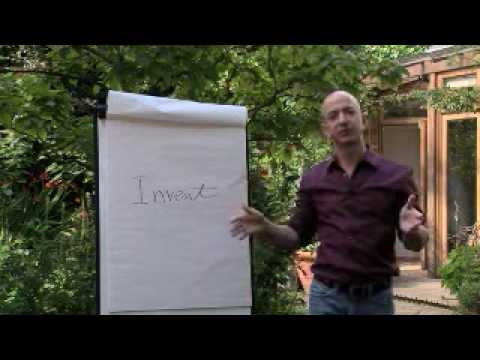
2:37 It's not where we get our motivation from. We really like to, uh, uh, start with customers and work backwards. And again, that is the key thing that I know, and it covers a lot of other mistakes. If you're truly obsessed over customers, it'll cover a lot of errors. Um, the second thing I know is invent. It's really important to invent. Um, anytime we have a problem, we never accept either-or thinking.
3:08 Uh, we try to figure out a solution that gets both things. And that often requires invention, but you can invent your way out of any box if you believe that you can. And what we talk about is inventing on behalf of customers. Uh, it's not a customer's job to invent on on for themselves. Uh, you need to listen to customers. It's critical. Uh, if you don't listen to customers, you will go astray, but they won't tell you everything. And so, you need to invent on their behalf. And that focus on invention has, uh, served us well. Some of the recent things, uh, even, uh, Kindle, uh, not just Kindle, but EC2, the Elastic Compute Cloud. These are things that we would have never gotten to if we didn't have an inventive culture. But But those are kind of large-grain things, but there's small things, too.
3:54 And then, think long-term. Uh this is really uh critical. Any company that wants to focus on customers and put customers first. Any company that wants to invent on behalf of customers has to be willing to think long-term. And it's actually much rarer than you might think. I find that most of the uh initiatives we undertake may take 5 to 7 years um before they pay any dividends for the company. Uh they may start paying dividends for customers right away. They often take a long time to pan out for shareholders in the company. So, that ability to think in sort of 5-year and 7-year time frames really is very, very useful uh for us. And And it's definitely one of the things that I know. It requires, by the way, uh and allows a willingness to be misunderstood. If you think long-term, many many of the inventions that we undertake may be if they're disruptive in a way, they may not be understood in in the early innings. And it's always been very important for us to think long-term so that we can tolerate being misunderstood. We've been called amazon.toast, amazon.con, um uh many different things. Uh many of them not uh appropriate for uh a video. Um And we if if we if we think we're right, um then we continue. If we think we're wrong, if we're criticized about something we think we're wrong, we change it. Um we fix it. Um so, uh it's important to really think about those things, but never to uh buckle to sort of uh kind of uh standard kinds of pressures that come on that really force short-term thinking. And it's a huge competitive advantage to be able to think long-term, and you get to serve customers much better.
5:43 All right. Um that's all that I know, really. I I know one more thing, I'll save it for the end. Um Um, but I want to, you know, this is a very exciting day. Um, Zappos is a company that I have long admired and for a very important reason. Zappos has a customer obsession, um, which is so easy for me to admire. It is the starting point for Zappos. It is the place where Zappos begins and ends. And that is a very key factor for me and I'm kind of, you know, I get all weak need when I see a customer obsessed company.
6:21 Um, and Zappos certainly is that. Zappos also has a totally unique culture. It's unique. I've seen a lot of companies and I have never seen a company with a culture like Zappos's and I think that that kind of unique culture is a very significant asset and I'm super excited about that. You know, I've spent a lot of time talking with Fred and Alfred and Tony and I have a good feeling for how important that culture is to Zappos, the Zappos brand, the Zappos customers, the Zappos employees. And that culture and the Zappos brand are huge assets that I value very much and I want to see those things continue and you're in such great hands with Fred, Alfred and Tony. That's a really that's a really big deal.
7:13 I've seen a lot of leaders who have come these two and I haven't seen people better than those three. There's a lot of growth ahead of us with Zappos. This really is the beginning. I am I'm I'm just totally excited about what can be accomplished over time. My my belief is we haven't seen anything yet. As much as Zappos has accomplished already and it's a lot with that unique culture and that great Zappos brand and those terrific leaders, I know that it's just the very beginning. And that brings me to my final thing that I know.
7:51 It's always day one. There's always more invention in the future. Always more customer innovation. New ways to obsess over customers. I'm super excited about Zappos. Thank you.
Summary
- Amazon started in Bezos's home with limited resources and faced early operational challenges.
- The company prioritized customer obsession over competitor focus, which has been key to its success.
- Innovation is essential; Bezos encourages inventing solutions on behalf of customers.
- Long-term thinking is critical, with many initiatives taking 5-7 years to yield results for shareholders.
- Tolerance for being misunderstood is necessary when pursuing disruptive innovations.
- Bezos admires Zappos for its strong customer obsession and unique culture, viewing it as a significant asset.
- He believes that the journey of innovation and customer service is ongoing, encapsulated in the idea that "it's always day one."