Section Insights
Protests Against Electoral Irregularities
What are the young protesters in Delhi demanding?
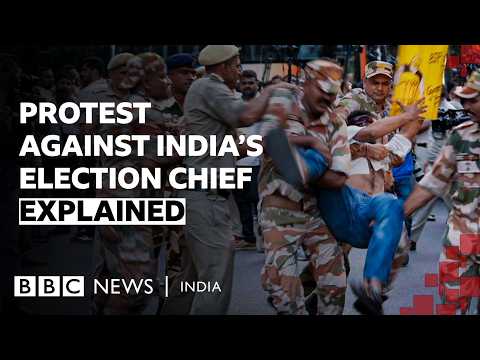
Young protesters in Delhi are demanding the resignation of India's Chief Election Commissioner, Gyanesh Kumar, in response to alleged irregularities in the electoral system, particularly concerning the updating of the voter list.
- Protests are a response to perceived electoral irregularities.
- The Chief Election Commissioner is a focal point of the protests.
- The updating of the voter list is a controversial issue.
Understanding the Special Intensive Revision (SIR)
What is the Special Intensive Revision (SIR) and why is it controversial?
The SIR is an exercise conducted by the Election Commission of India to update voter lists by mapping eligible voters. It has faced controversy due to the deletion of millions of names from the voter rolls, raising concerns about its impact on marginalized groups.
- SIR aims to create updated voter lists but has led to significant deletions.
- Critics argue it disproportionately affects poorer individuals and migrants.
- The process has been linked to broader questions of citizenship.
Allegations Against the Election Commission
What are the criticisms directed at the Election Commission regarding the SIR?
Critics, including opposition leaders, allege that the SIR is biased in favor of the ruling party and question the neutrality of the Election Commission. They argue that the process could disenfranchise eligible voters.
- There are allegations of bias in the SIR process favoring the ruling party.
- Concerns about the neutrality of the Election Commission are prevalent.
- The SIR's implementation raises fears of disenfranchisement.
Internal Disagreements Within the Election Commission
What internal disagreements have been reported within the Election Commission?
Reports indicate that there have been disagreements among the Election Commission members regarding the SIR, particularly about how voters are added or removed from the electoral rolls. However, the Commission denies any significant internal conflict.
- Disagreements within the Election Commission highlight governance issues.
- The Commission claims that differences are part of normal deliberations.
- The handling of voter registration procedures is a point of contention.
Controversy Over Form 6 Modifications
What is the controversy surrounding Form 6 in the voter registration process?
The controversy involves an additional declaration in Form 6 that asks applicants about their or their ancestors' presence on previous electoral rolls. Critics argue this modification was not legally introduced, leading to accusations of disenfranchisement.
- Form 6 modifications have sparked legal and ethical debates.
- The Supreme Court clarified it did not approve the changes to Form 6.
- Youth and political groups are mobilizing against the perceived disenfranchisement.
Transcript
0:00 Samadhi. Latioja, ganes. Kumar. Guys. Tipa. Laker range.
0:39 This is Delhi's Jantar Mantar. Just a few months ago, young protesters from across the country had gathered here to protest against irregularities in India's education sector. This time around, young protesters are back again to protest against alleged irregularities in India's electoral system. The demand they want India's Chief Election Commissioner, Gyanesh Kumar, to resign. At the heart of these protests is a controversial exercise to update India's voter list.
1:13 It's also called the Special Intensive Revision, or the sir. So what is the SIR and why is it so controversial? SIR is an exercise in mapping eligible voters and creating new and updated lists across the country. It's being exercised in phases across the states by the Election Commission of India, which Gyanesh Kumar heads.
1:45 The Election Commission of India is a constitutionally established body and is responsible for conducting elections and maintaining electoral rule. It's supposed to be functioning independently of the government. Ever since SIR came in, it has been part of a massive controversy. Millions of names have been deleted from voter lists since the process began in the eastern state of Bihar in 2025. In West Bengal, which saw elections earlier this year, the SIR's impact was particularly significant.
2:18 The scale of change to the voter list was such that the final roll published in February 2026 showed that around 6.2 million names, that's roughly 8% of the electorate, had been removed after the revision process. Critics say that this exercise could disproportionately affect poorer people or migrants, particularly those who move for work and may not be able to provide documents that are necessary to prove their eligibility. They've also questioned the scale and the transparency of the deletions.
2:51 India's opposition leaders have also questioned the neutrality of the Election Commission. Critics also allege that this exercise was carried out to favour the ruling Bhartiya Janata Party or the bjp. The commission has denied any such allegations and says that SIR is a periodic exercise that helps clean the voter lists. That means removing the names of those who have either died, migrated, appear twice or are ineligible otherwise.
3:23 SIR has increasingly been linked to the question of citizenship as well. That's because in practice, it asks voters to prove that they are entitled to remain on the electoral roll. Several petitions have challenged the SIR in India's Supreme Court. In May 2026, the court upheld the legality of the exercise, but it remains controversial because of one fundamental concern. Could an exercise meant to clean up voter rolls end up taking away eligible citizens right to vote?
3:54 And it is in this Context that a significant development involving CEC Gyanesh Kumar took place. A report by the Indian newspaper the Indian Express revealed that some decisions taken by the Election Commission regarding the SIR were not unanimous. The report said that Election Commissioners Subbir Singh Sandhu and Vivek Joshi had formally objected at least 14 times over 10 months to decisions and orders they said had been issued without their knowledge. The report alleged that the disagreements went to the heart of the SIR.
4:25 This included how people are added to or removed from electoral roles, changes to voter registration procedures and access to the database containing hundreds of millions of voters. That is particularly significant because the Election Commission is a three member body where disagreements are decided by a majority.
5:00 In a statement issued after the investigation, the Election Commission did not deny reports of disagreements, but it denied having any internal rupture. It said that differences of opinion were part of normal deliberations and that any decisions taken over the last year, including that on SIR, were ultimately unanimous. Kumar has not personally responded to the investigation and the BBC has contacted his office for a comment.
5:32 At the heart of another Controversy is Form 6, a form that's used for registering as a new voter. During sir, an additional declaration was added to its online version. It asked applicants whether they, their parents or their grandparents appeared on an earlier electoral role. The Election Commission has said that the SIR related declaration was upheld by the Supreme Court. But the Supreme Court has now made it clear that it did not approve any such modification to the form 6 and which is why the dispute is whether this additional declaration was legally introduced and whether the procedure was followed in bringing this change by the Election Commission.
6:17 Following the news report, India's youth pressure group, the Cockroach Janta Party or the CJP took up the issue. It demanded Gyanesh Kumar's resignation, accusing the Election Commission of disenfranchising millions of voters. Student political groups have also taken up the issue. Opposition parties including the Congress have joined the demand for his resignation. Protests have been organized across the country. The CJP organised its first protest in Mumbai which drew large crowds and its next destination is here at Jantar Mantar.
6:52 Just a few months ago, it mobilized many young Indians to demand the resignation of India's Education Minister over allegations of irregularities in examinations and which is why many are calling it the Jantar Mantar 2.0.
Summary
- Protests are fueled by allegations of irregularities in India's electoral system.
- The SIR aims to update voter lists but has resulted in significant deletions, especially in Bihar and West Bengal.
- Critics argue the process disproportionately affects poorer individuals and migrants who may lack necessary documentation.
- Allegations suggest the SIR may favor the ruling Bharatiya Janata Party (BJP), although the Election Commission denies these claims.
- A report revealed internal disagreements among Election Commissioners regarding the SIR, raising questions about decision-making transparency.
- The Supreme Court upheld the legality of the SIR but highlighted concerns about disenfranchisement of eligible voters.
- An additional declaration in voter registration forms has sparked legal disputes over its legitimacy.
- Youth groups and opposition parties are actively protesting, calling this movement "Jantar Mantar 2.0."
Questions Answered
What are the young protesters in Delhi demanding?
Young protesters in Delhi are demanding the resignation of India's Chief Election Commissioner, Gyanesh Kumar, in response to alleged irregularities in the electoral system, particularly concerning the updating of the voter list.
What is the Special Intensive Revision (SIR) and why is it controversial?
The SIR is an exercise conducted by the Election Commission of India to update voter lists by mapping eligible voters. It has faced controversy due to the deletion of millions of names from the voter rolls, raising concerns about its impact on marginalized groups.
What are the criticisms directed at the Election Commission regarding the SIR?
Critics, including opposition leaders, allege that the SIR is biased in favor of the ruling party and question the neutrality of the Election Commission. They argue that the process could disenfranchise eligible voters.
What internal disagreements have been reported within the Election Commission?
Reports indicate that there have been disagreements among the Election Commission members regarding the SIR, particularly about how voters are added or removed from the electoral rolls. However, the Commission denies any significant internal conflict.
What is the controversy surrounding Form 6 in the voter registration process?
The controversy involves an additional declaration in Form 6 that asks applicants about their or their ancestors' presence on previous electoral rolls. Critics argue this modification was not legally introduced, leading to accusations of disenfranchisement.