Transcript
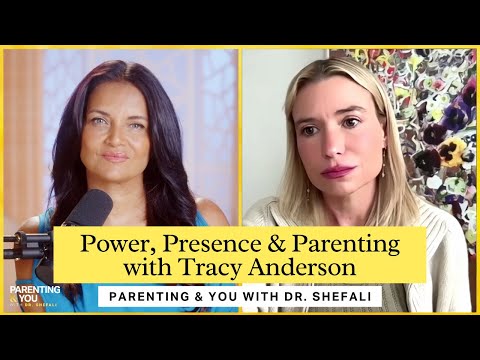
0:01 Hey everyone, you are in for a treat in this very special episode of parenting and you with me Dr. Shafali. Today you are about to meet a trailblazer in the world of wellness, fitness, and empowerment, none other than Tracy Anderson. She's a powerhouse entrepreneur, best-selling author, devoted mother, and the creator of the wildly popular Tracy Anderson method. Her unique approach to movement has transformed the lives of so many millions across the globe and she's worked with icons like Gwyneith Paltro, Jennifer Lopez and so many more. This is an interview you definitely don't want to miss. I cannot wait to dive in.
0:45 Joining me now, oh my goodness, guys, this woman is my inspiration. She's a true pioneer in the world of fitness and wellness. Entrepreneur, author, devoted mother Tracy Anderson. I feel like you are an icon in our culture. Tracy is the visionary behind the widely acclaimed Tracy Anderson method, a transformative movement methodology philosophy that's captured the attention of fitness enthusiasts and A-list celebrities all over the globe. With a digital platform spanning more than 53 countries, Tracy has cultivated a worldwide movement, uniting a diverse community through shared strength, sweat, and selfmpowerment and discovery. Tracy, my dear friend, welcome to the show. I'm so honored. You're my friend. We've connected and now you're here on my podcast.
1:40 >> I am so honored to be here. You're amazing and you always look like this complete goddess. You are the actual definition of when you do the inner work, that's the biggest beauty secret. Look at you. You're an angel on this earth. >> You embody and emblemize it all. Okay? Just take it from me. You do. Okay? Don't fight me. Okay? So now, when I first met you, I mean, I have to say I came with a very, you know, preconceived judgment. I was like, she can't be warm.
2:15 She can't be imperfect. she can't be human. She's just going to be this ice lady. But then to meet you is to just be shocked. I mean, it's almost traumatizing because one comes to you with this very preconceived idea and then to meet you and see your humanity, it's really very jarring and it's hard to catch up with it. Like I'm still catching up with it. So, do you feel that people project on you and women project on you and it's not fair and it's hard for you to, you know, be seen for who you are, which is just a mushball like innocent pure softy? Like, is it hard for you?
2:54 >> Your awareness is so incredible. I absolutely do feel that. And people stop me on the street all the time and they say to me, "Oh gosh, I love you, but oh, I could never work out with you. You are too hard." Or, "Wow, you're for some other form of being, but I could never." And I don't know if you ever feel this way in your practice where it's like, you know, people want to improve, they want to connect with their children more or they want to live their life, you know, from less, you know, fixed perspective, but yet they feel like your work like, oh, they could never shift the mold of parenting or they could never break open in that way. And I do get that a lot. And I feel like it's interesting because I had a lot of gatekeepers along the way when I wanted to share my work with the world essentially. And I think that that's just becoming more and more with technology where you're able to share.
4:00 But when I was coming up, I had these gatekeepers of, you know, I had to film a DVD and I had production companies and I was with like Fox or Paramount and they loved that I looked the part but really weren't into what I sounded like. And so I had to make a lot of choices along the way that I was either going to play by their playbook, so to speak, and hope that incrementally along the way. I think that's what I felt. I was like, I'll get my message out there. The truth will unfold if I'm consistent and if I'm patient. And I didn't know any other way of doing it because even when I wrote my first book, this big beautiful publishing house, they didn't want to know that I loved Mary Oliver or any of these, you know, or a John O'Donn lady, you're speaking a weird language over here. this is fitness and we need you to say five, six, seven, eight and go to it. Right.
5:02 >> Right. >> So the deeper conversations and the more like the truth of me definitely I think you know has taken a long time for people to know or understand and you know all of those gatekeepers that are the media and all of these things like they don't really care about the truth. They don't want to see the uneven edges unless it's a scandal. They'll take your uneven edges or they'll take your truth and they'll exploit it and they'll push it out of context and then make it look like you're really something that you're not. And that's also really traumatizing. So, you know, I think we're fortunate in a lot of ways today where people can have more authorship and there can be more voices. But you're right.
5:49 >> Yeah. I don't feel like people walk up on to me on the street and they really know my mission or know who I am or know how for them I am. >> I was shocked because I didn't know how deeply aligned you were with integration of the body and the mind and meditation and intention and that's really all your work. I mean it's literally got nothing to do with how we look on the outside and losing weight. It has all to do with that inner deep connect and how have you made sure that the choices you've made in your life stayed in alignment like you were just telling me before we signed on here that you know after the LA fires you knew in your gut that you may need to move to another place and you did and you made that decision quite fearlessly and spontaneously and I think that's how you move through life you really are in touch with who you are how did that come to be was That always Tracy or did you cultivate that?
6:49 >> I think it was always Tracy, but it was more reckless in my youth for sure. My ego was too involved in that ability to just pivot or dive in or take that risk, especially with men. >> Yeah. >> Yeah. >> But it was through my curiosity, my need and desire to learn that always sparked my creativity. So if I did definitely learn young that if I seek I become more creative and through that I was able to hone in and find my personal gifts which I believe we all have many of but I was able to find the one that I felt called to the most in movement in you know choreography and creating physical nonverbal experiences. is for people.
7:46 And it was Dr. James Austin's book, Zen in the Brain, that landed on my lap via my brother, who was very into philosophy in his early 20s. He now works for Apple for many years, but I grabbed that book off of his shelf in my 20s and I was like, I don't understand any of this, but yet I find it so fascinating. So, I got like a tutor to help me understand it. The tutor was even like I don't understand this >> right >> and that seeking lit up other pathways in me that wanted to be creative and it also helped me draw lines to where there was nothing out there that could help serve me because I did grow up as a dancer. My mom still teaches dance to this day. She still owns a ballet school and an art school and there's a certain grooming to that as well that is very limiting in a lot of ways and that doesn't draw a clear line to health.
8:51 It's definitely more, you know, performanceoriented. And so it helped me understand why my school in college when I gained a lot of weight at school for dance was like I mean I'm just going to say like fat shaming me like in a way where it was like you have so much talent can't you just make weight and I'm like well how do I make weight you know and they're just like >> we don't care >> it's called making weight is that the way they say it >> yes and like in wrestling with young wrestlers it's like you know these guys have to get on the scale and they have to make weight too so It is and so many people when you reach 18 and I think that you know our parents I don't know this is definitely your area of expertise but I think that you know no one was talking about transgenerational issues when I was growing up. It wasn't like friends, >> right, >> all like got around and we're like, "Oh, there's this thing called transgenerational issues." You know, there were teams of pouring like, you know, coffee into this thing and then diluting it down until like generations later it becomes clear, you know, I feel like I rebelled against a lot of that.
9:58 And I didn't have like eating disorders in my family. I didn't have parents that were like, "You better make it or whatever." I didn't have that kind of upbringing. So for me, I was lucky that I didn't fall prey to >> the body shaming. >> It hurt me. I wanted to do it, but I didn't take the measures that I saw so many of my peers take. >> Yeah. >> And actually, it's one of the reasons why it sparked my desire to actually come up with real solutions and to try and help like break open this whole, you know, industry. So at that point I needed to lose weight and I couldn't and I went to all the places because I was smart and intuitive and in tune with my gut. I think that's what you were saying. We're going to take a quick break. Don't go anywhere. When we come back, we'll have more with the amazing Tracy Anderson.
10:53 Let's talk about behind the scenes. I know you've had loss in your life. I know that your son's father, you know, is no longer here with us and you went through that transition with him and then your daughter. Take us behind the scenes to Tracy the human and the mom who's had to kind of juggle it all. >> Yeah. Well, I think that kind of ties into where I got lost in that on the transgenerational issues is that I'm a parent with no formation, right? So, I don't care if my kids I'm not going to teach my kids to respect me. I'm not going to teach my kids manners. I'm a very abstract parent. I love them beyond. I'm probably the mushiest parent. I'm very mushy. I'm very unstructured. I don't know if the lack of sort of formation for me came from like a fear of not wanting them to have to move through the baggage that I had to move through from my own parents. So, I was just like, I'm not even going to try and rewrite it. I'm also not a parent that falls prey to the systems.
12:05 Like, you know, my daughter is tardy to school a lot, you know, cuz I have my kids very far apart. So, I had my son when I was 22, my daughter when I was 38. With my son, something in my gut, something in me. Mind you, I also grew up when that phrase children are to be seen and not heard, was still a thing. >> Sure. >> And I remember my sort of inner world going, I hate this. So cruel. I'm scared of this kind of language. So when my son would start to say, "Mommy, I'm sick. I need to stay home from school." And as a mother, you know, you know, you do all the things and you're like, "I don't think you're sick." I started to realize like, "Oh, when he just needs like an emotional day, he's being trained to lie and say that he's actually sick to get what he needs."
13:00 >> And I thought that that was so wrong. So I said to him one day, I remember I was like, "Sam, do you need to just like stay in your cozy clothes today and just be home and like just cuz you need that?" And he was like, "Yeah." I was like, "But do you feel like you need like a doctor or medicine or whatever?" He was like, "No." So I was like, "You can just tell me that you need a cozy clothes day, you need to stay home, you need a mental break, and I will make sure that that's okay." And from then on, he didn't abuse it at all. He just was one of those kids that was able somehow to do what that system needed of him and do it well and then find this kind of like balance. So, he didn't abuse it, but he would come to me and he would say like, "I just can't do it today." And I'd be like, "Okay, fine."
13:47 And the crazy thing is I would have to call the school and say he was sick, >> right? You have to lie to the adults. >> They would never It would be like an emotional day. Get his ass to school, >> right? And then years later with my daughter when she was struggling in because she's not really a public school kid. I really identify with the parents where it's like you know the round peg in the square hole where it's like get them in here we'll take them. And I remember this principal saying to me like cuz she just was holding on to my leg and there was something that she didn't like about it and he was like bribing her with like do you want the school mascot to take you to the room?
14:23 You can give all of your peers pencils. do you want to have an extra treat? And he was like, Tracy, just like get her off the leg, give her to us and we've got them. And I was like, hell no. I was like, absolutely not. So, I don't parent in a way that tells my kids that they need to fit into any of these things in the world. I also don't know what I'm doing. And I just try and stay open. And with the extreme loss that both of my children have experienced, my son at 21 abruptly and his father was just a dream human being. He was like just the best person and the most dialed in father.
15:08 And as someone who was a professional athlete, he played pro basketball. To watch him never inflict that onto Sam in athletics was one of the most beautiful parenting things I've ever watched in my life. How he would tell me like he would make certain like teams that were really cool to make. And I would be like, "Sam, you made this team this." And Sam would be like, "I don't really want to do it." And I'd be like, "What do you mean?" And Eric would be like, "He doesn't have to do it. You got to really like want to do that if you want to do it. And if he doesn't want to do it, he doesn't need to do it, you know. And it was beautiful to watch that because you see so many parents living out their >> totally >> athletic dreams through pushing their kids and well, this is your whole thing, but >> So Sam went through that trauma and it was a trauma for you too.
16:00 >> Yeah. because I loved him deeply. And and the first thing his sister said to me when she called me to tell me that he had passed was the first thing out of her mouth was, "I always thought you guys would end up back together." And I was like, "Karen, what are you saying to me like right now? What are you saying?" And I in my heart always believed we'd end up back together because we were so young and I'm the one that messed up our marriage. There was something in me every time we almost tried to get back together that didn't feel like I deserved it because I messed up so bad.
16:33 It made me feel like I didn't deserve to have it back on some level. And I loved him and respected him so much that I felt like in a lot of ways he was safer without me holding his heart in that way. So I loved him deeply. So that broke me wide open for sure. >> Wow. And so now you're a single mother. >> I'm not. I'm married. >> No, back then. >> You were a single mother with a boy.
16:59 >> Oh, yeah. >> And then tell us about your daughter. What trauma did she have to experience? >> Yeah. Well, she experienced the same trauma of losing the biological father, but her relationship and my relationship with her biological father was very different because I think that the world sort of in part of my needing to break open, needing to I don't know if it teaches us in these kinds of ways. I think more we like call that because of our own deficiencies.
17:34 And I was filming this project called Metamorphosis, which was something that I worked so hard to get to. And Gwennneth Paltro, my like soul sister but business partner at the same time, helped me get to that place where she really heard me say like I didn't create everything that I've brought forward for to share with this world so that I could make a DVD a year. when I change your program every 10 days accustomed to your needs and where I see that there are weaknesses that can be improved upon that are ready to be improved upon where your skill set is literally growing and I can help support that growth and here we are with you with your epic legs and your beautiful presence and your like you know fame and all of these things where we're saying to people I'm the workout that you do and we're selling them one DVD a year but yet in reality, this is what you're doing. And she was like, I hear you. Let's figure this out.
18:40 And that was a really rare gift because so many celebrities make their income off of, you know, like you see so many musicians have giant beauty brands because their money more off of the beauty brands than even their art form. And the fact that Gwyneth was not, she never said to me like, "Look at the business plan, Tracy. we can make a lot more money if we produce only one DVD. She was like, let's bring them the real you. And so she really like sat by me in so many countless meetings to figure this out. And we landed on that like to explain it to the next best possible way to explain it was this infomercial. And to film I filmed 11,690 different movements in three days because they built a big set. You've got union people on there. You can't go overtime. And I wanted to film 90 days worth of content for people to be able to kind of see where their bodies are at in four different body types where it changes every 10 days. And then I ended up filming four years of that continuity after that. This is something that people have to really understand in their life and in their bodies. Balance is continuous. You will never reach any of these destinations. You will never go, I made it. I'm in the mold or I did it. Look at me. Here I am. I'm fixed and it's perfect. It that's not living.
20:06 That's not reality. It's >> It's a trap. Yeah. >> Huge trap that will keep you. Then the fear of needing to stay in that trap will mean you never know what living your life really really feels like or looks like. >> For me, to be able to have that opportunity was huge and to speak that truth. But when I was filming those 11,690 movements and when I was being so honored, my voice was being so heard by my partner and my friend, something in me was broken. And I was set up with Penny's biological father. And he was really fun. And he too has a heart that at the core I believe is truly beautiful. But boy, do I wish his parents had you.
21:01 >> If his parents had you, I think he would have had a chance. >> Right. Right. >> But he had a lot of things that he needed to work through that I became the victim of. I don't know if that was the world showing me like amplifying just how good of a human being Eric was despite his parents' deficiencies or if it was just something I needed to go through. or even in the world that we live in today.
21:27 >> So Eric was Sam's father. >> Eric was Sam's father, >> right? And then with Penny's father, how long did that marriage last? >> Penny's father literally I became pregnant. I've never told this to anybody, but I'm going to tell this to you. I became pregnant very quickly after we were dating because I'm just going to say it. The sex was great, >> right? >> Really fun, >> right? >> And I was creating a lot, >> right? this was some wild side of me that was there.
21:57 >> Mhm. >> And we were excited about it and I had a miscarriage and the doctor asked me to wait 11 days to be able to have sexual intercourse again. And Penny's father started to kind of like cry to me and process with me in his own way that he needed to feel close to me. I said, "I have to wait until the doctor clears me to have sex." But he was like, "I need to make love to you. I need to feel close to you." And I didn't see that as a red flag. I didn't see that as somebody not hearing me say, "My body's been through this. I need you to give my body a break, and I need my body to get medically cleared." I looked at that as I have the power to nurture you, too. I have the power to help your pain go away and help you feel better. So on the 10th day, he broke me down, >> right?
22:56 >> And I was like, Matt, oh my gosh. And he held me and he was crying. He was like, I just want to get pregnant with you again so badly. It just means everything to me. And that I didn't even see as a problem. I did. I did, but I didn't. >> Part of you, it's such a romantic thing. I want to have a baby with you. we want to create with you. So the female side of us gives into that, but we're not thinking deeply of the urgency or the need or what is this fulfilling in him.
23:25 >> You're right. >> And I became pregnant with Penny. That's Penny. >> Yes. Yes. >> And Penny's father literally when he got that reality, the parts of him that weren't really ready >> right >> for that started to show. And that's when I started to, you know, kind of learn who he really was, good and bad, but the bad parts really started to I became really the victim of >> I wanted to have her. And I think that in this moment, in this world, something that people need to understand is I have a skill set that is special. And I was able to do something that most women would not be able to do because as he sort of unraveled in his ability to do this with me, he filed for divorce in a state I didn't live in because that's where he wanted to live. Plus, he could get half my business. It cost me millions of dollars just to advocate for myself and for my daughter. Now, he loved her. But did he know how to do balanced, thoughtful things for the greater good of all considered?
24:36 Absolutely not. >> Right. >> And the last thing he said to me before he passed away was, "This happened to me because of everything I did to you." And I said, "Well, I forgive you because look at what we brought into the world." >> So, you have two children whose fathers passed away, Tracy. >> Both at 48 years old. >> No way. >> Yeah. Matt was diagnosed with brain cancer when Penny was in kindergarten. >> Wow. So, you've had to deal with that loss. And has Sam been able to help Penny because he went through that?
25:08 >> Yes. But this is why how we treat each other, how we understand each other, our ability to empathize, our ability to, you know, learn from teachers like you that I think you advocate for people wherever they are on the spectrum of their journey or their abilities. I think you advocate for all of them. And I think by doing that, it's easier for the person who's having a hard time with another person. And it's also the opportunity for the other person to know to have a beacon of light or direction from a much more enlightened source because most of those people don't have enlightened beacons that come into their, you know, circle. And there's reasons why everyone, you know, does the things that they do. But I had a super close relationship with Eric and I had a relationship full of struggle with Matt.
26:05 I'll tell you another really personal story when the fires happened in Los Angeles. We were going to go and fly and it was a scary scene by the way. I mean it was dangerous to go up Mandaville Canyon. It was blocked off. You weren't allowed to go up. And I do have this blessing where I do find a lot of people in my circle that are just deeply incredible people. And this gentleman who worked for us, he did like things around our property and everything. I said to him, I said, "Oh my gosh, Eric is in there, Sam's dad's ashes." And I said, "I I know you're not allowed to go up. Like I just pray and I would watch that watch duty app like you can't even believe as I saw the fire just like it stopped right before our street and I would watch and I would just you know pray that Eric would be okay and I have those big redwoods you know which was kind of like unusual for that property and I was like I know there are like fairies in there just blow it away.
27:03 >> Yeah. >> Whatever I could pull from I would. And um when he had to bring us some stuff to the airport as we were about to fly out, this is straight out of a movie scene. This guy comes walking up to the car with Eric and Sam and I just flood with tears and we're just holding each other's hands. And Penny, we talk about Eric a lot because I knew Eric since I was 17 and Eric and I were together for a very long time, even in our co-parenting. Gwennneth would say all the time like this is Tracy and this is Eric. They're not married but yet they are. They're kind of like brother and sister. I don't even know. It's like we definitely understood the conscious uncoupling.
27:46 >> Yeah. >> So Penny doesn't talk about what happened with her father very much at all. And all of a sudden Penny from the back seat goes, "Where's my dad?" And I literally had this moment. And then Sam was like, "Oh gosh, Penny." Like and my mind for a minute was like, "Oh my gosh, where is he?" like where do I have him? And then I remembered that Penny and I decided before we went to California that she wanted him to stay. We had a home in Pennsylvania and she wanted him to stay there because she had some special things and she put some special things in the box. And I remembered and I said, "You know what, Penny?" But I had a moment where I was like, "We need to balance this out, right?" Penny and I had this really great moment where Sam and I said to Penny, you know, like, Penny, we have a lot of great memories with your dad and we we're here to talk about any of it and we can, you know, and as soon as we got there, I didn't go to New York. I took Penny to Pennsylvania. We opened the cabinet. We brought out Matt and then I brought them both together. So now, >> now you have them in one place.
28:53 >> Now they're all here. They're in one place. But that's just a small example of like how deeply like difficult it is to navigate these things also with two different fathers, you know, two different fathers, two different age groups, but yet the same huge hole that you can't fill, you know, which is also another reason why I love Roomie so much and I love to tell them like the story of like, you know, the loss of Shams for Roomie and how like that was like such an unknown thing, but how instead of closing off, he dug deeper in himself and then created all of this beautiful, you know, poetry from that place of extreme like loss and confusion. And both of my kids are artists and so are you. I mean, you've always formed your pain into art, into movement and healing. And you know, but I'm so grateful to you for sharing that your journey hasn't been, you know, an easy ride into the sunset. You've had two children with two fathers who've passed away and you've had to carry the tremendous grief and loss and confusion and yet you show up every single day and you work through it and that's what you do. You teach people that their body is a living vessel for transformation. I mean that's your whole philosophy. So Tracy, thank you so much for sharing, for opening up, for being vulnerable, and giving us a glimpse into your history, your story, and the incredible strength that you bring, and you heal us all. So, thank you, my dear friend.
30:24 >> Only with you. I feel safe with you. But it's important that people are vulnerable on these platforms because that's how we truly help each other. >> Exactly. I love you. Thank you, Tracy. >> Love you. Bye. >> Thank you, Tracy, for joining us. Thank you all for listening in. For all things Tracy, including her workouts, programs, and products, head over to traceyanderson.com. Once again, thanks for tuning into the podcast. We'll see you on the next time on Parenting and You with me, Dr.
30:53 Chafali. Parenting and you with Dr. Shafali is for educational andformational purposes only. It is not intended as a substitute for professional medical, psychological, psychotherrapeutic, coaching, health care, or other qualified professional advice, diagnosis, or treatment.
Summary
- Tracy Anderson is a trailblazer in fitness and wellness, known for her transformative movement methodology.
- She emphasizes the integration of body and mind, focusing on inner connection rather than just physical appearance.
- Tracy has faced significant personal loss, including the deaths of her children's fathers, which has shaped her parenting style.
- She advocates for emotional honesty in parenting, allowing her children to express their needs without conforming to societal pressures.
- Tracy's journey includes overcoming industry gatekeepers to share her authentic voice and message.
- She highlights the importance of community and shared experiences in fostering empowerment and resilience.
- Tracy believes in continuous balance and growth, rejecting the notion of a fixed destination in personal development.
- The conversation underscores the value of vulnerability and openness in healing and supporting one another.