Transcript
0:07 Welcome to Southeast Medical Group, Georgia's most awarded primary care provider. We're here for everyone, offering comprehensive [music] care for all ages. Our services include annual checkups, chronic disease management, vaccinations and immunizations, [music] women's and men's health services, pediatric care, geriatric care, and mental health support. [music] With state-of-the-art facilities and a compassionate team of experts, we provide [music] personalized care for you and your loved ones. Experience award-winning care today. Schedule your appointment now and see why we're Georgia's top choice for primary care.
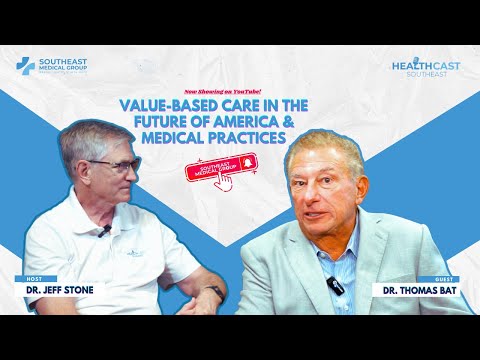
0:43 Southeast Medical Group. [music] Your health, our priority. [music] >> Hi and welcome to Healthcast Southeast. I'm your host, Dr. Jeff Stone, a family physician for over 40 years, and we are welcoming you today for something really special. Uh, you know, you heard us in other episodes talk about something called valuebased care, how it may be different than the fee for service that your usual primary care doctor has been used to treating you with. In this particular episode, we're going to try and define it, give you some historical perspective, tell you about what we think the future will be, and we'll do it with a very special guest. Our guest today is Dr. Thomas Bat. He is the board chair and CEO of Southeast Primary Care Partners. In that context, this creative, innovative personage and vision has put together, well, I'll let him explain it, a new model, a new way of doing business, especially in primary care. And in that context and with uh great uh privilege and pleasure, I'd like to introduce Dr. Thomas Bat.
2:03 >> Thank you, Jeff. Um it's a privilege to be here. We've been on a journey at Southeast Medical Group over the last five years to change how we deliver health care to our population and I hope we can speak about that some today. >> So Tom and can I call you Tom because I think we've known each other long enough to uh at least be casual with each other as well as the audience. But uh you know I want to know more about your beginnings, how it all came to be. How did you reach this vision? And where did you want to go? Where do you want to see the future? and uh roll it all into one.
2:36 I I'll give you you've got 10 seconds. Go ahead. >> Yeah. Put put 40 years of history in in 10 seconds. I think first we should all agree that healthc care is very very complicated. And some of the things we talk about sometimes continue to change and evolve over the last 40 years that we've been practicing. But one of the things that I think has become most challenging in healthcare is the fact that the cost of healthcare is consuming more and more of the American budget.
3:03 more and more of the family budget and it's creating a lot of anxiety amongst patients in health care, the payers in health care as well as us, the providers who give that health care. And so cost has become a huge challenge. When we started off in healthcare, we were both young docs and we were working for hospitals, we were training, we were doing residency programs and the cost of healthcare didn't impact us daytoday because larger thirdparty organizations really ran our patient panels for us.
3:33 But as we evolved into private practice, we noticed that a lot of that was changing as patients would come in and see us and would tell us that the cost of our new CAT scans, the cost of our new MRIs, the cost of some of our newer robotic surgical techniques were beyond their means to accomplish. So when we started growing our small primary care practice, we became very focused on what can we do to give the best quality care but do it at the best cost. So Tom, we've heard a little bit about the market forces that are well creating, if nothing else, stress on not just medicine, but everything and everybody.
4:11 Tell us about the rich history that you have that begins way back and where we're going. >> For sure. Primary care was sort of a new focus when we became docs and became one of the board certified medical specialties known as the American Academy of Family Practice. >> One of the first. Yeah. one of one of the first and so we we were lucky enough to train in these programs and part of the emphasis on these programs was totality of care comprehensive care or what I like to refer to as you like the word as well as patient centric care >> so we wanted to put the patient first and part of putting the patient first just didn't mean comprehensive good care it meant meeting quality metrics and trying to bring value to the patient try to bring it to a cost level that didn't bankrupt the average American and family. So when I started this practice in 1988, that was one of my goals and one of the ways to achieve those goals I thought was to look at how information technology might help us to bring a lower cost of care to our patients. At the time we had invented the CAT scanner. The MRI scanner was a brand new technology. Digitalization of mimography and other imaging techniques were coming out and all of this was somewhat expensive to the patient at the time.
5:26 But we thought that if we brought technology into our exam room, we'd be better utilizing our time to actually gather the data on the patient, share the data with the patient, share the lab results with the patient, share the actual medical wording and terminology, diseases and diagnoses and care plans with the patients. So part of our success actually became that we became a digitalized practice in the 1990s and even today we use that digitalized success to communicate with our patients through our electronic medical record.
6:00 Our patient portal sees over 40 to 50,000 visits every single month. Jeff, the other thing that it does too, it impresses me is that you can now collect that data and form registries or cataloges of disease states so that you can now not just necessarily hear from the patient, but the patient can hear from you in a prospective approach to treatment of those disease states. >> Um, that's very interesting. One of the first data sets we ran many years ago was on our patients with high blood pressure, what we refer to as hypertension. And a number of years ago, I hate to date myself, but it was maybe 15 years ago or so, they found a cancer producing agent made in some generic medication that was being made in China.
6:42 >> I remember that. >> And this was a very common blood pressure pill that we used a lot. So we were able to take our database, run a list of patients who actually took that particular medication and actually execute phone calls to them and change their medications without sort of giving away to the hysteria that was being caused by this substance that had been found in these Chinese generic medications at the time. >> And to be clear, you didn't have to wait for the patient to come in with this medication to change it. You could reach out to them and say, "Hey, listen. We got to find an alternative." And at least at the initiation, it didn't cost the patient anything to do that.
7:20 >> It it was very interesting because I think the news of this substance being in generic medications hit our profession first before it actually hit the general press and the general newspapers. So I think we as physicians were amazed because part of this push toward value or cost medic cost reduction medication is to use generic medications. So we as primary care physicians were always looking at medication compliance but also how could we manage your medication in the most cost-effective way and in the late 80s and the early 90s we know a lot of good medications came to market and are now becoming generic. So it was very important to us when we found out that our friends in China unfortunately were cutting corners in some of the medication production >> and clearly it would have been very ownorous to go back through 10,000 40,000 50,000 patient charts to try and figure out who was on that medication digitalized now you could do that you could do that ahead of time >> for sure I can actually remember sitting down even to this moment sitting down with my IT team and them generating the list of patients while I actually stood there and they handed me this list and I was amazed that one I had 900 patients with hypertension but only a small number of those were actually on that particular brand drug.
8:38 >> There's an old saying that technology will not save us and I'm going to challenge you a little bit too with this thought this question. Does this stop the uh or inhibit the patient doctor relationship uh or does it promote it? In other words, you know, are we just going to be communicating digitally or by phone from now on? What does that do to the doctor patient relationship? >> Wow, that is a loaded question. Um, one of the things I've been hearing on the news lately is how our children are spending way too much screen time and not enough time outdoors interacting with each other or with mother nature.
9:15 And I tend to think there is a huge risk if all we do is interface with the technology and not the person. there would be a huge downside to patient care. However, it's been my experience with my patients that I walk in the exam room and they know that I'm prepared. They know I'm loaded. They know that I know what they need. They know that I have their medical record. There was times when I used to practice, Jeff, where I'd walk in the room and I would have nothing. I would couldn't find the paper chart at the time and I sometimes couldn't remember a lot about the patient. With the electronic medical record, there's a brief synopsis on every single patient that I call the face sheet. So, I know it go up year after year. On a good year, we'll see an inflation of 2%, maybe 3%. On other years, we see six, seven, even 10%. I'm being told by the people that help run my practices that we'll probably see a 6 to 10% increase in insurance costs just this year alone. And and this is very, very frightful. So, does fee for service contribute to this? Fee for service sort of emphasizes that the sicker you are or the more care that I deliver to you or the more frequent care I give to you, the more money I make. I'm rewarded for doing more for you if you're sicker than if you're healthier. And what I think we should try to move health care to is how do we do more for you, keeping you healthier and get rewarded for preventative care, for wellness care, and for not taking care of just sick people, but helping people to stay healthy. And does this produce long-term savings not just to the patient, but to society and to the entire health care organization that we're responsible for?
10:58 >> You know, it's something that has been talked about. This is not a new concept and I'll go one step further that might be a little bit too into the weeds, but maybe you can help us define this. Accountable care organizations, the Medicare medical shared savings programs, uh other models that are out there that have been used that go as far back as the 1990s when we used to call it capitation. Uh you're instituting a lot of these kinds of models. Can you explain to the audience exactly how that works and why this will achieve the outcomes that we're looking for without increasing the cost?
11:33 >> Well, the Affordable Care Act that you referred to that was um passed by Congress in 2009, I think on Christmas Eve, um and was put into law in March 2010, which set up the accountable care organization model, was part of something that I think was talked about in a very fearful way that we're going to take health care away from you. And unfortunately I tend to think when we look backwards all the way back to when managed health care began there's been this negative connotation of health care. So I want to give a little bit of history of something I know about health care a 100red years ago. So there was in 1929 an economic downturn in America known as the Great Depression.
12:15 >> And in a very famous state with a very famous hospital, Baylor in Texas, they wanted to do something for the workers in their state. >> So there were about 1,500 teachers in Houston that they wanted to provide health care to. So they formed a company called Blue Cross >> and they decided that for a flat rate they would provide health care to all the teachers in Houston and that was the beginning of what became known as Blue Cross Blue Shield. And what happened then is the medical societies as I know you're a very renowned member of the medical association of Georgia. A lot of states formed companies called Blue Cross Blue Shield where Blue Shield helped pay for the doctor's bills and Blue Cross paid for the physician bills.
12:59 So there was a time literally a hundred years ago that we started to look at how can we pay for the cost of care in a more managed way that focused on keeping patients healthy, not just treating sick patients. >> The history is always fascinating too, but like a lot of things including Medicare that came about around 1960 that just seems to skyrocket in costs. And I know that a lot of these companies that have grown from that are also partnering to try and reduce cost but maintain that I'll call it quality of care. Uh they're graded by the government, they're oversighted, we're oversighted by the payers. Um can you describe any of those oversightes or those mechanisms that well incentivize us to do better job in the outcomes, not just in the number? Yeah, >> for sure. Let's bring us up to date to where we are today because in 2010 when we started instituting what we called the accountable care organization, we didn't want to make some of the mistakes we made in the 1990s. In the 1990s, we looked at capitated care. We paid a certain amount of per member per month.
14:06 We had very little data on patients. We didn't know who was sick, who was healthy. We didn't know who was consuming health care. We didn't have digitalization of records and we really didn't have full-based team-based care yet. So to clarify, you were getting paid on a month-to-month basis whether you saw the patient or not. And if you did the right thing, there might have been good outcomes, but you didn't have the records, the digitalization as you put it, to really give you any feedback as to how well you were doing. You were kind of stuck in the middle and so were the insurers.
14:36 >> For sure. We were sort of floating on our own without data. Um, we knew the patient one by one because we would see them in the room and we would give individual care, which is what we still do today. Yeah. because individual care is important. But we didn't have this concept of what I'll refer to throughout this talk today is population health. We needed to look at our entire population. The population that I treat at Southeast Medical Group, the population of diabetics, the population with heart disease, the population with kidney disease, and then I need to compare that to the population of my community. How am I doing to my peers? Dr. Stone and I at one time practiced in the same geographic area, but he was working for a different health care system than than I was working for at the time, but yet we're treating the same population. And we needed the metrics on how we could measure our outcomes and our success.
15:28 And that success would be based on quality as well as cost. And when you bring those two factors together, you come up with this term what we like to refer to as valuebased care. Sometimes I think the word valuebased makes me think of dollar general store, right? And yet I don't believe valuebased care is cheap. It is actually referring to the most comprehensive, complex, coordinated care model that we have ever seen developed in medicine to date and I think we're getting better at it and I hope we can keep talking about this.
16:01 >> Oh, I'm sure we will. Thank you very much. Are there any questions that I haven't asked you that need to be said? anything about maybe the future of medicine where you see it in the next 5 10 15 years >> well I I think part of to bring it down to a little bit of a nuance is how do we define quality in today's health care system and when we started in 1990s trying to define quality without metrics we had a lot of difficulty when we came up with the acco model we started defining quality based upon about 20 quality care metrics and some of those you and I both know pretty well We measured every patient's BMI. That was just a measure of their weight and their height. Believe it or not, that wasn't that wasn't infrequently done back before we started um this quality acco metric program. Um, we developed what was called the MYIPS system, the merit incentive payment systems where we developed and you chose anywhere from 8 to 12 quality metrics that you wanted to measure on your patients. And that could be obviously body weight, that could be diabetes control, blood pressure control. One of my favorites, immunizations. Um, we're talking a lot about immunizations in today's world.
17:15 And we all know that immunization health is tremendously important to the quality of care that we give our patients. My doctors that immunize their patients against flu see their patients miss work a lot less than my doctors who don't immunize against the flu >> and not spend as much money as the other patient who didn't get their flu shot. >> For sure. So something as simple as giving flu shots makes a huge difference in where we're going. But then Dr. Stone of course asked that big question that we all like to ask look in the crystal ball. Where are we going to be in 5 years? Where are we going to be in 10 years? Where are we going to be in 20 years? And even though I don't have the complete answer to that, I will go back to where I started this conversation.
17:56 Health care is very very complex and very very complicated. We would like to think in a socialized world that the health care in Canada or Eastern Europe is much more simple than it is here in America where there is a singlepayer government system. And yet I know for having friends over there that healthcare is not simple over there as well. Um healthcare is complex because one we're diagnosing better, two we're treating better, three science is advancing faster and faster with cures that we could not even imagine just 5 years ago. robotic techniques in removing tumors that that only could not be removed in the past. Imaging levels that that at a level that we can see disease before it occurs. using messenger RNA, which sometimes doesn't get talked about well in the press, but we're learning that we're able to harness the power of messenger RNA, perhaps to give us not just vaccinations against infective organisms, but maybe to vaccinate us against chronic disease like diabetes, chronic disease like cancer, chronic disease like heart disease. And and that should give us all hope for a future that looks totally different than where we are today. But one of the things I don't think that's going to change in the future of healthcare is I don't think you're going to go in in five or 10 years and see a robot taking care of you. I don't think artificial intelligence is going to create health care that becomes so depersonalized that a machine is actually going to be able to scan your body and fix your body like it does in some of these science fiction movies that I watch late at night.
19:31 >> I still watch them too. Good old Star Trek for sure. I'm I'm going to challenge you with this and there may not be a good answer for this as well too, but valuebased care, this whole concept of moving forward for outcomes, not necessarily the amount that we deliver, but the outcomes of those deliveries. What's plan B if this doesn't work? Is there a plan B? Wow, great question. Science is going to march forward regardless of what we do with the payer mechanisms and the cost of healthcare. Science just doesn't stop. We're we're having a large discussion in in our country right now as you know because of some of the changes at HHS and CMS over what directionality do we we head in healthcare. It's funny is we don't seem to talk about the cost of care as much as we're talking about some of the other controversies in care and health care is going to get more and more expensive and that's going to be a challenge for every American family. One of the things we have found throughout the the 40 plus years you and I have worked and we can even go back further and talk about those models at Baylor or Kaiser during World War II when Henry Kaiser developed a payment system in a model to build the Liberty ships and found that by providing health care upfront to people at work. They kept them at work longer.
20:45 They kept them healthier and it was actually more cost-effective. And I didn't think that one model is not going to go away. If we can build upon this patient centric primary care model where every patient has a patient centered medical home and team that takes care of them, that model will move us 5 years from now, 10 years from now, and I even think 20 years from now because health care will continue to get more complicated and more complex. But having that person that goes to bat for you, that understands you, that knows your health care, that puts your needs first, is going to give you better quality outcomes, going to keep you out of the hospital. It's going to keep you from spending as much money. And depending on who's paying for our healthcare, it may be a singlepayer system in in America in 20 years. I don't know. But whether it's these huge insurance conglomerates or it's the government, it is us individually who who take care of each other. And I tend to think we as providers owe it to our society to make sure that we keep developing this model going forward because that is the only way we're going to succeed in delivering healthcare in America.
21:54 >> No, I completely agree and again not unbiased opinion that actually shows in studies that in those zip codes where there are more primary care providers, outcomes are better. Simple as that. So, we need more primary care providers and uh that's going to be a challenge going forward, too. >> One of the things I'm proud of at Southeast Medical Group is that we view every patient as important. And there's another term we weren't here to talk about today, but it's called concier healthcare. And there's a model out there where a lot of our very affluent Americans purchase into health care a private connection to their doctor. They pay anywhere from $100 a month to I've see over $1,000 a month in certain plans so they can have that connectivity to spend more time with their physician and they feel like their physician is is incentivized to take care of them better. What I would like to believe that in the model that we're developing that uses value-based care, that uses complex or chronic care management, that uses team-based care, is that we develop this model for everybody to have this type of care in our practice. And I believe at the end of the day that this becomes a more cost-effective model, becomes a better model for society to move to. And I actually think even as providers, it benefits us as health caregivers because we can actually see the direct results of our care. Not just at our financial bottom line, but we can see it in a healthier population, which motivates me every day.
23:24 >> And see more patients because clearly our panel of patients will be bigger if we've got the infrastructure I talked about earlier versus the conc. All well and good, but that's it. That's where it stops >> for sure. I'll I'll never get away from, however, when I walk in that room, it's a one-on-one. I'm a concier physician for every patient I walk in. But I also have to remember at the end of the day that I have a population that I'm taking care of. And that population includes the 20 people I took care of yesterday, the 20 people I'm going to take care of tomorrow. The patients that my nurse practitioner and my PA are seeing as well. It also includes that list of patients whose data is coming to me in the electronic system. And that data is coming from hospitals. It's coming from specialists. It's coming from labs. We love to complain in medicine sometimes.
24:12 I think that's one of our favorite sports because we feel overwhelmed with data at times. However, I know that in a great system where my patients know who I am and I know who they are and they know how to get hold of me that we can prevent and delay chronic diseases and have better outcomes at a better price. And it's not just the money that makes the difference. It's the fact that we all are contributing to the success of our society and I think that makes the biggest difference of all.
24:41 >> Well said. I couldn't have said it better. And it sounds like Southeast Primary Care Partners is well on its way to achieving those goals and I want to thank you for your time here. It's been very eye opening, insightful, and as always a pleasure. >> For sure. We're certainly not going to cure all the economic worries in medicine, all the social determinance of health and all the stuff that interferes with getting good quality care. But if I can leave everybody with one message is is to make sure that you make that relationship because a relationship takes two people and Dr. Stone has done a really good job throughout his career at making that relationship but everybody has to reach out and make sure that they have formed that relationship with that person at the other end who reaches out to them and extends that helping hand. and we appreciate everything that everybody has done at Southeast Medical Group to become part of your success in life.
25:34 >> Well, thank you for tuning in. I hope you've enjoyed this episode of Healthcast Southeast. And if you did like it, well, check that box. If you didn't or if you had questions, please make comments and as always, share with your friends. It's been a pleasure and until next time, have a great day. Hey, Healthcast [music] Southeast is proud to bring you our presentations, and we'd like to bring you more. Now, we need to know what you want. I hope you've enjoyed [music] the episodes that you've seen so far. And to that end, we have a QR scan code that's on the screen. Please take the time, if you will, to complete that. Give us the feedback [music] and we'll send you what you want. We're looking forward to more episodes just like the ones that you've seen. And for now, have a great day.
Summary
- Value-based care aims to improve patient outcomes while controlling costs, contrasting with traditional fee-for-service models.
- The integration of technology, such as electronic medical records, enhances communication and data management, allowing for proactive patient care.
- Historical context highlights the evolution of healthcare payment models, from early managed care systems to modern accountable care organizations.
- Emphasis on preventive care and wellness can lead to better health outcomes and reduced costs for patients and society.
- The importance of maintaining strong doctor-patient relationships amidst increasing reliance on technology in healthcare.
- Future healthcare advancements may include innovative treatments and personalized medicine, but the human element in care will remain crucial.
- The goal is to create a healthcare system that is accessible and effective for all, not just affluent individuals seeking concierge services.