Transcript
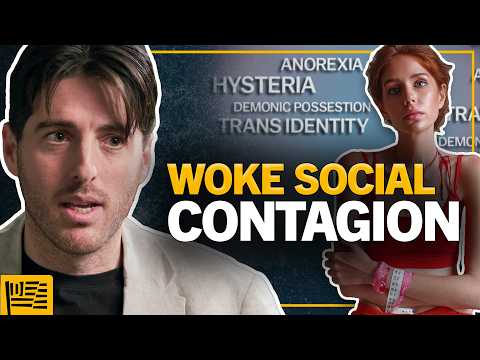
0:01 You have an article on your Substack that was you know about how what exorcism taught you about gender ideology. We have we have something called the symptom pool uh which has exist you know throughout time it changes whatever is fashionable at that time. So if a woman in the 1920s was depressed, she would be sent for fresh air uh and and told that she needs country country air and those kinds or that she might have some sort of wandering womb which comes from ancient Greece which is where the word hysteria comes from. Uh hysterical women and like their womb is going up in their head and they would use magnets to bring them down and all sorts of crazy things like that. Um, if you happen to be born in uh some parts of the impoverished suburbs of Argentina where I went and you have those kinds of issues, then you are told that you um have a demon inside you that is a very real demon and we have to do all sorts of prayers and throw things at you and all the stuff to get it out so you feel better. In the west right now, if you go to a doctor and you have all of those conditions, you will be told, not necessarily immediately by the doctor, but by your friends, by the fashions of the time, that you are in the wrong body. There is something wrong with your body. This is unbelievably similar to the exorcism stuff in Argentina. Uh in both cases these are mostly particularly young women 15 to 20 years old who are really struggling with who they are with suddenly uh sexuality happening to them like happening to them uh with the way men will gaze at them which is something that happen and then told that it's wrong to acknowledge it's a really confusing time for any any young boy or girl but I think particularly girls with dealing with puberty uh and that kind of stuff. So that's a tough time. A lot of girls get anorexia, bulimia, those, you know, how do you suddenly explain those things? Well, we don't know. And that's also the issue that I think people have with atheists. They say to me, well, how what happened before the big bang? What happened with it? I don't know. We don't know. And humans are not built that way.
1:57 We're built to know. We have to find that elephant and then find the reason why afterwards. So they were just so similar the demographics of young girls in Argentina that I found and those in the west that I thought this this is no coincidence. We have a similar thing happening in um it was Hong Kong uh with anorexia for example they had they didn't have the word it wasn't even a thing and then there was a high-profile case about 20 years ago where a girl died from that again sim I think it's that demographic of young girls with these things and uh they started looking journalists started looking at American and British movies uh and they coined it anorexia suddenly that shot through the roof everybody had it social contagion so you've got this age that's a very difficult age and whether It manifests itself as anorexia, exorcism, transgenderism, wandering womb.
2:47 Basically, what we're saying is this is really hard and we don't know how to treat it or what it is. Some sort of depression, who knows what and that's it. How um how do you understand the timing of this um this transgender hysterical craze? Because that's what it feels like. It feels like all of a sudden in the past 5 to 10 years, we went from the world of the before times where, you know, an SNL skit with a bunch of guys dressed like women would be like a joke and it was like guys and dolls and and like really not much had changed about our perception of this that that you know, yes, there's people who crossdress. Yes, there are some people who almost entirely male who feel they're only comfortable in this acting as if they are a woman to 30% of Californians saying that they're LGBTQ, which is like impossible. And it's and it's obviously different than in Idaho.
3:57 So that's probably not really real. It's cultural. But this all happened five minutes ago. This is like brand new global, but especially seems like in the Anglosphere in like America, UK, uh, Canada, Canada, Australia, New Zealand seem to be particularly afflicted by they love it. I island. So, so why why now? Well, the feminists didn't help. Um, and now, you know, and I don't like that. A lot of people get very um bitter and they they they'll say, "Well, you've made your bed. Look what you've done."
4:33 That kind of thing. And that wasn't what the feminists wanted. But they went away from truth, which is they for a long time started saying that men and women are equal in every single way. And I've spoken to several feminists who were saying that at the time who now say they regret that. They say we shouldn't have said that. That wasn't true. We were trying to get par. And what they were trying to get was equity. Really, they were not noticing the differences between the biologies. The bi the bi biological differences of the sexes that they're just totally different. And there are similarities as well. But men and women are like two bell curves, but they're offset a little along lots of different dimensions. And it turns out that that's mostly the same. Yeah. But where it's different, it's often different fairly dramatically. The dransitioners that I've interviewed have have given me a great insight into some of the biological and physical differences. So, um, one of them was saying that when she took testosterone, she found she couldn't cry. Right? So, I always thought crying, the reason men cry less than women, um, was because like a social construct. Men are told, "Be a big man. and women are told don't.
5:33 But she was saying, "No, no, just having the testosterone in me made me not able to cry." So, there is something about our biology that makes one sex much uh much more capable of crying. Not that men don't cry as well, of course. Um, do Italians have low tea then? Because like I'm like a blubbery mess. You were crying when I arrived. No, but seriously though, I actually I'm a pretty emotional guy. So, that's interesting. Yeah, but this it's outliers, isn't it?
5:57 It's like there's that meme, isn't there of some people who don't get averages. Um, and they say like the average height is 5'7, but I'm 5' n. That can't be true, you know. Um, but but yeah, I I I try to cry and I I find that I I I I so want to that as soon as I start crying, I'm so happy that I'm crying that the end it ends. Yeah, exactly. The Larry David, the son of Larry David. Um, were you trying to do Larry David or not? No, I just came Larry David. I liked it. Um but yeah, so the feminist didn't didn't help of course. Um we I I think students as well uh that sort of well the coddling of the what's Jonathan's codling of the American mind.
6:39 Social media is I mean a a lot a lot can be laid at the foot of social media for like the the psychotic contagions we have. Yeah. Social media and and what just parents being told to tell their kids they're amazing. The other thing social media does is it allows you to see the whole world. Suddenly your tribe goes from being like the 20 kids at school. Well, maybe you're doing pretty well compared to the 20 kids at school or whatever. Well, social media and the internet, now you're competing with like the entire country. So, you start off by your parents, everybody telling you you're the most wonderful, amazing person in the world. You get to university, you realize that's not true.
7:09 There's this um again the book the status game. I love this Will's book. It it really resonated with me. Uh there everything we do in life, pretty much everything is done for status to give us a better status. Our body again it's evolutionary biology but it's that your body will incentivize you. So it feels good inside you. It actually feels good when you do something that will get you more status. It feels bad when you do something that will ruin your status. So lying or keeping secrets feels bad. It actually feels bad inside you because that's your body warning you. Don't do this too often. You will lose status.
7:40 People won't like you. Now he says there are three main kinds of status. The the main and best route is success. If you were the one who built the wheel or made fire, everybody's given you food, a claim, women, or if you're a woman, men if they want that, I don't know. Um, they don't seem to. And then all the things you're getting all the things, shelter, um, but only a very tiny percentage of society can be successful because that's how su success works. If everyone was, then the successful ones would be the ones at the top of that.
8:10 So, you can only ever have a small percentage of people who are successful. But everybody wants status. We all live for that. So what are the other ways? Well, one of them is dominance. That's what people call toxic masculinity, right? But a lot of women exhibit those kinds of things as well, and a lot of men don't. Women tend to be more um socially aggressive and men more physically aggressive. But the levels of aggressiveness, as I understand it, are pretty similar. Yeah, exactly. It's just I will punch you in the face. If if we're two women, I will spread horrible rumors that you are um a or something. That's the third type. So dominance is the second one and it's it's obviously not as nice as success, but you can't succeed. Well, you're going to dominate and you're going to bring down that head monkey and you'll be the monkey in charge. Now, um, but a lot of women and a lot of men as well just are not naturally dominant. They're not physically built that way. They don't have it. That third way is virtue, right? So, virtue signaling. If you were the guy in the tribe who showed how nice they were and was sharing all the food and so on, you would get more food and you would get more shelter and those kinds of things. Um, the the difference with the interesting thing about virtue is that you didn't have to actually be virtuous. you just needed to give off the impression that you were. So, yeah, I'm giving everyone food all the time, but actually you're like keeping it for yourself. If you get away with that, you've done well. You know, you're climbing the the ranks. Anyway, you've got a huge generation now comparing themselves with the entire country who couldn't possibly be successful compared to like the top top percentage, right?
9:32 The 99% are nowhere near as successful. Yet they were told all by their parents because of the new way that we parent the coddling of the American mind that they are geniuses and brilliant who suddenly find themselves at about 20 years old at university uh utterly not interesting people not successful people haven't they're probably not very how do you be dominant in today's world you can't really all you have is virtue and and how do you get virtue when you're in a world that has found some semblance of as we were talking about before equality we were doing pretty well we were getting there so what do you do you you have to keep going and find that extra thing. What were the feminists saying?
10:06 Oh, they were saying that men and women are exactly the same. Well, well, maybe they are. And that's how you do it. You're all a bunch of transphobes. How do you know they're not right or more right than you feel like they are? Uh to be to play devil's advocate. Yeah, we've had, you know, you've already brought up that there has been even among the medical elite and experts, I mean, eugenics was considered like the premier science that everyone from uh you know, I can't say these people not scowl, but Margaret Sanger and George Bern Bernard Shaw and all I mean like it was the trust of science position eugenics in the United States, you know, to such an extent that Hitler was like, "Wow, you guys got some good ideas over there.
10:52 Um, how do we know that the extent to which we claim our gender uh our gendered nature, our sexual dimmorphism is um hardwired than that that they don't have a point that there isn't more fluidity than than than we feel like there is or like you know is there have you found any part of this gender progender fluid trans movement that you think has um a healthy truth claim.
11:29 Um, no. And I hate saying no because, you know, it's boring and I want to be like, well, actually the nuanced position is this. It it's as I was saying with religion, it's a case of they have to prove it. This is a this is about as extraordinary a claim as you can make. Like that man, you see that man over there? He's actually a woman. Let me tell you why. But they've ne I've never seen the why. What is the why? I don't know what that why is. It's it's it always seems to be well it's a social social construct. And you go yeah but what and that's a thought terminating cliche. A scientologist would just say yeah suppressive person. This is a social construct. Explain what that means. Wait wait wait that I've heard this term thought terminating cliche cliche. What does that mean? That is something that cults use and cultish groups as I was saying before any community. And if I think that's a good sign of a cultish community is is when you shout something out and it becomes a slogan. I suppose it's a sloganization of politics essentially. But it just means you no longer have to think because you've said the thing you're supposed to think or supposed to say which is in Scientology they would just say ah you're a suppressive person.
12:32 That's it. Don't need to say anything more. So woke is kind of that. It is. Yeah. It is just like oh they're woke so therefore that's why they that's why they hate it when you say that. But you need to be able to explain it. So, so that's the difference. So, suppress a person. Okay, that's what Scientologist would say. And you would then say, but why? Yeah, but but engage with what I'm saying. So, it is it is a thought timeing cliche. And I do I am guilty of it of using it by saying you well, you're just woke. But but I wouldn't say that in an argument. I would try and say I think you're being woke and I'll explain why. Sure. Um and so yeah, what was the one we were saying before is one. Well, I don't know. But transphobe is one of them. Yeah. I mean, yeah. I mean, a racist, homophobes, all these things, all these all these isms that that get thrown at people. Explain it.
13:16 Tell us why and and what and and what we've done. And then we can at least then have that debate because otherwise we're just shouting slurs at one another. If you like this clip, you should check out the full video and all the other great content we've got at Dad Saves America. So, be sure to hit the like button, subscribe, and ring that bell so you won't miss our new stuff as it drops each week.
Summary
- The "symptom pool" concept illustrates how societal trends shape perceptions of mental health and identity.
- Historical treatments for women's issues, such as hysteria, reflect changing cultural attitudes and misunderstandings.
- The speaker draws parallels between exorcism practices in Argentina and contemporary views on gender identity, particularly among young women.
- The rise in transgender identity is seen as a response to societal pressures and confusion during puberty.
- Feminism's insistence on gender equality may have inadvertently contributed to current gender ideology debates.
- Social media amplifies comparison and status anxiety among youth, leading to identity crises.
- The speaker critiques the lack of scientific grounding in claims about gender fluidity, emphasizing the need for evidence.
- The conversation highlights the importance of engaging in nuanced discussions rather than resorting to slogans or thought-terminating clichés.