Transcript
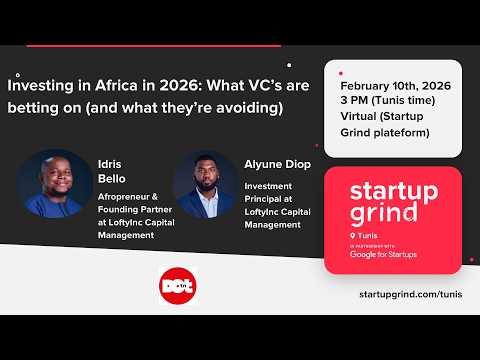
0:00 Yes, the recording started. So, we are live. So, thank you everyone who has joined us. Uh I'm Beea from Tunis, the chapter director of Startup Grind Tunis. And if it's the first time that you will join a startup grind event or community. So we are the biggest community in the world and we have chapters frantically around the world and I represent Tunis and Tunisia and if you are about inspiration, education, about entrepreneurship or just wanted to give a hand, you are on the right community.
0:32 So today we have two guests and thank thankfully they are available to answer our question but also to talk about investing in Africa in 2026 and especially what VCs are betting on and what to avoid. So today we have with us two representative of Lofty Inc. Uh we have Edris Bellow. He's the one of the VCs but the founder of uh Lofty and he's an afro uh as he describes himself. He was here in Tunis couple of months ago and he has a wild experience in several ecosystem in several countries and he's the right person to answer all the question about what VCs wants.
1:17 Thank you for joining us and for your availability. How are you today? >> Doing well doing well. Thank you very much. Uh I'm really really honored to be here. I'm glad to be uh to be here today. Yes. >> And also with Idris we had the pleasure today to have another representative of Lofty Capital. We and he's Alunob. Alun is an associate work on deal resourcing and exclusion portfolio support and investor relationship and previously he worked with several also other capitals and he worked on several ecosystems. So also he's your guide to give us another insight and what VCs are expecting and where what they are looking for. So without further introduction so we're going to talk a little bit about what's in Africa, what's going on. So Alun could you please tell us if you fast forward to the end of 26 and we are starting always to look at trends and what's going on. What do you think will change in the in the most in the Africa startup and investment rates landscape this year?
2:23 >> Thank you Ba and hello everyone. Um it's a pleasure to be to be to be here and to be talking to you all. Um so fast forward to the to the end of the of 2026 I think you know we're already seeing the seeing the trends actually and it's you know ecosystem going towards more more maturity and that means um you know not only startups not only raising equity but different type of of instruments. So for instance financing their working capital requirements with debt um instead of uh you know using equity as the as the go.
3:02 So I think that's that's number one. Number two um you know it's it's following trends uh global trends but we're definitely seeing the emergence of u and and and the acceleration even of of AI. Um so we're not really seeing software native businesses but AI native businesses. Um that's that's that's that. And and similarly on the on the financial services side, it's really the the intersection of um of you know AI and and sort of stable coin, crypto uh currencies, you know, innovations that are becoming more widespread. So I think across across the different verticals um that's that's sort of what we're seeing um and and probably where we'll be at the at the end of 2026.
3:47 >> Perfect. And already I think we started with the big words like the raise of iron, native business, crypto and stuff. And after the correction we saw in global venture capital, what is the new reality for African startups? Uh is there any hype gone left or new trend? >> Okay. So I I can jump in there. >> Yes, please. >> Yes. So, so I would like to say mostly hype is gone, but as we know hype never goes fully, right? So, there's always a small part of hype left waiting for the next cycle. But I think what we seeing is the emergence and the appreciation for real businesses. All right. Uh if you look at the at the 2020 2021 stage, you add a lot of hype, a lot of uh you know uh free money happening. Then you add so there was a lot of abundance right globally and across the continent.
4:48 Then you add the last two three years from 23 to 24 where it was more of a correction and now it's more of discipline. So you have fewer vanity rounds, you have healthier cap tables, but there's still some hype there. But I think what we've seen is uh revenue is starting to matter, margins are starting to matter, right? And and real businesses, real founders who actually are solving real problems and then governance is mattering cuz again what happened in the very rushing years in the 2021 time was because lots of deals are to be done very fast. People push governance aside. Now fast forward four five years later people are seeing the outcomes of that and companies are collapsing and so we're seeing people actually place a focus on governance now we're also seeing people actually start looking at what's your time to profitability right so what we seen is yes there's capital compared to 3 years ago where there was a scarcity today there's capital globally and we see that all the craziness in the US uh and there's capital on the continent too but that capital is demanding discipline.
5:55 It's demanding governance. It's determined it's demanded time to evaluate and it's ch making choices based on you know profitability or profitability on real businesses on the you know uh experienced founders and that's where it's different and uh and so basically the buy is higher right because capital is now you know trying to be move smarter and and that's healthy for us as a continent we just in the second decade of the VC space I think it's healthy Now how long this lasts for would uh it's what what remains to be seen.
6:32 >> Perfect and thank you for all this insights and to continue about the trend and the hype. Uh now we're going to talk a little bit about where capital is moving and can you tell us what sector are you personally most excited about going into 2026 and do I >> Yeah. Okay. So, so I I'll start that and hand over to Alon because Alon leads our deals uh uh here right uh lofty inc right but again if I look at so I wrote my first check in 2012 right and so it's been a while since then 14 years later what's changed and where is money going now I think what we had then was fintech one uh 101 or 1.0 and today what we seeing is fintech 2.0 Z work is not just payment for the sake of payments. It's payments embedded in travel. It's payment embedded in uh construction in design. So it's fintech uh applied applied fintech if you miss it. So and so that's quite interesting. So that that's one of the key things we're seeing. So fintech is still king. Again I know a lot of times people say okay what's next after fintech? There's a lot after fintech but what we seeing is applied fintech. You're seeing that also cross border is still not yet solved.
7:48 Despite the number of startups we have on the continent all serving uh cross border, it is still challenging to move money from Tunisia to Nigeria, from Kenya to Ghana, right? So we still seeing people doing that and now doing that with uh with stable coins and then we've seen a lot of that. Then also what you then realize is there are different sectors that are showing up in different parts of the continent. And so when you look at uh North Africa, Egypt, you seeing a lot of things around logistics going because there's a lot of manufacturing going and it's becoming the manufacturing hub and you see things that support fulfillment happening there. When you look at uh some part of uh Kenya, you're seen a lot of uh things happening in the mobility space. Uh whether that's with EVs, whether that's with uh gig uh the gig economy uh supporting uh drivers, whether that's energy transition. All right. use or carbon capture. So you see a lot of that, right? And again uh when Nigeria is a bit different for the this uh this year, but to focus on Tunisia, right?
8:52 Because we're a firm that's very active in Tunisia. I must uh you know give thanks to uh one of our key investors is another smart capital out of Tunisia. They one of our LPS and uh because of that we uh and addition to our plans, we've been very focused on Tunisia. We spend a lot of time talking to startups from Tunisia, founders from Tunia and we're seeing teams that are trying to build uh AI ready startups out of Tunisia. So that's something that interesting that we've seen. We're also seeing a few fintexs uh again uh in Tunisia. But again, we increasingly seeing a lot of deals coming out of Tunia that quite interesting right across multiple sectors. And I think uh so so I think you can take it from there. But again, you can see that it's still a wide variety of uh of places that money is going. So unlike the US where it's mostly been AI this year, I think it's still quite diverse on the continent. Back to you, Alon.
9:45 >> Definitely. And I think even you know speaking speaking about AI, it's also I would say that you know there's a there's a category that's been largely in touch historically across the continent which is enter enterprise software. um because it's a it's a category with higher entry barrier also from a technical perspective and this is something that has been completely rewritten right with the um with the AI craze um and and and the new world sort of that is uh that is emerging and it's it's really the intersection sort of of of of data um and sales capabilities that are showing us that you know across compliance verticals uh across marketing verticals across HR vertical um across you know DevOps verticals um cyber security verticals thing that are more technical um I would say um we're seeing the emergence of yeah as as was saying sort of version 2.0 or players that are AI native and I think one of our one of our portfolio company uh one of our portfolio founder based out of South Africa um you know we had a we had a meeting the other day they're actually starting to completely rewrite their their code architecture the reason behind it and I think he he phrased it very well said that every so every piece of software that's been built pre2023 is now considered legacy software.
11:15 Anything that is not AI native AI AI first can be considered legacy software today and I think that's why we're seeing a lot of opportunities that actually can be captured across the across the board. Thank you very much and indeed you mentioned now and even Adris mentioned we the curse whatever we are we're going to cross something like curse border cross even sometimes curse efforts uh and collaborate it's complete it doesn't it's not really accurate or it comes it doesn't come to some entrepreneurs's mind and going with that and on the flip side which sectors or startups model are you seeing less appetite for uh for investor maybe you mentioned the hype now and everybody is going on the trend of AI and you mentioned AR ready startups but are they any sectors that now feel less appealing for investors?
12:12 Yeah, definitely. I think we've learned uh over the past couple of years uh in those cycles and one of the things we're trying to avoid right now is you know back then you everybody had a marketplace good at all cost. You spend all money all you raise money to just acquire uh folks on your marketplace. You were running negative uh unit economics just to go GMV or just have people in your marketplace. And I think uh people are staying away from you know pure good at all cost uh marketplaces. I think that's one of the things uh we are seeing people stay away from. Also uh a couple of years ago it was mostly people just doing uh uh copy and copy and paste take a model from the US and come apply it in Africa. And we're seeing less of that now. So we're seeing people like or at least we're seeing less of money going into that where people are questioning uh how does this apply to this ecosystem this country uh we're also seeing where people are questioning well ex expansion from day one. So you see back then people raised VC money from day one and they wanted to be in Nigeria and Ghana and Tunia and Egypt and XYZ and today people are questioning that answer and saying depth pass of breath and uh questioning X-Man from day one uh models then talking about AI. So again, one thing we also seen come up, but uh hopefully they don't waste too much money is people just having rappers, right? Just taking an LLM that exists and putting a wrap around it and calling it a right and I think uh that's something to be we're being very careful of to avoid where people just take an existing LLM and just put some wrap around it and say they have an AI startup, right? Then also something to be careful about that we watching is also in the energy transition space because there's a lot of grant money a lot of development money going there you are seeing people with models that are not sustainable outside of subsidy >> and that's a challenge because you get subsidy for the first couple of years and then when that subsidy fails the business fails and so we're being careful not to just have uh put money in things in things like that. I think that that those are some of the things we're avoiding for now.
14:29 >> Okay. Thank you for those insights and I'm going to ask Alun. So we often hear about uh the everyday economy thesis. What does that actually mean in practice when you look to add deals? >> You want to take it to juice or you want me to go ahead? >> Go ahead. Go ahead. >> Yeah. I mean, you know, it's interesting when we when we at Love to speak about the everyday economy, it's really um sectors, but I would go beyond sectors.
14:58 It's actually business models that are embedded into daily lives. You know, the the premise of that is always that at the root of it, African are traders. So for us, that's that's that's how we that's how we tend to to look about it. Of course, you know, with trade, you have all the e-commerce uh B2B solutions, you need supply chain, you need logistics, you need to be able to um to to to layer financial services on top, you need to be able to pay, you need a way to be able to insure your goods, um you need to to to be able to leverage uh lending among others. So, that's really how we look about uh how we look at it. And beyond that, of course, you cannot you cannot trade if you if you don't have food. Um so that's you know all of your a um solutions you cannot trade if you're not healthy. Um so that's all of your healthcare solutions and beyond that you cannot trade if you're not educated. So that's that's that's really how we how we build our um our a core investment thesis I would say at lofty and that's how you you you we think about the everyday economy but you know I think it it may have a you know easy perception in the sense of negative but it's really how are you able to disrupt or change historical ways of living and you know make incremental gains along the way through the embedded of of technology.
16:21 That's really how we how we look at it from a from a lofty perspective. >> Yeah. And if I might if I may add a few points to that also, it's when you look at the continent broadly, right? I know we like to throw out the numbers a billion people anchor, but the middle class is very very small, right? And it's uh and so when you launch a product that's only for the upper class or the middle class, you limit uh what's it called? uh the folks who can afford you limit your market and so we look at what who are the people leveraging technology to get to the mass of people in these countries that we operate in uh when you leave leave Tunis and go to the other suburbs when you leave Cairo and go to Scander when you leave Lagos and go to court right there are people there who have the same aspirations who want to trade who want to move their goods who want to make payments right? Who is solving problems for these people beyond just a few thousands, right? Because those problems affect the everyday life.
17:26 And so what we're doing is always finding techn people who are leverage technology to solve problems directly for these people or people who are building technology formemes rightmemes, the informal economy powers the continent, right? And rather than fully digitizing them or moving them out of the formal into the informal, can even where they are, can you give them tools that allow them to do that? Well, if you have agencies that are booking travel for people, but they are using paper or excess sheets. Can you find people who are having technology that allows them to be able to take payments, allow them to be able to move people and reconcile and do that very seamlessly with technology? So again, it's about levering technology to touch everyday lives in a way that impacts the lives of millions of Africans and not just a small sliver. That's really what we are on when we talk about the everyday economic thesis.
18:18 >> Thank you very much. Indeed you have we have to look on the wider version and the wider get a wider angle about the whole economics not only from focus on some on on some specificities and regarding new investment criteras compared to the last let's say two or three years ago what has changed the most and how early stage startups are evaluated uh Alon >> yeah well I would just say that not much has changed but the bar the bar the bar is higher. That's really how you how you should think about it. Uh I'd say that capital capital for capital is now more mature across the across the African landscape is more institutional.
19:08 Um and what that means is that having a fancy deck and a well structured date room is is not enough anymore. So it's it's it's all the it's all the same fundamentals that we look for, right? Um strong founder fit, domain expertise, evidence of traction, um you know, true potential market size, unit economics, all of these things. But essentially, I would say that now the competition is is is is is more aggressive. the competition is is is is broader across the and it's always important and and that's that's something that we that we repeat a lot when we um sort of in Tunisia um founders need to understand that they're comp they're not competing against you know the next fintech in Tunisia or the next uh climate tech in Tunisia but the competition is is is at least Panaffrican at least because I'm saying at least because you have even investors with global mandates um so you at the very least you're competing against all of your African peers um if not um global peers. So that's that's that that's really um how we think about it, right? So again, strong domain expertise, clear traction, evidence that there is a dire need for your for your product and service and that there are customers that are that that are willing to um to to pay for it. But it's also important to understand from a founder perspective what what what are VCs seeking?
20:40 and what what what business we we own. We always try to explain that no for an investment to make sense for us for us to to come in and deploy $1 million um in your in your company at a you know 8 10520 million valuation. If your business does not does not have a clear path to reaching a hundred million dollar in valuation if not much more than that actually um it it it just does not make sense for for for us to pursue an investment. So that's really how you can try and back solve it. What does it mean for your business to reaching that type of valuation? How many customers you need to achieve? What type of revenue? What type of margins etc. And usually, you know, founders are are able to get the to get the answer fairly easily on would this would this be a fit for for venture capital or not.
21:34 >> Thank you, Alun. And especially I smiled earlier because I was at an event yesterday and the question was always like what VCs wants and the the answer was have your clear data room have your all those templates like in one let's say share drive and at least you get it now you say that especially now with all the templates online I think and at least notion templates uh you can get there but I think the challenge is getting the right data in those template not having them fancy and doing especially with AI >> I mean fancy helps having it fancy and tidy helps of course we always like to you know it's it's more enjoyable of course to look at a nice deck and a well structured date room etc etc but now every other deck and every other date room is structured so it's just not enough anymore >> indeed of course you mentioned the I think the golden word which is traction the clear like traction like what you are doing how How much are you selling?
22:36 How much are your incomes and where our money as investor will go and how our investment will be fruitful for you and for us. And this is something we forget sometimes as entrepreneurs like we are look at the investor at the same with with the same leverage and with the same eye like I talked with Adris and Luon with team of lofty like I talked with other VCs without like looking or any other criteria. This is one of the mistake that unfortunately is made and also since we talked about metrics. So are they any other important metrics there are essentials? We mentioned like traction but besid in terms of revenue, unit economics uh earlier we talked to or maybe the question was between economics and market share. So all those metrics what are the most important for startups and you as VC you look to or it depends on the startups.
23:40 >> Exactly. Go ahead Idris. >> Yeah. Yeah. So again uh just just ste what are looking for? We are looking for companies that make money. It's as simple as that. I think sometimes people forget that we want companies that make money. That's the business right. And also people need to realize VC is not for everybody. All right? And companies where you want to be a lifestyle business that's fine. If you don't want to seed control uh that's fine, right?
24:10 Then don't want to raise money from VCs. If you are not looking to grow a company to be big, that's also fine. Get working capital from your bank, get money from your uncles, get a grand, get stuff. But when you raise money from VC, there are things that come along with it. We need companies that are growing, they're growing quite fast, right? We need founders that understand what are their customer acquisition costs and even if they're not profitable today, they at least understand the contribution margins. They have a path to profitability. They understand the payback period of their services or whatever they are selling. So they have a path to profitability. They are economically literate, right? And so again, it's those basic things that needs to be there. Just need to be clear. How do you make money? I think this is so simple. The only number of founders we spend time with that don't know how they're going to make money.
25:02 And I know this is okay. Maybe the AI space and you could talk about open AI or the Uber days and things like that. There's a small slice, small segment where you have to be ahead of the cub where maybe you're not making money very early. And I'm sure there going to be questions around AI and agentic AI and all of that stuff later. Right? So there's a small slice where you're spending the first year to years building out stuff. But even though you have to have a clear eyed vision even though you don't have the money, the revenue today. So yes, we'll do mostly seed. We do mostly post revenue, but we still have a small pocket devoted to uh what we call moonshots, great founders in growing spaces and where again we're willing to move fast and and and examine. But for most uh of the investment again you have to make that clear understanding of economics that clear understanding of what the cost of a customer the lifetime of the customer and how do you make money and how how do you that consistently right and how do you do it with integrity and how do you grow that and I think that's again very basic stuff right and and founders need to spend a lot of time thinking through that as they spend their time on solving problems on building businesses and it's also important I also understand no two VCs are the same. So it helps you and helps the VC if you have done some research to understand what's the mandate of that VC. Do they even have a mandate for your country, for your sector, for your stage, right? Don't waste time talking to a series investor when you're just launching out of your garage. Right? So again, those things also make it easier uh uh for you when you're fundraising from Vis.
26:48 >> Indeed. And thank you Adris for saying it out loud like VCs are not for everyone because there are other sources of money and uh you're not uh also adaptable for all the startups. So there yeah at least do your homework all the information may most of the VCs if not all have all the information online on their website whether who they are who they are looking for what stage what type and also what other previous startup they have invested for to give some insights to the entrepreneurs are looking for invest investing if this the is this the right VC to look for or not and uh to close about the new investment criteras and trends. Could you please tell us if adding the AI to the pitch deck, especially now it's AI buzzword everywhere has a real value from the investor perspective.
27:44 Alun, I see you smiling. I mean, you know, it's it's it's interesting because it's actually well and and you know, every investor is different, of course, but for some of us, it's actually it's it's actually counter. It does the opposite thing. Um, and I I I want to make a difference here, right? We see everyone nowadays adding AI to their to their to their startup, but they're not AI native. It's it's AI embedded in the um in the tool, right? In the service.
28:15 And as I was say saying earlier that is just expected now uh if you if if you don't have um AI embedded into into your product well I would say that I mean I would I would question it let me put it that way. Now there's another bucket which are AI first companies um and sort of that's that you know the those moonshots that that that was talking about and those are those are different right those are yeah it's a different business it's a different way um uh of of for us of looking at it as well so so I I really want to make the the difference but if you if you're building a nonAI native product I You have to have AI anyway. So, no need to add it to your deck.
29:07 >> Yeah. And I think I think uh it's also about what does the AI do? Uh when look at the deals we've seen in the past six months, 60% of what people call AI is spreadsheets, right? It's basically the Excel doing the stuff. Another 20% is chargity. Basically, you have a charge copy or clone that answers questions or a chatbot. And we've been seeing chatbots for a while, right? So it's so and you need to separate that from the real agentic AI, right? And so for us when we talk about AI, we're looking at AI infrastructure, right? And we see some interesting things out out of Tunisia. Actually, one or two companies we've been speaking with out of Tunisia, right? Quite early, but quite quite interesting. So we're seeing some So again, we like to go cut through the, you know, all the the hype and see what does your AI do, right? Uh is it reducing the cost of transaction? Is it you know, insurance? Is it improving your underwriting? Is it helping with uh list scoring? Right? Is it increasing your contribution margin? And uh what's the mot here? If all you just done is change the rapper, right? So what stop someone else from doing? And what's the underlying understanding of the problem you want to solve? Again, I think that's still the thing people forget. AI is great, but again, it's still about what problem are you solving and who are you solving it for? And I think if people spend more time on that and less on just slapping AI on it, I think we'll make progress. But definitely there's some very interesting AI infrastructure plays that we've seen across the continent. And I think Tunisia really really has a great chance at this given the the strength of your high school and university and research system. And I think it's something that uh uh uh so in my ideal world you would have an AI startup out of Tunisia but that is serving the continent because again the markets might be small or serving the globe right because the market might be small in Tunisia but again you have the depth of talent and I think it's about what problems do you want to apply AI to solve >> indeed um and maybe it's important to go back to the basics as entrepreneur you are always solving a problem so what's your problem besides like adden a kush of um now I can't find the word kush in English so help me I know it's in French another layer >> layer >> layer yes I found it a layer of AI just to impress or just to to be on the trend and regarding still and what's funable means to you today because we talked uh earlier about the new investment criteria what are the trends how where capital is moving but let's talk about what is fundable and what means fundable means to you Alun and Idris so in 2016 what does truly fundable African startups look like uh at the pre or seed stage >> Idris how do we get today what does it take >> so so I think it's about clarity right again because we invest at seed mostly at late seed but if you at le starts with the founder what's their unique understanding of the problem set right and how is that different from other people's understanding of it what's their unfair advantage right and I think it always starts with that that deep understanding of the problem that passion about the problem I think it's always that blows you away when you see some of those founders and I could be the same problem everybody's looking at but then the way they approach it right is quite different. Uh and that's and that's quite key. Then also the very beginning the the focus right again it could be wide ocean but again having that very clear focus uh in the early days I think that helps uh understanding their market right getting early traction even non-paying customers that show that there's a market here there's a need here right of course uh you always have to decide early in early are you going for depth initially are you going for uh for width or for breath right? Are you trying to do is your business sustainable in just your country and or do you have to be pan-African or global to uh to to to to solve it? But in all cases, I think in most cases you still have to start local, right? You still have to start local and go deep. There are a few cases where I've seen where yes from day one you could because of the solution you are providing you could broaden but for most cases I think it's still about can you prove on a on a limited use case that this works this is needed and people are going to pay for this right all right so it's still the same basic things whether you're in the pre AAI world or the most AI post AI world it's still about do you have a clear problem do you have uh evidence that it's can be monetized can you build a team around it right and what's your unfair advantage and I think for me those are the uh c things when I look at um IC memos or you know decks and things like that right al policies more decks when I do so al what when you bring something to the IC what convinces you to bring to IC exactly what you say I think it always starts with the founder and you know really strong domain expertise and and strong understanding of the of the of the problem that they're solving but also the nature of the industry and all the moving parts. Um that's that that's always where it stems from I think then we like you know evidence of real market opportunity um from a size but also from a attractivity uh perspective um and then yeah then then we start digging into the business um and the nitty-gritty but but I think the at lofty we we're very big into into founders and into people so we we we we always try to try to look for for smart people um that we can work with. It's it's those two things. So also you know you need the the value alignment as well that is that is very important.
35:11 >> Yeah. And jumping on that also again I think Indonesia is an interesting place again in most markets we go we always tell them focus on the local market first right dominate your market right and then expand because expanding in Africa is tough even beyond neighbor between Nigeria and Ghana it's tough right and expansion punishes you in Africa you almost have to do everything differently right in each market but I see Tunia is unique because uh for a lot one it's a small market by itself Well, secondly is a bridge. It's a bridge to Europe. It's a bridge to Africa. It's a bridge to the Middle East and stuff like that. So, there's some unique opportunities that initia has that the rest of the continent doesn't have. And I think it's also important to be able to tap into that. But you need to decide very quickly the kind of business you are building. Is this something for the market in this share and understand the size of the market and be very realistic about it. If there only going to be few people using it, don't call it don't assume you're going to get a unicorn valuation in which case you need to be capital efficient and raise only what you need to raise because it's never going to go beyond what it is and if some going to expand be clear on what that means is you still start local but again you have a clear ambition uh that goes beyond the continent and you build in that in in in that in that part too.
36:29 So again I think having clarity as uh is infectious when we see founders who are very clear about their vision I think that infect you you get that and you're able to see where they taking this and and and we've seen this in some of our companies have done quite well. Thank you uh Adis and Alun for all this insight and maybe if you can add something I a little bit curious about what qualities in founder matters today.
36:57 Alun mentioned earlier the f the smart the smart part you are you mentioned nowadays also that the the fact that entrepreneurs have to be focused on their local market beside and before like thinking and always talking about go going abroad especially to other maybe tougher markets in Africa. So like for some qualities like speed, resilience, prefability, I think preferability will work. But what kind of mindset or is there some qualities like you are for you are a must or a killer for entrepreneurs?
37:38 >> Yes. I think for me more about the killers. What don't I like to see? Right. Again, the negatives, right? Uh it's I think for us start with integrity. When we're investing, we're investing in not just a company. We're investing in a vision in the people. We're investing in people we want to spend the next 5 to 10 years with, right? Want to believe every word they say. We want to believe every document they send us. And so when as we engage with you, we see uh fraud. We see statements not matching. We see claims being made on your deck that not match reality. We double check on things you have said about what you've done in the past and don't match up. No matter how exciting that idea is, we always back off because again we want to build relationships that go beyond just the business. We want to be able to support you on not just this business but the next one and the next one. And so the foundation for us is very very important. So for me that's the biggest killer. It's about the lack of integrity. Is your words not matching your actions? Is you not being dependable? because it then imposes emotional stress on us as investors where we have to question everything we hear from you. Every report we have to ask did you fudge it? Can we trust your word? Can you trust your claims? I think that's the biggest one for me. Again, there are multiple other things around your uh financial discipline and and emotional you know state and things like that. But for me that single one is if I can't trust you again the the currency here in this business is trust. If I can't trust you, I can't invest in you.
39:09 That's the simple one for me. Al, >> no, I mean it's it's it's exactly that. We're in the business of people first. Um so we want to we want to work with people that one we can work with and two we like to work with cuz you know very often um investor investy relationship it goes beyond the professional, right? you you have to be a therapist, marriage counselor, all of those things. Um it's it's it's all part of the it's all part of the part of the job and we we do it gladly. We spend a lot of time with our founders, you know, during the week, weekends um and so on. So we we we need to have people that we we we genuinely enjoy working with and share and and and are value aligned. It's as as as simple as that.
40:02 Thank you. Alun especially now you gave it's might be because you gave me an idea like um having like kind of a consultancy for invest investor relationship counseling mitigation a kind of couples therapy but for >> it is double therapy definitely. Yeah, we actually have some we actually have something that fun for our founders. We call it founders therapy, >> right? Because again the journey is lonely and so basically we pair older founders uh you know more experienced founders with new founders again. So whereas they're going through those cycles, the pain, they have someone they can actually uh you know connect with and things like that because it's a lonely journey. You're going to self-doubt at different points. You're going to question your own sanity. Your family is going to question you. The market is going to question you. And so it's very important to have bodies and uh and and peers along the journey. So yeah, it's it's tough.
40:56 >> Yes. And just here maybe I will talk a little bit about here what we are doing in Tunisia. We started last year at the end of last year everybody was having a rap year and this celebration the milestone that we did and here in startup grind and with the partner our partner the dot we hosted a small what we call storytelling night where entrepreneurs came. It was kind of a therapy. So the question was how was your year? How bad was it? What did you get it good? And where where did you fail? And how we can help you. And it was kind of indeed like what Adris talked about the entrepreneurship all the loneliness and being alone and have to think and sometimes the answer or the help is just sitting right next to you and you don't talk about it out loud. um and to move to maybe the next question and I will try to speed up with my question because I see a little of caution in the chat and I won't be I don't want to be the only one asking question and since we talked about integrities and the qualities of entrepreneurship so could you tell us what are the most common mistake you see in African founders making when they pitch to global investors.
42:12 Uh so I think one of the biggest mistakes is using uh Africa's population uh or the size of a country as a synonym for the market. So you're in Nigeria and you say because we have 250 million people so your adjustable market is 250 million. No, it's about what's the what's the purchasing power? We need this and I think that's one of the biggest ones. So being able to drill down to the actual market uh size and how much of this are you able to own because then that then you know shows is your business bankable or not right and I think a lot of people don't spend enough time really really defining that. I think also attached to that is people make a mistake of thinking their product is for everybody.
43:02 So one of the questions we ask very early is what's your ideal customer profile right and when you spend time defining your ideal customer profile it shrinks a lot of things off right if it's females between the age of 32 to 42 who are making this much monthly who live in this kind of houses then again you start going in on what's really the size of the people who who have this need and who can pay for that I think that's one of the biggest ones we're seeing another one also is when you look at people's so in their deck they always send all these projections right and they have I think they just run it I don't know let's tragivity on an excel model and just gives them you just see this oist stick just going up over the next 5 years right just inflated projections and someone tells you by the end of year one I'm going to be $30 million in revenue and you've been in this space you know the players and you know it's not possible right and then you start questioning did they do the right research right are they even clear about the business they understand their margins right uh I think the other part is also about uh people try to index too so much on valuation very early right and I think it's really finding the right partners very early understanding your product market fit or problem uh solution fit right very early and not overindexing on valuation and trying to grow into that valuation those are some of the uh the things we see uh lastly when look at decks I open the competition debt And what I see there tells me a lot about the founder. Usually what you see is people would put themselves in one column, put all the incubates another column.
44:48 I lost your sound, Idris. I don't know if it's me. >> I thought I was the only one. Uh, you lost >> your sound. Your sound. We can't hear you. No, we can't hear you. >> Yeah, >> I mean I think I can compliment while uh while you feel you get your mic back. But yeah, but what I think he was talking about the competition slide that's that's always a a running joke internally. But you see sort of the slide, you see, you know, the startup all of the competition and the startup has all of the things green and the others the competitors have all of the thing uh red. But surely, you know, it's it's it's a matter of maturity um and and and and understanding and acceptance of the fact that increment players actually, you know, they reach a market position for a reason. Um, so it's it's it indeed tells a lot about how much knowledge or research or both do you have about your about your market and about the problem that you're targeting and then sort of how are you positioning yourself as a company in order to win the to win um over the over these competitors. Are you back address?
46:05 >> I am back. Yes, we can't afford you to lose you at this point. >> Yeah. Yeah. Yeah. Thank you. But I I I think on the on the other side right on the so that it's it's yes you have the overestimate but I think one one one of the big thing that we see founders underestimating of especially at the preed and early seed stage it's it's it's one clarity and clarity on on unit economics more importantly now you have you have founders who will tell you doing x revenue but then when you dig revenue is actually you know GMV um And some founders get lost into the numbers.
46:45 It's really important to go to get an understanding of what what what what do the numbers mean? You know, if you're doing this GMV uh and this much revenue, how much gross profit are you doing? Um and and and that's that's that's that's really increasingly what we what we're looking at to assess of course the scalability of the business. Um and I think having that clarity on your on your margins on your unit economics is really key as a founders and some founders unfortunately tend to um overlook that.
47:21 >> Thank you Alon. You you answered already my my new question which is what do you what are founders tend to underestimate and you think it's critical. So since Alun answered could you address add another thing that maybe entrepreneurs underestimate and don't do much work on it. Governance governance. Governance. Uh people think in today times they think I'm in a rush. I need to quickly raise money. I need to get customers. And they don't have the right agreements in place. If you know the number of startups we've looked at the data room and they're making money but there's no agreements with their customers.
48:05 So there are no accounts properly done. There are no you know clarity around use of funds, personal accounts, company accounts even something as simple as where are you doiciled, where are you registered? Did you fully properly register? Do you have the right licenses? Right? Do you have the right founder agreement? Do you are you paying tax? And those things hurt you because now you're next round or round it will affect your valuation will affect the speed. So when founders complain that late seed investors or any investors take 6 months to do investment that is the reason because you have not put in governance from day one. So again with find the right amount of governance maybe you don't need a board on day one but you need get to seed you probably need a board you need advisor you need lawyers and if you don't do those things right from the very beginning it makes it tougher for you to raise from proper investors going forward so you just keep raising from your small cycle or from angels right and you never truly reach uh your skill because you're not doing those right things. So we say from the very beginning build in governance. It doesn't have to be the the amount of governance that the series A or series B company has but it's important for you to have governance from day one. Have the right lawyers have the right agreement in place. Uh when you build governance today it allows you to scale faster tomorrow. So again when we look into companies right now these are the kind of things we are looking for because again when we see someone has embedded governance from day one it tells us about the mindset of that founder. It tells us about how far they want to go and that's an encouraging sign for us.
49:51 >> Thank you Adri. And I think I'm going to take a little bit some questions from the audience because uh we keep getting uh uh we keep getting questions. Uh so we have here with us Nia who asked Nissaf sorry who asked us a couple of questions. So her first question was Africa is very attractive for investor nowadays. Are investing investors showing interest in climate focused products as a viable market opportunity or is still seen as a niche?
50:29 >> Al who will answer? >> Yeah, go ahead. >> Yeah. No, from a from a climate perspective, I think um you know from the partic report or something I believe that climate is now the second most funded category Africa after after fintech. So we can definitely not speak about niche anymore. There's a lot of lot of capital flowing into um climate climate focused startups but it's always the I mean the question is always what what what what type of startup are we talking about? What's the underlying business model? Is it is it viable? Also within climate you have different verticals right energy waste management etc etc. So what what are we talking about how sustainable it is and and commercial commercially viable beyond you know grant funding etc. Is there a real commercial investment case? Um, these are these are the questions sort of nav that you should be be asking yourself. But definitely I don't think that we can speak uh about climate focused startups as a as a niche uh as a niche category in Africa. Definitely not.
51:34 >> Yeah. And to start a very specific example, right? If you've been following the case in Kenya in the past uh week, right, I think it's Koko, right? And you saw the challenges there where the government withdrew the carbon uh credit certificate or they didn't sign off on it and the company had to lay off 700 people. So the challenge wasn't them raising money. They raised capital but the business model was such that each bofuel sto they were selling was being priced beyond the cost because that was the only way people adopt it. And they were balancing up the rest of their cost with selling uh carbon credits. But that carbon credit depended on the government and on the government withdrew or didn't approve business was gone. And so as you raise money in the carbon in the climate space be very clear you have clear uh commercial viability otherwise you could raise half a million dollars raise half a billion dollars and if the model is not sustainable in 3 years in five years in seven years it's going to be gone and that hurts everyone and so so we need to be very careful around that.
52:40 Thank you. Thank you both. And I'm jumping to another question. We have Quzi. I hope I pronounced your name right. And I'm if not cor And if I'm not if I'm correct, uh you're joining from Johannesburg. So your question is where is Africa and Argentic AI curve? Is is this something that investors are looking for for tangible use cases? Alun if you can answer since I think we lost Rece.
53:14 >> Yes. So I I I will say yes definitely yes. Now uh investors are indeed looking at it. It's it's always interesting because you know AI first companies you tend to look at it through different lenses. Um and you know I I know that a number of VCs are still trying to adjust their the investment process around it. Um because you know you can you can have a company that has that has nothing uh beyond the deck and raising at a 1520 million valuation etc. So I think from an AI agent perspective yes there is appetite across across the the continent especially when it's infrastructure applied to a specific vertical especially when there is clear domain expertise from the founder but beyond that I think it's important for for founders in the in the AI agentic space to still um you know subscribe to market realities and what does it mean to raise capital across across the continent and from a from a process perspective, from a formalization perspective, these are these are these are important element to keep in mind and uh just being honest a lot of us are still learning right again it's a new space for us for most VCs and most VC firms have older people uh uh again except for the young people like us and alun right so again it's it's a learning call for us right to learn uh that space and so what people then do is index on the founders. So if you're looking at three four founders who are building in the AI space agentic AI or other AI models right and you don't fully understand the scope then people then look at which founders have experience in other verticals or have built something before and you see that in Tunia right where you've seen repeat founders now building something and of course it was uh uh quickly funded uh but again I think there's a slope there's a slope there where people are trying to figure out you know what potentialities are here what I will also because in the aigentic space it's not just about building for Africa you know when you do fintech building a money point flutter wave a fi you have a moat locally when it comes to the AI space you can be competing with someone in San Francisco can be competing with someone in Japan right and so when we're investing there we're looking at not just the circle of competition locally but globally and saying if you build this and tomorrow open AI introduces this new free tool what does it do for your own business and again that's scary and again and that's the kind of considerations we have to look at before we invest in in those spaces >> thank you and another question from Niss what investment instrument are VCs using more now safe comfortable nodes equity revenue share especially for early stage African startups Depends on the VC.
56:17 Uh depend on the VC. For for for preed companies definitely we still see safe asking. I think interestingly there are now conversion automatic conversion mechanism that are embedded into safes. Um so almost closer to convertible. um you know some founders are still taking the equity route which is always the the preferred run from a right and governance perspective but of course that needs to be balanced with the stage of the of the company and cost associated so it's it's it's it's definitely a mix of instruments across the board >> but I think it's important for founders to look >> uh to research on what what they need and and and think and think accordingly >> exactly because a lot of people use uh safes to postpone evaluation to postpone uh you know deep uh reviews to postpone due diligence to postpone things while they figure it out. But a lot of times the saves become unsafe, right? And you see people piling saves upon saves upon saves and without doing the m the math the capable math and by the time they do it they've lost the company. Uh or yeah or people who thought they invested at the valuation they realize by time the saves are converted that was not really the valuation. So I tell people don't go beyond one or two rounds with your saves. find a way to get it priced and let the market really know what it is otherwise you can just be hurting yourself.
57:46 >> Thank you uh Idris and Dun. And one last question from our audience here in the platforms. So what milestone should founders prioritize before approaching VCs >> for? >> Yeah, let me step on that. Build a business that has a path to making money. Right. Uh I think the time is gone when all just did was add an idea and you got some angel money. I think uh there's been some maturity in most markets where your first idea doesn't get you anything. Uh so build find a problem to solve and validate that with customers. If you come to me and say I have this idea I'm building this and by the way I already have 500 signups. I already have these two banks who have issued LOI. The conversation is very different from just uh just an idea. So I think doing the job to ask uh uh you know for validation. The second thing is a lot of times when people say they need money the next question I is for what?
58:51 Because a lot of the things you need money for can be done without capital. All right. So if it's customers you need to acquire. Are there other ways you can acquire customers? This is people otherwise you acquire the people right don't make capital raising from vis your first thing index on finding customers if you're making money we will find you if you not raising money we will beg you to take our money right if you are making money and you have a business and not the other way around cuz I think you need to understand our own job as visits we have been given money by our LPS by another by IFC and we have been told we have to return multiple of that money in 7 to 10 years. That means we have to find companies that are making money and give them money so that they can make money for us to return. So you are the reason why we exist. And so if you are making money, we will haunt you that we would find where you are and we beg to take our money. But the point is most people have not done this. They're not making money. They don't understand how to make money and they spend a lot of time chasing after visas and then you don't get money. And that's the way I look at this.
59:55 >> Alon, do you want to add something? No, I mean it's it's always what we say that your best investors is your customer. Best money that you can get is actually revenue. Um so focus on getting revenue. Um convincing people you know to to use to buy to pay for your product or or software um and or service. And then you know also team if you can't convince really smart people to join you then maybe you should not be raising yet.
60:31 >> Thank you for for your honest truth since the beginning. This is feedback that we're getting here in the chat but I'm also getting privately regarding the watch party that it's hosted now and the and to close this fireside chat uh we took a lot of your time I we can't allow oursel to take more uh regard lofty days back to you what is lofty particularly focused on for in the upcoming let's say 12 and 18 months >> okay I I think I'm talking to entrepreneurs here. You guys are very lucky because you guys fall into multiple buckets with us. You are Francohone. We have a strong money to invest in microphone. You are in North Africa. We have a strong money to invest in North Africa. And we have LPS from Tunisia. We have an office in Tunisia.
61:22 We have a uh one of our people in Tunia. Now, if you don't know uh Nazi, right? So, again, Tonia with us. So, again, we're bullish on you people. We're looking for a great business out of Tunisia and we're willing to write checks and uh we're in Indonesia for the long term. So again, that's key for us. So I think that's one of the key things for us. We're investing, we're writing checks. We are it's fewer checks than before, but very strong checks in strong founders. So again, if you find good founders, if you think a good founder, reach out. Uh again, from a firm perspective, I think we're building up again. As many of you know, we had our first close last year. We having our final close this year. We are backed by many institutions that you know from the IFC to sins to another to ma and the rest of the so we're very bullish on the continent we are writing checks we're meeting founders so feel free to reach out through our website uh individually linked in uh but again we are very picky the buy is very high so I think that's something to know but again we're very bullish on supporting not just investing but also supporting the ecosystem and we hopefully this is part of it we've done a couple more and I think working with Nazi there's going to be more support beyond capital and I think that's the way we look at it. We say we we're here to support the ecosystem good ecosystem beyond capital and when we invest we're also looking we say it's we invest in four and many so that includes again so that's where we are and are grateful to have the opportunity to back good founders out of uh of >> so thank you and I have put on the chat the website of lofty in case you don't know it and you have nih how he's she's based in Tunisia for Tunisians for the others that are following our session from all over the globe globe virtually will always work and to summarize and to close up and my question will be for the both of you is there one sector in Africa you're most bullish on for 2026 >> um in the Africa well since we since we talking Tunisia um I'm going to say Um actually it was asked in the chat AI agentic um and and applied to to sort of enterprise the enterprise vertical that's that's definitely what I'm what I'm looking for out of Tunisia.
63:46 >> Okay. And you >> yeah since I to the AI one so it's it's uh for me it's about people building infrastructure formemes. I think there's so manymemes on the continent and I think the next wave is building infrastructure formemes that allow them to scale and you make money from them. So I think that's really I'm looking for financial infrastructure formemes. >> Thank you. And one trend founders should ignore besides >> AI. I'll take this first and it goes count what Alon said, right? So again adding AI to everything every thesis every thesis you send to us. If it's not AI not don't add AI to it. Don't Exactly. So everybody everything you send to us don't add AI AI to it. Leave the hype and build a business make money.
64:34 >> That should be written on a t-shirt. If not AI, don't use AI on your pitch. And for for you al >> I mean exact I mean I think Idris had the perfect lesson sentence >> one metric. So then one metric every early stage founder should know by heart >> very early stage very early stage I'll say number of customer how is that how is that evolving because you need to be as close as possible to your customer in order to keep refining and improving your product because again what matters most is not it's not the investor money that you'll raise but it's actually the revenue that you'll from your customers. If you have happy customers, they even um introduce you to VCs actually.
65:24 >> Okay. And you this? >> Yes. So, it starts with that. So, not just the customers, not just the quantity, but the quality of those customers. If you know the number of times people spend so much money on sales to acquire customers that have the payback period is just too long, right? So you must know what the uh the customer acquisition uh payback period and if it makes sense for you. If for instance be a fintech or a new bank and you're spending so much money on this high school students who in the next 10 15 years are never going to put enough money into your banks for you to make money that is a waste. So every founder must know what the customer acquisition payback period and if it makes sense.
66:06 And to close up, one piece of advice for a founder planning to raise in the next 12 months. >> So for me, I think race for growth, race for survival, not for valuation. And this seems so obvious, but if you know the number of people who raise for valuation and just jump up their valuation. So raise for survival, raise money for growth. Uh don't raise for valuation.
66:37 And you alone took mine as no he took mine as per usual. Um but I would I would say I mean it's it's it's a bit similar but build relationship for the long term. Build your business and relationship for the long term even whether whether it it it materialize in an investment now or not. Um do not do not burn bridges. >> Yeah. Yeah. Exactly. Exactly. Yeah. And one thing you've seen is we could complete our sentences. We spend too much time with each other. But I think it's also about the Lofty Inc. brand and our ethos. It's about integrity. It's about being authentic. And that's what founders will find with us. We will always be honest with you. In good times and in bad times, we will always be honest with you. We will be authentic.
67:25 And again, we don't chase the hype. We chase real people. Want to spend time with real people. Invest in real people and solve real problems. And that's lovely in promise. So this is the best closeup with the Lufty Inc. Promise and the qu this is a request I got like six times on several of my accounts. So now several of our community and startup brands are looking of more or to get more of you but not for your money but your for your wisdom.
67:53 So is there any like uh incoming travel to tuners or are you participating in any event? Yeah. So we were recently there late last year. I believe one of our GPS is there I believe in uh April and then because uh Naza is here there we also do uh in the startup clinics we put all different programs. So stay in close touch with LinkedIn follow us on uh LinkedIn uh lot in capital uh and again for those who are at the dots I think uh reach out to Nausea and again we're very responsive to our LinkedIn messages our emails and anchor so reach out. But yes, we do have a couple of programs planned for this year for Tunisia and would also be there a couple of times also.
68:36 >> So you have your all your information and for our community here in Tunisia and here in the dot I think you can uh meet with Naha she will be glad to answer your questions and share all the information you need. So Adris and Nun I won't keep you any longer. Thank you very much for your wisdom but also for being straightforward and honest without like coloring and especially for the energetic session for your time again and your wisdom and help. Hopefully we see you soon and we get a lot of Tunisian startup or African startups and Adris next time you are in Tunis we need a couple of your sweats. Uh please we won't do the copy ourself. We need to get to once from your side. So this is a request I was keeping from the beginning.
69:30 Thank you everybody.
Summary
- The African startup ecosystem is maturing, with a shift towards sustainable business models and profitability rather than hype-driven valuations.
- Investors are increasingly focused on real revenue, governance, and the integrity of founders, emphasizing the need for clear financial metrics and customer acquisition strategies.
- AI is a significant trend, but simply adding it to a pitch is not enough; startups must demonstrate genuine AI capabilities and applications.
- Founders should prioritize building strong customer relationships and understanding their market, rather than solely focusing on securing funding.
- Climate-focused startups are gaining traction, with significant investor interest, but must prove commercial viability beyond grant funding.
- Founders are encouraged to raise funds for growth and survival rather than just for valuation, and to maintain long-term relationships with investors.
- Governance and operational clarity are critical for startups to attract investment and scale effectively.
- The importance of local market focus before considering broader expansion is emphasized, especially in diverse and challenging African markets.