Transcript
0:05 let me now change and talk about self-driving cars again in the context of deep learning well its self-driving car stops a whole lot of benefits and we'll talk about it in just a moment one of its early implication there early manifestations is a feature called a DES using various sensors sometimes using your camera we can now have driver assistance driver assistance basically works by detecting a pedestrian detecting a car detecting some lines and
0:36 before you run into the car before you run into a pedestrian the car invokes the brakes and stops the car you could use this basic capability for highway adaptive cruise control just follows the car in front of you if the car in front of you slows now you slow down the car in front of you speeds up you speed up and the car in front of you stop you stop that basic capability of a dash is
1:01 incredibly useful already however stopping a car when you detect an object is far from a self-driving car it's far from a self-driving car it surely is certainly one step the question is how do we get to the future of self-driving cars now one one next step of course is detecting objects why don't just detect free space as well detect free space as well well I think that there's a very big difference between detecting an object and doing something and versus
1:33 understanding the environment the context of the environment and figuring out what to do driving is not about detecting driving is a learned behavior driving is not about detecting driving as a learned behavior our feeling is the right answer is to augment is to augment to add to today's aid as systems to augment today's ADA systems with a deep learning network that's our vision for
2:06 the Nvidia Drive px to augment a DES sure if somebody detects a car detects a pedestrian we ought to stop that feature is exist today and exist in a whole lot of different forms I think we ought to continue to let it exist however we should add augment that system with something that will learn the behavior of driving over time we'll learn the behavior of driving over time and that could be updated over time to become smarter and smarter and better a
2:37 better at driving now our perspective of deep learnings impact in self-driving cars it's very similar to the perspective to the events that just happened in the year 2012 the big thing I believe the Big Bang of self-driving cars about to come in the next couple of years because of the availability of massively parallel supercomputers like def box digits def box and the ease of training the availability of data just from
3:09 cameras like GoPro we're going to be able to train these networks with better and better behavior smarter and smarter behavior but we can't do that by coating it with if-then else's if I detect this before that in the minutes moving at this rate after that and every single condition and program a car and put it on the road and do it over and over again you'll never get there
3:39 and so we believe that the architecture just like deep neural Nets the Big Bang that happened in 2012 is about to happen here in self-driving cars and it starts by augmenting a task with a deep learning network now let's let me just illustrate a couple things this this particular road here the easy thing of course is to detect that there's a free space in front of you but that free space how you think about that free
4:07 space in this particular case I'll just drive through it that free space changes the meaning of that free space changes if all of a sudden there's a bus on the other side and that even changes if the bus is driving so be it but if the bus is stopped and the light is on my free space all of sudden recedes quite far in fact our free space Changez yet again if a car's parked by the side of the road but the door is
4:32 slightly open if that door slightly open I know it's about to become fully open and somebody's likely to step out and I should be extremely concerned the free space is now modified now that the world of free space driving doesn't work like this and of course here's an example of a free space that otherwise would be a free space it detects for some anomaly that I splurge or maybe as a whole or maybe it's a pool of water for all of us
5:01 we would just right through it just drive right over it if you aim the car properly you'll just drive right over it why stop well the way to think about that is this how do we think about self-driving and how do we think about computer code I think it's going to be very very difficult to code right if then else's and design feature detectors and condition detectors and scenario detectors of an infinite number of possibilities to go figure out how to
5:30 ultimately lead to a drive self-driving car it's a little bit like this it turns out that ping pong is one of my favorite favorite favorite games and and here's that here's the question how do you teach a baby how to play ping pong well if we use conventional a dance methodologies what we would do is this first we teach the baby held to detect a ping pong ball how when it leaves a ping-pong paddle let's go ahead and run
5:56 that video how it leaves the ping pong paddle but that's just the beginning that's just detecting detecting just just this is real that that's just detecting the ping pong ball now here's that here's here's one way we could do this we could teach the baby Newtonian physics when your paddle strikes the ball depending on the velocity of the paddle the elasticity of otherwise known
6:26 as the sponge on the paddle you will calculate the velocity that the ball leaves the paddle where it bounces on their side of the table and therefore you do a very very fast relatively simple computation you simulate the trajectory and before it enters your space you will start to you will start to swing the ball that's one method of doing teaching a baby how to play ping pong well this is the way I
6:57 learned how to play ping pong I wish I had started then I'd be smart now there you go here's the way you teach a teach here it's here's the way you teach a world-class athlete how to play ping pong what you do is this you show the baby what it means to play ping pong so you hit a couple of balls and then very quickly after that you put a bat in their hands and you let them smack away
7:26 and every time it hits it properly you reinforce the behavior every time if they repeat bad behavior or the wrong way of hitting after several times you show it again what it means is right behavior or turns out that training a baby how to play ping pong and training a car how to drive may be similar it may be similar now I know it sounds like lunacy at the moment it sounds like lunacy at the moment well it turns out
7:56 it's not so lunatic DARPA funded a project called Dave Dave DARPA autonomous vehicle it was the project leaders were two people one of them I mentioned earlier axe serendipitously is Yann laocoön Yan and Earth's Miller partnered to develop were funded by DARPA to create a self-driving car a self-driving vehicle that had no
8:28 programming at all there is simply a deep neural net inside Dave Dave was trained the behavior of driving Dave was trained the behavior of driving Dave was trained behavior of driving so Yan and Earth ours is now my chief architect for autonomous driving Yan an earth set off to figure out whether that's possible or not well here's Dave in action now the important thing about this is
8:58 this what Dave is trained to do is navigate in a very hostile environment and and what it's driving over right now is a very hostile environment it's finding its own path there's no programming involved there's of course a very very very well designed network that's running inside Dave but somehow it's finding its own way it's avoiding avoiding collisions it knows what to drive over it knows what it can't drive over some rocks it can
9:30 drive over some rocks it can't drive over the rubber hoses okay to drive over the wood stick is okay to drive over but some rocks are too big to drive over like that wall and it avoids it all by itself and a meanders along and in the size of Dave he's actually moving pretty fast by that scale all of this done all of this was done on just one CPU they were very computationally challenged it was trained on large clusters of CPUs
10:00 supercomputers basically and here's Dave and action now it's actually really interesting this is what Dave was taught with what Dave was taught with this basically a few hundred thousand images two hundred twenty-five thousand images and it was simply shown an image and it was also labeled by the human action what the human did what the coach did shown this image what did the human do shown another image what did the human
10:31 do these are all random objects in the backyard not the path this was trained on just some random objects in the backyard not ultimately the navigation path you could put it on any navigation path I'll do that so it's trained by these things it saw all these various objects and it was informed by what did the human do what did the coach do what is ground truth what is the right answer what is the right behavior it was trained over and
11:04 over again now here's the foros trained Dave was not very well informed runs into that bag this is trained after 52,000 images the behavior the input was images the output was Drive commands the input was images the output Drive commands so now it looks at these videos and it does
11:36 what the human would have done it looks at these videos processes through the deep neural network and does what the human would have done and this is fully trained it's not an amazing deep neural net in action it is perfect at predicting the expected behavior the right behavior the right behavior given a large amount of unstructured data deep
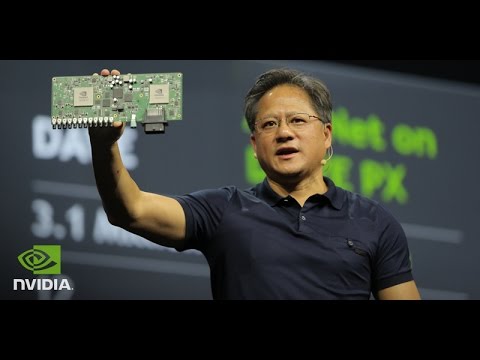
12:11 neural networks are just wonderful at taking large amounts of unstructured data like we do and predicting the right behavior the best behavior now just to compare it to drive px this is what a DRI P X's so Dave you guys saw you guys saw Dave Dave is basically completely computed on a CPU this is Drive px okay Drive px is to Tegra x1 about 2.3
12:44 teraflops this is a supercomputer right here in this little motherboard it has twelve cameras that comes into it so we could feed it with front cameras in this particular case Dave had front cameras we could feed it with cameras all around us and based on all of the input of the cameras all around us we can decide by training this network what is the proper behavior so the car in front of me stops however depending on what I see in my
13:12 rear view mirror or what the computer season in the rear view mirror and the side mirrors it might decide the best answer is not it might decide the best answer is simply changed lanes okay there are all kinds of things that we could teach the right behavior we simply have to provide it with a lot of data and so this is Drive px now just to compare it to if drive px can process Alec's net at
13:41 184 frames per second so the Elex net is the big huge network that was shown earlier drive px can process Alec's net at a hundred eighty frames per second Alec's net has if you can think of it essentially a brain this network has six hundred and 630 million connections almost a billion connections in this brain 630 million connections and we can activate those 630 million connections at a hundred and eighty four frames per second that's basically one hundred and
14:14 sixteen billion connections per second that brain is firing off a hundred billion times a second comparing what you saw was achievable by Dave that was thirty-eight million three thousand times faster three thousand times more neural capacity so the question is what can we teach drive px to do Drive px our vision of what this architecture is is basically to
14:46 augment today's ADA systems if our little drive px in little Drive starts to veer off into the wrong direction because it wasn't taught properly or it's teaching where its learning is incomplete all we have to do is stop the ADA system was simply kick in it's no different than us treating our kids we teach at the proper behavior we send it off it gets smarter all the time however every so often we tell it don't do that
15:14 that's gonna hurt a TAS system is going to be there for that to augment today's a TAS system with a deep learning network has enormous potentials and I'm looking forward to when that happens and the big bang happens in self-driving all of a sudden we have amazing cars doing amazing things and it's constantly getting smarter because Oh TA it dry px our platform for self-driving car computers it's the most advanced car platform on the planet car
15:46 computing platform on the planet it's available it may as a developer kit just like digits the def box we would like you to come to the website fill out your needs and we'll get right back to you the Deaf kid has $10,000 it comes with a ton of software and it gets you going to build your self-driving