Transcript
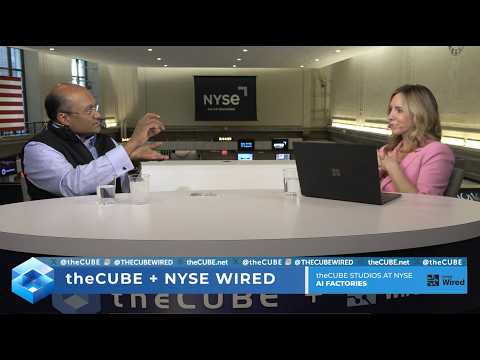
0:00 Palo Alto studio connecting Silicon Valley and Wall Street. >> I'm John Furrier posted here with Dave Vellante, my co-host. >> [music] >> Welcome back to the Cube studio here at the New York Stock Exchange. I'm Jem Sullivan and we are talking AI factories, one of our programs at NYSE Wired. And joining me now is Pradeep Surana, chief commercial officer and co-founder of Akash Systems. Welcome Pradeep.
0:32 >> Great to be here. >> So, this is some deep physics we're going to talk right now. >> Yes. We're going to go deep today, yes. >> We are going to really think about how we get the maximum energy from these GPUs in the most cost-efficient way possible. >> Yes. >> Break it down for me. What exactly is Akash Systems? >> Sure. We're a deep tech company backed Our seed investors include Vinod Khosla, Peter Thiel. We fundamentally Our mission every day is to solve the heat problem on GPUs.
1:04 And we do that by using lab-grown diamonds. So, >> this is a lab-grown diamond. It's obviously not exactly what we use, but that is really special. So, when you talk about physics, the physics of heat is what we deal with every day and it's what the ecosystem's dealing with every day. That piece of diamond is the most thermally conductive material on Earth. >> Wow. >> That'll move heat faster from one end to the other than any other material. In fact, it's five times faster than the second most thermally conductive element, which is copper. And that's what everyone uses today.
1:42 >> Wow. >> um our firm, we take the innovation of Mother Nature's carbon and interestingly we use it to decarbonize because that makes heat move quicker. And when you move heat quicker off a GPU, it lowers the wattage and power that you need. >> Okay. >> So, you can get more out of 1 W by using that. And if people are wondering why we have ice, this is really neat. >> I love this. It's like >> love to show you how, and I want you to experience just how fast that moves heat.
2:15 So, this is an ice, and pretend this is an air cooling system. This is the heat sink. This is what we're sending the heat to. Your hand is the GPU. >> Mhm. >> And you're 98.6°F. And we're going to take the heat from your hand across the diamond and into the air-cooled standing. And I want you to just hold it like you're cutting butter. And take a look how fast that goes. >> Wow. >> And there you go. You cut right through the ice.
2:45 >> Wow. And it got so cold. >> hand got cold, right? >> Yeah. >> That's us cooling the GPU. >> That is crazy. >> Exactly. And so, and tests by AMD and our customers, the GPU got cooler by 10°C. Your hand is still cold. >> How long does it take roughly for this to return to the the heat it was like before I cut the ice? >> Seconds. It should >> Wow. Yeah, I can feel it.
3:09 >> There you go. >> That is incredible. >> room temperature. >> Okay. >> whatever temperature. If you put this on a cup of coffee and dipped it, you'd burn your hand. And you felt how fast that was. >> Yeah, that's insane. >> Right. So, that's the speed we're moving heat. >> So, you guys are competing against copper, essentially, right? >> When I see technology like this and developments like this, my first thought is why did this not happen sooner? Like, you know, why did it take so long and for you guys to come together and think, "How can we solve for this?" to realize these innovations?
3:38 >> Yeah, there's there's two parts, and all good stories start with beer. >> [laughter] >> So, >> I love it. >> it was a couple of years ago, our our PhDs, um so, of the four co-founders, I'm the non-PhD. I was brought in to lower the average IQ. And >> doubt that. >> what these guys did was think about how they were doing this in space. So, the name Akash is the Sanskrit word for space, for the sky. So, we solved the heat problem on satellites. And if you think about space, it's really the harshest environment. Because when you're up there in the atmosphere, it's 2,000° C heat from the sun. You have solar radiation bombarding electron x.
4:21 And when your satellite rotates, it goes to minus 200. So, you're going from plus 2,000, minus 200, and it's rotating. So, whatever you put up in space has to handle that. >> Wow. >> We complain going in and out of a building, and imagine that the difference, right? So, if you can solve it in space, you can solve it on anything less than that. And so, 2 and 1/2 years ago, when the chat GPT and all of this started to come out, Felix Tai and Dan, the PhDs, were saying, "You know what? We did it in space. A GPU is only 100° C.
4:57 We can do it." We can do it. And 6 months later, uh we did it. And since then, we've launched a Dell Nvidia H200. >> Wow. >> We launched a Supermicro SMC 300 with AMD, a My Tech MD 350, and we're we're off and racing now. >> The rest is history, as they say. >> it started in space. >> I I love that. I mean, it's crazy though to think, right? How these innovations come to life here on Earth.
5:24 >> But, you guys just had so some news, funding announcements of late. >> Yeah. So, really exciting. When you think about the broader aspect of what's happening with all the capital being deployed, everyone's looking at efficiency. That's capital efficiency, heat efficiency, GPU efficiency, token efficiency. And everyone looks at two metrics, the cost per token, and then the revenue per watt that you're getting from the data center. We help both. So, we got funding um from a major Wall Street bank uh two to five billion dollars >> Wow.
5:59 >> at really subsidized rates because we're solving the densification issue at a data center and we're solving increased tokens at the server level. And so, we're really excited about having that amount of capital to loan to our clients who buy Diamond Cold Servers. >> Wow. >> Yeah. >> So, talk me through the total addressable market here. Let's break that down a little bit, right? Because I'm sure this major bank saw a lot of opportunity. We know there are huge constraints, huge bottlenecks, and it feels as though suddenly every company is a technology AI-led company.
6:36 >> Yes. Every single company is an AI company. Yes. >> When you guys thought, "Okay, we know this technology works. We know this science has huge value in data centers across the world. We're going to now begin thinking about how we can connect that to convert convert it opportunities to bring cash flow in." Where do you begin? Like are we talking neo clouds? Are we talking hyper scalers, enterprise players? Where do you start? >> Great question. So, from a customer segmentation standpoint we're focused on neo clouds and enterprise and also working with hyper scalers.
7:09 >> Okay. >> The neo clouds have a lot of economic and capital pressure to be really efficient and they're moving really quickly. So, we think our product gives them a great solution to get maximum tokens out of their server and getting the most out of the data center they own or are renting from. On the enterprise side these are companies whose servers have been sitting in data centers that were built 10, 5, 20 years ago. They need air cooling options. And so, our total addressable market today is on the air cooled data center market and we think there's absolute unlock large capacity to unlock there with enterprise and with neo clouds.
7:50 And we're going to geographically your question, we're going to start in the United States, but we are a global firm. We did ship our first server over to India. And now today we just feel like there's so much opportunity here in the US with existing data centers and then the new ones coming online. >> So you win a new deal, you talk to this company, you understand there is some reverse engineering, possibly that needs to happen here. There are rocks that could potentially be optimized or you're looking at kind of incremental new opportunities or both. What what do these kind of engagements look like and talk to me through what it would take if you did have, you know, a number of of rocks that you want to basically reverse engineer >> Sure.
8:33 >> using a cash systems. How quickly is it deployed? Like how quickly do you realize value from this? >> Yeah, great practical question. Uh so there's two customer segments we look two opportunities we look at. One is clients who are looking to upgrade their existing servers and are already looking to buy the newest, latest and greatest. So for that, we call that the upgrade server refresh cycle. And they can buy a new diamond cooled server for that.
9:01 The other one are ones who maybe just bought a server a year or two or go and still want to run the life of that. We can do an upgrade, some call it a retrofit, where what we do is we go to the data center, we put our diamond solution there and they turn it right back on and they've now got better performance. So we have two segments, both. >> Wow. Talk me through the ROI. >> Sure.
9:25 >> immediate ROI on this? >> It's material. So we had another major Wall Street bank do an ROI four years cash impact, you're looking at $2 million of cash impact with our servers that generate 50% token increase versus a stock. And you can run our servers instead of a 75° F data center environment like we're sitting in this nice comfortable air, you can turn off the power to a data air-cooled data center, let it run to 95° F, and now you've unlocked more energy to put more servers in. Wow.
10:05 So, for us, we think the ROI is at the server. So, if you're getting 50%, they normally cost a half million. We just saved you a quarter million dollars just on that. Then I saved you the construction cost of building a new data center, which is 15 million per megawatt. So, that's like another 300,000. So, that's a half million of just avoiding cost. And when you get 50% more tokens, they're whatever 30 cents, 80 cents, millions of tokens over 4 years, that's another million and a half. So, it's $2 million of pure incremental benefit.
10:43 Absolutely material. But again, for companies like hyperscalers or neo clouds, they may put aside that entire ROI because you can get capacity online today. And in this race that they're all in, we think that is in and of itself um a great reason to buy this. And then all of that other is incremental ROI. >> at the time in tech where money is almost secondary to the race. >> Yeah. >> Like it's true. We hear and see this all the time.
11:12 How scalable is this? >> Sure. >> So, it sounds like it's it's a fascinating business. Sounds capex heavy though from your perspective too, I'm sure, right? How how how scalable is this, you know, mid-term? Like over 5 years, what sort of market traction are you hoping for here? >> Sure. In the mid-term, I I think we're quite scalable to significant volume. Um hundreds of thousands of servers, couple of million of GPUs in the mid-term is easy to scale to.
11:41 >> Wow. >> And and so today we're starting with the enterprise and neo clouds and then um parallel tracking with the hyperscalers. >> I'm interested because you mentioned enterprise. I'm hearing lots about enterprise in other shows. Not so much in AI factories. I would say that we hear about it, but we don't have a lot of folks actually bringing their case studies, their unique story to the show yet, right? Because I feel like it's still a part of the industry that are trying to understand where they converge. Yeah. Enterprise meets, you know, full end-to-end management. What are you actually seeing? Like what sorts of workloads are you seeing, you know, enterprises truly own end-to-end and where is this intermediary vendor ecosystem still fully locked in?
12:26 >> Sure. We're seeing enterprise coming off of the sidelines. I think you have your natural progression of the innovators, the leaders, and some fast followers. And I think they're trying to figure out how do they operate in this fast-moving environment? How do they get their enterprise agentic AI progress is working. Again, we've seen the impact that has on SaaS companies. So I think they're trying to figure out and then within the stack, they're also trying to figure out. I think you're seeing uh them go in a a traditional enterprise approach, which is dual or multi-vendor strategy.
13:07 >> Mhm. >> And I think we'll continue to see that. And as far as having a bias towards open source, I think they're going to keep that lane wide open for them. And go after that because they're going to need that going forward. >> Interesting. >> Because how the sector is changing across all the different stack layers. I think enterprise they're starting to keep that open. >> When we think about AI strategies, we hear a lot about supply chain constraints, right? From every angle, you know, everything, right? Right through to, you know, engagements between the socioeconomic, geopolitical, and then here on the ground, right?
13:44 >> Sure. >> What does your own supply chain model look like? I assume there is some sort of global footprint here. >> Yes. >> And in terms of scaling that out, how do you see that trajectory going? Like you going to you said you're very US-focused right now. >> Yeah. >> But we all we all know why tech went global, right? It was for cost. >> it. >> Okay. >> Yes, that's right. >> So so what's the reality here?
14:06 >> For us, we've got a great diversified supply chain. It's global. We have Asia, we have Europe, and we have the United States. And part of our capital deployment is to also build our own um reactors to create the diamonds here in the United States as well. >> Wow. >> And we have significant support for that as well. >> You guys started as academics with a great idea. >> Yeah. >> What's the R&D like here? How intensive, regular, and what does this R&D relationship look like with, you know, companies like Nvidia and AMD and Broadcom? How how >> Sure.
14:42 >> connected are these conversations? >> Um I can't get into specifics, but I can assure you that we are talking to several chip companies because we are solving the number one problem that they have with the number one thermally conductive item. And the R&D process is intense, but again, we have that unique advantage of that we've learned to do it at 2,000° C with solar radiation, and that amount of heat we continue to innovate, and we innovate on every GPU, whether it's a Blackwell, Averroes Ruben, whether it's the Helios going to the future lines at AMD. So we're constantly in innovation. You can almost think of us as no different than our pharmaceutical company where we have multiple tracks solving multiple problems.
15:31 >> Wow. >> Cuz each of these have different powers. It's air cooling, liquid cooling. It's a lot of different items that go into it. So, that is a lot that we we focus on. >> Talk me through what you are seeing and hearing and believing in the air cooling liquid cooling space. We met at GTC here. Lots of conversations are in liquid cooling. What's ahead? I mean, that's been a promise for a long time. It wasn't really met reality if we're being frank.
16:00 >> Absolutely. >> What do you think? >> I categorically believe that air-cooled data centers, legacy air-cooled data centers, is the untapped market to satisfy this unbelievable appetite for power. Because when you look at the installed capacity in the United States, the dozens of gigawatts that we have, the best place to leverage that with the publicly traded, you know, pure-play data center companies, the Equinix, the Digital Realty's, and others, they have installed capacity.
16:35 >> Mhm. >> Most of them cannot handle liquid cooling that they're building in the future. So, what do you do with that existing data center? You have to learn or find ways to operate it to squeeze more power and dedicate it to the servers. And I think that you were talking about the socio-socioeconomic, the more and more communities decline the permits for these liquid cooling data centers, >> They're happening.
17:05 >> Yeah, that slope of the online capacity coming online, it's going to go this way, but the demand is going to keep going up. And that gap, they're going to have to come back to those legacy air cooled data centers. And so, and for us, there is massive opportunities in that, and that was just a domestic bias. If I think of Europe, where every, you know, the old European cities and the data centers that have been built, they don't have space for liquid, so they have to do their best with air cooled. So, we think we'll see a big opportunity there.
17:38 >> You know, we're seeing a lot in Europe in the data center space in those much colder territories, right? >> Yeah. >> In the in Finland and you know, close to the border of Russia. >> Iceland with Yeah. >> Yeah, again, right, which is very interesting. Ireland at one point had a thing data center model because of the rain, right? So, >> Right. >> a lot is changing, but again, this is all essentially about like economics. It's about maximum output for from input, right? Like >> Yes.
18:06 >> What are your thoughts? What What else do you see? Are there any kind of longer tail opportunities that we haven't quite uncovered yet, do you think? >> I think uh beyond the air cooled data center, I I think the longer tail will start to be how the business model changes for pure play companies in the neo cloud space or if you're just selling GPUs, I think you're going to see a switch from GPU by the hour to token based output models >> Mhm.
18:39 >> because you have to go revenue. And when you're borrowing this kind of money to get efficiency, you're going to have to be at the GPU level, sorry, at the data center level, then at the GPU level, the rack level, the data center, the VLLMs, the models. That was going to take time, but I think that's where the industry has to go to because as we've seen with the hyperscalers, the capital deployment is really important because they went from cash that they had, cash on the balance sheet, now they're moving to debt.
19:15 >> Mhm. >> And as we all know, if you want the canary in the gold mine, look at the credit and the debt covenants and the expectations. It's going to have to be on tokens per cost and the revenue per tokens. So, I think the long tail is us watching the industry move from GPU by the hour, which is like an occupancy-based model versus revenue per token or revenue per watt. Because the watt encompasses everything. And when you're financing, you're financing the watt, so you know the measure has to be the revenue. I think that's what we're going to see.
19:48 >> Wow, well, fascinating theory. So, for me, last question, what's ahead? I mean, you guys have had an interesting couple of months even since we met in San Jose. What does the next year look like for you for you and the team? >> Yeah, the next year looks like we're doing a series C round. We've got great interest and and success with what we're doing. We'll be announcing several new liquid-cooled products as well. And in July, we'll be at the AMD AAI event with our showcase product announcing the new 1400 watt server that we're coming out with.
20:21 >> I believe we might be, too, so I look forward to that. >> Oh, we should do this again. [laughter] Yes. >> I mean, Serona, thank you so much for coming on the Cube. >> Jena, thank you so much. >> I'm Jena Allen here at the Cube studio at the NYSE. This is AI factories, one of our programs with NYSE wired. Thanks for watching.
Summary
- Akash Systems focuses on improving GPU efficiency through advanced thermal management using lab-grown diamonds.
- Diamonds can move heat five times faster than copper, leading to lower power consumption and increased performance.
- The company has secured significant funding from Wall Street to address the densification issues in data centers.
- Target markets include neo clouds, enterprises, and hyperscalers, with a focus on upgrading existing air-cooled data centers.
- The ROI for clients can exceed $2 million over four years by increasing token generation and reducing cooling costs.
- Akash plans to expand its operations globally, starting with the U.S. and shipping products to India.
- The company is also developing its own diamond production facilities in the U.S. to enhance supply chain resilience.
- Future trends may shift the industry towards token-based revenue models, reflecting the need for efficiency in capital deployment.