Transcript
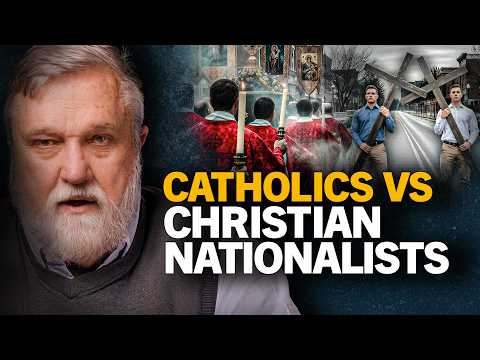
0:01 I want a Protestant nation. But a Protestant nation, I think, is capable of having carve-out spaces for Roman Catholics and even for Jews. What does it mean to have carve-outs? What is a You know, there there is is it still American law? How has the law changed that and is it still America if the law has changed in ways that have a a more more clearly Christian moral uh underpinnings, let's say? >> Let Let me give you a couple of very practical examples. Okay okay? Catholic church bells would be okay, right? Catholic church bells would be okay. But a parade in a parade in honor of the Virgin Mary carrying an image of the Virgin Mary down Main Street, no.
0:48 Right? You are probably the leading or one of the leading voices in this movement that is called Christian nationalism. You've got your book over your right shoulder there, Frequently Shouted Questions about Christian nationalism. So, let's actually start off with what is the biggest question people shout at you. The most frequently shouted question has to do with fears of um theocracy, um dictators with mirrored sunglasses, missile parades, goose-stepping armies, um women in red dresses having babies for the for the land of Gilead. Uh a lot of people are spooked by the word nationalism. Mhm. Right? That's That's the That's probably the thing that garners the most attention or the most angst or the most fear. It's What do you mean nationalism? Um and I'm Basically, I mean I'm a Christian and I love my country. And you put those two things together, that's what uh Christian nationalism has to do. Uh it has to do with being a Christian who is a patriot, who loves his country, and wants to see his country thrive, but thriving defined from outside the world. In other words, I don't I don't believe in a utilitarian thriving or a humanistic thriving. I want the best for my country, and I want God to be the one who defines what's best. Where does the Christian and the and the and the government come in? Because the We have the nation, but we also were we have we are a republic, we have a government.
2:31 The government institutes the laws, and there's a police function that So, where does where does Christianity intersect there for you? Uh, I would like to see, as a starting point, uh, an America that my great-grandfather lived his entire life under. Okay. >> So, I'm not wanting a novelty. I'm not want This is not a utopian scheme where if we just do this, this, and this, then this magical apparition is going to appear, and the sacred United States of America will will burst forth. That's not what I'm after.
3:12 Uh, I'm after something that has was historically accomplished and maintained over many years in the history of our country. And that's what I think we need to get back to. Uh, and and getting back to that doesn't solve all the problems or doesn't answer all the questions, but getting back to that gives us the platform for proceeding in a direction other than the one we proceeded in after the Second World War, when the secularization of our institutions really, uh, uh, picked up a head of steam. We were, uh, decidedly a Christian nation from Sabbath legislation to explicit reference to God to you know all of all of the things. It was not a theo-fascist country.
3:59 It was a country that rested upon a broad shared Christian consensus. Right? So we're not talking about some sort top-down imposition by some dictatorial Christian at the top making everybody accept the Christian faith like it or not. That's not what we're talking about. We're talking about widespread faith, churches everywhere, a robust shared consensus, and that consensus being reflected in the laws that we made. Okay, being reflected in how we thought of ourselves, how we how we governed ourselves. So that's the place I want to get back to initially. I want everybody to admit I want the secularists to admit that we were a Christian nation for couple hundred years.
4:46 And we thought of ourselves in those terms right up until the Second World War. And after which court cases started quietly surreptitiously inserting Jefferson's wall of separation between church and state. That was a phrase that Jefferson used in a letter letter to the Danbury Baptists Danbury, Connecticut. He was writing to them and said there's a wall of separation between church and state. Which incidentally I agree with. I'm in full of full agreement with the First Amendment.
5:19 I think there needs to be a separation of church and state, and I don't want Congress establishing a church of the United States. Don't want that. But there's a difference and this is this is why I would agree with John Stott who once said that fuzzy thinking is one of the sins of the age. The separation of church and state is not the same thing as the separation of morality and state. All right, who in their right mind would want to say I want to be governed by people who have no sense of who have no moral sense at all. What I have come to believe in the reason I'm now representing a Christian nationalist approach is I believe that the name of God must be named publicly. We can't We can't background them. We can't be embarrassed to refer to him. Our Our form of free government, our form of liberty, Republican form of government depends upon an open avowal of the fact that our liberties come from outside the world. It's not I don't get my freedoms from Congress. I don't get my freedoms from the Supreme Court. I don't get them from the president. Because if that's the source of any of my liberties, the The state giveth, the state taketh away.
6:34 And And I I just don't want to grant that. And so John Adams, our second president, said that our Constitution presupposes a moral and a religious people. He said it's wholly unfit for any other. >> Mhm. And I agree with that. So I I believe that we need to uh self-consciously acknowledge the Lordship of Jesus Christ, which was the backbone of what we held all along at the state level and local level, but we uh gradually drifted away from that at the federal level. So basically, that's what I'm That's what I'm after. I'm I want I'm a classical liberal only with Jesus not left out. Um So I How do you reconcile the sort of religious liberty in the First Amendment Right. and and the fact that like right from the beginning we this country was founded by like misfits, like people who were coming here, the Quakers, the Puritans, they were escaping persecution and they were escaping persecution from a Europe that wasn't like a singular thing, right? It was like the differences between Christian sects in Europe were the were the were part of monstrously murderous wars going back to the printing press and the Protestant Reformation. So, it's not like um our European lineage is one thing that was lived in peace under Christ. We were killing each other like crazy over our differences about what what is and isn't the true Christian faith.
8:17 That is That's true. That is true, but there was still an identifiable Christendom. The So, when when the ferocious Battle of Malta was fought and the the knights there at Malta fought off Suleiman the Magnificent and it was a great Christian victory over the forces of Islam. Queen Elizabeth I of England, a Protestant queen, had a medal struck in honor of the defense of Malta, right? So, there was a They Yeah, they fought among among themselves. There was a there were fierce rivalries and competitions and all of that was true.
9:01 But, they they had it structured so that they knew that the Turk was significantly greater threat. Um and so, they had their intramural battles and but to to your main point, the Americans who came here seeking liberty were all running from different things. They were you know, they were um they were refugees from different parts of Europe and consequently their concerns were different. Having said that, this and this is the important thing. The And I wanted to get to this because I think it's one of the central pieces in this whole discussion, and that is the First Amendment. Mhm.
9:42 The First Amendment begins, "Congress shall make no law concerning the establishment of religion." The only entity on Earth that can violate the First Amendment is Congress. And they would do it by establishing a church of the United States, a federal national church. >> Yeah. Or actively prohibiting other churches, right? Or there's the free exercise they that you can't establish the national church and you can't prohibit the free exercise thereof of other churches. Now, that was a federal restriction.
10:15 Okay, it was a a restriction that applied only to the national government. And we know this because four states uh uh New Hampshire, uh Massachusetts, uh and Connecticut, I'm sorry, three states. Uh three states came in formed the the uh adopted and and ratified the Constitution with a hard establishment at the state level. They the Congregational Church was the official church of New Hampshire, official church of Massachusetts, and official church of Connecticut. And then Vermont, when Vermont came in as the 14th state after the union was formed, Vermont came in with an with a hard establishment, a state a state church at the state level. And all of that was constitutional. Now, I I happen to believe in the separation of church and state at the state level, too, as a matter of prudence. I I'm opposed to state-level establishment. I think it's a bad idea, but it's not an unconstitutional idea.
11:24 Right? Yeah. So, in South in South Carolina, they did something that is more in in uh in line with my thinking, which is I would call soft establishment, where South Carolina said the Protestant religion is the official faith of this state. So, they didn't choose between any denom- They didn't select one denomination above others. If you were a Protestant Christian, then you were an adherent of the religion of that state. Now, there were at different places, there were and the state the Federal Constitution prohibits religious oaths as a test of as a uh qualification for office.
12:07 But, religious oaths were required all over at the state level. Now, um so, uh there were and it varied from state to state. So, in some places, uh you uh you couldn't be a Catholic and hold office. Right? You couldn't be a Catholic because you had to there was a religious oath that would prevent that. Um uh and up in up until the 1960s, you couldn't be a notary public in Maryland if you didn't believe in God.
12:38 Right? Right? Um so, basically, uh the this all of this was the result of a widespread Christian consensus that was overwhelmingly Protestant. And so, the WASP um Yeah. identity of the white Anglo-Saxon uh Protestant, that ident- that elite was established and was genuinely was the um the ruling elite of our country for a long, long time. And and then, of course, we we grew westward and there were the revivalists and all the other things going on out west, but basically, the consensus held for a long time. So, so, the thing my question is and I think, you know, it's funny cuz I think we we have a lot in we have a lot of shared views and places where maybe we differ but where we differ I'm I'm I'm curious to just try to understand even for myself. is I mean What I'm trying to get at is when you when you think about this Christian nationalism and when you think about the Christianity that has dominated America throughout its history um even within Christendom there's been an antagonism there starting with my own tribe which is Catholics like Catholics when Catholic immigration came into the states I think maybe first with in large measure with the Irish and then the Italians I might be getting that wrong but I think that's about right.
14:09 um You know it was scandalous that JFK was the first Catholic president and it was sort of scandalous that he was Catholic and we haven't had very many and um so how do you as a Protestant preacher and as a Christian nationalist understand my tribe as Catholics in the American in the America you want? Right. So that's a great question and as it happens I can still remember the election of JFK and the and the fact of his Catholicism being a big deal. It was a campaign issue. Yeah.
14:47 >> Right right and and he had to make statements uh making it clear that he would not be taking orders from the Vatican and that was a it was a deal. Mhm. um Now one of the things that we uh the one of the ways I would answer this question is and I'm answering your question I'm not trying to poke at anything or start something. Poke away then poke away that's fine. Okay. um I believe that Roman Catholics in America have largely been protestantized in the sense that Catholics think of themselves as a denomination.
15:27 And Protestant denominations think of Catholics as a denomination with too many too much incense and too many robes and too much of that stuff, but it's a it's a denomination. It's so uh in historically Catholic countries like in Reformation-era Spain, uh the Catholic Church was not a denomination. It was the church. Mhm. This This is the way it is. And the fact that uh we have in America a voluntarist system where Protestants go to Protestant churches and Catholics go to Catholic churches means that in this respect civilly, the Roman Catholic Church in North America has accepted the Protestant framing.
16:15 Okay? Um uh that we're that we build our church and people who want to be Catholic come to this church. That's the voluntarist system that America runs on and it's a denominational system. And it's largely something that is the fruit of Protestantism. Uh so and and but as a consequence, it's much it'll be much easier to work out a settlement in a in a North American uh Christian nation than it would be to to do the same thing in in a uh profoundly Catholic country. Let's say Poland. Right? So if if Poland uh sort of went all in on Christian nationalism, the Christian part would be defined right today would be defined by Roman Catholicism. Mhm. And and the imp- and so overwhelmingly so that Roman the Roman Catholic Church would be the church.
17:12 Uh in America, that's It's the way it would play out at all. And I would say that's the heritage of our of our Protestant legacy. But to come back to sort of your you you win the day through cultural persuasion. And it's 250 years from now. And how are my great great great grandchildren being treated as as like loyal Catholics? They're being treated they're being treated with dignity and respect.
17:46 Why? I would want the laws to reflect Protestant realities. I I I want a Protestant nation. But a Protestant nation I think is capable of having carve out spaces for Roman Catholics and even for Jews. So and that is a long and storied history, but basically in the Reformation era the Netherlands a very reformed country became a haven for Jews to to go. Oliver Cromwell reformed Lord Protector of England opened England back up to the Jews and the Jews came back to England. Historically speaking the reformed faith I'm I'm a reformed Christian. Historically speaking the reformed faith has been able to accommodate the Jewish faith.
18:39 Not as the foundation of law. Right? In In other words you can't at a certain point you can't keep splitting the difference. You've got to if if you want to say that my law that my vision of a Christian America is that the is that the governing authorities should recognize formally that Jesus rose from the dead. Then that's going to exclude the Jews because they don't believe that Jesus rose from the dead. Yeah. But Catholics do believe that that and Catholics are Trinitarian Christians together with Protestants. And so consequently I would say that's as far that's as far as we could bend or accommodate different groups to be part of the infrastructure but not not as part of the basis of law. The basis of law would have to be Christian and I would want it to be Protestant. What does that mean and because I I don't think I fully understand your answer in the sense that you've talked about a carve out for for my future kin.
19:46 What does it mean to have carve outs? What is a you know the the there Yeah, what's the >> Is it still American law? How has the law changed that and is it still America if the law has changed in ways that have a a more more clearly Christian moral underpinnings, let's say. >> Let me give you a couple of very practical examples. Okay okay? Could Could Could Muslims be here? Yes, they could be. Could they hold political office? No.
20:17 Could Could Muslims gather together with their Muslim family and friends to pray to Allah? Yes, right? Could you have a mosque? Yes. Could they have a minaret, a prayer tower that issues a public call to prayer? No. Because the public spaces belong to Christ. Right? We are Christian nation. So church bells are okay. Church bells are okay, but a Muslim call to prayer in the public space would not be okay. Catholic church bells would be okay.
20:52 Right? Catholic church bells would be okay, but a parade in a parade in honor of the Virgin Mary carrying an image of the Virgin Mary down Main Street, no. Right? So basically >> What about the Eucharist? What about a Eucharistic procession? That's the That's a new one. I would think of I would say uh probably not. It would depend on what was being done around it, how it was being conducted. But basically, public uh displays of idolatry, what the Protestant foundation of the law would consider to be idolatry, would not be allowed. So, you wouldn't have a Hindu procession of a with a Hindu god. You wouldn't have a procession of the Virgin Mary. But uh the Let me run ahead to anticipate something else. And that is what we're talking about is something that I would envision as uh being possible 500 years from now, 250 years from now. And it would only be possible as the result of evangelism, persuasion, broad Christian consensus. I don't I don't believe in going into a Catholic country, having a Protestant monarch go into a Catholic country, and then just by raw dictate uh suppress all the Catholic stuff. I I believe it needs our Paul says in 2 Corinthians 10 that our weapons are not carnal. Uh we don't uh seize power that way. We don't impose those sorts of issues that way. So, I think there might be a tension that's that you're not quite ad- addressing, or I don't feel like you have, and I want to give you a chance to. And that is you're saying, "Look, I want to achieve a a culture that is Christian."
22:42 Yes. And do it through persuasion, do it through ministry, do it peacefully, um do it as a as a pastor. Right. But then at some point, 250, 500 years from now, the law at the local level, so we'll stay within the sort of federalist framework, but the law at the local level and from your vantage point it would sound like in every state if you had your druthers, would actually apply the force of the state at the state level to prohibit you know, uh on Columbus Day from me and my, you know, now very diluted Italian Catholic clan from, you know, having a procession with the Blessed Mother. That would be the law. That wouldn't just be like people sort of morally shaming us into not thinking we should do it cuz we'll get dirty looks. It's like, no, the cops will come and say, "I'm sorry, you can't do that on the street."
23:40 Right. So, you you would we all know I'll get to your question in a minute, the heart of it, but when when someone wants to have any kind of parade now, they they get a permit. So, it would not be cops coming and chasing Catholics down the street with billy clubs. That's not what would happen. Is that what would happen is you wouldn't get the parade permit. That's what would happen. >> Well, sure, but you're splitting hairs a little bit there because it's like if I So, I there is a point of my point I'm when I'm trying to draw a sharp distinction here, which is there is a point at which you do see the the the the final outcome being that at the level of state law, the state can enforce these kinds of restrictions and and apply penalties and you know, so I I go I go I go to I go to I go to Austin City Council. I I I want to petition. I want to get a permit.
24:41 They say no, you know, no sorry papist, go back home. You can do it in your house. I proceed to get me and Guido and a bunch of my buddies together and we get the Blessed Mother and we go out into the street and eventually the the you know, this is the libertarian in me. Eventually the men with guns come if you keep if you do civil disobedience, right? Yeah, that's that's true. So, like let's let's like unvarnished this for a moment. Okay. How how is that consistent with um culture by means of persuasion? Why isn't that coercion now?
25:13 Well, the only way that could that state of affairs could ever arise would be if you had persuaded mostly everybody. Right. Right. So, um and this is this is has actually historically been a problem for the Christian faith from the very beginning. So, for the the the Christian faith, distinct from other world religions, um took root and formed in the teeth of opposition from the state. Mhm. Uh concerted persecution from the Roman Empire just over centuries.
25:52 And then finally, the uh Rome collapsed. Basically, Constantine converted on his deathbed, and you then you had Theodosius, the Christian emperor. And so, you have the the Roman Empire is now converted. What was a persecuted, beleaguered uh underground movement for three centuries Right. was now running the show and and was now um in possession of armies. Right? Uh what if what do we do with our armies? And thank goodness, cuz otherwise all of Europe would be Muslim.
26:28 Already. Yeah. Yes. Right. Um now now I recognize that when to to be in possession of the government is to be in possession of a monopoly on coercion. Yeah. And you've talked about in other places that you recognize essentially Lord Acton's warning that Yes. power corrupts, and absolute power corrupts absolutely. Correct. Now, the thing that the the danger and I think but we both share a libertarian streak here. Uh and I argue this in in detail in my book Mere Christendom. Uh and that is uh people say, "What are you going to do about you when you control the police force and you control the armies and you you're you've got a Christian nation, what are you going to do about blasphemy? What What are you going to do with the blasphemer?" Mhm. And and they usually have in mind the village atheist who's got this blasphemous newsletter that has a circulation of 17 people.
27:30 What are you going to do with that guy who won't stop blaspheming? And I'm I would say I would much prefer to recognize that in scripture over centuries, the biggest blasphemer has always been the state. The Lord Jesus himself was convicted and executed on a blasphemy charge. Right. So So, this should tell us every Christian should be extremely jumpy about wielding blasphemy legislation.
28:02 Because that's how our Lord was killed. Right? Now, that doesn't make the question go away. At some point, you have to deal with a village atheist newsletter and all. Yeah, at some point, you have to deal with him. But I am far more wary of and suspicious of the sword being applied unjustly than I am about the Virgin Mary procession. Um you are describing something that makes me uncomfortable, which is a uh and I you're you're giving Christendom the sword back. And ex- and it sounds like you're saying, "Hey, we should have our own Sharia law, too, because that's the only way we're going to make it. That's the only way we're going to have the kind of Christian moral society that would actually be just. And absent the sword, we'll just be a bunch of trans degenerates. I'm I'm putting words in your mouth here, but I'm just just in stylized.
29:05 We'll be a bunch of weird, wrecked out, degenerate, woke zombies that are transing our kids and doing all the kinds of horrible stuff that constitutes modernity where we raise atomized young people who are an anxious wreck and don't get married and don't, you know, don't live fruitful lives. And all this stuff about modernity that feels like that we can all kind of see is is the product of freedom. It's the product of freedom. The the freedom to have a merry procession down down a public street is of the same sort of danger as the freedom to, you know, s- raise your kids in a godless nightmare scenario. Um, and maybe I'm maybe I'm overplaying my hand here and trying to paint the picture, but to get the tension I'm I at the heart of this is like is that between liberty and theology.
30:04 And I do feel like you it it is clashing here at this moment that you're describing in the future, in the full revelation. No, I would respond to that by saying, if there if you don't have a theological grounding for it, there's no such thing as liberty. Okay, explain. Explain. I think I agree with you, but explain. If there is no God above the state, the state is God. So, if you don't recognize the authority of God over our affairs and whether or not there will be an abortion clinic in this town, whether or not trans surgeries of underage children are legal.
30:43 Right? When when you pass a law saying no more trans surgeries for kids, stop transing kids, no more abortion clinics, no more sodomite marriages, no more same-sex marriage. When you say that, you're only able to say that because there's been a Christian consensus and because you now have the guns. Isn't that just might makes right though? Isn't that just mob rule? >> Yeah. Well, no. That That's the point. It's mob rule now.
31:15 Okay. Right? What we have The guns are not going away either way. So, in in every society, there will be a locus of power. Someone's going to be in charge. There's going to be a an establishment somehow, someway. I want checks and balances on that power. Right? And this goes back to your citation of Lord Acton. Power corrupts and absolute power corrupts absolutely. And if there is no God recognized above the state, then the state has has the full liberty to claim absolute power to itself.
31:53 And so, the American Constitution was a work of theological genius because what they did was they carefully parceled out power, some to the executive branch, some to the legislative, some to the judicial, and it was a federalist system where then the rest of the parcels were parceled out to the states respectively to the people and to the states. This C.S. Lewis says that there are two kinds of Democrats, small d Democrats. One thinks that everybody's opinion is so valuable that you you can't take any action until you, you know, consult with everybody. The other approach to democracy and the one that Lewis said he held to and the one I hold to is that men are so corrupt and so sinful that you want to spread the power as thinly as possible so that no one person can lord it over everyone else. Yeah, I'm in Madison, you know, if men were angels, we wouldn't need government and what's the other I'm I'm I'm the inverse of that you know, uh Yeah, I think it's in Federalist 53, I think.
32:59 >> to remember but but basically, you know, we don't have angels to govern us. That's not an option and if we did, we wouldn't need them at all. Right and he said so he said, you must first enable the government to govern the people the the people and you must oblige the government to govern itself. That that's the trick. If you liked this clip, you should check out the full video and all the other great content we've got at Dad Saves America. So be sure to hit the like button, subscribe, and ring that bell so you won't miss our new stuff as it drops each week.
Summary
- The speaker supports a vision of America as a Protestant nation with allowances for other religions, emphasizing a historical Christian consensus.
- Concerns about theocracy and authoritarianism are addressed, with the speaker arguing for a Christian nationalism based on patriotism and love for the country.
- The First Amendment's separation of church and state is acknowledged, but the speaker advocates for a moral framework rooted in Christianity within the laws.
- The speaker believes that public expressions of Christianity should be prioritized, while public displays of non-Christian faiths would be restricted.
- Historical context is provided, noting that early American states had established churches and that a Christian consensus shaped the nation's laws.
- The speaker argues that a theological grounding is essential for true liberty, suggesting that without God, the state becomes the ultimate authority.
- Concerns about coercion and the potential for abuse of power are acknowledged, with a call for checks and balances within government structures.
- The discussion highlights the tension between liberty and theology, suggesting that a Christian moral framework is necessary to combat modern societal issues.