Section Insights
Introduction to Bitcoin
What is the significance of Bitcoin's creation?
Bitcoin was created during a time of financial crisis in 2008, reflecting a moment of distrust in traditional financial institutions. Its design is based on the premise that trust is not given but verified through blockchain technology.
- Bitcoin emerged from a financial crisis that shook trust in banks and governments.
- The blockchain technology behind Bitcoin allows for decentralized verification of transactions.
- Bitcoin's design presumes that trust must be established through verification, not assumed.
Bitcoin's Classification
How should Bitcoin be classified?
Bitcoin does not fit neatly into traditional asset categories like commodities or currencies. It lacks cash flows, making it difficult to classify as an asset, and while it is scarce, it may not function effectively as a commodity or currency.
- Bitcoin cannot be classified as a traditional asset due to the absence of cash flows.
- It is either a currency or a collectible, but its value is uncertain.
- The debate continues on whether Bitcoin should be viewed as a currency or a collectible.
Evaluating Bitcoin as Currency
What are the characteristics of a good currency, and how does Bitcoin measure up?
A good currency should be a reliable medium of exchange and store of value. Bitcoin's usage as a currency has been disappointing, with limited acceptance in transactions, indicating it may not fulfill the role of a good currency.
- Bitcoin's practical use as a currency is limited, with few instances of actual transactions.
- Institutional barriers and regulatory issues hinder Bitcoin's acceptance as a currency.
- The expectation is that these barriers will diminish over time, but current usage is low.
Bitcoin as a Collectible
Does Bitcoin meet the criteria for being a collectible?
Bitcoin is scarce, but scarcity alone does not guarantee value. Its desirability is questioned, especially if driven solely by past profits. The potential for new cryptocurrencies to emerge could impact Bitcoin's status as a collectible.
- Bitcoin is scarce but its value is not guaranteed by scarcity alone.
- Desirability may wane if Bitcoin's price does not sustain interest.
- The emergence of new cryptocurrencies could challenge Bitcoin's collectible status.
Comparative Analysis of Bitcoin and Other Cryptos
How does Bitcoin compare to other cryptocurrencies?
Bitcoin's volatility and behavior resemble risky stocks rather than stable collectibles. Other cryptocurrencies may offer cash flow opportunities or serve as commodities, suggesting a broader spectrum of value in the crypto market.
- Bitcoin's performance is inconsistent compared to traditional collectibles like gold.
- Other cryptocurrencies may provide better investment opportunities as assets or commodities.
- Investors should evaluate each cryptocurrency individually based on its characteristics and potential value.
Transcript
0:00 Hi, welcome back. We're approaching the end of this class and some of you might have been surprised that there is one investment class that I've completely not talked about during the course of the class. It's an investment that's recent in origin, but it's on everybody's minds even if it's not in their portfolios. I'm SP speaking specifically about Bitcoin and how it might or might not fit in your portfolio. To understand Bitcoin though, you need to go back in time to its creation.
0:34 It's the legend is out there of a of a creator is, you know, with a with a pseudonym, I think, Satoshi Nakamoto. But the paper that con that came up with the Bitcoin idea was written in November of 2008. At least it was made public. And for those of you who remember what November of 2008 looked like, it was two months in into one of the worst financial crises we've had in the last century. And a crisis that shook our faith. Shook our faith in government, shook our faith in banks, shook our faith in central banks and institutions in general. You're saying, "So what?"
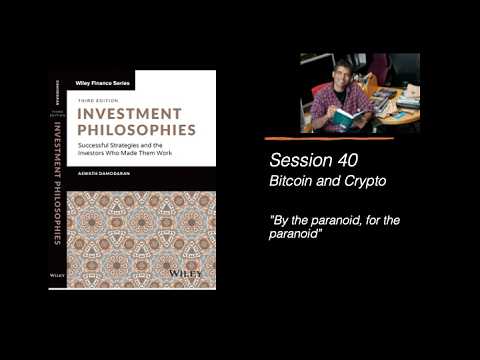
1:09 Bitcoin was born in a moment of distrust. And the design of Bitcoin reflects it. In fact, when you look at Bitcoin, it's built on the presumption that you can trust no one. You can't trust central banks. You can't trust governments. And the way this shows up is in the way in which Bitcoin transactions get verified. The notion of a blockchain is revolutionary, but it's really crowdchecking transactions. That's what a blockchain does. If you think about how paper currency works, you walk into a store and you pay with a $20 bill. Why does the shopkeeper take it? Because it's an element of trust. the $20 bill you assume is not counterfeit and essentially that'll buy it. In fact, even to show you that paper currency can differ depending on the currency you're using. if I used a $100 bill, many stores won't take it because they're worried about it could could might be a counterfeit bill. The truth is much of traditional transaction is built on trust. Trusting bank a banker, trusting a central bank, trusting paper currencies, Bitcoin because there is no trust. The way in which you check a transaction is you crowd check the transaction. People getting on their computers checking for a nine-digit number to make sure your transaction works through. I mean, I've long described Bitcoin as a currency designed by the paranoid for the paranoid. And I've taken some heat for it, but I will stick with that because there's nothing wrong again with being paranoid if that paranoia is based on something out there that could be real. So with that lead in, let's think about what makes Bitcoin so newsworthy. It's no secret the biggest reason Bitcoin is in the news is what's happened to its price. If you look at Bitcoin's prices over the last decade, they've gone from close to nothing to $100,000.
2:57 Put simply, if you'd put your money in Bitcoin 10 years ago, you'd have outstripped anybody in the stock market, the bond market, gold, whatever other investment class. and Bitcoin is some very high-profile supporters, especially in in in Silicon Valley who view it as the next best thing. So, let's step back and think about, hey, how should I think about Bitcoin? To assess Bitcoin, you have to first start off by deciding what it is. If you think what what do you mean what is it? I mean, if you remember a few sessions ago, I broke down investments into assets, commodities, currencies, and collectibles. And I said assets can be valued because they have cash flows. Examples of assets, stocks and bonds and businesses. Commodities can be valued at a macro level based on you know demand and supply at the macro level. Iron or you know oil price oil those are commodities.
3:48 Both assets and commodities can also be priced. So you can price and value those two. Currencies and collectibles can only be priced. The question is where does Bitcoin fall in this mix? Is Bitcoin an asset? I don't see how it can be because there are no cash flows. You buy Bitcoin and you hold it, you get no cash flows. You could design something with Bitcoin that pays cash flows. But you can design something with dollars that generates cash flows. A bond is designed might have be dollar based, but it's not the dollar itself that is the asset. It's a bond that you create. You could create a contractual obligation around Bitcoin that is an asset. But Bitcoin itself is not an asset.
4:28 Is it a commodity? I don't think so. There might be other cryptos that can be used as raw material to do something. Bitcoin, that's a stretch. I don't think it fits a commodity. So, it's either a currency or a collectible. And even within its advocates, people are not sure what to push for. Should I push for a currency? Should I push for a collectible? But the question about is Bitcoin worth 100,000, 80,000, 60,000 is really a question about is it a good currency? Is it a good collectible? So, let's try to address that question. The reality check with Bitcoin is you cannot value it because it's not an asset. If it's a currency, it should be judged on whether it's a good currency. So, let's pause right there and ask what makes for a good currency. Think about why we hold currency. It's as a medium of exchange.
5:17 You want to pay for things and is a store of value. Good currency is a good medium of exchange. You should be able to convert it to, you know, whatever you need to buy from a from lunch if that's what you're or a house if you're buying it. It's a medium of exchange and it should hold its value. So, you can already see why even within paper currencies is a continuum. The Swiss Frank is a great currency. Why?
5:42 Not only is it a medium of exchange in Switzerland, but you could travel anywhere in the world and you have no trouble converting Swiss Franks into the local currency and spending it. And it's a great store of value. I tell the story of putting a 100 Swiss Franks into my pocket on one of my trips, forgetting about it, ending up two years later in Zurich airport, pulling the 100 franks out, and being able to buy almost exactly what I would have bought two years ago. Why? Because there's almost no inflation. The Swiss Frank, great currency. Swiss Frank is a much better currency than the Indian rupee. I mean, don't take me wrong. I mean, I I hold rupees in my pocket. It's a good medium of exchange in India but once you leave India it becomes trickier. There are much of the world you can't convert take your rupees into a bank convert into local currency. So it's a decent medium of exchange and it's a decent store of value. What sense if you have 6 8% inflation you put a,000 rupees in your pocket and you forget about it for 2 years you'll be able to buy less when it comes out. And Venezuelan Boulevard don't even get me started. It's a fiat currency but it's a terrible currency.
6:49 Even within Venezuela, people don't want to accept it because it loses value while you hold it and it definitely doesn't hold value. So this notion of fiat versus crypto is a false one. It's really a question of, you know, is it a good currency? And within fiat currencies, you can have great currencies, good currencies, average currencies, bad currencies. The question you got to ask is where in that continuum would we put Bitcoin? We'll hold off on that question for a moment.
7:13 If it's a collectible, the question are asking is it a good collectible? If you remember our discussion of gold, think of what made for a collectible. It was scarce. It was durable. It was desirable. It's been desirable for a really long time. It holds its value. It's sustained. But more importantly, it held its value during crisis. A good collectible will hold its value when ev when you're panicking, when when catastrophe hits. And the key thing is you can't since you can't value Bitcoin, you can't invest in Bitcoin. You can trade it. And the we'll talk about whether you should trade Bitcoin or not.
7:49 But often I hear people asking the question is Bitcoin under or overvalued? The answer is it cannot be valued. It can only be priced. So with that lead in let's take a look at Bitcoin as currency. Bitcoin as I said came out in November of 2008. We're 18 years into the experiment approximately. And if you look at Bitcoin's usage as a currency, it's been extremely disappointing. There are pockets where it's gained acceptance. There's an entire country, El Salvador, where Bitcoin presumably is the local currency. I'm not sure that's true actually, even within El Salvador, but much of the rest of the world, Bitcoin is not used in transactions to buy things. And I regularly give talks at groups of people who are Bitcoin advocates. And one of the questions I ask these groups is when how many of you have actually used Bitcoin to buy things out there, a house, a car, your lunch.
8:51 Most of them have invested invested or traded Bitcoin. They bought and sold Bitcoin, but they haven't used it as a currency. Now, you can blame institutional barriers. You know, I'm in a country where I'm not allowed to use Bitcoin. India for a long time, you could use bit there and the barriers can be legal or regulatory. You can argue it's a young currency. I'm trying to use Bitcoin. The other person might not have heard of it. But you should expect to see both of those things fading over time because in more and more countries, people are allowed to use Bitcoin and it's no longer a currency that nobody's heard of, but usage is not picking up, which raises an interesting question.
9:28 Will that change? No, because what I think part of the reason Bitcoin has been slow to take off as a currency is not a very good currency. I know that sounds like a harsh thing to say, but it's a very inefficient currency. Remember that crowd checking you had to do to make sure that you had the Bitcoin in your pocket? You go in and pay for something. To check it, you got to run through this algorithm where hundreds of people get on see if you have it's that's no way to design a currency. And if you don't trust anyone, you create more inefficient currencies. And Bitcoin, one of the reasons it it's a for its appeal is it comes with a finite number, 21 million. You hit that, there are going to be no more Bitcoin out there. No good currency in history has ever had a complete cap.
10:18 Even during the gold standard, they were capped at a point in time, but it would grow. Your economy grew. The amount of the the currency you had could also grow. It's not a healthy currency with a finite limit. So I know there are people who are upbeat about Bitcoin who still believe it can become the currency of the future. I don't think so. Now it can either become a a niche currency used by failed countries where the local currency has failed or it can be a currency for use in illegal transactions, the Silk Road, but it's never going to be a widely used currency because of the way it's designed. So that's the currency part. But there's another argument you can make for Bitcoin which is as a collectible.
11:02 I've often again described Bitcoin as millennial gold that it you know for some people it has a characteristics of gold. So let's pass it through the collectible test. If you remember the three questions you ask is it scarce? Is it durable? Is it desirable? Is it scarce? Yeah, by definition it is scarce because of the 21 million bitcoin and no more. But scarcity alone is the weakest of all requirements. Right? There are lots of things that are scarce that don't have value. And it's scarce only if you define Bitcoin as an investment class by itself. If you define cryptocurrency is your investment class and Bitcoin as the most common cryptocurrency today. What if you had the equivalent of alchemy happen in Bitcoin? If you remember, alchemy has been the dream with gold that you can take common metals and convert them to gold. Thank god alchemy never worked because if it did it would have destroyed gold's value as a collectible because the scarcity would have imploded with Bitcoin. Alche with gold alchemy did not work. Bitcoin, who knows, alchemy might work. You can create something that resembles Bitcoin and gives people who buy Bitcoin an alternate instrument. It doesn't exist today, but what if it did? So, it's scarce, but only if you define Bitcoin as an investment class by itself. Is it desirable so far? Yes. I mean, Bitcoin is its ups and downs, but there are people out there who desire it. The question is why? If the only reason they desire it is because they made money in it in the past, that's not going to last because you you have an extended period, it's down, it's no longer desirable.
12:40 There are components of Bitcoin that I may I think make it appealing to a subset of people. Remember, we talked about not trusting governments, not trusting central banks, the paranoid. There's a subset of people and I'm not, you know, putting any any bad labels on this who've lost trust. They've lost trust in institutions, the people around them, governments, and banks. And for them, Bitcoin is not just a currency. It's not even it's not even a it's something that that essentially is the only thing they have trust in in a world without trust. So, we'll have to wait and see. It's been only two decades since Bitcoin has come out. It's been desirable so far, but if you put your pension money into Bitcoin and you're 35 years old, you need it to be desirable 30 years from now. And that's still up in the air. But there's a bigger issue with Bitcoin as a collectible that I want to point to. by using a correlation matrix a computer at the end of 2020.
13:41 2020 if you remember was a was a was a year of catastrophic events with COVID and the and the and COVID was not just stuff for the the economy shutting down but on markets. I computed the correlation of different asset classes that year. Remember, when you want to when you have a collectible, you want it to be lightly correlated with everything else in your portfolio, especially stocks and bonds and corporates. Gold fulfills that, right? It's lightly correlated. Bitcoin though is much more highly correlated with equities than any good collectible should be. In fact, over its lifetime, Bitcoin has behaved more like risky stock than like gold.
14:23 Now, that could pass. Maybe it'll change. And I keep watching crisis to see if it'll change because until it changes go Bitcoin is failing a very significant collectible test which is it's not holding its value during crisis in the first quarter of 2020. The S&P 500 is down almost a third 33%. Terrible quarter. One of the worst quarters we've had the index. Gold was up about 7%. It held its value. Bitcoin was down 55%.
14:57 In the next 6 months, stocks came roaring back up about 50%, Bitcoin was up 85%. You see where I'm going with this, right? You cannot have a collectible that behaves like risky stock. So, at the moment, if you ask me, would I pay 80,000 or 90,000 for Bitcoin? I'm going to say no. But it's a personal judgment because I don't think it meets my requirements for a good currency or a good collectible. Now your view might be entirely different and that's going to animate how you think about Bitcoin.
15:31 Incidentally, I've spent all of the session talking about Bitcoin. You're saying what about the other cryptos? Let's be be quite honest. Bitcoin sucks the oxygen out of the air. But there are other cryptos and they range a spectrum. There are crypto assets. There are some cryp tokens you can create that give you a claim on cash flows. Now those are assets. You can value them as assets. You can have crypto commodities know where they're used as raw material in something where you might be able to make money on being used as raw material. The example I gave is blockchain and how maybe Ether or Ethereum is a better lubricant for blockchains. And if you can figure out a way to get charged for that usage, maybe you can be priced as a commodity. So you have crypto tokens, crypto commodities, crypto collectibles, cryptocurrencies.
16:22 No one sizefits all. So what I've said about Bitcoin might not apply to other cryptos, but pass them through the test. What is it? Can it be valued before you take that next step? One final point, Bitcoin itself is not an asset, but you can have companies created around businesses that are built on Bitcoin that can be valued as assets. Coinbase is a company primarily built around Bitcoin, right? But to the extent that it's a transactionbased company and you collect revenues from those transactions, it's a business. You can value it like a brokerage house.
16:58 So just because you have a business built around Bitcoin doesn't mean that you can't value the business. You can still value the business. Bitcoin itself is not an asset. So does Bitcoin belong in your portfolio? Well, there are two ways you can use it. One is as an add-on just like gold. You add it to a portfolio. But for it to do its job there, it has to change fundamentally in the way it behaves because those add-ons are designed as insurance. The reason we add gold is as a as a hedge against catastrophe and and hyperinflation.
17:31 Bitcoin so far at least has not delivered on those. Maybe that'll change. And if it does, you should add it on. Or you could trade Bitcoin. Wild swings in price, right? If you can time the downs and the ups in Bitcoin, you never have to invest in anything else. It's all mood and momentum. But maybe you can deise a way to call Bitcoin direction. doesn't work for me, but it might work for you. So, as you look at investments in the crypto space, make your best judgment. Start with that question of what am I buying? Is it an asset? Is it a currency? Is it a collectible? Is it a commodity? Be honest with yourself. There are many of these things where you cannot invest in that crypto. You can only trade it. And if you're a good trader, all the more power to you. I hope you found this session useful. And I thank you very much for listening.
Summary
- Bitcoin was created in 2008 during a financial crisis, reflecting a distrust in traditional financial institutions.
- It operates on a blockchain system that verifies transactions through crowd-checking, eliminating the need for trust in central banks or governments.
- Bitcoin's price has experienced significant growth, but its use as a currency in transactions remains limited.
- The speaker categorizes Bitcoin as neither an asset nor a commodity, suggesting it could be viewed as a currency or a collectible.
- As a currency, Bitcoin is inefficient and has not gained widespread acceptance for everyday transactions.
- As a collectible, Bitcoin is scarce but lacks the stability and value retention characteristics of traditional collectibles like gold.
- Bitcoin's correlation with equities suggests it behaves more like a risky stock than a stable collectible.
- The speaker concludes that Bitcoin may not belong in a portfolio unless it fundamentally changes its characteristics or is used for trading based on price volatility.
Questions Answered
What is the significance of Bitcoin's creation?
Bitcoin was created during a time of financial crisis in 2008, reflecting a moment of distrust in traditional financial institutions. Its design is based on the premise that trust is not given but verified through blockchain technology.
How should Bitcoin be classified?
Bitcoin does not fit neatly into traditional asset categories like commodities or currencies. It lacks cash flows, making it difficult to classify as an asset, and while it is scarce, it may not function effectively as a commodity or currency.
What are the characteristics of a good currency, and how does Bitcoin measure up?
A good currency should be a reliable medium of exchange and store of value. Bitcoin's usage as a currency has been disappointing, with limited acceptance in transactions, indicating it may not fulfill the role of a good currency.
Does Bitcoin meet the criteria for being a collectible?
Bitcoin is scarce, but scarcity alone does not guarantee value. Its desirability is questioned, especially if driven solely by past profits. The potential for new cryptocurrencies to emerge could impact Bitcoin's status as a collectible.
How does Bitcoin compare to other cryptocurrencies?
Bitcoin's volatility and behavior resemble risky stocks rather than stable collectibles. Other cryptocurrencies may offer cash flow opportunities or serve as commodities, suggesting a broader spectrum of value in the crypto market.