Transcript
0:00 - As an occupational therapist and mom, I absolutely love baby push walkers. So you might also know these as baby activity walkers or baby stand walkers. What's great about baby push walkers is they give babies the confidence to start walking independently. Often babies are really happy to cruise along furniture or lounges, but lack the confidence to move off the lounge or furniture and start to walk. But when they're provided with the baby push walker, they have that confidence to let go of the lounge and start walking around independently.
0:30 Having that time to walk around independently using a baby push walker means that they're going to further develop their walking skills and the muscles required to walk, as well as their balancing skills in walking and in standing. In addition to increasing your baby's confidence to walk, it also provides an opportunity to work on their fine motor skills if it has that activity panel at the front. When you're looking at baby push walkers, you will notice that there are two different types of baby push walkers, wooden ones and plastic ones.
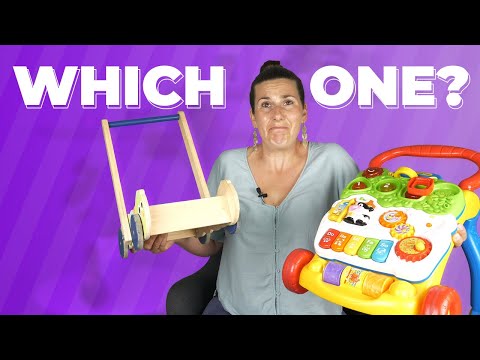
1:00 So in this video, we're going to cover the pros and cons of each to help you decide which baby push walker you wanna purchase for your little one. It's important to note that baby push walkers are different to baby walkers. I personally don't recommend the use of baby walkers because they have been associated with risks of developmental delays and safety concerns. If you want more information about that, you can click on the video link above or in the description box below.
1:23 Before we cover the pros and cons, make sure you click on that free PDF document in the description box below which covers the developmental milestones you can be expecting for your little one in their first year of life. This will give you an invaluable piece of mind as you'll know when to be expecting certain skills, and when to be concerned. Also, if you wanna make parenting significantly easier, make sure you start now by subscribing to my channel and hitting that bell where you'll learn the tips and tricks I've learned over the last 10 years, practicing as a pediatric occupational therapist and being a mom to two children.
1:52 Firstly, let's talk about when baby push walkers can be used by your little one. If the push walker comes with an activity panel like this, and it's detachable, you can actually place these on the ground in front of your baby during tummy time. And it will provide them with some motivation because it sings lots of songs and it lights up. So it gives them some motivation in tummy time. And then as they learn to sit up, you can place it back into the walker.
2:17 And then when they're sitting, they're starting to interact with this activity board in sitting. If you have a wooden one, then you would just do it in sitting and have your baby sitting in front of it and interacting with it. But you wanna make sure that the activity panel is in the front of the walker, not at the rear, 'cause that makes it a bit difficult to breach for the little one. Now, your baby will start to use the push walker as an actual push walker.
2:41 So to help them walk around independently, when they're able to cruise along furniture and starting to stay in independently for a short period of time. So this generally happens at around nine to 12 months of age. So with plastic push walkers, there are two different types. The first one is a plastic push walker which has an activity panel on the front. And the second one is a plastic push walker which is a three in one. So it has that activity panel on the front.
3:06 It acts as a baby push walker, and it also has the ability to convert into a stationary play step table for your little one to use. So the pros of plastic push walkers is they are extremely cheap and lightweight. And because they're so lightweight, your baby's gonna be easily able to negotiate corners and turn around which is really important when they're using it to walk around. They also have that activity panel at the front which is often able to be removed and placed on the floor for tummy time and when they're in sitting.
3:37 And that activity panel has lots of different music and lots of different noises it makes, so animal noises, and it also lights up and your baby can interact with it to develop their fine motor skills. Baby push walkers that are plastic also have the ability to adjust the speed of the wheel. So they generally have two different settings. So when your baby's first learning to walk, you put it on the lowest setting. And that just means that it's harder to push.
4:03 So it's not gonna roll away on them as easily. And then they also have the ability, some models to fold their legs, which means that it takes up less space when you're trying to store it. And it's also easily transportable. And the added benefit is that some of these models have inbuilt motion sensors. So when your baby starts walking and starts to play music and light up to provide some motivation for your little one. So the cons of plastic push walkers is that because they are so lightweight, they do tend to run away on little ones when they're first learning to pull themselves up from the ground into standing.
4:42 So when they do that and they need a lot of support to get up into standing, they generally tip the walker over. So you do need to be there to support your baby when they're doing that movement and getting stronger in that position. And the other thing is because it's so lightweight, and if it doesn't have that ability to change the speed of the wheels, the wheel speed can just pick up. And then the walker just rolls away from your little one and they will fall over.
5:08 Also, the models that have activity tables so you convert from a push walker to an activity table. Those tables are really unsteady because again, they're so lightweight. So your baby needs to be really confident in standing. So they're not needing to get support from that table to maintain that position. If they are, they're just going to tip that table right over. Because plastic push walkers are so lightweight, and they have that risk of running away on little kids when they're pushing it and also pulling themselves up into tipping over.
5:38 They are generally better to be used on carpeted flooring rather than tiles or wooden flooring just because it gets more traction when they're on carpeted flooring. And then they're less likely to run away on your little one, and also tip. But in saying that once your little one is able to walk around quite well using the push walker and not needing a lot of support, you're more than able to move the baby onto using the push walker when they're on tiles and on floorboards, my children cope totally fine.
6:07 So if you are looking at purchasing a plastic push walker for your little one, I find the Vtech sit-to-stand push walker the best. And that is because it has that adjustable wheel speed. It also has the ability to fold the legs, and it's relatively cheap. So in Australia you can buy it for $65, in the US it's around $45. Now let's cover wooden push walkers. So there are two different types of wooden push walkers. You have the really basic wooden push walkers which are generally really quite simple.
6:38 And they generally come with blocks in the front of here that you would use at another time. And then you have the more complex push walkers which have an activity panel on it. So it's at the front or at the back. The front ones are better because it's easy for little one to reach when they're in sitting. But some of them have them at the back. Now, when we're looking at wooden push walkers, the pros of these is that with the lightweight ones, so ones like this, they are really easy for your baby to move around and negotiate corners.
7:06 Whereas the ones with the activity panels, they tend to be a lot heavier and really difficult to move and negotiate corners. Now, because the wooden push walkers with the tray are extremely light, it does mean that there is a risk that they might run out from underneath your baby or tip. But really all baby walkers are likely to tip when your baby's first learning to do a sit to stand, so they pull themselves up from the floor into standing.
7:31 But because it is lightweight, but it has that tray, I generally just put a weight in the front. So I've used two kilos or rice bags or a kilo of rice bags. And here I've just got brown sugar, but that just weighs it down a bit. So it makes it a bit more stable in the beginning stages when your little one's first learning to walk. But as they get more confident, you can just remove the weight at the front, and then they'll start to put in teddies or blocks or cars or dinosaurs and move them all around the house.
8:03 Now, the walkers with the trays are significantly cheaper than the heavier wooden walker. So the ones with the trays, in Australia you can buy from around $60 and in the US it's around $45. Whereas the heavier ones you can purchase in the Australia for around $100, and in the US it's around $65. Wooden push walkers also tend to have rubber trimmed wheels, which will protect your flooring. So when we're thinking about the cons of wooden push walkers, if you've got those really heavy ones, they can only go in a straight line and then your baby's not able to turn them.
8:39 So you're going to have to pick them up and turn them around. And if you've got a really compact house with not much space, then that's probably not an ideal walker for your little one to use whereas the smaller ones, your baby's going to be able to easily move these around the house and negotiate those corners. The other con from wooden push walkers is that they are not able to be collapsed or folded when they're not in use for storage.
9:02 So that might take up a bit more space. And if you do get a simple wooden push walker, it doesn't have that activity panel. So it's purely just a push walker. If you do wanna buy a wooden push walker, I would lean towards buying the more basic push walkers that just come with the block thus the push walkers that have that activity panel because I find that when you're really wanting your baby to use a push walker is to work on their walking skills.
9:28 So if they can't push it or turn it around corners, they're going to get extremely frustrated. Whereas the lighter weight one, which is that really simple, basic wooden push walkers that come with blocks, they're able to move that freely around the house. And you can just put a weight in it initially so it doesn't roll away on your little one when they're first learning to walk. So those are the two different types of push walkers you can get.
9:52 Personally, I prefer the wooden push walkers with the simple blocks in it. And that is because I think that it has longevity. So basically my two and four year old continue to use it. So it's lasted for a number of years where the Vtech was suitable for the first two years. And then they're no longer interested in it. I hope you found this video extremely helpful. Now you know which one to purchase for your little one.
10:15 Don't forget to click on that free PDF document in the description box below. And hopefully I'll see you next week where I'll share more parenting tips and tricks. (upbeat music)
Summary
- Baby push walkers provide support and confidence for babies learning to walk independently.
- They differ from baby walkers, which are not recommended due to safety concerns.
- Plastic push walkers are lightweight, often cheaper, and may include adjustable wheel speeds and activity panels.
- Wooden push walkers can be heavier and may not turn easily, but they are durable and can be used for years.
- Both types can be used during various developmental stages, such as tummy time and sitting.
- Wooden walkers with blocks are recommended for longevity and ease of use.
- Safety tips include using weights to stabilize lightweight walkers and ensuring activity panels are accessible.
- The Vtech sit-to-stand push walker is highlighted as a top choice for plastic walkers.