Section Insights
Coordination Between OpenAI and Anthropic
How do OpenAI and Anthropic coordinate their efforts?
OpenAI and Anthropic maintain personal relationships and have collaborated on industry-wide issues, particularly in cybersecurity. They recognize the importance of aligning their efforts for the greater good, despite being competitors.
- There are strong personal connections between teams at OpenAI and Anthropic.
- Both organizations are aligned on significant issues like cybersecurity.
- Collaboration is seen as essential for addressing industry-wide challenges.
Trust and Collaboration in AI Development
What role does trust play in the collaboration between competing AI companies?
Trust is crucial for collaboration between competitors like OpenAI and Anthropic. Building trust through small joint efforts can lead to larger collaborative actions in the future, focusing on common interests rather than self-benefit.
- Trust-building is essential for effective collaboration.
- Small joint actions can pave the way for larger initiatives.
- The spirit of collaboration should prioritize the common good.
National Security and Global Competition
How does the competition with China influence AI development in the U.S.?
The U.S. views AI development as a national security interest, particularly in relation to competition with China. However, if China is leveraging U.S. technology, it raises questions about the urgency of U.S. AI advancements.
- AI development is framed as a national security issue.
- The competition with China influences U.S. AI strategies.
- Understanding technological advancements is key to navigating global competition.
Navigating AI Development Challenges
What are the key challenges in developing AI responsibly?
Developing AI responsibly involves serious consideration of its impacts and risks. Effective communication about these challenges is essential to ensure that progress is made without compromising safety or ethical standards.
- Responsible AI development requires addressing risks seriously.
- Effective communication is crucial for navigating challenges.
- Balancing progress with safety is a core challenge in AI development.
Future of AI Regulation and Oversight
What should future AI regulations focus on?
Future AI regulations should be grounded in current problems while anticipating future developments. They must ensure oversight and safeguards throughout the development process to address evolving challenges.
- Regulations should address both current and future AI challenges.
- Effective oversight is necessary during the AI development process.
- Anticipating future developments is key to creating relevant regulations.
Transcript
0:00 What is coordination currently look like between OpenAI and anthropic? Because I can't imagine is sound like constantly on the phone with Dario. Somehow I doubt it. But is there like the equivalent of a, you know, a red phone? Yeah. Well, look, we we all know each other personally. Many of us worked together in past lives. So I think that there's actually a lot of social connections between the labs. If you look at. There was another open letter that came out recently that we helped drive and that we in anthropic were both signatories on, which was about security, saying that we're in a cybersecurity moment, that everyone kind of needs to take this information of where cyber is going to be, and even just six months and needs to act a day proactively to defend themselves and actually talking behind the scenes to say, hey, we're actually aligned on this.
0:44 This is something that's about it's bigger than any company. This is about the industry in the world. And can we come together as one voice to say, this is important? It happened to. Me. Hello and welcome to another episode of the Odd Lots podcast. I'm Joe Weisenthal and I'm Tracy Alloway Tracy. I don't know if I've ever, said it. the podcast, we've talked a bit about my my vibe, coding adventures, etc.. no, you've never said, oh no. I said, you know, I recently switched from, Cloud Code to Codex. This is big news.
1:21 It is it is kind of big news, I think. Oh, so bold of you to declare your allegiance, to the public on the podcast. Well, you know, the I don't have allegiance. And you know what? It could switch again the way, like, you know, I guess one of the some stories of AI is like how easy it is to switch from time to time from one model to another. So maybe it's revealing and talks about some of the challenges the these businesses, that it was so easy. I found that Claude speak, you know, that I found it like a little bit hard to work with.
1:52 I'm not capable enough to like and understand, like advanced engineering practices were like, oh, I'm migrating a code base from or like, you know, translating this into rust or whatever. So the fact, I don't know, I found like OpenAI to be like the pros, to be clear, and therefore to work with as, like a completely non-technical person such as myself. That's really interesting. I mean, one thing you said, it's hard to keep up with the models, right? And whatever you're using today might not be the one that you're using in a week from now.
2:23 Yeah. And at the same time, everyone is talking about how fast the development is going and all the risks that it poses, right? Yes. And we are recording this September 10th. It felt like something broke through in the last couple of days where suddenly everyone is very keen on risk. The one thing with Codex and I guess called code is now every once in a while to get this pop up and it'll say the agent needs to connect to the internet in order to do this task, and I have to give it a permission. Yeah.
2:52 And normally I'm just like click, click click like yes, yes, yes, yes guys. And I still do that. Why is there I still just click yes, yes, yes. But it makes you think. But it makes you think for a second before you click. I think for one second, yeah, I'll have more than click. And, we were in Jackson Hole a couple of weeks ago and that's of course, when the, the meter report broke about, the, OpenAI hugging face attack. And I think since then, the anxiety about rogue AI, whatever you want to call it, has clearly snowballed.
3:24 Mhm. And it's just, you know, it's yes. It feels like it's only getting bigger and bigger. And it's already been an industry that's been shot through with risk and anxiety. And now there's sort of one thing that for many people in AI has been something they've talked about for 20 plus years before there was an AI industry to speak of. This idea of like misaligned quote, rogue models is starting to become top of mind, a reality.
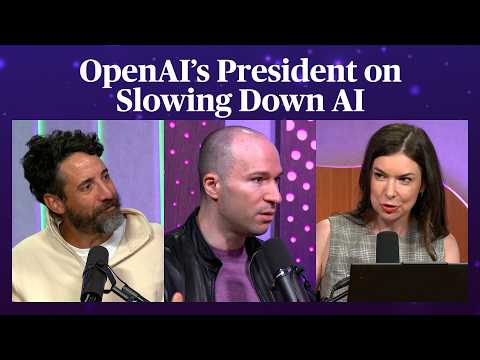
3:49 So this is our chance to ask a person directly involved in AI development about their respective, I guess, anxiety. Yeah. And what, what can that what can be done about that? Anyway, we literally have the perfect guest today. We're going to be speaking, of course, with Greg Brockman. He is the co-founder and president of OpenAI here with us in studio. So, Greg, thank you so much for coming on our lot. Thank you for having me. so many different ways we could start.
4:17 But here's something that I'm very curious about. let's just start with, let's just jump right into the post hugging face environment and all of that. Are you? Is it OpenAI I like as an organization. So okay, like an agent breaks out of, sandbox, not the first time it's happened, etc. it exhibits the sort of emergent behavior and then, you know, does something that people is a hack. When you think about the development of models and this incident and so forth, are you able to sort of diagnose the path or, sorry, the past and say like, you know what, like here's something that the models did that we don't like, or that people don't think it's good.
4:58 And are you able to like, if you like, look back, look back, whether it's in model training or post training, reinforcement learning, whatever I say, like this is where there was some some branch that went wrong such that this behavior emerged. Yeah, I would say that the fact of many elements of the hugging face incident were not a surprise, not a mystery to us. For example, the fact that the agents were coordinating made. That's because the agents were trained.
5:25 You trained them to be helpful. Exactly. And they were trained to coordinate to be a multi-agent system. And we've talked about this. It's a very useful property. Right. Makes them capable. But I think that the thing that was a surprise to us was the fact that the models had reached a level of capability where they were able to find that exploit in our sandbox environment. Right. Move through our research environment and then also capable enough to find exploits in hugging faces, production infrastructure and move through that.
5:53 But I think that a lot of the facts of what the models were capable of. That was that was clear to us. Right. So I don't think that there were surprises there for the way in which the capability had unfolded, but just really realizing that we needed to uplevel where we were in terms of our safety and security standards like that for us, was that was the real watershed. But just to be clear, setting aside the technical capabilities, you know, ideally we would have models that run into a wall and then don't try to find the crack in the wall because or at least when that crack would be a crime when a person did it.
6:25 Is there a way to identify the moment and training such that the models reasoned, oh, this would be okay. So this model that did that, the hugging face incident actually had not gone through our alignment training yet. Huh? Right. And it had lowered safeguards. And so that the reason we we were proceeding with this was because it was in a sandbox. And I think that our realization is that we need to pull back Earlier into our development process and training monitoring.
6:57 There's always going to be a phase at which you do alignment, but you need to think about alignment as a core part of even this, this earlier phase. And if you look at where we've been, we've always been very focused on the deployment side, right, of really thinking about deployment safety, having really good test and governance and all those things, and the fact that we're now at a point where even for development, that's important. We always knew it would happen. The fact is now that has been a huge watershed for us into something we've really risen to the occasion for.
7:24 Can I ask what is potentially a very dumb question with an obvious answer? But we hear about AI angst of all sorts, and in particular when it comes to cybersecurity. Why do we run training exercises where we ask AI to hack into various systems at all? Like why is this necessary for you? So I think it's very important to understand where we are with capabilities broadly. And I think that depending on the evaluation, depending on what you expect from the model, you need to have safeguards that are commensurate with that. And we think about this both, even just over these past couple of weeks, really starting to think about during the development process. You're always going to be testing different capabilities. And some of these capabilities are dual use, something like vulnerabilities that if those are in the hands of threat actors, that's something that could be could be negative.
8:13 But if you can find vulnerabilities in your own code base, you can fix them, right? You can uplevel. And we actually think that it's a very important capability for AIS to exhibit and be put in defenders hands. And so in order to know where we are. Evaluations are very, very key. And I'll say one other thing on this, which is that I think that hugging face, there's two aspects to it that I think are our learning opportunities, right. That there's one that I think is really about us and the realization that we are at a point where safety, security, alignment, during evaluation and development, we need to uplevel it.
8:44 That's something we've taken very seriously. We've slowed down a number of runs, like we did a very painful retooling of a lot of our processes that that's that's one reaction. But the second thing is this information on what the models are capable of today, what can they do in the real world? And I think that when mythos came out over the summer, you kind of saw just sort of, you know, just sort of public blog post about this, but it didn't really see impact or you didn't really see a real world understanding of, well, what can these models really do?
9:13 What are they capable of? I think that hugging face really showed today's models are capable of getting into a company's production infrastructure, and that's important because there will be many models with this kind of capability that will be produced by a number of different organizations across the world in maybe the next six months, maybe that time period a little bit last a little bit more, and we need to be prepared. Defenders need to know we got this extra information, almost like this time traveler came back from six months in the future and said, here's what's going to be possible, and you have an opportunity to be ready.
9:44 you mentioned slowing down, some of some of your work in the wake of this, focusing more on this idea of like pacing development has become a sort of buzzword or watchword in the industry. And there are a lot of employees in both of the labs. I think it was like an open letter that was signed by a bunch of people across the industry about, pacing. But it's a competitive capitalist environment and our investors, etc. talk to us about, I don't know if it's game theory or whatever, but like, what is your view on? Is it possible for let's set aside China for one second, because then that's a whole separate thing just in the American companies. Do you think that something can be reached where you trust each other, such that you can have this sort of coordinated pacing to avoid a race to the bottom, where it's all about getting there faster, even if it means sacrificing some security questions?
10:42 I absolutely believe it's possible, and I see I think it's going to take steps to get there. Yeah, but this is something we've been really investing in and thinking about and really even thinking about for almost a decade, right. It's always been kind of clear that they're going to go through a commercial phase that's really about competition. But there will be a phase where the technology itself, it's just so much bigger than any person, any company, even any country, right?
11:07 It's really about humanity as a whole that's in our mission, right? We want to benefit humanity as a whole. And so working together with others to really think about how does this technology, its capability increase, how do we make sure that we have safety cases that are really laid out so that we know that, that it is something that is beneficial, that we're able to have the appropriate controls and the right oversight, the right monitor bill, the all of those sort of technical systems in place.
11:33 And that's not about any one company, right. It's really about how the whole field evolves. Now, I think that there's work to be done here. And I think that the open letter is a good example of just a first baby step. And that was actually something we were very involved in helping craft that language. That was actually a pretty collaborative effort, and I think we were very happy to see that. That got some some real momentum and broke through.
11:52 And in some way, even the term pacing was a very deliberate choice. What does coordination currently look like between OpenAI and anthropic? Because I can't imagine Sam like constantly on the phone with Dario. Somehow I doubt it. But is there like the equivalent of a, you know, a red phone? Yeah. Well, look, we we all know each other personally, right? Many of us worked together in past lives. So I think that there's actually a lot of social connections between the labs.
12:19 If you look at there was another open letter that came out recently that we helped drive and that we in anthropic were both signatories on, which was about security, saying that we're in a cybersecurity moment, that everyone kind of needs to take this information of where cyber is going to be in even just six months and needs to act today proactively to defend themselves and actually talking behind the scenes to say, hey, we're actually aligned on this. This is something that's about it's bigger than any company. This is about the industry in the world.
12:47 And can we come together as one voice to say, this is important? It happened. And that that, you know, you pick up the phone. So I think that there's there's personal relationship between a few different exacts that I think have been forming. We're building trust. And I think that the way I view this is that because we are competitors and that that will remain true, but we are aligned on wanting to do the right thing for the world.
13:09 It always means that you really want for these coordination actions to really hone in on the what's the common interest? What's the thing that's like really about good for the world and that neither side is really trying to benefit themselves differentially or something like that. It's always a little backdrop of trying to make sure that that's like the spirit in which things are offered. And by the way, I think that my view of how these things should go is that it's never fully about, you know, there's always an element of trust, right?
13:38 It's always about trust building. Right? Because you can always sort of imagine ways that, like maybe the other party would try to, you know, take, take this other action that is not just closing. I think that a lot of this is just about intent and about the fact that as you start to do small things together, that actually sets the groundwork for you to do big things together in the future. You know, if you and anthropic were oil companies and you were talking publicly about slowing down the pace of drilling or slowing down the pace of pumping, people say this is an antitrust.
14:07 This is an antitrust violation. This is like, totally are you is there an issue that comes up? Would you. Should there be a carve out for AI companies such that they can formally say, we are all going to slow down and our coordinate our behaviors together in a way that in other contexts people would say, this is ridiculous. You can't publicly agree on all slowing down the production of something. Well, I'm not a lawyer, so I can't comment on this specific legalities, but I would say that as a general matter, that being able to freely talk about coordination on safety, security, like doing the right thing for the world, that seems like a very good thing to me. And I think that, again, everyone's interests are aligned here in terms of wanting to do the right thing for the world. So I think to the extent that there are legal barriers, I do think it would be very good to to help make it smooth for the for us to be able to work together on these issues.
14:58 And again, it's more than just the frontier lives, right. It's really about working together with cloud providers. It's working with government. It's working with, just all the different players in the ecosystem. And I think that this is, again, just one area that is bigger than any one company. And that's it should be. When you talk about pacing or slowing down, do you have a sense of like, what exact slowdown is acceptable to you? Because I imagine this is where the coordination problem comes in, where like how you measure development, what counts as development.
15:33 One person's slow down might be different to another person. Slow down. Do you have a sense of specificity of what you're talking about here? So I do. And I think that there's a high level picture which is increasingly coming into view and into specifics and into into details. And I think that the framing here really matters. And it's something, again, we've thought about for a decade, but it's very different once you start to really start to see line of Sight.
16:02 And to some extent, we're not there yet. We're starting to see systems where they're very capable. It's very clear that we need to have good safety practices around what we're doing right now. Things like train of thought, monitor ability. That's something that works very well in this moment as we move to more capable models. As we've talked about that those models start to be something like Astro starts to be able to I sort of have more, you know, like it needs the chain of thought last because the more capable model. And so you're going to need other answers, other ways of how you're going to monitor it.
16:34 But monitoring absolutely important. Right. And so really thinking about what are the standards. And that's again invariant. It's not about any one company's technology. It's really about just how this technology needs to evolve and how we can ensure that it has the right safety properties to it. And so my view is that it's important not to conflate too much. The moment that you're in today with the standard you're going to need for the future. And but also you can work backwards where it is very clear that as we move to a higher level of capability, you need to be able to make a safety case, right. You need to be able to really say that you do. You have good understanding of controllability and all of these things that that I think people are feeling anxiety about. Again, it's something we also feel anxiety about the way we think about a lot that we care a lot about as core to our mission. Part of the reason we started this place is that we want to help this technology going in a more positive direction.
17:29 And so I think that that my view is that you want to have a shared and as objective as possible, whether it's based on evals, there's always going to be some element of subjectivity. Maybe you want third party auditors that are able to evaluate whether the standards that are defined by Frontier Labs, the people who are there, and the technical details were always going to be the most calibrated on kind of how do you still make forward progress and ways to deliver those benefits, while also being able to to have the appropriate guarantees and in safety cases, and then to have that kind of observability and maybe ultimately enforceability of some kind.
18:07 Is that something that is just an industry voluntary standard? Is it something that's national? Is it something that's international? And how do you really get to that point that it is a humanity scale endeavor? And I think it is important to also recognize that what we're talking about, like, I think that a lot of people have this reaction of saying, well, am I going to be able to keep making my open source model? Am I going to be able to keep doing my hobbyist side project?
18:29 And the answer should be absolutely yes. Like, that's not the kind of things where we're talking about. When we're talking about pacing, we're talking about pacing. We're really talking about the sprint here. We're talking about these massive supercomputers that are hundreds of billions of dollars worth of capital expenditure. It's a very small number of players, and it's a very different kind of scale. And proceeding with that responsibly and thoughtfully and in a way where we're thinking about how do we achieve the best outcomes and mitigate the risks. That, to me is something that's why we started OpenAI, why I got excited about this field and how we actually get to those benefits, how we actually cure diseases and all of these things that this technology so capable of. And I think it really starts with having good processes around the kinds of things we're talking about here.
19:14 Just real quickly, since you mentioned third parties, obviously Mr.. Came in for a few days. they produced their report. We did an episode. Former OpenAI employee Miles Brundage, who now has his own, sort of third party, aspiring to be an auditor. Would you support a law that said, there should always be the presence of auditors, because obviously just looking at the models after the released isn't enough, given, that, these, you know, some of these major disasters occurred pre-release models. Would you support, law if they could be designed that would have essentially third party, auditors embedded in all of the major frontier orgs. Well, look, I'll always say that the nuance really matters. The details really matter.
20:03 So it's too hard to say at a high level whether any particular property is something that would work in practice. I do think a general direction of thinking about as you move toward these very capable models where you need to have safety cases, you need to lay out your standards. We're already having third party auditors for exactly that type of a process, right? If you look at how the evaluation processes for models over the past couple of months have, have, have evolved, right. We've had the Casey, which is a US organization that test models. Yeah, we have the UK, EC, these government Third party auditors test our models before I release them.
20:40 But so what about like and like? Here's the thing that I thought about in the wake of reading, about the hugging face incident and so forth. Like, yeah, you know, I think of OpenAI and anthropic as companies, but people like to call them, quote, labs. And when I think of labs, I think like, wow, like, you know, a lab, if we were talking about a bio lab or a chemical lab, we'd have just like all kinds of, like, rules and materials handling. And then maybe in this case, it would be like handling of the weights and whose computers they're on and who can access those computers and FDA approval before you go to market.
21:18 Yeah. And all of these things like just like an or even a restaurant, someone would come in and they say like, oh, is the stove sufficiently far back from the wall, etc.. So not just like, okay, like measuring the capabilities of the risks of the models themselves, but I'm thinking like the auditing of the lab process, the way that any other lab probably has regular inspections of like, how safe is the lab environment? Well, well, this is what I would say has been changing just even over the past couple of weeks.
21:50 Okay. Because the focus for, let's say, the past 12 months, 24 months, something like that has been on deployment. Yeah. Right. So you have a model, you've produced the model. You want to release it to the world. How do you decide whether you've you're at the right level there. And we have a preparedness framework anthropic as a responsible scaling policy. There's certain evaluations. Again there's Casey the UK. There's a whole ecosystem that's been built up around that. I think the thing that hugging Face has shown is that it is time to start pulling that process earlier.
22:24 You need to think about this during development and evaluation. And just it makes sense as the models are more capable for exactly the kinds of reasons that you're describing for for analogies to other fields. Now, there's a lot of specifics for AI, and I think it's very important to really engage with those. As you design a regime, as you think about what is a set up that involves first party, third party that involves government that has the right interactions amongst academics and other other parties, early testers. It's really about like, you really have to engage with the way that the eye process is going.
23:00 Right. And I think one thing that is the process, exactly one thing that is different, is that the ways there are some parts of AI that we understand well and are going to remain invariant, and to some extent, the core training process hasn't changed at all. Right. It's still forward pass. You do a backward pass. You do not optimize your step like that's how training is. And that's how it was in the 80s. Right. It's like actually totally remarkable.
23:21 Now, of course, the scale at which we run and the architectures that we use, a lot of these details that they have evolved. And I think that being very close to the technical details is the best way that you can ensure that you get the kinds of of safety guarantees we're talking about. For example, there was an article recently saying that, hey, OpenAI changed the architecture so that monitor ability is less change if not release new release.
23:46 I would consider this article to basically be fake news, right? That we actually have experiments that really show that our changes in monitor ability, that we've talked about, changes that monitor ability come from capability improvements. Just the model is smarter. So it relies on the train of thought us. Yeah. And so I think that if you say we're going to put a lot of rules around architectures, you're going to miss the boat, you're not actually going to solve the problem. And so this is where I think that the people who are the deepest on the technology, the people who are actually creating the technology, pushing for it, we have both a unique insight.
24:20 We have a unique voice. We have a unique sort of ability to say, hey, if we change things in this way, we'll actually get the safety property. But if you do it this other way, it's just going to put in place friction that won't actually solve the problem. And so I think that there's something a role for us to play. But it's not just about us. Right. And so I think it is very important that you think about these third parties.
24:42 You think about government oversight. And again, it's not just one company, not just one country. How do you get to international coordination and norms. You get to treaties. Like all this should be the conversation that we're having now. I don't think we have all the answers, but we can supply information. And that's one thing that we view also is very core to our mission. Hmm. Well, just on this note, one of the arguments you hear against government oversight and additional pacing is this idea that the U.S., it's a national security interest, and we need to compete against China. And then at the same time, you also hear and I think OpenAI has said this, that China's distilling US models US frontier models. And I guess the question to me is always like, well, if that's true, if China's building off the success of U.S.
25:25 companies, then if they pause, then the China problem is kind of solved, right? Like, why do we need to worry about China so much? Well, I view this technology is really about compute progress. Right. That really like why is I happening now? If you look at the 1990s Ray Kurzweil writings, yeah, he basically predicted this moment at about this time just based on compute.
25:56 Yeah. Growth. Right. Transistor density, memory density, all these things, you see these exponentials. And he was kind of like, this is the point where you'll be able to really build AGI. And I think that that is a really important thing for us all to kind of internalize that. You can kind of look at OpenAI or anthropic, you know, we're at the frontier, and I think it is an absolute both privilege and responsibility to be at that, that edge. But really this edge, there's always going to be someone who's at that frontier, right? Whether it's us, whether it's someone in a different country. There's going to be someone who's charting it, and I think you get a little bit of ability to help see into that future, right? Get information like with hugging face, where we can see this is what it's going to be like when these capabilities are out there. But it's not just about what we create.
26:45 And that I think maybe we have move forward the timeline to this technology by six months. Maybe we've moved it forward by two years. I certainly hope we didn't slow it down by six months or two years. I think that we have a track record of being the ones who have have repeatedly had the innovations and the breakthroughs, but I think that it will happen one way or another as long as people are building computers. And so to me that the the reason again, that we started this place, I got very excited about the idea of I from reading about 19 1950 Turing.
27:22 I you know, Alan Turing lots about about this about machines that could understand things that people would could not solve, problems that humans would not be able to spend a lot of time really thinking about your point of, you know, 20 years worth of thinking about misalignment and what that would be like before you even have I. I was reading a lot of these online blogs, and I started a reading group at stripe, which is the companies that previously talk about this every week. And so I care a lot about this.
27:46 Our company cares a lot about this. but I think that the, the idea that there's one the idea that this technology can only be created by, you know, the people who are currently the players. I don't think that's true at all. One more sort of question, specifically on some of the safety and alignment stuff. your chief scientist at OpenAI, I wrote a very interesting blog post. piece an alien mind. Jaco Pachuca wrote a very interesting piece into his one line in there that I thought was interesting.
28:16 You said about the release of Astra six and he said, we invest heavily along the spectrum of approaches spanned by these directions. We also see meaningful progress. GPT six is the first model that benefits from some important advancements. We have been working on in a long time and is significantly better aligned than 5.6 sol. should the labs share their alignment work? I mean, again, if we're talking about I understand your competitors and capability gains, etc. on questions of safety, if a lab makes a big breakthrough on the alignment question such that it can like develop advanced, I fast in a safer way.
28:59 Should that be diffused across the rest of the industry or should whatever this, quote, important advancement that you made to make GPT six Astra more aligned? Is that something that should be kept in-house? So I think that there's a lot of specific circumstances to answer that question for any specific advance, because the thing that to me can be a category error is thinking about things as it is a safety thing or it is a capability. Sure. And in fact, you want there to be as little separation as possible between the two.
29:30 You want as much intertwining. You want to have techniques that are, by their very nature, safer. And so just as you make more capability progress, that you also get the safety progress. And so I think that the way I look at it is the more things are a pure alignment thing, more that there a pure safety thing, the more that they are something that are just pure good, that you're just like, yes, everyone should obviously know this and use it, then yes, share it more.
29:55 The more that things are just about this will just make the model more capable, will make it safer. You know, maybe, maybe there's much less sort of reason to share for those reasons. And so I think you need to look at any specific advance along all these axes and all these factors. And I think that there are some areas where we have actually been extremely at the forefront with sharing and talking about it. Chain of thought monitor ability is a good example of that, where the moment that we and we were the ones who pioneer this paradigm of reasoning and change of thought.
30:26 The moment we saw that, we were instantly thinking, we need to preserve this for as long as possible. So when we released a product that we did not actually display the chain of thought, even though it would have been very helpful. People love reading that stuff. It's super interesting. It's super helpful, but it was just clear we're going to immediately feel like we have to optimize it. We're going to have to remove that legibility. We started talking about this. We helped spearhead a paper that was putting forth this position on that. You cannot optimize these things.
30:53 And again, we've we've shown a lot of the way and a lot of the way on various techniques. And so I think it comes down to the specifics, I'm going to move away from safety and alignment for a second. But you're the guy in charge of allocating compute at OpenAI, pretty much. Right. So actually, it's funny, I actually try to I, I do as little of the compute allocation as possible. Oh, seriously. Wait. Explain more. Well, okay, so I'm I'm someone who has spent a lot of effort to produce the compute. So I spent a lot of effort on the data center side, on the machine learning engineering side, the, and on the product side have to, you know, ultimately be accountable for how we allocate compute. but actually, I try to set up the systems and the processes and then the actual like a lot of the decisions on where research compute goes market or in Yakub, run those a lot of the actual, you know, we basically make a big decision on the split of how much goes to applied versus research. And then within applied, we have some frameworks now where we kind of have buckets for different products.
31:56 And I would just say that the the choice of where compute goes is like in some ways the hardest problem at OpenAI. It's like a capital allocation problem, but it's one that I actually think other people are, you know, I really try to have them, you know, leave it to them as much as possible. Well, how do you think about it from a product standpoint? Because, as you say, you can't I mean, you can't really disaggregate the two to much, right? Ultimately, you have to make decisions about what you want to develop and promote?
32:25 Yeah. So I do think that your values and prioritization shine through through compute allocation, because the world that we're in is one where there just is not enough compute, right. Compute is revenue, right? It's also the production of models. And so you kind of have different timescales of return. And you can think about doing more alignment work. You can do really any sort of task. It fundamentally comes down to compute. Well I mean let me let me tell a story. So for leading up to the launch of GPT 55, that we ran a process where we basically looked through all of the different places that we had compute that we could potentially squeeze, and we're like, we could cut back on this rate limit.
33:07 We could shut down this part of the product, we could do this, do that. And we had this whole stack rank of levers because we knew we're going to be 55. People are going to love this model, and we're going to run out of compute. And it was such a painful process because you're basically going through every single part of your product and being like. How valuable is this one? How much should we care about these users?
33:27 And of course, you care about all of them. Like we want to deliver value. And we built this product for a reason and people are using it. And you know, you're comparing the efficiency of cost, different things. And so what we've tried to do is move towards more of an objective standard. And you're never going to be fully there. But there's a second piece of detail as well that's mattered a lot, which is trying to push a lot of the constraint down closer to the people who are in the weeds on a particular product.
33:52 And so you say, hey, here's your compute allocation. We're about to release another model, new modality, some something like GPD live. Right. That's just like a totally different thing. And you need to fit in your existing budget. What do you do. And somehow people always find efficiencies. Sometimes people are like, you know what? Actually there is this like, you know, kernel efficiency that we didn't roll out yet. Well, I guess we'll roll it out now, right?
34:14 Or like, oh, it turns out that, you know, there's a peak to trough between your day and night, and we could actually pack this new thing on top of that. And so we actually don't need incremental. And so I think that really unleashing the creativity and the co-design of the people who are doing the work is actually maybe the thing that I really focus on. So I really try not to be as much in the like sort of arbiter, like just making these like super high level decisions. But instead of really focusing on how do we uplevel execution and get the most efficiency down to the, to the metal.
34:46 Do you have the theory for why some of the big, now, you know, I finally succumbed and I occasionally read the less wrong message boards now as like I do stage in my life. So it was an interesting post. Do you have a, theory for why some of these major incidents seem to occur in evil's pre-release and then rarely, you know, when I use the latest model, I've never had to go hack into a server until I get me some information. Do you have a theory for why we see these things emerge pre-release? Well, some of these are related to safeguards that are intentionally turned off.
35:21 Yeah. Right. Right. So there's there's really the things that are being evaluated are not necessarily representative. What is what is released. And we put so much effort into ensuring trust alignment with astro ability, all these things for deployed models. And again, I think it's just been that the evaluation and development phases have been much less rigorous, right, that the standards there have just been lower. And so it's not surprising to me that it wasn't just us.
35:51 Right? There's really many other lives of. All right. Yeah, it's important that others have had this as well. That's right. Since we're back on the safety topic. Can I ask? I'm just going to ask you to directly address that. I don't want to call it a conspiracy theory, but when whenever a lab comes out and says, like, we are worried about the possibility of human extinction or cyber attacks and all of that, someone will say, this is just marketing for the models. They want to make their models look as sophisticated and powerful as possible. What's your response to that directly?
36:31 It's just not I. Look, I think that the way I look at this is that so much of what we need to do is operationalize both the technical capability, but also the positive impacts in the world as verified by both controllability, monitor ability, steer ability, all those things, but also how these things are deployed in the world. And that finding the right way of talking about that and the right way of releasing practical and grounded.
37:04 I think that is a challenge that the labs have not fully figured out. It's something we spend a lot of time thinking about. I don't think we do a perfect job of it. But my view is that the what we're creating is it not just against any one company, just like us as a whole right now, as humanity, the way that we're shifting to this compute powered economy, I think, is something that will really lift up everyone.
37:27 I've a lot of optimism that we can navigate this moment, but you have to approach it with seriousness. And I think that finding a right way of really communicating about here's the right way of developing, like thinking about all these conversations we're having about the results of hugging face and what that teaches us. The defenders window that we're in that shows us where cybersecurity is going. The fact that and people are using these models to help with their own health, right, to get information that helps them. So many people, like even today, I was talking to one of my coworkers who was saying that I, her parents were texting her, saying ChatGPT, helping with my back pain and, my my my pinky.
38:04 And just like, you know, these these kinds of impacts are real. You know, people using Astra for one of my friends is using it to produce CAD designs for a guest house that now is being built. Right. It's like you can actually do so much more. You get all this leverage. And I think that, of course, we have to think about the impacts, the risks, and we have to encounter those seriously and really mitigate them. And so I think that that all of this has to be true at once.
38:29 We have to navigate through the small, the large and even the almost unthinkable. And I think that finding the right way of communicating about it so that you land all that nuance and say that, hey, we can operate through and make sure you don't throw a baby with the bathwater and that you don't get sort of, yeah, that you really stay on track. To me, that is a core challenge. And I think that that we all need to, to really work on that. You know, I had a reward hacking incident with something I was building. Yeah.
38:58 a little it's minor. Not the most, but I was like, several months ago. Remember, the guy claimed to have found Satoshi, and so I was like, oh, you know what? I'm going to, like, build a model that can identify Satoshi's writing version on Satoshi writing. And I got a bunch of examples of Satoshi writing held out of golden set and then like compared to ended like got 100 on it predicted 100% of the now in Satoshi you know the the held out.
39:25 Golden said. I was like oh my God. I built a model that can identify Satoshi's writing specifically. It turned out that just on all the Satoshi numbers, all listed Toshi examples, I had left the little page number of the thing on it, and it just reward hacked by identifying the page number. And so they called that overfitting and machine learning. But I think it's good conceptually similar to reward hacking. Sounds like human error to me. It found a different way to answer the question was not helpful. And then I gave up that project.
39:55 Can you walk through this term reinforcement learning? We're all learning about this, right? The world is where, can you walk through an example of a sort of like misconfigured RL environment so that people can actually understand, like what? Reward hacking and decide, look what what we call reward hacking. What it actually looks like. So back in, I think 2017 or so, maybe 2018. We published an example of a reward hacked agent. Okay.
40:27 In an environment. And this was about race. So it's just like a flash game. Like very simple video game of you. You have this boat that has to like, navigate through a bunch of obstacles in a big circle and, you know, past the finish line, and there's some like, you know, so you can pick up some items along the way that give you points. And that it turned out that there was this little inlet, this little lagoon where if you kind of did things in exactly a very precise way, that the boat with like keep running into things and kind of, you know, sort of taking damage, but then you would, you know, sort of pick up some item and get, get points. And it just the agent learned that if it went like backwards and like did this exact, precise pattern, it could just go around in a circle and just be picking up infinite points and nothing to do with actually completing the race. Yeah.
41:13 Right. Right. And so I think that this is an example where you're just like, okay, here's this behavior that actually conforms with the reward you're giving. You're saying maximize the points. Yeah. But actually the hope was maximize the points means that you're going to complete the race. Is it your understanding anthropic has made this claim is that your understanding is, well, that if you have if in the training process, you have misconfigured RL environments so that there's a lot of those equivalent of boat races, that the final model is more likely to exhibit misaligned tendencies in a broad range of things.
41:51 If it's essentially internalize the idea that cheating or not technically doing what the the, researcher wanted that that generalizes into more misaligned behavior. Well, we see this kind of thing all the time. Okay. And even with 551 of the in five six, like one of the things that we saw is as the models get more capable, they do find holes in your craters. If your craters aren't perfect, if they kind of correlate with the thing you want but aren't exactly what you want. And so actually, a lot of our progress and reinforcement learning has been improving the reliability of the craters and ensuring that they cannot be reward hacked.
42:26 And so I think that that is one of the areas where as the models get more capable, as you build your safety case for why is the next training run something that that you know, that we, you know, should should run that? Making sure that you've actually uplevel those graders. That's actually very core. And the way this shows up sometimes, by the way, is just less good models, like for example, the writing, like that's something where we haven't had very good graders on it.
42:53 And so then you end up with writing that just like you look at this is like, this is slop. It's not very good. And it was good, according to the writer. But it's just not actually good. And so I actually think that this is a very optimistic story as well, because what it means is that these graders are now like, how do you judge what good writing is? The answer is you use an eye to evaluate if you have good writing.
43:14 And so you actually, as you get better AI capability, have the ability to build much more reliable graders. And now of course, you start thinking about, okay, but if the eye is judging the eye, like how do you make sure that it actually stays on track? Yeah, it starts to be a little bit of, of, you know, if you're if you're yeah, you might think about how can that possibly work. But it turns out there are some problems where generation is much harder than what's called discrimination.
43:37 Right. Coming up with a good answer to a super hard problem is often much harder than judging whether that answer was correct. Okay. And so we have various techniques really dating back to 2018 or so, where we published about how can you have very smart models that are actually able to keep even smarter models in check and to judge them and to ensure that they're on track? And so I think there's a lot of ideas that were previously theory that we're starting to see bear fruit in reality. And I think that this, by the way, points to a direction for AI that's going to be both very important, very pervasive and very positive, which is called I for defense, for securing systems, for ensuring that AIS are aligned, for providing oversight, guidance and really amplifying the human accountability.
44:26 The human, at the end of the day, who's the judge in providing those goals? And so I think that this is all part of the puzzle and that really keeping. Yeah. It all starts with with thinking about how you ensure that those graders are doing the right job. How do you stop the models who are grading from like colluding with the model that's being tested? Because this is the oh, I mean, this is the AI 2027 scenarios, right? Where like the earlier models are the ones charged with evaluating the new model and then they end up, you know, cooperating, which is something we just saw in the hugging face incident.
44:58 So like, how do you avoid that possibility? Well, one thing it's important to think about in the hugging face scenario is that those models were taught to collaborate with other models, but they were never taught that sometimes other models might be trying to pull you off course, right. That they never were exposed to adversarial other actors. And I think that the answer to your question is that you have to actually train them that way. And I think that to your earlier question, too, of why do you need to evaluate these? I is on on hacking environments, right?
45:30 If you've never if you've only seen kind of the good version of things, right, you've never kind of seen the negative version of things, you're not going to be robust to the negative version of things. It's like just like a person, you need to be exposed to kind of both sides to know how to avoid one side and really lean into the other. And I think that where we need to go is it's really a question of trust is how do you really build up trust in your monitor?
45:50 How do you build up trust in this oversight agent? And a lot of that is that it's been through the ringer. It's been through the adversarial versions. And of course, one thing that's also important is thinking about, well, just how capable is that adversary, right. If you have a very an agent that's being monitored that is extremely capable relative to the the monitor. Probably that monitor is not going to do a very good job. And again this is in theory this is actually what we see in practice that we think about the balance of of capability of different different agents.
46:21 And so I think that again, a lot of this comes down to we can build the systems with the right technical approaches, and it's very grounded in the details. let's talk politics. So there's so much communication happening every day. And even I think just last night there is a new, piece out from OpenAI. Chris Lehane, I think does a lot of public affairs stuff, talking about the importance of regulation. At the end of, last year, we had, Alex Burrus on the podcast who was like the one political candidate, basically the entire country who is not talking about data centers, but he was actually talking about AI model regulation specifically, and I believe he was a big target of leaving the future, which is a super PAC that, you've been involved in funding and, you know, to oppose his candidacy.
47:12 And then the statement last night from Crystal hand is like, actually, we support a bunch of like, statewide regulations. I'm just curious, like you specifically, you like, think about that race when you think about these things. Like, have you yourself changed your mind on some of these state laws, like in the past 6 to 9 months? Well, look, I think that it is very important that we have a harmonized framework, right? The kind of thing that I think would be very, very hard is if you have 50 different regulations that are individually very different and that you have to comply with all of them.
47:53 And that's the kind of thing that I think doesn't achieve the goal and just makes it hard to comply. Opening I would figure it out. But with other smaller companies like for example, you see the I mean, I understand this, but, you know, you've supported in this piece or the piece that came out last night supporting California's SB 53, the New York Res Act, Illinois's SB 315, auditing requirements in Massachusetts. I don't think anyone thinks that this patchwork of state by state regulations is the best way, and it certainly seems like it would create all kinds of thickets, particularly for startups and new entrants, etc.. But at this point, would you say I, I guess I don't know, the, the least worst option or something like where some of these laws about if you have, incident and you don't, there is a penalty for not disclosing it publicly such that Alex pushed for when he was in the New York State Assembly. Well, I guess I would say there are places where I feel like there's a limit to my my personal expertise.
48:53 So I don't want to over comment. but maybe the thing that I would say is that in my mind, we we absolutely like the way a system that I think has been working pretty well or that I think is a good pattern to replicate, is that the Frontier Labs have actually explored a lot of the space, or thought a lot about the space of like, what are the kinds of things that are important for our own development? And there's processes like responsible scaling policy and the, the preparedness framework, those kinds of things that have come to bear and that actually elements of what's in there and up in some of these regulations. And I think that when there's something that we're like, we actually implemented this for ourselves voluntarily, and then it's being pulled into a more broad framework and, being systematized, that's, I think, generally a pretty good motion.
49:40 And I think that a lot of these, these, out of the direction of travel in my mind is really starting to think about again, like we ourselves have learned, even just over the past month, that it's not just about deployment is so easy for everyone to focus on deployment. That's been the focus. That's not enough. And so if that's exactly where everything had ended up, I don't think that that would quite result in the positive outcomes either. And then really also thinking about what what is the ultimate goal? It's not just about the current models, right? When we talk about all these questions of pacing and frontier capability, it's really about future models and looking forward to where's this all going like? Fast forward five years, ten years and work backwards from there. Even two years, you know, thinking about the capability that we're on. Like, we clearly need to be in this different regime now of how do we about how do we have good oversight and safeguards during that development process.
50:28 And so I think my answer to this question is that I think the most important thing is that the regulations that come into existence are ones that are well grounded in the problem that needs to be solved, and that really contemplate both the current understanding, but also how things are going to evolve for the future. And so all the elements that you mentioned, I think that those are actually pretty core things that we were like, yep, that's something that that just makes sense.
50:53 And exactly how these get implemented, I think there's lots of different ways. You mentioned finding super hard problems to solve earlier. And one of these was in the news recently. I won't pretend to know what exactly the Navier-Stokes problem is. I read through it in the press, but OpenAI, you know, supposedly solved it, which is a very cool thing for a model to do, as far as I can tell. But there's also been some controversy because a mathematician who was also working on the problem was using publicly available OpenAI models to try to solve this. And then allegedly, OpenAI saw that he was trying to do it, and they used a private model, used a private model to solve it. And you were successful.
51:37 You're in charge of of product. What sort of message does that, I guess, send to enterprise clients? Well, first of all, I think it is a like I have a lot of respect for the mathematicians who are working on this problem and honestly, the whole mathematical community who has just moved forward, humanity in such significant ways. Like I grew up with your math guy, I was a math person and my personal heroes were at Galois Gauss, you know, these people who are working on, like.
52:03 Like 100 year time horizons. Right. I was just like, that is the coolest thing. I actually thought that was what I wanted to do as, like, if anything, that I do gets used that maybe wasn't abstract enough. Like, I want it to be just like this foundational, really transformative kind of work. And I think that to me, the fact that we have tools that can really make impact within mathematics, it's it's a really amazing thing. Like mathematics is something that is really for humanity, right? In a very, very real way.
52:29 Now, on the specifics, I think we've talked about the fact that I my understanding is that that the mathematician who was working on this, they had some result in the past month. And I think that we said earlier this week, as we said, hey, like, we're not looking at this data. This data is not something that has influenced this result in any way. and I think that last night, I think we also went confirmed that actually for the model that we used, the last data that was in it was as of early July or so. The timelines just don't add up.
52:59 Right. So the truth of the matter is that it's an independent piece of work. And we also said that we have significant progress on another one of these money problems. Yeah. And so this to me is the truth of it is that it's really not about I guess the anxiety is, though, if you have an academic discipline where there's a culture of talking about your work and I'm like, you know, Tracy, like I'm making a lot of progress on, P equals NP and I've been using AI and someone here and they're like, oh, I have a model two generations ahead of it.
53:30 So this person is working on it. Like, should we not be able to talk about it? Because then the assumption is like, oh, now the labs know that actually the models which we don't have access to, if they could do it with the public models, they can raise their hand faster. Well, there is something about the premise that I do find a little surprising, which is, for example, for Fermat's Last Theorem. Andrew Wiles, I believe, solved it, famously spent ten years secretly working on. Yeah, in his attic.
53:55 You know, one about it. And so there is a long history of kind of this, these questions of of academic credit and things like that. I do think that part of how we've thought about this is that we despite that, that story I just told, like we really want to show up in the best possible way as an amplifier for for people who want to lean in. And that how we approach this particular thing, how we approach other problems, is for people who we know are working on it.
54:20 We actually try to reach out and say, hey, do you want to collaborate on this? Is this like, that's why there are some some back and forth about like, maybe you could write a paper together like we had a solution, but maybe you could rewrite it like all of those things. Like we're not trying to do like we're not we're not in the academic publishing game. And it just feels like we want to to show up in a way that like, amplifies and elevates and moves humanity forward. And so I'm not saying we're always get it right. I'm not saying we'll always be perfect about it, but that's the intention. And again, when it comes to operationalization, like we want feedback and we want to keep doing it better. I think I had just one more question and unfortunately I just like a dark question.
54:57 But part of the reason why everyone is like talking about all this stuff this week, including the guy who quit anthropic and then the guy and then the guy who still haven't drop it comes out and he talks about a greater than 10% chance of like human extinction risk in the last decade. And it's just insane. not that he's insane, but that these are things that like companies that may IPO soon and the real companies are talking about how prevalent inside the labs is.
55:29 Is this type of like thinking like is this is like, do you feel that there's a small fringe? Because I don't think it is. I think these are like widely spread, real anxieties where people actually put numbers on, really about the most severe catastrophe, you know, the end of the world. how deep is the anxiety and how common are views like this at the Frontier Labs? Well, I want to separate out some of the pieces of it.
55:56 So things like putting precise probabilities on very hard to quantify outcomes. There's a culture that that culture, I think is actually a very tough one to operationalize. Right. Because again, it's there definitely are people who like to do that. But I don't know that that actually leads to real action or it doesn't lead to like real conclusions. And I think that that part of how I view it is that I think that the underlying question, right, the underlying question of this technology, like what does it mean to build it right. Like, why are we building in the first place? Why are we all here?
56:30 Why did we start OpenAI like all of that? I think that that underlying question of this kind of risk and mitigating it, leaning into it and not shying away from the uncomfortable questions that culture absolutely prevalent. And so to me, that a lot of how we've thought about OpenAI and other may be different. I can't comment on that, but I can just say at OpenAI is that we've really tried to think about we are here because we think that this technology, it's going to be the most transformative technology ever, that we think that it does have risks that we need to, as leaders, really lean into and mitigate and that that is core and that I think that we believe that, again, we have a lot of optimism that we can navigate. But again, it comes to this leadership, this so openness, this taking the mission seriously.
57:15 And at the end of the day, like we think that we will like the reason we do it is for the benefits, the for the fact that it can lift everyone up. but you only get there by really engaging in all these hard questions. Trump and XI are going to meet and I is going to be on the agenda. If there's one thing that you would hope that could come out of that, and again, we could have spent an hour just talking about the geopolitical dynamics of all this. If there's one thing that you would hope productive that could theoretically come out of their meeting, what would you like to see? I would love if we had even an intention, even an opening to discuss international coordination, maybe eventually international treaties on the long term development of I.
57:59 And I think it is just something that's bigger than any person, any company in any country. It is a humanity scale endeavor that we are collectively on right now. It's about how we relate to each other. It's about the economy. It's about all these things is about how do we build a better life. And I think that is something where there is, again, a common interest across everyone in. The more that we can have an open dialogue about that question, at the very least, I think would be, would be would be wonderful. I have one I have one more question.
58:26 So I read in the Wall Street Journal that, you had an interest in acting. Is that true? That's true. What do you think about your casting in the upcoming artificial movie? Well, I mean, I, I, I guess you could have played yourself. Yeah. Missed opportunity. I am, I am sad that I was not asked to sit down now. All right. Greg Brockman, thank you so much for coming on all that. Thank you for having me. There was a lot that interesting in there.
58:56 Also a lot of like clearly unsettled questions, as in things that sound good in theory. Yeah, but the gap between theory and practice still seems very big to me. I mean, the pacing question. Yeah. How do companies that are like trillion dollar companies, capitalist enterprises, where, you know, they're bitter rivals, right? You know, there's that famous, photo in India of like, Dario and Sam holding their hand up together, and they can't even hold hands, right? Neither of them look particularly happy in that moment. Yeah.
59:34 How did you how do you get into there? Where? Like, they actually trust each other. Seems like a really big thing. Yeah. So humans are not great at coordination at the best of times when they're trying to coordinate with other humans. Right. And the thing I keep thinking is when it comes to AI development and safety, you're in addition to competing with other labs, you're competing in some respects against the models themselves, which are becoming smarter and smarter and more self recursive in terms of their development. And those models as the hugging face incident showed. Seem to be very good at coordinating in an extremely rational, often literal way.
60:08 Oh shoot, I forgot to ask. Damn, I forgot to ask Greg whether he approved or disapproved of the quote. The three civilizations framing that to Aakash characterized those models, because that gets into, a whole other thing. You know, the other thing too, is like, there seems to be a version of safety that is essentially like keeping the guardrails up, right? So if you go to ChatGPT right now and you ask it for some script to hack into, you know, maybe you want to hack into my website or something like that. It's just not I really don't yeah, I know, I really do, but like it's just not going to it would be capable of producing but it would be tech but it won't.
60:52 But that's just because there's a classifier model on there. And so okay, part of the hugging face incident. And maybe what's going to change is that some of these cybersecurity classifiers, these like very like kind of crude technology that just gates type of, certain types of talk, like it won't be allowed. That's it. That may be very helpful. That still doesn't strike me as alignment per se, because in the ideal world, you would just have models that have in tuned, internalize what most of us know that you shouldn't hack, right?
61:27 Right. are you going to hesitate for more than one second when you click the button? No, I'm so reckless. It's just like, give me access to the internet. Like give me access to the internet. I'm glad we all learned something. Yeah. Shall we leave it there? Sure. Let's leave it there. This has been another episode of the Odd Lots podcast. I'm Tracy Alloway you can follow me at Tracy Alloway and I'm Joe Weisenthal. You can follow me at The Stalwart.
61:49 Follow our guest, Greg Brockman. he's @GDB. Follow our producer. Carmen Rodriguez @Carmenarmen Dashiell Bennett @dashbot and Cale Brooks @calebrooks and Kevin Lozano @kevinlloydlozano And for more Odd Lots, content, you can check out our daily newsletter. You can find that at Bloomberg.com/oddlots and you can chat about all of these topics 24-7 in our discord discord. discord/gg/oddlots And if you enjoyed this conversation, then please leave a comment or like the video. Or better yet, subscribe! Thanks for watching.
Summary
- OpenAI and Anthropic maintain personal connections among their teams, fostering collaboration on safety and security initiatives.
- A recent open letter signed by both organizations emphasizes the need for proactive measures in cybersecurity.
- The rapid development of AI models raises concerns about risks, including rogue AI behavior and cybersecurity threats.
- OpenAI acknowledges the need for improved alignment training earlier in the model development process to prevent emergent harmful behaviors.
- The industry is exploring the concept of "pacing" development to ensure safety without sacrificing innovation.
- There is a call for international coordination and regulatory frameworks to manage the risks associated with advanced AI technologies.
- OpenAI views collaboration on safety and alignment as essential for the responsible advancement of AI, while also recognizing the competitive landscape.
- The conversation around AI safety includes the need for third-party audits and oversight to ensure responsible practices in model development and deployment.
Questions Answered
How do OpenAI and Anthropic coordinate their efforts?
OpenAI and Anthropic maintain personal relationships and have collaborated on industry-wide issues, particularly in cybersecurity. They recognize the importance of aligning their efforts for the greater good, despite being competitors.
What role does trust play in the collaboration between competing AI companies?
Trust is crucial for collaboration between competitors like OpenAI and Anthropic. Building trust through small joint efforts can lead to larger collaborative actions in the future, focusing on common interests rather than self-benefit.
How does the competition with China influence AI development in the U.S.?
The U.S. views AI development as a national security interest, particularly in relation to competition with China. However, if China is leveraging U.S. technology, it raises questions about the urgency of U.S. AI advancements.
What are the key challenges in developing AI responsibly?
Developing AI responsibly involves serious consideration of its impacts and risks. Effective communication about these challenges is essential to ensure that progress is made without compromising safety or ethical standards.
What should future AI regulations focus on?
Future AI regulations should be grounded in current problems while anticipating future developments. They must ensure oversight and safeguards throughout the development process to address evolving challenges.