Section Insights
Understanding IMAX Film Format
What makes IMAX film different from standard film formats?
IMAX film uses a larger 70 mm format with 15 perforations per frame, resulting in a significantly larger image size compared to standard 35 mm film. This allows for greater detail and clarity when projected on large screens.
- IMAX film is almost 10 times the size of standard 35 mm film.
- The larger format enhances detail visible to the naked eye.
- IMAX films are heavier and require specialized handling during production.
Film Assembly Process
How is film assembled for screening?
Film assembly involves organizing and splicing together various scenes from a movie into a daily reel. Technicians keep detailed records to locate specific scenes efficiently.
- Each film reel is meticulously chronicled for easy reference.
- Technicians must sift through numerous scenes to find specific clips.
- The assembly process is akin to piecing together a puzzle.
Weight and Volume of Film
What challenges arise from the weight and volume of IMAX film?
The sheer weight and volume of IMAX film prints pose logistical challenges, similar to managing fuel weight in airplanes. The heavy prints require specialized equipment and careful handling.
- IMAX film prints can weigh dozens of pounds for less than an hour of footage.
- Managing the weight of film is crucial for efficient operation.
- The complexity of handling heavy film formats requires bespoke machinery.
Projector Setup and Film Handling
How is the film prepared for projection?
Film is spooled with a significant amount of leader to facilitate its movement to the projector, which is located on a different floor. This setup is designed to accommodate the heavy weight of the film.
- The film must travel a considerable distance to reach the projector.
- Special accommodations are made in theater architecture to handle heavy film.
- Dust management is important to preserve film quality.
Projector Systems in IMAX
What types of projectors are used in IMAX theaters?
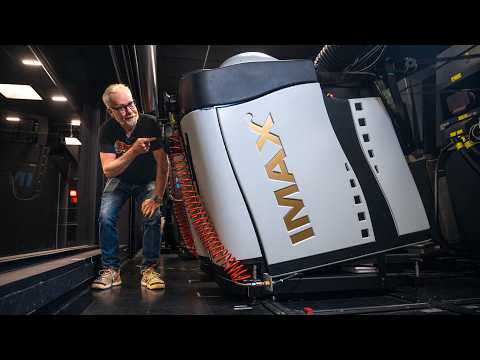
IMAX theaters utilize a combination of film and digital projectors, with dual digital projectors for enhanced brightness and stereo projection. The system allows for quick transitions between formats.
- IMAX theaters have multiple projectors for flexibility in screening formats.
- Auto calibration ensures optimal image quality when switching projectors.
- The engineering behind projector systems is complex yet effective.
Transcript
0:05 >> When a movie is filmed for and projected in IMAX, the large format that you're watching isn't just about the size of the theater screen. It's also about the size of the image on the screen print. This is a single frame of IMAX 70 mm film. It runs horizontally through the projector and it's called 15 perf because there are 15 perforations on the film for every frame. This picture is almost 10 times the size of that stored on a standard 35 mm frame which has the same size perforations on the smaller film and has to share real estate with the soundtrack on the right. That's a difference in detail that I can see with my naked eye both on the frame and when it's projected on a 90-ft tall film screen. Tested went to IMAX's LA headquarters to tour their vault of film prints and bed with technicians splicing together reels heavier than me and larger than this table and visit the projection booth of their in-house theater where some of the world's greatest directors come daily to review and sign off on their vision printed in film's largest format.
1:07 Greg, you you told me this is about 2 and 1/2 minutes of film give or take? >> right. I was a projectionist in my youth and I'm just trying to wrap my head around the volume and weight. How do you guys handle something as simple as like dailies or or post-production? >> Well, we have a team that does that and which you'll meet in a second. And so we take this large roll film. This actually is not as big as some.
1:31 They go up to 1,000 even bigger than that. They all get assembled onto the rewind on on a larger reel through the rewind bench and they get spliced and and we wheel them out there which you'll see as well. Yeah. >> Okay, let's let's let's walk through this process. Okay. All right Adam, so this is print assembly. All right, so this is where heavy things get assembled into heavier things >> >> and then eventually they leave.
1:55 >> Yes. God, the the volume of it is just staggering. >> Yeah, yeah, we have a lot of stations here, a lot of work gets done. Irving has a group of two so three all together in print assembly. How many platters are you processing out of this room in a day? >> It It really depends. I mean generally they're working on one at a time. It really depends if we have multiple titles happening at the same time. In this case we have one film that that is getting plattered up for a screening this afternoon and it's basically a bunch of film out reels that are are processed and printed at FotoKem and we're going to show them here at our theater. It's amazing. I mean I remember my rewind table at the theater was like the size of a thing. This is the size of my first apartment in New York.
2:31 >> Yes, these are custom. There's one of one and they're very old but they work. Amazing. Hey Irving. How are you? Good to see you. So you have been here for 33 years? >> Yes, I am. Is it safe to say that you have touched almost every print that's come out of here? I would say yes. Okay, so walk me through walk me through what happens here. Usually when they start a production they go with making dailies and every daily that is made we come to this place then it's get to be a screen review, make sure that there is no scratches, that physically look okay.
3:06 Because scratches can happen in the camera and the negatives or it can happen in printing in the lab. So you want to make sure that everything is okay. Also everything that we had a screen we keep a record. So we had like records in 1980s. Yeah. We keep all those records. Every single roll that have been screened they keep a record and we keep it on So every last thing that's come through here is chronicled. Yes.
3:33 >> Okay. And right now we're working in a project a demo and I'm going to pull There is different play different pictures they're making from different parts of the movies Yeah. and right now we are trying trying to put a a portion of that movie and put it together like a puzzle and then that's what we're going to do right now. I'm looking for a specific scene. Can I help? you can try it if you feel comfortable.
4:05 >> >> But we just going to roll it. This was built like a a month ago. Okay. And probably it was made with a It was make a You have probably a hundred scenes inside this. Okay, so this is our daily reel with like a hundred scenes in it. Yes and then we're going to look for the specific one that they need right now. But they they just give us we need this and we have to find it in all of this.
4:36 You have to go through this and figure out where it is. Okay. And usually that's why we are trying to keep this kind of list so they will give me an idea where they are. >> Amazing. >> Cuz otherwise you will be impossible to find it. And after that the piece that we're going to find there is going to go into this little roll and from that roll we're going to take a portion of the same material and go into the demo that they need to screen tomorrow actually.
5:17 And this is like an old tape machine. Remember when you push the cassette tape and you play move this way or move that way? Yeah, yeah. Oh, that's what it is. Okay. So this one will if I want to push over there, move over there just press this one or if I want to go the other way, go that way and stop and and it's very simple. And this are only tension you know because you need it's a lot of you need tension and these are the speed control which is how one here one here is the same one the same control. And I've been here for more than 35 years so >> These have been here longer than you.
5:51 >> Yes. Okay. But this one is say that start from chapter 78 to 101 which is what we got here. Okay, so now you go find that. >> 78 cuz it start 78 and then I'm going to go all the way. It start from one but But that means that all of these have already been left in file. >> a different platters. >> Got you. Cuz you cannot this platters only can hold like a one hour platter and sometime we had a screening of two hours plus so we need to build into small platters like this and then take it to whatever we need to screen. That's the small platter. this is the regular platter 45 inch platter. Okay. The this is the standard for most of the films.
6:35 >> Got you. But a big movie two hours and a half movie will go in three of this. And then you build it into one platter in whatever theater you go. Yes. I find myself wondering if there's a machine shop somewhere in the world that just makes these. I mean maybe there's more than one but I mean it's got to be a pretty bespoke business.
7:12 Look at that. Wow. So here we are putting tension on this side so it will not wind loose to this. So we're and then you have clutches that so it can allow the engine to engage to the platter and it can rotate. So this one we're going to go that way which is ready there.
7:44 I just help a little bit. And because you cannot go see it doesn't have no number no nothing we just You just scroll and then you go hunt for it. >> Yes. But you know that it's probably right around >> Somewhere there. Yeah, cuz this is This have 100 shots but it's starting from shot 78 so probably somewhere in here. Holy cow.
8:19 It really is sort of blowing my mind just the sheer weight, the sheer volume of plastic and aluminum required to move these pieces and prints around. this is less than an hour of film but at such a resolution that it weighs, you know, dozens and dozens of pounds. It's amazing. It's like it's like the single heaviest component of flying an airplane is its fuel. Like you don't really think about that but it really is like most of managing an airplane's weight is about managing the weight of its fuel. And for some reason that seems to me to have some parity to like if you want the best the most the sharpest film format, well it's it's going to get heavy. It's going to get heavy in a hurry.
9:03 That's the splice, yeah? >> Yeah, that's the tape. >> have a cutter that cuts that Yes and this is the one that does that. Oh, oh so is that the difference between this splicer and that splicer? This one does the zigzag splice. This one does the zigzag so you can pull it apart and put it back like a puzzle but this one once you do one of those because it's well kind of welded so you cannot pull it apart. If you pull it apart you cannot put it back together. So this is for like final assembly?
9:29 >> Yes. And this is for temporary assembly. Got you. Okay, so we're in part of the projection room here. >> We are. We are below it. >> Okay. Yeah. can can I help? Can I help put load this? Oh, amazing. Okay. So now we're lifting the platter up onto the Mark reel unit.
9:59 Okay, now we're going to lock it in. okay. >> Got to be careful like and also we have the screws. If you could pass me this one. >> >> And I just got tight there. >> all right. Now, this is going up to the projector. And so we need a lot of free that leader and we're going to spool a lot of it. So we go cuz the projectors are in the second floor. So you see it's going to travel from here all the way up and then coming down. So it's not going to be the actual movie. It's just leader. Right, right, right. So this is all just blank film, but it's going to travel all the way up where that rope's going through the hole? Yes.
10:38 >> Because because all the work is done down here and all the heavy lifting comes down on the first floor. There's there was no real way to get these into the booth as you'll see when we go up there. So the weight of this means that architecturally this is an accommodation because of how heavy these are. >> It is and it might seem crazy like why would you invent something like that, but it works. Amazing. >> Yeah. You guys must now have some intense HVAC here because I would imagine small amounts of dust can damage this print over time.
11:05 >> Yeah, it's it's not as big a deal as it is with negative. >> Of course. >> And we have special rollers too that help make sure that that everything's clean before it goes into the projector. Incredible. Yeah. Okay, so that's a lot of film he just wound up there. Oh, look at that. Yeah, how many feet Irving do you have of of leader on the head? I don't know, probably like 100 ft. Wow. IMAX film is 337 ft per minute. So that's just over you know, 20 seconds of of of leader, right? Wow.
11:41 330 and 35 mm is like 90 ft per Yeah. Yeah. Right, an hour is a mile in 35 mm. Oh my god, the cable carries the film up. Okay, now we're going to walk up Okay. >> and pull this so we can continue. >> Okay, so you go up there and pull it. You don't just We just go like fishing. We kind of I'm sort of I'm still wrapping my head around the fact that this travels 30 ft into the ceiling to get to the projector.
12:17 >> Yeah, yeah, it does. And then it has to come back down. Oh my god, of course it does. >> Yes. So it travels another 30 ft back down to get the the take-up reel, which is of course it's there. >> That's insane. I love that that works. It is amazing. For 3D movies is it double this? It is double this. Yeah, we actually have a whole other Mark II assembly platter system over there. And if you notice there's plat there's there's these little pulleys that go over your head. And so we actually have two sets that can go up there for left eye and right eye film projector.
12:49 >> Oh my god, two separate gigantic prints for left eye and right eye. Yes. Amazing. Just to give you a sense of the size of this. This is a roughly hour-long reel and loaded with film weighs about 300 lb. This is a 68-in reel holds just shy of 3 hours, weighs almost 600 lb and this is not their biggest reel. This is their second biggest reel. Crazy. I'm only a tiny bit taller than this.
13:19 >> >> So here's Yvon with the film that came from below. I just love that these are bolted to the the engineering in me thinks this shouldn't be possible, but it's perfect. Okay, so what's the next step for this to get into the projector? So he's going to go through that hole. Okay. And we're going to be using that film projector.
13:54 Wow. So this is the David Keighley theater booth. >> Got you. And we have three sets of projectors, one film and two digital. Okay, so that's a set of film projectors. >> Yes. A set of digital projectors and another digital projector. >> And they're all on a rail system that allows us to basically prep for a session. So we might have a digital session 10 minutes ago, it wraps and then we have to basically go right into film. So they can prep all this and load it all up and then slide it over in literally 5 minutes we're operating on film. Amazing. And is the reason there's two digital projectors is for stereo projection? Yes, and and also to get the power we need on the screen. That's our GT digital projection system. So you double it? Yeah, it's it's full 143. In fact, every morning we have a calibration system. Anytime these projectors move, we have an auto calibration system that converges the two projectors. Wow. And so you're putting one image on top of the other to get the maximum amount of brightness from the digital projector.
14:53 >> Yes. This is the only way to achieve full 143 digital projection in IMAX. So even though he is spooling the film into the film projector, that projector is still going to move into its final position. >> And this rig can accommodate that. >> Absolutely. Again, the engineer in me is like this shouldn't really work. It shouldn't, but it does. All right, and then it's coming back. >> That's right. This is the return trip. Through the same hole. Right, cuz left eye, right eye.
15:20 >> Right, right, right. Going fishing. Yeah, and here's the the film projector is going into place. You can run both these projectors if you're doing 3D, but also if you're doing a rollover. So basically if you're going to transfer over from one to the ever other. If he had let's say two different reels that we needed to go from one to the other, we could go into that mode. >> So they don't you don't have little burn holes in the corner of the >> Yeah, cuz the first one and the second one >> Yeah, totally. You don't do that. How do you know when to do the changeover?
15:50 >> Because we're not doing it for final product. >> Okay. >> Yeah, so they'll basically just change over to the other one when we need to. But it's all it's all in sync. Even our sound. Our sound is basically a digital track that goes in on an optical disc and we we ingest it into a hard drive system. And it syncs up with that. >> It syncs up with the with the film, exactly. Similar to the DTS system. Got you. All right, so this is the business end of the process we just watched. A director who is working on a film with IMAX is coming in in a few minutes to watch some dailies of their film. We can't tell you what it is, but it's now been spooled into this projector and it's about to be projected. I am Everything about this process is sort of gargantuan and incredible to me and I can only imagine how thrilling it is for that director to see their footage in such a format.
16:44 It's got to be intoxicating. >>
Summary
- IMAX 70 mm film is significantly larger than standard 35 mm film, providing enhanced detail and resolution.
- The film is processed and assembled in a specialized print assembly area, where technicians handle heavy reels and splicing.
- Each film print is meticulously reviewed for quality, with records kept of all dailies screened since the 1980s.
- The projection process involves a complex setup, including custom equipment to manage the weight and volume of the film.
- IMAX theaters utilize both film and digital projectors, often switching between formats seamlessly for screenings.
- The sheer weight of IMAX film can reach up to 600 lbs for longer reels, necessitating specialized handling and storage solutions.
- The projection booth is equipped with advanced technology to ensure synchronization between film and sound, enhancing the viewing experience.
- Directors frequently visit the facility to review their films in IMAX format, adding a layer of excitement to the production process.
Questions Answered
What makes IMAX film different from standard film formats?
IMAX film uses a larger 70 mm format with 15 perforations per frame, resulting in a significantly larger image size compared to standard 35 mm film. This allows for greater detail and clarity when projected on large screens.
How is film assembled for screening?
Film assembly involves organizing and splicing together various scenes from a movie into a daily reel. Technicians keep detailed records to locate specific scenes efficiently.
What challenges arise from the weight and volume of IMAX film?
The sheer weight and volume of IMAX film prints pose logistical challenges, similar to managing fuel weight in airplanes. The heavy prints require specialized equipment and careful handling.
How is the film prepared for projection?
Film is spooled with a significant amount of leader to facilitate its movement to the projector, which is located on a different floor. This setup is designed to accommodate the heavy weight of the film.
What types of projectors are used in IMAX theaters?
IMAX theaters utilize a combination of film and digital projectors, with dual digital projectors for enhanced brightness and stereo projection. The system allows for quick transitions between formats.