Transcript
0:00 - We are officially off to the presidential horse races, and what a race it is. (bell ringing) Both major parties have their defacto nominees already more or less selected. - Don't mess with women in America unless you wanna get the benefit. - While young vultures swirl around their aging bodies, ready to swoop in if either one of them is taken out by an act of God. Meanwhile, sloganeering around our democracy has been in full force since the 2016 election, when the Washington Post bravely adopted the phrase, "Democracy dies in darkness," as its first official motto in 140 years.
0:40 And the talking heads are ramping up their rhetoric. - Our democracy. - Democracy. - Our democracy is- - Our democracy. - Democracy is on the ballot this year. - It's enough to make you break down and weep for our country. - I'm gonna try to get through this. Thank you for what you did three years ago today. - Was that guy really brought to tears over the future of our democracy? Maybe he got a look at the current state of civics education in America, because that is enough to make a grown man weep.
1:09 According to the National Assessment of Educational Progress, only 22% of eighth-graders were proficient in civics, and only 13% in US history. - Me fail English? That's unpossible. - So our kids, and more specifically, our schools, are getting a deep red F on the nation's report card when it comes to learning how our political system works and what our role should be in it. Let's face the facts. If we want our kids to understand our political system and how it actually works in reality, we're gonna need to roll up our sleeves as parents and do it ourselves.
1:46 Because this whole system is predicated on an educated citizenry. So we don't end up here. - [Announcer] Bringing another miracle! - Yeah! (heavy rock music) - Okay, I admit we might already be there. - [Announcer] Bringing another Miracle! - [Speaker] Oh my goodness! (crowd shouting) - No, we're there. But if we wanna escape Idiocracy, we need to go beyond the schoolhouse rock explanations we got when we were kids. - He signed you, Bill. Now you're a law.
2:17 - Oh, yes! - Frankly, we'd be lucky to get back to that Mr. Bill, because these days our kids' civic knowledge looks a little too much like the other Mr. Bill. - Oh, oh, oh- - Oh no! - But fear not, dear friends, starting with this video, and throughout the year, I'm gonna be breaking down some of the basics of how our political system was designed, how it seems to work in reality, and what we as citizens can do about it.
2:43 So in the words of civics advocate and Spielberg movie favorite Richard Dreyfuss, we as parents must teach our kids how to run our country before they're called upon to run it, or someone else will. - What the hell is going on around here? Who are you people? - So grab your kids, and let's run through this together, starting with a proper understanding of the D word. (uplifting music) If you like these videos, please help us out with a like.
3:20 And if you wanna see more, be sure to subscribe and ring that bell. I look forward to engaging in the comments below. I really try to read all of them. Okay, say it with me now, people. Democracy, democracy, democracy, democracy. - Democracy, democracy, democracy, democracy, democracy, democracy, democracy, democracy- - Democracy, democracy, democracy. - Yes! - Everyone loves democracy. Democracy is sacrosanct. Democracy is the end of history, the best system of government, or at least, as Winston Churchill put it, "The worst form of government except for all the others that have been tried."
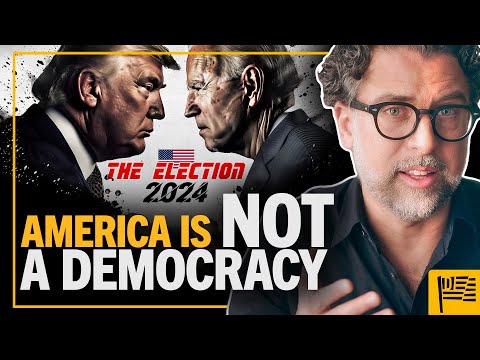
3:58 There's just one problem. The United States is not a democracy. - What? - We're a constitutional republic. I can't even tell you how many times my grandfather, Geno Popola, a medical doctor and American history buff, said this to me over the years. - Where in the constitution does it say about that? It doesn't say that. It doesn't say anything at all. - When I followed up with, "What does that mean, Grandpop?" He would respond, "It means we're a nation of laws, not mob rule."
4:29 Rule of law versus mob rule. Is that a fair take? Well, our founding fathers would think so. They wrote at length about the historical and philosophical problems with direct democracy and designed the constitution to constrain it. But before we get into that, let's dive deeper into what democracy is and where it breaks. - I love democracy. I love the republic. - Democracy is, technically speaking, majority rule. In a simple, direct democracy, every citizen would vote directly for this or that new law or policy.
5:03 Want a park in your neighborhood? Everyone votes on it. The simple majority wins. And majorities can become a mob real quick. The phrase the madness of crowds is a common saying and a popular book title for a reason. The word democracy comes from the Greek word demos, meaning the people, and kratia, meaning power or rule. Demokratia. Take a trip through France in the 1500's, and you end up with democracy, power to, of, by, and for the people.
5:35 - Oui, oui! - What could possibly be wrong with that? Don't we want the people to have the power instead of all those corrupt elites, aristocrats, monarchs, and warlords? Well, certainly. Remember the great historian writer and English parliamentarian Lord Acton who said, "Power tends to corrupt. And absolute power corrupts absolutely. Great men are almost always bad men, even when they exercise influence and not authority. There is no worse heresy than that the office sanctifies the holder of it."
6:11 So if absolute power corrupts, distribution of power to the people seems like a solution, right? Well, not so fast. A few more questions are in order, like the power to do what, exactly? And to whom? And which people are deciding? Well, the rules of a direct democracy are pretty simple. Without any constraints, democracy is the power to do anything to anyone so long as a simple majority wants it done.
6:41 Popularity rules. So if you can get 50.0001% of the people to agree and vote on your proposition, you can tax people you don't like to pay for things you want or force everyone to buy a product, like health insurance, or get vaccinated, or burn so-called witches at the stake, abuse or enslaved minorities, draft other people's children and send them off to war, or simply kill unpopular people. All of these things have happened in America and around the world with majority support at one point or another.
7:15 If all that sounds like the acts of a mob, well, you'd be right, it can be. (crowd yelling) Maybe it always is. Democracy is never really power to all the people. It's technically power to most of the people. Part of the 49% club? Well, better luck next time, assuming there is a next time for you. (dramatic music) "What's wrong with that?" you might be saying. Sounds fair. To the victor goes the spoils. As famed American journalist and critic H.L. Mencken put it, "Democracy is the theory that the common people know what they want and deserve to get it good and hard."
7:54 Put another way, democracy can look like two wolves and a sheep voting on what, or who, to have for dinner tonight. And we all understand this at a small scale. - Remember, catch him alive if you can, but get him. (crowd yelling) - If I can convince a majority of neighbors to ransack your house, it's still robbery. Voting to do it doesn't change the fact that it's a crime. But scale that up to the nation, and suddenly it's a civic duty with a fancy obfuscating name, eminent domain.
8:25 The founding fathers were deeply worried about this tyranny of the majority. James Madison, the father of the Constitution, wrote in "Federalist Number 10," "Measures are too often decided not according to the rules of justice and the rights of the minor party, but by the superior force of an interested and overbearing majority." There's nothing especially moral about an idea being popular. Evil ideas have been popular throughout human history, including racism, eugenics, slavery, religious jihad, and on and on and on.
8:58 Tyranny of the majority wasn't the founder's only concern. They also worried that direct democracy would lead to the creation of selfish parties and factions who would put their own group interests above the common good. That public opinion was often impulsive and driven by momentary passions. (blade thudding) (crowd cheering) Again, that madness of crowds runs deep. They worried that our large country would make a direct democracy just impractical, and though it's not polite to admit this, they worried that the people would not be well-educated enough on particular issues to make informed voting decisions.
9:32 Again, see our kids' civic scores for proof of this concern. If all of those concerns sound familiar and reasonable, well, they should, and they are. Every single one of them has happened, even with the various protections in our constitution. Let's be honest here, we're all pretty ignorant of the issues that we're asked to vote on. And for good reason. We're too busy trying to earn a living, pursue our dreams, and protect our families. Ask yourself honestly, how much time have you really spent trying to understand all of the issues confronting the current or future president?
10:05 Before we get to what exactly the founders did to try to correct for these problems, I wanna bring up a newer and even more challenging discovery about the democratic process itself. Buckle up, because deep sci-fi style paradoxes await. (mysterious music) we've all gotten tied in knots over the legitimacy of our recent elections. This isn't anything new in American history, and it certainly isn't limited to one side or the other of the political spectrum.
10:39 - If you count the illegal votes, they can try to steal the election from us. - President Trump won this election, so everyone who's listening, do not be quiet. - Votes remain to be counted. There are voices that are waiting to be heard. - You can run the best campaign, you can even become the nominee, and you can have the election stolen from you. - This is all understandable, given the tyrannical power our political system wields over our lives today.
11:08 And outright cheating can't be allowed. The stakes are high, and despite what some people claim, there's been plenty of election interference in American history. Even the New York Times, back in the '90's before everything went completely crazy, admitted that Lyndon B. Johnson stole his Senate seat. Machine politics and ballot stuffing, especially at the local level, goes all the way back to the beginning. Google Boss Tweed or Tammany Hall or the New York Problem for more. Or just watch "Gangs of New York," though not with your kids, it's rated R.
11:41 - I already voted today. Cast for Monk and Tammany, by God. Twice. - Twice? Only twice? You call that doing your civic duty? - But while people have been obsessing over outright fraud or technical issues like mail-in ballots versus in-person paper versus electronic voting machines, almost everyone has been ignoring something far deeper and far crazier about the democratic electoral process. It's a set of secret formulas discovered by economists who devoted their careers to studying how people make decisions in groups.
12:15 These are the public choice theorists, and what they've discovered is as shocking as it is counterintuitive. The implications of what I'm going to try my best to explain here are truly profound. Welcome to Kenneth Arrow's Impossibility Theorem, also known as Arrow's Paradox. Arrow starts with a simple goal, that our voting system should meet a few key criteria in order to be truly fair and representative of majority opinion.
12:46 The first criteria, unanimous consent. If everyone prefers option A over option D, then option A should beat option D every time. Seems fair, right? The second criteria, irrelevant choices don't change the outcome. If everyone's top pick is option A and their last choice is option D, then the order of the irrelevant options B and C in the middle should have no impact on the outcome. Again, seems fair, doesn't it?
13:17 And this should be pretty easy to deal with, right? I mean, why would the order of irrelevant options to your main choice ever matter? Add as many candidates as you want, I like this guy. Now here comes the shocking surprise. There is only one form of decision-making when there's more than two choices that satisfy these simple conditions. Are you ready for it? It's dictatorship. (chuckles) Seriously, a single decider. No democratic electoral process can satisfy these two simple benchmarks for fairness.
13:50 Only one person making the choice can do it. Does this mean that Churchill was wrong about democracy and Plato was right, that a philosopher king or benevolent overlord is the ideal form of government? No way. All of history points to the fact that Lord Acton's warning is justified. Absolute power corrupts absolutely. Waiting for a platonic ideal dictator will leave you waiting forever. And this completes the paradox when we add the final criteria.
14:20 No dictators allowed. - [Crowd] Yay! - It is mathematically impossible for any system to deliver on all three. No democratic system can deliver more than one, and we don't want a dictator. If you wanna go deeper into exactly how these conclusions work, we'll put some links to a few great videos that walk you through proofs of Arrow's Paradox down below. So where does this leave us exactly? And what are the implications of this paradox?
14:51 Arrow's Paradox has a very important lesson. The rules of the voting system determine the outcome of the system. - There are certain rules. - And those rules vary state by state. So for any given set of choices, without any change in the voter's opinions, if you change the rules of the voting system, you can change the outcome. For example, the caucus rules in Iowa will produce different results for the same voters than a first past the post system, like most states have, or a ranked choice voting system used in some states, versus, say, a two-round system where a runoff is required if no candidate gets over 50%.
15:34 And again, none of those systems satisfy these basic criteria of fairness. Arrow himself downplayed his conclusions, saying, "Most systems are not gonna work badly all of the time. All I proved is that all can work badly at times." This is a massive understatement, and one that I have to imagine was born out of the deeply uncomfortable nature of his own discovery. There is no such thing as a purely democratic will of the people. It's mathematically impossible.
16:05 It's kind of rhetorical flourish, a poetry, a fairytale, a secular religion. Arrow's Paradox is not the only way to arrive at this conclusion, but it's perhaps the only one that doesn't try to make a philosophical or values-based argument to do so. The math doesn't lie. - How do you like them apples? - We've seen Arrow's Paradox play out clearly in open primary seasons where there's more than two choices, such as 2016. The rules of each party's primary determined who won.
16:38 The sequencing mattered to the outcome. This means that we could change the rules in our primaries and get totally different winners without a single person changing their opinion of any of the candidates. For example, Donald Trump didn't win more than 50% in the GOP primary until 30 states had their primaries and the field began to narrow. What that means is that the GOP nominee did not have a majority of Republican support in a majority of states.
17:08 But this is not unique to Trump, it's just the nature of the beast. Just ask Bernie. - The establishment determined who the anointed candidate will be. - The paradox also leads to other outcomes we've observed, such as driving people to focus more on who can beat their party's opponent versus which candidate best represents their values. This results in what's called favorite betrayal and other sort of fake strategies to try to outsmart the system. - I'm smart!
17:36 - But it also produces polarization. I call these fake strategies because the other deeply uncomfortable mathematical fact is that no one individual vote actually matters in any system, unless it's the tiebreaker. If I stay home in November, I know for a stone cold mathematical fact that the election results will not be impacted. Okay, take a deep breath. I know that none of this is what you want to hear. And I can imagine the pushback.
18:06 Maybe you hate me for spreading malformation, also known as bad but true facts about our democracy. Maybe you hate me for saying things that could discourage participation and hurt your preferred candidate. How dare I reduce the incentive to vote? What kind of dad who claims he wants to save America would do such a thing? All right, now that some of you feel heard, let me be clear. I am not saying don't vote, and don't encourage your kids to vote.
18:36 And I'm definitely not being un-American by showing ample skepticism about majority rule. I would say, in fact, that I'm being patriotic. Remember what my Grandpop told me? We're a nation of laws, not mob rule. America is not a democracy. When Ben Franklin was asked, "Well doctor, what have we got?" as he left the constitutional convention, Franklin responded, "A republic, if you can keep it." (uplifting music) A republic, if we can keep it.
19:10 Almost 250 years after Franklin gave that answer to Elizabeth Willing Powel, we are still projecting that identity to the world. Consider this excellent description of the United States political system on our US Embassy website. "While often categorized as a democracy, the United States is more accurately defined as a constitutional federal republic." What does that mean? Constitutional refers to the fact that the government in the United States is based on a constitution, which is the supreme law of the United States.
19:42 The Constitution not only provides the framework for how the federal and state governments are structured, but also places significant limits on their powers. Federal means that there are both a national government and governments in the 50 states. A republic is a form of government in which the people hold power but elect representatives to exercise that power. Our founding fathers started with a fundamental assumption, that every person was endowed by our creator with unalienable rights to life, liberty, and the pursuit of happiness.
20:15 Our power as individuals is grounded in our natural right to self-ownership, our individual sovereignty. And yes, this foundation was at odds with slavery, which also set the stage for its inevitable end. This foundation provided the North Star for the constitution's limits on government power. The founders and framers of the Constitution were not being guided by the simpleton ethic that whatever is popular must be good and true. They understood the democratic electoral process to be a tool for protecting individual sovereignty from the capricious predation of the state, not an end unto itself.
20:53 They were radical revolutionaries who just escaped rule by a monarch and had no interest in replacing him with a mad mob. (blade thudding) (crowd cheering) Almost every component of the original constitutional system, some of which has since been tragically weakened or dismantled, sought to restrict what government could do to people. These are limits on what political democracy can do to people. The Bill of Rights are limits on democracy and majority rule. The First Amendment protects speech, assembly and religion from majority rule.
21:26 We are free to hold unpopular opinions and belong to unpopular groups or creeds. The Second Amendment protects the right to bear arms, even if gun ownership is unpopular. - Fire! - Go down the list, and each and every, "Congress shall pass no law," should properly be understood as Democratic majority rule cannot mess with this. But they went further still. They divided the government into three equal branches, the executive, judicial, and legislative, and pitted them against each other so that that competition would constrain them.
22:01 In the words of James Madison, "The accumulation of all powers, legislative, executive, and judiciary, in the same hands, whether of one, a few, or many, and whether hereditary, self-appointed, or elective, may justly be pronounced the very definition of tyranny." They split the legislative branch into a lower chamber, the House of Representatives, directly elected by voters in the district, and in upper chamber, the Senate, who were appointed by the legislatures from each state.
22:34 That's right, senators were not directly elected. And there's good reason to revisit that approach, though I'll save that for another time. But the founders went further still, putting in 2/3 super majority requirements for major decisions. Impeachment, expelling members of Congress, overriding presidential vetoes, and ratifying treaties all require 2/3 majority votes. It's easy for presidents to veto a bill and much harder for the Congress to override that veto. Finally, wanna make a change to the rules of the game and amend our constitution?
23:08 Good luck. No simple democratic majority will do. It'll take 3/4 of the states to ratify any amendment. All of this must be understood as limits on simple majority rule. Each and every restriction on government power is a restriction on the power of a simple 50-point-something percent majority to tell everyone else what to do. By setting a much higher bar for big changes, the founders limited the randomness Arrow-style paradoxes.
23:39 75% of the states might not be the will of all the people, but it's a much better guarantor that the madness of crowds isn't dominating the decision. Now, there is a counterargument to everything I've laid out here, except the mathematical fact of Arrow's Paradox, that is. This counterargument is the central moral claim of the populous progressive movement that kicked off in the 1890s and continues to this very day. They claim that only democratic political power exercised through government action can counteract the predation of large private power.
24:14 They claim that these constraints on democracy's worst angels are archaic relics at best, and now little more than tools of the oligarchy to prevent needed radical social reform. Some go even further. Were all of the Constitution and Bill of Rights individual protections from democratic interference actually done in the name of protecting George Washington and the privileges of his elite white male cronies? Progressives have long argued yes. And to some extent they had a point. The constitution had compromises which allowed slavery to persist, denied slaves full rights, and left determining the right to vote up to the states, which resulted in only a few states where women could vote.
24:56 Now, this late 1800's progressive movement cannot take any credit for ending slavery, but they can absolutely pat themselves on the back for delivering universal women's suffrage with the passage of the 19th Amendment. In the name of democracy, they passed the 17th Amendment, resulting in the direct popular election of senators. So yes, as we've all heard, the American progressive left has long claimed to be the champion of democracy. They are the populist counter revolution to our democracy's skeptical founders.
25:30 There's just one problem. The progressive movement did more to centralize power than ever before, including in the hands of truly unelected agencies. US President Woodrow Wilson, who presided over the passage of both the 17th and 19th amendments, is the poster child for progressive authoritarianism. You see, he was ultra woke way before it was cool. Think of Wilson as the Claudine gay of his time on bionic steroids. He, too, was a former Ivy League University president, a lover of centralized power, a warmongering globalist who took cancel culture to the next level with the Sedition Act of 1918.
26:10 Wilson was also a virulent racial essentialist who embraced eugenics and re-segregated the federal government. He also screened "Birth of a Nation" in the White House. Wilson's ghost is surely looking down, or more likely up, from beyond at today's newly segregated college graduation ceremonies with proto-woke approval. And don't forget, Wilson created America's least democratic institution ever, the Federal Reserve. - Hey, listen, party at the Fed. (heavy rock music) - The most ironic thing of all?
26:42 Woodrow Wilson won his first presidential election with only 41.8% of the vote, and his reelection with 49.2%. The man never got a majority. Arrow's Paradox looms large. Progressives, it turns out, have been fair weather friends to democracy, but instead of constraining it in the name of individual liberty, they've preferred more abstract collective goals, like equity. Democratic socialists going all the way back to Wilson competitor Eugene Debs, through Bernie Sanders, have long gone even further, subordinating virtually all individual rights to the right to vote.
27:21 So if the majority wants to take your stuff and give it to someone else in the name of equality or any other reason that might be popular, they can do it without any constraint under that system. ♪ I steal from the rich and give to the needy ♪ ♪ He takes a wee percentage ♪ ♪ But I'm not greedy ♪ - Majority rules, until it doesn't, that is, which a century of communist dictatorship has made crystal clear.
27:43 Remember, power corrupts, and absolute power, popular or not, corrupts absolutely. As it turns out, the best defenders of democracy are the ones most skeptical of its moral authority. ♪ DSA ♪ - Our political system, largely driven by a century of progressive centralization, has turned all of our eyes and way too much of our attention towards Washington DC, or as my beltway Politico friends like to call it, Hollywood for ugly people.
28:17 (distorted music) And with the birth of digital media, all of us can gorge 24/7 on an endless supply of national political nonsense, and it's not doing us any good. 40% of Americans say that politics is a significant source of anxiety. 65% say that they feel exhausted when thinking about politics. And all of this is coming at a time when turnout for our federal elections are at all time highs. This is not a coincidence.
28:47 When every single problem is turned into a national issue up for grabs in congressional and presidential elections, we are forced to turn on each other in a political zero sum war at the ballot box. Meanwhile, only 4% of US adults say our political system is working well. And who the hell are these people? I've never met one. - Who are you people? - The reason for our dissatisfaction is simple. Centralization doesn't work. Most problems are best solved at the local level, where people have actual knowledge and experience with the particular challenges and the networks of relationships in the community to help.
29:27 We are more accountable to our local community. And when we come up with a local solution that works in our community, there's no need to try and force it on anyone else. If other people in other cities or states think our solution to education, transportation, or homelessness can work for them, they can copy it and change it as they need without forcing us to adopt their changes. Why on earth does anyone think that the contents of our kids' classrooms should all be the same nationwide or be dictated by DC or our state capital?
30:00 Where is the evidence that that works? Unless by works, you mean transforming our schools into political battlegrounds that can't teach civics. If you wanna get politics out of school, you need to get government out of it. When my son's private school started pushing gender fluid messaging on him in sixth grade, I didn't feel powerless or take to the streets. I pulled him out. And the best vote you can cast is always with your feet. The era of big centralized government has made everything political and left all of us miserable.
30:36 We're more engaged than ever in our democracy with a capital D, and it's crowding out the kind of small D democracy that made America truly special. But there's a ray of hope. A 2019 survey found that while only 43% of Americans were satisfied with the direction of the country, a number that has collapsed 25% in more recent surveys, 73% felt good about how things were going in their local community. The great thing about America is that we can vote with our feet at every level, state, city, and local.
31:10 When you look up democracy in Miriam-Webster, way down at definition number five, you find what might be the heart and soul of American democracy as the founders saw it, "The absence of hereditary or arbitrary class distinctions or privileges." This is the deep democratic virtue of our declaration that all men are created equal. Our founders sought to establish a system to protect that God-given equality. The 13th Amendment, which ended slavery, enshrined equal protection under the law for everyone.
31:45 And by protecting us from the democratic whims of national politics, our people have been more free to solve problems in their communities in a multitude of ways, as diverse as we are as a people. This is the democracy that famed French philosopher Alexis de Tocqueville celebrated in his monumental tome "Democracy in America," noting, "The health of a democratic society may be measured by the quality of functions performed by private citizens."
32:15 De Tocqueville understood democracy in America to be more than voting. It was private, voluntary action. He saw that Americans didn't wait for politicians to solve problems. We rolled up our sleeves and did it ourselves. We paved roads, built schools, fed the hungry, and provided health insurance and mutual aid, all of it. This, too, is a small D democratic ideal. Unlike the French of his time, Americans didn't expect their political class, and certainly not the federal government, to come to the rescue or solve every social ill.
32:49 At the very heart of this thriving democratic culture was what De Tocqueville called provisional institutions. Today we call this civil society. He noted, "Americans of all ages, all conditions, and all minds, constantly unite. Not only do they have commercial and industrial associations in which all take part, but they also have a thousand other kinds. Religious, moral, grave, futile, very general, and very particular, immense, and very small.
33:23 Everywhere that at the head of a new undertaking, you see the government in France and a great lord in England, count on it that you will perceive an association in the United States." Now more than ever, we need to rediscover the truly American small D democratic ideals of De Tocqueville and teach them to our kids. If nothing else, we should do it for our mental health. A recent study found that adolescents involved in school or community-based civic activities have elevated psychological wellbeing, increased academic engagement, and more involvement in activities than peers who were not involved in these activities.
34:02 Everyone ends up more satisfied when they focus their attention locally. I can personally attest to this fact. Our family moved to a small community of just 700 or so residents on the outskirts of Austin in 2019, with its own city council and local governance. For the first time in my adult life, I got truly engaged in the local community. My wife, Lisa, and I have volunteered on local committees and supported local events. We've gotten to know all of the city council members and several mayors.
34:32 Our son even worked for the public works, earning his first official paychecks honestly in the 100 degree heat. We voted with our feet to move into this community, which is a million times more important and more impactful a vote than every national lever we will ever pull. That's not an opinion. It is a statement of statistical fact. We've seen the difference being engaged locally can make in our family. We feel more connected. I can't walk our dog without striking up a conversation with our neighbors, and I love it.
35:03 We've made friends, even amid disagreements, and our national politics and tribal party lines haven't been part of that conversation. I'm frankly dreading the return of presidential lawn signs, our modern version of tribal war paint. This is what American democracy truly is or should be. It's what our founders fought to protect. It's what we should pass on to our children, and it's entirely within our control. The late great American journalist and political satirist P.J. O'Rourke wrote, "Don't vote.
35:37 It just encourages the bastards." I'm not saying that, though it is hilarious. Please, be my guest to vote for the bastard you hate the least this year. Just don't pretend that that lever pull is any substitute for being a real participant in democracy in America. (uplifting music) - [Speaker] Democracy!
Summary
- Both major parties have their nominees set for the upcoming presidential election, highlighting the urgency of civic engagement.
- Only 22% of eighth-graders are proficient in civics, indicating a significant gap in civic education.
- The U.S. is a constitutional republic, not a direct democracy, designed to prevent mob rule and protect individual rights.
- Majority rule can lead to tyranny, as decisions made by a simple majority can infringe on the rights of minorities.
- Arrow's Impossibility Theorem suggests that no democratic system can be perfectly fair, as it often leads to outcomes that do not represent the true will of the people.
- The founding fathers implemented checks and balances, including the Bill of Rights, to limit government power and protect individual liberties.
- Local engagement and community involvement are essential for a healthy democracy, as they foster connections and solutions tailored to specific needs.
- The speaker encourages parents to teach their children about civic responsibility and the importance of local governance over national politics.