Transcript
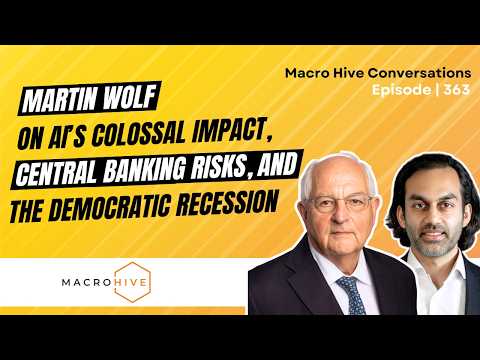
0:01 Welcome to the MacroHive Conversations podcast. [music] I'm Bilal Hafeez, head of strategy at MacroHive. Before we dive in, a quick update. Following [music] MacroHive's acquisition by the BGC Group, BGC has launched a new regulated business called MacroHive Markets. For the first time, onboarded clients can [music] also access execution services via MacroHive Markets. This new workflow will allow macro institutional investors to benefit [music] from strategy and quant insights alongside access to global liquidity. [music] Please contact Andrew Simon or Guillermo Cebrian on Bloomberg or click the link in the description below for more details on MacroHive Markets and its service offering. Now, on this episode, we have someone who needs no introduction. It's Martin Wolf. Martin, as all of you should know, is the chief economics commentator at the Financial Times. He was awarded a CBE in 2000 for services to financial journalism. Now, onto our conversation. Greetings and welcome, Martin. It's always fantastic to speak to you.
0:56 >> I had the pleasure to be with you again. It's been a while, I think. >> It has been, yeah. Now, Martin, one of the reasons I like speaking to you is because you you have the sort of a depth of understanding and and also a focus on timely topics as well. And one of the big topics we're all grappling with right now is AI. Um there's different angles one can take, you know, one is the whole bubble or not. Then there's the impact on the economy. Is it displacing jobs or not? Is it a different type of technological uh disruption where we won't see the jobs?
1:25 Um its broader impact on society. Um so, I mean, what are some of the ways you're thinking about AI? >> Well, all of those, actually. Uh the I I think it it's always very difficult to know what's going on in real time. Uh uh and uh it was perfectly obvious to me, well, roughly 30 years ago, that the internet was a very big thing. Uh and would change a lot. But, looking back on it, there were so many things we missed.
1:59 And uh I was on the the pessimistic side then, so I didn't believe in this great future of Anarcho libertarianism, which many were putting forward. But some of the harms that emerged rather surprised me. So I'm very very clear in my mind having sort of been very much in this sort of activity and adult as it were in that technological revolution that I didn't fully understand its implications. And I think if you look back in economic history, at least the last couple of centuries of big technological transformations, on the whole people didn't really understand fully how it was going to change things. And I think a technological revolution that involves computers starting to behave to behave and sound as if they're thinking, that could not but be colossal.
2:55 Um because it's in some sense the ultimate general-purpose technology. If you were were we were asked, "What is the general asset or characteristic that humans have that has allowed them to become the dominant species on the planet and all the other things that they've done, well, we would have to say thinking and thinking socially, thinking together. Uh and the the technologies we have developed to do that, uh well, language has obviously just evolved, but writing and printing have changed everything. So the internet was significant in that, and just being able to replicate thought itself in some way is very significant. And then you um when we're at the early stages of this revolution, it's right to ask, "Well, since it's a commercial technology, are we getting its economic and financial implications right? And my view on that is almost certainly not, because humanity has always got this wrong. If you look at, you know, bubbles of the past in various directions, uh not necessarily [clears throat] because they were wrong about how transformative the technology was, what they were wrong about is who's going to make the money and who wasn't going to make the money and and therefore which businesses would collapse as a result. And I'm sure things like that will emerge from from this technology, but unlike some of the bubbles of the past, and I argued that in a column last week, say the famous South Sea Bubble in early 18th century England or the Mississippi Bubble in just a little bit later in France, was it later or for earlier? Roughly the same time. Um they they were bubbles that didn't really leave much, but most of the great bubbles associated with technology, and the railway one is probably one of the most famous, um um they left a lot. So, I think it's there is a bubble element. I suspect some of the companies investing colossal amounts of money in it will not be the winners.
5:04 Uh market is just struggling, but it's pretty clear, I think really it's increasingly clear, that there are businesses here. And there are it looks as though there are winners or beginning to be a winners. There aren't so many of them and they are offering something fairly valuable, so somebody's going to make some money. So, that's that's that. But then you've got other questions uh and the crucial thing is what is it going to to do to society and the economy?
5:35 Everything really to have computers that sound like very, very, very intelligent humans and seem to be able to do tasks that humans can't to uh in months or even years in minutes. And we've got quite a lot of examples of quite extraordinary performance. I'm just state one example. It turns out that these can be these programs are really good at mathematics. Field medal level, I'm told. So, that's colossal. And then there are of course a huge number of possible harms. And the ones I'm trying to distinguish are It's about value harms, which is I think what the Pope has rightly been focusing on.
6:22 Well, you know, if these entities become, as seems increasingly likely, part of our society in some sense, they are engaging with us. They will manage things. As I point out in my column for tomorrow, Javier Milei, the president of Argentina, suggested we should have corporations with or we could have legal corporations with essentially no human management. I mean, that's pretty radical, isn't it? Who's accountable in that context? Who's responsible? Who do we blame? Who goes to court? I mean, you can take the company to court, but so what? You can liquidate it, but nobody's punished for crimes. And a similar problem is arising in other areas like accountability and responsibility. If we have computers running war on their own, who's accountable for war crimes? The programmers?
7:15 The army that That's a great point, Martin. I mean, what what what what huge issue. So, let me So, and then there are the straightforward damages they can do, creating terrible pathogens or just destroying jobs, as you said. The range of things that we have to think about and how we manage it. And the very final point is so far we haven't found any way to regulate any of this. >> No, no, they they're they're all fantastic points. I mean, just on the on the comparison to the dot-com the internet period, I mean, is this technology you're just categorically different from that one, would you say, in terms of its impact and then then, you know, its impact on jobs as well? Because there is this general notion in in sort of economic history that, okay, technology displaces takes away some jobs and on balance you end up with enough new jobs so that you end up with full employ some form of full employment. So, I mean, is there something so fundamentally different about this technology that would make us question that assumption?
8:12 >> I think that there are two different two points about this. First of all, um I think I thought we focused on the dot com bubble, but I sort of think of it as the internet. Uh and the companies that exploited it. But basically what the internet was was an extraordinary communications technology. Uh it it basically linked everybody together. That's not a small thing. It's a colossal thing and it has revolutionized, you know, farmers in Africa.
8:48 I'm sure you know that. Farmers in India. I mean, you know, people do things they couldn't imagine doing. The globalization era was driven by this and it's one of the reasons why I don't think it will go away because you know, we can do services online instantaneously across the world. All this is revolutionary. Now, part of that was the question, well, which businesses would emerge from this to be dominant and part of it is what sort of infrastructure we needed. Well, the dot com bubble really was about those things.
9:18 Uh and it turned out that the businesses that really really a lot about it weren't actually around when the dot com bubble happened. I mean, Google, Facebook, these are the obvious sort of winning businesses, but nobody really heard of them in in I don't know exactly when they were founded, but essentially they didn't mean anything. Um Um, but the the really big thing the dot-com bubble did was get businesses to lay an awful lot of fiber cable, fiber optic cable. And that was all good stuff. But the key point is communications is an enabler for every business. So in that sense it's sort of neutral.
9:58 Uh uh uh of course uh as I said there were some businesses that emerge and I would say social media in particular and search were transformative. Now the only thing that is sort of like AI of all that, I think, is search. Because AI is in part pretty big part, I think, for many of us, certainly for somebody like me, I suspect you a very superior search engine. So in that sense it's like the old Google but more so. That's not transformative, it seems to me. It's an accelerator. Uh so there you could say it is not different. But if you look at it in other ways, AI can do tasks.
10:42 It's an it has agent capacity. It can do things. You can program it to do things and it can program itself to do things and they include very important things like running robot armies. Uh uh like coding. Uh uh like uh and clearly like playing in markets, making investment decisions, forecasting, all sorts of things that humans do. So it looks as though you and what AI will do is make intelligence much much cheaper than it's been. And knowledge, which is part of intelligence, much much cheaper than it's been. Now that is quite different from communications, which I said was sort of neutral. It's not really. It brought China into the world. So that's I'm but it's it's about an improvement in communication technology. It was a bit like an improvement in transport technology. Just communications transport of information.
11:43 But what AI seems to me to be doing is making thinking much much cheaper. Since thinking is a very large part of what humans do in the modern economy, much more than they did 2 or 300 years ago, and most of the most successful prosperous people in our world, people like you and me and others doing far more lucrative things, but still the same thing. They're that they're doing that because they can think. Because they can think and write and analyze and forecast and trade and all these other things. If these machines can do that and it seems increasingly likely that they might be able to do it much better, more rationally, quote unquote, more dispassionately than humans, I cannot see how this can possibly not be economically transformative in the long run. It might take quite a while.
12:41 And so there's this question, is it complementary or substitute for human labor and particularly for skilled human labor? My guess is it's going to be both, but the substitution element is going to be important and that in a sense is radically equalizing in our society. I mean it's not going to affect pure brown work and it's not going to affect caring work in the way and these are relatively poorly paid jobs. So they might be very equalizing among workers, but very disequalizing between workers including very skilled workers and the people who happen to own these businesses. That's going to create another huge problem. So, I would my instinct as an economist is for the reasons I've given this analysis. Yes, this could be a much much bigger transformation. It's as big as at least as the impact of machinery on human labor. I mean, the 19th and early 20th century powered machinery changed everything and you just think of manufactured textiles and textiles is one industry. I mean, the development of machines destroyed the Indian hand weaving industry. That was a huge thing.
14:03 Fact, it millions and millions and millions of people as of course you know. So, this looks like that but on an even bigger scale. So, I think uh >> Those are great points there. >> The range of things and and that leaves aside the question of what these AI-run companies are going to be like. >> We'll see. We'll see. Um now now the I mean, AI's obviously been a big thing this year and also in in early years as well. But the other big thing this year has been the whole obviously the whole Middle East war and you know, I guess one of the kind of strange things has been that despite the Strait of Hormuz being closed, energy markets are behaving relatively well.
14:41 Non-energy markets seem to be just ignoring what's going on in the in the in the Middle East. Um so, I mean, what what do you make of this? I mean, are we in an energy crisis or not? >> Well, to tell you the honest truth, I don't really Well, I think there are two answers in I don't know. Uh and I've always thought that Oh, no. I've thought now for a long time that the markets have been very complacent.
15:08 What I understand and God knows I'm not an expert on the current energy business. So, like many other people I've had to swot up quite a bit that if the the remain closed, say to the end of the year or well into next year. Then inventories will be largely run down. We We went into the war The world went to the war with very large inventories, particularly in China. And and the US of course is self-sufficient, so it's less of a problem for the US.
15:44 But if they remain closed, um prices will have to go up is my understanding because uh we're going to be consuming, if we continue on the current trend, more than the world will be producing. Um now, that of course we can adjust that, uh but it will involve part of the adjustment will be higher prices. And part of the adjustment will be lower output. So, my assumption would be there will be a slowdown. I'm not talking about a recession. There will be a slowdown in the world economy and that will be by compressing output and demand, particularly in large net importers.
16:28 Country like India will be very vulnerable, I would imagine. European countries. Um and uh and that would go with the higher prices, which I will have at least some inflationary effects, including second round which central banks are unquestionably worrying about now. So, implicitly my conclusion is the markets believe all this will be over very soon. >> Yeah. >> And uh I don't know that one way or the other, uh Iran and the US will do a deal, which however humiliating, will allow the straits to be open even if it's clearly by permission of Iran and even if Iran takes a toll of some kind. It won't go on. I think part of the reason they think that is they think Donald Trump will really not want this to continue into the midterms and in fact he will want it over before the summer.
17:26 And if it's over before the summer, yes, there's damage. There'll be some permanent hit but it will probably be enough to to get the tankers all back to where they should be by the end of the year. And I assume, this might be wrong, that that's sort of the calculation. It does sound crazy to me. >> No, I think that all sounds reasonable. Now, you mentioned central bankers there and of course we have a change in the central bank governor.
17:52 Jay Powell's leaving obviously and Walsh is coming in. On on on Jay Powell, you know, how would you grade him as a central bank governor? He obviously had some quite difficult events to deal with. So, if you had to kind of score him or grade him, how how would you do that? >> Um Well, I I wrote a column on that. So, um There are several things. Firstly, it was a very, very complicated term. I mean, one of the most challenging terms I've seen since the 70s and I've been around that long.
18:30 I mean, I can't think of a uh of a Fed chairman who had to grapple with so much. So, he had Donald Trump one which was very difficult, very combustible under more remorseless remorseless attack. Then there was the pandemic. And then there was Donald Trump two and the and the Ukraine shock and this. Uh and uh so, it was very highly politicized. The Fed was was in the sights of the president to the same president twice.
19:09 He had a a huge problem managing the financial markets at the beginning of the pandemic. And then uh he had a huge problem of adjusting monetary policy in the context of an of an unexpectedly rapid recovery uh in which inflation suddenly became prices just soared. Uh inflation hit a peak of about 10%. I can't remember the exact figure, but something like that. And then he had the two war shocks. And so this is a very very complicated thing.
19:40 And I would that's very important. And he had to ride, you know, keep this team together. Uh uh I think as in dealing with the political pressure, he was superb. Uh he he's an honorable, decent person. And that came over. And he held up he held uh with the sort of the banner, the standard of the Fed as an independent institution up superbly. And we must, I think, give him enormous credit for that. He's also a very likable man. I've met him on many occasions. And I criticized him quite fiercely at one occasion.
20:20 Uh and yet he we always had a very good relationship. I respect him enormously as a man. Uh he's not an economist, which I think is important. Um and he was to some extent therefore at the mercy of the Fed economists. And I think they made some big mistakes. Um in all in terms of his total performance, I would say despite all these shocks, the Fed's credibility is pretty well uh uh still there. I mean, Wall Street can still do a lot of damage, as it were.
20:56 Which suggests there's a lot to damage. And that's very important. And the second thing, uh and he's kept the institution together. That said, uh I have disagreed with him rather strongly uh, on two decisions he made, both of which I think really from came from Fed staff. And other very good economists agree on at least one of them and and a few agree on both. So, the first thing I think that he made a mistake on, though it was very much the fashion of the time, was the decision and if I think it was in 2019 to announce a new monetary framework, which I think of was backward-looking.
21:36 And I just think it's crazy for a central bank. It's too complicated. Nobody understands it to, >> [clears throat] >> uh, say that the policy going to pursue now will be designed to offset mistakes we made 10 years ago. It's too complicated. You don't know enough. And the forward guidance that emerges from that is usually inaccurate and you just shouldn't do it. So, there are two dimensions. One was this backward backcasting and the second linked with this was an implied forward car forward guidance, which was related to the statement, "Well, we've had inflation about below target for a while and now we're going to have above inflation target and that's what we're aiming for." And that's very disembling. People don't understand all that. And in any case, you don't control all that stuff.
22:23 It you can't fine-tune that way. So, I'm very much with Mervyn King on this. He's always said he to, he he made indicated he doesn't really agree with forward guidance and I disagreed with Mark Carney, our governor at the time, that he was very much inclined towards this. The second much more significant change was not, I think, the exceptional monetary policy in the early 2020. They had to do that because the markets fell about. What it showed you is the hedge funds were all over core markets in our economy and that terrifies the wits out of me.
22:58 Uh, and it's an abiding concern of mine and it's now all over the bond markets. So, Liz Truss moments, I think, could easily happen in the US, and that really sort of frightens me. Uh but they handled that well. The problem mistake they made was not to realize that they had created a giant jump in in broad money aggregates, which I think are revealing indices. They They They had to allow for the possibility that if the vaccines came quickly, and they did, there could be a And there was huge fiscal spending, there could be an extraordinary surge in spending, as it was, and nominal demand across the West, and very much in the US, overshot previous trends massively. And in that context, with inevitably constrained supply, because, well, we've had a pandemic, and everything's in the wrong place, we're going to have a big price level jump.
23:54 And there was a And I so I don't see it as inflation. They had a They created a big price level jump. Prices ended up Well, what's it about? 10, 12%? I can't remember exactly. Above the pre- previous trends. And people notice. When they say there's an affordability crisis, what they mean, I think that's a failure. What they meant is suddenly things that we thought would cost X are now costing X plus 15%, and we don't like that, and it destabilizes expectations. Now, once he realized Well, I think he realized this about a year too late, at least, he started to tighten. But this wasn't really until 2022. And by this time, a lot of the damage had been done. Fortunately, partly because of his own wisdom, and partly because of what had happened previously, the underlying inflation expectations were not broken. Uh so, you could say people still more or less expect uh 2% plus. I think they've been undermined a bit, and I think it's going to be more difficult to get keep inflation expectations under control now we've had another shock that people expect what's going to happen again.
25:05 And so the but the damage wasn't that great, but there was damage and my own view is they should have started tightening significantly at least a year earlier. And if the US had done it, others would have done it, and we wouldn't have had such a big inflation shock or price level shock. And while the recovery would have been slower, it wouldn't have been so destabilizing. those are matters of judgment. Uh and I could be wrong, of course I could.
25:32 And and I would stress that he he and the Fed itself and the other central banks had to manage uh our economies over that period of 8 years. This Yes, 8 years. Uh um uh which was were it quite extraordinary difficult. >> No, that's a that's very good point. We we have to kind of remember the context. Now, obviously Kevin Warsh is is going to take the chairmanship of the the leadership of the Fed. By the time this podcast comes out, I think we may have had his first meeting, but there are some fears that he may become like an Arthur Burns, so you know, from the Nixon period and and you know, this independence is questioned. Do you have that fear or not?
26:21 >> I don't really understand Kevin Warsh. I mean, I think I've met him a few times. He's very charming and intelligent. Um he's given a lot of speeches over the years, including when he was a Fed governor, which really don't sort of never really made sense to me. I I mean, he was very worried about inflation from the monetary policy sort back in 2010 if I remember correctly. He did speeches about it. And like I'm at the time I thought I'm righteous, it turned out it was completely crazy. The last thing we needed to be worried about was inflation when we were in the middle of the biggest slump since the '30s.
26:58 And and it wasn't going to return quickly because well, a huge financial bubble had burst. Nothing to do with to do with the dot com but of course. And the um so that didn't make sense. Then he got very worked up about the expansion of the Fed's balance sheet. And well, I'm I don't know. I should have said I'm a monetarist so in part I'm low lower case monetarist. But I'm also a sense I think a sensible economist.
27:27 We've just been hit by a massive shock in which the private sector in the US and around the world was retrenching. They were all stopping borrowing and bank credit was at best stable if not shrinking. Well, in that situation somebody has to lend and create credit and well, who else but the central bank? I mean, of course in normal circumstances he was actually right but those weren't normal circumstances. And you know, he was arguing that Ben Bernanke and and Janet Yellen were idiots. Well, they're not.
28:01 Um so that was perverse, I thought. Sort of ideological sort of Republican talking points. He was sort of There were a lot of Republicans I remember I got into a debate with one at a conference in about 2010 or 11. He was saying, "With all this money creation we'll have hyperinflation next week." And I said, "No, we won't." Uh and what he was feeding that. So that raises the question, is he how much is he an understanding economist economics? He's not really an economist.
28:29 Uh and how much is it ideolo- ideology, political loyalty? And that then is further worse aggravated by these very disturbing remarks that AI will necessarily be deflationary. It might be but it might also not be because it is generating the biggest investment boom probably in absolute terms in the history of the world. Certainly the biggest pri- one of the biggest private sector investment booms ever ever. And that's not disinflationary, you know.
29:02 As Keynes would say, lots of investment is very good for demand. It's just what we want. But it in this is a economy at full employment. So, that doesn't make sense. So, a lot of his what he's about is not clear. Uh and I have worry about it. I've indicated that in my columns on him. At the same time, he's embedded in the Fed, which is a formidable institution. There are lots of independent people on the board. They can ignore him. One of them will be Jay Powell, and I'm sure he will ignore him.
29:34 Uh well, that's a bet, but I would guess so. And he will be very influential. And I think people in the Fed board, there are a few strange people there, but the people on the Fed board and the presidents don't want to go down as creating another huge inflationary mess. And and they really don't. Once is enough in their professional life. So, I think if he tries to do something they regard as really silly, they will oppose him. And he will split the the board, and he could well end up in the minority, which I think is basically unheard of.
30:07 Uh not like the the Bank of England where at least once or twice um Mervyn was in the minority. He didn't mind. I don't think Mark Carney would. He would mind. But the point is uh he has to watch out for he will look ridiculous if he doesn't have the support of the board. Of course, it will be horrible if if uh if Trump threatens him uh with dismissal uh and attacks him, but he can't be dismissed. I think it's pretty clear that the the Supreme Court will not allow the president just to dismiss him because he's not entitled to.
30:46 You know, there's laws about this. I mean, he he's appointed under law. And the president is not the law. So, uh I think I sort of think if he's a man concerned about his reputation, he doesn't want to go down Arthur Burns, I'm sure. Who does? Uh he won't doesn't want to be known as the man who messed it all up. If he can't carry the board, um I can't imagine he would be isolated and demanding interest rate cuts.
31:22 Uh in the coun- in a country which has buoyant inflation, pretty buoyant economy, huge investment boom going on, and inflation hasn't consistently got close to its target since the pandemic for years now. So, just because the president is screaming at him, um is crazy. And he might and he knows, unlike the president, and last point, if he cuts, and that leads to people think, "God, the Fed really has gone crazy. We're going to sell sell the dollar, and we're going to sell US bonds."
32:00 Uh and the long rate will be going out up in the middle of a in the middle of uh an inflationary period where the Fed is cutting, well, that's a signal for the world to sell. Uh I mean, that's a signal that this place is becoming a banana republic. And the US is a huge net debtor, uh as we know, and a lot of the assets are held by by people who are very, very shrewd, and a lot of them are held by hedge funds.
32:32 So, I think the risks are just too great. So, I expect him to behave sensibly in line with the Fed consensus and to take it on the chin. Uh, but I don't know because he has a strange history. I'm sorry it's such a long answer, but because because because I've thought of him about him a lot and I hope that he will do what's good for his career and good for the Fed and good for the world. But we really don't want a dollar crisis, too.
33:03 >> No, no, no, I agree. Um, now I did want to speak a bit about the UK. You've written a lot recently on that about Brexit and then the productivity and so on. I mean, in terms of some of these larger structural issues, I mean, some people I mean, what what do you I mean, this is a perennial question, I guess, sort of UK productivity problem. You know, what's your thoughts on that and then does that is that linked to Brexit in some way?
33:30 >> Yes, the um, I think there's a there are some real puzzles. So, I think it's clear if you look at the figures what's happened. Um, up to from about 1980, roughly 1985, certainly 19 to 2007, we had what appeared to be until it appears to be if you look at the data, rather good productivity growth.
34:03 Uh, and in addition, of course, reasonably strong growth because we were get accepting a lot of immigrants, particularly in the 2000s. And uh, public revenue was buoyant and it looked as though and our productivity growth was higher than in comparable countries in Europe. Actually, it was even higher than America. It's not dramatically, but it So, people like me felt that, um, you know, the I wrote quite a bit at the time the Thatcher revolution wasn't as revolutionary as people thought, but it seems to have done some good things certainly compared with the 70s.
34:43 And then if you look at the period after that, well basically productivity collapsed to close to zero. A little bit more, but not much. And while that was close to what happened in many European countries, what what stood out out for Britain and I made this point in the case of Britain is that the productivity growth slowed in absolute terms by more than any other comparable economy. So that looked pretty grim. It looks pretty grim. And it's not clear yet to me that we've decisively turned the corner on that, although there are people in the government and people I like and respect like John Van Reenan who's been arguing that it is improving.
35:25 Um but this might be to do with the fact that nobody's employing young people which doesn't seem to me to be a good way productivity. You understand the point. So so driving people out of the labor force and I think that's what we've been doing is not a good policy in this situation. Looks too much like France of 30 years ago. So then there are basically two possibilities. One is that most of the productivity growth we saw with 2007 was not so much an illusion as a series of one-offs.
36:00 And you would say uh the discovery and and availability of oil and gas. The um financial globalization and the um you know, the the the Big Bang and the the emergence of the UK as the the offshore base for US finance in Europe. Uh that's a one-off. Uh uh, and the uh, um, we had a very big housing boom which generated very strong demand, which is another sort of one-off. And of course, along with this very big domestic credit boom, which encouraged uh, uh, a lot of investment which was perhaps we misrecorded in productivity statistics. And then the argument was all that turned out to be a temporary illusion.
36:55 And then uh, we we went back more to where we really were. Not fully, but we went back to where we are. And the other possibility is of course, and I think there's something in that, that it turned out that the things we thought were going to work very well really didn't work very well in in the uh, post-globalization post-globalization period. And particularly of course, we're worse than by Brexit. Okay, so trade with And I think at the moment, um, I'm agnostic on which these stories is right. My my suspicion is that they're both right. That is to say, we overestimated trend productivity growth before the crisis and we are still in one-off adjustments in part after the crisis and it will improve but not as much as we would like. And we're definitely a slow-growing, slow productivity growth economy now. Maybe it'll get to 1% or so.
37:58 Uh, that would be a very good outcome, but that's far below what we need. But if you choose to to knock out immigration. Um, cuz that basically means the economy is not going to grow much more than 1% but productivity is the main driver. Uh, we can get more people in employment but not have clearly how much I leave aside the AI possibility. >> Yeah. Um, so, um, I think that whatever way you look at it is bad news. It's just the nature of the bad news is difficult uh, is difficult fully to fathom. And finally, I do think that a number of the decisions made by this government and the previous one, obviously the Brexit, how the Brexit was handled, the fiscal policy mess mistakes we've made which have affected bond yields, um, uh, a whole slew of tax mistakes made by the present government.
38:55 You don't need to go into all that, but you I'm sure people who are watching this will be well aware of them have combined to basically make this worse and sort of lower expectations. And once you get to a position where everybody expects an economy to grow less than 1% say, then may invest accordingly. And it becomes a it becomes a vicious circle. It becomes self-fulfilling. So, I I I think I don't see now, given what's happening, even if we don't understand quite why it happened, I can't see what would change it.
39:33 >> Yeah. No, I understood. Now, I wanted to round up with a final question, a big one. You know, you've been a very vocal proponent and a supporter of liberal democracy as which which used to be a consensus view back in the day, but seems today not to be as as popular for some reason. I mean, you've had these major concerns. We've been on panels together where you've you've talked about that. You've written about this and and and things. How worried are you today about the state of liberal democracy? I mean, obviously we had the Hungary results, you know, which Orbán left, you know, was you know, was was voted out. Um, you know, so you know, so it's not necessarily a one-way train so to speak, but what you know, how worried are you?
40:13 Well, uh, Uh, I'm very worried. And I think the dangers are very great. But, it's not a one-way movement. I mean, the the aggregate statistics are, I think, pretty clear. If you look at the latest data uh, from um, the one that the best one now, I think, is this uh, Swedish-American group called V-Dem. And they did a um, they published a report very recently which looked at what happened. And if you look at that, you know, the proportion of regimes they call liberal democracies in uh, in the world what and they look at it in terms of uh, popular shares of population, not countries, which in many ways is more real- realistic in the sense. So, of course, it gets dominated by two countries. Pretty obvious.
41:08 Um, but at least the changes sort of aren't affected by that where weighting things. And essentially, the proportion of liberal democracies, I think, in the world, genuinely liberal democracies, roughly halved. Um, proportion of electoral democracies, I think, is also roughly halved. And then our really uh, electoral democracies are well below half of the world's population. And uh, liberal democracies are can't quite remember, about 10% of the world's population.
41:40 Uh, now, this includes, of course, some very big debatable judgments. I think most people would agree, for example, now that India is no longer a liberal democracy, but it's an electoral democracy of some kind. Um, uh, uh, there's a real question now about how one cat- categorizes the contemporary US. It's fallen a long way on the liberal democracy thing, but it's clearly been an electoral democracy. So, so there is some judgments here. But when you start talking about liberal democracies, you're really talking about Western Europe, Japan, um Australia, New Zealand, Canada.
42:25 Quite a small group of countries by population. So, this these figures that they're producing make sense if you think about it. You know, countries that could have been become democracies and I thought would become thriving democracies 25 years ago and aren't now one of the leading ones is Turkey, which is very depressing to me. I had such great hopes. Poland is sort of wobbly. We don't know what will happen next. And in every major country, America, and in Western Europe, there are very sizable populist autocratic parties, which really didn't exist at all 20 years ago. Well, except in France, where it's always been powerful. So, I think it is reasonable to say that sort of Larry Diamond is this great expert on this, very influential for me, who he who described us as living through a period of the democratic recession in 26, 2006, after this huge explosion in democracy in the '90s.
43:30 He would say, well, I I've just said, well, it's now a depression. I mean, if you look across Africa, Asia, and so forth, we can't feel that the world is moving in the direction of democracy at all. Now, do I think that's a bad thing? Well, I'm suppose I'm basically with Churchill. Democracy is the worst possible system except for all the others. And that's partly based because I've seen them. I mean, I'm not going to go back into the the pre-war history of Europe, but by and large and on the whole, and I think there are a couple of exceptions.
44:08 Um Well, dictatorships are very unpleasant regimes, and most of them are very, very badly run. And the uh you know, we might like to have highly benevolent, tolerant uh uh autocrats, but that's on the whole what we get. Now, and even in China, well, my view is that China is suffering from a very significant economic problems, despite like the wonderful things they can do. But if you look at the overall performance of the economy as far as we can see, it's pretty poor, given the potential for catch-up. And they're making some very big mistakes, and because you know, one man is in charge and his little team, there's no feedback. There's nothing that will force them to change. I mean, one of the huge advantages of democracy is if it's bad enough, you can get rid of them without having a civil war. That seems to me a pretty important plus. Um And when I look at the other autocracies around the world, where or places where the army is dominant, like Pakistan, they're not They're hardly pillars of superb governance, are they? So, yeah, I still believe in democracy. I still believe in freedom, but unfortunately, a large part of the world doesn't, and there's a whole host of reasons for that, uh which haven't got any better.
45:28 Now, do Am I a bit cheered up? I'm probably more cheerful than I was 6 months ago. And the reason is most of the that illiberal autocratic regimes that emerge in in democracies, out of democracy, where somebody seizes power as a sort of um illiberal democrat or or would-be autocrat, these regimes tend very quickly and be proven. You just think of Hungary, think of the US.
46:01 Uh think of Russia. Uh it wasn't really a democracy, but it was moving that and uh, or Turkey. They become very corrupt very quickly. Uh, also a problem, I think, in India. Uh, very corrupt. Legal institutions get very seriously damaged. The civil service gets very seriously damaged. And who you know matters far more than what you know and what you can do and what you how you're competing in the market. Cumulatively, that's very damaging. Uh, I mean, it may not be instantaneous. It may take a generation, but it's damaging.
46:41 Unfortunately, if you have proper elections, people start to notice. Now, it's not perfect, but they do start to notice. They start to say, "These guys are bozos, or worse, they're crooks, and we don't like that." And we're beginning to see that in America now. I mean, if you look at the polls, uh, I mean, it's pretty clear that the American public pretty disenchanted with Trump. >> No, that's great. No, that's >> Very late, but rather better late than never. So, that cheers me up. Hungarian result cheered me up. Uh, and no European country has yet fallen to an out-and-out autocratic regime. Meloni in Italy has been much more sensible.
47:24 So, I don't think it's over. But, there are countries, the US really does worry me. I don't know where this goes. I'm very I'm not sure where India's going, and it's an incredibly important country politically. Uh, but I don't think the cause of democracy is over because, by and large, autocra- autocracies are really pretty bad systems of government. And when people have them for a very long time, if they're given the chance, as the Iranians showed before all this um, they want to they want to get rid of it.
47:56 So, that's my optimism. >> No, that's a that's a good uh good answer there. Now, the final question actually I've been asking all my guests this question. I I get a lot of calls from youngsters who are you know, soon to leave university about jobs and what they should do and so on. What advice do you give them? I mean, there's a lot of unease amongst the youth I've noticed more so than ever before, you know, AI and so on. It's It seems like the job market's much harder for graduates. But what what what what advice do you give to to people to youngsters?
48:25 >> I'm not sure I'm very good at giving advice because I think we've made really gigantic mistakes policy level. Leave aside the freak accident freak It's not the not a freak, but the unexpected and sudden emergence of AI whose impact is is very debated how much this is part of it. And my friend my colleague and friend John Burn-Murdoch who's really wonderful has produced results which really cast doubt about whether AI is the dominant reason. It's clearly something.
49:09 Um But But when I think about it This is This is the problem. I don't want to exaggerate it, but No, I went to university a very long time ago. But it's a lifetime. And when I went 5% of the generation went to university. 5%. So, of course we found it easy to find jobs. I mean, a lot of the people who had then doing managerial jobs, top jobs never been to university at all.
49:41 So, it wasn't difficult to persuade people that somebody with a education in economics or science engineering would be a replacement for somebody who that job in an engineering company who wasn't at all qualified. So, the opportunities were enormous. Uh got to 10% I think at 5 years last year up it came up, but now it's close to 50. And I mean my own view not an expert, my wife is the expert. There never was a demand under any plausible assumption for people operating at graduate level using graduate skills in 50% of the jobs in the country. It just wasn't wasn't plausible. Now, of course they're vastly more than they used to be.
50:31 Teaching, of course, has expanded because schools have expanded. But somewhere between 25% and 50% we went too far. I think. And then, of course, to fund and I would supported this, to fund that huge expansion uh nobody wanted to raise the taxes to do that because it was expensive. So, we constructed this delayed taxation system of student debt and income contingent loans, which I very strongly supported as opposed to making everybody pay the same amount whatever they earned.
51:08 Uh but the result is they emerge with a debt which amounts to an additional taxation. So, that feels bad. Uh um and then, of course, we've had lots of huge economic slowdown, which has made it even worse than that. So, I mean I have this terrible feeling that the real answer I would have to give is I wouldn't start from here because we made this terrible series of mistakes. There are reasons which I won't go into now because it would take too long why once we got to 10 or to 20% it exploded up to 50.
51:38 Uh cuz it's a signaling exercise. And everybody wants to make the same signal. But I think it's inevitable that a very large number of people will end up doing non-graduate jobs. And that's miserable. And of course, um we don't have a very strong economy, so people aren't um employing a lot of people anyway. Uh and it's not quite clear how we solve that either. So, there's a structural problem and uh and a cyclical problem, pretty obviously.
52:11 None of which is at all um helpful. Um I think that I what to my wife always tells me is sort of the sensible thing for the ones who don't have first-class degrees in and actually first-class degrees don't mean anything either now.
52:42 God, that's a When I went to Oxford in the Middle Ages, when there were only 5% of the generation went to university, only 8% got first at Oxford, which was the marriage. Now I'm told 30% do when it's 50% of the generation. I mean, that's that's pretty massive because you know, everybody was going to get a top-class first has has always been at university. So, the the bad luck. So, the there's been a collapse of standards, in other words. And I mean, bound to be. Uh uh Um So, I think most people, not all of course, would say, "Well, I've done the degree and I sort of have to forget about it."
53:25 I mean, what I what to do is say uh I was just saying, my wife is really is an expert here. The most important way to get a job have a job is to get one. >> Yeah. >> And learn on >> main point, yeah. >> Don't sit around at home feeling utterly miserable. Now, that's understandable. Uh trying to avoid getting to the disability support trap, uh which is clearly a trap. Try and get a job of almost any kind, and then show people that you are fantastically good, energetic, and enterprising, and go from there. Uh all this is in these sectors very, very difficult. Um but I'm seeing with our interns at the FT lots of incredibly >> talented people.
54:11 >> who are making thousands of applications, presumably they're all created by AI, and they get thrown to the bottom of the >> Yeah. >> Now, what I do think, which I didn't really realize, is of that last comment. Of course, if we sold that many young people in school all over the West, um on the idea that university education will give you a safe middle-class life, and they find it doesn't, then you're going to have a hugely disaffected young population, and that's political dynamite. And if you add AI to the mix, you could say, well, liberal democracy and our political system and our society is really threatened, and it worries me a lot.
55:02 >> And I think on that note, let's wrap up the uh >> It's depressing me. >> but it's a great point. Just get a job. >> I would love I would love to be optimistic. The government should use all the money I've made this is the other point. This isn't important. All the money it spends on benefits for people not working should go into job subs uh employment subsidies for young people to start jobs. I I do think that's incredibly important. We shouldn't be pay We can pay old people not to work, but we should not, if at all possible, I understand the difficulties, if at all possible, we should be using the money we pay to young people to get them into employment because it is the basis for their feeling that they're adult.
55:49 >> Yeah. Great, Martin. Fantastic speaking to you as always. Keep up the good work on the articles. I thoroughly enjoy them and and and hopefully we'll speak soon. Thanks for listening to the episode. Please subscribe to the podcast show on Apple, Spotify, or wherever you listen to podcast. Leave a five-star rating, a nice comment, [music] and let other people know about the show. We'll be very very grateful. Finally, sign up for our free newsletter at macwire.com/free.
56:13 We'll be back soon, so tune in then.
Summary
- AI represents a significant technological revolution, potentially transforming economies by making intelligence and knowledge cheaper.
- Historical patterns suggest that technological advancements often lead to economic bubbles and unforeseen consequences, with winners and losers emerging unpredictably.
- The current geopolitical climate, particularly in the Middle East, raises concerns about energy markets and potential economic slowdowns.
- Wolf critiques Jay Powell's tenure as Fed chair, noting both the challenges he faced and the mistakes made regarding inflation management.
- The rise of populist and autocratic movements poses a threat to liberal democracy, with many countries experiencing democratic regression.
- Wolf advises young graduates to seek employment in any capacity to gain experience, highlighting the structural issues in the job market exacerbated by rising university attendance and economic challenges.
- He stresses the importance of using government resources to support youth employment rather than benefits for non-working individuals.