Section Insights
Introduction to Agent Evaluation
What is the basic structure of agent evaluation in Lang graph?
The section introduces the concept of agent evaluation, explaining the architecture of a Lang graph agent, which involves an LLM making decisions to call tools based on inputs. It outlines the process of evaluating the final response and evaluating single steps in the agent's decision-making.
- Agents in Lang graph utilize a structured architecture for tool calling.
- Evaluation can focus on final responses or specific tool usage decisions.
- Understanding tool invocation is crucial for effective agent evaluation.
Setting Up Lang Graph Agent for SQL
How do you set up a Lang graph agent for SQL evaluation?
The section discusses the setup of a Lang graph agent specifically for SQL, using a notebook to define tools and state. It emphasizes the importance of evaluating tool usage effectiveness in the context of different LLMs.
- A notebook can be used to define and set up a Lang graph agent for SQL.
- Custom tools can be integrated into the agent for specific evaluations.
- Evaluating tool calling effectiveness is essential for various LLMs.
Isolating LLM Tool Invocation
How can you evaluate LLM tool invocation in isolation?
This section explains how to isolate the LLM tool invocation for evaluation, allowing for testing without the full agent context. It describes passing example questions to the LLM and obtaining results, which can either be tool calls or direct responses.
- Isolating LLM tool invocation allows for focused evaluation.
- Example questions can be used to test the LLM's decision-making.
- Results can vary between tool calls and direct responses.
Custom Evaluator for Tool Calls
What is a custom evaluator for tool calls and how does it work?
The section details the creation of a custom evaluator that checks whether the tool called by the LLM matches the expected tool. It describes a simple scoring system to assess the correctness of tool calls.
- A custom evaluator can effectively assess tool call accuracy.
- The evaluation process can be simplified to a binary scoring system.
- This method is applicable to various LLMs with tool calling capabilities.
Evaluating Tool Call Accuracy
How can you evaluate the accuracy of tool calls in an LLM?
This section discusses the evaluation results of tool calls, showing that the LLM correctly calls the expected SQL tool for all input questions. It also mentions the possibility of more sophisticated evaluations by referencing tool names in the dataset.
- The LLM can be tested in isolation to confirm correct tool calls.
- Hardcoding expected tool calls simplifies evaluation but can be enhanced.
- More complex evaluations can involve dynamic tool references based on input.
Transcript
0:00 hey this is l l chain we're continuing our lsmith evaluation series talking about agent evaluation so in the last video I kind of gave a deep dive into General structure of agents and Tool calling and how agents can be laid out so we talked about Lang graph agent and this is kind of the classical kind of langra agent layout where you have a tool calling llm with some bound tools input the llm makes a decision to
0:26 use a tool or not if it uses a tool that goes to a different node this tool node that actually runs the tool Returns the tool output to the llm and this continues until LM just returns a text response and doesn't choose to call tool anymore so that's like a very basic agent architecture you can put together with Lang graph and we talked about three types of eval so one type of eval is evaluating the final response which
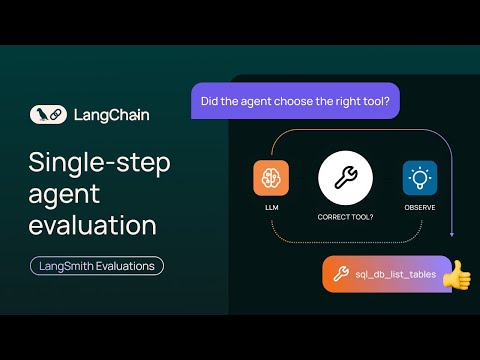
0:48 is we talk through in detail now the second thing you can do is think about evaluating a single step in this agent so typically what this looks like is you might evaluate given an input do I call the right tool so let's show how to let kind of blid that out again when we look at tool use right really what you're doing is you have an llm you're binding a tool to it or so a set of tools
1:09 typically and given an input you're just kind of checking whether or not the right tool is called so this is actually really useful especially because so many different llms right now have tool calling you may want to evaluate like how well is it actually working in my case with my tools so this is a really good eval to think about now this is The Notebook we already talked through so just in case you hadn't seen it yet
1:30 this basically sets up a lang graph agent for SQL so I'm using chin chinuk DB so this is kind of all the code we already talked through this is basically setting up my Lang graph agent this is kind of defining all the different tools I want so I'm using the SQL toolkit and I'm defining two custom tools right here this query Checker and then this result Checker so those are my tools I Define my state I Define my agent and
1:57 again we talked through this already so you know you can proceed the prior video if you wanted to see a little bit more explanation here lay out my graph and there you go you can see the graph we always showed how you can run this as a test now we just talk through response evaluation and for that we built a data set of question answer pairs okay so that's what we have now let's talk about this single tool
2:19 evaluation so for this what's kind of nice is I don't even really need my agent all I need is basically just that llm tool invocation I can test that in isolations that's a nice little component I can I can test so this function basically just wraps that assistant runnable is basically you can go back and look that is basically just our SQL agent so or or sorry I should be more clear that is the llm that's part
2:42 of our agent so that is this piece okay llm tool to use and you can see you you put it in our agent like this so you have the llm it gets a prompt it makes decisions whether or not to use a tool and Lang graph orchestrates this by basically connecting this llm piece to a tool to node so this is like kind of your assistant node tool node and this goes in a circle but the key thing is
3:05 that llm node needs to be able to use choose the right tool at the right time so that's something you may absolutely want to evaluate okay so that's that's what this runnable is this is basically that llm node and isolation first I def find this very simple function that wraps my assistant runnable which we just talked through so again that assistant runnable is basically just going to invoke tool use or not so I'm going to basically
3:30 pass example questions from my data set which we talked about previously so I have five different questions related to my database I'm going to pass each example into my runnable right here and I'll get some result out now again if you look at our diagram here that result is either going to be a tool call or just a response of some type okay and all I'm going to do is in my evaluation function I'm just going to go ahead and
3:55 grab that response so that's what you see here and I'm going to extract the tool call if there is one now there may not be but that's fine I just try to catch it so if there's a tool call I get it and I compare the tool call to what I expected that's all I'm doing one if if it's correct else zero so this is a really simple way to build a custom evaluator that basically looks at
4:15 whether or not the tool called by your llm matches the tool you expect and this is very generally useful you can use this with you know many different llms that offer tool calling so I can go ahead and kick off an evaluation so again I'm just passing in my function here I'm passing in my data set name I'm passing in my custom evaluator that's all I need I go to my data set look at my experiments great and ran so I can
4:40 look at all my examples and here I can look at this is just like the raw output of my of my llm and you can see here's the input the output is indeed a tool call and it's calling the SQL DB list tables which is exactly what we want so basically the way to think about this is for our particular agent for any input question the first thing we've instructed to do is hit the SQL DB to
5:02 list the tables okay so for all cases we expect this is the tool that it'll call so that's just a really nice simple thing and I've hardcoded that in my evaluation function if I go back and look I can see one one one one so these are my single tool call scores and they're all correct so basically my agent or in this case it's just my llm I'm testing in isolation is correctly for every input question calling that
5:27 SQL DB list tables you can see them all right here so this is a good example of a really simple single step evaluation you can do in my particular case I always expected for any of input question that this tool will be called and so that's why I can hardcode it now you can also be more sophisticated here because you could put this tool name in your eval set as a reference and then for if for example if
5:55 different questions or prompts basically elicited different tools you can encode all that and very simply run that evaluation as well so this is showing like the simplest case where you hardcode your tool call but you can absolutely do more sophisticated things like basically put this tool call in your in your data set as a reference you could run the eval that way so again really simple very useful eval and very useful for evaluating different llms that all offer tool calling thanks
Summary
- Overview of a basic agent architecture using Lang graph, where an LLM decides whether to call a tool based on input.
- Three types of evaluations discussed: final response evaluation, single step evaluation, and tool invocation correctness.
- A practical example is provided using a SQL agent setup with custom tools for query and result checking.
- The evaluation process involves testing LLM tool invocation in isolation, comparing actual tool calls to expected ones.
- The evaluation function captures tool calls and assesses their correctness, yielding a simple score system.
- The video highlights the flexibility of the evaluation approach, allowing for more sophisticated setups where expected tool calls can be referenced from a dataset.
- Emphasizes the utility of this evaluation method across various LLMs that support tool calling.
Questions Answered
What is the basic structure of agent evaluation in Lang graph?
The section introduces the concept of agent evaluation, explaining the architecture of a Lang graph agent, which involves an LLM making decisions to call tools based on inputs. It outlines the process of evaluating the final response and evaluating single steps in the agent's decision-making.
How do you set up a Lang graph agent for SQL evaluation?
The section discusses the setup of a Lang graph agent specifically for SQL, using a notebook to define tools and state. It emphasizes the importance of evaluating tool usage effectiveness in the context of different LLMs.
How can you evaluate LLM tool invocation in isolation?
This section explains how to isolate the LLM tool invocation for evaluation, allowing for testing without the full agent context. It describes passing example questions to the LLM and obtaining results, which can either be tool calls or direct responses.
What is a custom evaluator for tool calls and how does it work?
The section details the creation of a custom evaluator that checks whether the tool called by the LLM matches the expected tool. It describes a simple scoring system to assess the correctness of tool calls.
How can you evaluate the accuracy of tool calls in an LLM?
This section discusses the evaluation results of tool calls, showing that the LLM correctly calls the expected SQL tool for all input questions. It also mentions the possibility of more sophisticated evaluations by referencing tool names in the dataset.