Section Insights
Current State of AI Adoption in Enterprises
Where are companies really at with AI?
Most enterprises are still in the early stages of AI adoption, often overestimating their progress. While many believe they are advanced, the reality is that most are not effectively utilizing AI yet.
- Enterprises are generally in the first two phases of AI adoption.
- Many companies lack the necessary understanding of how to implement AI effectively.
- There will not be an overnight shift to AI-driven operations; it will take years for proper deployment.
Leveraging Partnerships for Market Entry
How can startups effectively enter the enterprise market?
Startups can gain access to enterprises by partnering with established companies that already have distribution channels. This approach can help them overcome barriers to entry.
- Partnerships with larger companies can provide crucial access to enterprise clients.
- Startups should focus on aligning their product offerings with the needs of potential partners.
- Understanding the enterprise's requirements can facilitate faster market entry.
The Future of SaaS in Enterprises
Have enterprises moved past the idea of coding their own software?
Yes, the initial excitement around enterprises coding their own software has diminished. Companies are realizing the practicality of using existing SaaS solutions rather than building their own applications.
- The trend of enterprises creating their own applications is declining.
- SaaS is becoming more established as a system of record for data management.
- Enterprises prefer simple solutions over complex custom-built applications.
Importance of Domain Knowledge in AI Solutions
What is crucial for deploying AI solutions in enterprises?
Having a deep understanding of the enterprise's domain, data sets, and workflows is essential for successfully deploying AI solutions.
- Domain knowledge helps in tailoring AI solutions to specific enterprise needs.
- Understanding workflows is critical for the adoption of AI technologies.
- Successful AI deployment requires both technical and contextual knowledge.
Finding Key Advocates in Enterprises
How can startups identify key advocates within enterprises?
Startups can find advocates by engaging with communities that have previously adopted their technology or similar solutions. Networking at conferences and targeting users of legacy systems can also be effective.
- Engaging with existing communities can help identify potential advocates.
- Targeting users of legacy systems can provide a pathway to demonstrate product superiority.
- Building relationships at industry events is crucial for startup visibility.
Transcript
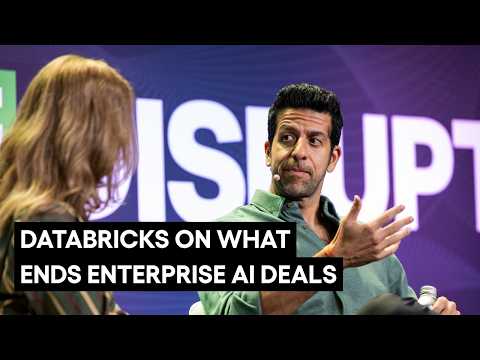
0:02 Hi Arsalan. >> How are you? >> Welcome to Disrupt. >> Thanks for having me. >> So, for those who don't know, Arsalan's a co-founder of Databricks, the senior VP of field engineering. Databricks was founded in 2013. This was 2 years before OpenAI was even a twinkle in Sam Altman's eye. It's long before we stumbled upon ChatGPT. Today, your company is valued at 190 billion, and it's a leader in enterprise AI.
0:33 So, today we're going to talk about selling into the enterprise, what the enterprise is doing with AI. But before we get to those kinds of specific questions, I just want to get like a a feeling. Like here in the Valley bubble, we're all seem we're building for the day when all the humans have agents at work home and everywhere. And maybe maybe humans aren't even involved work it out all anymore. But outside in the Valley, where where are companies really at with AI?
1:06 >> it's a it's a great question. short answer is not very far at all. right, there's kind of I jokingly say there's like five phases. We don't have to go through like one is that you're not really using it. And I don't count asking ChatGPT a question as using AI. And five is like you have new capabilities you've let out. I'll always go in a room of enterprise and say, "Where are you Where do you guys think you are of one to five?" And everybody loves picking I'm three leaning towards four. This is safe place.
1:36 99% of the ones I talk to are in bucket one and two, right? And the reality is not just the tech. They it's people and processes learning like how do I use AI? How do I get value out of it? Like there's a lot of hard things. There's I don't see there being some overnight change where everybody's going to massively be run by agents. It's going to take many, many years before people can actually properly deploy AI in a very mean meaningful way in the enterprise.
2:01 >> So, are they mostly at the point where like they've got Claude for their engineering team? Or not even there? >> No, I I think it depends on the organization that you're talking about, right? I think in the valley we think about everybody has this large engineering work. That isn't true of everything. I think people are farther along on using a coding tool for engineering. It's for everywhere else. And then even when they're using their coding tools, if you ask them what is your ROI? How much benefit have you got? Are you really controlling costs? You'll get a hand-wavy answers.
2:32 There's a lot more being built. Whether it's allowing them to ship faster deliver better capabilities is, you know, far from a certain outcome for any of them still. >> Okay, so outside of the valley we're sort of at, I don't know, early 2025 levels maybe. >> Early enough, yes. I think >> Okay. So, we are going to have time for questions audience audience questions. So, we've got mics set up and I'll I'll let you know when it's time to line up, but start thinking of your questions. We will save time for that.
3:05 So, All right, let's just go right into what everyone's thinking. Like, what's the biggest misconception most startups have when selling tech products to enterprises? >> Ooh, this is a fun question. it's not one of the ones you said you were going to ask, so I like it. >> >> one of one of the biggest misconceptions, I think first off, I think everybody when they're selling to enterprises at startups, they think it's all about the tech. And so, I would walk in there, you know, in the early days of Databricks, I was like, "Okay, we're going to go into an enterprise. I think we have the best what was known as Spark distribution.
3:43 We have the best Spark distribution. It's faster. It's greater than that. it's going to win. The best tech is going to win." we learned very quickly that people and processes matter the most. You walked into a room and you didn't realize I want to talk to you about my new technology, but this guy is the guy that signed the contract for one of our competitors 2 years ago and he has no interest in listening to me cuz he cuz he bet his career on that competitor or he doesn't want in order to convince him to do something, he's got to get approval for these three other people. He's got to go to legal and security. And so the amount of time that you spend finding people, what makes them tick, how do you get them to adopt it, that is where you spend most of your time. Whereas as technologists, we think it's all about the tech and having the best tech and the latest product or feature. And that was I think a sobering moment in the early days as we went to enterprises realizing it's why you get large, you know, kind of sales organizations who've sold into the enterprise before cuz they understand how to navigate that org.
4:42 It's very hard often times for technologists. >> Yeah, you said something just in the back room there that I found really fascinating and you said sort of the light bulb moment for Databricks was when you partnered with a larger company that was already selling to the enterprises. >> Yeah. So, look, in the early days so Databricks for the first I would say about 3 years predominantly, I think like 90% of our basically like sales were to digital native small medium businesses for a variety of reasons.
5:16 And when we went into the enterprises there was a bunch of messes that I'm happy to, you know, share, you know, if you want on there. Mistakes that we made like having me play a lawyer cuz I thought that I had seen enough Law & Order so I knew how to negotiate it. That was >> You have to wait, wait, wait, stop. You have to tell this story. What What? You pretended to be a lawyer? >> pretended to be a lawyer, but I was like I was like, "Hey, we don't have a lawyer. It's expensive to pay for it. I can negotiate this contract." And I remember coming back to our CEO, I was like, "Listen, this is great. They're willing to sign.
5:52 We just have to give them like some stupid thing like unlimited liability. Like, we'll indemnify them for everything and they'll sign." They were like, "This is a great idea." Later on when we actually got a lawyer, they're like, "Who is responsible for these? We need to spend 4 years unwinding these things, right?" So, there was a bunch of those, but >> funny. >> you get into a large organization. Like, I remember you know, it was a large Swiss bank like UBS. We were trying to get into it beforehand to figure out how you get to it cuz they have 13 CIOs and all that. We could We did a partnership with Microsoft, right? and so Databricks it became Azure Databricks, a first-party service, which meant it was on Microsoft paper, you know, Microsoft's like terms, like customers who had Microsoft agreements could just use it without needing to sign another paper. And all of a sudden, that meeting that was hard to get, the next week the Microsoft rep is like, "Hey, we're going to meet with the global CIO of UBS. We think Azure Databricks is great. Come in there." So, it was a huge boon to us that we were able to partner with somebody who had that access and distribution, and our product fit an area that we need. We started getting pulled everywhere. I had other problems where they would call me say, "Arsalan, I need your top" and we're like a small company, "I need your top two basically like Thai-speaking essays that live in Singapore." And I was like, "I don't have any essays in Singapore, much less Thai-speaking ones." So, but that was a way that we kind of shortcut getting into the enterprise riding on their coattails.
7:19 >> Okay, so that's really interesting. That's a great tip and not one that I think a lot of startups I talk to you know about. Most of the ones that I've been talking to lately have been hitting their head against how do I get enterprises to buy my product? Not just buy my product, but just not make me wait a year to do it and do 27 meetings and shoot offs. >> Yeah. >> So, it sounds Now, you guys are on the flip side, right? So, now you guys you have your own VC firm or your arm and and you're investing in startups, but you're also doing some go-to-market with startups. Can you tell me a little bit about how that's working?
7:56 >> Yeah, so we do a bunch with them, right? Cuz look, don't tell all the stodgy enterprises, but you know, like I think most of the innovation, especially in this space coming is coming from many of the startups, right? Digital natives and startups. And so, when we go in with startups, I think that there's a a couple of pieces that we have. One, the model as people are saying like in the old days you would build these kind of monolithic stacks that you have to sell software that was like the data, the platform, security, and everything. Now, everybody is saying I actually want to build a composable app, which means I run on, you know, kind of open data and AI architecture, which Databricks provides.
8:33 So, we do a lot of partnerships with you know, basically startups where we effectively say either built on where we underpin their product to go do it, or we basically have inside the product a customer says, "I need this need." I'm like, "Hey, you can click a button with this startup and you can deploy it immediately on top of Databricks inside of the security perimeter." So, they bypass all of the hard parts, which is where do I find the data? How do I connect to it? How do I then basically get through security? How do I find the buyer? And with many of these startups, we also do, you know, partnerships of things that are known like MDF, market development funds, where we do events with them, we're bringing to all of our customers to to see it as well.
9:12 Customers can kind of use the big commit what they did with Databricks to draw down on that for spend on them. So, it's kind of it's a win-win because for them, they're getting distribution, and for us, right? We're ultimately a platform being able to show the customers we can build the best bring the best new innovation into your platform as well. We've had it's been great seeing the success there. >> Can you give me an example of the type of startup that gets this special treatment?
9:38 >> so there's basically different ones, right? If you say from a customer space, right? You would talk about something like HighTouch, which does an incredible like customer data platform. Every customer wants to know 360. So HighTouch comes in there. We do a bunch of joint events together. In the financial space, like Ad Abar is a basically a very very you know, cool company for kind of financial analysts. They want to connect to open data. They basically come in and we do events together. And then we've also done a bunch with kind of let's call it more horizontal platforms. Like we did it with Tecton in the machine learning space. We had done it with you know, DBT in the data modeling space and many other ones. So these are all ones that they basically provided features around Databricks as a platform either above to the side that we did joint events and then we had really healthy pipeline of the and they got a ton of new customers that they were able to build into.
10:30 >> You've talked about how much work enterprises need to do before they can get AI agents even up and going. So it's things like teaching the agents the company's context and ensuring it doesn't grab like outdated documents from years ago. So can you talk me through a little bit like a lot of founders in here or a lot of founders in Silicon Valley right now are building agents that do X for the enterprise. They have to solve some of these problems before they even make it their foot in the door. So can you walk through some of the things that you're seeing that need to be solved before agents can come in and be employees at the enterprise?
11:05 >> Sure. and you're going to have to you know, excuse me as you basically get into larger and larger enterprises, you have to come up with cheesy mnemonics about it, right? So for me, I think about like like whenever I go to an enterprise, they care about four C's. Like the first one is context, right? And so why do you care about What does context even mean? It's like this weird word. We talk about context, semantics, ontology. You have all of your raw data, but somewhere in the line think about when you bring on an agent, it's like bringing on a new employee. You want to explain all the certain things like at Databricks, what is a calendar quarter versus a fiscal quarter, what is a Mia, what are our strategic products, how do we You need to teach it all of these things so it can give you good answers. And the reason you do that is you give a normal coding agent without context, take your best one, you won't get better than 50% accuracy. With context, you can jump up north of 90%.
11:56 So, one is like how do I build context? And I've got to do it outside of like tying it to one model or the other. That's one. Second is people care a lot about choice because, you know, the answer was, and I'm going to get in trouble for this, like a year ago the answer was like OpenAI was crushing it. 6 months ago it was like Google and Gemini, like they Google's figured it out, they're going to do it. 3 months ago, the only company that will exist in the world is Anthropic. And then now it's like maybe it's Grok and SpaceX, maybe it's OpenAI again, maybe it's the open weight model.
12:27 So, it's like people are like how do I get choice? Nobody wants to bind themselves to like pick a winner. Why should they? Third is a big deal for them is that they need cost. Like the spend is going through the roof, so they need some way to control it with budgets. And then lastly, you need some form of controlling the agents, right? So, everybody reads the story of this hack or that hack, and nobody wants to be the one that says, "I'm a bank. I let the agents go wild and I leaked people's social security numbers or credit card numbers." So, they're all looking at can you give me something that gives me these core like basically four pillars to be able to run it. First startup, that's a lot to ask them to do, which is where we partner because they don't have our own, you know, foundation models, nor are we domain experts, but this is what we are good at. We're good at, you know, kind of data and AI, all these things. We said cost, control, context. So, that's typically where we partner. They say, "If you can nail that, I can come and deploy all of my agents and get them going faster." It's kind of a win-win for us.
13:28 >> So, we're going to take questions in about a minute. So, if you have questions, you can start lining up, please. >> She's very interested to see who's brave enough to ask the first question, by the way. >> >> There was a short time this year when the world was worried that Enterprise would be vibe coding all their own software, ditch SaaS, all that stuff. I I'd argue we've moved past that. Like, we all kind of realized that they're not going to do that anymore than they were eating all their other apps, but it and it seems like SaaS is going to become like a systems of record hosting data. Would you agree that we've moved both past that ability or that or or not the ability, but moved past that sort of fear and that SaaS is going to become system of systems of record?
14:18 >> Look, I think we've we've moved past the vibe coding. I think there was an element where everybody was super There's this thing that people love the concept of feeling like they're technical. And there's no better way to say that I'm technical than I built stuff, right? Like, that's really exciting. and everybody internally is like, I got access to these tools. I'm building an app for everything, but it was overblown. Like, my favorite example was that I think our CEO kind of got super upset.
14:48 He asked, "Hey, I want to send a survey out to our field and ask them one question." And somebody was like, "Look, I vibe coded this app that they log." And he's like, "Why the F do I need an app? It's literally a question. Give me a Google form. Give me an email." Like, like, I think everybody came to the answer The answer isn't an app. Then let me know what the question is. So, I think that and people are very quickly realizing building something is like fun, but you don't want to maintain it cuz if it's successful, what about support?
15:17 What about outages? I think what is inevitably happening and you referred to it is the era of everybody running these applications which are like stove piped like separate stores of data in a proprietary format. They all do the that era is over. That era is ending. Everybody is now saying how do I bring all of the data I think that the govern system of record which you talk about is like you have open data. You have and then you have governance around it which is many of the things we talked about and you have context or ontology. That's what you build and then you let everybody build applications on top. I think that's the world that's coming. We're already seeing that happen and I think that the big difference instead of everybody's going to vibe code of stuff is pick a vendor that basically has their position because of their monopoly and there's many of them in the SaaS space that you're like I have to do it. I don't like them. I have to.
16:07 >> Yeah, one starts with an O. >> You know, you now you're definitely going to get me in trouble. She's like does it start with an S or an O? >> One starts WITH AN S. >> THE LAST LETTER CAN FILL IN THE MIDDLE. I think the short answer is 12 months from now anyone where people spend material information there's material spend. Monopolies will not exist anymore because the cost of building software has come down. So there's a bunch of startups hopefully many of the people in this room that look and say their margin is my opportunity. So I can build and the cost of migrating has gone down so much so customer enterprises can easily switch between different ones as well.
16:44 >> So what types of things are enterprises vibe coding that they would never buy from a startup? >> I think it's a good question. I think that we'll see it over time. It's mainly where I see people doing stuff is instead of building full-blown apps, it's really doing last mile customization for stuff. So let me give you a sense of what I mean. There is a lot of workflows that if you look at in the enterprise what it really is is it's just a dashboard or dashboard with a a of buttons, right? If you you know, so as an example, I'm going to buy a platform that gives me data and a dashboarding, but I don't need somebody to come I don't need to go get a vendor that tells me how do I look at like my team's token spend or how do I figure out how I want my sales team to kind of follow these eight steps? Like that's really easy for me to build, but I'm more customizing the last hop of some of these agents, right? So, I think those are the areas where you see people are doing the last hop tailoring. I don't think you're going to see a lot of people sitting down and saying, "I'm going to build something from scratch."
17:49 Cuz as an example, if I go talk to, you know, I go talk to UHG for healthcare or if I go talk to J&J for pharma, the list of compliance requirements is pretty long, right? And you don't want to vibe code and basically deal with that. So, for any major application where it needs compliance, you still want external. It's that customization. >> The the user interface level. They're they're vibe coding like mad for that. Oh, okay. First question.
18:15 >> Hello. firstly, thank you for sharing your experience. like as an engineer, you were able to go in as a lawyer and you know, things didn't turn out fine. >> >> Would not recommend it. But let's continue. you know, part of what I was thinking is thank you for sharing around cost you know, control and contacts. as the models get cheaper and you know, as the sort of world change, how what's the framework to think about what is it that you want to own? What is it that you'll allow model providers to continue to sort of give? There's sort of a dance there. How do you know as it gets smarter what are you going to start to relegate and trust in that direction versus what an enterprise or a startup will continue to want to have control and governance over?
18:55 >> so, it's a good question, right? Look, first off, I will I will tell you something which is the current and sorry, I'm going to date myself on this one. Like the current fixation on model reminds me of the early days when we're putting together our own computers where you're like, "I have a Pentium 50, I have a Pentium 66, I have a Pentium 75 or whatever. And at some point you're like, that's not the long pole in the tent, right? You have like all of that and you have no memory so in the system.
19:22 So, for many of the tasks that people have, you do not need, you know, kind of a more powerful model. Like you do not need Fable 5.5 for drafting your email. I don't care how complex it is, right? so, one of it is like the existing model is good enough, but instead, how do you get value out of it? A lot of it is still how do you get connected to data? How do you do that? Second, I think a lot of the value of what people build on top cuz there's this tension where a lot of people are looking at it and worried as a startup of I'm a thin wrapper, is the next model going to basically just eat into everything that I've been doing? What is my moat, right?
19:57 That's kind of a version of what you're asking. I think it's do you have expertise in that particular domain? And by the way, the domain doesn't just mean data. It means workflows and understanding it, right? Cuz a lot of times of when you deploy. Like we went into like a large oil and gas company, right? And their hard part is not just I set agents out. It's somebody needs to go and figure out this is the process all the way from upstream to downstream. How do we think about finding oil? How do we think of who do we tell to next? How do we think about targeting it? How do we think about moving Understanding that allows you to deploy a solution for them much faster. So, it's like how much domain knowledge do you actually have in there? How much do you understand the data sets? How do you understand the data models? And how do you know how to speak the language of people in that organization? That's a big part, right?
20:44 I think that you're going to see one, the models get better. Now everybody's also trying to figure out what is the form factor, which by the way, I don't think everybody's going to create their own. You saw first it was like I have a chatbot, then it's like I kind of have semi-proactive. Now the answer is everybody wants these long-running horizon agents. It's Muse, it's Dots, it's basically like Instinct determines like that's where you're going to go.
21:07 I think that the bigger answers for all of those is do you understand the workflows? Can you codify that, you know, kind of context and have the know-how to how you can transform organizations to adopt it? That's the big piece for me. I think that there's going to be other kinds of innovations, but that's the stuff that the models are not going to be good at, nor are they going to pick up over time. It's not just a matter of the model getting better. Those are outputs from outside.
21:31 >> Thank you. >> Yep. >> Once upon a time, your company was a tiny startup. I know, that's like way back. >> We still call ourselves a startup, but apparently it's not allowed. >> A tiny startup. >> Okay. >> so, tell us the story of how Databricks landed its first big enterprise customer. >> Ooh. That was you know, I can tell you how we landed our first big customer or where the things that we struggled with.
21:57 So, look, we Databricks made three bets, you know, like betting on secular trends when we started the company, which is what also made it hard to land an enterprise. We said, one, we're going to bet on the public cloud. And you've got to remember, this is 2013. Like, the feedback we get from people is why are you going to go somewhere that nobody puts any actual real workloads on, >> >> right? Second is that we said that you're going to like, I think data and AI need to come together. Now, back then it was data and ML and advanced analytics, but like, that was going to be the case. And the third was that we were big believers in open source. Which again, you know, most people were like, I don't know, enterprises. Red Hat was the only one, you know, and we said, you know, Red Hat was the only success story. Technically, they got caught, sold to IBM, so we can debate how much of a success story that was. Sorry to the IBMers.
22:50 But look, those were the three. And so, when you went into an enterprise, I still remember you know, a couple of the first ones that we tried to go in. And And this one I'll definitely get to. chuckle. So, one was we went into Disney. I remember going into Disney in the early days. and we're like, we should use our platform. He's like, "Where are you from compliance? Like, how good are you at compliance?" And we went through all of our security stuff. And then we're like, "Okay, we're small startup. We need to get somebody in here.
23:19 and so we went and asked the ops person who were like, he actually can talk about security and ops. That was a bad idea because >> >> he didn't read the context. And I'll never forget the customer, our CRO was in the room. He put the ops person on there and he said, "Fire away. What questions do you have?" And I remember the Disney CISO said, "How confident are you that you can prevent anybody using Databricks's platform?" And I will never forget these words, "for putting child porn into basically Disney's like Databricks account that could leak out." And the guy didn't even miss a beat. He's like, "No, we can't guarantee that."
23:59 >> >> NOT THE THAT'S NOT EXACTLY HOW I would have answered that question, right? And so I was like, "Okay, that the deal died on the vine right there." It took us a while before we could come back to Disney, to be frank. I think that there was another one where I remember one of our earliest customers. And we were adamantly opposed. I told you we were public cloud business. We were only going to go into on the public cloud. And it was Capital One was the customer.
24:27 And they were in the cloud, but they wanted control of everything. And we hired really, really good solution architects. And he came back and said, "Great news, guys. you know, you told me to do whatever was necessary to get this enterprise customer using it, and they love the platform." And our CEO was like, "This is great. What did you do?" He's like, "Well, I took all of the source code for Databricks, downloaded it, built it into a jar, and deployed it in their environment entirely on their own. And it works great." So, I was like, "So, you basically just gave gave an on-prem version of the software?" And they're like, "They loved Satisfied all the security. We're like, okay, that's also not what we wanted to do. So, there was a bunch of these early takes that we got and, you know, honestly, it helped to hone the product for a long time and then find enterprises that were more willing to bet with us. Like, Capital One was always known as being on the cutting edge and kind of working with you. And so, that was one of the early ones that we looked at. There was another one like Viacom as a media company data and analytics. They were willing to kind of early on say, "How do we deploy in pockets?" So, you found those, they helped you understand what kind of compliance and regulation was there, and they gave you credibility to be able to walk into the next one of NBC and say, "We worked with Viacom." and walk into JPMC and say, "We worked with Capital One." and use that to kind of snowball into additional pieces.
25:44 >> So, you too can become a $190 billion company if you tell Disney it's not impossible to teleport once they're on their network. So, never fear. If you can come back from that, that's awesome. But, so Gabe, if you were launching a startup today and you work with a lot of startups, this isn't very far from your imagination, but what couple of things would you do to gain traction with those first marquee enterprise customers?
26:14 >> I think you've got Look, with the enterprise customers, what's the the way that it works for all of them is there are 15 people along the way who are ready to say no. Right? You're going to go to the person who wants budget, the person who wants legal, the person who wants security, whatever. And the way that you get around that is, you know, I would, you know, liken it to the example of like, hey, if you by yourself go ask for, you know, a specialist, they'll say 8 months, but if you get a really, really good doctor who picks up the phone, you can get there in basically like a week. Same thing.
26:47 You've got to find somebody who is a change agent, who's willing to fight for you and champion for you. And for that, you've got to figure out a hard problem that they have that you can solve. And for us, there was many of these folks that were trying to figure out how do we have like Spark was really hard to use back then. Can you give me an easy version that you give me an environment that is fully managed and works well? I can see the productivity benefit. And if you get them sold, they will basically shepherd you through. So, I think that that's the most important one. They have all these sales >> Where do you find find that person in an enterprise? Like at conferences or >> Yeah, I think that I think that there's different ways of doing it. For us, one of our, you know, kind of secret sauces was way before we started Databricks, we was, you know, Spark was an open source project. So, we had these like this whole community that we had built. And this community was people who had adopted the We knew either you had adopted the open source version. So, we went and found the people who adopted the open source version and said, "Hey, what if we give you a managed version?"
27:48 So, I think that that resonated with them. Second, we then went to a lot of people that was public back then. Spark was looking to be the successor to something called Hadoop, which was, you know, popular but broken. So, then you went, "Okay, I'm going to go to all of these conferences and see who are the Hadoop users and be able to go to the Hadoop users and say, 'Hey, I can do what you can do. I can basically port your code over, but look how much better I can do.'" So, you basically found adjacencies to things that you thought that you had product market fit and you honed in on that persona.
28:18 >> That's That's a great tip. All right, we have time for one more question. I know it's the end of the day. >> I scared them all away. Oh. >> Yeah. I I know you have questions. I can feel it. >> So, I'm a public markets investor and I have question on the market side and the technology side as well. But, I'll go on the technology side first. So, any thoughts on the legacy systems that have existed in, you know, industries like financial services. You know, there are still systems where you have COBOL and, you know, all kinds of, you know, from like the way back, like, you know, dark ages stuff. So, do you have any insight on where that's going to go in the age of AI or maybe over the next decade or so? That's on the technical side. And then from market side, you talked a little bit about vibe coding going away, like, you know, people want this aura that they you know, their technical and, you know, all of that stuff. But, does that in any way compress margins to the extent where, you know, those SAS companies don't really go away, they just kind of linger around and then, you know, it's like they linger around but with a lower margin profile and, you know, do you see that happening now that the SAS apocalypse is seem seems to be over?
29:40 >> Yeah. I like how we waited till the end. He's like, I have a two-part deep like meaning life question. you know, >> Who's going to fail? It's basically predict who's going to fail. >> Great. So, look, I think that there's a couple of ways to that. So, I'll basically give like the high-level answer to that one. one, I do think that the legacy places that you basically the legacy technologies that you talked about are going to get modernized and, you know, kind of move out. But, maybe not in the way that you think about them, right?
30:17 I think one of the reasons that most people have not touched legacy stuff. Like, if you go to any bank today, they still have AS/400s and they have mainframes sitting out there. And, you know, the person who wrote that code has been replaced by a person who's been replaced by a person who were celebrating their retirements today, right? Like, it's like that kind of piece. And nobody wanted to touch it cuz nobody knew what that code did, right? I think that the the big difference that's happening now is you're able to deploy agents where things that are complex for humans agents can go in and understand and actually decompose what that code does, how does it work, right? And we've seen people do that for like people who wrote COBOL code or ABAP code for kind of SAP. So, you can actually understand what they did well and move them to modern systems. That's one.
30:59 I think the second thing is if they work well, you would say you don't want to use that cuz you're like, I don't know COBOL, I don't know this interface is crappy, but when a bunch of software is actually the connecting to the systems is going to be done by agents, that's less of an issue. If it's working in as long as they have an interface and agents can go grab the data and do what they need. So, I think you're going to modernize it, but it'll first be kind of modernizing the interface that people work with it. And then over time, I think as people move, it's not necessarily that they'll migrate. Those new agents will basically have new workflows and people will put net new data in the new systems of records. So, I think that that is I think that that is a big thing that's going to happen.
31:36 So, you're going to see like I truly do believe 5 like 95% of the software that we will use 5 years from now doesn't exist today. That doesn't mean that vendors are getting replaced, but it means you're modernizing first from the interface and that allows you to move the basically the system of records over time. That's going to come across. And as I mentioned, the cost of migration has gone down, right? I think the second thing that you asked about on the public market side and I thought like I thought you were going to end it asking me when are we going to IPO and I was just going to >> >> you know kind of go off on a tangent. So, thanks for the margin question.
32:08 Look, I think margins are going to come under pressure. I think that there that's only sensible in looking at it, right? Then different people disagree, but here's my sense. you have a bunch of places where you had a moat, right? And your moat maybe you're a monopoly, you understood the workflow, you you could basically like charge customers a lot. That point that I said earlier is hey, your margin is my opportunity. Now you're going to have competition cuz somebody's going to come build something modern. and the second thing that you're going to have happen on top of that that you say like somebody else is going to come, you know, into this is the cost of migration went lower. So, what's going to happen? You You basically were selling this deal for $100 with great margin. Somebody else comes in, you're not going to let them move away. You're going to start cutting your prices to kind of compete. So, you're naturally compressing margin. So, there's going to be this big push that people are going to have to say gross margins are coming down, on some piece. Can I squeeze on other places outside of my opex stuff to basically be able to pay for some of that? Or am I What am I going to do is now because cost of building is going down, I'm going to go into 10 or 20 more new areas to find new sources of revenue. So, I think that roller coaster that we're going to sit on is going to be the case.
33:20 And candidly this has happened to every industry other than tech. Tech is just kind of an insulated. And now I think in the AI era where it's like cost of building has come low, switching costs are kind of coming low, we're going to see some of the similar pressures on margin. >> Fascinating. If agents actually like save Cobalt. >> >> Save is a strong word, right? You know, but yes. >> Well, thank you so much. You were full of tips. You were full of fun stories.
33:48 It's It was a pleasure to have you at Disrupt. >> Thanks for having me. Thank you, guys.
Summary
- Most enterprises are at a low level of AI adoption, often not utilizing it effectively.
- Startups often mistakenly believe that having superior technology alone will win enterprise contracts; understanding people and processes is crucial.
- Partnering with established companies can significantly ease entry into enterprise markets.
- Successful enterprise sales require identifying and engaging change agents within organizations who can champion the product.
- Key factors for deploying AI effectively in enterprises include context, choice, cost control, and governance.
- Legacy systems in industries like finance will be modernized through AI, but the transition will be gradual and involve new workflows.
- Margins for SaaS companies may compress as competition increases and the cost of switching providers decreases.
Questions Answered
Where are companies really at with AI?
Most enterprises are still in the early stages of AI adoption, often overestimating their progress. While many believe they are advanced, the reality is that most are not effectively utilizing AI yet.
How can startups effectively enter the enterprise market?
Startups can gain access to enterprises by partnering with established companies that already have distribution channels. This approach can help them overcome barriers to entry.
Have enterprises moved past the idea of coding their own software?
Yes, the initial excitement around enterprises coding their own software has diminished. Companies are realizing the practicality of using existing SaaS solutions rather than building their own applications.
What is crucial for deploying AI solutions in enterprises?
Having a deep understanding of the enterprise's domain, data sets, and workflows is essential for successfully deploying AI solutions.
How can startups identify key advocates within enterprises?
Startups can find advocates by engaging with communities that have previously adopted their technology or similar solutions. Networking at conferences and targeting users of legacy systems can also be effective.