Transcript
0:00 Please welcome Semaphor's Ben Smith. >> Appreciate the one person applauding. it's great to see you all again this morning. and and after just an amazing day of conversation. And you know when when we when we started building this platform just basically about a year ago it was based on this sort of intuition this sense that that Silicon Valley and Glo and global capitals and and Washington but but others as well were on a kind of collision course. last year basically felt like felt like the collision which for those of us in the news business made it a incredibly kind of energizing and exciting moment to be having these conversations. But of course, the the story is so far from over and and and the thing that I have heard and have felt over the course of yesterday is just how inextricably linked at this moment political power is with the future of the tech industry and these huge these huge breakthroughs that we've been you know that we've been covering. And so we feel really lucky to be here with you all at this particular moment. Last yesterday we heard you know from we began the day hearing from Sam Alman talking about how Jensen Wong is his hero. ended the day at a dinner where Calun al- Mubarak told us that winter is coming but that he hopes it won't be like a negative 30°ree winter just a a mild winter. and had government officials from Singapore to Washington DC you know reacting to these very urgent crises that they're that they're managing right now. so thank you all so much for for being here and we're we're excited for another day of conversations. beginning this morning with CNBC's Kate Rooney in conversation with Andy Jasse and and and then end at 100 p.m. today. If you haven't seen yet on the program, Jeff Bezos will be here talking to our Liz Hoffman hopefully also heckling Andy Jasse this morning. so thank you all so much for joining us and look forward to the conversations through the day.
2:18 Please welcome Andy Jasse of Amazon and Kate Rooney of CNBC. >> >> All right. Andy, it's great to see you in person. >> Great to be here with you. >> Welcome to the Bay Area. >> Yeah, thank you. >> what a great event. Thank you so much for for having us. nothing going on. Gosh, I wish we had more to talk about. There's it's been a very busy news week. but I think AI is just such an interesting part of obviously Amazon's business. I've heard you on so many earnings calls talk about how consistently bullish you are, how big the opportunity is, but it's been interesting. We were just talking backstage about kind of the difference in in Wall Street's reactions. It can fluctuate more than than your message on AI. Give us sort of the big picture on what you're seeing, what signals you're seeing that actually justify all of the spending, 220 billion in capex that you're about to spend. Well, you know, I I think this is the most transformative technology that we've experienced in our lifetime, which is saying a lot given what we've been through. And I I look back on the beginning of AWS and we felt like the business was growing really fast in the beginning. In the first three years, we had about a 57 million annual revenue run rate. And in the first three years of this generative AI wave, just in AI revenue, we it's over$2 billion. So about 440 times faster than the way we grew in AWS when we thought we were growing fast. So it is growing unbelievably quickly. you know I look at the demand that we have you know we always save a significant amount of demand for ondemand you know for for services like EC2 and bedrock our infant service but the big chunks of capacity are largely reserved already in 27.
4:09 much of it is reserved already in 28 and a good chunk in 29. So we we have very clear very substantial demand signals that are unlike anything we've ever seen before. Now the way that the cash cycle works in a business like AWS is that you have to spend the cash for data centers and for servers and networking gear well in advance of when you can monetize it. So when you're growing at this unprecedented rate like I mentioned, you end up having a lot of capbacks which you know creates some headwinds on your short-term free cash flow. But the economics of the business are such that once you get a few years out and you have all the data centers installed and you're monetizing with the servers and the networking gear that you have in place, you really like the free cash flow and the return of invested capital. And I I think we're going to be a much larger company. and AWS is going to be much larger business than we ever anticipated. We felt like when we were building AWS the last number of years, we we felt like AWS could be a few hundred billion dollar revenue run rate business. We now believe it can be over a trillion dollars in the next 5 to 10 years. and so I think we're going to be much larger company with much more revenue and free cash flow with a very strong return on invested capital.
5:25 >> How broad is the demand? That's one question that we hear that a lot of the power users in AI, sort of the 1% are making up most of the demand that it's very topheavy. A lot of these companies are also venturebacked which I think has caused some jitters. What do you see in terms of how broad it is and what the potential is for this to expand and more people to actually start using it versus sort of this this bubble that we're in in Silicon Valley?
5:48 >> Yeah. Well, I you know, I don't really think of it as bum bubble. I mean, it's it's pretty the demand is pretty diverse. You know, I I first I'd just say that today we don't have if you look at our backlog, which is about $580 billion, there's no one company that represents even a quarter of it. So, it's it's pretty diverse. you know, 80 over 80% of the Fortune 100 are using Bedrock or inference service. So, it's grown really quickly. I still think if you were going to zoom out and look at what the what the demand has looked like early on, it's it's been barbelled in that you have the AI labs who are consuming a lot of compute and some very significant applications like chat GPT or cloud code and then you have a lot of enterprises who are getting value out of AI today in cost avoidance and productivity. So automating customer service or business process automation or fraud and then in the middle of that barbell are all the current enterprise production applications.
6:53 increasingly are are using inference but still the vast majority of them are yet to use inference as pervasively as they will and that is you know that that is going to happen. To me it's not a question of if it's just when and a lot of what we're building right now is focused on trying to help enterprises get there. Do you get the bubble question a lot? And I wonder if there are pockets of AI that you worry about that are maybe overhyped. I mean, we've got this rate environment, interest rates are going up. Are there areas that you do worry about where you're building any sort of contingency plan within Amazon?
7:28 >> Well, I would, you know, for there different questions about whether we worry about it for Amazon versus, you know, are there areas that have more risk? I I would say from an Amazon perspective we feel very convicted about what we're building and that it's going to return very well for the company and for our shareholders. And it's because in part because of all the demand signals we see, but also if you think about when you spend the capital, the the biggest amount of capital that you spend is for the servers and networking gear. And so whereas with the data centers you have to lay out the capital about a couple years and ahead ahead of when you can monetize it for the servers and the networking gear it's just a few months.
8:10 So we have real visibility before we pull the trigger on that. If we don't see the demand we won't we won't do that. But so we feel very good about it from an Amazon perspective. you know there are I think it'll be interesting over time whether all the different players who are building data centers whether they have a broad enough business with enough services that you know they'll build long-term sustainable businesses and we'll have to see I mean there is it is growing so fast I can understand why a lot of people are interested in it >> when we talk about data centers midterms were a big moment for the data center backlash. What do you think the AI industry so far is getting wrong and why was there this public rebuke of data centers? I wonder just your thoughts about how this could be done better and what if anything a slowdown potential moratoriums in certain states will mean for your business.
9:06 >> Well, you know, look, everything that we do today is driven by data centers. You know, banking, trading stocks, shopping, entertainment, ride hailing, ordering food. I mean everything we do in our lives runs through data centers and that's before AI which we just talked about as the most transformative technology of our time. And so you know I think that collectively in the country and really around the world we had not invested in upgrading the grid in a meaningful way in the way we were gonna we were going to need to. So at some point you were going to have to make a bunch of these investments. It just turned out AI happened. happened quickly that pushed a lot of these to happen sooner than than it otherwise would. I I think that we're in a moment of time right now where it's happening really quickly and and sometimes when things are happening quickly, you worry about it.
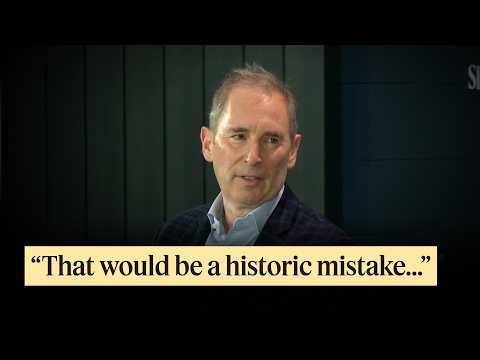
10:00 And but I I if you think about the type of buildout that's required for AI and and the pace it's growing that we're talking about, we haven't experienced a buildout like this of infrastructure in the United States since probably the 1950s when we were building out the highways and the bridges and we have to do it. I I I cannot fathom any scenario where the United States stops building data centers and allows another country like China to establish all the norms. Like I I think that would be a historic mistake by the United States that we would we would all regret for a very long time. I do think at the same time there are ways that we can all do it better with you know and and partner more closely with our communities. And I I think if you look at the data centers being built and they're being built quickly, there are differences between some of the companies that are doing it more responsibly and partnering with communities and those that aren't. I just think collectively as a group, we got to remember that we we are building it in neighborhoods. And you know, there are some there's a lot of good things in those neighborhoods, too. If you look at, for instance, in St. Joseph County in Indiana where we have a big presence.
11:10 You know, if you look at the next few years, we'll contribute over $3 billion of taxes, whereas the previous land owners contributed about a million dollars of taxes. All those taxes go towards the community. They go towards schools and utilities and things that matter in those neighborhoods. And so, you know, partnering with those communities, building programs like we've built with Built Together where we've contributed another billion dollars to things that matter in those neighborhoods and in those communities are important. And I think we can all partner better than we have in the past.
11:40 But I I also think it's I just cannot imagine a scenario where we allow ourselves to to to chase rather than to lead here. Are you talking to other CEOs and are there sort of bad actors that have done this the wrong way and given the industry a bad name here? >> This just a lot of there is a lot of building and some of it are cloud providers and some of it are you know real estate folks and some of it are just developers and you know we're not privy to all the folks that are doing We're just trying. We've set a set of standards that we think are really important to both partner well with communities and to have the infrastructure that people need and we're going to work hard to abide by.
12:20 >> I also wonder about the position that hyperscalers are in given that you have so many existing data centers. I've talked to other CEOs about this who actually say if there is a slowdown or some sort of moratorum, you guys might actually be advantaged here because you've already got these existing buildings. I've heard that theory too and it's I'm not saying it's wrong. We we do have we have a lot of infrastructure. We put a lot of capacity in in 2026. We're putting, you know, a substantially larger amount of that capacity in in 2027 and 2028, much of which is in progress, but it's not what we're rooting for. it it's incredibly important for the US to build out this this data center infrastructure so that we can allow the type of innovation and growth that that wants to happen here. So we we are rooting for the ability to build out that infrastructure and we're going to do everything we can to help.
13:12 >> We'll talk about geopolitics in a second. I want to get your take on Nvidia and some of the fallout with Jensen Wong this week. I know you don't know the details exactly but he was is such a central figure in the AI space. Nvidia is so central as a finance year to a lot of the startups. You use Nvidia chips. What is your take on what the Nvidia scandal has meant for the industry and will mean for for the tech industry in the near term?
13:37 >> You know, I I you know, I I have a lot of respect for Jensen. I have a lot of respect for Nvidia. They're a really important partner of ours and have been for a long time and will be for as long as I can foresee in the future. I I think the AI the growth in AI as we were just talking about is staggering and it's you know it's more than one company. It's it's a number of companies that are having unprecedented success and growth right now and I I you know I they'll have to work out how how they move forward as a company. But we'll be partners with them either way and I you know we're excited about what we're building.
14:15 >> Is there any impact on Amazon? I I don't think has an impact on Amazon. >> When you think about your own semiconductor business, you have this relationship with Nvidia. I sort of think of of it as a a friendmy relationship. You might push back on that, but you are very reliant on their chips, but you're also building this competitive custom silicon business. Export controls are now back in the spotlight. Does it change the way that you think about where you can sell your chips and and the the potential for this business overseas, especially in China?
14:48 >> Well, in the in the technology space, you you have to be used to coopetition. That's just it's how it works, especially Yeah. If you're if you're working across >> lots of different products like we are. And you're right, we we have we've had a very long and fruitful partnership with Nvidia and and I expect that to continue for as long as I can foresee and at the same time we're also building our own custom silicon in Trrenium which is you know doing incredibly well we you know the last time we talked about it which was in Q2 tranium had you know I'll say our chips business which is inclusive of both tranium which is our AI accelerator and graviton which is our CPU chip you know was over a $25 billion annual revenue run rate business. So we we have you know we have a very large offering on our own and the majority of what we actually use for bedrock which is our inference service which continues to grow real quickly that you know the majority of that are tranium chips and yet we also have Nvidia chips we use some of them ourselves we we have customers who use Nvidia and so I I expect that will continue to be the case for a long time and and you know I would say on the export controls you know we will abide by whatever the rules are And and that's you know in any country in which we operate that's what we have to do and that's what you hear too.
16:12 >> It seems like there's been two different camps. There is sort of the side of China shouldn't have access to the best US chips. And then there's the other camp which is we want US technology to be everywhere. We want that sort of to be the currency of the world. Where do you stand on on all those arguments? >> It's a it's a hard one. and I you know national security matters a lot. I understand both sides of that argument and you know and at different times we may choose different paths there but again we we have long abided by whatever the laws are of the land and and we'll do the same here.
16:49 >> You've spent time in DC though when you talk to the president is there any recommendation that you would make? Do you ever call Trump and say, "Okay, here's here's what I would do. I'll follow the rules, but what what's in your best interest?" >> Yeah. No, I don't call him with those recommendations. >> >> He's not calling you. >> All right, fair enough. anthropic is also, I mean, a major topic this week. They're set to price tomorrow, start listing on the NASDAQ. You were really early. Can you take us back to sort of that initial investment and what you saw in Anthropic and Daria Amade at the time?
17:22 >> Well, I mean, it it doesn't take a lot of studying to realize how talented that team is. and and we you know like a number of folks we we thought we were very impressed with Daario. We were very impressed with his founding team and and and the crew that he had assembled. I I thought they took a very thoughtful focused approach in building a model that was particularly good at coding and we had experience we you know we had a number of customers who wanted to run anthropics models on top of bedrock and on top of AWS's compute. So we had experience early with that and you know as we got to know the team you know we built a deep partnership you know a lot of what they've done in training models and running inferences on top of our custom silicon on top of tranium I think that we learned a lot from them and and hopefully we we helped them as well in the process and and we just have a lot of joint customers who want to run the anthropic models on top of our infrastructure. So that relationship was naturally bringing us together and then you know as we got closer to them we also we we believed in the company and we we wanted to invest and I you know I think that they have a lot to be proud of. It's still it's still so early in this space but the milestone that they're about to reach is is really remarkable. they have a lot in front of them and we're proud to be partners.
18:47 >> Pretty good return on a venture investment for you guys. I mean, now it'll also be sitting there. It's similar to Rivian where you had there's more volatility. It's going to be publicly traded. I think we'll probably watch out for that in earnings. But does anything about the relationship change now that they're a public company? >> I don't think so. I I think it's hard to sometimes realize this because of how fast it's grown and how much we hear about it every day, but we are in the unbelievably early stages of AI. There is a lot to play out and we have a lot planned in in partnering with Anthropic and I don't think it changes because they're a public company.
19:20 >> One of the questions we get is sort of this interplay between you guys are an investor in Anthropic. They turn around and buy compute, they buy chips from Amazon and there's this this thought that this might be circular financing in some ways. what do you how what's your response to that criticism? It's a question we get so often and how do you answer it? I I you know I I I don't really spend a lot of time answering it or or or thinking deeply about it. You know it's you know these relationships have always been interconnected. I mean way before AI you know you had companies that used each other for different services. I mean we are we're users of Adobe software and Adobe primarily runs on top of AWS.
20:06 So it's it's not new. I think each company has to pick the best services and capabilities for what they're trying to accomplish. And we have a lot of customers who want to run Enthropics models and our infrastructure and they want to run their infrastructure on the chips that allow them to train the best models and get the best price performance on their inference and and that allow them to accomplish what they want with the right stability and security. So I just think I think the relationships are born out of using products that really help you accomplish your goal.
20:37 >> Speaking of what did you call it coopetition, you've also got this massive investment in OpenAI which came after anthropic. How do you manage those two relationships and think about you know they're fierce competitors but you're backing both. You're using both technologies. What are your conversations like with Sam and Daria on that side? Well, who we choose to partner with is always driven by what customers want. And that one of the things that we see over and over and over again is that customers want choice. They don't believe in one tool to rule the world. It was never true in databases or analytics or in the early stages of AI with these frameworks, everyone thought we'd only use TensorFlow and look at what PyTorch, you know, is doing. So, and it's not true in models either. Customers want choice. And the reality is as an enterprise you are they're going to be I think three to five years from now they're going to be six to eight models that are about as good as each other and they're all going to be a little bit better at something. Some are going to be better at coding. Some are going to be better at math. Some are going to be better at reasoning. Some are going to be better at visual arts. Some are going to be less expensive or lower latency.
21:45 And customers are going to use multiple models for what their needs are. And in fact in the same application they're going to use multiple models. And so they want the capability to use multiple models easily. That's why bedrock is so compelling for customers. And one of the requests that we got over and over again from customers was we we love the cloud models. We love anthropics models but we want to use open AI as models too. And so our having that partnership with open AI so that our customers can use open AI models on top of AWS was a very important delivery for our customers for our business. It's growing really quickly. All of those model companies have multiple partnerships and they understand that we're going to have multiple partnerships too and and and you can do so and be successful.
22:29 >> It's interesting similar to how we started. I think the perception on Amazon's AI strategy has also changed. I think in the beginning there was a lot of criticism that you guys didn't have a competitive frontier model. The fact that you're now sort of this Switzerland that's able to offer choice I think has been perceived differently. Do you feel vindicated at all that you've sort of stuck with it? I think you said something maybe you were quoting Jeff Bezos but you're willing to be misunderstood for a long time.
22:54 >> Yeah, Jeff said that for a long time and I I you know check you know I think that but I also No, it's not about feeling vindicated. I I think that it's easy to decide that you know the answer at any one juncture of something and as I said earlier it's unbelievably early and so it wasn't hard for us to envision that people wanted choice because that's what we've been seeing for for 20 plus years and you know I do believe as I said earlier they're going to be 6 to8 models that are about as good as each other and we're going to have that selection and by the way I think one of those models is going to be ours So you will have a competitive frontier model.
23:34 >> I think so. >> Very interesting. agents so that I I am a power user of these AI agents. I'm using instinct. I'm using dots. I can't have it go on Amazon. And that has been strategic by you guys. I mean you have said that we are not going to be opening up Amazon.com the retail side to other agents. Why not? Will will you change your mind on that? >> Well, I don't think that we've said we're not going to open it up. It's just that it has to be a good customer experience, which it hasn't been to date. And it has to be a fair exchange of value. Like those two things have to exist. And you know, we have an agentic capability inside of Amazon where if there's selection that we don't have on Amazon, our agent can buy it for you and we give people the right to opt in or opt out like you know if if they don't want to be part of it, they have the right to opt out. And that is true I think for every company that has a business. They should have the right to decide how they're going to interact interact with agents. You know, we are huge believers in Agentic shopping. It's why we've invested the way we have in Alexa for shopping. We have over 400 million people who've used it in the last 12 months. It's gotten it's it's very it's very good and it's driving very significant downstream revenue for us. And I I happen to believe that the primary way that people are going to use Agentic Shopping is going to be in concert with the retailer that they like to use because when you're on the app, you know, you you you want to be browsing. You want to ask the agent questions as you're browsing. You see a product. You actually want to ask the agent questions about the details of the project. You get inspired by something.
25:12 You want to ask the agent to dynamically rerender the page in front of you. Those things are hard to do unless you're on that app. If you, you know, you want to be able to tell the the app, you know, buy me the deodorant that I normally buy and it has my past orders and it has my shipping information. It has my payment information. Those are all going to be done in concert with the agent that's part of that app. That said, I really do believe that we'll have relationships with the horizontal agents. We're talking to every one of those companies. We have to find a customer experience that is a good one for customers and where there's a good exchange and a fair exchange of value.
25:49 >> Could this be deflationary? You're talking about these agents sort of price comparing. I wonder what it does for cost even on your own platform. >> You mean pricing for >> I mean having if you have these agents, this fleet of agents that's going out and doing price comparison, is it going to lower cost? >> I look we're all for anything that continues to take prices now for customers. you know, we we have had, you know, the the three evergreen benefits that we see consumers care about is they want really broad selection, they want low prices, and they want delivery really quickly. And and by the way, it's that is what customers care about. And we have prided ourselves in having the lowest prices for a long time. there have been comparison shopping engines for you know for forever before agents and you you know we benchmark ourselves very carefully against other retailers. So for us if this makes it easier for customers to see lower prices it's great.
26:48 >> We talked so much about tech but obviously Amazon is this e-commerce behemoth. What is the health of the consumer look like right now and what are you seeing in terms of spending habits? >> I think the health of the consumer is pretty resilient. you know, consu we've seen it's been pretty consistent for the last 18 months or so. Consumers are buying they they're conscious on price where they can trade down on price. They they are they look for deals wherever they can find deals.
27:21 And you know, we have, you know, our big Turkey 12 coming up, you know, in in the next few days. But but people are shopping. >> What about on the tech side? We'll end on this. I know our shot clock is coming up, but health of the enterprise. I mean, you're you're describing a really strong economy. It's not starting. Oil prices, interest rates aren't starting to bite yet. >> We we see we have not seen any attenuation in demand on the enterprise side. And I think we talked a lot about AI and the demand for AI and the way it's growing and it's still early days. I also think that there was a period of time coming out of the pandemic when the economy was a little bit less certain that you found a lot of enterprises who had been on this march to move from on premises infrastructure to the cloud >> pause a little bit focused more on cost optimizing what they had and then when they had resources they came that came back they they were mostly figuring out how to use it in AI and what we've seen over the last year year and a half is that increasingly You remember as big as the cloud is today, 80 to 85% of the global IT spend is still on premises. There's a lot that's going to move to the cloud. I think that equation will flip in the next 10 to 20 years. And we've seen over the last 18 months companies and enterprises renewing their efforts to figure out how to move from on premises to the cloud. So there's you know there is a lot of growth in front of us.
28:47 we haven't seen any attenuation in it. and we hope the economy will stay in a reasonable spot. >> Attenuation. It's the SAT word of the day. It's it's great. Well terrific Andy. We are out of time. That flew by. thank you so much for doing this and thanks all for for joining.
29:21 Please welcome Dan Schulman of Verizon and Semaphor's Andrew Edgcliffe Johnson. >> It flies by, Andy. I was like all of a sudden I look up and I was like, "Oh man, we got four minutes." >> Andrew. >> Well, thanks for doing that. What a treat. >> Of course. Yeah, that was a lot of fun. It's nice to have the time to get to dive into some of this stuff. Even though it's still 25 minutes,