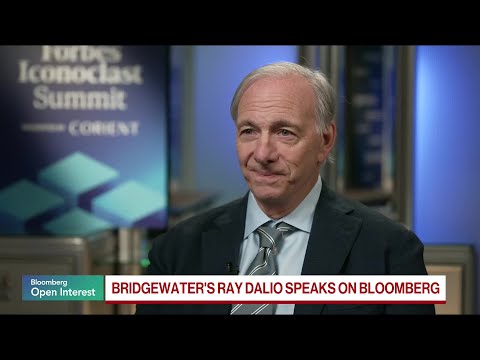
Transcript
0:00 Frae, thank you so much for joining. It's a treat. And, look, you've been doing a lot of work. You've been busy with these five forces that have been shaping the global economy. Just to quickly go through them, money and debt, internal order and disow order, power conflict, acts of nature, and technology. I wanna start on that first one, though, because it's a point that you've made globally but here in The US. $7,000,000,000,000 in spending, but only $5,000,000,000,000 in revenue. Ray, are we already past the point of no return that the fact we have this dynamic means that some sort of crisis is inevitable?
0:33 Yes. We're we're past the point of no return, meaning, when debt service payments squeeze out spending, like plaque in the circulatory squeezes out the flow of, money, the flow of blood. It's the same kind of thing. It could be measured. So we're seeing that happen. And then there's a supply and a demand issue. The supply of, one budget deficit means that debt has to be sold, and you have a supply demand issue. And we could see it happening in the bond market, and we could see that bonds have been a bad investment and that there's pressure in interest rates and there's borrowing. And that's one of the five factors as you're saying, But that dynamic is happening. People are treating it, like, if it had hasn't happened before. They don't understand that like plaque in the arteries that it builds up and they have that exposure. So I think when you're looking I think of a particularly vulnerable period is, after the midterm elections and before the presidential election, because as we connect these forces, we have, that issue Right. The debt issue. And we also are going to have a great deal of political conflict that has implications for for taxes. It has implications for all sorts of things.
2:03 So what does history tell us that this looks like when we get closer to that point? Is it yields breaching a certain level? Is it failed auctions? What would you look for to say, the time is here. The bond temper tantrum is is finally occurring. Well, it could be seen, excuse me, in either the bond market the the market action. It's by long rates rising relative to short rates. In other words, they're trying to hold the short rates down, and the long rates are rising.
2:31 And we are seeing some of that. And you're then you're seeing the weakening then of the dollar, and and then you're seeing movements such as in gold and other assets. And when you see that rise in rates, then that starts to affect the stock market. Because what's happened now is that with bonds going down and stocks going up, the perspective returns now of, stocks are now down low relative to the perspective returns of bonds. And so that upward pressure then starts to translate into a stock market pressure. That is the classic dynamic and something that the Federal Reserve then or any central bank is in a position of not easily being able to manage because it becomes more of a stagflationary environment. So the stagflation that we're seeing right now, the Fed wrestles Mhmm. With the question if it's tightening or if it's easing. That also has in a, economy where there is such a wealth disparity, but also think about the implications of whether you own stocks or whether you don't own stocks and that difference. That impact is is very different. That has huge political implications.
3:52 I say, give it where that period because this is an administration that has been very explicit in its desire for cuts, and this is part of the reason that Kevin Walsh is now our Fed chair, of course, has said, I am independent. Do you think throughout history, there's often been bond markets that test a Federal Reserve chair? Is Kevin Worsch about to get a big test? Of of course. One man's debts are another man's assets. Okay? And if there's not a high enough real return, then those bonds are not appreciated. Okay? So what are you holding the bond for? You're holding it for a real return. So the markets ultimately the the marketplace can ultimately decide whether it owns it or not. Right?
4:40 Do you think we head to the nineteen thirties again where it's a treasury that works with the Fed, that some of that independence is kind of chipped away out of a necessity to keep debt servicing costs low, for example? That's that's I think it's exactly headed to that kind of thing, which we also saw a number of times through quantitative easing. It's called financial repression, and the idea is that you drive the bond yields down with buying of assets and so on. Sometimes it includes even foreign exchange controls to try to prevent money from going outside the country and and so on, but to have that forced low real rates. And then that's usually accompanied by high taxation and a higher level of inflation to bring in revenue. And because money wants to go to other things, that's when gold has been illegalized. That's when foreign exchange controls come in and so on and so forth. I'm not saying we're going that far, but I do think the reality is, yes, that the bond market either is fundamentally good by providing a high enough real return to compensate people, or it's going to be manipulated in a sense this way that will make it unattractive. In either case, it's relatively unattractive. And so money goes elsewhere, and, you know, that's just the way it works. You've also been very forward and very early saying that the Strait Of Hormuz is an issue for The US, And people followed on and said that, and now it feels like we're ignoring it. I know you've compared this to the Suez crisis in 1956. Are we heading towards similar environment where we become Britain, where if we can't control the Strait Of Hormuz, that is something that could also cause a crisis of confidence in The US and US financial markets ultimately.
6:35 What what we're seeing now, indisputably and I'm I travel around the world, and I speak with world leaders. I was just a month in Asia and ten days in China and so on. And what we're seeing around the world is the, question of will The United States can The United States fight a war in defense or an offsetting, set of pressures, of other powers, particularly China. Right. And in Asia, right now, all the leaders I spoke with would say, we we it's clear that The United States cannot fight a war because the population doesn't want the cost of living impact, that they don't want, people to die.
7:22 They don't want they want it to be over fast. Okay. And, also, the country can't be overextended. How can it fight a war in The Middle East and fight a war there? It's getting overextended. Well, that fact, that realization is having very big geopolitical implications for those who expect because it was a policy of containment for China. Okay. There's Taiwan issue. Mhmm. And then around the Taiwan issue are questions of borders and so on. There was a a process of containment. Right. That's that's over pretty much. And so, as a result of that, there's a dynamic. Taiwan and Taiwan's very serious case because it's not just political.
8:08 It's chips. That's right. And and for example, it's entirely within the power of the Chinese government to basically say, let's take, let's put a blockade or and let's have a a week of no chips out coming out. Let's just imagine that that signal was given to the market that all the tech all the stocks, AI stocks, and everything would crash. The stock market would crash. Yes. And considering how high we're coming from, I would kinda love to combine these ideas because on one hand, you have the spending we're already doing. War has been incredibly expensive.
8:47 That's more spending from The US. And then there's AI and the desire for AI sovereignty. Debt markets are being flooded with AI. Alphabet raising their debt, their equity offering to $85,000,000,000. Are you concerned that there's a crowding out happening in this market? Can we handle that amount that's coming? All great technology changes, produce bubbles. And the reason they produce bubbles is because nobody can get get it exactly right. Okay? There, you have to either spend a ton of money to capture your market share and so on. And you and don't worry about whether it's too much or not. Or you don't spend enough money and you lose your market share. And it's very imprecise with a lot of competition. Okay? And then when people bet on the technology, which I'll bet on the technology, but they think that buying the stocks is betting on the technologies, which is a different thing because the stocks can be expensive and so on. That's that's a problem. And what happens is when wealth grows a lot relative to incomes I wanna distinguish wealth from incomes. Okay? Wealth is you can create wealth very easily in the following way. You say I'm gonna have a raise $50,000,000,000 $50,000,000 on a billion dollar valuation. Okay? That's counted as a billion dollars of money, and now you're a billionaire, but you only put up 50,000,000. Okay? And so wealth, you cannot spend wealth. Wealth is you have to sell wealth to get money because you can only spend money. So when there's a lot of wealth relative to the amount of money there is, there is a vulnerability and bubbles burst when money when wealth needs to be converted into money.
10:42 Well, what is trend for that? Well, often that's because of debt, but it could be for anything. It could be for wealth taxes, for example. Supposing you put in wealth taxes, then those people who have wealth are going to have to sell some of that wealth to pay taxes. That dynamic that I'm talking about Right. Accompanies the miracle technologies that over a period of time have wonderful implications for productivity. So I don't think it it has a problem with productivity.
11:11 I do think that, but productivity, it has a big wealth gap implication. A very small percentage of the population is gonna do unbelievably, and a lot of people won't. So what do we do? Can we work together politically to deal with those issues, and how do you Are you optimistic? Not believe I'm not optimistic on us working together to solve some So what so what's the end? Is it a bubble that burst eventually? So I I I think it is. Yes. And then that moment, there's always the issue of a bubble, and we can measure a bubble. I have indicators, and that that there's how many people are over owned, what's the sentiment, a lot of indicators for bubble. And we are right now rising close to, closer to, not at, the same level in 2000 and same level in 1929.
11:59 Specific level where you say, oh, no. Here's the one that we really need to worry about. The thing about it is there's two parts to it. There is, quote, a bubble, and then there's the pricking of the bubble. And the pricking of the bubble happens when there's a need for wealth to be sold to get the money, like, normally in a dynamic of a debt problem. Okay? If you take Japanese bubble, take the '29 bubble, take the 2000 bubble. All of them have an element of, you know, tightening money to to because it can't go on forever. It'll find its bubble. The question is how long you let the bubble go before there's the pricking. So in order to do the market timing, to know how to market time, it requires both the understanding of the bubble and the looking for the pricking, and the pricking is the converting of wealth into money because I need money in order but I have wealth, but so I have to sell some of the wealth in order to get the money. That's how it works. That dynamic is following that kind of path even though it's a wonderful technology that'll have Right. Great Ray, we could talk about this all day, and I'm so upset we're out of time because I know you're using it specifically in your family office. We're gonna have to talk again specifically about that because I'm really interested to hear more about that too. Ray, thank you so much for sitting down with me. Really appreciate your time.
Summary
- The U.S. is facing a $7 trillion spending deficit against $5 trillion in revenue, indicating a looming debt crisis.
- Rising debt service payments are squeezing out essential spending, similar to plaque in arteries affecting blood flow.
- The bond market is under pressure, with rising long-term rates potentially leading to a stock market downturn.
- Geopolitical concerns, particularly regarding U.S. military capabilities and the Strait of Hormuz, could undermine confidence in U.S. financial markets.
- The emergence of AI technology is creating bubbles in the market, with significant investments leading to wealth disparities.
- Historical parallels are drawn to the 1930s, suggesting potential financial repression and manipulation of bond yields.
- The speaker expresses skepticism about the political will to address these economic challenges collaboratively.
- Indicators suggest that the market is nearing bubble levels similar to those seen in 1929 and 2000, with a risk of a significant correction when wealth needs to be converted into cash.