Transcript
0:00 My name is Farhan Thawar. I'm the head of engineering at Shopify. And I want to spend some time thinking through this question, which is with AI coming and doing so many parts of the jobs of engineers, I want to explore what is our job now? Cuz really things have really changed, especially for engineering, but across all of R&D and even actually for other disciplines as well. And so I want to explore this question. But before we explore this question, I first want to take a little bit of a moment of silence. This tweet really hit me hard.
0:28 This is the culmination of all of the software that we have come to use in all of our lives, including many of you, me too, that we wrote character by character. And it's amazing to think that everything up until now was written this way. So, moment of silence, a little bit of uh crying maybe because it was uh it was how we did things in the past and not really how we're going to do things in the future. And I want to explore what has changed. And if you look at the SDLC, the software development life cycle, what you'll notice is that where we spend our time is moving. So, if you look at the chart on the left, you'll see the majority of time was spent in coding. You of course spend time planning and verifying and testing and maintaining, but a lot of the big bulk, that big blue box, was the coding step. And what's changed when you look at the right is that the coding part has changed dramatically because you're going to spend more time using tools to plan and analyze. You might be spending your time validating what's coming out of the AI tools, but that coding step is very different. And there's two kinds of things to think about in that coding step. There's what's on the screen there, which is like parallel coding. So, this idea of I'm going to break my tasks down into subtasks. And then within those subtasks, I'm going to have the agents act upon those. And then I kind of come back and consolidate and do some kind of validation.
1:46 But there's also this notion of sequential, very heavy, like critique loops. This idea of I'm going to really pair with one AI. I'm going to do something in a deep way, use an extra high or reasoning model. I'm going to have potentially another model come and interrogate that. But again, you're the one not necessarily writing the code. You are working with an AI agent and you are trying to plan out how to build something for your end customers. And so things are changing and how you spend your time is changing. Hence the question of like what is our actual job?
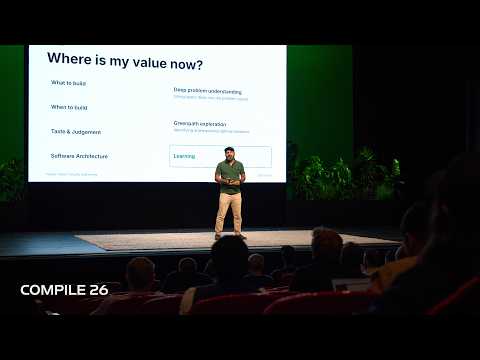
2:18 And it turns out your value just changes from the person who typed character by character all of those commands into the into your programming, your ID of choice and the programming language you chose, to these other things. Taste, judgment, when should I build something? Why should I build something? What should I build? How do I think about uh the architecture of what I'm building? Companies famously think about things in different ways. At Shopify for example, we have a monolith. We try to build things into the monolith and we try not to break things down into sub microservices. Other companies might choose it differently. How does that fit into your workflow? But of course, understanding the problem, spending a lot of time thinking through problems with your customers, also thinking through the possible set of solutions. We have this line inside Shopify where we talk about when someone brings something to us, we might say, "That's cool, so it works. How did you choose this solution among the 10,000 possible right solutions? How did you land on this green path solution?" And then of course, learning.
3:13 A real part of building software and actually working with customers and inside your teams is the learning process. We actually have a funny story about this. Pre-LLMs had a pretty large team, about 50 engineers working on one of our projects and they spent 18 months building out uh in in this case like something for our merchants. And we were just about to launch it. We had a famous Tobi review. Tobi's our founder and CEO. And we walked through the architecture, we walked through everything we built. We showed it to him, he's like, "This is great.
3:39 We should launch it." And right when we were walking out the door from the meetings pre uh pre pre us being remote, he stopped and he said, "Hey, actually one question. If you could start over, how would you build it?" And the team kind of stopped and were like, "Well." and then somebody went up to the whiteboard and said, well, knowing everything I know now, we would have built it this way." And he described a completely different and simpler architecture.
4:01 And Toby said, "Well, why don't you build that?" And literally what happened was we pivoted and he said, "Just delete what you did and start over." Because what he was trying to show us was the learning was the collateral, not the code. And so what we did was we deleted that we didn't actually delete the code cuz that's super hard to do, but we we came up with this way to actually use what we learned meaning you're allowed to look at that code but not cut and paste it because that is the natural tendency and we rebuilt the new the system in 3 months. And what happened was we had a much simpler elegant solution because the learning was the collateral, not the code. And so what's happening now with the AI changes in AI in terms of workflow and SDLC is the bottleneck. I don't know if folks have read this book.
4:39 It's a very good book, uh fictional book about a guy in a factory and he's trying to optimize various stages in the factory. And what happens actually is that he goes to fix a bottleneck and what happens there is that he solves the bottleneck there and then he realizes, "Oh my god, I'm looking at this workflow and another bottleneck has appeared." And so then he goes and fixes that bottleneck and guess what? Another bottleneck appears. And so what's happening is he is optimizing the factory and he is finding things that are bottlenecks and then turning them into not a bottleneck and then he finds something else. It's exactly what's happening right now.
5:12 The AI step of writing the code is moving the bottleneck to other parts of the SDLC. And so as you're spending time playing or validating or in this case writing code, your bottleneck is going to move and that's fine. You're just going to find out how to resolve that bottleneck and guess what? You'll find another bottleneck. And the same thing's going to happen over and over, but it's a very good um book to read and again, it's going to go back to what we saw in the last slide is your taste and judgment and you still bring a lot of value to the process. It's just a different bottleneck. And so why do we care at Shopify?
5:42 Like why am I talking about the SDLC? Why am I talking about AI? Well, it turns out we actually power a lot of the commerce infrastructure all over the world. We spend a lot of time thinking through how to build things in a way such that people can build on top of us. One mantra we have at Shopify is we always try to build infrastructure. So, one example, if I could build a feature in 2 weeks or I could build infrastructure in 2 months that allows me to build that same feature in 1 hour, I will always choose the latter.
6:12 That means we try to focus on infra as a way to enable our developers and our ecosystem of developers to build on top of our infrastructure. And the reason we do that is because we believe that it's unclear what's going to happen in the future and if we build the infra, again, I can build that feature in an hour on top of it, who knows what else other people can build on top of it. So, that's how we're focusing. And now with the And now what's funny is I gave you that example, but with LLMs, it might be possible not to have to make that trade-off anymore.
6:39 If I have my problem defined well enough, do I have to actually make a trade-off between 2 weeks and 2 months? Maybe they're about the same because the clanker, which is a term that Toby likes to use, can write all the code. I don't have to think through that trade-off of like 2 weeks versus 2 months. And here's some stats just to show you that we are at scale. We try to spend a lot of time optimizing our infrastructure as well. Performance matters a lot, simplicity matters a lot, resiliency matters a lot, availability matters a lot, and you can still, of course, get all of these things using AI to write your code.
7:09 It just means, again, the place where you spend your time is going to move. Now, our journey in AI has been going on for a while. We were the first users of GitHub Copilot in 2021. That's a year before ChatGPT. I mostly bullied the CEO of GitHub to give it to us. And that allowed us to be in this age of auto complete, if you folks remember that, where I would start writing a line of code and then it would auto complete the remaining line, or I would write a comment inside of a file and it would just fill out a function. This idea of like pairing with the AI.
7:39 Right? This ability to go back and forth and let's try to build something together. We launched features using ChatGPT right away and this was really the the couple of years of the AI Centaur phase where you have like a brain and an LLM and you bring those two to work and together you build something. And of course, what happened in 2025, last year? Toby dropped what we call the tweet heard around the world which is that AI is going to be a baseline expectation for employees at Shopify. What was funny about this tweet was not that it was first an internal memo and then it became a tweet was that CTOs and CEOs would text me after this came out and share with me their own version of this same message inside their companies.
8:18 Because what they wanted people to understand was that we want you to understand how to use this tool. We want you to be AI reflexive. What does that mean? AI reflexive means we want the distance that you travel between running into a problem and reaching for AI to be very small. How quickly can you reach for AI? How long does it take you to get stopped and then go, oh hold on, let me pull this in in a way that I can I can quickly move through AI.
8:45 And so we spent time thinking about AI reflexivity at Shopify. We wrote articles. We started to share different ways in which companies, including ours, could use it in various disciplines. Not just engineering, not just product, not just in R&D, but across the company. And we have lots of examples of how to do this. One of the main ways I brought AI reflexivity to Shopify was by a cursor. We deployed cursor in 2025 and I quickly ran out of cursor licenses. We are a company about 8,000 people.
9:15 I bought a 1,500 licenses and in the first week I ran out of all of those licenses. And I think the most interesting thing that I learned and also I shared with cursor was that it wasn't the typical disciplines that were using AI. So I thought right away it would be engineers, product, data scientists, maybe designers. Instead what I saw was finance, HR, sales, marketing. They were using cursor as a way for them to get a window into these agents.
9:44 Even though they weren't looking at the code, they were looking at using this as a way to kind of interact with their back-end LLM. And so it was really interesting to me to see this happening. And of course I procured more licenses and more licenses until, you know, by the way, almost all of Shopify was using these tools. Today we have a huge set of tools including cursor that people use. They use Pi and they use Claude code and they use code acts and you know, we even have an internal tool called River that we use that it's like an agentic substrate across the whole company that you can ask it questions, it can write code for you. But it just shows you that people have choice and our first step in kind of getting to that AI reflexive moment was literally just dropping cursor. That line shows you when the internal memo was dropped. So for those of you thinking through in your companies, like can a mandate like this change behavior?
10:32 Literally Toby's memo and like you see everything go up from there. It made a huge change in how Shopify thinks about things. Not only did we see actually cursor usage and people adopting these tools, we saw real use cases. The support team built a tool called Scout, which allows you literally to ask it questions about the feedback we were getting from our support teams and now our product management team uses it all the time. You can go in any day and see like what are the top merchant frustrations.
10:56 We had customer success teams building out like monthly business reviews and quarterly business reviews using cursor. It was a real way to to get information and insight to their customers. Finance built forecasting tools. So it's really cool for us to see how not just engineers were using what we had built. The other thing I really wanted to change was the culture in the company at the same time. In 2024 we had 75 interns at Shopify and in 2025 and in 2025 2026 we have a thousand.
11:25 The reason to bring the interns to work was not for charity. You know, some people like, "Oh, it's community service. Bring interns and you know, it's like good for them and it's a good experience. It was the opposite for us. We wanted them to come in and teach us how to work. Think about the interns and the folks in college these days and early talent. How what percentage of their life have they been with AI? This year, 2026, the graduating class had their entire college life having ChatGPT or another tool. And so these folks, we wanted them to come to our offices and question everything about how we work. Why do things work this way? We wanted their hunger, their intensity. We wanted to change the culture in the company.
12:01 So 1,000 interns came in. We ended up hiring a lot of them as well to come work full-time with us, but it's a great way to kind of kickstart your company and make a cultural change. Not just the mandate of AI being reflexive, but also changing the culture of the types of people that came into your company. And again, the key part for me here, this is like literally my tweet, was the AI centaur moniker. The idea of human plus LLM together can build something better.
12:27 And I really like this term AI centaur. Like I mentioned, we had it for a few years, 2021 to like 2024, 2025-ish. And unfortunately, it didn't last as long as I wanted. It was like this amazing time when we could like pair with the AI and that the AI still really needed us to like talk about like and and give it advice on code. And uh as you know, in December of 2025, it all went away.
12:53 Why? Well, people call it the Opus 45 moment or or GPT 52 moment. This is where a lot of the world's top engineers during the Christmas break said, "I think the LLM is better at coding than I am." And so this whole notion, and this is again the ethos of an engineer and being like, "Oh my god, my job was like to write code and everything about my life and my work is about typing in character by character the thing that the machine will turn into machine code and execute for me."
13:23 To like now I'm going to be like the AI a person. Because when the LLM is better at writing code than you, you should focus the bottleneck, which used to be writing code, to somewhere else in the pipeline. And so, this was the big moment for us. And in you know, this is again the clanker versus human. This is where you have to really step back and introspect to yourself, where do I want to spend my time?
13:46 If the AI is better at writing code, should you write code anymore? Right? It's an open question. Are there times when maybe there's something specific that you're writing that the LLM won't be good at that you have to write code? Potentially. But I would contend 90-plus percent of the code now at a lot of companies is it should be written by AI because it's just better than you are. And in 2026, right after that December 2025 moment, we started changing also how we think about expectations of the company. The word token maxing became a noun because what's happening is people are just using tokens over and over.
14:18 And because we had become AI reflexive at the beginning, we wanted to move away from reflexivity because we had the whole company now using AI, to AI leverage. This ability to not only use AI for your work and to remove your toil and for you to focus on your area that you care about and that you can bring human value and judgment to, but also this notion of how can I brag about how lazy I am?
14:40 This ability to be like, you know what? I just built this in 5 minutes. It would have taken me 5 months. And so, we wanted to role model and we want to show people what's possible. We of course, like everyone else, had a LLM leaderboard. Right? This ability to show everybody, "Hey, look how many tokens I use and I'm in the top 10." We moved away from that to like a usage dashboard, which really it does still show you um what you actually where your what your token spend is and how you value uh how you can gauge yourself against your peers, but it's not focused on being on the leaderboard anymore. It's not focused on being in the top 10. It's focused about providing value.
15:10 And what's interesting about it is you not only can see, of course, who's using the most tokens or what disciplines are using the most tokens or what seniority or manager versus IC or, you know, even uh area of the world they live in, but also who's using the most expensive tokens? Right? Something interesting is this idea of like, "Hey, these people are doing like actual reasoning and the tokens they use are more expensive per million tokens versus those people who are just using lots of tokens." We don't have any limits of tokens at Shopify. We do have circuit breakers.
15:36 A circuit breaker really is just something to find whether you are you have a runaway agent. And we've seen this happen, right? You might try to introspect some large piece of code or might give a problem that the agent might go off in a in a weird tangent. And what'll happen is you'll get stopped. You'll get a Slack message that says, "Hey, we've stopped your agent. You used X dollars today. Are you sure you want to keep going?" And people are like, "Yep, I want to keep going." And then we don't block you. You might say, "Nope, I don't want to keep going because actually, you're right. I didn't think that this was going to take this much this much money or this this amount of time." And I can stop it. But outside of that, we're still in this mode of like opening the tools and letting people use whatever they want to kind of accomplish their goals. Some things haven't changed by the way as we move to AI. I talked about some of the things that did change. This is something that hadn't.
16:18 Parkinson's law. One of my favorite laws, right? Which is basically the amount of time you give something is how long it's going to take. If I ask you for something for by Friday, you'll give it to me by Friday. If I ask you for something for next Friday, you'll give it to me next Friday. And now what's amazing about Parkinson's law and AI is that everything has changed because the road map is no longer going to be 6 months. It's typically be like, "Why Why can't you finish it this month? Why can't you finish it this week? Why can't you finish it today?" And this idea of like prototyping quickly and then taking that prototype and maybe showing something to a customer very early on because you've got these clankers writing the code for you.
16:50 It's not as hard as you think and you should really look at Parkinson's law again and pull all those road maps in. We have this saying that we can finally see the end of the road map at Shopify now because we've got these tools. What else is not changing? Learning. I talked about this before. Everything that we focus on is to learn as much as possible. The code is not the collateral. The learning is the collateral. You want to make sure that you are actively asking your teams and you know, I hear some people talk about shipping every week. We talk about like learning every week.
17:16 What is it that you learned this week? What is like unintuitive? What is like a secret that you believe that others don't because you looked at the data, you've tried and prototype something, you put something in front of a customer. What is that you've learned that allows you then to make a different decision next week? This hasn't changed. I love this picture. This is what I This is what I got when I asked the AI to create a picture for pair programming.
17:33 Makes no sense, but I think it's funny. Because literally it's like this is what pair programming is to me. I'm like, well, not on one keyboard, but on multiple keyboards, but pair programming hasn't changed. There's going to be things that you will learn with another human in front of a computer along with an LLM that you wouldn't learn with an LLM alone. And yes, you know, you can use these clunkers to write the code and you're going to learn some things, but having another smart human and working together at the planning stage and at validation stage and of course the coding stage will allow the learning to increase. And again, don't forget learning is the goal.
18:05 This is a real picture of pair programming. Two people, one computer, typically could be two monitors and two keyboards, but the idea is two people working together against the same goal. And yes, in today's parlance they will have an LLM also. This is one of my favorite pair programming quotes not to make this talk about pair programming, but the idea is that it's not lines of code. It's never been lines of code. Anytime I talk to executives, they're like, wait a second, if I got two engineers like they're going to write less. I'm like, yeah, hopefully even even less than that.
18:31 The whole point is not lines of code. I think it's funny when people look at like token maxing or lines of code to try to figure out if teams are productive. And so, if you can't use those, what can you use? So, we have a bunch of things that we've noticed over time by looking at the Shopify ecosystem to see what we are noticing as things that potentially are interesting artifacts, but none of them, even the whole set, could be used to identify um whether we're efficient or not. PRs per an engineer are up. That's probably not surprising. Everyone's seen that across the industry.
19:03 We're seeing the complexity of PRs going up. So, each PR, yes, the numbers are going up, but the complexity of each one is also going up. We're noticing the project duration is going down. So, we have a product management system and we can see based on no other changes that actually the duration of projects is shortening. So, we're attributing that to AI as well. And then the more importantly, the ambition of projects is going up. The things people are attempting, the things they're trying to bring to our customers is going up as well and it's actually causing us to be more ambitious in how we think about the problem. We still like to do weekly demos. We think this is a great way, if you're always wondering when I talk to executives, like what's the best way to gauge engineering velocity? Weekly demos. It's the best way to see what's going out to your customers.
19:39 And then don't confuse the map with the territory. This happens to me all the time. An executive might code something and shows it to you like, "Look how easy it is. I built this thing and why can't you just deploy this production?" A prototype? A prototype is not production. I see this all the time. Don't forget I have a CEO who codes. He will say the same thing to me, "Wait a second, I just built this thing in 5 minutes. Why did it take the team a month?" I'm like, "Because the prototype is not the production level quality of code."
20:04 Still true. Uh and has not changed. But, prototyping is an amazing way to get feedback and to try things out. We try really, really hard to delete the prototype code or like don't use it because it's really a green pathing exploration exercise versus actually the code you can use in production. Here's an example. I had an intern delete six lines of code and save over $600,000 per year in our infrastructure. So, tell me which of those metrics in the previous slide would have showed me that this intern is awesome.
20:33 None of them. Right? I actually don't even know, but I'm pretty sure this intern did many more things that term instead of this and it would have been fine if they did this one thing. So, there's really no way to manage by spreadsheet. So, if you think you're going to try to manage by spreadsheet cuz you have AI, um good luck to you. So, I'm going to go through like five things that we talk about at Shopify as how we work and so people can kind of get a sense and I'd love to talk to folks after about what they're seeing.
20:53 One, model selection. We still only allow our engineers to use the most the largest, most expensive models. We let them only use Opus 4.5 or GPT 5.5. We don't or you know, Gemini 3.5. We don't let them use a smaller model because we believe that the human time is worth more than the clanker time. What that means is, if a human used a smaller model and a small bug was introduced, it would take them many, many hours to find it versus if they just use the bigger model. So, as the bigger models come out, we use them, we don't let people use a smaller models, at least in engineering.
21:25 Two, the bottleneck is code review. You probably already thought about this when I came up with that bottleneck slide. Lots of code is being generated, how do you review it all? Right? Let me show you the four scariest letters in the human language. Every [ __ ] PR says this thing and then it might still have a problem in it, it might still cause a life side incident. Like it's insane. And so, if you thought your current process is working and you're like, "I can't let an AI look at my code." Look at these letters.
21:51 Your humans were not looking at the code. They were not good at this. So, you should do something else. And so, we use accounts and I'll show you a slide on the council of LLMs, but we use lots of other things using AI tools to actually help figure out whether these code artifacts should go to production or not. Is it perfect? Of course not. Were the humans perfect? Of course not. I have people complaining to me now who say, "Oh my god, it takes an hour for the AI LLM to review my code." I'm like, "Before the LLM, didn't it take 24 hours or 48 hours for a human to give me the LGTM?"
22:23 Who cares? The LLM is better. The LLM is going to be more accurate. Is it 100% accurate? No. Is it better than humans? Yes. Here's an example of like what a council of LLMs looks like. Right? This is like, you know, fictional, but like the idea is that we have different models to having different tasks and they look at different parts of the code as it goes through and look for different things. Like you can see accessibility here.
22:45 They're looking for other things and they We use all of these judges to be like, "Should this code go to production or not? Should I send it back with some commentary?" Responsibility. We do not let AI take responsibility at Shopify. You get to work with an LLM, you get to have it write as much code as you want. You of course do validation, but your name goes on the PR. You might also tag your LLM. Cool.
23:06 But it is not about the LLM, it is about you. Responsibility can be shared, but it cannot be given away. Your name on the PR, your PR going to production. This one is an interesting one. How to think about hiring? So, we have not The shrug emoji there is because we have no idea how to hire for AI. I don't think anybody does. I don't even know how Actually, Cursor famously didn't allow you to use Cursor for your interviews, so I don't know what Cursor's doing now, but we are definitely still trying to figure this out. But I like this model, by the way, which is an interesting model to kind of think through the problem. I went to Waterloo my first year I did a math degree. We were not allowed to use a calculator. So, the whole first year was no calculator, and then second year we got a calculator.
23:43 It forced me to learn everything by hand. Everybody learn everything by hand, and then you can introduce the calculator. So, AI is kind of similar. If we want people to understand the underlying parts of AI, we want them to be able to work without AI. So, that's number one. Giving them a problem they can't use AI on. Number two, AI optional. So, maybe I can't actually use AI, or I'm sorry, maybe I can't do it by hand, but maybe I can use the AI.
24:05 So, you can optionally pull it in if you want. And then lastly, AI mandatory. I'm going to give you a problem so large, not enough time, and now you have to wield this tool. And I think when you look across all three of those, you kind of get a good sense of if somebody is good across all three of those. The thing it'll miss is like the savants, right? This is kind of like the chess player who like just makes a move and it says it feels good.
24:25 There's going to be people like that who can just use the AI and be like, "I don't understand code, but I can wield the the tool in a way that gives me amazing results." And then lastly, I think the funniest thing from executives is like, "Oh, can't I make my dev team smaller?" This is like the funniest thing I hear. Like, "Oh, we have 100 engineers. What if we just had 10?" I'm like, that's so [ __ ] unambitious. Like, we think about the other way. I'm like, "We have 3,000 engineers. Why can't they act like 100,000?" That's literally the line we use.
24:49 Because that is more ambitious. You can do more, right? Jevons paradox. You make something cheaper, you make something available, more people will use it. We're trying to solve the problem of entrepreneurship. Why aren't there more entrepreneurs? You think we're going to try to shrink? No, we think everyone can be more productive. There's even a funny blog post that came out. Somebody wrote this, the AI set up behind Shopify's 23,000 engineers. I'm like, I'm a half I'm a quarter of the way there.
25:11 It feels like we have 23,000 engineers to somebody. That's awesome. We only have 3,000. I want somebody to write the article that says, you know, the power behind Shopify's 100,000 engineers. All right, lastly, just to close. So, some things have changed and some things haven't, right? The clunkers will write and review code. Get over it. This is what's happening. You should try to embrace it. You will spend more time on other parts of the ecosystem, right? Of of the SDLC. You're going to spend time on planning. You're going to spend time on validation.
25:39 And you might change your seniority mix. I just introduced a thousand interns. And by the way, I convinced Cloudflare to do a thousand interns. And then I saw Matt Garman at AWS hire 11,000 interns this year. Everything's changing across seniorities. You might decide differently. You might decide to hire more mid-level. You might decide to hire more senior. And then what's the same? Taste and judgment. You're still going to have to care about taste and judgment, what goes out to your users. And you're going to have more time to spend on it cuz you can go deeper into the problem.
26:04 It still remains hard to gauge engineering performance. That's not going to change. You're not going to be able to manage by spreadsheet. You're not going to be able to be like all of a sudden be like, "Hey, we figured out the formula." Like for sales people, it's just how much they can sell. Like engineers, it's how many what? I don't think there is a a metric. And finally and importantly, learning still remains the goal. So, for those thinking about running engineering teams, don't look at the collateral.
26:27 It's not about the code. It's not about shipping It's like how quickly are you learning? Because you can use these tools to build whatever you want as quickly as you want. Thank you very much.
Summary
- The role of engineers is evolving from writing code to using AI tools for planning, validating, and problem-solving.
- AI is reshaping the SDLC, moving bottlenecks from coding to other stages like planning and validation.
- Engineers must focus on taste, judgment, and understanding customer needs rather than just coding.
- Shopify emphasizes building infrastructure that allows for rapid feature development and adaptability.
- AI reflexivity is crucial; employees should quickly reach for AI tools to enhance productivity.
- The culture at Shopify is shifting with a focus on learning and adapting to AI, including hiring interns to bring fresh perspectives.
- Performance metrics for engineers are changing; traditional measures like lines of code are less relevant.
- Learning remains the primary goal, with an emphasis on using AI to facilitate rapid prototyping and innovation.