Transcript
0:00 Okay, so if you're a parent, you know this struggle. You set a limit. No more screen time. It's bedtime. You can't have a cookie. And bam, suddenly you're dealing with a huge emotional reaction. It's so frustrating, right? It's a battle parents face literally every single day. But what if? What if we've been looking at that resistance all wrong? Let's dive into this. I mean, it's a natural conclusion to jump to, isn't it? They cry, they yell, they try to negotiate their way out of it. The obvious takeaway is, well, they just don't like the rule. We've all been there. Thinking our kid is just fighting the structure we're trying so hard to provide. But here's a thought that might just change everything. What if that meltdown isn't actually about the no?
0:44 What if their resistance is really a signal of something much deeper? Something we might be unintentionally creating? And this brings us right to the heart of what we're talking about today. What I like to call the predictability problem. We're going to explore how a lack of consistency might be the real reason behind our kids' biggest struggles with boundaries. So, let's really unpack this. The push back, the negotiations, the tears, they might not be a review of the rule you just set. No, it could actually be a reaction to the environment that rule exists in.
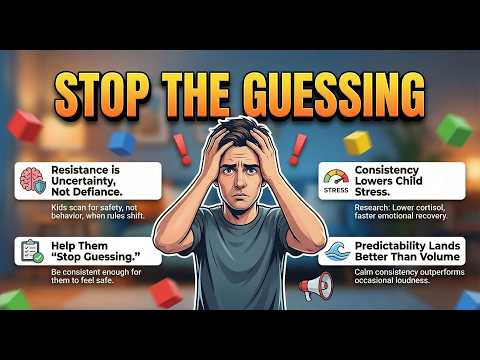
1:18 Right? So, on the one hand, we think the child is just fighting the rule. But the real issue, it's the mental whiplash of uncertainty. Their brain isn't just processing no screen time. It's spinning, asking, "Wait a minute. Was this the rule yesterday? Is it going to be the rule tomorrow? Cuz it definitely wasn't the rule after dinner last Saturday." That inconsistency, that's the real source of the friction. And to really get this, we need to step inside a child's mind for a second and understand how their developing brain even processes this kind of inconsistency. You'll see it's not really about defiance. It's about neurology. Think about it like this. If a boundary is rock solid on Monday when you're feeling great, but it kind of vanishes on Tuesday when you're exhausted, well, the child learns something really important. They learn that the rule isn't the thing to watch.
2:08 The adult is. So, their focus shifts from managing their own behavior to managing their parent. This puts them on constant high alert. So instead of just relaxing into a world that makes sense, their nervous system goes into overdrive. They become these little detectives, always scanning for clues, trying to figure out which version of the rules is active right now. You can almost hear their internal monologue just racing. Okay, is mom in a good mood? Is this a strict day? Or is this one of those flexible days where I might I just might get away with it? And probably the biggest question of all, do they seem tired enough or calm enough that if I push back just a little, they'll just give in? And this just perfectly shows the cost, right? This constant scanning is so mentally and emotionally draining. Their little brains are just flooded with uncertainty. And all that exhaustion, all that anxiety, it has to go somewhere. It bubbles up to the surface and looks to us like pure defiance. But that behavior we see, it's just the tip of the iceberg. So all of this is building towards a really powerful reframe. We're about to shift how we define this behavior entirely. And for a lot of you, this might be the moment where everything just clicks into place.
3:22 So what we've been calling defiance is in so many cases something else entirely. It's a symptom. It's a sign of a nervous system that feels unsteady and unsafe because the world just isn't making sense. It's really a cry for clarity, not a battle for control. This slide just puts it so perfectly. The old way of thinking assumes a kid is being manipulative, asking, "How do I get my way?" But this new understanding shows their vulnerability. Their brain is actually asking a much more basic fundamental question. What are the rules? Is my world safe and predictable today or isn't it? Okay, so if inconsistency is the problem, then a solution becomes incredibly clear, right? The path forward is all about creating safety through consistency. And this isn't just some nice parenting idea. It's totally backed by science.
4:12 Yeah. The research in developmental psychology is super clear on this. When kids live in predictable homes, their bodies are physically calmer. We're talking literally lower levels of the stress hormone cortisol. They have fewer big meltdowns. And when arguments do happen, they bounce back way faster. Predictability isn't a preference. It's a biological need. And this is a really key distinction. A lot of people hear consistency and they think it means being rigid or overly strict. But that's not it at all. Predictability isn't about being mean. It's about creating a world that makes sense to your child.
4:45 It's about providing psychological safety. Now, let's be super clear. This is not about creating a child who never gets upset. Your kid will still be disappointed when they can't have another cookie. Of course, they will. That's a normal human feeling. The goal of consistency isn't to get rid of feelings. It's to get rid of the confusion. And that is the absolute sweet spot. A child who feels disappointed inside of a predictable structure still feels fundamentally safe. They know the rule is firm. They know you love them and they can actually process their disappointment without that extra messy layer of anxiety and confusion. This is such a powerful reminder for all of us as parents. It's not about how loud our voice is or how intense our no is. It's about the quiet strength of our consistency. A calm, predictable boundary is infinitely more effective and kinder than a loud, unpredictable one. And what happens when a child's world finally makes sense?
5:42 When the rule is the same on Tuesday as it was on Saturday, while the arguments, they slowly start to fade. Not because the child has given up, but because they no longer have to spend all that energy scanning and guessing. Their nervous system can finally finally relax. They feel safe enough to just settle. So, I'll leave you with this one question to think about. When you really look at the limits you set in your home, are they a constant battleground, a source of friction and conflict, or are they the calm, predictable guard rails that make your child feel truly, deeply safe? The answer might just change everything.
Summary
- Children's meltdowns often reflect confusion and uncertainty rather than simple defiance.
- Inconsistency in rules leads to anxiety, as children constantly scan for clues about their parents' moods and the applicability of rules.
- This mental strain can manifest as what appears to be defiance but is actually a cry for clarity and safety.
- Predictability in a child's environment is crucial for their emotional well-being and is supported by developmental psychology research.
- Consistency does not mean rigidity; it involves creating a safe, understandable framework for children.
- A predictable structure allows children to process disappointment without added anxiety, fostering emotional resilience.
- Calm, consistent boundaries are more effective than unpredictable, intense responses from parents.
- Parents should evaluate whether their limits create conflict or provide a safe, predictable environment for their children.