Transcript
0:00 From an economist's perspective. Is there such a thing as the disinflationary boom worried the deflationary boom even. So this is about, uh, you know, making a distinction between now and what comes next. Yeah. No. It is about the high levels of investment, right? Right. Clearly, right now it's pushing everything up. But let's imagine ten years from now and we've done it. We have this in credit, and somehow we've solved all the sci fi scenarios so that the ad doesn't want to kill us all, etc.
0:29 let's just imagine the rosy scenario in which we have this look like there are some under discussed risk factors. And so but right, like let's just say the robots don't kill us, assuming we solve that and the AI works on our behalf and it does what we wanted to do, and it can create incredible material gains while also make while also very delivery of cheaply because it's just one AI, etc.. Is that a contemplated, uh, um, scenario? From an economists perspective, there is absolutely a scenario where we could be in that wonderful place with high productivity growth. At the same time, we don't have civil unrest or right, you know, rogue forces. Yeah.
1:10 Using AI for or for ill. That is a scenario. But I do not know a single person who will put a probability on that scenario and say that that's going to happen, you know, with a significant amount of certainty. Yeah, there was a very high degree of uncertainty. And there are several who also believe that it's yet to be seen whether there is going to be any major productivity gain of the kind that, you know, there are analysts who believe the productivity could go up by two percentage points a year, you know, over and above what's where it is right now, which is around two percentage point a year, and that is you. There is no evidence right now of that kind of productivity wave coming through.
1:56 So it's early. But you know, I use the technology and I find it terrific. I mean, it is. It's been really great for my own productivity. It's not affecting my wages or anything so far, but it is there. It is, it is uh uh, it is, uh, you know, very valuable technology, but there is a lot of uncertainty. Hello, and welcome to another episode of the All Thoughts podcast. I'm Tracy Alloway and I'm Joe Weisenthal.
2:26 Joe, the big story in markets right now has to be one of the big stories. The bond market selloff, by the way, as I say that I just got this massive feeling of deja vu because I'm pretty sure we've done a few episodes where I've started out saying the exact same line. Well, I mean, one obviously this is sort of one of the trends of our time, which is that after a decade pre-COVID, where we just sort of assumed that rates were going to head lower, that is obviously there's been a regime change, as economists sometimes like to say. And so now we have rates pushing higher again. They've come back a little bit in in the last couple of days, but that's not really the point.
3:04 The point is it is is this global phenomenon around the world. Rates going up? I would still say probably the big story in markets is I and memory and chimps. But if it weren't for that everyone would be talking about interest rates higher in almost every country in the world. So here's the thing. I actually think I and the rate sell off is kind of connected. So you know, we're talking about yields going up generally in developed markets.
3:29 And we've seen that recently. I know we saw for instance, the the long end of the UK gilt market hit like the highest since 1998. The ten year U.S. Treasury yield was kind of inching up towards 5%. But it's come down mostly. A lot of those yields have been moving in line with the oil price, right. So a lot of people will say that this is just because oil's going up. That's inflationary. Maybe we'll get higher rates.
3:55 And so this is why yields have been backing up. However, there is an argument I'm seeing more and more people make this one. That what's going on is actually a repricing of something, you know, less transitory. Yeah. My allowed to say that word anymore, less transitory and something more secular. Yeah. In what's happening with the rates market, something that's more about the massive amounts of capital that I is actually consuming and having a crowding out effect on sovereign bonds, or maybe something that's more about, you know, the ability of the developed world to actually finance itself, you know, in the longer term. And so you're starting to see some of those bigger themes creep into the discussion about the bond market sell off. This idea that it's something else is happening here, something more than the oil price.
4:40 Totally. Actually, just speaking of the nexus between, uh, interest rates and I, uh, Torsten slug, uh, has a good chart out. Came out this morning pointing out essentially that one thing what they are is the sort of FOMO aspect not among investors per se, but about companies and not wanting to let their models be six months behind until they all pay whatever the cost is to catch up. And therefore, he argues that perhaps higher rates do not have the slowing effect that they might have had in another cycle. Mhm.
5:11 Because it's like, well yeah, it's no fun to finance this data center at higher rates. But if the alternative is being consigned to the permanent underclass when the other company builds the most advanced model, you're going to do it nonetheless. And so yes, between oil, between the eye boom, between demographics and the challenges of sort of resourcing for care of, uh, the elderly and the infirm between all of these things, resource nationalism, building up, thinking that we are in this real secular shift and we have to understand it better.
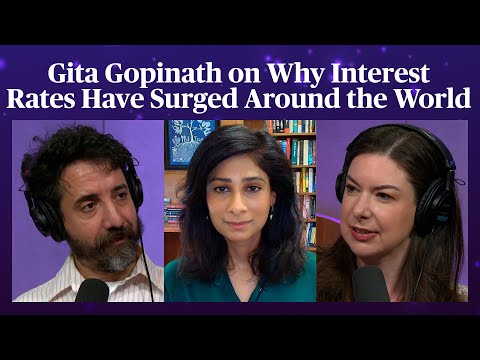
5:45 Yes. So I am very happy to say we do, in fact, have the perfect guest to talk about all of this. We're going to be speaking with Geeta Gopinath. She is, of course, a professor of economics at Harvard University, but also famously the first deputy managing director of the IMF. So truly the perfect guest to speak to someone who's been talking about, you know, a change in the bond market for quite some time. Geeta, thank you so much for coming on awfully.
6:08 It's a pleasure, Tracy. And, Joe, great to be on your show. So what's your take when you're staring, presumably, you know, on a minute by minute basis at a chart of the U.S. ten year yield? What are you thinking? I mean, firstly, I think it's it's absolutely right to start with the conversation about what's happening in bond markets, because frankly, you know, despite all the many different shocks going around in the world, I actually do think the one that's most worrisome is what we see with public debt levels everywhere in the in the world, in the US. We've seen yields go up.
6:43 Uh, it's a combination of things. You just talked about, all of them, which is one is the fact that inflation is now expected to be higher. And there is a sense that the real rate at which the economy will stay, you know, at a somewhat stable level of inflation is higher. So the kind of the real interest rate has drifted up. The R star has drifted up from pre pandemic when it was like half a percentage point. Now it's a one percentage point.
7:14 But on top of that you have the premia that's coming from the risk of inflation from very importantly the large amount of fiscal uh you know the large fiscal deficits that the U.S. is running and is projected to continue to run into the foreseeable future. And, of course, the third element, which is the eye boom and the expenditure of the capital expenditure that's being undertaken for that is also shifting. The hours are up to maybe even higher than one percentage point. So because of all these reasons, we've suddenly moved away from the pre-pandemic period of low for long interest rates. And what we were talking about, the, you know, the end of, I think we are have the end of secular stagnation at this point, secular stagnation was about the fact that there was not enough investment happening, especially in the private sector.
8:10 That is no longer an issue anymore. So because of the combination of inflation, I boom, fiscal deficits all over the world, high public debt everywhere, you know, we are seeing yields go up. And that's true in the US too. What changed. I mean what I want to drill into all of these specific things. But you know, let's start with like the high level of public debt. That was the thing that people were talking about quite a bit, um, prior to the pandemic as well, and raised just kept going lower and lower, including famously in Japan, where, uh, debt to GDP levels are even much higher than they are in the Western world. And that was sort of famously known as the widowmaker trade because rates kept going lower.
8:57 What's changed? Um, between 2023, 2020 and 2020 such that this suddenly, in your view, and perhaps the market's view, this became an important thing that was not perceived by the market as being important pre-COVID. So a few things changed. Uh, one, the eye boom was unexpected. That was not something that was being priced in markets pre-pandemic for sure, that that big increase in demand for capital coming from the private sector is one, a big change.
9:34 The other big change is the fact that fiscal deficits are now projected to stay at levels that nobody was expecting the US to run. So some 7% fiscal deficits for the foreseeable future. That is the another important factor. And the third is the composition of who's the marginal buyer of this debt. So we had a period when central banks everywhere were buying, uh, yeah, government debt. And that also helped to keep interest rates low.
10:06 In fact, that was part of the strategy of how to, you know, strengthen the economy. Uh, quantitative easing was part of the toolkit. And so that helped keep interest rates low. But that's changed. And now we have the central banks everywhere who have either stopped buying or they're writing it down like it's happening in Japan. And the marginal buyer are the more volatile. You know, investors, hedge funds in the US are the US market makers over here.
10:38 And so whenever there are any shifts in global market conditions, you see a lot more sensitivity than you would have seen, uh, if it was mainly official, uh, credit flows. And by the way, that's also true about capital flows coming into the U.S.. Previously, the buyers of U.S. treasuries used to be foreign central banks. They're not doing as much anymore. It's mainly coming from non-bank financial institutions from the rest of the world. And so they're also much more volatile. And you're going to see just generally high volatility in the yield curve. Can you talk a little bit more about the AI boom. Because we hear people talk about a crowding out effect. And I think this is actually like something that is just starting to get a lot of attention.
11:21 But the proportion of issuance in the corporate bond market that's coming from AI companies or AI related, you know, investment right now is just insane. And you mentioned Torsten stock chart. Uh, Torsten is going to be at our upcoming. That's right. We're recording this on May 27th, our upcoming live show in New York. And so I've previewed some of the charts he's going to be sharing there? There's a chart there that shows, uh, basically the proportion of AI in the corporate bond market. It's now 50% of all investment grade issuance, um, year to date. And in even junk rated debt, it's creeping up to like almost 40%. So this is a significant amount of debt that's being issued into the market. Is it reasonable to think that investors are maybe going to think like, well, I'll buy some big tech mega cap IG debt versus a U.S. Treasury?
12:16 At least when you look at the pricing in markets, that seems to be the case, especially when it comes to equities. You everybody wants to have a piece of the eye boom. Uh, and yes, I think there is that sense that, well, this is a sector where we could really see real gains, especially, you know, in terms of productivity increases and profitability. And that's going to help. That's going to be some, you know, something that they want to be a part of?
12:43 So there is that demand for corporate bonds and for US equity, which is coming again both from domestic investors but also from international investors, which, you know, where I is, the trade. I mean, that's where all the dynamism is and that's where people want to put their money. Now we've we've pointed at all the reasons why rates are likely to stay high. But I just want to point out that we since we still have the ongoing Iran conflict and we still have the Strait of Hormuz closed, if that is not resolved and you in anytime soon, like, you know, the next month or so. Yeah.
13:26 And you see a even steeper increase in oil prices and crude prices going up to say, $160 a barrel, which is what some of the projections would be in that case. Then we could see much less, much more demand destruction that we have seen today. and we could be back in that space where at least the short end. Interest rates are being cut pretty rapidly. I want to, on this question, going back to the effect that the I build out is having across rates and bonds and so forth.
13:56 I want to sort of get some clarification here of what either you or what economists mean when they talk about, say, like crowding out because there's one version of it that is like, okay, there is a lot of there. There's a lot of debt being issued right now by, uh, very highly rated companies may probably yields a little bit more than U.S. government bonds. That is attractive for investors. Perhaps there's and maybe that has some sort of crowding out in the financial markets. The other way that one can that I tend to think of crowding out is that these I, uh, the I build out, it's like they're taking up all of the wind turbines.
14:36 They're taking up all of the trucking capacity to get the goods to the data centers. They're taking up all the skilled contractors and laborers within the regions that these data centers are being built. And that creates inflationary pressure that adds to the strain and therefore, all things being equal, that says higher inflation and therefore higher rates for longer to maintain that, which of those two models, whether it's the sort of financial markets version or the sort of real economy version, is a more useful way of thinking about that linkage between private and public sector spending slash debt.
15:12 So both of those are in play right now. So that's the difference between what's happening to real rates versus what's happening to nominal rates. Okay. And what's happening to the pricing of uh, the fed fed rate path. Right. So the first channel that you mentioned, which is just the fact that there is so much of demand from the private markets, from the I investor's forecast that, you know, yeah, companies for capital is going to raise real rates.
15:40 You know, even if there is no effect on inflation or inflation, expectations are not moving. We should expect to see real rates rise. And that's certainly we're seeing some of that. And then the other is the effect that's working through the demand for the different inputs. Then going to I. And that's creating an inflationary pressure which would then need higher nominal rates. And that is also, you know, playing out. I think right now I suspect that the real rate piece is more important.
16:14 The inflationary part is being driven a lot by what's happening with energy prices and passed through from energy prices into also for inflation. So I think that's the more of the, the, you know, the higher inflation, higher rate path story is coming from other forces on inflation as opposed to what's coming from, uh, I itself. And then you have the real rate path, which is going up also because of the general risk, risky environment that we are in, but also because of what's coming from this increase in, you know, capital demand coming from the AI sector.
16:50 So one of the reasons we wanted to speak with you is because you do have that very significant policy experience. And so when faced with, you know, potentially rising real rates because of an AI boom, what should policymakers be doing here? Because, you know, certainly in the U.S., we've already seen some fed officials or outgoing fed officials start to argue that they can look through the AI boom and its impact on inflation. But if real rates are, you know, structurally rising, if our star is structurally higher than it was before, is that the right move? So, I mean, what matters crucially, is what we believe are the main drivers of our story at this moment.
17:31 Is it coming because of higher productivity growth which is then leading to higher investment and therefore demand for capital. You know, all of that is good. Is it kind of the good kind of increase in our star? Because that's an economy that is going to is projected to grow at a faster rate. And that helps. That helps on many fronts, including in terms of bringing debt to GDP down. The other reason our star is going up is because of the increase in fiscal deficits and just general high levels of government borrowing in the US, that is less appealing because that tends to be not necessarily growth enhancing, that, you know, the money that's being raised is not for, you know, productive, necessarily productive infrastructure investment that's going to generate enough growth.
18:19 So that's more problematic because it's just generating our star without generating the higher growth that comes that should come with it. And that can be a problem from a policymakers perspective. Of course, you have to firstly be able to tell what is driving the car. Is it a good kind or is it the bad kind? But regardless if our style is drifting up and you have an inflation target of 2%, you are looking at higher nominal interest rates, right? So right now the fed has in our star food cost of about 1%. If you put 2% inflation on top of that as their target, we're looking at 3%, uh, nominal rates, which is a clear shift away from what it used to be pre pandemic.
19:04 Then you have to check to see whether the R star increase is actually slowing the economy down, or the increase in your nominal rates are slowing the economy down. And how much higher than that are. So do you have to be to be able to bring, uh, inflation down because there is obviously above target inflation in the US at this moment. That is now the big question whether the productivity boom is going to mean that you don't need that much of a above our, our interest rate, or do we have mean to any other forces coming from energy prices passing through into core inflation, the lesser, lower levels of immigration in the country, just general trade disruptions, supply chain disruptions, and those are the main drivers in case. In which case maybe you need to keep interest rates even higher. So being able to tease that apart, uh, is where, you know, I think that's where the tough decisions are.
19:58 But what is squarely the case is that we are looking at higher nominal interest rates. I mean, regardless of where the our star is coming from, the good kind or the bad good, you know, there is this fantasy and hopefully it comes true. But there is certainly this fantasy of a lot of people who are into I would I would think it is called they would call like the disinflationary boom, right. So the let's just imagine we have extremely powerful artificial intelligence that is capable of delivering, you know, incredible material gains for people.
20:34 It makes health care really easy and quick. It could power robots that care for us. It can build things, etc. we're not. And meanwhile, the cost of commodities collapses. Maybe the cost of labor collapses. Is that is that a scenario in which it's worth contemplating and thinking about? Well, so everything gets really cheap because it all gets super automated. But also our standards of living rise dramatically because the eye takes care of it for us. Is that conceivable?
21:05 Like from an if you just from an economist's perspective, is there such thing as the disinflationary boom worried the deflationary boom? Even so, this is about, uh, you know, making a distinction between now and what comes next. Yeah. No. It is about the high levels of investment, right? Like, clearly right now it's pushing everything up. But let's imagine ten years from now and we've done it. We have this in Cairo, and somehow we've solved all the Sci scenarios so that the ad doesn't want to kill us all, etc.
21:37 let's just imagine the rosy scenario in which we have this look like there are some under discussed risk factors and then go but right, like let's just say the robots don't kill us. Assuming we solve that and the AI works on our behalf, and it does what we wanted to do, and it can create incredible material gains while also make while also very delivery of cheaply because it's just one AI, etc., is that it contemplates, uh, um, the scenario from an economists perspective, there is absolutely a scenario where we could be in that wonderful place with high productivity growth. At the same time, we don't have civil unrest or right, you know, rogue forces. Yeah.
22:19 Using AI for for ill. That is a scenario. But I do not know a single person who will put a probability on that Scenario and say that that's going to happen, you know, with a significant amount of certainty. Yeah, there was a very high degree of uncertainty. And there are several who also believe that it's yet to be seen whether there is going to be any major productivity gain of the kind that, you know, there are analysts who believe the productivity could go up by two percentage points a year, you know, over and above what's where it is right now, which is around two percentage point a year. And that is you huge.
22:59 There is no evidence right now of that kind of productivity wave coming through. So it's early. But you know, I use the technology and I find it terrific. I mean, it is it's been really great for my own productivity. Uh, it's not affecting my wages or anything so far. But it is, it is, it is uh uh, it is, uh, you know, very valuable technology, but there is a lot of uncertainty and which is what is very curious about the markets. Right.
23:26 Because on the one hand, it is impressive where the stock markets are again at the close to a record high. And maybe you one can explain that by this by saying that, well, there is a scenario where everything goes perfectly well, but there are so many other scenarios that could play out between now and next year or even two years from now, and you barely see that price being priced in markets. So I think that's frankly more surprising than just looking at what's happening with just the level of, you know, of the stock market. Okay, we keep talking about the stock market and, um, you know, debt issuance in the corporate bond market and how everyone wants a piece of ie. Does that basically mean that we're seeing, I guess maybe scarcity of capital versus the global?
24:14 We used to call it a global savings in the early 2000. Right. Which ended up, per Bernanke, um, pushing yields lower. Does anyone still talk about a savings glut or should we all be talking about, you know, like capital scarcity. No, we don't have a global savings glut anymore. And proof of that is real rates going up. Interest rates going up. So that's so that's that. What we certainly seem to have in the U.S. is I don't know if what to call it, but, you know, a gelatinous demand for US equity. Yeah.
24:45 Coming both from domestic investors but also from foreign investors. It's I mean, we're at 40 trillion in terms of foreign holdings of U.S. equities. That is at a historic high. Even if you look at as a share of the rest of the world's GDP, it's about twice as high as what it was just before the 2000 dotcom bust. I guess is the peak of the dot.com. Uh, so this is, uh, you know, the world has never been that invested in U.S. equity markets.
25:18 It's like it's the only game in town. So, you know, there's a glut if there's a gluttony. Robert, I would say this for us. US equities. We're all in this together. And as we know in terms of what's coming into the markets right now, I mean, we have some very big IPOs. And, uh, that will make us even more all tight at the hip when it comes to eye in stock markets. Speaking of, um, big IPOs, Tracy Ryan, this reminds me and saying this is a message to our producers. We should really do an episode um, soon about are you including voice memos to producers and voice memos to producers?
25:58 No, I really want to do an episode soon about the fact that all the big index funds are going to have to include companies at basically their peak where you think like historically, okay, like a company like Apple, like, and know there's the S&P 500 and, I don't know, maybe a $20 billion market cap. And then it's a multi-trillion dollar market cap. This will be the first time that the index fund owners are going to eventually have to buy these really big companies without having ever experienced any of the gains from the run up.
26:34 And I think that's going to be a historic moment for both markets. Indexing and ETF. This has been one of my long running criticisms of the big benchmark index providers, which is like they always say that they're not making investment judgments, they're just holding up a mirror to the market. But like, actually a lot of these decisions are like incredibly embedded with judgment calls. And they do end up having an impact on the entire market. Yeah. This is, uh, this is, I think, going to be a historic time for sort of index investing.
27:03 Anyway, I know that this is a divergence. I just needed to get that voice memo in to our producers. Yes. I mean, one was, you know, hey, there are there are more ETFs than there are actually companies being created on the market. So if one is if you want to spend a lot of time picking and choosing, you could be you could be selective. events. Yeah I want to switch ETF but then I have to take a capital gains hit. So I can't you know this is the the.
27:27 Anyway we're getting pretty pretty sidetracked here I want to talk more I mean there are many phenomenons or many things going on at once. But when we think about these pressures, one of and it relates to I, but it also relates to commodities itself, is this idea of essentially national resource hoarding and the decline of sort of free trade. And so the fact is, it's like, you know, maybe at one point we could say, you know, what a country could say, you know, it's great that America is building a bunch of fighter jets so we don't have to have our own indigenous fighter jet industry, etc.. How much?
28:04 When you look at what's going on with the rates picture and pushing up inflation and so forth, is this phenomenon in which no country fully trusts other countries to deliver goods for them, and therefore there's a lot of replication or duplication of capital investment. Capital investment. Happening in every country all at once, simultaneously. We're seeing a lot of that. I mean, we moved squarely, firmly, decisively away from the pure efficiency based model of I'm going to buy from the cheapest place, and I'm going to sell it from the cheapest source to one where everybody is building up their own capacity as much as they can. And of course, depending on the country and depending on how much of fiscal space you have, that can be a small group of things or a big group of things.
28:54 For sure, energy security is just there's everybody's paying attention to it. Uh, how do we make sure that we don't have to import fuel from the rest of the world? And how can we have our own fuel at home, either through renewables, you know, whatever we need to do or maybe just returning to coal for now. Mhm. That is we're going to see we're seeing that defense expenditure. We need to be able to not just spend more on defense, but make sure that we can actually produce more of that, uh, of the weapons that we need. Semiconductor chips, rare earths?
29:31 Yes. There are. You know, I think there's so little trust in the world right now in terms of relying on your trading partners. Yeah, that countries are just going to be spending a lot more on this. It's just that it depends on whether you are a country that can afford to raise the finances for it or not. And, uh, but everybody is heading in that direction. So if you look at the list of, of, you know, all the sources of demand for capital, that is a very, very long list. Yeah.
30:01 If you look at the sources of supply of capital, there's just one category which is aging demographics. I mean, that's, you know, we often tend to blame old people for the fact that we need to spend so much on retirement and on health and, um, for their for the future. But the truth is the reason interest rates are not much more high than they would have been is because of the supply of savings coming from aging demographics around the world. Well, you mentioned fiscal space.
30:29 Um, and I know you've talked previously about the need to, you know, reduce some entitlement, um, spending if governments are going to be serious about reducing deficits. And yet we've seen numerous attempts in the developed world to actually cut back on government spending. And it seems very, very hard to do in elected democracies. Right. Like it is not a popular platform to be elected and say, what we really need is austerity for the longer term, and all of you are going to have to suffer in the near term.
30:59 How are policymakers, like, realistically supposed to navigate that tension, assuming that they're up for election every 2 to 4 years? I mean, we have the additional problem that I think policymakers actually are not really keen on or particularly worried about where their debt to GDP is. If you look around the world again, except for places where the bond markets are simply just not letting you do more spending. Uh, even in the U.S., uh, you know, you just I don't believe there's anybody in Congress who is truly worried.
31:32 There are. Sorry. Not there are a couple in Congress who are worried about the U.S. debt level, but not enough given where debt levels are and given the forced, you know, foreseeable path of spending that's happening. But again, it's just a step back and see. It's helpful to look at what has happened historically. And when have countries been able and how have they been able to bring their debt to GDP levels down? It's a couple of things.
31:56 It is one is just a spurt of growth, uh, that has come about either because you are some sort of a commodity exporter and you just had positive terms of trade shock. And because of that, you have your debt to GDP. You hit the jackpot, basically. Yes, exactly. You got lucky or productivity growth or boom, above average growth. And I believe that's what we're betting on this time with the eye. The hope is that with AI, we will get growth from 2% up to 4%. And then that will certainly solve problems if we have that only persistent basis.
32:31 But that's ten countries, especially developed countries have tended to rely on that. And then you have inflation. If you go back even further, and also obviously during right after the pandemic, inflation helped bring that GDP levels down. And then of course, the third is what we see with developing countries as you end up with with default and restructuring and crises. And then again, you bring debt to GDP down that way. So those have been the typical part. Uh, we've never had to worry about debt crises in developed economies. But but now more and more and I think this is also a new feature of the world we live in is the developed world, uh, is moving into that space where their debt costs and the borrowing costs are far more volatile, far more sensitive to market conditions.
33:22 I mean, the stock cases, the UK, where you see that on a day to day basis, but you know, you see that in other countries too in Europe and uh, some of it in France and more generally, even Japan, where for the longest time we didn't have to worry about borrowing costs. Those have squarely moved up. The ten year rates have moved up. Uh, you know, Germany's ten year rates have moved up. So everywhere we are seeing developed economies also now having to face higher, uh, borrowing costs. The U.S., I think, is still the exception in the sense that even though ten year yield.
33:57 Arrietty. Well, 4.5% right now, just given the level of supply of of debt and what's expected to come out in the future, markets are still treating it as have giving it some privilege, even if it was not as big as it used to be in the past. What does a in your view, a debt crisis look like in a country that borrows in its own currency? Because obviously, like technically speaking, we know politically, you know, maybe the debt ceiling doesn't get raised.
34:27 There were certainly political ways to default. But economically, the the US never theoretically has to run out of dollars per se. In fact, I would say it's the you say it's the same thing with the UK. You say it's the same thing with Japan. There's you know, they're not going to be can't run out of yen the same way, in the same way that, say, an emerging market that borrows in a foreign currency could theoretically run out of dollar reserves.
34:58 Which is why we watch reserve levels when we talk about sort of on the edge emerging market. To you, what does a debt crisis look like in an advanced economy in which all of its debt is denominated in its own currency. A crisis in, uh, you know, and a developed economy would look more like a credit crunch that then leads into a financial crisis. So we would see a sharp increase in borrowing costs that will affect many other asset classes.
35:30 You would see a slump in investment, uh, the economy. So is this debt overhang, high levels of death and that you have to roll over on it on a daily basis. That overhang which slows growth, slows dynamism. Uh, that is what a typical crisis looks like. And yes, you can have financial crises. One of the wonderful things about the last several years is despite all the shocks, we haven't had any financial crises in the developed world or in any emerging market and a big emerging market.
35:59 And that has been very helpful to bring back a fast recovery of the world economy every time after every shock. And we talk about resilience. So in a case where we end up with just debt levels that are really high, it's just costs going up everywhere, and that will eventually slow down economies, if not just trigger a financial crisis right away. Given how sanguine financial conditions have been. What happened? You mentioned that one of the things that's changed pre to post pandemic has been the, um, changing marginal position of central bankers with respect to the bond market and the fact that they've gone from being often although even in the U.S., I mean, quantitative easing ended in the 20 tens, etc. but what happens is if, say, we talk about some, uh, central bank in one of these developed markets and they say, you know what? We're just going to we're going to cap the long and we're going to we're going to buy bonds until the rates are long, um, held. Um, you know, they don't go above 2% or 3% or etc.. Seems very plausible that something like that could happen in the developed market before too long.
37:11 What would be the sort of fallout if a central bank explicitly came out and said, we are going to buy government debt and just hold down the rates in a very explicit manner like that. If a central bank comes out and says that we are, you know, different from our mandate of price stability and full employment, regardless of what's happening there, we are going to go out and buy long term debt. Then that's what's going to happen, is you're going to see inflation expectations drift up, and then the nominal rates are going to go up and real rates will also go up because of the risk associated with inflation. Premium will go up.
37:55 And that would be, you know, the end of, uh, the wonderful error that we've had of central bank independence. And that's helping to keep interest rates low, so that strategy just doesn't exist. You can play through it for a little while, but eventually it gets priced into markets. So I mean, unless of course it is a tool for monetary policy because you hit the zero lower bound. Sure. And you still need to stimulate the economy then you do that. But right now we're far from right there. We currently have the opposite situation where we have the opposite. So it is you know, countries try have tried it in the past. And these are usually the countries that the IMF works with because they eventually find themselves in crisis.
38:38 But what typically happens is you get a tiny period when it looks like this is helping. And then you just get much higher interest rates, and you just don't get any of the benefits of of central bank buying your debt. You know, you mentioned earlier that we haven't really had a major financial crisis in recent years. And if we could just broaden that idea out a little bit, I think that the resilience of the global economy. And certainly the U.S.
39:06 economy has been surprising to a lot of people. We've had multiple shocks, but overall, certainly in America, people just keep spending. Everything kind of keeps ticking along. Is there something that economists are maybe like underestimating when it comes to why? It seems like, again, the global economy to a lesser extent, but certainly the U.S. economy seems so resilient in the face of all these once in a lifetime shocks that we keep seeing. There's been a combination of things that have helped, uh, and some of it have been surprises.
39:44 Again, since we're talking about debt, that increase in debt has come about because of the very large amounts of support that governments around the world, uh, gave during each of these crises. So during the pandemic, I mean, advanced economies spent about 25% of GDP. If you look at the combination of not just outright support, but all kinds of loan guarantees and, and equity infusions and so on. Um, that was huge. That was those were much higher levels than anything we'd seen, uh, in, you know, in recent times.
40:17 And because of that. But, you know, households and businesses came out of the pandemic with stronger balance sheets than they did going in. And that has helped hold up demand also, and also has helped, therefore helps hold up profitability in a lot of businesses because of that strength that came from all that large amount of of support. That was one. Second is the eye boom. Is is a big player right now. If we didn't have high and if we didn't have the increase in demand coming from I, we would be looking at just much lower growth rates, uh, in many parts of the world at this time.
40:58 And we would also see trade being much weaker. I mean, trade is being held up a lot by the inputs flowing around that. Uh, that's also been a big contributor. So we've had these positive offsetting events. Uh, the question is what happens is the next crises in the next crises? We countries do not have the fiscal space to provide that kind of support. And we mean, see much less resilience than we've seen, uh, the last few years. I mean, I think that's something we should keep in mind. I don't think we should take this resilience as some sort of a, an absolute structural shift that keeps economies growing at their, you know, long term trends, regardless of how big the shock is that's affecting them. You wrote a piece, I think, recently for the Financial Times, which you talked about the bliss trade, I think, as you call it. And can you clarify, because it sounds like expand on this idea that there is this assumption of state support.
41:57 There's an assumption of a backstop. Things go bad. The government will be able to do something. And this is seems to be the core of your idea that this is mistaken. We have this mindset right now and in policy in the policy world, and therefore people who are investing in markets that the state is there to fix a lot of the problems. And we see it right away. Even now, what's happening with energy prices going up is that there are many countries that are capping fuel prices, that are cutting energy taxes.
42:32 The instinctive reaction is to protect households and protect their spending power. And when you do that, that helps corporate profitability and that is going to be favorable for markets. So we've been in this environment now either explicitly or implicitly. And there there has to be this notion that the economy has been resilient and it is a reflection of the the Blitz. When I call Blitz, which is big, lasting state support which has helped economies all over the world, not just in the US but in many other countries. So the expectation is that that will continue. And going back to where we started this conversation, just given how high debt levels are, you know, that's just increasingly questionable, which means that I think governments are going to move towards far more unorthodox approaches, including price controls, financial repression. You know, the kinds of things that we haven't encouraged in a long time. You know, we've talked about some of the big structural phenomenons in the global economy, the AI boom demographic, certain things with trade. There's one thing we haven't really talked about, which is something I think about, which is that if a country makes something physical, there is a very good chance that either right now or in the future, China will be able to make it cheaper and better.
44:00 And this is no matter what it is. There are still some things that aren't the case. The most advanced semiconductors aren't manufactured in, uh, in China. Um, uh, Boeing, Boeing and Airbus jets and stuff. There's a few examples, but by and large, when you think about the stresses that are being placed on economies all around the world, how much is this particular dimension? Um, a factor of the fact that, like any, almost any tradable good might at some point be most efficiently, uh, originate from China.
44:36 Yeah. I read a lot of pieces on this that somehow the China will continue to run trade surpluses because everything it wants, it wants, it produces for itself and produces for the rest of the world. And so that's that. I mean, that that makes little sense to me. Firstly, if you just look at China's spending behavior that, you know, they run a surpluses surplus on their goods trade front, but they run a deficit on their services trade front. And so one of the reasons why China's overall deficit. Uh, you know, current account deficit with trade deficit is around 3% of GDP as compared to the 10% of GDP before the great financial crisis is because they are big consumers of services around the world. Chinese tourism, uh, has been a big contributor to incomes around the world and the service deficit that they run.
45:36 So so just that. Right. So there's nothing there's no sense in which China ultimately gets to do everything. Secondly, usually if you get to a point where you are, if you're so successful, if you're so good at manufacturing, making everything you ultimately are going to have very high levels of investment that given the level of savings in your country. That usually means that you start running three deficits, right? So it cannot be a story of China being very successful in its investment and being very productive with any kind of a high productivity investment boom story means the country running deficits. What has happened in China is basically very a lot of consumption suppression. Because of that, you're seeing surpluses that the country is running. And we are also now seeing all the problems of very high levels of investment that's come from the crash in the property market, which, despite the last four years of interventions and government policies, is actually looking quite bad.
46:43 So the weakness in the property market is the weakness in consumption. Uh, you know, if China is going is running surpluses at this point, it is because investment has dropped in China. You have. That's gone both from the property market crash, but also because of all the, uh, you know, excess supply and the overcapacity that they've created. You've seen a declining investment. So 2025 was a first year when investment in China actually declined. That explains why it's running a big trade surplus now. Yes.
47:16 There are, uh, a lot of exports coming out of China. Forget about the surplus deficit part, but just the fact that they're sending a lot of goods out of their country is a source of competition for manufacturers around the world. I believe that this is not sustainable. I don't think Europe or other Asian economies in East Asia are going to just say, well, that's okay. We are okay with China dumping all these goods on us. They're going to put tariffs on China.
47:46 China is aware of that, which is also partly why they're trying to, you know, see how they can manage their own exports to some extent. They will move in that direction. But I am not a buyer of the whole. China produces everything and does everything on its own, and somehow we still continue buying from China. That makes little sense to me. You know, just going back to the beginning of this conversation, I mentioned a bit of a deja vu feeling, because we do have these bond sell offs from time to time, and we often record podcast episodes on them.
48:19 And the idea of a debt crisis has also been a popular theme on many podcasts, not just ours. What are you? Do you have any sense of what a catalyst for? You know, this actually exploding into a real life debt crisis? Could be. Or are there certain levels or numbers or behaviors that you kind of watch out for from, from here? I think it's very important. What's going to happen with EI and the productivity boom that we are hoping for?
48:51 me, that is going to be very important. If it turns out that there is very little showing up in productivity from I, or we have a setback that comes from just discovering that though, there's so much of hallucination that it's just you can't really use it for anything very important. If that's the case, then I, I could see a situation where the pricing of debt, uh, you know, it drops even more. It's a lot more concern about what's going to happen in terms of government's, uh, ability to repay all of that that they have, and not just now, but that's expected to come into the future. So for me, that's one thing.
49:31 I mean, what's it is important that there is growth in the economy and that that growth is coming from good places. At this point, it seems like the growth is coming from a investment. Uh, and the hope that it's going to generate all that productivity growth if that story goes away. We have a problem in terms of the concerns around fiscal positions around the world. Geeta, thank you so much for coming on all that's truly the perfect guest for this moment in time.
50:00 We really appreciate it. Thank you. Um, it was a lot of fun. Joe, here is my overwhelming takeaway from that. Just go on. There are so much riding on I. Yeah, right. Like. Like, honestly, I know it's the last answer is like, well, it kind of all depends on economic growth and whether we get that productivity boost via I. Yeah. Like the idea that the entire sort of Western economic model and I guess social compact with governments is now dependent on whether I actually does what it says on on the label on the tin is is nuts.
50:33 Yeah. I mean, the numbers are obviously just extraordinarily big. And they're so, you know, they're and they're affecting everything and they're obviously it shows up in financial markets, but it also shows up in the real economy and is a major force of sustained upward pressure. Yeah, I think there's no disputing that. It's like we've all become. Uh, we're all watching along. Sort of like eating popcorn and knowing that our fates will somehow. And I'm serious, you know? So Gwyneth said it really well, which is like, we're all basically in the I trade together whether you want to be or not.
51:07 No, I know, and it's like, you know, I look at my like, uh, very passively diversified, um, retirement money and I'm like, I'm such a genius these days, you know, because it's like, because you don't even have to be an star, though. Do you feel pressure to keep spending on tokens in order to support equity market valuations? Yes, I like Keith. Like yes. That's right. I keep like thinking of more tests. And I could do it I because like, oh I need to make sure the tokens are boosted.
51:35 No, it's really wild. It's uh, it really is everything. And then you I mean, this gets and then the whole conversation is like, um, the last six years have been crazy. Crazy. Like, seriously? No, seriously. I have a voice memo for producers, which is? We need to clip that quote of Joe going crazy. No, seriously, you just think of all the things that have happened in the last six years. Oof! And so I guess I'm not surprised. Well, that also a regime shift during that time. I mean, that also gets to Guido's response about this idea that, like, there is this assumption in markets that while we got through the last like 18 once in a lifetime cases just fine, and so we'll manage to get through the next one.
52:15 But then the question is fiscal capacity and I guess political will, it's both of those. And it's like, you know, the way I think about it. And Japan I think is instructive example here, which is that like when I think of fiscal capacity, I don't think of like a sort of like if you have 80% debt to GDP level, you have fiscal capacity. If you have 120%, you don't, because we don't know if there is that number.
52:42 But what you do know, and what we can say is that in a period of high inflation and in a period where where resources are already constrained, and governments have made a commitment to say to seniors that their, you know, that their standard of living will be in government to meet against, uh, commitment to so and so the defense that it's not going to drop low eggs, that once a lot of these certain just sort of commitments have been made, if you get another shock in which you say, okay, let's just God forbid, let's just say there were another pandemic in which a bunch of people temporarily and we tried to do the same playbook again. And it's like, okay, we're going to, uh, replace your lost income for a few months.
53:24 Um, well, at a time in which we're already very, like, resource constrained. Mhm. You see how that just becomes, you know, there was a lag. We're like instantly inflationary because we're already sort of that's the difference of in 20 in early 2020 and late 2019. We were not pushing against our real resource limits in the way that we appear to be right now. Yeah, I think that's right. Okay. Well, on that happy note, shall we leave it there? Yeah, let's leave it there.
53:51 Okay. This has been another episode of the All Bots podcast. I'm Tracy Alloway. You can follow me at Tracy Alloway and I'm Joe Weisenthal. You can follow me at the stalwart. Follow our guest, Geeta Gopinath. She is at Geeta Gopinath. Follow our producers Kerman Rodriguez at Kerman, Arman Bennett at dashboard, Kale Brooks at Kale Brooks and Kevin Lozano at Kevin Lloyd Lozano. And for more all thoughts content, you should check out our daily newsletter. You can find that at Bloomberg.com.
54:17 Forward slash author and you can chat about all of these topics 24 over seven in our discord Discord upgrade lots. And if you enjoyed this conversation, then please leave a comment or like the video. Or better yet, subscribe! Thanks for watching. Just to be.
Summary
- Rising interest rates are a global phenomenon, influenced by inflation expectations and fiscal deficits.
- The AI boom is creating high demand for capital, which may crowd out traditional investments and affect bond markets.
- There is skepticism about whether AI will deliver the anticipated productivity gains, with current evidence lacking.
- High public debt levels are concerning, especially as governments may struggle to provide support during future economic shocks.
- The concept of "Blitz" suggests an expectation of ongoing state support, which may not be sustainable given high debt levels.
- The potential for a debt crisis in developed economies could manifest as a credit crunch rather than a traditional default.
- There is a shift from a global savings glut to capital scarcity, affecting investment dynamics.
- Policymakers face challenges in balancing fiscal responsibility with the need for economic growth, particularly in light of demographic changes and resource constraints.