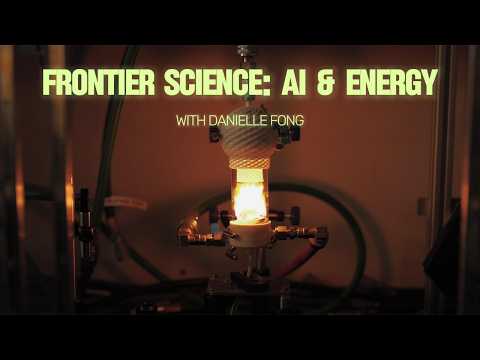
Transcript
0:08 three years of sort of compound design ADHD science bootstrapping. >> So this is a world in in profound crisis that ride this into a hyperamerican millennium. So there's a demand that far outstrips all existing players. I'm >> here with Danielle in your super cool energy source energy energy storage lab propane.
0:38 >> it's like what lab? What do you do? It's like it's like it's energy physics and AI. That's what we do. >> Energy, physics, AI. Danielle Fong is a Canadian scientist and entrepreneur who has been pushing the boundaries of energy technology for over a decade. She grew up in Dartmouth, Nova Scotia, and enrolled at Delhausy University at the age of 12. Yes, 12. graduating at 17 with a degree in physics and computer science with first class honors. From there, she went to Princeton to pursue a PhD in plasma physics, but dropped out at 20 to go build things. In 2009, she co-founded Light Sale Energy in Berkeley, where she served as chief scientist. Light developed a novel approach to compressed air energy storage. The idea being to make solar and wind power available on demand by storing energy cheaply at scale. The company raised over $37 million and was backed by Kla amongst others. Danielle has been recognized by Forbes 30 under 30, MIT technology reviews innovators under 35 and Times 30 under 30. She's spoken at TED CERN at the United Nations and has been a mentor with the Teal Fellowship. More recently, she founded Light Cell Energy where she's CEO. Light Cell is developing a new kind of energy conversion device. Essentially turning fuel into electricity using heated salt that radiates light into specialty designed solar cells.
1:55 >> Wow, incredible background. Can you explain to us what Light Cell is doing? >> so the Chinese have known how to make fireworks for for centuries. but no one has ever tapped into the basic physics. for power. but when I started to explore it, I found that it was super linear in how intense it could get as you increase in temperature. So, if only someone could figure out a way to get a flame as hot as possible without destroying everything, you would be able to produce an incredibly bright light source that's brighter than the sun ever gets on the Earth's surface, maybe 10 times brighter. That if you surrounded with solar cells, could make a power source that is like a portable Dyson sphere, like a sci-fi glowing power source that has dramatically higher energy density than a battery. So maybe 20 times the range on a robot or a drone or a vehicle and quiet and lightweight and potentially not just chemical power but also producing power from novel fision or or fusion processes as well. So basically we've called it a a portable Dyson sphere or a solid state internal combustion engine.
3:20 everything from data centers to something that you can put into your your backpack and power your Burning Man camp and power your Starlink, your laptop, charge your phone, brew your UT. the ability to build these light engines out of ceramic and sapphire and solar panels. And we 3D print these sort of corrugated lattises that are essentially a combination of heat exchanger and candle wick united in one that provides sodium chloride to the flame to make extremely bright light.
4:00 and then that light you can match to solar panels and it's more efficient than the conversion of light from the the sun on Earth maybe double or triple the efficiency of a typical solar cell. >> And can you talk a little bit about what's going on in the world? what's going on within the energy landscape that makes this really kind of a global crisis in terms of like future energy needs.
4:30 >> okay. Well, today or mid-March there's been a war with Iran and as of very recently Israel attacked Iranian infrastructure. Iran warned that they would retaliate on energy infrastructure after this. They have therefore attacked and what they have attacked is is basically the world's largest natural gas fields and oil fields and they've restricted movement of oil through the the straight of Hormuz. And so that's 20% of the world's oil, 30% of the world's natural gas, 50% of the world's helium, 1/3 of all of the ura, which is for fertilizer during the time of of planting. so this is a world in in profound crisis that the dawning realization of how of how restricted it's going to be has not unfurled itself before the people yet because those price signals have been damped out even by the government. And so as the price which which has has in for physical barrels has topped $170 which is the highest ever for for crude oil.
5:51 $170 per barrel it's going to continue to increase as long as the demand remains high which it will be and the supply is restricted and being attacked. not just the current transportation but also the infrastructure which takes years to build or decades and and and is currently under threat. And so people are going to need to be more efficient and people are going to need to have other sources and there are so many even just in terms of like turbine manufacturer time deliveries were stretched out like seven years But now that you have problems in the supply chain for fuels, you have a lot of things that you know can't be used efficiently. So you have to you have to do something. So this is going to really kick off a critical period of innovation in in energy both invention and use of novel energy because people are desperate from existing needs and then also this exploding need for AI compute power concentrated in one spot so that you can you don't have too much networking challenges. and so these things are all hitting at the same time.
7:12 >> So this is the game field. This really sets what it will be for the entire rest of the century, probably certainly the back half of this decade. and as a result, >> everybody who had been working on energy, even if they it's been very thin in terms of what you can raise money to do in terms of frontier tech and timelines or whatever, now people are like, "Forget money. I have infinite money. >> >> I have I have GPUs burning a hole in my pocket >> that every second every year that I I h I I have a GPU that I don't have plugged in, >> the depreciation on that GPU is worth an entire nuclear power plant.
7:54 >> Wow. >> So that's the current state of desperation for everyone. Now, I'd love to hear how Light Cell or generally the innovation you're working on could fit into this power landscape and the future of energy and energy storage and and your vision. >> Right. So, well the key is that because we use heat now it's high temperature heat but because we can use heat then we have the possibility of using a wide variety of different fuels.
8:25 So that includes hydrogen that you can just create from solar or any renewable when it's available. that includes producing excess fuels, synthetic fuels from from nuclear or or solar or or any any abundant resource. And so that breaks the kind of chicken and egg problem of synthetic fuels, which is what are you building for? and the way that we do this is we essentially make an extremely bright candle and there's kind of two key pieces to that.
8:59 one is as you get it hotter, it gets nonlinearly brighter. even faster than the the temperature to the fourth power of black body emitters >> goes this >> I'm sorry. Can you explain what black body emitters are? >> Oh, sorry. it's a physics term meaning the sort of idealized typical although it's never perfect emission of something that gets that gets hot and starts glowing.
9:29 >> if as if if it were black at room temperature and you can't see it, it first gets >> red and then orange and then so on up to white. won't get blue before being too hot to to exist as a solid. But u that's what a black body means. but this is something different. This is like a quantum resonance that takes place as the electron is actually oscillating around the atom. It's like a big I like to think of it as like a big bell that like gets thermally wanged.
10:05 That's the technical term. and it resonates like a very pure tone. >> and this this this particular color of yellow and this is used to make extremely bright almost monochromatic and almost exponentially brighter as you increase in the temperature. And to achieve that really high temperature, we've pushed heat exchangers to into materials and temperature ranges that have never before been achieved. Wow.
10:37 >> in an unclassified setting which is to use almost like a three-dimensional arch continuous curvature sort of lattice to to shape the flow and transfer and have a lot of surface area to transfer heat and also wick sodium chloride which provides the the sodium which is that special bell. And then the chloride stays the chlorine stays around reforms with the sodium and then condenses and it it processes it like a like a recondenser.
11:16 >> Anyway, so you can think of it just as like a power spectrum of like here's the amount of power that we want to deliver for the application. and which which lines up pretty well, I mean maybe not perfectly, but pretty well with, you know, our increasing confidence in working with increasingly large and energetic things. So at the smallest scale of of a thing that you could want is something you can fit in your purse >> and it can power your phone, power your laptop, power your Starlink, and it provides heat and light and it provides power and hot water, right? And it's this general basic fundamental utility that everyone on the planet's going to want. M >> every person much less every military every person right so that's that's kind of the platonic ideal of the thing that we want to produce kind of a pretty broad range is like 30 watts charge a phone fast 150 watts kind of what you would want for the Starlink and a laptop going straight and like Joanie IV just sold his thing like lamp thing >> for thousands of dollars and We could clearly beat that with a really functional piece of equipment that would be actually ideal. You know, we could tell you what Joe, you and I collaborate. so that's on the small scale. You can imagine something like that powering any kind of robot or drone. And then as you scale up to about, you know, 1 kilowatt, that's sort of a heavy lift heavy lift drone up to about 1500 watts. That's the maximum you're allowed to draw of a single appliance, any electric appliance, is 1500 watts. That's a good generator size that replaces back backup generators up to 4 kow, which turns out that's the largest size that you don't have to tell anybody about, >> quote anybody >> in terms of government.
13:19 >> In terms of government regulation, so you can just go to the Home Depot and get it right. So, you want to make that but quiet and not smelly and not vibrating and really sophisticated so I can sell it at a nice margin. and that's that's a great scale. Then 25 kW, that's what you want for like an electric flying boat. They they asked for that scale like long range extender, any kind of vehicle. So, so like a Chevy Volt, like if reboot that, you replace the the electric motor with this and it's primarily an electric car, but it has range extension, can go a thousand miles.
13:59 >> And can you where in the spectrum is a so I think with the open claw Mac mini phenomenon, we saw how many people wanted their own. >> Yeah. Yeah. Yeah. The first scale would be able to just run off of propane or whatever or or hydrogen or for and run and run your open claw unless unless you were using the very largest Mac studio in which case you might not need need to. >> Okay. So your next open claw setup is going to be potentially powered.
14:26 >> It should be it should Yeah, you wouldn't need to plug it into you can make it a little exoskeleton. You wouldn't need to actually have it plugged into the wall. >> Whoa. Okay. What do you think about the line between selling to the US government and selling to consumers moving ahead? Oh. I think it's really important to remember that the United States government leads the future, still has the most innovative set of swashbuckling entrepreneurs and scientists and inventors and can still ride this into a hyperamerican millennium. And that means supporting as as powerfully the American dominion that it is leading as possible. That means not killing Claude and that means funding people who yes they have it would imaginably have military applications but it has profound civilian applications too. So, people talk about drones. obviously drones can cause a lot of damage.
15:38 Here in California, the just the health impacts of the wildfires, if you if you study it, if you if you if you basically calculate it out, >> is between 50 and hundred billion dollars a year in just health impacts. >> Wow. Because there's where all the places where you can easily build are built and then there's all of these like edge areas where there's flammable infrastructure and trees in wildfire areas in a warming world and you can't drive trucks around.
16:11 Enter my friends Fly Senica who make the world's greatest wildfire fighting drone. Carries 100 pounds of water, flies right up to it, squirts it Instead of at a great distance dropping things individually with two planes, they can fly a continuous set of these drones. If we increase their range by 20x, the surface area of what gets covered by the same base increases by 400x. >> Wow, that's incredible. >> So they have an enormous benefit. That's just in California 50 to 100 billion.
16:47 That is well maybe equal to the amount of damage that Iran is doing with long range drones that also use fuel >> on like it would stop the f like it could stop fire. >> That's right. It can stop those and it could you know you can fly around and put out the fires that are currently raging in the Middle East. So that's one example. Another friends of mine, friends of mine, Zipline, they deliver 90% of all of the medicine in Kenya. I think I might have gotten one of two of those details wrong because the mountainous country that it is has underbuilt road network, lots of mountains, great distances. And so there's lots and lots of great distance, you know, away from Nairobi, medicine that or blood or something needs to be delivered. And so they built the world's first delivery network for really high value medical supplies and now they've extended it to well, it's in they did with Walmart, Arkansas, and like people were just getting ice cream just dropped from drones. and like people were so, you know, they would always order a tub of ice cream and they were a little worried, feeling maybe a little bad, oh, if they hurt this guy's health continuing to deliver ice cream >> and he stopped at one point like, oh, is he? No, he was just gone for a little bit. He came back and he's he's still doing it. But this delivery and a lot of things that are just last mile >> for completely civilian purposes can become totally automated at the same time air defense. So >> yeah.
18:24 >> Okay. So all the above have the the following parameter which is that like the infrastructure is a property of how many bases that you put on and the range is I mean maybe you can't do at the maximum distance the same number of flights but the the total number of things that are in range goes as the square of the range which basically goes with energy density because your your weight that gets dominating all of the drones or most of these electric vehicles the most expensive and the heaviest thing is the battery and we would be able to replace that kind of weight with a fuel system that has all of the advantages of a lightweight battery system in terms of control of the motors and all all that flexibility but 20 times the distance >> so again 400 times the range that that that's just a profound change in the the geometry of the global economy. It's clearly going to be part of the future.
19:23 I was like, how the hell do I get on to this and take advantage of these two orders of magnitude that are available to me? >> We doubleclick on data centers and compute and AI. Where on the timeline do you think we are for data centers pulling in a new energy source like this? They're already every major hyperscaler has schedules out multiple years where they are trying to >> at least qualify every new idea that they can think of.
19:54 >> Okay. >> Okay. >> So that that goes from quite outlandish but it might be real. I mean they're actually producing neutrons. Helon with Microsoft as an offtaker at 1 cent per kilowatt hour. So that it's not really a commercial offtake actually. But nevertheless, they're making neutrons with dutium tridium in in in Washington Belleview. and all the way to, you know, there's lots of geothermal. There's people who are trying all kinds of fuel cells. Every fuel cell company has basically come alive >> because like no one was funding them because they're even though they're more efficient, they're more expensive. And so what you do is you get it financed, but you know there's a bunch of different middlemen and they all want to take their own piece and so you know it's a little more marshal. Suddenly it's just like they need a capacity.
20:50 all the way to people I including myself have gotten into the business of trying to find chunks of power in the tens of megawws to the hundreds of megawatts to the multiple gigawatts of categories >> that are like for some reason this isn't a data center yet this is just out of equilibrium right it was formerly being you know in a contract where they're selling their power at less than a cent per kilowatt hour the data centers they're actually buying it's not just if you calculate laid out like what a typical rate would be. It's like sort of order of magnitude like 30 cents per kilowatt hour, but like people are signing contracts for 75 cents per kilowatt hour because it's still a fraction of the depreciation of not running your GPUs and the GPUs, if you look at it, it's like, okay, well, are the GPUs going to depreciate? Well, it turns out that the H100 is actually more in demand and therefore it's actually renting out at a higher price than it did when it first came out. Well, why is that?
21:50 semi analysis pointed this out. >> Well, big one is that it's producing more valuable tokens. GPT 5.4 is like zillion times. >> Well, okay, it's not a zillion times. It was more it's smaller. It's more efficient and it's I I assume more valuable. >> Maybe there's some inflation there. producing more tokens, but also the re researchers need it. So, there's a lot of different generations of GPUs that are going to maintain value and they're going to want to cook for as long as they exist and still have value. They're they're they're going to be a demand on the electrical grid at the same time as EV, at the same as EVs, at the same time as oil is going to be in in short supply.
22:32 >> And when when you have a a a supply of something that's deeply valuable and it's short supply at 20%, it doesn't mean prices go up 20%. It means things start pricing at closer to what they're valued by people in desperation and other people who are in desperation who don't have the money don't get it. >> So I understand these contracts are being signed now. >> how like how far away are we from having a data center potentially powered in part if not totally by like a propane based energy source?
23:05 >> I mean we are trying to do that here. So in addition to so we've been at the cutting edge of actually using AI for doing the things that's been increasingly powerful to do from like really power powerful web and literature surveys to representing famous old data scientists and like their their perspective on things while I talk it out, you know, a little little better than rubber duck. to now doing full agentic implementation and now everybody at the company has been using these tools is enhanced. we're also doing our own training runs >> all the time >> and we're and and we're running our own furnaces and so we are we are now maxed out for the amount of power that we can run here.
23:51 >> Wait, I want to double check. So on a high level what are you all modeling here? So, we have a complex of tools and projects in something called a mind palace that has pulled in all of the papers and all of my tweets and all of the project and all the experiments and >> has amazing posts. Obviously, this is going to come out on X, but like you really are so tapped into AI and research and everything happening. So, you have the mind palace.
24:22 >> So, right. So, like what you know and and why do I have all that on Twitter? It's it is because like initially when I got like the first iPad Pro and I had the pencil I started using free form imagery and Apple notes to store everything that I could think of and pretty soon had thousands of notes pretty soon by about 10,000 there's enough N squared algorithms in there to just be like crashing out and I I needed to put my thoughts somewhere I had to put her so I started putting they're like you're crazy. You're putting out too many thoughts. I'm like, that sounds like a you problem.
25:01 >> Like, what are you doing in my notes app, you know? And so, as a result, instead of just tweeting into the void about like things that I was joking about wanting to build, it actually was the perfect like corpus to to pull in when the first time I had the opportunity to use the Agentic coding tools when they got really good this Christmas. >> Mhm. to pull everything down. Hey, would it be useful? You know, AI is always asking me what I would think. Can't you just simulate me and then do something that I would think is good? Okay, sure. And then, holy AGI. Okay, I had it talking iteratively and visually with with Gemini, which has all of the it's trained on all of the YouTube content and it has all this.
25:48 >> And so, even though it wasn't able to make images, cloud code was able to look at it. And even though Gemini wasn't very good in its own CLI, >> it was able to be driven by it. Even though the imagery, if you tried to make it in AI studio, was really annoying, cloud code could completely do it. And and that was a full sort of psychological loop like like an artist would have. And so this just I was blown away. Took off. And so now I'm like, okay, how do I make this so that it extends from being like it'll work for my dev environment for this kind of weird workflow that I've I've found a way to hack around to being like a product that anybody can use. I can just give and not worry too much about supporting it. So have a bunch of domain names, have a way to use the system itself to document itself and then you register the domain name, put it all in CloudFare, push a single command and also like and these are obviously not exactly the same system. sandbox somewhat, but we have a whole, you know, testing frameworks and rubrics to judge how well it's doing, >> which is also how we develop the >> much more tested and like statically analyzed code that moves valves around in our science and records everything and then puts it into the thing. And so this is basically coming together. So this is like a a a Gonzo attempt to bootstrap right on top of the singularity artificial intelligence AGI event and it's happening now and lead the way with the most exciting physics work ever and just build our own harness and then put it out. So we're we're sort of and we we're hugely advantage. We we we we know in addition to all the experience that we have just working with these things from from from the beginning really intensively. these guys are our friends. We're talking out in the open and we're sharing our ideas. So, a lot of people want to share, you know, so and the big labs don't find it as easy as we do to pull in in communication all of the frontier models to hash it out.
27:55 So, you know, all these models are out of out of date. Well, no problem. Grock is really good at knowing what is hot going on at X and figuring out how to how to recommend that and pull that in. Great situational awareness for all of them. Okay. Gemini is a genius scientist and artist, but is maybe a little too enthusiastic and skitso. No problem. Codeex is going to make sure to read the policy instructions before it's convinced about anything. That calms it down. And Claude Code is, you know, the man of action. just wants to do it. Like, so you put these together and you build your own ways to reflect on your own work, the rubrics that you repeatedly use, the doctrines that you use, and then you start optimizing out how often you need to be able to give it advice. And also, is it notifying you?
28:53 Is the notification showing up on your Apple Watch? Is it showing up in the lighting system in the building? Is it going onto a task manager that everything is able to read and are are you able to read? Every time you improve these things, even though it's a lot of infrastructural work and it, you know, it can have some trouble with sort of building multiple parallel paths and then getting confused or or or forgetting to use to not use certain things like it it has trouble with that, but those dramatically enhance the scale of what's possible as a tiny company.
29:30 Mhm. >> And so we we feel that we're we're we're part of a new generation of basically AI cavalry or perhaps hordes that essentially are super empowered like almost like comic book heroes relative to what would normally be feasible. Yeah. And can you talk a little bit about as a CEO and founder in Frontier Science, how do you project timelines when you're running obviously these physical experiments? And it's it's not a wet lab, but you're dealing with materials that like is it harder to project timelines on getting towards products?
30:09 >> You know, it is for sure. It's just the fact, right? And you know there's there's two ends of that that you can optimize, right? The first is if you optimize the timeline, which is primarily how many iterations does it take for you to learn the critical lesson >> that the universe will eventually tell you. At best, it takes you no experiments. You already know the answer. You just weren't considering the data which you already have. That that can happen a lot. But sometimes it's just a certain number of iterations, right? And and usually it's a certain number of iterations and people get stuck behind the first iteration. They ask all kinds of advice and they go to conferences and blah blah blah and they wait years and they raise money for 10 years or whatever it is. This is not the way to do it.
31:00 If you don't have a great idea, do actions that give you information >> and move forward and try to answer the most critical thing. And this can just it's qualitative, right? You can you can have AI help you understand from different perspectives what the really qualitative thing is. But what's going to flip the bit first thing for me okay was I I have I have to stop just reading papers about this and see if it's really true. Can I just from salt and a high temperature flame produce this incredibly bright light? I've convinced my parents, let me use their garden shed to do some experiments. I got a glass blower's torch based on snooping some YouTuber hacksmith on YouTube. what he used, shout out Waterlue area.
31:57 and I put a steel spoon with salt in front of this flame. And my dad was there to get a picture, make sure nothing went too wrong. it was like blinding. I'm like, do you have it? Like, yeah. And like I'm walking around the next day and I've got a line ac after image across my like that. Okay, that's that's not supposed to happen. But also, holy Okay, it's really it really is the effect. It is of the order of magnitude.
32:32 This is before there there's a light trapping component, but if you calculate out how bright it should be without light trapping, it's like kilowatts or megawatts and like this this very tiny area. Okay, this is very interesting. And and then I knew and then I was all in, right? It was actually is profoundly an emotional thing. What what is answering the question for you? You're not trying to convince other investors. You're not trying to convince other people. You might be trying to convince your co-founders, but really you're trying to know and then move forward.
33:06 You're you you are your own most diff easiest person to fool, but you're also the most important person to convince. If you can hold those two things in tension like or like pedals on a on a bicycle then you can direct yourself to okay let's answering let's answer the critical questions with the minimum amount of money and the minimum amount of iterations and then what's limiting you it's usually the bravery to do the experiment no one else will do it which other reason it doesn't happen in government labs or university labs or anything there's no secret because it is dangerous. You have to think hard about everything that you're doing >> otherwise you you know you can easily burn yourself much less like have a an explosion or something which is occasionally >> happened.
33:57 >> Yeah. When I code I don't worry about an explosion like that's a very real >> not usually. >> Not usually that's a very real element to the iteration cycle here. >> Yeah. Yeah. I know it's true. So it was so it's it's it's it's somehow you have to tune into yourself to the point where you're like okay this is time to do it. This is a this is safe enough to push forward and we can we can continue. and I have a huge amount of respect for the experimental physicists and mechanical engineers you know who've who've done this kind of work in the past and you know people working on much larger energetic systems rockets this is very similar to a rocket >> or bombs >> micronuclear reactors are quite similar.
34:49 Okay. So like all these things these are like the aspirational targets of like what you eventually build up all of the confidence in systems to be able to safely design not bombs micronuclear reactors but and jets but but these things these things absolutely took take time to like to square up to and then do and do and and even you know and Even then there were some reckless decisions that we do do. I think there was basically you know some of the answer of why we made progress where others just just didn't or wouldn't. and one big one is oh isn't it isn't that too bright Danielle there must be a point that we are not far from where just the heat loading on my eyeballs is a concern in addition to the brightness. But we are, it's a little different from the sun.
35:49 The sun itself is extremely bright, 6,000° at the surface. the unit is 2 billion candelas per meter squared. It's this crazy unit. we we never quite approach that. We'll be into the low millions, but we cover 100% of the sky instead of the sun, which is only one 600 th00,000th of the sky. And I'd love to ask you looking ahead maybe at the next two years, what hot take do you have around the energy landscape? I know we talked a little bit about obviously like the war in Iran and geopolitical tensions. are there Yeah. any hot takes just being able to see maybe a bit farther than anyone who's not so deep in the tech.
36:36 >> I I think that the ways in which energy isn't this way even beyond like it will definitely be a massive financial thing but it will be more a physical and temporal constraint than anybody really understands. from this point on for the entire not just the rest of the decade. This is setting the tone for the entire century, right? >> Wow. >> Because the you know previously it's like oh we don't have the technology to switch off of fossil fuels.
37:11 >> Okay. Well, we have the technology but it's either woke or Chinese. It's both. It's woke and Chinese worldwide. it simply being available, much less available at like 1/ half or a third the cost will easily make that decision for people. And so the crisis is upon the supply crisis is upon us. It can't be avoided. The technology an an a foundational technology which you can integrate like we're an example of something that can integrate the fact that solar is practically free. Again, it's the cost of building material. In other words, you can make roofs and we have done this. We have built little solar temporarily solar villages, A-frame villages to to to be useful structures in addition to being inexpensive ways to mount solar and the whole thing works. And so you're going to like in China, you have whole mountain sites, otherwise unusable land, maybe it was arid.
38:13 Not only is the solar helpful, but it helps hold the mountain sides down and in the rain shadow, it condenses water for the plant life. So, we're going to end up So, that's like a foundational thing. Another another thing, friend of mine, Casey Hanmer, shout out Terraform Industries, Light Cell sponsor. they they they have basically been like, look, people aren't aren't solarpilled. What do you need? Well, you need synthetic fuels. >> Synthetic fuels that we can burn >> from hydrogen to methane. And actually my co-founder Steve's son went to MIT. Now he's a professor. He works on synthetic propane which is what we use for the a most experiments here.
38:51 Hank Williams. There's nothing more American than propane and propane accessories. that's we're basically going to sell a barbecue that can power your Burning Man camp. >> That's awesome. >> And and so that's sort of the next tier up from the thing that you know you can have in your in your purse. And then tier after that is a shipping container. 10 megawatts of power like basically you know those backyard patio heaters with a big quartz tube big flame.
39:22 >> I think they were very popular during co especially in New York City for restaurants. >> Yeah. >> So it's a 20 lb propane and then there's big quartz tube. That quartz tube mass-produced costs like it's like I think it's like 25 bucks. You can buy it on Amazon for like 40 bucks. it's so cheap. But one of those is order of magnitude the sort of thing we can get 100 kow out of. So you multiply that by 100, put it in a shipping container, make sure there's pretty good basically air movements to cool the solar cells, and you have an off- peak, you know, solid state peaker plant, backup plant, something to power a data center that is cheaper and more efficient than a simple cycle gas turbine and can be integrated in a into a combined cycle basically as a topping cycle. to have much more energy efficiency and can use any fuel including hydrogen at any mix. So therefore you can just store the solar energy. So now you're using now we're compounding in two different ways.
40:28 This foundational advance in the cost of solar cells directly because we're generating power through solar cells and we're generating power that's stored from the original fusion reactor, the sun in the sky. so, so that is going to be that plus batteries, solar plus batteries every everywhere. EVs, a huge kick in the pants everywhere. Chinese EVs already. It's going to be in Canada, Mexico, EU. Okay. And they're they're more advanced than the Teslas right now, which maybe Elon can focus on that.
41:04 Okay. so basically that's going to be on the energy side and at the same time if you look at all most of the advances happening now these came out of research invention efforts scientific efforts things that got funded from the previous oil crisis. Okay now that's not going to happen in the United States from the government right but it's going to happen from people who have much deeper pockets with a much clearer need. So hyperscalers, billionaire philanthropists, >> hyperscalers, >> okay, >> billionaire philanthropists who want to get on top of it and who have managed to negotiate themselves into the problem of having hundreds of megawatts of GPUs and nowhere to plug it in that isn't going to get sued because the the the time frame for a grid interconnect is on the on the order of 3 to seven years. And so what FK has been pushing the the federal energy research resource comm regulatory commission is like okay hyperscalers must bring their own power they must bring their own capacity.
42:10 So there's a demand that far outstrips all existing players for generators gas turbines and the electrical grid. So this is going to seed a golden age in energy technology >> and maybe it won't be funded by the government here. Maybe it will and maybe we're sufficiently not woke since we burn fossil fuels. You know, drill baby drill. But it will be funded everywhere on the planet because they're in the same problem.
42:43 Well, Danielle, thank you so much for walking us through all of this frontier science and future product needs and maybe what's coming up ahead. Are there any questions I didn't ask you that I should have? >> what does this thing look like? >> Okay. All right. Do you guys want to see it? Yeah. >> We're going to go look.