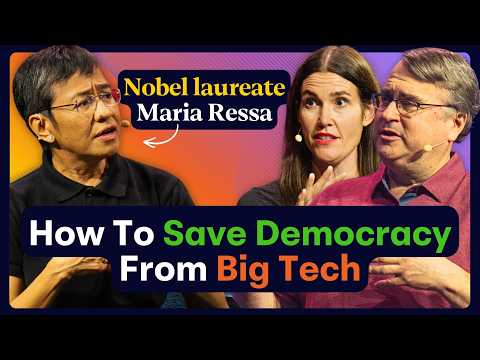
Section Insights
Can Silicon Valley Reform Itself?
Can Silicon Valley still reform itself?
The speaker expresses concern about the current state of news organizations and the potential for reform in Silicon Valley, emphasizing the need for action before the opportunity closes.
- Silicon Valley faces a market failure in news organizations.
- There is a risk of a Faustian bargain in the new world order.
- The time for action is limited and urgent.
Understanding the Three Intertwined Crises
What are the three intertwined crises affecting society?
The speaker identifies three crises: the crisis of truth, the crisis of order, and the crisis of accountability, all stemming from the inability to distinguish fact from fiction.
- The crisis of truth is exacerbated by social media.
- The breakdown of truth leads to a hollowing out of institutions.
- Without accountability, societal organization fails.
Steps to Combat Information Warfare
What steps can individuals take to address the challenges posed by misinformation?
The speaker suggests practical steps like assessing screen time and identifying anger-inducing apps to reduce exposure to harmful content, emphasizing a step-by-step approach to tackling misinformation.
- Monitor and limit screen time to combat misinformation.
- Identify and consider deleting apps that provoke anger.
- Take incremental steps towards understanding and defending against misinformation.
The Business Model of News Organizations
How are news organizations adapting to market failures?
The speaker discusses the challenges faced by news organizations due to declining referral traffic and advertising revenue, highlighting the need for innovation and adaptation in their business models.
- News organizations are experiencing a significant drop in referral traffic.
- Adapting to market changes is crucial for survival.
- Innovative approaches can create new revenue streams.
Civic Engagement and Action
What actions should individuals take in the face of democratic crises?
The speaker urges individuals to engage actively in civic duties, emphasizing the importance of building communities and defending electoral integrity as a response to threats against democracy.
- Civic engagement is essential for defending democracy.
- Building small communities can foster collective action.
- Individuals should take proactive steps to ensure electoral integrity.
Transcript
0:01 >> My question really is, can Silicon Valley still reform itself? Can you do enough with values? This is a period of market failure for news organizations. There's so much that could be used for good. But be careful of the Faustian bargain. The new world order that's being created is made up of strands, like a spider web. Each strand, it looks weak, you can tear it, but the spider web can hold if those countries can hold together. Act, please. The window is still open, but it's closing fast.
0:34 >> >> Please welcome Nobel Laureate Maria Ressa, Reid Hoffman, and Arya Finger. >> >> Maria, so glad you could join us. first, congratulations on your victories in the Filipino Supreme Court. >> >> And if you ever thought you're like super young at heart, right? An instance. So, you have just one case still pending, yes? >> Yeah, so it took almost a decade, but there were 10 cases filed against Rappler, the company that I led, and 11 against me.
1:13 a case now has gone all the way up to the Supreme Court. So, it's meant for almost a decade I've had to ask for I lost my right to travel. So, until today to be here in front of you, you had to write a letter to my Supreme Court to ask for permission for me to travel. So, guys, when you lose your rights, be careful. It takes a while to claw them back. >> Yes. >> Easier to defend it up front.
1:36 >> But where is the corrupt leader who tried to stop you and your fellow journalists right now? >> Okay, well, so first, >> >> the fight back has two dictators, right? But as you pointed out, Arya, the dictator Rodrigo Duterte, who had tried to put me in jail for the rest of my life and close Rappler down, was arrested in March 2025. He's charged with crimes against humanity and his trial at the International Criminal Court begins November 30th.
2:06 >> Okay. >> >> But that's the first dictator. My second dictator, and I do mean that. And I would argue the more powerful dictator in the Philippines is was is Mark Zuckerberg. This is data-driven. We worked with them at that point 97% of Filipinos are on the internet. We're on Facebook. Facebook is was our internet. Today it's 100% right? But at that point I sat with him and I in 2017, I said, you know, Mark, you have to come visit the Philippines because it's it's so powerful. The the ability to do good is incredible.
2:47 He was frowning at me. Reid doesn't frown at me. >> >> but he was frowning. And and then he said, Maria, where are the other 3%? And that was my introduction. So, my second dictator has along with other dictators in tech has gone more power. One system of governance has has had some level of accountability. the trial begins. It's a whole of society approach, right? but the other dictator has gone on to get more power and that same culture is is global, right? So, I mean, in 2016, I sat in California and in Mountain View at that point to say what was happening to us is coming for you.
3:37 I feel like Cassandra and Sisyphus combined and like really Reid, the reason I'm so happy you're here because, you know, my question really is can Silicon Valley still reform itself? Can you do enough with values? Guys, we've been talking about values all day. >> Well, hold on 1 second before we get to the next question. I do think and this is part of the like the Masters Scale Summit, which is part of the thing of not just technology, but it's kind of soul and culture and humanism and people. And I do think that one of the things that Silicon Valley is a bit of a microcosm for America is also good at, you know, kind of like rebuilding, reinventing itself. So, I have that hope and optimism. I do think it's some work you have to focus on you know, what are the human impacts. I think technology, you know, I've I've said we're homo technet, that the technology is fundamental to being human, but you have to focus on the human part of it. And so, that's part of the reason we wanted you out here and on the stage so that Silicon Valley can, you know, hear that and participate, but it's just as your own work, it's work.
4:43 >> Yeah, a lot. And we're counting on you. But But wait, Maria, you are the one you need to keep talking. You are the one who can help us solve this. We have so much to learn. You know, in your book, The Fight Back, you say we're not just fighting one crisis. This is three inter- intertwined crises, which is a lot. How would you define these three? Because we need your experience to make sure we don't go all the way down that road.
5:11 >> I mean, look, at the 80th anniversary of the United Nations, so the Universal Declaration of Human Rights, right? That was how the world responded to Hiroshima and Nagasaki and our own potential self-destruction. At the UN on the 80th year, I said that if we win information integrity, if we can tell the difference between fact and fiction, then we can begin to fight the other problems, climate, gender, rule of law.
5:42 If you don't If people, the citizens, cannot tell the difference between fact and delusion, with information warfare, with narrative warfare, cognitive surrender now, right? Then we lose it all. So, here's the way the three things roll out, right? The first is the crisis of truth. You We've heard that a lot, and that goes to social media, right? We can't tell the difference. Literally by design, social media, except LinkedIn, social media, yeah, he had some values, no?
6:18 >> One or two. >> But literally, lies spread faster. And if you if you use fear, anger, and hate in the Philippines in 2017, women journalists were attacked at least 10 times more than men. So, gender disinformation. The second part of is the crisis. If you can't tell fact from fiction, then you move down to what hollows out. Your institutions hollow out. That breaks down the crisis of order, right? If you don't have rule of law, how do you organize society? This is why there's impunity of the two dictators. And the third rung is without that, you have a crisis of accountability. And part of that is you have a system of laws. The United Nations is set up for accountability that is frayed at the edges, but look, my Rodrigo Duterte is facing crimes against humanity. But you have the tech that rules our world. And I'll pull this out, right? Please tell me I'm wrong. I'm waiting for you, Ari also.
7:25 Three layers of AI that starts with that culture that started social media. Hacked our biology, the attention economy. The second layer is are the chatbots that that the large language models, that second layer. I called it in the book, it hacked intimacy. So, trust is broken to intimacy, what makes us human. And then the last one is agency itself, from the agentic and multi-agentic. And I co-chair the UN's international independent international panel on scientific intelligence.
8:04 Sorry, scientific panel on artificial intelligence, mouthful. And we came out with this with this report in July that said that, you know, geopolitically we're changing the world because 75% of the compute power comes from America. America points to China, but only 15% of the compute power is China. And then the world's laws come from EU, which has 5%. The pace has accelerated. You both said this. And then the last piece, as early as July, the people who built it themselves said they could not control it.
8:43 They could not control the frontier model. So the question, of course, is why do they build it? >> So we're going to get to AI in one moment. I know. >> Oh, good. I'm taking you where I want to go. >> But the very clever journalist is turning the interview around. >> stay tuned. Maria's going to interview Reed for 20 minutes after. But okay, you started with the information. No, we want to hear from you. Yes. You started with information integrity being sort of the most important fight, and it's the first one that leads to the next three. There are a lot of people here who agree with you and really care about information integrity.
9:19 How do we fight it? How do we fight back against that first layer? What are all the answers? >> First, get off your seats and stop with learned helplessness. I think it's the first one, right? >> >> The title, agency. It's the cellular level of a democracy that the technology targets. You have tremendous power, and that's part of what the fight back is, you know, at after the first chapter. So every chapter has 10 steps, and at the end of the book, there are 10 strategic goals. We did not, you know, I fought with my publisher cuz they wanted to put the strategic goals at the beginning, and I was like, "No."
10:01 Because it looks like you have to climb Mount Everest with strategic goals. When when you do it step by step, you just take a step forward, right? You just So, the first chapter is called the two dictators. And the first step you have to do, you should do it like as soon as you leave, next tomorrow, just take a look. How much time do you spend on screens? >> Too much. >> And then when you have that, the second step is which app makes you angriest?
10:31 Consider deleting it. Right? I mean, these are easy steps. So, that's the first. And the book is is set up so it's there's the first three chapters, understand. The second four chapters, defend. Chapter four is defend yourself. Have you done the 15-minute security audit? Defend your community. Defend your journalists before it's too late. Defend your institutions. And the last chunk, build. Hillary Clinton asked me this. Yes, we have to because she she actually said, Maria, we know the problems, but why are we always playing defense?
11:08 And so, what's the offense? Chapter eight, build your own technology. Right? Where is public interest tech? Read and area. Where is public interest tech? Right? >> She keeps trying to turn the interview around, you know. >> Chapter nine, super important where again we go bottom up, but chapter nine is govern collectively. Because no nation on the earth can do this on their own, but the leaders who are trying to fight this battle are getting elected out. Why do we think tech and far right are kind of close-knit?
11:42 There were decisions that have made that have shifted the world, right? So, govern collectively. And the last one, and think about this one for your for your kids, for your family, the world we want. What's our vision of the world we want? I know you both have a vision of the world we want. But that's there. So, the strategical are at the end, but everyone in this room, you guys are all so powerful. You're so powerful. You're in Silicon Valley for God's sakes.
12:11 >> >> This little area has turned my world upside down in the global south. And on January 6th, I thought, "Oh my gosh, Silicon Valley sins came home to roost." But you really didn't learn the lesson. I hope you learn the lesson now. Fight back. >> Yeah. It's important to take your own agency. >> >> So, one of the things that Silicon Valley innovates on that isn't just, you know, technology, networks, etc., but is also business models.
12:48 >> Yes. >> So, journalism needs a new business model. >> Yes. >> Say a little bit about that. >> Yeah. So, I think Rappler Well, let me first talk about our own experiences. We survived our our state dictator. We survived barely. and it happens. The fear is real. So, I empathize. I'm I'm Filipino and I'm American. Imagine going through this twice in a decade. >> And can you tell everyone in one sentence what Rappler is for the folks who don't know?
13:19 >> Sure. Rappler is a news organization. So, this is my 40th year as a journalist. I'm an I'm an investigative reporter. I worked for I opened the Manila bureau of CNN in 1987 and and and in Jakarta in 1995. and then I ran the largest news group in in the Philippines. In 2011, I realized that the tech was transformative and I bit hook, line, and sinker. I thought that social media, Facebook, would be a way to come bottom up, to hold power to account. And for a while, it was.
13:56 Right? For a while, it was. And then it wasn't. And that's when it was tweaked. But Rappler is a news organization of about 100 120 people. We We're small. We're about $5 million a year. Nothing like what you have heard here in in Silicon Valley. But here's what happens when the news group becomes mission-driven. when the when the Philippine government first tried to shut us down in January 15, 2018, I remember these dates.
14:28 We had a meeting. All 100 of us and our median age in Rappler's 23 years old, 23. So, when Duterte was bullying our reporter, she was 26 years old, right? So, I said "This is a different time. If you want to leave, we will help you find a job." And not one of the journalists left. And we became so focused. But, let me answer your question about the business model.
14:59 I think the business model today, so we survived Duterte. And my gosh, we will do our best We are doing our best to survive this time period because this is a period of market failure for news organizations. If you don't know this yet, right? zero-click search means that referral traffic to every news site has gone down. In my country, a drop of 85%. in Facebook, Facebook was the first one, once the largest distributor of news globally. That went down by 2024, at least 60 to 70%. So, that means unless you already have us on your phone, you will not discover us. That's one so revenue stream. But, the flip side of that is that you know what doesn't kill you makes you stronger.
15:46 In a weird way, I have to thank Duterte. because when he tried to shut us down, within 4 months, we dropped 49% of our advertising revenue. We should have died in 2018, but we pivoted and created a company that did tech and data. Like, literally, it the company our sister company was called Nerve. And that was how we figured out like we could do NLP, figure out here's the cluster of the messaging that's attacking us, and here are the networks that are spreading it.
16:21 When we did that, that allowed us to maintain it's a it now contributes roughly 40% of our revenues because advertising model is dead, essentially. So, what doesn't kill you does make you stronger, right? Embrace your fear and create. I think this is part of what we've been saying all day. but, having said that, folks, 53% of the traffic on the internet today is non-human. Let me say one non-human, right? And there's so much of the AI companies that have gotten money. So, what do they do?
16:59 They scrape. When they scrape Rappler or any other news group, your server costs go up. So, I'm literally paying for someone else to steal our content. and and they're doing it. Anyway, I'm just saying that support your journalists before it's too late. >> Yeah. I'm done. So, we only have about 3 minutes. Should we Should we do the UN question or >> Go for it.
17:31 >> I have that one, and then I have one after. >> Okay, great. So, you also lead efforts to the UN to create AI safety guidelines. Say a little bit about that, and say, you know, usually Silicon Valley is a fairly skeptical environment but the UN. Say, you know, kind of how and why we should get behind it. >> Yeah, because no country can fix this problem on its own, and what we've seen is that the Security Council is compromised, right? Nothing has moved.
17:58 So, what happened in the last 2 years is the General Assembly began the act of creation. The independent international scientific panel on AI that the UN created, the US voted against it. But, that set the facts. So, like everything, we need the facts. And what So, we did that by July, and then when we went to the global dialogue also created last year, and we talked to the countries, then we began to realize that they were only talking to the people selling them the tech that are both predatory and extractive, right? So, what we can see now is countries in the global south in particular want to know how the tech can be used for good, and there's so much that could be used for good.
18:43 But, be careful of the Faustian bargain. I I I'll say this. Chapter 9, govern collectively, is about the nations that are trying to come together despite the fact that the American beam has been pulled out. The new world order that's being created is made up of strands like a spider web. Each strand it looks weak, you can tear it, but the spider web can hold if those countries can hold together. So, what I hope for is the middle countries, the global south, Asia, that these countries can come together. Again, think about it this way, right? China has 15% of the world's compute power. The US still has huge power if you can nudge them in the right direction, but if you can't, what's the rest of the world doing? It's 193 member countries in the UN, and we're the global majority. So, if we can move forward, then we need help from people like you guys, you guys, right?
19:42 That's the order that we're after. I haven't given up. I mean, you can't give up. >> Well, you never give up. That's great. Exactly. >> So, clearly the US is consequential when we're talking about AI, compute, etc. All of these companies are based in Silicon Valley. I'm sure no one here knows this, but in 2 weeks we have the midterms. >> What? Sorry? >> Yeah, exactly. Less than 2 weeks now, right? >> weeks. Some might say that I mean, democracy is once again in crisis. Some people aren't sort of aware of the threats, other people are resigned to inaction because what can we do?
20:19 What is like the warning or hope or what would you tell us less than two weeks out from the midterms that we need to be watching? >> Well, first get up off your seats and go do things, right? Hope comes from action. If again, 100 tactical steps in the book, but chapter eight, sorry, chapter seven is defend your institutions. There's all these things that are there. You guys are going to go through what we went through in the Philippines in 1986. You will have to fight for electoral integrity, right? So, go be a poll watcher, go run, do things, build communities of action.
20:59 I mean, Minneapolis is very inspiring, right? The >> >> civic circles. Start with the civic circle. Eight to 15 people. And I when I write this, I write this from like someone who's had to do drills for the worst-case scenarios. What's your civic circle? How will you guys work together? And And then the last part, since you're in Silicon Valley, please build public interest tech, right? Like little Rappler in the Philippines, because we were playing Whac-A-Mole for a decade. And I begged the Silicon dictators. No. I I begged.
21:40 But it doesn't make money. They did They weren't nice in some ways. So, what we did is we we went and if you're familiar with the Matrix protocol, the Matrix protocol has 150 million addressable users. France and Germany, all of Germany's health system is on the Matrix protocol. And so, what's the future of news? Because we're not going to give up. The future of news is a global federation that is built on the Matrix protocol. We built the chat app. We rolled it out in 2023. There's 65 Filipino news groups. We're just rolling it out in Southeast Asia.
22:14 When you go on something that's federated that isn't manipulating you, I warn you, it will be boring. But you will have information integrity and when push comes to shove. So this is this new cycle normally is that you get 1 to 5% normally. That's a normal news thing cuz people don't want to be watching the news all day. But when crisis hits, you go and we hit 99 to 100%. Your news organizations are going to the gym every day to always make sure we're factually accurate. None of the tech you use actually care about the facts. Maybe except LinkedIn.
22:55 >> >> But go to public interest tech and then well the last one I'll say also is that we all have shared interests including Silicon Valley. And one of the things we saw was a common you've worked with Camille François and Roost wrote robust open online safety tools. We incubated this in in CIPA at Columbia University and you were part of this also. What it is is we went to all the tech companies here and they worked together and what we said is give us your trust and safety tools. So even OpenAI gave us an OSS. Discord gave us they became an alliance because we took what they didn't want to do, we perfected it and we rolled it out to everyone for free.
23:45 That's what what a floor for safety can look like, right? So it's a lot of moving parts. You are so incredibly important. We don't we the rest of the world often don't have a seat at the table that you have. So act, please, right? The time the window is still open but it's closing fast. >> Well, on that note you can tell why a profile in courage, vigor and strength who will never give up. Maria, so thank you for going.
24:20 >> >> Woo!
Summary
- Ressa warns of a "Faustian bargain" in technology, urging Silicon Valley to prioritize values and accountability.
- She identifies three intertwined crises: the crisis of truth (misinformation), the crisis of order (hollowed institutions), and the crisis of accountability (weak legal frameworks).
- Ressa describes her experiences with Rappler, emphasizing the importance of mission-driven journalism in the face of authoritarianism.
- She advocates for a new business model for journalism, pivoting towards technology and data to survive market failures.
- Ressa stresses the need for collective governance in addressing AI and technology challenges, particularly for countries in the Global South.
- She encourages individuals to take action, emphasizing that hope comes from active participation in democracy and community building.
- Ressa promotes the development of public interest technology to ensure information integrity and combat misinformation effectively.
- The discussion underscores the critical role of Silicon Valley in shaping global narratives and the responsibility to act before the opportunity closes.
Questions Answered
Can Silicon Valley still reform itself?
The speaker expresses concern about the current state of news organizations and the potential for reform in Silicon Valley, emphasizing the need for action before the opportunity closes.
What are the three intertwined crises affecting society?
The speaker identifies three crises: the crisis of truth, the crisis of order, and the crisis of accountability, all stemming from the inability to distinguish fact from fiction.
What steps can individuals take to address the challenges posed by misinformation?
The speaker suggests practical steps like assessing screen time and identifying anger-inducing apps to reduce exposure to harmful content, emphasizing a step-by-step approach to tackling misinformation.
How are news organizations adapting to market failures?
The speaker discusses the challenges faced by news organizations due to declining referral traffic and advertising revenue, highlighting the need for innovation and adaptation in their business models.
What actions should individuals take in the face of democratic crises?
The speaker urges individuals to engage actively in civic duties, emphasizing the importance of building communities and defending electoral integrity as a response to threats against democracy.