Section Insights
Introduction to Agentic Inference
What is agentic inference and why is it important?
The speaker introduces agentic inference, explaining its significance and how Friendly AI has rebuilt its inference cloud to support agents effectively. The company is positioned as a leader in AI inference for agents, emphasizing its research roots and innovations.
- Agentic inference is crucial for the future of AI agents.
- Friendly AI specializes in scalable, reliable, and cost-effective inference for agents.
- The company has a strong research background and has contributed significantly to industry standards.
The Shift from Chat to Task-Based Workloads
How do agentic workloads differ from traditional chat-based workloads?
Agentic workloads focus on tasks rather than individual requests, requiring optimization for task completion rather than response latency. This shift necessitates a different approach to inference, as users care about the overall task completion time.
- Agentic workloads involve multiple tasks and require different optimization strategies.
- Users prioritize the completion of entire tasks over the speed of individual requests.
- The structure of agent workflows is more complex than traditional chat interactions.
Challenges of Agent Inference
What are the unique challenges associated with agent inference?
Agent inference presents unique challenges, such as the need for continuous context growth and the interleaving of model and tool executions. The focus must be on end-to-end task latency rather than just individual request latency.
- Agent inference requires managing a growing context over time.
- End-to-end task latency is the key performance metric for agents.
- The complexity of agent workflows necessitates a tailored inference approach.
Engineering Solutions for Agentic Inference
What engineering strategies does Friendly AI employ to optimize agent inference?
Friendly AI has developed a multi-layered engineering approach that includes prefix caching, memory management, cache-aware routing, and agent-aware optimization to enhance the efficiency and speed of agentic inference.
- Prefix caching and hierarchical memory management are critical for optimizing performance.
- Cache-aware routing improves efficiency by maintaining cache locality.
- Agent-aware optimization allows for better decision-making based on the context of agent workflows.
Real-World Applications and Performance
How does Friendly AI perform in real-world applications?
Friendly AI has demonstrated superior performance in real-world applications, providing faster and more reliable agentic inference compared to competitors. The company supports various clients, from startups to global enterprises, highlighting its versatility and effectiveness.
- Friendly AI has proven to be significantly faster and more reliable than other inference providers.
- The platform is adaptable for different deployment needs, including APIs and dedicated endpoints.
- Successful case studies illustrate the practical benefits of using Friendly AI for agentic inference.
Transcript
0:13 Let's get started. hi everyone. Thank you for coming. this is the late afternoon in the last day. so I really appre appreciate it. I'm gone, founder and CEO of friendly AI. Today I want to talk about agentic inference. So I'll first walk through what changed why it matters and how we rebuilt the inference cloud for agents. Before we go deeper let me briefly introduce friendly AI. Friendly AI is the frontier AI inference cloud for agents. So we run inference for agents at scale faster, cheaper and more reliably. We are born from a research team at S National University and those research roots still define us. We are the team that invented continuous batching. The inference optimization that is now standard across the industry and our orca work inspired 3LM a widely used open source framework.
1:16 Today we operate globally headquartered in San Francisco with a team in soul to scale frontier inference. As you know 2026 is a year agents go into massive production and it's driven by two trends coming together. First agents are going exponential. AI agents are driving explosive adoption across software operations and knowledge work. Second, open rate motors have reached the frontier and make agents economic.
1:51 They now rival closed frontier motors in capability, which means you can run frontier quality agents on open motors with much lower token cost. Let me make the openweight motor part concrete. Open weight motors are now strong enough for these types of real agentic workflows. Here we gave the exact same task building a tower defense game with a coding agent to two models. On the left is GLM 5.2 an openw rate motor running on friendly AI. On the right is anthropics opus 4.8.
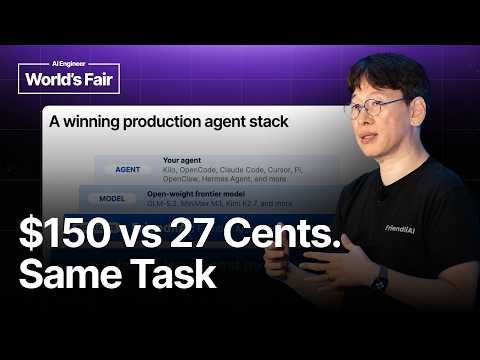
2:29 The important point is not that the outputs are identical. The point is that both complete the task at a level that is clearly usable for many agentic workflows. Open weight models have crossed the quality threshold but the economics are very different for the same task. Opus 4.8 cost about a $150 GLM 5.2 unfriendly AI cost 27 cents about 5.6 times cheaper.
3:03 So this is the promise I mentioned earlier. Open rate models give you frontier quality agents at a fraction of cost. But motor cost is only one part of the story. To make agent actually fast and reliable, the inference stack itself has to change. So let's look at what actually happens inside an agentic workload. So first let's look at changes in the workload. In the past the dominant usage was chat. The basic unit was a request.
3:36 A person asks a question, the model answers and the person reads it. Latency meant how fast did I get one response. Agents are different. The basic unit is a task. A task may involve many model cores, many tool cores and it may run autonomously for a while. So the user does not really care about the latency of one individual request. The user cares about when the whole task is completed.
4:08 That means we have to optimize for tasks, not just individual requests. Let's look at agent workflows more closely. An agent really runs a session made up of tasks. Each task typically runs in a loop. First, it plans, which usually means an LLM call. Then, it acts maybe by calling a tool. Then it observes the result and adds the that back into the context and it repeats this until the task is done.
4:42 So we are constantly alternating between LLM inference and one or more nonLM tool executions. So there is a gap between LLM calls. An agent can also create sub agents and run them in parallel. Agent inputs also look very different from chat. The graph here shows the prompt and completion length distributions of our internal coding agent runs with GLM 5.2 which we use day-to-day.
5:16 They are much longer. They grow as the task progresses since every observation gets appended back into the context. There's an important pattern here. Consecutive agent steps usually share a huge prefix. If we recomp compute the same prefix every time, we are burning a lot of compute on work we already did. So this is one of the biggest opportunities in agentic inference.
5:46 So how token hungry are agents? Now let's look at a long horizon task example like deep research. We ran explained the spec decoding framework in VLM using code with GLM 5.2 unfriendly AI. There are multiple stages and each stage is composed of sub agents which run multiple inferences and tool cores. So it might run tens or even hundreds of inference steps sometimes over minutes or hours and the shared context keeps going the whole time. For the user what matters is not the latency of a single token or one core. What matters is when is my test completed.
6:35 So agent inference is not just chat with more requests. It's a different problem. The context grows over time. Tour work is interled between model cores. The number of model cores depends on the input. So you can't really plan around a fixed request rate plan. And the real metric is end to end test latency, not a single request latency. This is where friendly AI comes in. We rebuilt the frontier inference cloud specifically for agentic goal close around the challenges I just walked through and we set one goal optimize end to end test latency the task not just the request. So how do we do that? Let me show you the key engineering behind it.
7:27 Here's the engineering map for how we think about it. We built the stack layer by layer around agent workflows. There are four big pillars I'm going to cover today. Prefix caching key value in short KB cache management, cash aware routing, agent aware optimization and of course underneath we need model layer optimization like sparse attention for long context techniques to reduce errors, fast corners, resilience serving and more. In this talk, I'm going to focus on the four pillars.
8:08 Let's start with prefix caching. Since Asian steps share a large prefix, we compute key value for that prefix once and cache it. Then on later steps, we reuse the cache key value and only process the new suffix. Reading from cache is much cheaper than recmp computing prefill. So this improves time to first token and reduces compute on every step. And the longer the task runs in agents, the more valuable this becomes.
8:41 But caching only works if the KV cache actually fits and can move around efficiently. So we need strong KV cache management. We use frugal memory management to pack more active context onto each GPU memory. We use KB contigation to reduce the memory footprint. We you we use hierarchical caching across GPU memory, host memory and disks. So we can go beyond GPU limits.
9:14 And we also use distributed caching. So one prefix can be served across replicas, not just inside one instance. At global cluster scale, routing becomes really important. A knife load balancer may spread requests evenly across GPU clusters, but it can destroy cache locality. A cache aware router at a global scale does something smarter. It sends a request to part that already has the right prefix cached turning a cord prefill into one cache ship. At the same time, it still has to balance load. So one part doesn't become a hot spot.
9:58 In this example, the two requests of task A go to the same part one for cache locality. The next piece is agent aware optimization. And this is the next fronture of agentic inference. Today, most systems schedule each LLM core as if it were independent. They don't really understand that this core is part of a longer agent program. But if the optimizer knows the agent level context, we can make better decisions. For example, preempting the right work, speculatively prefilling context for an unlikely next step or making a better cache eviction decision based on agent level context.
10:49 So the goal is to reduce ant latency not just make one call look fast. When we put all of this together, this is the payoff. We are using the same model GLM 5.2 with kilo code to create a simple mobile game. We ran the same task with model APIs of friendly AI and another well-known inference provider. As you can see, friendly completes the same task end to end tox thanks to our Asenticentric cloud design.
11:27 So what does this unlock in practice? a stronger production agent stack. Take an agent you already like. Now plug in openweight frontier models like GLM 5.2, Minimax and Kimi served on friendly AI. The motor gives you frontier quality capability and better economics. Friendly AI gives you the speed, reliability and endtoend test performance needed in production. That combination, quality, speed, reliability, and cost is what makes agents actually useful and economical in production.
12:09 Friendly AI is currently powering teams in production from AI native startups to global enterprises. I'd like to highlight a couple here. Hilo is a hugely popular Asantic AI coding tool serving millions of users. LG is a global enterprise whose businesses range from electronics to healthcare to energy. Very different companies, but they all need the same thing. Fast, reliable, cost effective agentic inference.
12:45 This testimonial from our client Kilo says it all. Over the past year, Kilo Code has tested several inference providers hosting both open and closed models. In a split test of GLM5 usage compared against other thirdparty providers and direct usage from the model lab G.A.I., Friendly AI was consistently seven times faster with a significantly lower error rate. Today, friendly AI is a core component of the killer stack.
13:20 And you can consume this however fits your stack. Model API is the fastest way to start. Core frontier open weight models through our serless API. Dedicated endpoints give you your own isolated deployment with guaranteed SLAs's for production workloads. And BYOG bring your own GPU lets you run friendly inference on your own infrastructure. Same stack, three ways to deploy. To wrap up, there are three things to remember. First, frontier open weight models make production agents economically scalable.
13:59 Second, agents are not just chat with more cores. Agentic inference requires optimizing end to end task latency with the challenges I mentioned. Third, friendly AI is built as an inference cloud for that word. Fast, reliable, cost effective agentic inference. Thank you for attending my session. If you're building agents, give frontier openweight motors a try on friendly today. You can get started at friendly.ai in minutes. And thank you. I'll be around after the session.
14:37 thank you. >>
Summary
- Friendly AI specializes in inference for AI agents, leveraging research roots from S National University.
- The company has developed continuous batching, a standard optimization in the industry.
- The year 2026 is projected as a pivotal moment for the production of AI agents due to exponential growth in their adoption.
- Open-weight models now deliver comparable quality to closed models at significantly lower costs (e.g., GLM 5.2 costs 27 cents vs. Opus 4.8 at $150).
- Agentic inference differs from traditional chat models by focusing on task completion rather than single request latency.
- Key engineering innovations include prefix caching, cache-aware routing, and agent-aware optimization to enhance performance.
- Friendly AI's platform is already in use by various enterprises, demonstrating superior speed and reliability compared to competitors.
- The company offers flexible deployment options, including serverless APIs and dedicated endpoints for production workloads.
Questions Answered
What is agentic inference and why is it important?
The speaker introduces agentic inference, explaining its significance and how Friendly AI has rebuilt its inference cloud to support agents effectively. The company is positioned as a leader in AI inference for agents, emphasizing its research roots and innovations.
How do agentic workloads differ from traditional chat-based workloads?
Agentic workloads focus on tasks rather than individual requests, requiring optimization for task completion rather than response latency. This shift necessitates a different approach to inference, as users care about the overall task completion time.
What are the unique challenges associated with agent inference?
Agent inference presents unique challenges, such as the need for continuous context growth and the interleaving of model and tool executions. The focus must be on end-to-end task latency rather than just individual request latency.
What engineering strategies does Friendly AI employ to optimize agent inference?
Friendly AI has developed a multi-layered engineering approach that includes prefix caching, memory management, cache-aware routing, and agent-aware optimization to enhance the efficiency and speed of agentic inference.
How does Friendly AI perform in real-world applications?
Friendly AI has demonstrated superior performance in real-world applications, providing faster and more reliable agentic inference compared to competitors. The company supports various clients, from startups to global enterprises, highlighting its versatility and effectiveness.