Section Insights
Introduction to Nanogram
What is Nanogram and how does it work?
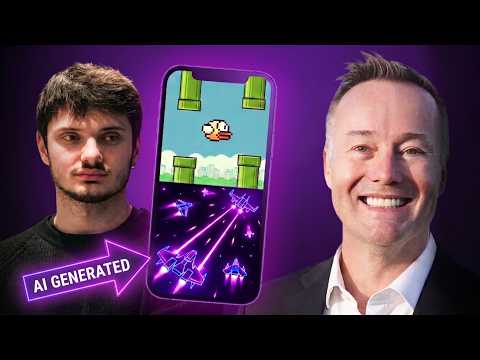
Nanogram is a mobile app that allows users to create and play casual mobile video games in a TikTok-like format. Users can quickly switch between games, minimizing choice paralysis and enhancing engagement.
- Nanogram combines game creation and gameplay in a seamless experience.
- The app addresses choice paralysis by allowing users to easily scroll through games.
- It features an AI-assisted game creation tool with templates for users.
Brand Engagement and Monetization
How can brands engage with users on Nanogram?
Brands can create content without needing permission, promoting their games organically or through paid boosts. Monetization options for creators include selling in-game items or levels.
- Brands have freedom to create and promote content on Nanogram.
- Paid boosts can enhance visibility for brand content.
- Monetization strategies for creators are still being explored.
The Evolution of Robotics
What advancements have been made in robotics for practical applications?
The development of Neo, a safer and more intelligent robot, reflects a shift towards creating robots that have real-world impact, moving beyond laboratory settings to practical industrial applications.
- Neo represents a significant advancement in robotics, focusing on safety and usability.
- The goal is to create robots that can learn and adapt in real-world environments.
- Industrial applications are a key focus for the future of robotics.
Safety in Robotics
How is safety being ensured in robotic tasks?
Safety is prioritized by simulating potential risks before executing tasks, ensuring robots choose the safest actions and can halt operations if risks are identified.
- Robots are designed to simulate outcomes to avoid potential failures.
- Safety protocols are being developed to ensure robots operate without causing harm.
- Continuous improvement in safety measures is crucial for robotic applications.
Integrated Development in Robotics
Why is integrated development important for robotics?
Having all aspects of research, development, and manufacturing under one roof accelerates innovation and allows for rapid iteration across disciplines, leading to safer and more effective robots.
- Integrated development enhances the speed of technological advancements.
- Collaboration across disciplines leads to innovative solutions in robotics.
- In-person work is emphasized as crucial for effective collaboration and discovery.
Transcript
0:00 Welcome back to this week in startups with me Elon Harris. I'm Jason Calacanis. >> We've got Albert Brotherton and Boris Ratulov. Jason, they're the co-creators of Nanogram. I really like this. This is a cool thing. It's basically TikTok for mobile video games. It's available right now. It's in the Google Play Store. It's in the iOS store. Guys, thanks so much for being here. Thanks for having us, guys. >> So, tell us what you're working on. Yeah, Boris, do you want to kind of bring up bring up the demo and walk them through it?
0:24 >> Yes. Yes. just give me 1 second to get my screen sharing up. >> this is I have it on my phone, Jason. This is it's available now. It's basically work it's like think TikTok, but people can create their own video games very quickly like casual mobile games. And then you just scroll when you're tired of playing one, you just scroll up and you go to the next game. It's pretty remarkable. Typical TikTok feed. This is the MVP we put out a month and a half ago. You're playing the game, you get bored, and you're going to the next game. You play this game, you get bored, you're going to the next one.
0:54 It's very simple concept proving to be quite interesting, but the whole brain room maxing of playing multiple games in a row is just part of the flywheel. The second half of the flywheel is the creation aspect. >> When you're looking for a new game to play, it can be that complete like tyranny of choice like choice paralysis like there's hundreds of games. I don't have time to research every single video game. This is just like open your phone, start playing a game. The creation is even cooler. If you go on your create tab, you click create with AI, and you have all these templates you could go off, or you could do a custom template.
1:25 And I'm just going to quickly demo something real quick for you. So, when I was like 14, I started programming cuz I wanted to make video games. And you know, now with AI and agents, something that would have taken me a week back then now takes 90 seconds. So, for example, if I want to make like a 3D version of Flappy Bird, all I have to do is go on 3D, write Flappy Bird, hit generate, and now it's going to cook up the game for me.
1:50 And what's really cool is while you wait for the agent, you get to play other games that other people have made for inspiration. and usually on the first prompt, it takes about 60 to 90 seconds like one shot a full game. and after that, the cool part is that you're absolutely free to remix it. I'm having a hard time playing and talking here at the same time. You have to forgive my poor performance. But, the idea Yeah, the idea is, after that, you can remix the game as many times as you want, and we'll just probably get that shortly.
2:23 additionally, you can remix other people's games. So, for example, if I make like a really cool game, I send it to Jason here, and he can remix it, change it in a way that he likes. So, here is the the 3D Flappy Bird that I made for us. and this is very basic. This is like a starting point for us, and I get to play this. And as a little kid, I I this would have taken me a few days to figure out before the age of AI. But, interesting enough, I can now do this in like 90 seconds, and I can go prompt it, and I can say, "Hey, can you please add guns to this?"
3:01 I like that you said please, very polite. So, this is all just AI prompting to make games. What's the engine behind it? Would you use this Claude or something? Or is this like some bespoke AI engine to make games? >> what we're doing is we've created a custom game engine, and then we're using Gemini, and a bunch of agentic harnesses and like tool calling to give it the ability to create 3D assets, create 2D assets out of like pixel art, and and things like this. Basically, what we've created here is we're trying to rely on the native platforms as much as possible.
3:32 So, we're really relying on Gemini to do the tool calling for us, and then we're putting a bunch of tools such as like generate 3D mesh, generate, 2D pixel art, generate sound, things like this. And then it figures out how to call these, put it in the game, and and do all all sort of stuff for the user. Genius, can I take Lan's game and build off of it and fork it? Yep, yep, yep. Okay, so that's inherent in it is you just fork stuff.
4:05 It's like the remixing. It's remixing, yeah. Yeah, it's like the remixing on Sora where I can see your video and I can say make them say this instead and it's just like everybody's idea builds on everybody else's idea, yeah. What's the business model here and and who are you two dudes? So, I'm Albert and this is Boris. I'm the CEO he's the CTO. And yeah, I mean the the business model is I mean look at the end of the day we're like a feed of interactive content, right? That's that's like I'm not even saying games because that's the direction we're moving in, right?
4:33 Interactive content. And you know, we have a lot of red experiments we want to do, right? Because this is a very new field. We can't know exactly what it's going to be, right? But I think it's a very interesting space where you know, there is no accessible interactive ad space that's really easily distributed right now. Right? So, I'll use an example here. So, let's take like a big advertising provider like Domino's, right? And they want to, you know, do some easy ad space stuff.
4:59 They're going to go on short form content, right? And they'll have a marketing team that's great at short form content. They'll post on Instagram, they'll post on TikTok, right? But, you know, at the end of the day interaction is much higher converting, right? And Yeah, it's engagement so they're going to spend more time on it so Domino's can come in and say I want to make an Asteroids-like game where the boulders and the asteroids are Domino's and when you break them apart they turn into the pretzel bites and then I want to have a spaceship go by that's the brownie, whatever it is. Genius. Make the pizza and the call to action can be order the exact pizza you've made in the game, for example. Yeah, very cool. Albert and Boris, you guys went to school together, you're you're in high school right now.
5:37 What's the story? no, so I'm I'm 22, Boris is 24. We've worked together for >> I look so young, Jason. I was referring to Albert, but okay. no, I'm You both look pretty young. But so you're you were you're out of college. Did you skip college? You went to college? >> I I I skipped college personally. Well done. I I went to college unfortunately and I went >> Where did you go? Where did you study? University of Leeds. I studied computer science and yeah, unfortunately it was right during COVID. So for the two of the three years, I literally just didn't go to classes. So So you paid a fortune and got nothing.
6:10 Got it. Okay. >> Yep. Yep. How much debt you got, Boris? How much is your debt? Not much. It's like 40, 50k. In the UK it's quite cheap. >> $50,000? Okay, we got to make this startup work. I mean, compared to some of the people that like in the US where they're getting on, yeah. All right, Albert. What's your story? You're the business guy, you're a developer, who are you? You I'm I'm the business guy. I'm the business guy. I'm the hustler. Yeah, I mean, I've kind of I've I've been a gamer since I was six by the way. I'm like one of the weird people in Gen Z that plays a lot of World of Warcraft, which is kind of like more of a millennial thing. Wow, very cool. Boris is too by the way. We play together. But I've played since I was six and >> Is that how you met? Did you meet in World of Warcraft? No, we met through a childhood friend that kind of grew up with, you know, me and grew up with Boris and he just intro'd us about three years ago and we kind of kicked off and became best friends. Like And now you're sitting in a gamer chair, right? That's a gamer chair, Albert.
7:01 >> a Razer, yeah. >> It's a Razer one. See, now this is what I I'm like the Colombo of investors. Like I look for little clues and I'm like, "Hey, you with these line. I noticed Albert is sitting in a chair. The chair is a gamer chair and it's a it's the brand Razer and I had a Razer I brother-in-law had a Razer mouse and it was used for playing games like World of Warcraft. So you're very much into gaming, are you not, Albert?
7:25 So you guys vibe coded all this you did it. You have There you go, Razer. Yeah, and it has weights in it too. You can put different weights into it depending on the game you're playing. What's your story? You guys are going to raise money for this? You want to come to an incubator? You have raised money? You did go to an incubator? Have you incorporated? What's the story here? Cuz this is a great idea. Yeah, yeah. So we have raised money. I mean, it's a really exciting time for us. We've raised from Drive >> Awesome, fantastic. Well, and where are you based? So, we're based out of London and Sofia at the moment, but with plans to go towards New York, yeah. Okay, great. That's my hometown.
7:56 It's great. Just when you go there, please don't join ISIS, okay? So, when you You get to Ellis Island, they're going to be like, "Would you like to go to the ISIS training camp or you like to go to Brooklyn or whatever it is?" >> a bit like that in London, to be honest, too, so don't worry, you know. Yeah, you just have to defend yourself as young people against these ideologies. Don't blow anything up. fantastic. New York is a very place where you can just marketing in New York and people experiment and this could be permissionless. So, if you just tell brands, "Hey, you can just build whatever you want as a brand." Some young person at a brand, I don't know if you're watching the Staples baddie.
8:32 Do you know about Staples baddie? No. Lon, do you know about Staples baddie on TikTok? Okay, so one of our team, Jacob, will very quickly pull up Staples I found it. And Staples baddie, she basically is passionate about Staples. And she works at Staples. She is like a baddie in the internet slang and she just talks about like, "Here's the best pen." And she was talking about pens the other day and I was looking for a new pen and I don't want to spend a dollar on a pen, but I don't want to spend $100 on a pen and I was searching for a pen and she came up. And one of the pens that she liked was the Zebra G750 that I literally bought it. Now, I I didn't happen to buy it from Staples, but I did follow her, so now I'm giving credit to Staples for it.
9:16 Anyway, my point is, she's getting more views and Lon probably has done a bunch of research on her right now. She's gotten more views and has done more for the brand online than anybody in corporate who spent $10 million or $100 million ever had because she connected with people authentically. Hiring can be its own full-time job and hey, guess what? I already have a full-time job. I make podcasts and I invest. But, when you're running a small company, we both know every hire matters. You don't want to waste any of the seats you have at your company. And the best partner you can have is LinkedIn Hiring Pro. Why?
9:50 There's a billion people using LinkedIn. All the great talent are there. If you're proud of your work, you build a LinkedIn page and you update it. LinkedIn Hiring Pro is going to streamline and simplify the entire process for you. Nearly 60% of companies using LinkedIn Hiring Pro, you're going to get an incredible candidate to interview in the first week. And you know, we're looking for a new producer for the pod. We did shout-outs here on the show. We posted it on my social media. We asked friends. You know where we found our next great hire? LinkedIn.
10:16 And it was competitive. We had like three or four really good choices. So, hire right the first time. Post your first job and get $100 off towards your post at linkedin.com/hiringprooffer. That's linkedin.com/hiringprooffer. Terms and conditions apply. She went through journals. She went through pens. Now she's getting picked up or whatever. Now, other people, Office Depot's trying to find their baddie. It's become like a whole thing. Well, it's like the the fast-food burger thing. Did you were following that last week? It's the same It's the same concept. The McDonald's CEO did a TikTok Explain to the audience. That was That was really bad.
10:53 He ate a burger, but it he took a really small bite and it looked like he's disgusted by his own burgers. And so, now every other fast-food CEO has done their own version where they love their burgers and they're eating the stuff in their face with them. And it really became like every single fast-food CEO had to do one to get the momentum from this viral McDonald's video. I think the problem with his video, cuz I did see it. Yeah. And the problem was he's very robotic. Yes. He's almost like an MBA who's a bit on the spectrum. I don't want to diagnose people, but when I say like he's robotic, you know, you get the idea. It's not meant to be.
11:33 >> and and and it just it >> He's awkward. >> He's not a good enough actor to pull off like I really am enjoying this and I want to eat this burger. >> even able to pull off he's a human. >> No. And at one point he goes, "And this and this is going to be my lunch later." And that's not a hard thing to convince me that you're going to eat a burger for lunch, but I don't believe him. He also called it a product. A product. It was like very awkward. And he takes a very tiny bite.
11:58 >> He does not take a big bite. I thought the same thing about the Burger King guy, honestly. The Burger King guy got did one and I was like he also doesn't really take like a a big like a man-sized bite like he loves burgers. The question is who let them pose this? Like there was probably a whole marketing department there for like Like the right, there wasn't a social media person there being like, "Can we Can you take a a bigger bite like you like your your burger?"
12:22 Cuz that that's so dainty. It's like it's Yeah, he even shows it and it's like it doesn't look like he bit into it. >> clear Albert, when you see this that this person does not like their own product. It just couldn't be more >> And then there is a There is literally a salad that has been made to his specifica- specification by his chef off camera and he is going to spit out whatever he ate swish his mouth with some Pellegrino at the exact temperature he wants and then he's going to eat that freaking salad that his chef made with that literally each item was weighed and put into his you know, spreadsheet where he keeps his calorie count.
13:01 You what you need is somebody who actually is sitting there with the chef saying, "Put more onions on." And like you know, the mustard ratio is off, which is what the Crock which which is what the McDonald's brothers were doing. Yeah. Albert, what's the vision here? for Oh, so anyway, back to the permissionless we're talking about brands. I think you just let the brands do whatever they want on it and then you give them the ability to promote them.
13:26 Yeah. Which would be just what brands are doing now. Brands just make content. There's no permission to do that. And if they get views and they do a good job, it gets views organically, but they can boost it. and they can pay to boost. I think just paying to boost such a good idea. Then what about monetization from I'm the creator? Could I put a game up there and say I if you want more levels, you can buy coins or is that annoying to customers and against your philosophy, Albert? So again, this is a big Rev experiment we want to do. Like look, there's two there's two ways I look at it. You can look at someone like Roblox, right?
13:58 That's done incredible creator currency, right? However, their games are 100% more long-form, right? Where you're not going to be playing like, you know, 100 games an hour, right? Or more, right? So I mean, it's very normal to have microtransactions and, you know, a creator currency where you as a creator can say, "Hey, look, I want to add an extra level, you know, clear it's clear I got a million plays on my game. Let's add an extra level for my big supporters that want to do it, right?" this is something we want to experiment with. So yes, we're we're we're we're looking at experimenting with a creator currency, you know, because I think there's a big incentive there for creators, right? So let's say you you put a game up, right?
14:32 Short-form, you made it in 2 minutes, right? You did like three prompts. And you get a million plays, right? And just so we have a game in in our minds that we all know, let's just say it's a Candy Crush and Candy Crush doesn't exist, right? And you pioneered the first level. I want that to be a big incentive for you to kind of This is something you don't see in socials, you know, like iterate on that already posted thing, right? Unit of content. This is something you don't do in like Instagram and TikTok. You know, the moment you like press post, that's it, you know, the ship's sailed. So I mean, there is an aspect that we want to test on this, but to be totally to be totally frank, we're too early, I think, to really know how that will go. And, you know, we are not the ones that can decide if it will work or not on that I think you spend the first literal 2 years just trying to make the tool so good and so addictive that people get into it.
15:21 I mean, it's already kind of getting that. I mean, have you Do you know anything about like our retention and like kind of our engagement? >> Yeah. They tell us a little bit about it, yeah. Quite cool. So, we launched like mid-January and we've got about 100k users so far. and 20% of them are what we call power users, right? And these guys play more than 25 games per session. And their average session time is around 21 minutes and they do two sessions a day.
15:43 So, they're playing, you know, just under an hour a day and going through over 50 games. And I think this is really cool because I mean, you saw like a brief glimpse of the feed. We don't have an algorithm, A, which is what drives most social engagement on platforms like Instagram and TikTok. Again, the point on algorithm, you know, I won't linger too long is never been introduced to gaming before, right? Drives most short-form social engagement, but never been done in gaming, right? So, we have really high session times for, you know, basically giving you slop, right? That that's what it is, you know, until it gets better.
16:14 And, you know, what we're seeing is kind of people are already really excited about it. Yeah, I think this is going to be a breakout hit. and >> How do you get the first couple of casual users? Where do you find users for the product? We started this with Discord to be honest. you know, we started Discord community. Like we had the idea in November. We started Discord, got it to like 10k people, but as Discord is not not all 10k people were kind of super active. Kind of like 2k of them were. And these were like our test users. We had like a running beta of 200 people up until we launched in January. And these guys loved it. Like everyone that made games back then are still making games today. So, you know, insane, you know, commitment to it. And at the time we didn't have like game generation. They were like doing it on their own and, you know, uploading it.
16:59 but then, you know, a huge way, you know, and I won't really touch on ads because I mean, ads are quite obviously to get users, but, you know, another really interesting thing is sharing games, right? Like I don't know. You mentioned a lot about socials and sharing stuff. Have you shared a Twitter a tweet, you know, or a >> Yeah, I mean, in the group chat, etc. So, that's going to be in high scores and sharing and then not to mention you have games that are a duel. So, like Ron and I could play versus each other or we could invite each other to beat a score. So, that that's where like the loop could happen, right? A Wordle-type game and then I send it to Ron and say, "Look, I I solved this in three and out of five. Can you try and beat it?"
17:37 >> Yeah, I think it's really interesting because like look, I I think the big point I'm trying to make with this is it's not in our culture to share games, right? Like you say you share, you know, reels. I think it's true. You can tweet. But when was the last time you were playing a game with your happy pal? >> Well, I will say there is one. It's people will share clips of like specific kills in Call of Duty on YouTube, whatever. But that's like deep gamer culture. It's not casual.
18:01 >> That's still content and that's still super niche. At the end of the day like, you know, you will if you are an avid Instagram user, you will daily send reels. I mean, this is a way of keeping in contact. Like I'm a middle child. I have two brothers. I send them reels every day and they send back, right? >> Yes. But games aren't something people share, right? They don't. Right, so this is like one of two big questions we had before doing this of What By the way, we have the answers. I think it's really interesting. But these are one of two big questions we had before doing this was like A, do people want to share games? Cuz they don't right now, right?
18:29 And B, will this shift look the same as the long-form content YouTube shift to short-form content Instagram Tik Tok, right? So, the answer for the first one is yes. Per 100 likes on the app right now, we're getting cuz we have likes and shares but you didn't see on Boris's beta version cuz it's a beta version that we're running right now. But per 100 likes, we're getting between 30 and 50 shares at the moment. It's huge amounts. Nearly one in two. And then when it comes to the long-form short-form shift, I've already told you, you know, the stats of we have 20% of our user base going through 25 games possession in in less than 25 minutes, right? Around 21 minutes. So, I mean, the big thing here that was like a huge sign for us was Look, when you are talking about long-form content and before Tik Tok and Instagram, there is a use case to spend 3 seconds on a video.
19:13 It's your camera roll. Genius. The camera roll from iPhone, whatever Android has as well, right? You can go watch 3-second clips that you've taken yourself or a friend has sent you and scroll through them. But games are very different, right? Yes, because with a game, you go on Flappy Bird, what's the session time? It's like 8 minutes, you know? You go Subway Surf, something like this. I mean, don't quote me on those stats. I don't know exactly what Subway Surf session times are, but it's not 5 seconds, right? But I mean, so this was our big question. Will people basically do this hyper-casual doom scrolling, but for gaming? And we'll be honest, it's yes.
19:42 >> Awesome. great idea. Can't wait to get working with you, and we will have you back on the program in 6 months and see what your progress has been. Really exciting, Albert and Boris. Thanks for coming on the pod. Awesome. It's been a pleasure. I look at 10,000 startups every year. What is the essential nature of Uber or Robinhood, these incredible companies that I was lucky enough to invest in? They focused on their customers. They focused on their product. And then, they had support for chores. Let's call it what it is. Your incorporation, your banking, your payroll, your benefits, your taxes, all of that back office. You can drown in that, or you can find a partner who loves doing chores. And every.io wants to do this detailed work for you.
20:26 They're going to handle your Delaware C Corp, your EIN, getting yourself a registered agent, all with no legal fees, all without delays. And if you're further along in your founder journey, and you need to scale, Every will help you hire contractors in over 200 countries. There's talent everywhere, but there are blockers. Or maybe, hey, health and dental benefits. That's all baked right in. And you're going to get 3% cash back on every dollar you spend with your Every corporate card. So, head over to every.io and stop wasting time on the stuff that isn't growing your company. That's e v e r y dot i o every.io.
21:01 Welcome back to Twist. My name is Alex, and today we're going to solve one of the largest pain points in my life, which is picking up after my children. I have a great many children. They leave things all over the house, on top of things, underneath things. It's a mess. It's a constant struggle to keep my house up to a reasonable standard of care, which means that I'm constantly bending over and making bottles and changing diapers. Now, I love my kids, but oh my gosh, would I not appreciate a little bit more help. The good news for parents like myself out there is that there are companies building humanoid robots that are going to make our lives easier in time. And even more importantly, there's one company called 1X that's making a robot called Neo that's designed just for your home. It's my absolute dream. So, to tell us more about it, how it's going to come to market, and when, please join me in welcoming to the show it's Bernt Børnick. How you doing? Welcome to the show.
21:49 >> Hey, great to be here. Looking forward to this one. So, I've known about 1X for a while, you know, been tracking keeping track of your progress and so forth. But one thing I didn't know was that you guys actually got started building robots not for the home, but for industrial settings, and you had a robot called the Eve Industrial on wheels years back, but made a pivot towards the home. But take us back in time to the robot that you guys actually put into in you know, industrial applications years back.
22:16 >> started the company, it's been 11 years. It's been a while. the first things that were I really wrote down, they still stand today. It's like we we want to make robots that are safe so they can live and learn among people. They need to be capable, like they need to have the dexterity, the strength, the agility that we have, or they're just toys. And then of course it needs to be scalable and affordable so that it can have an impact.
22:37 And when we designed Eve, it was very early, and we didn't have the power density and the technology yet to make this as general as we would wish. But we can make it very general for its time. And it was an amazing robot. And what people might not know is that I actually had Eve at home for multiple years. Oh, really? So, you had the robot that was designed for what appeared to be similar to >> designed >> for industrial use cases, but it it was like designed for general labor. That's the thing about humanoids, right? So, to me, humanoids is a play in like you want to create general labor.
23:11 Because at scale, if you look at the system at the limit, what is going to be the most reliable, the most affordable, the most intelligent, and the most helpful is going to be whatever has the largest scale. And all technology goes through these cycles. And maybe the simplest one to talk about is computers, right? Mhm. Started with mainframes. And at some point consumer PCs came around. Mhm. And it got scaled to this incredible number. And the ecosystem and the reliability and the cost and everything that comes with it, right? So, now it's just this one tool is this is like the hammer that solves everything. And whether you're like typing something up or you're recording a podcast, we're all doing it on the same computer, right?
23:54 There's no special In the end, it actually goes full circle. And the market is so big that you get specialization again. It's happening in computers now. You have like specific computes for inference, for training, for simulation workloads, for all kinds of things, right? Because each of these markets are are gigantic at this point. This is happening with robotics or physical AI. It started with industrial robots. That's kind of like our mainframe. Now we're going through the general labor phase, where you just want to create the machine that is as general as possible, that can really unlock humanity from kind of being bottled bottlenecked by access to productivity.
24:39 Yeah. In the end, it'll probably be all Star Wars, and there will be different droids for all kinds of By the way, as a long winded way of saying like Evals are best shot at like making something that's as general as possible to get started on this multi-decade journey of how do we create something that can completely and fully kind of empower us as humans to work on the things that matter. And I had it at home because it was very important for me to make sure that like, hey, this is going to be in people's homes at some point.
25:11 Right. We need to start early. But it wasn't safe enough. That That's actually the thing. Like, it's extremely safe robot for what it is, and I would argue it's safer than most of the other robots out there today, but it was a bit too heavy. Okay. And not quite general enough. And that was really what led us to use this for industrial markets. Because I I I've been working all my life on robotics, and we've built a lot of beautiful robots up through the years, but like, they didn't have any real-world impact. And it was so important to me when I started 1X. We wanted to do something that has real-world impact. So it can't be on YouTube. It can't be on a lab. It has to actually be out there doing things. And those industrial use cases were great early applications. But if you want to make something that is generally useful to humans, you're going to need a couple of things to make that happen. Going off of the original Eve idea into Neo, which is legs, and I would presume modern AI techniques that allow the robot to become more generally useful by learning new things on the go. So it sounds like you had a good proof of concept, and then you refined it, and then imbued it with the latest in you kind of modern AI, and as a combination you've come up with Neo, which we're going to put on the screen right now. And and so everyone can see it. And the result is essentially a softer, lighter, more intelligent, and more frankly human robot is my read of Neo. Is that a fair encapsulation? There are many reasons for this. Let me Let me start with a couple of like very important ones that I think is quite unique to 1X. We've been very all in on we have to create something that moves and interacts with the world exactly like a human does.
26:46 All the way down to like the smallest interaction of like how what's the stiffness of like the tissue and your skin and how does that interact with the world, right? If you get that right and the sensing and everything, then you can take all of humanity's knowledge, mostly encoded in video and all the things that exist out there, and these priors hold and you can use them to get intelligence off like off the ground. And this is so important because the alternative is go out and create an internet-size data. I'm not saying these things aren't useful. We also use Teleop. Yeah, yeah.
27:23 It's not the solution to bootstrap your way to having billions of tokens that you can train your models on. So, >> Yeah. you kind of have to find some way to bootstrap. And I think that's what makes me the most excited about Neo these days is that we're getting to where we're clearly seeing that that works. Like the world model work that we've been putting out, and there's some amazing stuff coming right around the corner actually on this that's the continuation of that, really starts proving out that this bet is a bet that holds and we can get true general intelligence.
27:55 Most of what you see robots do today on YouTube are kind of like fine-tuned policies, as we call them, meaning like it's not necessarily one task, but like you take a set of tasks and you gather all the data on specifically these tasks. Yeah. >> can have the robot do these tasks maybe in another environment, but the tasks are the same tasks and they're very similar. What we're building here is actually true general intelligence where you can ask the robot to essentially do anything and it will do a pretty good job at it.
28:21 >> Let's go back. We're going to get into world models in a second, but the point you made about Neo, the robot for your home, designed for that, having similar physical attributes to humans. You mentioned like finger skin tension, for example. That allows you to map how humans interact to the world to the robot itself, so that way it can learn more cleanly, accurately, quickly from how the world operates. So, essentially as you make it more human, it learns faster.
28:52 >> It does, right? It's just like if if if I pick something up, I do that in a specific manner with my fingers. Like I rotate If like if I rotate that one like you just rotated that in your hand, right? Mhm. The way you use your fingers to do that is very hard to transfer that to like a three-finger gripper or a claw or whatever, right? It doesn't transfer. So, like yeah, so then you would need to go out and gather gather all that data. Yeah. So, that's one part of it that's just so important. It learns faster. If you've got an engineering team at your company, I'm betting there's a solid chance they're spending far too much time on infrastructure. You need your team building your product to delight your customers, not configuring your virtual network. Render is the all-in-one cloud platform for developers that allows you to deploy, scale, and secure your apps and agents with zero ops. Most cloud platforms ask you to split your focus between product and infrastructure, or they force you into platform constraints that you know you'll outgrow in 6 months. But just connect your GitHub repo to Render and you are live, l i v e. Web services, cron jobs, managed Postgres, the whole stack in one platform. It's time to find out why 5 million developers are already using Render. Go to render.com/twist and apply for the Render Startup Program. You'll get anywhere from $500 to $100,000 in free credits, depending on your stage and who your backers are. That's render.com/twist.
30:22 >> Now, the second one, of course, is that the world is made for us. Yeah. So, like if you want to get around the home and like do all these things that you don't want to do yourself, you kind of have to be very close to human. And I also think there's something quite magical about creating something that the embodiment kind of connects to us emotionally. and the companion part of the product is also so big part of the product that doesn't get talked enough about.
30:46 It's not just about doing the labor. It's about doing the labor and being your companion throughout life and how this can kind of like help you interact better with technology. And I think we're very quickly trending, at least for me now that's using this every day, in the direction of like I I don't talk to my computer, I talk to my robot. Yeah. >> It gets you away from screens and it gets you more present in like your everyday life and I think there's a beautiful story to be told there someday about how this can get us away from screens. Well, I I I think also there's an enormous elder care component to this. I mean, we've we've all heard about how society is graying, how our elderly, you know, parents and friends are lonely. And so to me like, sure we have pets, that's great, but pets can't help you with the dishes. And you know what? What if you're older, need help, and you're a little bit lonely? Well, we can kind of fulfill a lot of all that with one device in the case of Neon. I I don't view that as dystopian at all. I view it as a way that humans are taking care of humans via technology. And then to me that's a a good future. 100% agree. And this is actually one of the main things that gets me up in the morning. I think we we are at a point in history where this is not optional. Like we we have to apply technology to solve this because we have to be able to give everyone essentially like dignity in in the way you get treated as you age. Yeah.
32:07 People sometimes mistake this for being like a replacement. It is not. And I like to say as someone who has one at home, like it doesn't it doesn't replace my dog. It doesn't replace my kids. It doesn't replace my wife. It is something new, right? and just like a dog is also something new that you add to your family. Yeah. This beautiful companion throughout life that like is always on your side, it's helping you with everything, it remembers what's going on. And I kind of almost see it more like my my Hobbs in Calvin and Hobbs.
32:37 -huh. Yeah. Yeah. Yeah, yeah, yeah. Well, if you don't know that reference, Calvin and Hobbs is an American child-focused comic strip, and a young boy has a stuffed tiger that he thinks is real, and they play games and such. So, that's that's the context of it. So, essentially, it becomes >> don't get that context, go read it. Yeah, go Bill Watterson. It's It's a great >> It's amazing. It's a great strip. I grew up on it, so that's that's very near and dear to my heart. So, here's the thing though. You're talking about, you know, YouTube demos, and we're not going to name out any names. We're not going to say Figure. We're not going to name any of the companies out there who are famous for doing a lot of demos online.
33:12 versus the ability to make something that works, you know, in your home. So, you have Neo at home right now, and I know pre-orders are up. it's going to start shipping later this year. We'll get to that in a second. 20K or 500 bucks a month. So, how good now is Neo at general household tasks, and how quickly is it improving against that problem set? And the context here, Berant, is that I'm curious about the 1X world model, and I'm also curious about how teleop plays into this, because I love the idea of being able to call an expert into my Neo to help it learn a new task. But at the same time, to me, with my unlettered perspective here, is that certainly, after s- enough usage, we'll have closed those gaps, because enough people will have needed that bit of help. So, I'm curious about, compared to YouTube demos, how we're doing today, and how quickly we're improving Neo. I want to back up one step. I'll answer that from a bird's-eye view. So, first of all, you asked a question earlier, which I kind of covered, but not all of it, which is why the home first, right? Because this is about general labors. It's not just the home. But it has to start in the home, because we want our machines to live and learn among people.
34:19 And we want it to like hold the door open for grandma, and we want it to understand the social context of work. And this enormous diversity is actually what gives intelligence. So, if you're in this narrow environment where you're seeing the same thing every day, you don't actually learn. It's the same for people. Like, we need people to learn. so, that's why kind of the home has to happen first. And that's also why I think like this let's call it the early adopter program, like what what what we're shipping here, the 20K robots, literally was called the early adopter program.
34:51 and it's going to be rough. I I'm just going to like tell everyone up front, it's going to be rough because it's the first time in history anyone does this. But it's going to be one heck of a journey. And right now, I would say in my home, the robot is doing a reasonably good job. It's not doing everything, but it's like it's doing my laundry. It's doing a lot of the tidying and cleaning. It's It's doing a lot of fun stuff just around like companionship and just being around, like opening the door if like a guest is coming over or all these things. That's a hell of a party trick. Opening a door when the door when the DoorDash guy comes over is actually a lot of fun.
35:28 and just see what you get package. So, now, the way this works right now is there are two modes. And we're going to listen to customer feedback here also. So, like none of this is locked in stone. But like the way it works right now is is there's two modes. There's best effort autonomy mode, where you're running the war robot and it's doing like whatever I ask it to do. And it'll do best effort. And you can ask it to do things with just speech. You can talk to >> You just talk to it. And it's extremely general, right? The thing that blew my mind the most is the other day was like I was just asked the robot like, "Can you pick the post-it note on the board over there and read it to me?"
36:03 And the robot could do that. That's not in the training data. Like, that's pretty magical to me, right? That's actual true general intelligence. Now, the next time I ask it about the same thing because it was so fun, sh- hey, look at this. Like, Neo, go read the post-it note. It didn't get the post-it note. So, it doesn't always work. That's my probabilistic AI. Dang it. And this is actually the magical robot. Because what it gives you is it gives you this incredible general base layer of intelligence where you can have the robot sensibly, just based on voice, it'll have a sensible approach to essentially any task.
36:39 Now all you need to do is to have a try but then it learns. Mhm. >> And that's a lot of fun. there are tasks where this is extremely fun and just works. Like it's very good at laundry because if it screws up folding my shirt, they just ask you to do it again. Right. There's a lot of risk. If it's taking grandma's like ancient vase out of the cabinet to put it on the table, I would probably not do it that way.
37:02 so there are tasks where easily repeatable and where like failure is not a problem. Then the robot is actually very good. Opening a door is not a good example because we make the robots, just like us, right? To be soft, compliant, low energy, lightweight. So like it won't hurt itself, it won't hurt the door. It can just try it until it gets it. So for these tasks it's starting to work extremely well. For tasks where you don't want it to fail, then we're still relying largely on scaling our fleet also internally to work on these tasks to get them to where there's an extremely high probability of success and also that you have a very good way of ensuring that if the task is going to fail, you identify it early and you stop.
37:42 this is another thing that's incredibly cool about the world model because it it works very similar to how we do when we're thinking. Right? So you said you have kids. So and you're going going to go over and like pick up the coffee cup with hot coffee, then you will immediately kind of like simulate forward what can go wrong. Like through your mind immediately shows up like you pouring coffee on the kid or like all these things.
38:06 >> Yeah. Yeah. Yeah. Yeah. >> And then you select the safest kind of like trajectory to achieve your task based on all these constraints. And this is literally what the world model is doing. It is looking forward simulating like if I take these actions, what will happen? And that's kind of like a search and then like, "Hey, the best way to do this." Yeah. And we're working very heavily on the safety side of that currently. I'm like, "How do you ensure that the robot always takes the safest possible paths to do things? And how do you ensure that if there's undue risk that the robot does not do the task?" Now, this is still working progress. This is still working progress, but it's incredibly important progress because safety has two aspects.
38:46 It's the aspect where like the robot just is physically not able to harm you because it's light enough and low energy and soft and all these things that we've been working on for a decade. And that's kind of like that's that's a separate thing because that's just you prove out that this is safe. Standard certifications. And then you have the AI part of things where right now for customers, we limit to some extent what the robot is allowed to do because we >> It's not allowed to cook, for example.
39:12 >> allowed to cook, etc., right? No no no hot liquids, no like dangerous items, these kind of things. But of course, long term, we want to be able to do this with a very good safety profile. and that's really like I think now the bleeding edge of like what's getting worked on on the AI side to ensure these things can be done safely. So, in my >> oh, sorry, please. As you were going to say like, so in my house that best effort AI mode is what I use when I'm home. -huh. And it's a lot a lot of fun.
39:38 When I leave for work, I just take off my Neo app and I say that I'm leaving. Do all the daily chores. When I come home, it's all done. And there is sometimes teleop involved in that to make sure that everything gets done super well. Yeah. And I don't care. I'm not there. I don't care either. I just I just want the laundry to be done. I want there to be clean socks for every child when they're needed. You know, like I mean, that's I That's why people are like, "Oh, 500 bucks a month." I'm like, "Yeah, but do you know how much this would save my life?" Like it's It gets worth it pretty quickly. Now, I want to talk about the world model for a second. You guys have written a lot about how VLMs are not a sufficient answer to general intelligence for physical AI, aka robots.
40:23 For folks out there who are listening who are not as deep into AI as you are, can you explain what a world model is and what it took to build the one you guys have released and apparently are going to be updating very soon? VLMs are essentially take a language model and then bolt on some actions that a robot can do. So, and how does this work then in practice, right? So, okay. You take a screenshot essentially of the world. Mhm.
40:51 So, you have and you have some text of what you want to achieve and you have a picture of how the world works. And then you make a plan. And then you start executing this plan and you take a new screenshot of the world and do this. And it doesn't really capture the the my dynamics of the world. And the beautiful thing about human intelligence is that we understand how the world works down to like we can visualize what will happen when we do things.
41:17 And to do this you need to capture like the space and temporal dynamics essentially. That's a complicated word, but what it essentially just means is we live in 3D and we care about time. Mhm. We see how the world evolves in 3D over time. Language models is like a 2D screenshot. It doesn't have time. It doesn't have 3D. and it works incredibly well, by the way. Like language models are incredible. I love them. Yeah, yeah, yeah.
41:48 it's just it's not the full solution for general intelligence. It's a very narrow type of intelligence that works really well on a subset of problems. And it's very exciting to see that when you actually train these world models, which then essentially what we're training them on is can you predict what will happen? So, very canonical example would be if I take this and I drop it, what happens? That doesn't sound too complicated. You can do that and that's like it's not magical. Like it learns how physics works essentially. Mhm. But when you start doing this at scale, there's a lot of magical things that happen.
42:22 So for example, back to why the home and why among people, to navigate a social situation, to get your Coke in the fridge, the robot needs to understand how people will behave. Oh, and the world model includes >> see now in the world model that like people appear in the world model, right? Because the robot is thinking about what people how they will look, what they will do, etc. Right. >> People appear in the world model and behave like people.
42:48 This is kind of like an inception type argument here, but like it's kind of like an AGI complete problem because to be able to fully understand how to interact with the world, you need to be able to fully simulate how people work. Yeah. >> and it is just in my opinion, it's the it's the natural next step in intelligence, right? So it's not that we're not using language. Clearly language has is a part of our intelligence.
43:12 But language is not the base model one of our intelligence. That is our sensory visual body and how we interact with the world. And you can see this with kids, right? They they learn how the world works and then they start to express this through language. Slowly. Yeah. So >> it's it's it's really exciting and we are starting to see, like I said, like the first kind of breadcrumbs of like things with a robot data like this working better than the pure digital data.
43:45 Getting us increasingly confident that like the future of AI will be models that actually train on an embodiment, not just the web. Now we still train on the web. It's not it's not like instead of. It's an addition to. Yeah. But it's it's currently a missing component that I'm very excited about. So when you get the early adopter Neos out into the market this year and I I do want to ask you about how many win and so forth in a second. But putting that aside for now, as you get more of them out there, that increases essentially the Neo footprint in the real world to test its vision model against reality, and I presume greatly increase the the flywheel of learning that you guys can then bring to bear on future iterations to its intelligence, right? 100%. Like this is one of the most important things we do, right? And why we need to get it out there as early as possible.
44:35 >> That's why I I I'm excited actually that you're saying it's going to be a little rough for the early adopters, cuz that means you're getting them out probably as soon as you can to get the learning started to make it better. So, how many Neos do you need in homes to have the right influx of data to to learn and improve the world model and embodied intelligence as quickly as you like? Is it 100 Neos? Is it 10,000? I don't have a good sense of scale. The honest answer here is that no one knows because it's not been done before. True.
45:07 I can give you some first principle numbers. Yeah. We know that we know that pre-training on a data set roughly the size of YouTube gets you very far with respect to general intelligence. Now, of course, that data doesn't actually have what we call agentic behavior, and it doesn't have physical interactions with like forces. The the agentic behavior is actually extremely important. So, let me spend 30 seconds on it. When we train on video, you only know what's going to happen next.
45:38 You don't know what was the action that the agent took. So, like you know, if I'm going to pick up my phone over there, Mhm. I think first of all, I have a goal I want to achieve. I want to pick up my phone. So, I know the goal. And then I decide to take an action to go do it, and then you see the result. So, these are like the three different types of data. Mhm. Video only has the last one.
46:02 Robot data has all three. It has the internal state of a robot, what it was thinking, what it was trying to achieve, all the actions it decided to attempt. Here you see the result. So, this data is way richer. So, we hope we can get away with way less data. But, if you look at YouTube as an example, about 10,000 robots, you will be having the about the same influx of data as YouTube has. So, that's a good baseline. That's not a small number, but not an insurmountable large number because you could you could get half of YouTube with 5,000. I presume it kind of scales up and down.
46:36 And the YouTube corpus is so big. Like, that's actually a pretty impressive amount of data inflow from just 10,000 robots compared to all of YouTube. And just to tell you my story, it's not all of existing YouTube, but the upload rate to YouTube, which is growing, is about the same as the influx from 10,000 robots. Oh, okay. I see. I see. I see. I see. Okay. Yep. Well, that's that's still doable. That that's It's very doable. But, it doesn't stop there, of course. Like, the goal here is to create something that is so intelligent that it can really accelerate the progress of humanity, right? You will have robots helping us build out all our infrastructure, make sure we have enough manufacturing, enough compute, data centers, power infrastructure.
47:21 Everything is done sustainably because if you don't have to cut corners on cost and labor, why not do everything sustainably? Progress science. Like, these AI models will not really help us solve all of our outstanding problems in science or especially medicine and without doing that work, right? Your AI has to design the experiment, run the experiments, qualify, make sure the data was done correctly. Iterate on this. Like, that that that that's how you do research. And today it's extremely bottlenecked in that models are getting good at coming up with suggestions, but they can't close the loop and check whether it worked. Well, we have to go into the real world for that. And if we're going to do that, we're going to ape human institutions like laboratories and so forth. So, it makes sense to have a humanoid robot doing that. It's just It's funny because when we're talking about Neo today, I'm thinking about having a helper in the house cuz that's what I did. And I I'm I'm fixated on that cuz it's it's what I want. But, in your example of improving the intelligence of these general-purpose robots over time to do more and more things, to me they're moving in some sense away from the home and into a dark factory or a dark lab where there's not humans per se. It's just robots doing what we need them to do. So, it's interesting that we end up training them at home to be more generally useful out on their own. It's almost like we're raising children as a as a like a class of of robots and then sending them out into the world.
48:46 what's the time gap between you know, Neo getting good enough at the home stuff that you're like, this is ready for everyone to buy one and when we can have humanoid robots helping us automate laboratory work to accelerate science. Is that a short time period or is that relatively long? It's quite short. the home is actually the most complex. Really? >> it's It's such a good place to start because you have to solve it then you just like you jump into the water and now you need to learn to swim, right?
49:15 So, like I do want to make sure that we really strive to satisfy all of our customers and the demand. And that's kind of like what's constraining it now. So, exactly when we roll out in some of these other markets really depends on how quickly we can scale manufacturing. Okay, so let's talk about that. before we jumped on, you guys just opened up a new facility in San Carlos. You're going to have, I think you said, design and even manufacturing under one roof.
49:44 >> Absolutely everything under one roof here. So, research development AI, production, service. And in production we also mean manufacturing development and R&D, right? We build the machines that build the machine. everything under one roof. And this you know, actually this is one of the things that I'm very proud of with 1X and it's quite unique. We literally go raw material raw materials even further than raw materials. We develop new alloys and materials all the way up to the foundation walls on the AI side under one roof.
50:19 And Wow. for zero to one technology this is incredibly important. Because the development speed is just going to be a function of how quickly you can iterate across the entire stack. And if you're reliant on suppliers, it's going to be extremely hard. But even more importantly almost all of the greatest discoveries that we have made on how to make robots safer, more affordable, and just in general better they are between the lines of these disciplines of science, right? So it's when someone on the hardware side says like, "Hey, I see you're struggling with that. If I do this, I think your robot would learn better."
50:54 or like, "Oh, you need these tolerances in assembly. That's really hard. You don't actually need that. I can just use a neural network and we can learn how to calibrate this. And you can like loosen up your tolerances and we can produce cheaper." And it's like this incredible kind of almost like Bell Labs type think that >> Yeah. of science. And I think it's the most exciting place in the world to work, actually. It's one of the few, I think, really good examples of when in-person work is not just better, it's much better. And I I I like that that you're having that effect. But at this new facility in San Carlos, when you're at early stages of of productivity, how many Neos can you make per quarter, per year? Is it 5, 50, 500?
51:40 >> The factory that we have in Hayward that is now up and running fully. and that will be the factory that delivers home robots this year. Okay. That can do tens of thousands per year. The one that we're building in Hayward now can do hundreds of thousands per year. Tens of thousands per year is a lot given our earlier point about YouTube, but I'm curious, is there enough early commercial demand from early adopters to keep your factory running at that pace, or are you guys more looking to sell like a few thousand to get them out there to start the the faster learning process?
52:14 the There's demand, but of course the product quality needs to be there. Yeah. So, right now we're being very cautious, and we're essentially doing very fast ramp of like a batch. -huh. Then we evaluate in the market because we do the product We're not at end customers yet. But they're in homes, right? And things are under NDA and stuff, but like we we we of course we're testing this. So, it goes into goes it goes into homes and some other industrial applications. And then we get data. We figure out how well this works. We figure out what's not what's not optimal.
52:51 We rev the design. We do a quick batch again. So, we're kind of like running our factory at like full steam, retool, full steam, retool. And we're doing this until the product is rock stable. You only get to do this once. Like this is the first time in history that anyone does this and ships robots like this. And we want to make it right. Yeah. That's also why we haven't really given a specific date on shipment. We've said we're we're shipping 2026, and we will. We're good on track for that.
53:17 But it is when it's ready because you only do this once. No, no, I I I I That makes perfect sense to me. I can wait 6 months. It's fine. I will not wait 6 years, but I will wait 6 months. Yeah. I'm a financial nerd, Ben, so I'm I'm really curious about the $20,000 price point, and everyone knows economies of scale bring down the price of things and so forth. You're doing smaller batches, but does $20,000 cover the bill of materials?
53:42 Does it cover bill of materials plus labor? Is it profitable? Is it super unprofitable? I just don't know where to like where to peg that number in terms of economics for humanoid robots. So, I have to take you back all the way to the beginning then. Because if you don't think about the scale and affordability from day one, how are you going to manufacture this at scale? Then you're not going to get there. Because you essentially get locked into a corner because you're making specific decisions about the design and actually even the technical direction.
54:14 So, if I'm going to make a parallel, I'd say do you want to make an electric car or a gasoline car? You're not going to make a gasoline car in small volume and then when you're like, now we're going to ramp, let's make an electric car. No, like you've spent the last decade making the wrong technology. Doesn't work. So, we really thought about this from day one. There's going to be billions of humanoids on the planet.
54:35 Meaning you need to think about is there any special raw materials in there that are rare? Even further, like how much raw material is in there? Neo just weighs 66 lb, around 30 kilos. Mhm. Almost a third of most of our competitors. Well, that's a third of the raw materials. That really matters when you're going to make a billion. Yeah. Cuz it's dramatically reduces the number of ships that have to bring gallium or or whatever, you know, And mining refinement, like at a at a billion you're starting to even think about like, oh, that's a significant percentage of the world's aluminum and magnesium. Like how are you going to refine that, right? My first thought was when you said billions was, do we have enough metal available to us? Cuz and then I think about how many cars we make per year, but it's not a it's not an insubstantial demand on, you know, raw materials, resources, and commodities.
55:26 Like that's a lot of new product to bring to market. >> it is. So, yeah, but you have to think about that and then you have to think about like tolerances, right? How how accurate does this need to be because it sets your the co- the cost of like refining essentially at these volumes, you take raw material cost and you refine it into finished product, and that refinement step can actually be very cheap if you have the right output, right? If if what you need is something that doesn't need to be that accurate. So, that has to be core part core part of the design. And what we're doing here with these unique motors that we have developed that allows us to pull on these tendons instead of the classical gears.
56:06 >> One of the earliest discoveries of the company, even before Eve went to the industrial applications, yeah? Yeah, yeah. This is like Neo is just the nth generation of that technology, right? that is extremely lenient with respect to manufacturing. Like we can get away with very very few parts, very loose tolerances, no special materials. And if you then do all this and you start also working really hard on how to automate assembly. And of course, we are using robots in our factory, robots building robots. Neos are building Neos. Text me a picture of that when we're done.
56:40 Thanks. Then we we can get very low on cost. That being said, it's an incredibly complex system. It's probably one of the most complex systems on the planet. so, it's going to take us some volume to get the cost down to where we would make money on that and have a good margin. But, it is a sustainable business, which is the most important to me. I'm I'm just really glad to hear that because $20,000 is the point at which I can probably just buy one, you know, without without having to like do math. But, if it was 50, then I'm going to say, I'd rather have, you know, a year of my kids' college paid or something. so, if it works at 20, hot damn. That I can see, you know, the the the real volume coming out and just being being tremendous. I'm I'm really excited about this. And I take it, given the work you've done on supply and components and stuff, you're relatively de-risked from China in terms of supply chain issues? There are certain key components that is very hard to get.
57:39 magnets being the obvious one that everyone talks Yep, definitely. Now we're deep into magnets, right? Because like even the first year of OneX, what I was working on was like designing new processes for magnets because the way we do our own motors. And we have some great companies there that we've been working with in in China on like cold developing these specific new ways of doing magnetics. We're working towards also ensuring that this is something we can do in the US.
58:10 Yeah. And there are amazing programs around this that are getting spun up. So I'm very hopeful that this will be something that we can handle in the future. but it's not there yet. it's it's it's one of the many things that need to happen. But I mean outside of that most of it is raw materials that is generally accessible in open market, right? So copper, aluminum, etc. Steel. It's cheaper in some of the countries in Asia but it's also available here. And you don't have to worry about boat shipping times, tariffs, and other things. All right, last question before I let you go, Ben.
58:44 You guys initially raised from as far as I can tell like some Norwegian investors. You went ahead and have expanded your capital base with investors from around the world. how much capital do you need to get Neo through its launch this year and then into its next generation? is that another couple hundred million? Is that billions of dollars? I'm I'm curious. The short answer is we have enough money to ship Neo. Okay. the longer answer is I think the impact that this is going to have on humanity is not yet fully understood. It's probably going to be one of the most impactful technologies ever.
59:21 Everything we consume is physical in the end. And intelligence becoming general and physical is going to unblock essentially a new way of life, right? I am very excited to push that to happen as fast as possible. Because I think it can build a very, very beautiful world. Where we all have what we need. And where we can all focus on what makes us human instead of doing physical labor so that we can get paid.
59:59 And that's a long way of saying we will probably raise money because we can accelerate the path. Yeah. But we we don't we don't need it to to to ship to consumers. That's the risk. I'm just trying to figure out how much you need. cuz if you were a SaaS company, I could literally just like sit down, think about your number of employees, and your current CAC, and like I could do the math. Robots are so different. So Well, let let me say it like this. Like if you want to go max max here, Yeah, I get it.
60:30 it's we need as much computers as everyone else, right? We're going to train the best models. Now, we're going to train way better models than everyone else because we're going to have more we're we're going to have better data. I'm not saying we're going to be smarter than them. There's a lot of smart people there, but we're just going to have better data. and then we need to also build out all the manufacturing. So, it's going to be a very capital-intensive race. That's the that's probably I'm doing in saying that. we do have a very potentially unfair advantage here, though.
61:00 Which is that we can labor arbitrage our own scale. Cuz you're making your own general-purpose robots. No, I I mean if you develop it just calling up Jensen and saying, "Look, I want to I'm in a hurry. I'm going to I'm going to buy so much compute. You should definitely give me another pile of money so I can just go faster now." Like I I I guess I'm I'm happily impatient, if that makes sense. I would like this future to become even faster. So I I just hope that the investors out there get it and are like knocking on your door constantly trying to give you more money because I don't think we can get to this future fast enough. I'm just I'm just excited.
61:35 >> I love the positivity. It's going to echo a future. So come back on the show when Neil starts to go out to non-NDA people cuz I'm I'm really curious to see how the reviews come and I'm going to start asking my spouse if I can >> >> if I can throw my name down. But I think she's going to have to something more practical in mind. But Baron, thank you so much for coming on and explaining this to me and walking me through it. If people want to learn more, what's the website? Where should they go?
62:00 >> Well, next up tech. Clean and plain enough. Clean and simple. This is a lot of fun. A lot of fun. Thank you for the show. >> I appreciate you.
Summary
- Nanogram is described as "TikTok for mobile games," allowing users to quickly create and play casual games.
- The app features an AI-driven game creation tool that can generate games in 60-90 seconds based on user prompts.
- Users can remix existing games, fostering a collaborative gaming environment.
- The founders emphasize the importance of user engagement, with 20% of users playing over 25 games per session.
- The business model includes potential interactive advertising opportunities for brands to create engaging ad experiences.
- The founders have raised initial funding and are based in London and Sofia, with plans to expand to New York.
- The app is currently available on both iOS and Android platforms.
- The founders aim to explore monetization strategies, including creator currencies and microtransactions for additional game content.
Questions Answered
What is Nanogram and how does it work?
Nanogram is a mobile app that allows users to create and play casual mobile video games in a TikTok-like format. Users can quickly switch between games, minimizing choice paralysis and enhancing engagement.
How can brands engage with users on Nanogram?
Brands can create content without needing permission, promoting their games organically or through paid boosts. Monetization options for creators include selling in-game items or levels.
What advancements have been made in robotics for practical applications?
The development of Neo, a safer and more intelligent robot, reflects a shift towards creating robots that have real-world impact, moving beyond laboratory settings to practical industrial applications.
How is safety being ensured in robotic tasks?
Safety is prioritized by simulating potential risks before executing tasks, ensuring robots choose the safest actions and can halt operations if risks are identified.
Why is integrated development important for robotics?
Having all aspects of research, development, and manufacturing under one roof accelerates innovation and allows for rapid iteration across disciplines, leading to safer and more effective robots.