Transcript
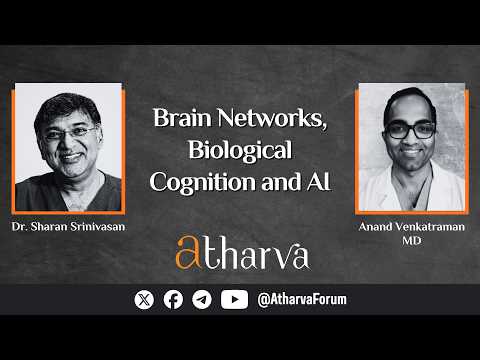
0:02 [music] Namaste everybody. Welcome to the Atara forum. A very great honor and pleasure to have you guys here. Today we have a very fascinating topic of great importance to the present moment which is the brain in the AI era and the future of neuro innovation. As you can imagine, tremendous changes are a foot in the world of technology and medicine uh affecting every country in the world including India. And to discuss this topic, we have with us a very very very special speaker Dr.
0:48 Sharon Siniasan from Bangalore. My name is Dr. Ankar Raman. I am an interventional neurologist and I would like to tell you that Dr. Sharon Swiniasan is a doctor and surgeon unlike anything that any of you would have met before. He is a neurosurgeon but not just a regular neurosurgeon. He is a very specialized fellowship trained from Japan. So he's not just a regular neurosurgeon. He is what is called a stereotactic and functional neurosurgeon which is like a highly specialized fellowship trained neurosurgeon who basically treats the brain as a very complicated electronic circuit and does tiny tiny surgeries to rewire it the way necessary needs to be working properly.
1:34 But it's not just that there are many neurosurgeons in the world. There are reasonable number of stereotactic and functional neurosurgeons in the world. But beyond that Dr. Sharon is probably one of the world's leading experts in rehabilitation. Meaning if the brain is broken for whatever reason, he is one of the world's top people in bringing it back to function. Not only that, it's not just a theoretical expertise. He runs his own center where he has produced some fantastic results. I myself have referred many friends and family and my own patients to Dr. Sharon for getting better after a stroke and you know many other brain conditions.
2:15 Not just that he's also an author. He has written like some exceptionally good books on this particular topic which are very very very shall we say unique because it's easy to write a generic book. It's easy to write a textbook, but this is a book which is meant for the average person, but is so specific at the intersection of so many complex little fields that he's probably the only person in the world who could have written them. And not only that, he's also a very famous uh YouTuber and podcaster. He actually has like a very popular show of his own like where he talks about all this stuff. So all of that is Dr. Sharon's background. But there is a specific reason. Maybe there's 10 people like that in the world who you know maybe do the same thing but I wanted to only pick him for this particular interview. Uh because I have met him in person multiple times over the last five six years and there is something about him. He is an iconoclastic thinker like a very very out ofthe-box innovator whose heart is truly with the average person with the average patient and he has never been the guy who will take no for an answer.
3:27 And it is only somebody like him who I think will be able to weigh in on this moment in medicine and science where I think we are on the cusp of a essentially another industrial revolution. If we say the first industrial revolution was in Britain, the second one maybe was the computers and internet. I think with this era of AIS and LLMs and all that, we are at the cusp of a third tremendous change where knowledge is going to spread throughout the world from the top to the bottom.
3:57 It's going to be democratized in an incredible manner and we need somebody who knows the ins and out of the system and also who has proven themselves over and over in the real world to be able to kind of give advice to students, doctors, teachers, policy makers and I think Dr. Sharon is the best one. Let me just say uh you know on a speaking on an auspicious note yesterday I took my family and my kid to uh see this Tamil movie called Karup uh very beautiful movie you guys definitely should catch it. It is about uh Karupus Swami. He's a he's a Kal Devata of a guardian dity, a village who basically it's a it's a legal drama. Essentially, it's about how the legal system in India is a very uh it's not very personfriendly. It's not serving the interests of the average person. Lot of corruption like poor people are taking advantage of it's very slow. So this karpami takes note of this. He comes and strikes in favor of the average person. And basically the entirety of the thing is how moribburn structures can be reinvigorated and made to work and function better. And I think when I saw that the first thing I thought about that was well something very similar could be uh true for the medical system as well not just in India across the world. And I think uh kind of just like a good opportunity to kind of get into this topic uh with a person like Dr. Shahan. Um Dr. Sharon so thank you very much. Uh if you have anything to add. Thank namaste Aron thank you for having me on the show I think it was a very generous introduction that you have given so yes I agree with you that I I am a guy who challenges the status quo and I am the guy I consider I'm always out of outside the box you know that's how it is because I think the box is too suffocating it's too boxing you up >> I I think that's the perfect topic or shall we say the attit itude for today's interview Dr. Shah. So the thing is medicine like law or whatever is a very bureaucratic and hierarchical field.
6:00 >> I agree. >> Most of the time the voices you hear amplified by organizations the ones at the top like a senior neurosurgeon like average senior neurosurgeon is somebody who's been cowed down by the system does says behaves exactly how he's been told from age 10. So you are the rare opportunity who has that expertise but also has this mentality of wanting to break moribundant structures. So please use this as a platform to send this message out into the universe as it were because remember that what you have to say nobody 99% of the people are not going to say. So unless you say it today like most likely uh you know it'll get just swamped in the average guy like saying ar beta do this do that. So let me ask you first question. Okay. So the old ways are dying. So now initiative agency willpower those are going to be the differentiating factors in the future because AI is now going to put specialized very very specialized knowledge in every average guy's hands.
7:12 Like I myself use AI when I'm dealing with like my complex cases. I'm sure my patients deal with it too. And this is only going to get more popular in the future. So this is going to change doctors. It's going to change patients. It's going to change a lot of things. So if you were advising a young doctor like somebody who's getting into the medical field, Dr. Sharon, what advice would you give them like overall like how should they choose their specialty? How can they choose to push the frontier instead of just you know like when I was training even like whatever 15 20 years ago like being a doctor is essentially for a long time being a passive recipient of what some foreign academ gives you as a guideline and you study study study listen to it follow it but now this is going to change quite a bit.
7:57 So, so how should an average person entering a medical college today become somebody who is able to work at that frontier, who's able to leverage all the opportunities? So, you are the person who when I think of somebody who's allied with the patient and who's allied with the truth, search for truth. So, you are the one who comes to mind. How would you advise a new new medical student? >> Okay. So, one thing is for sure. I'll start with a joke. All right. There was this doctor in whose house the tap was leaking.
8:28 >> Okay. >> And the doctor tried something to do to stop it. He couldn't stop it. He called the plumber. The plumber came in and he tightened something in 2 minutes and the leak stopped. >> Okay. >> The doctor said, "How much?" He said, "500 rupees." He said, "What? 500 rupees to tighten a nut?" He said, "No sir, 50 rupees to tighten the nut." 450 rupees to know which nut to tighten. When I teach, I tell my people I start with this joke and always say when I teach, I teach you which not to title.
9:03 No book teaches you this. >> That is the key. And if you do not realize that, that's why we always call it the art and science of practice of medicine. >> Not the theory of medicine. So that is the important thing. My professor in Japan, he always quotes professor Lars Lexel, professor Takomeara in Japan who under whom I trained for my stereotactic and functional neurosurgery. He quotes Professor L. Lexel from Sweden who says a fool with a tool is still a fool.
9:38 [laughter] >> Okay. So today the the youngsters are thinking that I don't have to think because somebody else is thinking for me. Ah >> that is so much farther than the truth. >> Okay >> because if your bladder is full the AI cannot think. >> True true true very true >> which is reality. Is this going to change? As long as the human body doesn't change.
10:11 >> Ah >> nothing is going to change. This is what my son taught me. My son is now 28 years. He's a data data engineer data guy. >> He says dad you want upper you want to understand one thing. >> See tech in the technology world >> technology is changing so fast within every few years something is defun something new is coming sometimes unconnected from the past >> but you guys are so lucky this human body doesn't change.
10:37 >> True true absolutely >> doesn't go here the mode doesn't go here nothing changes. So there's there's a there's a definitiveness. Ah >> there's a method in the you may use a new technology to access the nose but it's still the same nose. >> Yes. Absolutely. Absolutely. >> So there is a stability in what is going on. >> True. >> If I do a surgery through the nose whether you it's done in America or India or anywhere in the world it's the same damn thing. You will reach eventually the pituitary gland.
11:08 >> That's true. >> But the phones made by different companies are different. Ah >> the cards made by different companies are different. >> Okay. >> So you understand that. So this is the first message. The sec. So you once you get this there is no shortcut to anything that a new MBBS medical student is going to do. >> Ah >> it still takes a gynecologist 9 months to have a baby. It still takes an orthopedic surgeon 3 months for the board to heal. The magic happens only in movies and on in the unreal world or the virtual world. In real world nothing happens.
11:46 >> Absolutely. >> So when I introduce myself any forum I go I tell everybody greetings from the Silicon Valley of India which is Bengaluru and greetings from the original I come from the original IT industry which is a central nervous system. >> Everything else is a copy. So first of all once you have the knowledge >> yes >> you have to have knowledge in a systematic way so that you can go and leverage and manipulate that knowledge the knowledge has to come in layers there's no escape to that >> true >> you can't learn learn complex algebra and trigonometry without learning 1 plus 1 is two >> absolutely >> and and those are fundamental truths you can't say why can't it be three once we get that and start building knowledge on that then you decided How can I use technology to get there?
12:38 This is one of the best ways for people to understand because today what's happening Anand is most of these youngsters, most of these people think I have all knowledge on my fingertips. >> And people tell me all of those things. Oh, you don't know doc. I can they'll come with 100 pages of you know information they have googled. You have seen that? I have seen all of those things. So recently I was talking you know we were doing an AI neuroscience AI you know forum not a forum we were trying to make a a special action group to do some you know thing in neuroscience and AI and there were some the from a key university I don't want to name the university and the state and everything else from India the vice chancellor of the university the number two of the university and couple of us were all on the you know the the call together online and each of us were sharing what we are good at what we do just to know the strengths and you know the interest areas of interest of each of team member and then one of the team members because they have the big university they have a lot of money there a lot of he says oh we have this high-end computing machines we can compute any amount of uh data we can do this we can do that I said sir I want to ask tell you a fundamental thing who has this data of neuroscience for you to manipulate >> it doesn't exist >> that's true it doesn't exist absolutely >> or it doesn't exist in the way that may be manipulatable because in the data industry we call if it is garbage in garbage out.
14:04 >> Absolutely. >> So this is the truth. >> Absolutely. >> So then I asked him then he was not convinced. I said sir let me ask you a fundamental question. The vice chancellor of a very prominent university in a very educated state in India. So do you know what is a stroke ready hospital? You know what he said an I'm hearing it for the first time I said sir what data will you manipulate >> exactly very true >> on a stroke radio hospital >> absolutely >> you do not know about it >> I know >> what command will you give what nothing >> absolutely an illusion of ability is provided when you think that the data you have is all that you need but the truth is you miss the fact that the data that is provided is actually completely unconnected to the reality.
14:55 >> No, this is what is happening in this field. This is if you don't talk Yeah. you're in stone age. >> Yes. Yes. >> This is this is why it's happening. It's like you you flash a four. I said listen you know a 4G 5G 6G all G's you have with you. You don't know what is a stroke ready hospital. You don't know what's a stroke protocol MRI. You don't know what is time is brain. You have no idea when the fundamental things where are we talking about functional brain circuit and all of those that is step number 25 an >> absolutely that's a very good point I think so the point you're trying to make is without a very strong >> adhar or like base or foundation and a stepwise progression of your knowledge there is no sense in rushing into the technological ability and if we take that step too we we run the risk of really burning down whatever little foundation we have built uh over the decades >> which is true. So before I go forth I want to tell the audience that I always wanted to be a neurosurgeon from an eighth stand.
15:59 So I am living my dream and everybody's fundamental question was what made you think about neurosurgery at the age of at the age of 13 for example or 13 14 for example at that time this is the pre- internet era >> this in this internet era he didn't know stroke radio hospital I'm quite sure most of the people listening this will not know this forget about any new everything else >> there was no YouTube there was nothing else going on you know this is in the 1980s in India Yeah, my mother used to subscribe to the reader digest magazine.
16:33 >> Ah, >> and I was an avid reader and the first thing in any readers, I don't know whether you're familiar with the reader judges book. >> Yeah, I've read it. Yes. Yes. >> The first thing I would read in the book is drama in real life. >> I like real life stories first. So, I would open that and first thing I would read is that. >> Okay. And that particular episode uh edition had a drama and realized story of a lady who was skiing down the Swiss Alp and then she fell unconscious. The helicopter came and picked her up and then in the hospital they did whatever they did they for an aneurysm in her brain they operated her they did whatever treatment she did well.
17:13 >> Okay. >> So that's the first story. The second story was a story of a Canadian neurosurgeon who used to be who was an expert in treating brain stem glomomas in children. >> Okay, >> you know glomomas are challenging and brain stem glomomas are really one hell of a challenge especially in children and he was talking not only about the complexity of operating and all of those things. was also talking about the social emotional side of managing the parents and the grandparents >> and the grandparents come in more often than not only when they're children you know that whole of dealing with different people.
17:47 >> So that saw gave me the human side of what was going on and then there was a third article which spoke about the brain itself and how much is not known about the brain. The moment somebody says nothing is not known, that's where I get excelled. >> For me, I tell all my people, I thrive in chaos. >> The moment it gets organized, I have no further interest in the matter. >> Somebody else can take it forward and you know get it sorted out to implement it on the ground. So the moment there's cure, there's more confusion, there's more unclarity, that's when I roll up my sleeve said come on guys, let's go for it. I'm at my best and you know as a surgeon that's the way it is because we we deal with so many uncertain things especially in emergencies and things like that.
18:34 >> So this is the key that this people have to understand coming back to how the brain learns itself. Once we understand that as we start learning then we understand how do we now add technology to enhance the way we want to deliver something or we want to access some other information that's about all >> so this anand I think is the big one of the biggest myths I want to break here see if I was reading a book on transforming businesses you know technologically and things like that one of our business books and they say say the fundament funamental needs of a human being has never changed.
19:14 >> But what has changed is instead of you going to a restaurant which is you know 10 kilometers away trying to find a parking place, you can swiggy it. >> Ah >> to your house. >> Okay. >> So that is a technological vehicle to get you your favorite dish to you. M >> if you look at movies all Netflix and this OTT platform have done is get the movies to you without you going out >> you're still paying the money you're still searching the list you're still want deciding what you want to do you want genres you decide you want to see English you want to see Hindi you want to see kana you want to see Tamil you want to see comedy you want to see tragedy you want to see whatever it is >> they're still organized the same way >> okay >> none of those things have changed Understood. Understood.
20:04 >> So first yes. So one of the things that people have to understand is the AI and technology is not going to think for you. >> You have to do the thinking. >> Understood. >> I will give it back to you. You ask me next then I'll tell you how to build. But this is where I want the students to start. >> You are not going to go out of business. >> Yes. >> But if you want to build a100 phone, you're going to be out of business.
20:32 Ah no that's very do >> that's also not true. I was reading a news recently that lot of the youngsters are going to non-s smartphones. Yeah [laughter] I myself I'm thinking I'm tired. >> I don't know so I may withdraw my statement of the 1000 phone but I'm just telling you about that. >> No but that's I think a very crucial uh point that you have made that like how you say you thrive in chaos. So that's the very human aspect of thing. The human expert is is meant to thrive in chaos. Once something becomes very organized and systematic, you get bored and that essentially means that probably a machine could do a reasonable job of something like you know reaching out to >> Exactly.
21:19 >> So so that's a very great point that I'm taking away from what you just said Dr. Sharon that the training of a doctor should focus on doing those extremely human things dealing with other human beings dealing with a patient at that emotional difficult crux of life. >> Yes. and thriving in that chaos where the protocols are going to break down where you have to use your knowledge, your innovation to decide what is the next step. And then the simpler things like outreach, making it easy to schedule an appointment, you know, getting your clinic throughput. Instead of seeing 10 patients, you're able to see 25 patients. Those are the things potentially where uh leverage can be uh used from technology.
22:05 >> Yeah. See, it's so true. You know, you don't understand the moment. See, you see, I just said my statement. I thrive in chaos. >> Do you think AI thrives in chaos? Impossible. >> It breaks down. >> Exactly. >> Very good point. Very good point. >> So that is what people need to get. >> Ah >> the world was born out of this chaos and everything else and everything start you know the dust settled you know then it started getting suffered and what same way. So once it starts getting organized then you see what can I say so what I would do when I was a you know senior resident or junior or you what okay now that I know this work what can I outsource >> yes >> or delegate >> this guy can do this this guy can do this this guy this work I only have to do >> yes yes yes >> we were doing that all the time >> yes >> we continue to do that >> understood understood that's a very very good insight >> yes so I'll give you an example is one You know neurosurgery training for those who don't understand it's a six years training after five and a half years medical school you keep on studying and then we remain a student of the subject all our life we never know we never die without learning every single day it's very unique in medical you know healthcare and medicine so there was a one of those days when I wasn't doing my residency I had one of a bad call day so many emergencies hardly any sleep you know maybe an an hour or two got up in the morning I do all my night around. So I didn't get my breakfast. Maybe I had a cup of coffee and then I was dealing with a lot of hundred other things and I didn't have my lunch. My my chief came for a for a round. By the time we finished all of that was 3:30 in the afternoon.
23:48 >> So he asked me did you have your lunch? He said not I haven't had my breakfast. He said let me buy some food for you. So both of us went down to the the canteen, you know, minus 2 basement >> and then I sat there and the guy who goes to serve me came in. And I asked something and he went and brought something else and I was in my wits and I was hypoxic, hypocarbic, you know, hypoglycemic all the hypos were happening at the end of the day and I gave him a mouthful. I said, "What do you understand? You don't understand what's going on and everything else."
24:16 Once he went away from me, my one of the biggest lessons my chief Dr. Aski taught me s you have to understand one thing. If he was smarter than this, he would not be doing this job. You know what I learned from that one statement he made Anand? It is called horses for courses. >> The first thing I decided after that is there are two kinds of people in this world. A horse and a donkey.
24:46 So you can't sh you need both. >> True. Very true. Yeah. >> But you can't make a donkey a horse. >> True. Okay. >> So that's very important. So I had to sort out people around me. So who are these people around me that I'm interacting with every day starting with a ward to an with a junior nurse to a senior nurse to this to that to there's so many people around me who are helping me run this whole show >> so I had to decide which who is the horse who's the donkey and which course is he going to run >> very very very okay >> if I give the wrong advice to the wrong thing he is bound to screw up >> wow >> and then I am fixing a problem which I didn't realize myself and making that correcting the mistakes would take me more time.
25:33 >> Ah so that discriminative power to figure out who can be given what responsibility and be wise about it. Don't just be like I have told somebody to do it now it's not my problem anymore. Now ultimately you are the decision maker so it's your job to make sure you give the right job to the right person. >> Today that job can be given to a computer. >> Yes. Some of [snorts] them do that job can be given to somebody else but you still need to know what is that job.
26:02 >> Yeah. You can't become just like a like a >> you don't the air can't know WHETHER YOU WANT TO EAT A MASALA or a breakfast. How does the air know? Yeah. Come on. >> No. Very good. Very very very good practical advice really like somebody who's some you know startup who's building you know AI tools for medical field actually will benefit from this kind of insight. It's a very important insight. Let me think. Let me give you one more thing. Now let us let us translate this to the neuroscience.
26:30 >> How does is okay Dr. Shan is saying all those things. Anand is saying all. Is this really true in the human brain? >> And if you ask me that question Anand >> you you always hear smart people saying I multitask. >> You multitask. I multitask. You might have made the statement. I have made the statement. >> Okay. >> But truthfully Anand are you multitasking >> or just doing serial tasks one after the other? So when people look at me like this I said listen you have opened two screens in front of you on your computer can you type on both the screens at the same time >> no >> you can't you may move screen to screen but at any time you are working actively on only one screen >> h yet you think you're multitasking but we human beings multitask let me tell you how we multitask Imagine you are driving a car >> right now all of us drive a car. Many of us we know how to drive a car very see easily.
27:35 >> The first day we sat in the car. >> It was a sensory overload for us >> because we have two hands two feet. That time we still had the non-automatic cars. We had the gear shift. You know you had a gear on the left hand side, you had the steering wheel on the right hand side. You have three pedals only two feet. M and then you have to manage the rear view mirror, the front, the side, the extra. There's so much going on.
28:04 Yet 6 months later, if I ask you an when you drove and what all signals you saw, what all turns you take, you have no idea. >> Yet you reached my house. >> At that time, you may be even talking on the phone. >> The phone is the screen that you are working on. The car driving has now become autonomous. >> True. >> True. >> Because of practice.
28:35 >> H. >> So now I tie this up. I explain this is how I explain to my people to understand. So what do you want to do? You want to become an expert. >> Yes. >> I'm giving you certain things to know. Then how do you automate it? That's where we are heading in this conversation. Okay. Absolutely. Because I seem to be saying certain different things. I'm not saying it randomly. I'm giving you a methodology to for people to understand with real life.
28:58 >> Absolutely. >> So there are four stages to become an expert. >> So before I tell you these four stages, I normally draw a circle, >> okay, >> on a board, >> okay? >> And I ask all the audience, I'm asking you and your audience, >> okay? >> If this circle represents all the knowledge in this world, all the knowledge of everything, >> okay? How much of the knowledge do you know an >> there's this like very famous saying in meaning what you know is equivalent to how much sand you can hold in your fist what you don't know is the rest of the world >> so people would say a small dot or whatever less than that something similar to what you're saying >> so I would draw a small pi just to make it appear okay on the board This small pie is the knowledge that you know.
29:54 I know to brush my teeth. I know to dress myself. I know to walk to school. I know to drive a car. I know to do neurosurgery. So on and so forth. That is I know that I know >> I I know that I know this. >> Okay. >> Then there's a larger segment pi that I know that I don't know. I know that I don't know how to fly a plane. >> True. True. >> I know that I cannot do laparoscopic surgery.
30:24 >> So on and so forth. I know that I can't do something else. I can't run the marathon or whatever it is. I know IK. I know that I don't know. There's a large area that's still left undefined. What is that area? Do you know what? >> I know that I don't know. >> Exactly. You don't know. And you don't even know that you don't know. >> That's true. >> That is humility. >> Yes. No, that is where new knowledge comes in Anand.
30:56 >> Ah okay. So now coming back from that knowledge to these four levels of becoming expert when you are born you know you are unc you're unconscious to your incompetence. >> Yes true >> you're unconscious and incompetent. You don't even know that you don't know what you are in that world as a baby newborn baby to whatever it is you know. >> True. >> After some time you become conscious to your incompetence.
31:28 >> True. Oh, I can't do this. Oh, how do you do it? And you know how that oh comes? It is that bulb that comes on in our head. You remember the comics that >> I call it the aha moment. >> I tell all my people you have to have minimum five to 10 ahas every day. Uh-huh. That's how to double puncture when I put an IV line. >> Ah, yes. Yes. Yes. >> Uh-huh. This is how not to do a lumbar puncture.
31:56 >> Yes. Yes. Yes. You get what I'm saying? And people say, "Oh, this is aha, this is how to burn the dosa." >> You know things unless you do it with aha, you have a good aha, you have a not so good aha. >> Hopefully the aha comes at a low price and not anything irreversible. >> Absolutely. Then that idea comes. Then what do you do? You say, "I have to go learn this." >> Yes. >> Okay. So you go to a teacher to an expert who already understands this.
32:25 that the teacher teaches you. Then you become conscious and you become competent. And how does that conscious competent happen? With not only with learning with practice. You practice, you practice, you practice and then you start getting competence but you're still conscious about it. >> And then the ultimate stage of being an expert an is called unconscious incompetence. M >> you're not sorry unconscious competence.
32:56 >> Okay. >> That means your unconscious operative competence that is example of you driving a car. >> Okay. Okay. Very it's a very good mental framework and you know now that you brought up the automation I think this is a great point for me to probably weigh in on at least my thoughts on this topic over the last few months. >> In December I bought a Tesla Model Y. It's a self-driving car. Specifically, I bought it for this because I moved to a new city. Lot more driving. And I tell you, 95% of my drives now I use that self drive. I have to do some supervision. You're like, it's supposed to watch it, but otherwise it does everything. Accelerate, stop, it has cameras everywhere. So, all of that. And the reason I was doing more reading about it, the reason it works is that driving to a certain extent is a very organized and streamlined activity in the United States. It's like the highways are very this thing the rules are very strict and there's very simple things like certain things like don't go too close to a car whether in front or side if the car is coming you stay back you you know it's easy to feed that in fact I think the self-driving and Tesla which is supposed to be the best of all the companies is I believe headed by an Indian like Ashoke Elisami is what I believe the guy's name is so >> yeah so so and I've been so impressed that you know apparently it's not just me like insurance companies give you lower insurance rates if you're a Tesla owner who uses the self-driving quite frequently in the US because they have found that in fact apparently it crashes less than human drivers do which is true because a human driver sometimes you're tired you're distracted your kids are screaming something something the self-driving like you know if I'm going to the hospital at 2 a.m. It takes me there. It brings me back. Even if I'm very very sleepy at the wheel like it still does the job and you know so that's so what is being advantaged or what is being leveraged here to provide this experience. The initial set driving a few years ago was very bad apparently but it is a machine. It doesn't get tired. It has access to data from every Tesla in the world which is real time data is being transmitted back to the Tesla headquarters. Their AI is learning on it, training on it. The humans are figuring out what is wrong, what is wrong. So from every mistake it learns, it is learning from other people's mistakes and it never gets tired. It constantly updates itself. So this has progressed from a system which was crashing, killing people just a few years ago. Now it's like insurance companies are literally giving you less insurance premium if you're willing to use the self-driving more. So I don't doubt that this is going to become more and more widely adopted in different places. And in my own field which is interventional neurology uh there are robotics companies which are attempting this. Obviously as you transition from a closed system like driving on a highway relatively close to driving to doing procedures involving the human body it becomes much more complex much more risky a lot of things can go wrong but you know endovvascular stuff presumably is a fewer degrees of freedom. So hopefully it's somewhat more aminable to automation than a pure open surgery or something. So what's what's what's changing things now is things like haptics, you know, where basically they're developing gloves which provide feedback on pressure and then these humanoid robots are coming out which are being kind of uh so what all of this stuff used to exist in independent silos before but apparently what's changing now is that all of these bodies are basically being hooked up to a self improving learning algorithm in form of the LLM. And so that's where the system is able to learn from its mistakes. So I took your point very seriously about the fact about the chaos and the organization. So from what I can see now in the in in the kind of initial stages is that things which are somewhat organized and not too chaotic could get uh assisted by the self-improving AI tools because the technology is progressing. But um as you said the the human engine needs to be there to make sure it doesn't stagnate. So otherwise you will reach a certain level and the AI is happy you are happy and that's it. From that in unconscious incompetence to moving towards unconscious competence there is a certain uh uh certain drive you might say like that is pushing you ahead and a machine is not going to have that. So if you were like you said you were talking on this meeting with like VCs of various colleges and stuff same thing I if you were advising a group of VCs and university professors and stuff how to train the student of the future for this stuff what are the things that you think he should focus on like we already talked about student the main thing is focus on competence don't think that just because you can google an answer you know that answer that's not true at all because the truth is anybody can do that but you when you're in that operating room you are the expert you know like the people are relying on you their life is in your hands so for students I understood if you were advising a VC a university chancellor university professor head of department what would you say what are the risks what are the opportunities and what should they do to make sure they produce guys who are iconoclastic but also experts >> as you're as you're talking and asking me the question I was thinking if there's cyber warfare >> and somebody shuts down our Wi-Fi.
38:26 >> Yeah, absolutely. >> Will your will your car run? >> Absolutely. Won't that exactly very very fear of that that uh if there's a cyber war one virus is all it'll take to crash. >> It's just a virus. You don't even have to have something else. That's >> absolutely absolutely >> don't know. So, first of all, you made a long statement about Tesla. Tesla failed failed miserably failed spectacularly. We all know the journey and now they some level in an organized place.
38:57 >> The first thing in Indian roads is chaos. >> Yes. Absolutely. >> The dog to the buffalo to the child to this to one thing you are clear is they may not follow the rules. >> Absumes modified you know beyond anything else. >> The first assumption is there are no rules. There is no way that Tesla is going to succeed in India anywhere in the future anywhere. >> Absolutely. Absolutely. >> So the Yeah, that's the first thing. So 10,000 people, 100,000 people, 200,000 people driving a Tesla CL car is not going to change the world.
39:37 >> Good point. >> This is my truth. >> Okay. Even if you ask me to give a self-driving car, I only drive 800 kilometers in a year in a in a month. I said, do I need a self-driving car >> is my question. So if I want I what will I do with self? I still have to look at the road. >> True. Absolutely. >> Human supervision is there because that 5 10% is what is going to determine whether you're going to survive or you're going to die.
40:03 >> Yeah. Yeah. Yeah. Absolutely. >> The guy on the road is going to survive or die. >> True. True. True. If I don't want to do that, I am tired. The simpler, cheaper thing is to either hire a driver or take an Uber. >> True. True. >> So, what am I trying to communicate? The problem is because they only look at uh Tesla or Elon Musk or these big companies as the place to be in these universities. Huh?
40:32 >> So they think I have to solve such a big problem to become another Alon Musk. >> Okay. >> They don't realize there are simple fundamental problems from the ground dayto-day moment to moment problems that can make life easier for somebody like you and me. >> Okay, >> which nobody's solving. >> Okay, >> see just look at UPI. >> Okay, >> why did India come up with UPI? It has solved so many problems for me bus for me personally >> and for millions of Indians. First of all, I am not worried about paying my electricity bill.
41:05 >> I am not worried about paying my water bill. >> Okay. >> Before we had to wait for the bill to come. Even today it comes >> and then [clears throat] I had to find somebody. I had to go somewhere and go to a counter, stand in a queue and pay the bill. >> Okay. >> Correct. I I'm quite sure your dad would have done all that. Your dad, >> I remember all that. Yeah. >> Correct. Today, not only that I'm paying online, I I have automated it.
41:27 >> Yes. Yes, >> the the the app picks up the bill from the water supply department. >> It knows exactly I one time fill it pays the bill. >> Okay. >> So all of these mundane tasks which is taking up my time is now being automated >> at no cost. >> Okay. Okay. >> Please understand it is I am not spending money for this. I'm spending literally peanuts versus me going to some place taking my time off. time is money and things like that.
42:00 >> So all I'm trying to make people understand is solve simple human problems. >> Okay. >> That nobody is doing. Everybody wants to talk only about this automated this. No an is not going to work. You this is the way I answer. You don't need an AK-47 to kill a fly. You need a good SWAT. So focus on what what is necessary and important >> and then when it comes for the masses there's lot of technology that required at the ground level you start layering it up.
42:35 >> Ah okay. >> Then you know at which level do you want to solve the problem who are the number of people who are going to be benefited by you solving this problem. >> Okay. Okay. >> Then you say is this worth a business opportunity? >> Okay. Okay. Otherwise it's not going to happen. >> Now people who are sitting in glass houses, who are sitting in these research places are unconnected from reality. >> True. Very true.
43:03 >> Unconnected. Where is the money? Who has the money today? In India, we're trying to drive on one side you are trying to democratize things and making it affordable. Other side you are unnecessarily putting technology when we don't need technology. >> Ah okay. Okay. >> So this is the problem that is happening. So people are not understanding the appropriate and judicial use of technology >> and judicial use of what we have. This is my take on that. I am I am a very future looking fellow but I still understand that you still have to walk to the bathroom.
43:37 >> True. >> You understand? No that's not what you understand the fundamental things that makes a big difference. >> Yes. Very very good point. Yes. >> Yeah. I don't know whether you accept what I said there. Simple thing UPI. The the people who are diag who have made self-driving cars still got to have UPI. >> No, absolutely. Because I think what you say about walking to the bathroom, especially the work that you do, which is recovery from strokes.
44:04 All the technology in the world, as you say, when your bladder is full, that guy who's paralyzed still needs to be able to walk to the bathroom. And there's no automation, no technology, no laptop whatever can make up for that. And that is limited to a certain extent by the realities of the body, realities of the brain, realities of biology. So that's a very very important, shall we say, a grounding uh view that needs to be percolated to everybody that don't ever detach yourself in too much uh hallucinations.
44:41 stay grounded to what is uh the physicality of of our existence. >> Very true. No, >> absolutely. Healthare there is emotion. There's so many other things going on. >> It doesn't happen in a machine. >> True. Very very good point. Okay. >> Doesn't happen in a machine. >> Obviously, you've had extraordinary success in helping people like this who are bed bound. They are not able to go to the bathroom. A few months in your center, they are able to go to the bathroom. I myself have referred patients to you. I you know no financial relationship whatsoever. I have personally heard great reviews from friends and family and patients that I have referred to you and they have told me that oh my goodness what a miracle.
45:20 So I know that you can do these miracles. Um what do you envision coming down in this field in the future as we have this progression of knowledge and technology and come you know coming out to the rest of the country. So how do you think this field is going to improve? So one thing is you have innovated with almost your mind your resources without much you know backing from any big uh organization but you have still achieved so much. What is coming in the next 10 years? Like do you think the pace of recovery is going to pick up or do you think we are still kind of uh uh you know to some extent limited in what hope we can have like if somebody has a stroke you're like sorry like 6 months it's you know it's going to be it's going to be what it is or do you see anything really exciting that might turn things for the better?
46:19 And the it's actually very I I said the f in the first cut itself it takes a gynecologist 9 months to have a baby. >> Oh >> so forget about a stroke patient. Can you make a child finish medicine by the age of 10 years? >> Not Elon Musk child was Elon Musk has all the access all the knowledge all the money all this all that and everything else. Can he make his child a doctor neurosurgeon with the age of 10 years?
46:51 >> I will say this probably not for the average child but in the US there is this chain called alpha school which charges like a bomb like $100,000 or $50,000 $100,000 per year per child. What they say is they use personally targeted uh electronically delivered learning modules which basically get harder as you get better at answering and it's kind of like a video game based kind of essentially like a motivation hacking type thing. They claim they compress the day curriculum into 2 hours and then the remaining 6 hours they spent on socializing and play. That's their claim. It's a new thing over the last few years. So there are people out there who claim that with the appropriately targeted uh technology and uh learning ideas you can accelerate learning. Whether you can make them a neurosurgeon is like a far-off thing.
47:45 No, >> when you say accelerated learning they may be compressing 4 hours into 2 hours. >> Yes, >> I'm not I am not asking that question. That is changing from yellow shirt to green shirt. >> Okay. >> Instead of wearing eight buttons, I'm wearing three buttons and I drop it on. That's not what I'm saying. Can you shorten that journey? See for us right now I don't know how it is in the US but I know that in India you have to do 10 + 2 + 5 MBBS plus 6 years neurosarch.
48:11 >> True. >> 10 + 2 is 12. 12 + 11 is uh 23 years. >> Can I shorten this 23 years to half the time? >> It's a good question. Honestly, I don't know. I don't know. I'm wish You are sitting the US don't know means it's not happening. >> Yeah. Yeah. Yeah. I mean I I haven't heard anything like that but I mean I'm just wondering >> it doesn't exist an it doesn't exist. >> Okay.
48:38 >> So if I can't do it for a super intelligent normal functioning brain >> ah >> how can I make a damaged brain recover any faster? >> Okay that's a >> that is the point I'm trying to drive home. People want instant gratification. >> Okay. Okay. It's not going to happen. See, when I was a kid, >> when I had to write communicate to my cousin who is in the US, >> okay, >> I had to write physically on something called an aeroggram.
49:10 >> Okay. >> Write a long mail. >> Okay. >> Stick it up and put it in the post box. >> Okay. >> The Indian Postal Service picks it up, does whatever it is. On an average, it would take 15 days to reach him. >> I never took a photo copy of the letter I wrote. M >> so I need to remember what I wrote. >> Ah >> and then I have to wait 15 days for him to receive it.
49:33 >> Ah >> then he will write back. >> Oh >> and he will never take a par and attach it and give a reply. >> Yeah. Yeah. Yeah. So he left. >> He will write what he's going to write. >> He's going to post it into his post box. >> Yeah. >> So take us 50 days which was a communication of one piece of paper one month. >> Ah >> by time the loop is closed. >> M >> correct. Now I have said something. He has said something >> and he say something again with one more letter.
49:59 >> Yes. Yes. >> Today when somebody types a WhatsApp message in 5 seconds if they don't see a blue tick they get restless. >> Ah >> this is called instant gratification. >> Ah >> technology has shortened things so much that people think the same thing happens in healing. >> Ah so healing very true >> doesn't happen in healing. >> Okay. It doesn't happen in healing. So because they think it has to happen, they think if I go to a robotic rehab, if I go something else, if I do this, if I do software, it's going to happen faster.
50:38 >> Ah, okay. >> It's not going to happen any faster. >> Okay. What? >> So this is very important for you to know. >> So I many times when I start my talk, I start my talk by showing this and ask everybody what is this? >> Okay. >> People say it's a pen. The next question to them is your eyes telling it's a pen or brain telling it's a pen. >> Huh? >> And people are fixed.
51:01 >> Okay. >> And normally I get a 50/50 answer. >> Okay. >> 50% says eyes, 50% say brain. >> Okay. >> Okay. And I tell the guys who told the brain. I said you are telling brain because a neurosurgeon asked a question. You're giving me a smart answer. >> Okay. >> We always say no. Can't you see with your eyes? Have you ever said can't you see with your brain? Nobody makes that statement. That's a stupid statement to make.
51:20 >> Yeah. Yeah. Yeah. Then I follow up and ask the question. Imagine you're sleeping now. I carefully open the eyelid and show the pen. Do you see the pen? They say no. Are you blind? They say no. Then why don't you see the pen? Because the eye is on. The brain is off. >> Okay. Okay. >> Is your tongue telling you vanilla ice cream or brain telling you vanilla ice cream? >> Is your ear telling you sonic song or brain telling you song? Your heart to me same dubdubdub. My heart use same dubdub the same vanilla flavored activity from the day we are born to the day we die.
51:58 >> Okay. >> But your brain to me cannot do neurosurgery my brain too can't do what you're doing because the hardware is the same software is different. >> True >> anand if my phone crashes today >> and you and me have exactly the same iPhone model. >> Okay. Can I pick up your iPhone and do all that I can do with my phone? >> No, of course not. Yeah. >> Impossible.
52:29 What does that mean? If I can't take anybody's phone and perform function, that means your phone is having things that is only customized to you. >> Yes. >> And my phone has things customized to me. >> True. >> But the basics are the same. The battery is the same. The connector is the same. All of the yet it is different. >> Okay. >> The human brain is like that. >> Okay. >> I'm connecting both constantly to make you understand what the difference in this and how similar it is yet it is different. So now let me give you a very simple example.
53:07 You draw your blood sample. >> Okay? >> You get a report. >> Understood? >> You you get your number and the number next to it. >> Okay. Okay. >> Which is a normative data. >> Yes. >> The range, whatever you call the range. >> Yeah. Yeah. Yeah. >> Both these numbers are not there in neuroscience in the world today. >> True. There's no such thing as a very true >> brain function test. >> Absolutely. >> I can't look at your face and tell your blood sugar. I can't look at your face and tell your blood sugar uh blood pressure.
53:36 >> True. >> Without testing, I can't blindly give you insulin and make you die because you you are overdosed or keep on testing in between. [clears throat] So when I started asking myself this fundamental question, I realized there's no brain function tests. >> If there's no brain function tests, how do I treat my patient and how do I know what do I do to make them better? If the blood sugar is 500, your strategy is different.
54:02 >> Blood sugar is 200, the strategy is different. Starting with admission, ICU, insulin, infusion, whatever, whatever it is. >> Very, very simple logic, you know. Decision making is different >> based on the starting number. >> Yeah. >> And the subsequent numbers. >> Yeah. >> And you're constantly dynamically changing the strategy. >> True. >> In in some way or but there's constant data coming data flowing data flowing decision making data flowing decision making. >> Understood. >> Correct.
54:32 >> Now if my patient of stroke comes to me for rehab. >> Okay. >> I do not know whether my patient is disabled at second standard level, third standard level, fourth standard level. How can I tell you that you're going to get better in 3 months not knowing? If you put a child in third standard, how long is it going to take to take to 10 standard? What's the answer you get? Seven years. >> Ah, because you're not a starting point. You know the duration.
54:59 >> True. Of course uh Anand you have to understand based on my starting point entry point of my patient's disability >> and which abilities he needs to have >> and what all needs to be done >> yes >> I can be able to give a reasonable prediction >> okay >> now if people do not understand these nuances >> ah >> you can't carpet bomb treatment of stroke like a vaccination program Oh, >> true, true, true, very good point. Okay, very good point.
55:32 >> So, what do you think about this? >> That's a very good point. So, it all depends a lot on the individual where their starting point is, what their innate brains resilience or what you might call it. So, from your >> huh, exactly. >> Damaged. >> How much is damaged? Absolutely. So what what is the what is it from your perspective that what intervention do you think makes the most uh bang for the buck you might say or most value in terms of what you can provide to them?
56:03 Like of course a lot of it depends on what they bring to you when they come into your clinic. But what is it that you think as a rehab person who is interested in healing that damaged brain? What is the what are the few things that make that big difference? I'll give you a I'm going to start with a very different answer, but I'm going to get to it. Prevention is the best, safest, and cheapest cure.
56:26 >> Oh, okay. That's true. >> Helmet with a buckle. Manage your blood sugar, blood pressure, all of those things because nobody can afford disability. >> No, >> this is the truth of the process. You know, this is the reality. >> Having said that, unfortunately, in spite of all you do or whatever it is, you got there. Now I have to understand you know which parts of the brain right side, left side, top, bottom, there's that all of those things. So I need a starting point.
56:50 >> Okay. >> If if he's he's having chest infection, urinary tract infection and something else, my strategy is different. >> If he's having associated kidney problem, my strategy gets added differently. So on and so forth. Similarly, I want to know what all areas of the brain, what all circuits of the brain are are damaged >> radiologically. And from there how much is he able to do or not able to do. So I get certain starting points.
57:15 >> Some of it are damaged more, some of it are damaged less and things like that. Based on that, I start having different strategies. >> I'm not going to do a carpet bombing strategy. >> This is important. So I asked people a question. Imagine this hand, right hand got paralyzed in a stroke >> m >> and it recovered completely and in front of you Anand is three cups of coffee. >> Okay. >> One is in a steel cup, >> one is in a thermocle cup and one is in a glass cup. If I use a thermoc plant for the glass, I will drop the glass.
57:54 >> If I use a steel plant for the thermocal, I will squeeze the cup. M >> who decides the plan? Is it the hand? Is it the eye? Or is it the brain? >> Okay. Okay. >> Okay. >> It is a brain eye hand coordination that works real time >> constant constantly you know looking taking visual feedback audiary feedback you know tactile feedback is it hot is it this is it that your old knowledge your old memory so much is coming in.
58:27 Okay. Okay. >> So based on all of this, you're making real time changes. Is the cup having a handle, not having a handle? Is it that steel cup with that thing that you mix and drink? How it looks too hot? Then you touch it carefully. >> So which AI, which Grobo, which technology can teach you all these things that you can drink without burning your lips, >> without rubbing it on, >> without spilling it. So what I'm trying to make you understand is certain basic actions can happen by a robo.
59:02 >> Ah >> you understand but teaching you all these nuances >> we are far away from that. >> Very good point. >> There is no escape to this. Lot of people come and ask me do you have a robo in your in your rehab center? I said do you want robo or you want rehab? >> Very good point. very very very good point that >> and people think they get upset with me think ah because he doesn't have a robo he's talking like this I said no if today imagine guys if sundar pichai of google if his child is weak in mathematics can google help him >> no >> no he needs mathematics tution by teacher or somebody online >> very suchin tendukar has to improve his cover drive do you think putting an exoskeleton into his hand will improve his carbon drive.
59:56 >> So it has >> skill an is not a movement. >> Robo creates movement. >> Brain network creates skill. >> People are mistaking movement for skill. >> Yes. >> Some of the robotic games teach you some of the scenarios. I agree. I'm not saying no to that. You understand? Maybe you can say I can have a set of games to brush teeth. >> Ah >> where you show the right way to brush wrong way to brush all of those are those games existing I'm not too sure games are making them play different kind of games you know ball game this game that playing they're all basically to reconnect the movements >> to get to get your reaction time and everything else eventually he has to go back to his life and you know India culturally how different it is. Yes, absolutely. Absolutely.
60:49 >> It's very very different. So we have to so each patients a 70y old right-sided stroke expectation is different from a 20-year-old leftsided stroke. >> Okay. So I think sorry >> you get you have asked so many questions before I decided to put a customized rehabilitation plan for him >> understand [clears throat] his starting point and then start doing some strategy. see how he responds to the strategy and then take action. You mentioned the school of this alpha and everything else. Eventually the child has to learn.
61:23 >> Yes. Absolutely. Yeah. Absolutely. >> The patient says I will not do anything. He look at like this. What will you do? >> Ah okay. >> So eventually the patient has to participate in reconnecting his brain. >> Ah okay. Okay. >> Correct. No. So half your job is to motivate the guy. Yes. So very interesting. >> Very interesting. >> So you said you said a fourletter word h o p e. >> Yes.
61:54 >> That is the key. >> Ah >> you say you will walk again sir. Will I walk? Then he said sir I will try. >> Okay. >> But somebody you're not going to walk again. You're going to wheelch. >> Ah >> what's the point sir? >> Okay. Okay. No, that's a very very ah very good. Uh I think I understand what you're trying to say. Basically the important things are the motivation which as the good doctor you want to try to generate in that patient. So that's a very human thing and it's not easy to explain but it's something you develop a skill. And the other thing is you need to have that expertise to figure out what is this particular guy's problem like >> which nut to tighten.
62:43 >> Huh? >> Which nut to tighten. >> Exactly. Exactly. Which nut to tighten for this guy. Exactly. So >> it's each person may have a different problem and your expertise needs to be able to identify what are the most important things for him and how to motivate him and what expertise. So basically when I asked you what is the most important thing that a good rehab neuro rehab center will provide as opposed to like a bad one. Uh because I'm sure there are many bad ones. So I know you are one of the best one. things that you cannot mass produce, things you cannot easily standardize, the things that you cannot like just duplicate without that uh expertise is you need to know which nut to tighten and you need to have that that what you call the shi to motivate the guy to want to do it from himself because until that that rises inside him there's no point you can do whatever you want from outside.
63:33 >> Yeah. So now that you've got the fundamentals now I I'm going to add layers to this now. >> Okay. >> Okay. So having said this, there's a very famous oxymoron word we have mastered in our center called mass customization. >> Okay. Okay. >> Oxymoron. The moment you make mass, it's mass. >> Yeah. >> The moment you say customize, it is customized. >> But how can they work together? That's why I call it an oxymoron. >> Okay.
64:01 >> For a subset of patients, you can mass customize a plan. >> Oh, okay. Okay. Okay. You got the point? >> Understood. Understood. >> For a subset of patients, that is what we have defined. Then what happens is if we you categorize these patients into the small small chunks. >> Okay. >> And then find the best possible path for them. Then I have efficiencies coming in. >> Oh okay. Okay. Then I know that what will be a trial and error for 10 weeks can happen in 3 4 weeks because I know what not to do. Uh okay okay okay >> you got the point >> that is the key nobody has understood >> that's what we have cracked in our system >> okay understood understood >> that's why you see see very people say I have people who come sir I have done physotherapy six two years for my son >> what more can you do I said I don't know what you have done I don't know whether what I do is going to help your son. Try us for one month. But I tell them I keep a hand like this. I say normally the brain is damaged here.
65:16 The patient is functioning here because nobody understands this. Very few people like us understand this. >> Understood. >> It is akin to your coach or teacher telling you you're not working to potential. >> Ah okay. >> You are a 90% student but you're getting 70% marks but you're not putting good effort. >> Ah >> you get the point. No. >> Yes. Very good. And then the same person in one month said, "Sir, my patient is so much better. What happened?"
65:42 >> I said, "We just did this." >> Okay. >> That's where the magic happens. You understand the miracle. The magic happens because see I will I never tell people I create a miracle. >> It looks like a miracle. See when I am stopping this tremor of the hand by putting the electrode in the brain, that's a science that I'm doing. For somebody who doesn't understand the science, it looks like magic. >> Yes. Yes. Yes. >> The intervention radio neurology you do an >> guy went into a cat lab with a stroke, right side weakness. You do a throctomy, he comes out with his hands up. It's a miracle.
66:20 >> It is a miracle. It looks like a miracle. But yeah, when you see it, >> you understand that [laughter] you did some some defined stepby-step process. >> Very true. Very true. It looks like a miracle if you don't understand what's going on. >> Exactly. >> Yes. >> So you have to understand this and go step by step. So we we give them realistic promises. >> Wonderful. >> I tell them let's try for one month. Then I can set the pace cuz I know how much patient is getting motivated, how much is system is responding, what is happening. Then we can sort of fine-tune it, sharpen it, you know, do what we call a synaptic pruning.
67:01 >> You know, you trim everything to make sure that you don't do. Then what we do is what we have learned in our system is we take the best results from all people there and make that the standard of care. >> Okay. Okay. Okay. >> That's what we have done. We have used our natural intelligence >> and put all the natural intelligence into a software called neurologics and made it artificial intelligence. >> Brilliant. Brilliant. Brilliant. >> That is what we have done first and that is our LLM.
67:32 >> Wow. >> We have made our database. So if you look at uh now I'm going to compare this with Tesla autonomous driving. >> Yes. Now, can Tesla's autonomous driving data be used by BYD? >> No. Exactly. It is. It is uh uh proprietary. >> Proprietary. Even if it is not proprietary. >> Even if it's not the technology. >> Exactly. >> Has a different hardware, different software, different process. If B does everything Tesla does, it's not B. It's Tesla.
68:06 >> Exactly. It won't work. Yeah. It will crash. If it works exactly the same, it's Tesla. It's not copied it. He had any other [laughter] name. >> Yeah. Yeah. Yeah. Yeah. No. Very good. Very good point. Yeah. >> Yeah. So this is the key. The key is that so moment you understand that I can now mass customize this program, I can now bring my software to you and make it happen in the US. >> Ah >> because an MC stroke is an MCS stroke is an MCS stroke wherever it is.
68:38 Absolutely. Absolutely. >> The motor strip is a motor strip where it is broadcast the speech area where everything is defined. >> Absolutely. Absolutely. >> Then I must customize a conversation based on what has happened. >> Ah >> for this you need a framework to think. Don't you agree? >> Yes. Absolutely. >> Now Tesla autonomous has a framework to get in data to process it to think and act and everything else. All of us doctors have a similar framework that none of all of us have in our head but never bother to put it down on paper.
69:14 >> Yeah. >> So I asked myself I as a doctor is an evidence-based guy. >> Yes. >> You know I am not shooting in the dark. >> True. >> I need some evidence in input output input output. >> True. >> If no input there's no output. It can't be you know you're only shooting in the dark. >> True. >> So how do I process information? So I sat there and made my own evidence-based principle which eventually become a framework. It is called the care ray framework. C A R E P A R E K Ray framework. C is clinical.
69:52 A is anatomical. R is radiological. EPA is etopathological. >> Ray is rehab. M >> the care part determines the ray >> okay >> if the care is Alzheimer's the ray is paliative >> if the kpa is a nonprogressive disase ray can be curated >> true >> so there's a active interplay between kpa and ray >> there's a constant so this is how we have made a method in the madness by putting it it may sound too much for nor they need to Understand you need a framework to think.
70:34 >> Absolutely. And this is not a simple thing. >> Yeah. These are complex >> form to fill. >> Yeah. You have to fill a form everywhere you go. A text other number you know pin code blah blah blah. Only then you know what is going on? Others how will the post reach you? How will the career reach you? You have to fill all of those damn fields. >> Very true. Very true. >> It's the same way. So once you understand that way with a framework you can go to the last familiar point and work your way back again if something didn't work >> and take a different path maybe this that and that's how you start mass customizing because you start seeing 70% this for treat patients a treatment will work I think 30% I should use B's treatment >> because he's got that variable so that is how my system helps people to think >> wow Okay. So you have brought some amount of order to a chaos by distilling your experience.
71:32 >> Exactly. That's why I started from there. >> Ah >> this order from chaos in neuroscience you kept on happening in my head did small small things. Eventually we tied everything together during the covid lockdown. >> Okay. I would like to tell our audience. Yeah, I in fact uh uh uh I would like to tell my audience that this is one of the things that is very unique that I don't see other physicians doing. I honestly don't know off the top of my head I can't even come up with five doctors who are doing anything similar to what you're doing because this is truly innovating at the frontier but also standardizing it enough that another person could potentially use it. So this is >> what I want. Yeah, >> exactly.
72:20 Continue. Continue. >> No, I think I think that's kind of I think it's a great place for me to actually step back and you know summarize. I think this has been a very exceptional learning opportunity for me kind of to get into your mind uh and kind of get your thoughts on the biology versus the technology and like the role of each and the role of order and the role of chaos. They both have roles. education training the future and you know I think you know I would like to maybe take some closing statements from you for this uh episode we'll come back and shoot a next episode as well where we'll focus more on policy related questions shall we say more like you know organization political that sort of stuff but u I think this has been a very uh helpful conversation for anybody interested in innovation thinking about the future thinking about how to get involved in healthcare research you know uh what opport opportunities exist and I think it's been exceptionally good and I think personally you know I would love to see your intellectual product get much broader adoption. It's going to be quite revolutionary and help a lot of people who need who need help. And currently as you were saying a lot of people say they went to rehab physical therapy but they didn't get better. They just think it is because that's just the way it is. It's like you know I have cancer, I have stroke, it's okay, it's done. They don't realize that there is that gap which a skilled, motivated and sympathetic doctor can fill but you need to find that guy the one who can do it.
73:55 >> So I'll start with basic thing before I give some ending comments. When family spends time with me or my doctors, you know what they say? So you're the first doctor who patiently listen to us. We spend half an hour with the patient. He said nobody nobody sometimes 45 minutes. Nobody is willing to listen to us. >> Wow. >> So fundamentally we need to listen. That's why God has given us two years and one months >> to listen process and give. So they see that I have heard doctor has heard me.
74:30 So things will get better. That's the first thing at a very human level. I'm telling you. >> Yes. Yes. Yes. Oh, if you remember the movie Chitty, the Chitty in the movie end of >> you know what happened? You know it he was a robo. >> Yeah. >> And then he put emotion to fall in love. >> You remember that? >> Yeah. How the robo became a humanoid robot or whatever. >> The human emotion that is there that is very critical to happen. [snorts] >> That is the key for people to understand the what has to be done.
75:03 >> Okay. today and the brain keeps on improving. Yesterday I did uh you know a Botox injection for a 23 year old boy who had a bad head injury. He had a left side weakness. Seven years after the head injury he came they came to see me. Okay. Seven years >> he was still not able to walk independently. He had a little slightly slurred speech. He went he had gone ahead and done some course and all of that. He was only in 12th grade or something when he had had the head injury. Okay. But he was struggling with his job. He couldn't get in an auto rick show independently. He couldn't get into a mall independently. He he had struggle getting onto an escalator. Every time the parents had to be with them all the time, people would say, "Oh, problem.
75:43 Please take him here." You know, they could clearly see this guy had a problem. >> Yes. >> And seven years everybody said this is it. >> Yes. >> It's been 2 years since he came to me after that seven years. >> That boy now is traveling independently in metro for a job. Wow. You come. He comes for rehab independently. Yesterday his mother told me she has taken a job. >> Wow. >> A mother who thought that she is going to have to micromanage her son for the rest of his life.
76:19 I had to also make the mother cut the umbilical cord. >> So let go of this guy >> to the extent yesterday she told me you know you better inv call Dr. Sarin for your wedding. I said even if you don't call I'm going to get crashed into the wedding. That's what I said. You see the difference? I said what? I said sir the way you listen to us and put our plan in place we cannot imagine how much he has improved. The only regret is they took seven years to find me.
76:50 >> True. True. And that's >> the catch. >> That is why we want to democratize healthcare. >> Yes. >> We want to make sure this reaches everybody. There's no point me holding on to the knowledge like this and say I am the greatest premium. That's not how we are. But we also want to make sure fundamentally I'm a healer. I want to make sure everything is tested before I go out. We in the process of doing that.
77:12 So and two people who are listening to us there are healthcare guys there are engineers AI. >> Yes. >> All the engineers 1 plus 1 is only two. An >> yes >> I tell all the engineers this for you the problem is for you 1 plus 1 is only two. for us doctors is any other number except two. >> Ah >> correct. No and they don't get this. >> We inherently understand that you know the outcome may not be like this. We know how to manipulate data. They can't compos you give me one clear answer sir. You can't give me a doesn't I mean they're struggling with this whole process.
77:48 >> Yeah. Yeah. That's a very good way of thinking about it. Right. >> So there was there's a doctor Dr. Ravi Na you know who was a ENT surgeon who is you know one of guy who has inspired me to go beyond the thinking though I was doing a lot of my thinking in the lateral space and you know one of the guys I bounce a lot of ideas from you know with >> so he is also into you know in you know startup space and all of that so he one day he was telling me a story a real story >> where he was driving his car sitting in the backseat of reading newspaper and he saw an article in a leading Indian English newspaper talking about a foot operated wheelchair which has was produced by one of the leading engineering colleges in Bangalore.
78:30 >> Okay. >> Okay. And then as he was reading this article he was close to that engineering college. >> Oh okay. >> So he went into the engineering college and looked for the teacher that person who whose student had made it because his name appeared there and went and met him and he asked him a very he told him a very fundamental statement. Do you realize that if that guy can control his wheelchair with his foot, he doesn't need the wheelchair?
78:57 >> Huh? >> And that fellow he's his balloon is punched >> because he thought he he had made a great invention. So he was upset. Then the said sir don't worry you remove the foot operate put it on the handle so that he can operate with his hand. You got the point Anad? >> Yeah. Yeah. Yeah. >> Unless the engineer comes and sits like this in our rehabilitation center or where we work and patiently watches what we do.
79:31 >> Yes. >> And then captures the micro moments many of which we ourselves don't know. Maybe capture a video and then ask us those questions. They will never be able to build anything in healthcare worth its sort. Many of the bigger institutions when I go to all these famous people all over the world when I go and sit in those air conditioned channels and hear all of them talking all this intellectual stuff you guys are not on the ground please come to the ground you please see the crying the ground is singing songs giving you data >> don't sit in this you know uh ivory chamber and think that you got funding from ABC D I've got a million dollars I'm going to build this if you go to the rehab institute of Chicago there's a graveyard of devised devices that are lying there.
80:20 >> Because somebody has designed something is all dumped there because it's not seen the light of the day. >> Oh, >> so we don't want those things uh Anand because we don't have enough money. >> Please understand. Don't burn money tens and millions of dollars trying to deise a useless device. that $10 million can be used to save get 100,000 people back on their feet with fundamental rehab. So frugality is very important like how India sent the Mars rover at a budget cheaper than the Avatar movie.
80:55 >> Ah >> we are strong in frugality. So I am telling the Indians today guys don't think the west knows all the answers. >> Their answers are too expensive. ah >> you have to Indianize this and that is the final message I'm going to give I call this goi manurinizing the business you know the moment in India you say Chinese food what's the first dish everybody remembers go munch >> in the original Chinese dish an this doesn't exist >> I know it's a purely Indian invention >> yes so you have to you have to get this down to the ground keep it simple I am telling you the World will alter if people think big but remain grounded.
81:41 >> Very very good. Yeah. That's been the theme of the entire >> because we are on the ground. You and me are on the ground. >> Yes. Absolutely. So think big but on the ground >> suffering every day. >> Yeah. >> You can't wait for 10 years for a device to come out. >> Not possible. I'm not interested. I suppose small things. Some of things will get longer. I'm not saying no. But everybody is working on a 20-year budget.
82:05 >> Very good point. Very good point. >> Very good point. I think I've seen some people also kind of say that the reason people are able to have these huge research budgets in the US is like low interest rates, reserve currency status of the US dollar, all of that stuff. But if you're not operating with those freedoms unless you're getting like some huge funding from the government like in China in India it's like reality like you know like small loops between the innovator the user the patient and then you kind of iterate based on that and then don't be wasteful be smart and be be useful >> but I'm telling you Anand I don't think US is in great shape medically >> I'm telling you I know because I know so many people there the average man is not getting access to quality care.
82:50 >> Oh >> yeah. So that's what I'm saying. >> Yes. And that is something I probably should mention to the people who are viewing as well that I have visited your center and it's a in spite of the fact that you talk at this level. It's something that is meant to serve everybody. It's not necessarily gatekeep or something. It's like even if you only have this much, you are still most welcome. You come benefit from the services. So, and I remember you telling me that your philosophy is you're building for the average guy because the patient is the average guy. He's not like a millionaire necessarily. So, that's a great constraint to put on yourself and you know you're able to provide that extraordinarily value in spite of having to deal with that uh restriction. So, that's wonderful Dr. I think that's a great place to stop uh probably for the first episode. I think I've learned a lot and I think hopefully everybody who's listened in has learned a lot as well. So we'll pick up for our second session soon. This one was about innovation. The next one will be more of your advice. Namaste. Thank you so much for everybody who's watched. Uh please like and subscribe. Uh follow the Aturva forum. Uh thank you all.
84:00 Thank you.
Summary
- The future of medicine is at a pivotal moment due to AI and technology, requiring a shift in how healthcare is delivered.
- Young doctors should focus on building a strong foundational knowledge and not rely solely on technology for decision-making.
- Effective rehabilitation requires understanding individual patient needs and customizing treatment plans rather than applying a one-size-fits-all approach.
- Personal connection and listening to patients are crucial for successful outcomes in healthcare.
- Innovation should prioritize solving simple, everyday problems rather than chasing high-tech solutions that may not address fundamental needs.
- The healthcare system must democratize access to quality care, ensuring it is available to everyone, not just the affluent.
- The integration of technology in rehabilitation should enhance, not replace, the human element of care.
- A framework for understanding patient needs and treatment efficacy is essential for improving rehabilitation outcomes.