Transcript
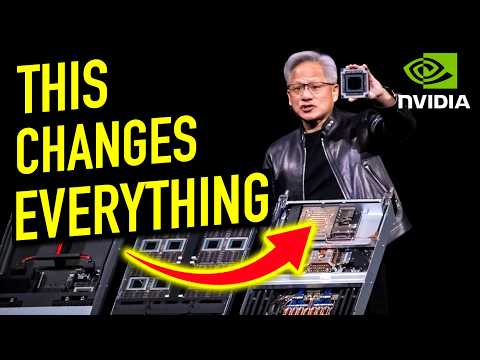
0:00 The new Vera Rubin platform, seven chips, >> [music] >> five rack scale computers, one revolutionary AI supercomputer for agentic AI. 40 million times more compute in just 10 years. >> [music] >> Now, in the in the good old days, when I would say hopper, I would hold up a chip.
0:34 That's just adorable. This is Vera Rubin. When we think Vera >> [applause] >> Okay, so this is the Vera Rubin system. Notice since the last time, 100% liquid cooled. All of the cables gone. What used to take what used to take two days to install, now takes two hours. Incredible. And so the manufacturing cycle time we're going to dramatically reduce. This is also a supercomputer that is cooled by it's cooled by hot water, 45°, which takes the pressure off of the data center, takes all of that cost and all of that energy that's used to cool the data center and makes it available for the system.
1:25 This is the secret sauce. It is the only We're the only company in the world that has today built the sixth sixth generation scale-up switching system. This is not Ethernet. This is not InfiniBand. This is NVLink. This is the sixth generation NVLink. This is insanely hard to do well. It is insanely hard to do, period. And I'm just super proud of the team. NVLink, completely liquid cooled. This is the brand new Groq system, and I'll show you a little bit more about it.
1:57 This system eight Grace chips This is the LP 30, the world's never seen it. Anything that the world's ever seen is V1. This is third generation. And we're in volume production now. And I'll show you more about that in just a second. The world's first CPO Spectrum-X switch. This is also in full production. Co-packaged optics. Optics comes directly onto this chip.
2:29 Interfaces directly to silicon. Electrons gets translated to photons and it gets [snorts] directly directly connected to this chip. We invented the process technology with TSMC. We're the only one in production with it today. It's called Co-op. It's completely revolutionary. Nvidia is in full production with Spectrum-X. >> [applause] >> This is the Vera system. Twice the performance per watt of any any CPUs in the world today. It is also in production.
3:03 Well, you know, we never we never thought we would be selling CPUs standalone. Um we are selling a lot of CPUs standalone. This is already for sure going to be a multi-billion dollar business for us. So, I'm very very pleased with our CPU architects. We designed a revolutionary CPU. And this is the CX9 powered with Vera CPU, the BlueField 4 STX, our new storage platform. Okay, so these are the four These are the the the racks. And it's connected Each one of these racks the NVLink rack This is I've shown you guys this before. It's a super heavy. It seems to get heavier every year.
3:50 Because I think there's just more cables in there every year. And so So this is the NVLink rack. We've also taken this technology because it it is so efficient to create a data center with these cabling systems, structured cables. So we decided to do that for Ethernet. So this is Ethernet 256 liquid-cooled nodes in one rack and it is also connected with these incredible connectors.
4:25 You guys want to see um Rubin Ultra? >> [applause] [applause] [clears throat] >> So this is the Rubin Ultra compute node. Unlike Rubin that slides in horizontally, Rubin Ultra goes into a whole new rack. It's called Kyber that enables us to connect 144 GPUs in one NVLink domain. And so the Kyber rack, this I I could lift it, I'm sure, but I won't.
5:12 It's quite heavy. This This is one compute node and it slides into the Kyber rack vertically. This is where it connects into. This is the midplane. The Kyber racks could those four top NVLink connectors slide in and connect into this, and this becomes one of the nodes. And each one of these racks is a different compute node. And this is the amazing part. This is the midplane.
5:43 And the back of the midplane, instead of the cabling system, which has its limits in terms of how far we could drive cables, copper cables, we now have this system to connect 144 GPUs. This is the new NVLink. This sits also vertically and it connects into the midplanes on the back. Compute in the front, NVLink switches in the back, one giant computer.
6:15 Okay? So, that is Rubin Ultra. >> [applause and cheering] >> As I mentioned, as I mentioned last year, I told you something very, very important. And it's so important, it's worthwhile to tell you again. This is probably the single most important chart for the future of AI factories. On the vertical axis, thank you, guys. On the vertical axis is throughput. On the horizontal axis is token rate. Today, I'm going to show you this.
6:53 Because we're able Because we're now able to increase the token speed, and because model sizes are increasing, because the token length, the context length, depending on the different grades of uh different application use case, continues to grow from maybe 100,000 tokens input length to maybe millions, the token input length is growing, and also the output token length is growing. And so, all of these play into ultimately the marketing and the pricing of future tokens. You would like to be able to keep pushing this boundary because the larger the model, smarter, the more input token context length, more relevant, the higher the speed, the long the more you can think and iterate smarter AI models. So, this is about smarter AI models. So, we believe that this is the future. This is where AI wants to go. This is where it is today.
7:58 It had to start here to establish the value and establish its usefulness and get better and better and better. In the future, you're going to see most services encompass encompass all of that. This is Hopper. Hopper started and I moved the moved the chart. This is 50. This is 100. Hopper looks like this. And you would have expected Hopper, the next generation, to be higher, but nobody would have expected it to be that much higher. This is Grace Blackwell. What Grace Blackwell did is at your free tier, increase your throughput tremendously.
8:32 However, where you mostly monetize your service, it increased your throughput by 35 times. This is no different than any product that every company makes. The higher the tier, the higher the quality, the higher the performance, the lower the volume, the lower the capacity. And so, it is no different than any other business in the world. And so, now we're able to increase this tier by 35x. And we introduced a whole new tier.
9:05 This This is the benefit of Grace Blackwell. A huge jump over Hopper. Well, this is what we're doing with Okay, so this is Grace Blackwell. Okay, let me just reset reset this. And this is Vera Rubin. Okay? >> [applause] >> Now, just think just think what just happened. At every single tier at every single tier, at every single tier, we increase the throughput.
9:41 And at the tier that where your highest ASP and your most valuable segment, we increased it by 10x. That is the hard work. This is incredibly hard to do out here. This is the benefit of Epyc 72. This is the benefit of extremely low latency. This is the benefit of extreme co-design that we could shift the entire area up. Now, what does it mean from a customer perspective in the end? Suppose I were to take all of that and I just, you know, multiply it against, suppose I took 25% of my power, used it in a free tier, 25% of my power in the medium tier, 25% of my power in the high tier, and 25% of my power in the premium tier.
10:21 My data center only has a gigawatt. And so I get to decide how I want to distribute. The free tier allows me to track more customers. This allows me to serve my most valuable customers. And the combination, the product of all that, allows you basically your revenues. The revenues you can generate, assuming this simplistic example, allows Vera Rubin to generate five times Yeah. >> [applause] >> But we want even more. We want even more. And so let me just show you go back to this.
10:55 This is as you as I as I told you, this throughput requires a ton of flops. This latency, this interactivity requires enormous amount of bandwidth. Computers don't like extreme amount of flops, extreme amount of bandwidth because there's only so much surface area for chips that any systems has. And so optimizing for high throughput and optimizing for low latency are in fact enemies of each other. And so this is what happened when we combined with Groq. Okay? And so we we acquired the team that worked on the Groq chips and licensed the technology and we've been working together now to integrate the system.
11:37 This is what that looks like. So, at the most valuable tier, at the most valuable tier, we're now going to increase performance by 35x. Now, this very simple chart revealed to you exactly the reason why NVIDIA is so strong in the vast majority of the workloads so far. And the reason for that is because up in this area throughput matters so much, NVLink 72 is so game-changing. It is exactly the right architecture and it's even hard to beat even as you add Groq to it.
12:14 However, if you extended this chart way out here and you said you wanted to have services that delivers not 400 tokens per second, but 1,000 tokens per second, all of a sudden NVLink 72 runs out of steam and it simply can't get there. We just don't have enough bandwidth. And so, this is where Groq comes in and this is what happens when we push that out. So, it goes out beyond Thank you. >> [clears throat] >> Goes out beyond even the limits of what NVLink 72 can do. And if you were to do that, translate that into revenues, relative to Blackwell, Vera Rubin is 5x. If most of your workload is high throughput, I would stick with just 100% Vera Rubin. If a lot of your workload wants to be coding and very high-valued engineering token generation, I would add Groq to it. I would add Groq to maybe 25% of my total data center. The rest of my data center is all 100% Vera Rubin.
13:22 And so, that gives you a sense of how you would add Groq to Vera Rubin and extend its performance and extend its value even more. This is what happens. Vera This is a contrast. The reason why The reason why Grok was so attractive to me is because their computing system it is designed just for inference, this one workload. Now, this one workload, as it turns out, is the workload of AI factories. And as the world continues to increase the amount of high-speed tokens it wants to generate with super smart tokens it wants to generate, the value of this integration is going to get even higher.
14:03 And so, these are two extreme processors as you could see. One chip, 500 megabytes. One Vera Rubin chip, one Rubin chip, 288 gigabytes. It would take a lot of Grok chips to be able to hold the parameter size of Rubin as well as all of the context that has to go the KV cache that has to go along with it. So, that limited Grok's ability to really reach the mainstream, to really take off until we had a great idea.
14:35 What if we disaggregated inference altogether with a piece of software called Dynamo? What if we re-architected the way that inference is done in the pipeline so that we could put the work that makes perfect sense on Vera Rubin and then offload the decode generation, the low latency, the bandwidth limited, challenged part of the workload for Grok. And so, we united, unified two processors of extreme differences.
15:06 One for high throughput, one for low latency. It still doesn't change the fact that we need a lot of memory. And so, Grok, we're just going to add a whole bunch of Grok chips which expands the amount of memory it has. And so, if you could just imagine out of a trillion parameter model, we have to store all of that in Groq chips. However, it sits next to Nvidia Vera Rubin, where we could we could hold the massive amounts of KV cache that's necessary in processing all of these agentic AI systems. It's based upon this idea of disaggregated inference.
15:45 We do the prefill. That's the easy part, but we also tightly integrate the decode. So, the attention part of decode is done on Nvidia's Vera Rubin, which needs a lot of math, and the feedforward network part of it, the decode part, is done uh the token generation part is done on on the Groq chip. The two of them working tightly coupled together over today Ethernet with a special mode to reduce its latency by about half. And so, that capability allows us to integrate these two systems. We run Dynamo, this incredible operating system for AI factories, on top of it. And [snorts] you get 35 times increase.
16:28 35 times increase, not to mention additional new tiers of inference performance for token generation the world's ever seen. Okay? So, this is the Vera Rubin system. Now, what's amazing is this. In just 2 years time in a 1 GW factory in just 2 years time in 1 GW factory using using the mathematics that I showed you earlier whereas Moore's law would have given us a couple of steps, we would have, you know, x-factored the number of transistors, we would x-factored the number of flops, we would x-factored the number of amount of bandwidth, but with this architecture, we're going to take our token generation speed, token generation rate from 2 2 million to 700 million, 350 times increase.
17:24 >> [applause] >> This is This is the power of extreme co-design. This is what I mean when we integrate and optimize vertically, but then we open it horizontally for everybody to enjoy. This is our road map. Very quickly, Blackwell is here, the Oberon system. In the case of Rubin, we have the Oberon system. We're always backwards compatible so that if you wanted to not change anything and just keep on moving through with the new architecture, you could do so.
17:57 The old system the the standard um rack system Oberon still available. Oberon is copper scale up and with Oberon, we could also use optical scale out or excuse me, optical scale up to expand to NVLink 576. Okay? And so, there's a lot of conversation about is NVIDIA going to copper scale up or optical scale up? We're going to do both. So, we're going to have NVLink 144 with Kyber and then with Optoran uh Optoran Oberon, we're going to NVLink 72 plus optical to get to NVLink 576.
18:41 The next generation of Ruben with Ruben Ultra, we have the Ruben Ultra chip which is coming which is taping out and we have a brand new chip LP35. LP35 will for the first time incorporate NVIDIA's MVFP4 computing structure. Give you another few X X factor speed up. Okay? And so, this is Oberon NVLink 72 optical scale up and it uses Spectrum 6, the world's first co-packaged op- optical, and all of this is in production.
19:18 The next generation from here is Feynman. Feynman has a new GPU, of course. It also has a new LPU, LP40, big step up, incredible incredible new technology. Now, uniting the scale of NVIDIA and the Grok team building together LP40, it's going to be incredible. A brand new CPU called Rosa, short for Rosalind, BlueField 5, which connects the next CPU with the next SuperNIC, CX10.
19:59 We will have Kyber, which is copper scale up. We will also have Kyber CPO scale up. So, for the first time, we will scale up with both copper and co-packaged optics. Okay? And so, a lot of people have been asking, you know, Jensen, are is copper going to still be important? The answer is yes. Jensen, are you going to scale up optical?
20:33 Yes. Are you going to scale out optical? Yes. And so, for everybody who is in our ecosystem, we need a lot more capacity. And that's really the key. We need a lot more capacity for cop for copper, we need a lot more capacity for optics, we need a lot more capacity for CPO, and that's the reason why we've been working with all of you to lay the foundation for this level of growth. And so, Feynman will have all of that.
21:03 Let me see if I missed everything. That's it. Every single year, brand new architecture. Very quickly, Nvidia went from a chip company, and now we're building entire AI factories. There's so much power that is squandered in these AI factories. We want to make sure that these AI factories come together, designed in the best possible way. Most of these components never meet each other. Most Most of us technology vendors, now we all know each other, but in the past, we never met each other until the data center. That can't happen. We're building super complex systems. And so we have to meet each other virtually somewhere else. And so we created Omniverse and the Omniverse DSX world, a platform where all of us can meet and design these gigafactories giga you know, gigawatt AI factories virtually in system. We have simulation systems for the racks, for mechanical, thermal, electrical, networking. Those simulation systems integrated into all of our ecosystem partners of incredible tools companies.
22:14 We also operated, connected to the grid, so that we could interact with each other, send each other information, so that we could adjust grid power and data center power accordingly, saving energy. And then inside the data center, using Max-Q, so that we could adjust the system dynamically across power and cooling and all of the different technologies we all work on together, so that we leave no power squandered, so that we run at the most optimal rate to deliver enormous amount of token throughput.
22:50 There's no question in my mind there's a factor of two in here. And a factor of two at the scale we're talking about is gigantic. We call this the Nvidia DSX platform. And just as all of our platforms, there's the hardware layer, there's the library layer, and there's the ecosystem layer. It's exactly the same way. I'll spend very little time on this as this time. However, we're going to space. We've already been out in space. Uh Thor is radiation approved and uh we're in satellites. You do imaging from the from satellites. In the future, we'll also build data centers in this in the in the in space. Uh obviously very complicated to do so. We have working with our partners on a new computer called Vera Rubin Space One, and it's going to go out to space and start data centers out out in space. Now, of course, in space, there's no conduction, there's no convection, there's just radiation. And so, we have to figure out how to um uh cool these systems uh out in space.
23:50 But, we've got lots of great engineers working on it. Let me talk to you about something new. >> [applause] >> So, so um uh Peter Steinberg is here, and um uh he he wrote a piece of software. Uh it's called OpenCLAW. And and um I don't know if he realized uh how successful it was going to be. Um but, the importance is profound.
24:22 OpenCLAW is the number one is the most popular open source project in the history of humanity, and it did so in just a few weeks. >> [applause] >> It exceeded It exceeded what Linux did in 30 years. And it's that important. It is that important. What is OpenCLAW? It connects It's an It's an agentic system. It calls and connects to large language models. So, the first thing it has, it has resources that it manages.
24:54 It man- It could access tools, it could access file systems, it could access large language models. It It's able to do scheduling. It's able to do cron jobs. It's able to um decompose a problem that a prompt that you gave it into step-by-step-by-step. It could spun off and call upon other sub-agents. It has IO. You could talk to it in any modality you want. You could wave at it and it understands you. You could talk to any modality you want.
25:25 It sends you messages. It texts you, sends you email. So, it's got IO. Well, based on that, you could you could say, in fact, it's an operating system. I've just used the same syntax that I would describe an operating system. Open Claw has open-sourced essentially the operating system of agentic computers. It is no different than how Windows made it possible for us to create personal computers. Now, Open Claw has made it possible for us to create personal agents.
26:03 The implication is incredible. The implication is incredible. First of all, the adoption says something, you know, all in itself. However, the most important thing is this, every single company now realize every single company, every single software company, every single technology company for the CEOs, the question is, what's your Open Claw strategy? Just as we needed all have a Linux strategy, we all needed to have a HTTP HTML strategy, which started the internet. We all needed to have a Kubernetes strategy, which made it possible for mobile cloud to happen.
26:37 Every company in the world today needs to have an Open Claw strategy, an agentic system strategy. This is the new computer. There's just one catch. Agentic systems in the corporate network can have access to sensitive information. It can execute code and it can communicate externally. Just say that out loud, okay? Think about it. Access sensitive information, execute code, communicate externally.
27:09 You could, of course, access employee information, access supply chain access finance information sensitive information and send it out, communicate externally. Obviously, this can't possibly be allowed. And so, what we did was we worked with Peter, we took some of the world's best security and computing experts and we worked with Peter to make Open Claw Open Claw enterprise secure and enterprise private capable.
27:40 And we call that This is our NVIDIA Open Claw reference for Open Nemo Claw, which is a reference for Open Claw, and it has all these agentic AI toolkits, and the first part of it is technology we call Open Shell that has now been integrated into Open Claw. Now, it's enterprise ready. We also added several things to the agentic system. And one of the most important things you want to do with your own Claw custom claws is so that you can have your custom models. And this is NVIDIA's open model initiative. We are now at the frontier of every single domain of AI models.
28:28 Whether it's Nemotron, Cosmos world foundation model, Groot, artificial general robotics humanoid robotics models, Alpaca Myo for autonomous vehicle, BioNemo for digital biology, or 2 for AI physics, we are at the frontier on every single one. Our models are mo- Thank you. Our models are valuable to all of you because number one, it's on the top of the leaderboard.
28:58 It's world-class. But most importantly, it's because we are not going to give up working on it. We're going to keep on working on it every single day. NeMo tron 3 is going to be followed by NeMo tron 4. Cosmos 1 was followed by Cosmos 2. Groot Groot at generation 2. Each and one of these want to continue to advance these models. Vertical integration, horizontal openness so that we can enable everybody to join the AI revolution. Number one on leaderboard across research and voice and world models and artificial general botics and self-driving cars and reasoning and of course one of the most important one, this is NeMo tron 3 in Open Claw.
29:46 This is NeMo tron 3 in Open Claw and look at the top three. They are the three best models in the world. Okay? So, we are at the frontier. >> [applause]
Summary
- Vera Rubin platform boasts 40 million times more compute power in a decade.
- Features 100% liquid cooling and reduced installation time from two days to two hours.
- Incorporates sixth-generation NVLink technology, enhancing data transfer efficiency.
- The Groq system integrates with Vera Rubin to improve performance, especially for inference tasks.
- New software, OpenCLAW, enables the creation of agentic systems that can manage resources and execute tasks autonomously.
- Emphasizes the need for enterprise security in agentic systems to protect sensitive information.
- NVIDIA's open model initiative aims to continuously improve AI models across various domains.
- The presentation underscores the importance of vertical integration and horizontal openness in advancing AI technology.