Section Insights
Max Levchin's Engineering Identity
How does Max Levchin view his identity as an engineering CEO?
Max Levchin expresses that coding is integral to his identity as an engineering-first CEO. He feels a strong connection to his technical skills, which he believes enhances his credibility and leadership in driving his company forward.
- Coding is a core part of Levchin's identity.
- His technical expertise boosts team confidence in his leadership.
- Levchin's excitement for engineering drives company productivity.
Understanding the Firm's Model
What are the common misconceptions about the firm's lending model?
Levchin clarifies that unlike traditional lenders, his company does not charge late fees or compound interest. Instead, they focus on responsible lending by ensuring they only lend to those who can repay, using extensive data for underwriting.
- The firm avoids compounding interest and late fees.
- Responsible lending is based on data-driven underwriting.
- Misunderstandings often arise from comparisons to traditional lending models.
Affordability and Consumer Responsibility
How does the firm ensure responsible lending while serving both merchants and consumers?
Levchin explains that the firm uses an affordability calculator to help consumers understand their payment schedules. They assess each transaction individually, ensuring that loans are only approved when there's a high certainty of repayment.
- Affordability calculators enhance consumer understanding.
- Each loan is assessed individually to ensure responsible lending.
- Data sharing with retailers is crucial for effective underwriting.
Balancing Engineering and Leadership
How has Levchin adapted his role from engineer to CEO?
Levchin emphasizes that his primary role as CEO is to set the vision and culture of the company while still engaging in engineering tasks. He finds that AI has significantly increased productivity, allowing him to contribute more directly to product development.
- The CEO's role includes setting vision and culture.
- Levchin still engages in engineering, leveraging AI for productivity.
- Maintaining a hands-on approach helps in guiding the engineering team.
The Future of Work and Productivity
What is Levchin's perspective on the impact of AI on workforce productivity?
Levchin believes that AI acts as a force multiplier for productivity, allowing his company to operate more efficiently. He notes that they are currently 3 to 4 times more productive and aims for even greater efficiency in the future.
- AI significantly enhances productivity in the workplace.
- Levchin's company is already seeing a 3 to 4x productivity increase.
- Future goals include striving for even higher productivity metrics.
Transcript
0:00 If I couldn't write code anymore, I would feel like I'm missing a finger. Like it it's that core to sort of how I think of who I am as an engineering first CEO. I know exactly what it'll take. I know what I would do. I know what prompts I would write. I know which agent I would use. I know which set of techniques would apply here. It's exciting for me, but it's also, I think, more compelling as you tell people, hey, like we're going to go take this hill and it'll be fun. It'll be faster than you've ever seen. and will be 10x more productive and they get to believe me because they know I actually know how to do this. I I'm not just reading it in a newspaper.
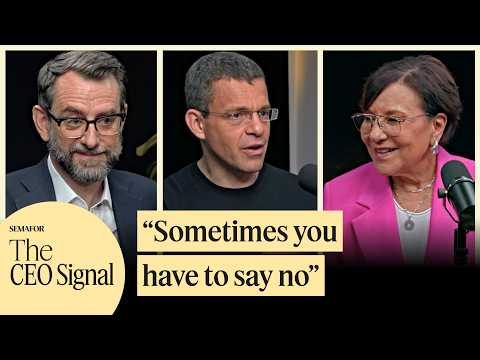
0:35 >> Today on the CEO Signal, we're talking to Max Levchin, the founder and CEO of a firm, a company built to challenge the way traditional consumer credit works. >> The firm began with a simple idea, but a pretty radical one. Lenders should not make more money when borrowers fall behind. That idea took a firm from a checkout option to a public company. >> The challenge is how he turns this disruptive model into a lasting business at scale. From SEO, this is the CEO signal.
1:17 >> Hello, Edge. How are you? >> Great Penny. Good to be back. >> Good to be here. So we have a different kind of guest this time. Max Levchin, founder of a firm is the first founder CEO we've had on the CEO signal show and 14 years after founding the company, he's still firmly in charge. >> He has a fascinating founder story. He comes to the United States as a teenager from Ukraine. He's part of the PayPal mafia, founding PayPal with the likes of Elon Musk and David Saxs and Peter Teal.
1:49 He then goes on to have a frustration in trying to borrow money to buy a car and that leads him to starting a company called a firm. >> Yeah. And the business really interests me. He started with this simple idea. No late fees, no compounding, none of the penalties that customers hate about credit card companies. but what I'd really love to dig into is what he saw that others missed about how you could still make money in that world. In fact, if you take away some of the ways that lenders have traditionally made money, I have a real question. How does his business model work? And now he's leading a firm at a very different phase. He's going from proving the model as the plucky startup into running a much more scaled financial network.
2:36 >> We've got a really interesting episode ahead of us. >> Let's bring them in. >> The CEO Signal is sponsored by PWC. Are you ready to bust some silos? Zero full stack mesh. >> Left hand meet right hand. >> At PWC, we don't just talk tech. We make yours work harder together. >> Great plan. Let's do it. >> So you can become a more intelligent enterprise. >> Welcome, Max. We're so glad to have you here.
3:07 >> Great to have you, Max. Thanks for joining us. >> Thank you for having me. >> So Max, you came to the United States from Ukraine when you were how old? 16. >> 16. And you moved to Chicago, my hometown. And so how has being an immigrant, how's that inform what you who and what you are today? >> It's definitely a core part of my identity. Although I also consider Chicago my hometown.
3:39 It's more than anything American by choice. I want to be part of this country with all my own, you know, bag of tricks and and and and and perhaps quirks, but it is important to me was to assimilate as much as I could. >> I love that. >> So you have this early foundational entrepreneurial experience with a group of other very very prominent now entrepreneurs, some of them immigrants themselves at PayPal. you do quite well out of that and then you go to make quite a big purchase and you have this experience where you are refused credit.
4:16 Can you just tell that story quickly because this is the the foundation story of a firm, isn't it? Yeah. I'm I'm not good enough to come up with foundational myths. So, this is a true one. the very short version is I was bumming rides off my friends for quite some time during PayPal and right after we went public, I decided it's time to to own a car. And so I flew to LA with my then girlfriend, now wife, and sort of with great panache decided I'm going to buy a convertible and then drive it from LA back to San Francisco. And it was I had this great plan. And we showed up to 9:00 a.m. to the dealer having landed in LA and the guy checks my credit and says I I cannot sell you a car. Like what happened? So it as it happens this was not my first startup was the first successful one. The first few failed while I was still in college and I lived primarily off credit cards which I was not particularly diligent in paying off on time. that destroyed and by that I mean like mid 500s so like bad credit score and then he'd recognize him and said wait a second aren't you like the one of the PayPal guys like you guys took the company public congratulations like oh cool and they're like but your credit is still no good here like pay cash or go home the worst part of it was the woman of my dreams was right next to me going like wow I've been dating a deadbeat like I never want to go through this again >> so how did that experience of being turned down to buy a car to get a car loan inform what you built at a firm.
5:48 >> This is long before a firm. This was like a full 15-ish years before plus or minus before a firm was born. But as I was debating with actually some of my University of Illinois compatriots also at PayPal sort of what to do next after another startup. So you know like there was this one thing that stuck with me like the most embarrassing moment of my life when I was trying to buy a cool car and was told that I am basically unwelcome as a customer. I I wonder if that's just me and within 15 seconds like oh we all had this experience like borrowing sucks. It's embarrassing. We don't understand the terms. All of us have gotten to like, how did I get this >> giant revolving balance? This idea that I have no idea how this works. I know I'm paying too much. I'm probably getting screwed and it's too complicated. And that that's the origin story in that.
6:40 >> Okay. So, you describe a firm as its mission is building an honest financial services company with honest products that improves lives. So help us understand what does that mean and what is a firm? >> A firm at the product level is a way to pay for things at the point of sale. It's now in many different products. So we have a card, we have integrations with many retailers, but it's a way to pay for things over time. But unlike credit cards, it's deliberately transparent. It goes over the top to be transparent. You see a schedule. We don't charge late fees. We don't compound interest. We pre-pric the total cost. If there's interest, you find out how many dollars you'll pay. If you pay early, we take out the interest. So there's an incentive for you to get out of debt sooner. So how much of your role as a founder CEO is just explaining the model that didn't exist 15 years ago?
7:36 You know, for a long time that felt like the the only role because the before we started the company, I sat down with a bank CEO and I tried to explain here's what I'm going to do and guy I got to tell you like you seem like a smart guy. Don't do any of this. This is the way we make money in this industry is late fees. You're not going to charge late fees. It's half my profits. Like just go do something else. Like you're obviously talented. And explaining that to layman was a thousand times harder because if you are used to getting charged late fees your answer like yeah I'm not a crook no late fees like you're not actually telling the truth are you and so just explaining this explaining this to the team you would be interviewing someone and like hey so we're not charging like yeah we got it we got it that that's like the thing you do as an intro like it's not an introductory offer it is the thing we do we have never charged late fees we never will like but then behind in the curtain like there is no curtain. What you see is exactly what you and it it got easier but it took a long time.
8:35 >> Do they ask you you know so how are we going to make money and margin? >> Oh yeah every every time >> and >> we will make money by people coming back and saying this was a great thing I want to do it again. 96% of our transactions today come from repeat users. Extraordinary draw. People love transparency in their financial products. >> What what's the biggest misunderstanding now about the model? because I know a lot of people park you with buy now pay later lenders. You don't like that term.
9:03 >> Yeah, I've made my piece with BNPL. I I I now prefer to refer to it as an acronym because maybe over time it'll just become like a thing onto itself without the the full unpacking of of of the of the four letters. But the thing that used to bug me when you told people I lend money for a living like compounding like we don't compound. How is that possible? Like we don't compound. We tell you it's this many dollars and that's it. That's the most you'll pay.
9:31 Like oh you make your money on late fees. >> But the point but part of the point you're making is that the retailer if they want to make the sale can say I can compensate you for what you're doing which is you're facilitating a buyer. >> That's exactly. >> So then my next question is what responsibility do you have to that buyer? Cuz somebody's buying something they can't afford to buy. Unlike your car situation where you could afford to pay cash, someone's buying something that otherwise they would not be able to buy. How what how do you manage that part of the system?
10:03 >> That's actually so that is not accidental but absolutely crucial component of not charging late fees and not compounding interest. Our entire emmo was if we don't charge late fees, we don't compound interest, the only time we can lend structurally is when we have 100% conviction that you will pay us back. If you cannot pay us back and we can see it in the data we understand about you and we have to be good at using this data. So underwriting etc has to be extraordinary. But if you have that level of expertise, you don't need late fees. In fact, you are buying insurance, intellectual insurance on never making a loan you think is not going to come back. But it's okay because there's late fee income to to to house.
10:44 >> This is the thing I said to Edge when we were first trying to unpack your company and said they've got to be really believe in their underwriting because they're basically saying, you know, we're not going to penalize the borrower. >> That's right. >> If we get it wrong, >> you get it exactly right. We pay for the wrong the wrongs we make, the mistakes we make. We pay for every one of those. I don't think I've heard you mention a single percentage in this conversation so far. You know, we talked about margins.
11:19 >> I'm holding myself back. >> But what I hear you talking about instead is fundamentals. You know, I think a firm is your ninth or 10th startup. Is that a broad approach you have generally to start with first principles rather than with, hey, I could make 2% more than the next guy? >> no. In fact, there's actually a cool story in that. So, PayPal was incredible. It was the most transformative thing, not just financially, but I I grew up I I came into PayPal being very much a crazy freshly minted undergraduate computer science kid with ambitions and no idea what I was doing. And I exited a seasoned chief technology officer with a public company. And I never understood why I was so successful. I I like, well, we we just did it right. Then I started another company and I just said, "Well, I'm going to dive right in, do it another going to be like PayPal because I learned my lesson." That company did fine, but it was a a shadow of what PayPal was. And it never really quite had that same intensity and excitement and the team dynamic. And I tried like I I was genuinely trying very hard. In fact, I tried to do better than PayPal.
12:24 I tried to shape the culture to fix the wrongs of PayPal. And I knew some things that I didn't quite like and I would do better. I was a CEO, so I had full control. And at the end it was sort of like okay well people made a bunch of money but it did not feel that way at all. So right before I started a firm I sat down and said I'm going to compare the two and I'm going to be very very deliberate about what it is that made PayPal so special and why did the next one was such a dud from the culture perspective because that's clearly what happened >> and what did you identify?
12:52 >> I had a whole list and the most important thing I learned and and again this is the thing that I took for granted. So at PayPal, we recruited the smartest, but also the highest integrity people we knew in college. And then like we wouldn't want to work with jerks. We literally had the best people we knew from the crucible we just spent four years in pulling all nighters and eating pizza on the floor and and all the things you do in college. And we never had to write down core values. We never had to say things like the mission is X because the shared context of how we do things we do was just ingrained. So this a firm founding sort of like before I write a single line of code before percentages enter the conversation I have to have a mission I have to have core values I have to write down not just the core values but the Bible interpreting core values so when someone comes in and says I want to work here I think say read this if you can sign your name under it you're at the right place if you can't please go like I would love for you not to join this company if it doesn't ring true so and I try to make all of it public so if you search a firm core for operating principles online, you'll find a document from I think 2012 where I say here's how you interpret what we mean. And it was very very deliberately I want to reproduce this smartest people I know, zero jerks, high integrity, no deviation from mission. Mission is more important than dollars. On and on and on and on. Where did you get the most push back early on?
14:24 Where where did it look as though this might not get traction? We got rejected by a fair number of people, which was actually quite embarrassing. Like, I'm starting a payments company. I'm the PayPal guy. They're like, "Yeah, you're Max Lin. You've made a name already." Yeah. >> But what did you see that others missed? >> So, my co-founder, Nathan, and I go back to high school days. So, he was one of the two smartest kids I knew in college.
14:44 Full stop. He was my head of risk at PayPal. He built all the really sophisticated anti-fraud stuff. He managed a team and he he and I built it together a lot, but he he's incredibly good at this. And I read this study as we were discussing this idea that said it was called Millennial Disruption Index and it basically said the study could have been boiled down to what do millennials hate and like what do they hate the most? And it turned out that they hated banks the most. So that was sort of like the product and marketing insight and then when so like I'm going to do this. I'd love for you to help me. Do you think you can build a model that does not need the safety margin of late fees and compounding interest and all the stuff that the guys who are hated rely on? He said, I'm sure I can. I have no idea if he thought he could. It would be a fun adventure to do another company with Max. But he was like, I'm in. Let's go build this model. And that was that.
15:38 But but in those early years, was there ever a moment where you thought, oh yeah, this is not going to get too big? Oh, we have we have we had so many. there many stories and I I would love to save them for the Till memoir one day, but if you're a non-depository lender, you're lending against capital that someone provided and we were not exactly having a great time raising money. So, the bank of the Lechin family was in fact the capital provider for first loan book. I am perfectly comfortable putting I don't know a few medium-sized inheritances into the bank of a firm to to to lend against. The day before launch I was like what do you think the loss rate is going to be on our first iteration of the model? Nathan was like I don't know 25%. like we're going to run out of money and I was terrified and of course I couldn't show it. Like this is not not a thing you do on the eve of your launch to your team that you recruited and told we're going to break this industry's bad habits and teach them how it's done.
16:42 Like if you're losing a quarter of the principle does doesn't doesn't come >> math doesn't work. >> The math does not work. And so like well we're going to find out. And of course, this is a, by the way, classic example of the fear you have is not the fear that you should. As as an entrepreneur, that is a and I was dumb enough to forget that, but I I literally wrote that down for myself years ago. Like the thing you're scared of is the wrong thing. There's another thing, and that's the true scary thing. This isn't one.
17:09 Like, whatever. >> This is the true scary thing. >> No one cared. So, we had I said, I'm gonna I'm okay losing $100,000 of my personal money in the first week. We'll make a $400,000 worth of loans and if a quarter disappears, I will live. I'll explain it to my wife. We'll be fine. And we made I don't know $500 worth of loans in the first six months. >> Nobody showed up. No one cared. No one cared.
17:33 >> So what did you do? >> We actually So we experimented with the product. We experimented with how we explained it. We launched a product that said pay us back in 30 days. We introduced the idea of a firm as here's an affordability calculator. It's a $500 thing. You can pay for it in four $125 hits. And that was the that thing people were clicking on a little bit. It wasn't it wasn't yet a thing, but it was like, wait a second, people care about affordability. They like this idea of a schedule. They they love the predictability of when it's done. And that was the the tail we grabbed. So explaining what a firm is and how we make money was a huge deal in those days.
18:21 >> So Max, it's a little bit of a tight rope it feels like you're on. In other words, you're serving merchants, you're serving customers, you've got to make loans that are responsible as well as you know profitable. So you're judging individuals. you know what happens when the economy changes. >> So a big part of the design behind the product from the very beginning. So this we knew from day zero. The advantage that we would find in modeling would be three-fold. We would ask retailers to share a lot more data with us than normally goes to Visa, Mastercard etc.
19:02 So we would ask a lot more from the consumer about themselves and we would also ask the retailer a lot more about what it is they're selling. So that was kind of idea number one. Data is profoundly important. The other part is structural. We approve or decline every single transaction separately. We do not tell you here's $5,000. Don't spend it all in one place. It's the you would like to borrow $500 for this coffee maker. We will tell you what the price would be and we reserve the right to say no. We're pretty good and in the age of AI we're actually getting even better at telling you why. So most of the time when your card doesn't work it's like I don't know what happened but that's embarrassing. So I really wanted to avoid that. But sometimes you do have to say no. We have to be able to say this is more than you can afford and we we love you. We want you to come back. We would like you to get your purchasing power back when you're done paying off an obligation to us or to whoever else you owe money.
20:00 >> And it sounds like trust. >> Yes. >> Because you're having a dialogue with the borrower or the customer and you're saying, >> you know, and somewhat you're paternalistic maybe in looking out for them or >> we spent a long time asking who are we? Like if if we were a a relative or a friend or a bird or a pet, what are we? And we basically decided that we are the smarter older sister. Like, hey, >> let me tell you what you're doing wrong.
20:29 Like the like, your parents didn't teach you this part, >> but you got to use deodorant or or whatever. Like the the advice that's not comfortable, but you have someone who is in your family telling you like, listen, this is what's going on. And so that that that's the persona we embody sort of the I mean I think sometimes we call it the coach persona but I always think of like >> so when you think about your culture and then your notion of trust >> how does that fold into >> that is profound like we ask ourselves every time when we launch a new product when we send a communication to our consumers is this trust enhancing or trust destroying and if the answer is not trust enhancing the bar isn't oh this will not change things like if we are doing more things to help you trust us more. That is a worthwhile thing to do. If we're doing things that are neutral, it's probably not worth doing and we will never do something to break your trust. That that's very important to us. As a firm scales, you pulling back from the individual decisions on what you say no to and individual loans you say no to.
21:28 you have many options, you know, for where you choose to compete. how are you using those values and that culture to decide what you will do and you what you're not going to chase? One sort of litmus test for me has always been if there's a margin being made in an industry, does the person paying the margin, supplying the extra money, if you will, understand that they are in fact the source of money? The answer is not really. That is a fantastic place for us to go shine a light on because no one's going to be upset if we say, "Wait a second." Like, "Do you know that you're overpaying by, did you know that you're paying for this?" Like, you may think you're getting a deal. You're not. So, that that's always been a sort of like a honeypot for me where like oo people are getting taken advantage of. Great.
22:19 That's a opportunity for our fa. we won't touch things where we feel the market is efficient because we we are first and foremost mathematically driven company. So showing up with some sort of a we'll sell it cheaper or we'll undercut on price is not part of the culture and I you know I'm I just don't see how that's worth chasing. >> we've never touched secured lending. So lending is fundamentally one of two things. I trust you, you'll pay me back, or I trust you, but if you don't pay me back, I'll take the thing away. I've never figured out a way to have a humane, for lack of a better term, approach to the latter. I don't know if we could be in a business where we say, "We need to take your car now because you haven't made your last payment." And that that's actually more than anything on me. Like I would love to go and find a way to be insecure lending as well just because it's a huge market and there's all sorts of things going on there that I think are quite ripe for disruption but I don't know exactly how to do it without the repossession part.
23:29 >> At what point does a firm stop being a startup and but start being a much more scaled financial play? >> I hope never. Why do you say that? We have to remain hungry. We have to remain reasonably scared. This sense of like we can still reinvent ourselves. We can still reinvent the future. We can still do crazy things and be exciting and be a little bit terrified of the next launch. Like that's what makes startups so cool. It's also what makes them so prone to failure. So it's nice to be scaled. It's nice to be profitable. But the excitement of launching new things, it's hard to replicate that in a stable scaled financial company. I think that's why we've been able to infiltrate the industry and do as well as we have because we've always taken this underdog approach.
24:14 >> >> The CEO signal is sponsored by PWC. AI performance requires ambition and experimentation, but it also relies on a strong foundation. In conversations with industry leaders, the gap between isolated wins and sustained performance usually comes down to what's built underneath. Is the data reliable? Are teams equipped to use it well? Are there clear guard rails around how it's deployed? Without that discipline, results may be uneven and progress can stall. But when the foundation is solid, performance becomes consistent. At enterprise level, AI isn't built on experimentation alone. It's built on structure.
25:09 You mentioned a couple times engineer founded or engineer-led companies. You know, at what point, you know, talk about being an engineer leading a business, but also at what point did you realize you weren't the engineer anymore? Now you're the CEO. >> You're I'm I'm having an identity crisis right now. I am an engineer. every time somebody asked me what do you do, I introduce myself. I'm an engineer. I I am an engineer. That that is how I I'm an immigrant engineer. That's who I am.
25:41 >> I love that. >> It that that is that really is honestly who I am. if I couldn't write code anymore, I would feel like I'm missing a finger. Like it it's that core to sort of how I think of who I am. >> What do you think it gives you to be an engineer? >> You understand exactly what's happening underneath. AI to most people looks like magic. And it is quite magical. like the experience you have the first time you talk to chat GPT or you sort of try to I mean it's not thinking it's it's just predicting the next token but it sure looks like it's thinking and it's got a personality now and it will write code for you if you ask it correctly and so the magic is is amazing if you know what's going on both from the point of view of how does it actually work but also what is it actually doing like when you tell it go build me an app for a layman it's like well it's an app like I I can run it I could scrap to an engineer like I can start modding it. I can start telling you like go change the way it works. I want a different feature. I want a different approach. I think it would be faster if we did this.
26:41 How have you changed in this process of you know being an engineer but also you have to run a business. You have to recruit those thousand engineers. You have to have a vision of what are the products. You have to stand up for the things you won't do. The most important job is still sort of in reverse order of what you said. The the number one job of a CEO is to set the vision to keep true to the culture to have the core values in mind to recruit the team of like-minded people who will actually follow the division and and the values. So that is still a lot of what I do. In the past, I would have 10% time available to me and you know mostly would go to email. I probably still have 10% time given those things have not yet been replaced or aided by AI that much. But that 10% time can now be spent building software again and you could actually it's not a thing that you build episodically over the course of a year to have one feature.
27:40 It's a thing you build over a weekend and it's a new product >> and you could do it alone or with two other engineers and you feel like you're flying. And so just the productivity gain you get from AI is extraordinary. It's, I think, harder to tell an engineering team, we could do this go. If you don't actually know that you could do it yourself as an engineering first CEO, I know exactly what it'll take. I know what I would do. I know what prompts I would write. I know which agent I would use. I know which set of techniques would apply here. It's exciting for me, but it's also, I think, more compelling as you tell people, hey, like, we're going to go take this hill and it'll be fun. It'll be faster than you've ever seen. It will be 10x more productive. And they get to believe me because they know I actually know how to do this. I I'm not just sort of reading it in a newspaper. So, you've described yourself as being pretty hands-on. You you want to be involved in a lot in this company, but in the early days, you were literally in the room for everything. I imagine you knew everybody by name. Now, it's a much bigger company. You can't be there for every decision. What have you found is most important for giving people the framework to take the decisions you would want them to take if you were in the room when you're not there?
28:54 >> That one is pretty easy, I think, so long as you are entirely non-compromising in the people you surround yourself with and you in in that set you include that same idea recursively. you'll have a team where a decision made at any level will generally speaking map to what I would have decided like we do not do these kind of products full stop or we would love to do this because it'll make the world a better place let's go we don't care about the incremental we're going to lose on this thing and so that's it it's just team all the way down but you are quite explicit at setting out the culture as you said you've had a couple of different attempts to sort of describe what you want people to be doing what how you want them to think about a firm you've sat down periodically and written quite long memos which you've made public how important is that just to be explicit with people as a founder I think it's your responsibility to try to set up some very clear guidelines and a good way to do it is you don't write we do this in extreme precision of what this means but rather this as a concept this as a category this as a genre they have to back it up and I'm very proud of the fact that we always acted with integrity relative to the core values and those moments in that moment feel tough but sort of like you know you have to make make a decision you know what the answer is and and you move on >> I actually think if you're really clear with your organization this is my experience about what you stand for then making the hard decisions isn't that hard even though the you know sometimes the consequence could be you lose some business or you But, you know, doing the right thing and doing it the right way at the end of the day has its payoff.
30:45 >> Yeah, that's exactly right. I think that's that's applied culture. >> Yeah. And you've said culture doesn't take care of itself. You know what? We've talked a lot about the mission side of the culture. What about the kind of speed side and how what are you doing to keep that hunger? You can't be ridiculous. Somebody tells you this is going to take us six months. and you say, "Well, I actually want 6 minutes because by God I'm in charge." Like, "Okay, you're crazy." If you know how things are made and you've made them yourself and you have the credibility, you can say, "Look, I think we can actually find a way to do this. I think you can do it. I think you're much better than you give yourself credit for." So, like, come back with a plan that tries to get it two/3s faster. And maybe it'll be one third faster instead of two, but that's the right sort of push versus say, "Oh, well, I don't really know how this stuff works, so okay, six months it is." And so, and I I think I I'd like to believe I straddled the ridiculous and the reasonable reasonably well, although the mockery and suggest that I'm probably more on the ridiculous side.
31:45 We've talked before about what a keen sci-fi reader you are and how you use science fiction to help you think about possible futures. Can you give us any examples of how that's actually informed your thinking about the business you're in and a firm and what it's building towards? it's definitely funny. I I was somewhere today earlier imploring the person to go immediately drop everything and read AM forers the machine stops. I don't know if you've read it's a it's a fantastic piece of dystopia from 1914 >> which is sort of mind-numbingly old and yet so preant. It's basically one of the forks in the road for AI where in you know we all live in polyhedra underground food comes from the sky or from from the ceiling and the machine prods and pokes us and feeds us and closes us and we don't know how it works and like the terror of it doesn't work as well as it used to. What do we do?
32:45 the the the the scary but exciting future is Skynet. The machine stops version of the future is the we don't know how AI works which is the future I'm working very hard to prevent. I think that the happy future is the one where we are working with the machine to make it better and we know how it works underneath and we are improving as producers as creators because we know not just what it can do but what we want it to do next. And so I'm I'm a I'm a big reader of dystopia in part because I want to know what the wrong fork could look like. This sounds a lot bigger than lending and I'm just curious when you say, you know, you're trying to work towards the non-disystopian future.
33:25 What what kind of things are you doing or do you see yourself doing to to stop that dystopian future for AI? The problem we're solving is fundamentally the machine that is made in lending and finance and consumer finance and small business finance. All the things that we think we're going to impact one day. The problem is lack of knowledge. It's lack of participants understanding what's being done to them. They don't know how the machine works because it's too complicated. And sometimes by design, sometimes because no one's gotten to it. But shining the light and being the source of clarity of how things work allows you to say here's how they should work and like not everything is perfect. I'm confident there are many things we can do better as we build this company but the first thing you have to do is you have to understand it fully.
34:11 One idea that felt a little futuristic until recently was agentic commerce but we're already seeing a lot of people choose to let their AI agents do at least part of their shopping for them. why would my AI agent choose to pay with a firm? That is maybe the single most exciting thing about the future that's near distance. So, you will probably not fall for an asterisk right next to a zero. I will not. I'm a payments professional. I know what I'm looking for. I know the fine print is where the business model is.
34:44 Man, woman, child on the street of New York City or everywhere on America. looks at a zero, doesn't notice the asterisk, gets trapped by a bad financial product all the time. That is where that half the business model comes from. Your agent has a PhD in consumer finance and a PhD in everything else. They will not get trapped. They will notice exactly what's going on. They will in fact choose a firm. By the way, if they choose an affirm competitor that sworn off late fees, sworn off all the junk that the industry is infamous for, great. I don't mind changing the world by pushing everyone to come join us on on the light side of the of of this industry. So I'm very excited about just a simple idea that agents will not make mistakes on your behalf.
35:28 >> So so building upon the fact that agentic AI is with us and is part of life and is very exciting. There's a lot of workforce is a topic that's a passion of mine and something I care deeply about and obviously there's a lot of fear about the impact on work and headcount. How are you thinking about that at a firm? We're still hiring engineers. The bar for the engineer has always been very very high. If you look at our productivity per engineer, if you take a look at the revenue per engineer, revenue per employee, any sort of employee productivity metrics, we are extremely extremely productive. So we we have already built the lean mean revenue making machine for our shareholders. We have no one to lose. Like we we actually need a few more hands. The good news is the agents are force multipliers. We think we're probably going to be like right now we we think we're about 3 to 4x more productive than we were before.
36:21 The goal our head of engineering who's a very very conservative gentleman told me he thinks we can get to 10x which of course I'm going to come back with. Well that that sounds like a good starting point. How about 15? >> Of course. But the fact that the guy whose job is to make sure the productivity remains high is already thinking in order of magnitude is unbelievable. And so the day we start running out of ideas is the day I'll start worrying about do we really need all these people. Right now we need all these people. We we want a few more. Let's ask you to look a little beyond the middle distance. Let's say 15 years from now.
36:56 How profound a change are we in for in the world of credit? We have a lot of plans that are easy to prognosticate about because they're so far out. We haven't started planning how to plan them. But I do think it's all going to go to extreme transparency. I think the knowledge of how money works will no longer be domain of the elites who can do exponential math. I think the idea of everything from purchasing power to supply chain lending will compress because people will understand thanks to AI exactly where the inefficiencies are. If you look at a thing that was made in some country and imported here and resold and stocked and warehoused, there's enormous amount of leakage and there's a margin for everyone in the chain and someone's paying for it and no one knows exactly who to whom. the spotlights are going to be very bright because none of this will be well, you know what, I'll get to it later. You'll have an agent that'll get to it now and tell you exactly where you're wasting capital and not putting it to work. One of the things about being an immigrant that didn't come from capitalism is I have enormous and endless appreciation for capitalism. And we can improve on it by being more transparent and more honest and that that is the business we're in. But the idea of capital efficiency, capital wanting to find the most efficient way to improve the world is like one one of the many things that I hold extremely dear. thanks to being an American by choice. And I think that's what's going to happen. I think the next 15 years is going to be all about spotlights, brighter than bright, going like, "Wow, that's a huge waste." So, I'm extremely optimistic on just efficiency of money.
38:30 >> You're a serial founder. Will a firm be the last company you found? >> I hope not. I have too many ideas to to chase, but I'm also in zero danger of leaving. So, it might be, but it's a cliffhanger even for myself. Don't know on that cliffhanger. Max, thank you very much for joining us. >> Thank you, Max. This was really, really fabulous. >> Thank you. >> Stay with us. Penny and I will be back after the break with the readout.
39:03 Are you ready to bust some silos? >> It is time to get on the same page. >> Zero full stack mesh. >> Dynamic collaborative ecosystem. >> 1 + 1 equals 3. >> Left hand meet right hand. Break down silos. >> At PWC, we don't just talk tech. We make yours work harder together. >> Great plan. Let's do it. >> We'll get back on >> so you can become a more intelligent enterprise.
39:34 >> >> So Penny, when we arranged this conversation with Max, I was thinking of it as our first founder CEO. We'd get a a very specific insight into how different it is to have a company read led by somebody who created it. I don't think that was the point at all. I think the point was he's an engineer CEO. >> Totally. In fact, he self-describes as I'm an immigrant engineer and if I'm not coding, it would be like I had lost a finger. And so he his whole persona is not one of CEO, it's one of engineer.
40:08 And he really fundamentally believes that's how you have to lead his company. And frankly, he believes it's the way you should lead most companies. And >> so, so what do you think the difference is having heard what he said? What do you think the special source is of an engineer CEO? Well, I think he understands under the hood how the product works. It's not here's what I want it to be. And in fact, remember member underwriting is critical to their success. And so he's right in there understanding how the machinery works, if you will, to produce the insights from all the data that they're collecting.
40:45 I was so fascinated by him and his the combination of being a serious serious engineer and mathematician and also his moral leadership. >> I mean he was this is he's on a mission. I think it's quite unusual to have somebody in the finance business fundamentally talking in those very sweeping moral terms as openly and freely as he does and to have that as a motivating factor for the business he's running. And in fact, the other thing I found so interesting was he really believes in the age of AI, agentic AI particularly, that he's a winner because we're going to use our agents to examine our financial activities. And the agents are going to tell us where we're being inefficient or spending money we shouldn't or taking on products that we should stay away from.
41:43 And since he's in the business of transparency, which he believes transparency is absolutely essential, part of his culture and part of his product development. I think I had no idea that that's what we were going to learn today. >> Yeah, I think two things will stick with me for a very long time. One is the idea that he's setting this company up to be like your smarter older sister. saves you from making terrible decisions. But then that is the idea that our AI agents are going to be even smarter than our older sisters and will sort of clean up a lot of the bad practices that we've fallen into because we just don't understand some of the businesses we're dealing with >> fundamentally helping us.
42:31 >> So I I knew he was a huge sci-fi fan. What did he make of where he took that sci-fi conversation? Well, the fact that he's so interested in dystopia and what can go wrong makes me think a lot about where we are in the world of AI today. And I think he's very committed to having a moral agentic AI. I'm not sure every company is thinking about it that way. And I felt like he used sci-fi to help bring that to life. And I I think you know if anybody is thinking dystopian futures and morality are a bit sweeping for me. I think the point here is a lot of businesses could save themselves by thinking about what might go wrong and just asking that question so they can make some decisions about what they need to do to avoid that kind of future and actually help their customers build something more positive.
43:24 Well, also this idea that you're going to have a PhD in your pocket really for almost everything that you do, including your financial life, and that's going to advise you as to what's smart for you as a customer. I think as producers of product, as leaders of businesses, as CEOs, you can't pull the wool over people's eyes anymore. And he made that point. I think he didn't drive it home, but he made that point. And I think that's an advantage for a firm.
43:58 >> And so maybe one of the lessons here is that CEOs right now have to be planning for a future where the customer is a lot smarter than they might have been in the past. >> Absolutely. >> Thanks, Penny. >> Thank you, Edge.
Summary
- Levchin's identity as an engineer is central to his leadership style and decision-making.
- A firm was founded on the principle that lenders should not profit from borrowers' failures, promoting a transparent financial model.
- The company has shifted from startup to a scaled financial network while maintaining a hunger for innovation.
- Levchin believes that AI will enhance consumer understanding of financial products, reducing exploitation by traditional lenders.
- He emphasizes the importance of culture and core values in decision-making and maintaining trust with customers.
- Levchin views the future of credit as one of increased transparency and efficiency, driven by technology and consumer knowledge.
- He aims to create a company that acts as a "smarter older sister," guiding customers to make better financial decisions.
- Levchin is optimistic about the potential of AI to improve financial literacy and efficiency in the lending industry.
Questions Answered
How does Max Levchin view his identity as an engineering CEO?
Max Levchin expresses that coding is integral to his identity as an engineering-first CEO. He feels a strong connection to his technical skills, which he believes enhances his credibility and leadership in driving his company forward.
What are the common misconceptions about the firm's lending model?
Levchin clarifies that unlike traditional lenders, his company does not charge late fees or compound interest. Instead, they focus on responsible lending by ensuring they only lend to those who can repay, using extensive data for underwriting.
How does the firm ensure responsible lending while serving both merchants and consumers?
Levchin explains that the firm uses an affordability calculator to help consumers understand their payment schedules. They assess each transaction individually, ensuring that loans are only approved when there's a high certainty of repayment.
How has Levchin adapted his role from engineer to CEO?
Levchin emphasizes that his primary role as CEO is to set the vision and culture of the company while still engaging in engineering tasks. He finds that AI has significantly increased productivity, allowing him to contribute more directly to product development.
What is Levchin's perspective on the impact of AI on workforce productivity?
Levchin believes that AI acts as a force multiplier for productivity, allowing his company to operate more efficiently. He notes that they are currently 3 to 4 times more productive and aims for even greater efficiency in the future.