Section Insights
Introduction to AI Training Methods
What is the significance of backpropagation in AI model training?
Backpropagation has been the standard algorithm for training AI models since 1986, but recent advancements by Q Labs show that alternative methods can outperform it.
- Backpropagation is the traditional method for training AI models.
- Q Labs has developed a new method that challenges the effectiveness of backpropagation.
- Understanding alternative training methods is crucial for future AI developments.
Limitations of Backpropagation
What are the constraints of using backpropagation for training models?
Backpropagation requires every component of the model to be differentiable, which limits the types of architectures that can be used.
- Backpropagation's requirement for differentiability shapes AI architecture.
- Alternative methods like evolution strategies exist but are slower.
- Understanding these limitations can lead to innovative training approaches.
The Dust Method Explained
How does the Dust method improve upon traditional training methods?
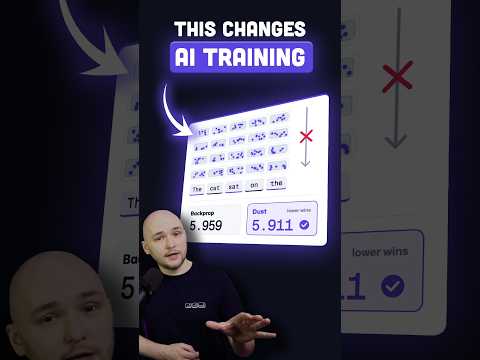
Dust introduces random noise to the activations instead of the weights, allowing for multiple experiments to occur in parallel during a single forward pass.
- Dust creates a 'virtual population' of experiments within one forward pass.
- This method allows for efficient gradient estimation without traditional backpropagation.
- Innovative approaches like Dust can lead to smarter models in shorter training times.
Performance Comparison of Dust
How does Dust compare to backpropagation and other guessing methods?
Dust outperformed backpropagation in shorter training runs and significantly surpassed the best existing guessing method, Egg Roll, even with fewer guesses.
- Dust showed superior performance in initial training phases compared to backpropagation.
- Larger models benefit more from the Dust method, contrary to expectations.
- The results suggest potential for further exploration of non-traditional training methods.
Challenges and Future Potential of Dust
What are the challenges and future implications of the Dust method?
While Dust has shown promise, it requires significantly more computational resources than backpropagation, and efficiency improvements are necessary for practical use.
- Dust's high computational demand limits its current practicality.
- If made efficient, Dust could enable non-differentiable architectures.
- The research opens avenues for future AI models that can utilize more complex computations.
Transcript
0:00 Every AI model you've ever used was trained with the same algorithm called backpropagation, which was popularized all the way back in 1986. But a team at Q Labs just pre-trained a transformer without it, and in some of their tests, their method actually beat backpropagation. Let me explain how they did it. So, when you train a neural network, you run data forward through a model and measure how wrong the output is, which is called the loss. Then, you need to figure out which way to adjust each of the model's weights so the loss goes down, and that direction is called the gradient. Backpropagation finds the gradient by running a second pass backwards through every layer using the chain rule from calculus to work out exactly how much each weight contributed to the error. It's precise and efficient, but it comes with a big requirement. Every single piece of your model has to be differentiable, and that constraint has shaped pretty much every architecture, optimizer, and GPU we use today. The alternative has always been search. Instead of calculating the gradient, you just guess. You nudge the weights randomly, run the model, and check whether the loss went up or down.
0:59 If you do that across a big population of random nudges, the good directions start to add up. These are called evolution strategies, and the problem is that they're painfully slow because every guess needs its own copy of the weights and its own forward pass. Q Labs' method is called Dust, and it's a trick to stop nudging the weights and nudge the activations instead. It adds a tiny bit of random noise to the output of each layer independently every single token and then checks how the loss changed at each token. So, one sequence of 2,048 tokens becomes 2,048 separate experiments running in parallel inside a single forward pass. The researchers called this a virtual population. The noise that lowered the loss gets rewarded, everything gets averaged out, and you end up with an estimate of the gradient at each layer. From there, the weight update is computed exactly the way backpropagation does it. The only difference is that the gradient comes from trial and error instead of from calculus. And the results are quite surprising. They tested it on small GPT-style models, and on the shorter training runs, Dust actually ended up with a smarter model than backpropagation did. On the longer runs, it didn't quite catch up, but the more guesses they gave, the closer it got.
2:05 They also compared it to the best existing guessing method called Egg Roll, and the difference was huge. Even when Egg Roll was allowed 256 times more guesses, it still couldn't match Dust. And bigger models actually got better at learning this way, which is the opposite of what everyone expected. Now, there is a big catch though. Dust needs a lot more compute than backpropagation, and the authors say outright that it has to get orders of magnitude more efficient before it's practical. The largest model they tested was only 243 million parameters, but the long-term idea is really interesting because if you don't need a backward pass, your model doesn't need to be differentiable at all. That opens the door to architectures that backpropagation struggle with, like models that call external programs mid-computation or loop over themselves many times. The code is already on GitHub if you want to dig deeper into it, and if you want to stay up-to-date with the latest in AI research, be sure to subscribe to the Better Stack channel.
Summary
- Dust replaces backpropagation by adding random noise to layer outputs and measuring loss changes, creating a "virtual population" of experiments.
- This method allows for parallel experimentation within a single forward pass, significantly increasing efficiency.
- In tests with small GPT-style models, Dust produced smarter models than backpropagation in shorter training runs.
- Dust outperformed the existing guessing method, Egg Roll, even when Egg Roll had significantly more attempts.
- Larger models benefitted more from Dust, contrary to expectations that larger models would struggle with this method.
- A major limitation of Dust is its high computational demand, requiring significant improvements for practical use.
- The approach opens possibilities for non-differentiable architectures, potentially allowing for more complex model designs.
- The research code is available on GitHub for further exploration and development.
Questions Answered
What is the significance of backpropagation in AI model training?
Backpropagation has been the standard algorithm for training AI models since 1986, but recent advancements by Q Labs show that alternative methods can outperform it.
What are the constraints of using backpropagation for training models?
Backpropagation requires every component of the model to be differentiable, which limits the types of architectures that can be used.
How does the Dust method improve upon traditional training methods?
Dust introduces random noise to the activations instead of the weights, allowing for multiple experiments to occur in parallel during a single forward pass.
How does Dust compare to backpropagation and other guessing methods?
Dust outperformed backpropagation in shorter training runs and significantly surpassed the best existing guessing method, Egg Roll, even with fewer guesses.
What are the challenges and future implications of the Dust method?
While Dust has shown promise, it requires significantly more computational resources than backpropagation, and efficiency improvements are necessary for practical use.