Transcript
0:10 Hello everyone and welcome. Thank you all so much for joining us today for this live stream event. My name is Alexia and I am the program manager of the Microsoft Reactor Toronto. I will be sharing session resources with you in the chat. But before we begin, I'd like to quickly review two items. our code of conduct and event guidelines. First, please take a moment to review our code of conduct. Microsoft Reactor seeks to provide a respectful environment for both our audience and presenters. We encourage engagement in the chat, but please be mindful of your commentary. Remain professional and on topic. And secondly, our event guidelines. The session is being recorded and will be available on demand through the Microsoft Reactor YouTube channel in about 24 to 48 hours. I will be sharing the link in the chat for our on demand content. And if you have not been on a live stream to YouTube before, please note that you must create an account on YouTube in order to have access and interact in the chat. You can set that up now. And if you're unable to use the chat but have questions, feel free to reach out to us through social media or on our website. Which brings us to today's session. I'm going to bring in our speaker here for today, Juan Richa.
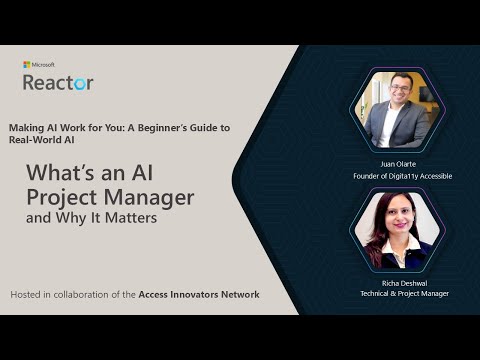
1:33 Hello. Hello. Welcome back. Alexa, thank you so much. Yeah, we're very excited to kick off um the new season uh for the Access Innovators Network. Um so without further ado, Juan, take it away. Thank you so much, Alexia. So, welcome everybody. My name is Juan Olerte. We are here to learn more about AI, especially AI that can help people with different type of abilities or different uh backgrounds. We want to make sure they understand how to utilize it. With that said, this is our first episode of our second season, making AI work for you. One thing to uh consider if you want to learn more about us, please come and find us on LinkedIn as the access innovators network newsletter. And with that, I want to a first thank Microsoft and Alexia for partner partnering up with us and then introduce Richa. So Rich, thank you so much for being our first guest and can you please introduce yourself? My pleasure. Thank you. Uh my name is Richa Deshwal. I live in Toronto, Canada. Uh I'm uh I'm a technical project manager working for the Glob and Mail which is uh one of Canada's leading newspaper. I started my career as a developer um building products using Java and then websites using JavaScript, HTML, CSS. Then I transitioned into project management because I was more passionate about it.
2:59 I think I'm a better project manager than a developer. And then in the year 2021, so more than uh four years ago, I transitioned into AI project management. And since then, I have been working on uh building a lot of products and projects that are based on AI uh based on traditional machine learning engineering as well as based on generative AI. Uh currently at the global mail uh I manage the work uh priorities and streamline the work for the team of seven data scientists and machine learning engineers and we are working on many projects right now based on generative AI and machine learning um that are responsible for uh improving the user experience uh for um revenue for um automation and u building efficiencies as well.
3:50 That's awesome. Thank you so much. Um, now you mentioned you had a technical background, but also right now you're doing project management. A lot of people when they think about AI, they think it's going to be mainly for developers or for data sciences. Can you please expand a little bit in terms of what are some of the other roles that can also utilize AI? Absolutely. One, yeah, I think that is a misconception. I hear about that all the time as well. Um yes there are many technical roles for example there are data scientists uh there are machine learning engineers there is ML ops which are related to the development of models or deployment of models or training of models um so these technical roles are focused on development deployment but just like any other technical uh projects uh it's not only the developers but there are many other roles that are crucial for their development and uh for uh for enabling them for users. So um there are many I will start with a product manager. Uh so a product manager is somebody who's responsible for um creating the strategy and which vision for a product. Uh they're responsible for um deciding which features of the product should be prioritized and streamlining the backlog for the developers. So just just like a poor product manager on any technology the AI product manager would work on with the team to make sure that they are working on the right priorities. Uh number two uh a UX or UI designer. Uh so the the the machine learning engineers they work on the model and on the data but the interface that that is built to interact with the users that is something that is designed by a UI or UX designer. An example of that would be uh a popular tool. We all use chat GBT these days. So a UX or UI designer must have built the interface with which we interact using chat or any text to speech. Um so that is another role. Uh then you have roles like sales and marketings which are responsible for communicating to the users of the value of the product. Um so they are they that is a crucial role uh as well. And then uh unique to uh data and AI projects I would say um a role called say ethical ethics and um uh responsible AI management. There is no specific role name and every company is using a different name for this but essentially what they're responsible for is the um making sure that the products that are built are ethical. um they do not have the bias uh they are fair and also there is a data privacy as aspect of it that AI should not use any personal information of of users and their the their PII is protected uh then um other roles would be change management project management um so today AI is not only adopted by technology companies but they're also adopted by say healthare care industries or factories where you there there is a lot of uh automation being uh uh done. So the adoption of AI is done by change uh is uh enabled by change managers and then the last would be the project managers. Uh they are um responsible for say initiation, planning, execution and closing the project. But they if they are AI project managers, they are focused on projects that are based on AI.
7:32 That's fantastic. I think we went through you went through a lot of different content in there but uh we talk about or you talk about different type of roles and why is important for those roles that are not super technical to start utilizing AI uh you know the the the technical roles uh they are just developing the product but essentially the the non-technical roles that I mentioned they are the ones that are responsible for overall develop velopment uh of of the of the product of the features that the right products and features are prioritized and developed and also they are marketed in the right way to the users. So um for example any LLM like any chat GPT it's not just the model creation that can reach the users you have to package it and you have to um um starting from the development understand what the user needs are and then package them accordingly and deliver to them and communicate the value that's really important I think what is really vital in here is taking under consideration the user needs and how you can utilize AI as a skill to enhance yourself or to really try to achieve velocity or productivity. Now you build your career connecting the dots between business and people. But in your opinion, what does a project manager in AI does exactly when trying to help different projects organizations?
9:07 Uh right, Juan. So yeah, I was a project manager uh building uh web interfaces, building websites and apps and I transitioned into a project manager that is focused on AI uh projects. Um so let me break down first what a project manager does. So a project manager is responsible for um the initiation of the project which is which can include say what is the budget of the project, what are the resources that are required to deliver this project. Um and then they are responsible for building the project plan which is to break down the project into uh e executable steps. uh then they are responsible for execution of the plan. Making sure that uh the timelines are adhered, the budgets that are and everybody in working on that project understands the responsibility and connecting the dots uh between business and tech teams and then they're responsible for monitoring the project and making sure it reaches um it is uh it is closed uh and completed. So that is a responsibility of a project manager and they could be working in technology, they could be working in uh any business field, any factories, any healthcare. Uh but the any a project manager that is focused on AI, they are also doing the same thing. The only difference is that they are focused on data and AI. So this they should be aware of um say they will have two they need to have two additional skills. One thing is a good understanding of data, a good understanding of machine learning and AI and what can they do and then second uh they should be aware of the challenges that a specifically an AI project goes through in uh in development. So um for example um when they're responsible for budgeting it's not very straightforward to budget an AI project uh as compared to a traditional software engineering project because say if they are a if it's a generative AI project then you have to understand what will be the cost of this project once it's deployed how many users will be using it there will be uh cloud costs uh say if you're using AWS or Azure so it's very hard to uh budget it and understand the cost of it. Um then there are other challenges. For example, project managers are responsible for building a timeline and sticking to it.
11:28 Uh for the project execution, it's not very straightforward to build a timeline and predict when some the project can be delivered if it's an AI project because they are a little research based. They are dependent on data. So sometimes you have to take additional steps for data collection for data cleaning uh which you may not have uh projected before starting the project and because it's research page sometimes during the development you realize you require a lot more resources than you planned before. So it's uh it's it's the same thing as a project manager does but because it's focused on AI it's slightly more challenging and uh understanding of data and AI can help you um reach that.
12:11 Thank you so much. I really love how you created a or you you draw a difference between regular project management and then project management with AI. If we were to quickly go back to that uh you talk about um um budgeting does that also include when a project manager for AI is working in a project is going to try to say oh I'm going to have x amount of team members and they're going to be using different type of AI applications and then assign those to them and then do you also look in terms of the results that they're going to be producing that's correct that's correct so there are more aspects text to it. So um the the results that they will be producing.
12:54 So I want to again like to give a better picture. I want to compare it with a traditional software uh projects. For example, uh if you're building a website uh when you are building a website, you can have a design of how exactly this project is going to look like when it is developed and and completed. But that is very challenging. the outcome of an AI product is very difficult to um to to uh to predict just um just at the start. So because you cannot have a design it is something that's dependent on data. So to mitigate that what we do is we don't initially start the profit project we start to do uh a little bit of co P that can enable you to understand what kind of outcome this project will have and often in when you're working in a corporate environment uh the the stakeholders also want to understand before it reaches the users they also have to have a buy in that this project is going to be um something that is going to be of value. So uh you have to build a little bit of P which may not use the full-fledged data and all the features but can somehow show the outcome of the project.
14:04 That that's very interesting and if we can go back in there so if I understand correctly you have a regular project manager um perhaps there's going to be a web application that is going to be built and then you go either through your agile or waterfall type of methodology but you know you have a specific product and you're going to be creating. Can you maybe give us an example of what the AI is going to to look like? Uh so you talk a little bit about the process, but if you can just maybe provide an example of what a real life application will be.
14:36 Um is one uh if I understand the question correct, you're asking um how do we understand the the outcome of the project before we deliver? Correct. So so let me go back in there. So we if we have a regular project management project uh let's say the outcome of it is going to be us creating a banking application but um for for a for a project where you're using AI is it going to be you creating the the specific AI application or utilizing AI to help you create that application?
15:13 Um so um yeah I think if we take an example of a banking application itself and suppose we are going to build a feature that is say um a personalized feature for for users it's it provides you a personalized um recommendations. So in order to do that um you basically um if if you're talking about the outcome of the project it's going to um something that is um you cannot design it because it's going to be like say a different feature for for you and different uh output for you and different output for me. But what we can do it a sample size of uh certain uh users. So you can you can have your uh user personas that you were going to build that product for uh this kind of 10 kind of users and then you can um build that product as a in the PC phase for that those 10 users test how the personalization is looking like is it actually recommending the right kind of features for all those 10 users. Uh and if that is successful that is when you can go and um go ahead in the project build it a oneonone personalization for each of the users um to uh to again like uh build a production level project.
16:34 Perfect. Thank you so much. Now uh if we were to shift a little bit um if you were to imagine somebody who's just starting their journey in business perhaps doing project management and they are not that technical but they want to get into AI what are some of the first things that they need to to learn or look into? Uh great question Juan. So this is something that I myself educated myself with when I transitioned into AI. So uh it's an interesting topic for sure and right now I think there are so many resources free resources available uh as well to pick up that but if I come back to the exactly the kind of skills that is required for you to get into any non-technical role in AI be it a project manager or be it any other kind of roles that we discussed uh at the start of our conversation. So um I think I would number one I would say just understanding what AI can do and cannot do. So for example, I specifically work in the domain of machine learning and generative AI. So I should be able to um understand the boundaries of it and what does it take to build a machine learning or AI project. So um understanding that it cannot do everything and and it's possible that it can do uh a lot of things but may not do it correctly or may not uh be the the right use case for it. So I think uh that understanding the basics of AI what it it can do and cannot do is very crucial. Um I want to recommend a course uh which is by from Andrew NG we we all know he's a popular name in the space of AI. He has uh this course called AI for everyone which is not focused on just the technical um aspect of uh AI but it is in general understanding good understanding of how AI works uh if it's dependent on data how so it it will help you understand um what AI is capable of or not and specifically it's require it's very much needed for the non-technical roles because say if you're a project manager you're entrepreneur you should be able to understand how you can leverage AI and uh and use it for your for your uh benefit. Um then number um do do you want to say something? No, no, no. I was good. I was going I was I was just n it's good. Okay. The number two thing I would say is uh if you have good understanding of AI now now you have to build your complimentary skills. For example, if you're a project manager, then uh you should uh now if you want to transition into AI project manager, try to understand what it takes to be an AI project manager and try to build those complimentary skills. Uh because for to get into AI, you don't have to quit everything and do a PhD and then become a data scientist to be in in AI. You can pretty much whatever you are doing, try to understand what is a complimentary role for me corresponding to AI. So for for a project manager it can be AI project manager and it can also be that you have some domain expertise in your area. For example if you are uh into healthcare and you have very good understanding of uh what are the what are the pain points and what kind of predictions you require uh in everyday basis uh when you're working at healthcare. So you can be a domain and expertise and for AI as well. So you can work with AI teams to help them understand uh about healthcare because essentially we are talking about working with say data scientists or machine learning engineers who are an expert in building models but they are not an expert in in your domain field. So whichever domain, whichever business you come from, um if you have some good expertise and you know that um AI can be leveraged uh to build a product to automate something or to to predict something in that area then you can be anme a business stakeholder as well.
20:37 Then you have um roles like accessibility advocate. uh so they are accessibility advocate that are that work with say product managers to help them understand how to make their products accessible to how to make their apps accessible. So you can again transition into AI accessibility advocate and you can uh uh do the similar role by just understanding how data biasness fairness all of that works and transition into AI. Um then uh other things there are other things that you can do is also educating yourself by tools that are not very complicated to use. For example, if you use LLMs uh you have OpenAI, Chad GPT, Llama from Meta, Enthropic Cloud, Perplexity, you have all these very famous LLM tools these days which almost everyone is using. So get your familiarized yourself with with AI and the products and also um a lot of popular products that you use like you use Canva or use Adobe they have their uh AI features available now. So just understanding how they're using EIC for summarizing, summarizing meeting minutes, generating images, it will help you understand the use cases of how you can implement all of that in your area as well so that you can come up with some uh good ideas. And uh I would say lastly if you are in an organization which has an AI department you can get involved uh in with them in in whatever capacity whatever route you're currently in so that you can get adapted to that.
22:14 I agree with that. I think one one thing that you touched on and I think is super important is if you may not have like a lot of knowledge in terms of AI but you're a subject mirror expert uh that is going to be super important because at the end of the day AI is going to be a tool and a lot of times information is not going to be factual. So it's really going to be how you can present that information and then try to manage biases.
22:43 If if I were to ask you maybe one or two skills that somebody needs to have when trying to communicate with an AI interface, whether it's going to be a chat, GPT, uh clock, um what would be that thing that is going to make them better at are trying to get results from from an AI system for that specific field with the understanding that they are subject matter experts. like is there is there a skill or something that they need to to to learn or to know before they can try to interact with them?
23:17 Um it's a so one there are two aspects of it. One thing is that like educating yourself and getting yourself familiarized with the tool and the second aspect of this would be say getting involved in AI projects. Um I think the uh the first aspect of it which is to interact with AI tools I think it's more about practicing and try to uh adopt it in your everyday basis. So I mean with with like for example for generative AI sky is the limit of what it can do for you right. So if you try to adopt it in everyday basis uh like uh create this image for me so that I can use it for my presentation or tell me the recipes which are uh specifically these many carbs or these many proteins uh or um asking it to write an email on your behalf or if you're going to have a difficult conversation uh just give you some tips of that. So the sky is the limit of how you can leverage these tools and try to trying to adopt it in your everyday basis which help it just makes your uh understanding much easier.
24:17 Uh and of course adopt it in your uh in your workplace as well for doing your task uses it as as your assistant. So if um you have to draft an email, if you have to build a presentation, if you have to have a conversation, uh you can use uh these LLM models and uh to to help you assist with that. Um I use it all the time. Like if I'm drafting an email, it becomes too long. So I just ask uh Charg to make it more concise and uh that just saves me a lot of times. If I received a document which is like 10 pages and I want to have it summarized or u if I um ask for some updates to uh on a document on somebody else I can uh I can ask charge to review whether those changes were done or not. So there are many interesting uh areas where you can use these tools uh for um for your purpose. The more you use it the more you'll understand the usage. uh but I think the second aspect of it is also one um your your question is that um how do we uh say get involved in building these projects or get involved in these uh with with the AI teams. So um um I think there is no like straightforward one answer for this like because it depends on the role but I can give examples of how I transitioned into an AI project manager. Um I was uh building uh websites uh as a project manager and I transitioned into a company which was more focused on AI and it was building machine learning products and uh they uh they they required my help to um build the the web interface for it, the analytics interface for it. So I did that but I did had or did showcase interest in learning more about data science. So whenever there was an opportunity for me to do a project with them which is I do not have the technical knowledge but I do understand how to work with say developers and and uh create a project plan for that whether it is focused on something which is uh user uh which is building a user interface or it is something that is for automation costsaving. So I took all these projects gradually and I started to educate myself on the side doing some courses on AI and also whenever I was talking to anyone uh from the technical team and if I did not understand anything if I was present in the meetings I used to note down what are the terms that I did not understand and then end of the day I would go and uh just learn those terms so that next day I'm more familiar with what they're talking and I can start contributing to the discussion as well. Yeah. So all of that I I love that as actually that's a real example of how you transition between project management into into AI.
27:02 Um is there another challenge that was appearing to you other than the fact that oh I may not know much about specific data science but I'm going to be learning about it. Was there something else that you said oh this is a challenge and and if so how did you overcome that? Yeah. Uh uh because working on um any machine learning or any data science projects, it's not only um just the building the model part. I think there are a lot of challenges around it and uh underlying is to understand data. So if you're working with data scientists, you also have to understand data engineering a little bit. uh because uh that will help you understand uh how you how can you utilize this data what kind of features you can build on top of that.
27:51 So that learning also was required and then um also understanding data analytics. So able to understand the outcome of these models um how do you um if if the model is running and it is giving you uh some output how do you read how it is impacting your metrics how it is impacting your KPIs. So just understanding a little bit of data analytics. I think there was a lot of learning uh around it with not just with data science but data engineering and and data analytics as well. And uh uh again like it depends on your role and what you're focused on but I wanted to uh get an overall uh understanding of data science products. So I touched base like every every other detail that was related to the data science. Great.
28:36 Thank you. Um, one things that we do here at the actions network is we try to understand those um um how can AI really help underserved communities like people with disabilities um or other communities that may not have as much access to it. Um have you ever come across with any examples where AI was really used for a positive impact? Uh yes for sure. So there there are some features that um I have myself uh worked on and uh there there are also a lot of examples that I see around in the um uh in the in in other industries. So uh I mean um if you talk about accessibility, it is not something that is u that has to come later. I mean while you're developing it, it is something that should be part of your development of your projects u from day one. So it's because it's not only about say compliance but it is also about responsibility as well. Uh and then you have to advocate it from day one and also continue to advocate for it um as a foundation not as an afterthought. So um so there there are yeah many use cases like that. Um for example um a use case I think not just brought by me but I think it's a very common use case I see across industries wherever you have uh interfaces which uses screen readers.
30:10 You have a concept of using alt text which is the alternative text and um it's basically it is used to describe an image or describe a video any kind of visual and uh screen readers use this alt text uh so that they are able to explain uh the the visuals to the readers. Um so all text is not a new concept but uh often what we have seen is that it's sometimes we miss adding all text we uh or we add a text all text which is not the right description of the image and then what happens is just uh thinking from um perspective of a person using those accessibility devices uh it becomes uh if it feels like some information was missed or some information was not correctly presented.
30:58 So now uh with the use of generative AI it's actually very used to it is very um easy to have all texts uh and it's a common use case that I'm seeing across industries wherever you have an user interfaces uh generative AI is used which is able to understand the image or video and is able to provide a better description. So this way there is no missing data and there is no misinformation as well and it does a pretty good job uh of uh of this and it also makes developers life easy because they don't have to now worry about alt text. Uh that's one thing. Uh then the other usage that I see again across multiple industries and everyone is using is uh the text to speech feature.
31:44 Um now um like for example with chat GP you can also speak to chat GB you don't have to type your question but you can also speak and hear back uh so that is the texttospech uh capability it converts the text into sound and the sound into text and it's able to uh have an interaction between uh users voice and also the model returning the output in terms of voice. So I see a very good adoption of text to features across all industries. I will talk about say um u media because I work in the in the media industry. So not just uh the newspapers or just the mag magazines. Now you have uh many uh digital magazines available that you can and books audio books available you can just uh play and and listen to it. It is not a a very new feature but because of generative AI it's extremely easy and it's much more accurate and then you can have uh much better voices which are um which are not robotic and very difficult to hear and understand. Uh uh I worked on an accessibility project almost decade ago and uh when the testing was horrible like the testing time was horrible because I used to hear the the website in different languages that is working fine and the tone was so robotic and so hard to hear. So I could just empathize with people who rely on these kind of uh devices for for understanding and navigating the website. So but now we have uh text to features available.
33:22 There are many good products like 11 labs and Amazon poly and there are numerous such products which are uh available at reasonable level. So reasonable prices. So many companies are now encouraged to incorporate text to fe uh speech uh incorporating in their products uh because they are now able to reach out to users the section of users that they were not able to reach out uh as much. So it's a win-win situation for everybody. So yeah, I think the voice features is also an incredible um feature. I would say very easily easy to implement using generative AI.
34:00 Thank you so much for those examples. That's great. Now Rich, you just launched a book project management. Um if I have it here, it's going to be um machine learning from project managers. Can you talk to us a little bit more about your book? Uh yes, I uh just launched it uh just a week ago uh a book called machine learning for product managers. I I have the I have the book with me here. So this is uh this is um a 200 pages book and I launched it on Amazon and um yeah I think the the idea for me was that because I transitioned into machine learning and AI field uh just a couple of years ago and then I uh learned a lot about uh machine learning uh in a techn non-technical role. Um often um I face challenges in understanding the technology because I am not an uh data scientist not an expert but I had to still understand uh techn uh machine learning technologies to some extent and uh I definitely there were some courses available that I had to go through but a lot of this information was actually either too technical that is not required for me or it was so non-technical that I was not able to bridge the gap and understand the data scientists uh very well. So that's why that's where the idea of writing this book came and uh um it has like um 200 pages and 11 chapters that are specifically written for people who are um who have some business background and they want to get into AI. Say you're an entrepreneur, you're a product manager, you're a project manager or even you're a student who wants to learn about AI.
35:42 So they are able to understand what AI does, what it's capable of, what is data, what is models and simplifying it uh for the users to uh help them understand how uh how they can use AI for for their uh features and for building their models. Definitely I had read uh through a book and recently I was traveling and I was in a in a plane for eight hours and eight hours straight. So I know I started reading the book and I really love how you make the distinction between AI and and and and machine learning which many times people don't understand. Would you be able to maybe talk a little bit in terms of that the difference between AI and machine learning? I know you you put it beautifully in your book. Yeah, thank you so much. Yes. uh I think the that was the first that is the first chapter uh of my book and that is where I begin because I think it's important to understand in distinguishing between AI and machine learning and often we use these words interchangeably but uh they are not the same. So machine learning is just a sub field for artificial intelligence and it is uh the field of the subset of uh AI which uses data um for any kind of prediction for any kind of uh pro processing data in order to build any features. So for example um if you have you talk about these robots that we see in movies and like upcoming uh um we will have like some robots. So that is definitely an example of AI which is able to use artificial intelligence to act like humans to have performed tasks as humans. Now machine learning is only a subset of AI. So it uses data for training the models to be able to produce outputs. And an example of machine learning which is not AI a machine learning product specifically would be say uh Netflix Netflix recommendations. So Netflix uses your uh data which is like um which is KPIs like for example what are the movies or web series you have watched so far what are the typical kind of movies you you're more inclined towards what kind of yonor do you listen to? How many um um which are the movies which you started but you did not finish it. So they have all these kind of data which helps them understand what are your preferences and they're able to recommend you uh the right movies and recommendation system is something that's used in almost all industries today um you get personalized offers marketing offers uh you get personalized uh news today you get personalized recommendations on Instagram so social media so um that is all using the data to able to understand you and give you uh uh give you personalized experience. So that is specifically machine learning. But if you talk about say robots that is not machine learning that is another field of AI. So wherever you talk about machine learning it is related to natural language processing, generative AI and data science uh as which is a subset. Awesome. That's great. So again I encourage everybody uh who is viewing uh to please go grab the book. It is amazing. Um, Rich, just before we go, uh, and obviously we're going to have some time for Q&A, but before we go, if you have people, if you were to provide advice to somebody who's going to really start and in terms of like jumping from their non-technical job into AI or perhaps it's going to be project management, what is the number one advice you would give them other than learn more about it, but is there something in concrete that they can actually go on sorry do uh yeah absolutely um I think um first of all like understanding what exactly you want to do in the field of AI uh like I talked about um we can you can build complimentary skills of your existing role. So understand that where you want to go, what is your trajectory and then uh there are so many courses available for understanding AI and machine learning that are that are saved by by Microsoft uh a lot of these companies have given some free AI courses. So I would say like start by like educating yourself, understanding the products and also see where is that trajectory. Is it something that you can transition into a role within your current company then you can start uh communicating and starting starting to transition while educating yourself. Um but then if you suppose you have to transition into a different industry understanding where you want to go what is your trajectory what is that your dream role I think that is the first step and then you educate yourself uh take some professional courses and then uh transition into the role excellent thank you so much I think maybe we can jump into some uh Q&As's maybe we have some questions um Alexia maybe you can help us with that or Sure thing. Um, our first question is what is the best type of data that AI can use and what is the best way to structure the data? Um, so I I would say um it definitely depends on the use case that you're you're planning to build.
41:12 Uh, but we just touched base upon some personalization. So I will try to explain it with with that. Um first of all like if you're building a a uh any AI product it goes through certain phases it does not go through the directly to the development but there are steps of say data collection and data preparation as well before you go into development and uh so when I talk when you ask about the best type of data I think that would be depending on the use case. Now if you want to create some personalized recommendations you need to have enough data for the users. Now um for example there could be some users that are anonymous to your website. They come and go and you are not able to connect um them. So in that case you cannot provide a personalized experience to your um to anonymous users. But you can provide some personalized experience to your the registered users because you're able to map the data with them.
42:09 And then uh if it's about giving personalized recommendations then uh you should have like enough clean data that is able to produce recommendations and it's you have enough data to understand uh their preferences very well. Um so when you talk about best type of data so um the better the cleaner data you have the more better recommendations you can uh you can give but for example anonymous users or a new users if you do not have enough data for them then you can fall back to certain other rule based uh um algorithms as well um uh if you do not have the right site of set of data for recommendations that could be say when they join and log in for the first time you can ask them their preference ES and give the recommendations based on that. So that's something that you can use for anonymous users. So the best kind of data um it is um I would say it totally depends on your use case and uh in general practices is to have clean data not missing data um some not having outliers. So which is which is done uh in the in the in the steps of data cleaning and data processing and then what is the best way to structure the data. Um there are different like um ways to structure your data and different organizations uses like different data warehouses, databases to structure them. Um but uh I would say it's also a misconception that you need absolutely structured and labeled data in order to use AI. It's definitely preferred if you have labelled data and structured data. But there are also algorithms that are able say to classify uh your class use classification algorithms to uh generate some machine learning recommendations as well. So I think both of these questions are definitely linked to the kind of use case. Um for every use case you require a different different kind of data available which is um if it's userf facing it's generally capturing all kind of user uh user data that comes from their interactions to your product by what are they clicking what are they skipping uh all of that I hope that answers Michaela all right and thank you so much for this answer the next question is is Is there any good certification for AI project manager?
44:36 Uh yeah definitely there are uh many certifications and u I think one certification by Google uh is something that was launched almost a year ago and that I've seen is like uh the AI project manager Google certification that is a very comprehensive uh course available for free then you can you can take that but um it again like there there are many many more certifications available that for which you do don't even have to pay and you just uh need to look up and uh um yeah so no specific recommendations but the Google one is something that I've done myself so it's all awesome thank you so much and I think that that was it for our questions correct yes awesome thank you so much so with that reach I really want to Thank you for being our first guest in a in a um the second in the first episode in our second season. Uh it was wonderful. If people want to connect with you, where should they find you? Um they can they can definitely connect with me on LinkedIn. I'm very active on LinkedIn uh over messages as well. And uh yeah um I think that would be the easiest way to connect with me. I'm happy to answer any questions afterwards as well. I'm very passionate about this topic and uh I'm always looking to connect with people who are uh looking forward to learning more and then teaching me more as well and it was a pleasure Juan thank you for inviting me. Thank you so much. So again, I encourage everybody to go and get the book machine learning for project managers available in Amazon.
46:21 And thank you so much for Microsoft Reactor and Alexia for um helping us promote this uh uh information in terms of AI that we hope are going to help different type of users especially those ones who are not technical to really get into AI. Thank you both so much for today's session. We have lots of great interaction in the chat. Everyone is saying thank you. So, thank you everyone in the chat who also joined us today.
46:48 Um, I'm just sharing a link to our survey. If folks are interested in sharing more about their feedback, we love to receive feedback on to what you'd like to see more on the reactor. Um, you can scan the QR code on the screen or um, go at aka.msreactor/servey. Got cut off a little bit on the slide, but I will share it in the chat. The event code is S-1526. And if you are interested in joining an AI community, um you can scan the two QR code that we're having for the Microsoft AI community. We have a Discord community as well as a GitHub discussion. Juan Richa, thank you again so much for today's session and we looking forward to seeing you on the next episode. Definitely. Cheers everybody. Thank you. Thanks everyone.
47:42 Thank Okay.
Summary
- AI is not limited to technical roles; non-technical roles like product managers, UX designers, and project managers are crucial in AI development.
- Understanding AI's capabilities and limitations is essential for non-technical professionals to leverage it effectively.
- Project managers in AI must navigate unique challenges, such as budgeting and timeline estimation, due to the research-oriented nature of AI projects.
- Familiarity with data and machine learning concepts is vital for project managers to facilitate communication between technical and non-technical teams.
- Accessibility in AI should be integrated from the start, with examples like generative AI improving alt text and text-to-speech features.
- Continuous learning through courses and hands-on experience with AI tools is recommended for those transitioning into AI roles.
- Richa's new book, "Machine Learning for Project Managers," aims to bridge the knowledge gap for non-technical professionals interested in AI.
- Engaging with AI communities and resources can provide valuable support and networking opportunities for aspiring AI professionals.