Transcript
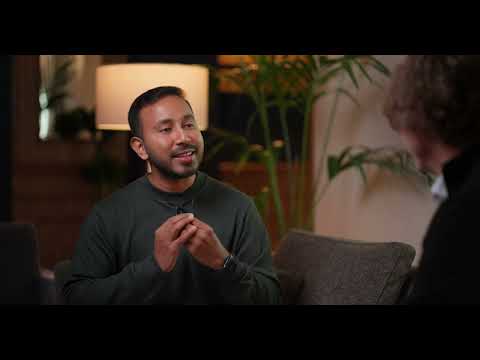
0:01 Welcome to the Atomical Coffee with series where we showcase the real stories behind the greatest founders we have the privilege to work with. In this episode, we sit down with Praakar Reddi, founder and CEO of Open FX. Having previously built Falcon X into crypto's first prime broker and an 8 billion company, Prabakar is now tackling one of the hardest problems in global finance, fixing how money actually moves.
0:33 >> Pra, thank you so much for joining us for a cup of coffee. We'd like to have a conversation with you and and hear a bit more about your journey. You launched Falcon X and that became an $8 billion outcome. Quite extraordinary. When you think about success now, when you have had such success before with with Falcon X, it's like are you using your company as a personal benchmark? How big does this have to be to be successful? Thank you for having me, Nicholas. Wonderful bit to be doing this. Good question. And I think about I thought about this even before starting the company. I think about this every day.
1:10 >> Success for me is not a monetary outcome any longer. Like you know at certain stage more money won't change your life in any means or manner >> but it is in terms of impact and the scale at which we'll reach. >> So today if you look at global money moment but $7 trillion moves across the world at any given day of which $2 trillion is spot money moment for me success or maturity of open effects is when we're actually able to do $1 trillion of daily polyine process through open effects. Not because we're doing one of the two trillion dollars, but because of our ability to sort of jumpst start this entire ecosystem from a postal network to almost SMS network of, >> you know, money moving near instantly, we believe that the two trillion will become 200 trillion. So us doing on a trillion dollars of that is fantastic scale and that is maturity in my view and success in >> what's the impact then for for the world if if if you get to those numbers.
2:02 >> Great question. you know uh as I was researching this space in 2023 I came across a report by an institute called ADBI Asian Development Bank Institute which had fascinating stats most of the remittances around the world okay and I say remittances because it's a large chunk of global crossber payments um usually go from emerging developed nations to emerging nations >> and remittances are a huge huge portion of the emerging nations GDP.
2:35 >> Yeah. >> And there was a fascinating stat there which said that 1% increase in incoming GDP incoming remittances into those emerging nations creates a 22% reduction in the poverty of those countries. So if you can increase the velocity of money movement and reduce the cost structure, what does that mean for a lot of these nations? And that is again impact in very different ways, right? And not just that, there's so many other ways in which the world will change, especially if you can make money move like data across.
3:04 >> Open FX is the fastest growing uh fintech. And a lot of people haven't heard about it yet. So you've been very quiet about it, but you also started actually two years ago. So in simple terms, what is open FX and what's the benefit for the its customers? >> We have been intentionally in stealth for the first 18 months. Um, Open FX just celebrated our 2-year birthday last week on the same day. So, it's now 2-y year old company. Uh, initially we were, if you know, you know, kind of a firm, but I think that is going to change in 2026. We're going to be loud and about and ensure that we sort of market territory in the world. So, what is open FX? We are an FX infrastructure company >> that helps power other financial institutions and make it cheaper, faster, more efficient for them to move money from country A to country B and convert currency A to curren country currency B. So that in a nutshell is what we do. So if you're a remittance company, you're a neo bank, you're a payment gateway, payroll processor, most of the times you're trying to move money from country A to country B, you're usually using a legacy bank or some, you know, legacy fintech provider.
4:09 The problems are money today doesn't move even in 2026 on weekends across borders. Money doesn't move after 4 p.m. after bank cut off timings. Money doesn't move on national holidays. But the world is becoming more and more global, right? And the next 10 years are going to be a very different world as we were discussing last night. >> Yeah. >> We're going to basically see the uh rise of AI agents. And I believe that in the next 10 years, the largest users of FX and global crossber money movement are not going to be humans, you know, sending money, but AI agents.
4:39 >> Wow. >> And the world is not ready for that, right? So, we're building towards that. You've been talking about making money move across borders just like data as freely and as fast and as cheap as data. How fast is it today and how fast will you get in a few years you think? And what about the cost? Average crossber settlement time today in the world is about 2 days. It's t plus two is standard and then goes up to 5 7 days as well when you go to longtail emerging nations. Open effects has been live for about 2 years. We're live out of 150 currencies that exist in the world. rely with 11 currencies. So, we're very young and early in our journey. We have a lot long way to go. But in these 11 currencies, we're very proud that our 98th percentile of settlement happens in under 60 minutes. Regardless of the time of the day, regardless of when it is in the week, we will collect your currency A and send it out in currency B in under 60 minutes. And it's we're proud of that.
5:34 >> Uh where are we going to head to? >> So, we've come from last year from 4 hours down to 2 hours to now 1 hour. But we don't want to basically do the step function change of 60 minutes to 45 to 30. That is going to be a natural aggression. But if you ask me where will we be in 2030, I believe it's going to be near instant. It's going to be like the way you send a text message on iOS, >> right? You're not going to wait like another 3 minutes for you to receive the text. That's what your money transfer should look like. That's the ecosystem and infrastructure that we're building.
6:03 >> No, that and that that must be the that must be the vision, right? And I think that it's just a matter of time how long time it takes to get there. I feel confident uh that by 2030 for about 50 to 70% of the currencies that we support, we should be able to get there near instantly. We've got the plan, we've got the infrastructure, we've got the team, and we should be able to get there. We talked about you started 2 years ago and and you went live in Q2 2024 and you've been growing to incredible fast to $40 billion in in in global uh volume. This is actually about 10% of established players like Wise and others. And your team is really small and you also have a distributed team. Um and and what are the things that unlock this incredible velocity?
6:50 >> We actually do process 25% of what transfer wise processes not 10% transfer wise last year did roughly about uh 160 billion of transactions in 2024. We process $40 billion of that. >> So and we are a 2-year-old company. wises. It's not apples to apples comparison, but just for you know a comparison of scale, they're a 16 year old company with uh about 4,000 6,500 employees actually. >> We are 1% of that roughly 65 employees doing 25% of their volume. How did we get there? Honestly, two things. One, incredibly proud of our team.
7:27 >> Um almost every single leader in the company I worked with in some past avatar of my life. So I'm very happy that they've followed me into this journey again uh across product engineering go to market operations um and 25% of our existing team are exfounders people who have been there done that at scale had their own niche they were looking to solve and some of the founders are actually unicorn founders they built their own unicorn companies and they decided to follow into this journey with me to solve this problem and make my problem theirs which is fascinating >> uh and the second thing is our intentional focus on automation Because a trillion dollars a day of volume, I can't build 50,000 employees. That's not what I'm looking to do. With a very small lean team, the intention is to basically build the infrastructure that automates and moves money. Cuz if you throw people at this problem, we'll be back to sending money in 2 days. But like I said, in 10 years time, it's going to be AI agents who are going to send money from point A to point B. And it's going to be expected to move in subsecond time frames. And that only happens through automation and that's how we're doing it.
8:34 >> Yeah. So I'm sure now with with now the fifth company there's so much experience how you recruit and how you build teams and and I think it's also so fascinating that you recruiting entrepreneurs. So I've seen this in a few other companies but it's rare when I see it and I know that's okay that's a really strong founder who's able to recruit other founders and it requires about a lot of humility to be able to do that on both sides I think and I think you can do that because you have this really big big vision and mission that that you're taking on and then that's is so inspiring. I also wonder um that when you build a company now uh with the toolkit that we have as founders and and and uh to build companies with automation AI tools, it also enables you to build this company so much more leaner that if you would start if if you were started say 3 years before I'm pretty sure it would been different. You would probably have h have to hire many more people. What what's your what's your take on that? You know the times are changing for sure. 3 years ago I think we still had a lot of the barebones infrastructure. 10 years ago it would have been impossible right because a lot of the tools that we have today a lot of the AI infrastructure a lot of the automation capabilities were still not there. uh the world today is not as advanced as you would think especially in the world of finance a lot of the banks don't have APIs right so we have to actually create our own robotic process automation systems to sort of make our own APIs for it and was it feasible 101 15 years ago no today with the tech that we have the kind of intelligence that we have the kind of AI tooling that we have we're able to sort of like get integrations up and running in 48 to 72 hours at any platform >> this is of course a lot of innovation here and with the conversations with your customers, do they get it or do you have to do a lot of education? What what are the kind of the typically the conversations with with some of your customers today?
10:30 >> Great question. So to answer that, let's touch upon who our customers are, right? So our ICP, which is our ideal customer persona, is any fintech who is basically moving between $5 million to about $2 billion a month. So that is our core ideal customer persona that we target and they fall into multiple buckets. If you're a fintech running remittance platform, payroll processor, payment gateway, near bank etc. >> Now for them these are typically like seed to CDC fintech companies.
11:00 >> Uh they usually don't have a very large balance sheet. They're on transfer wise with a billion pound balance sheet. >> So for them the pain point is very acute because without open FX where would they be going? They'd be going to the regional bank. They'd be going to some crypto exchange perhaps to sort of bypass the swift layers and try to convert into stable coins or they would use some other legacy fintech provider. >> Now all of them come to you and say hey we're going from series A to B to C.
11:25 Please give us more money not because of opex but because of working capital needs and every fintech company is doing the same thing. So now comes open effects and we're like you know what you don't have to preund your capital 3 days ahead of time. You don't have to raise these large VC rounds to you know just get your growth. You don't have to basically hire a currency operations team and every single firm to sort of move money from point A to point B.
11:45 We'll offiscate all of that for you. Just will collect your dollars, bank those dollars, convert it and pay out where you need to. And all of that in a programmatic API >> is like a no-brainer. So our sales cycle conversations are usually a 30-minut Zoom call. We don't do feet on street. We don't go, you know, try to sell them for like months together. out of those 30 minutes usually 25 minutes only because five minutes is high hill or still can you hear me?
12:10 >> Uh and at the end of 25 minutes they're like where can you sign up because we are building a product that we ourselves would love to. So there's no long-term contracts there's no like you know gotchas there is no hidden fees >> basically the way we set it up is if we are the best you should use us if not good use something else. >> What were the defining moments in your entrepreneurial journey that made you go from company to company and think even bigger? defining moments several I'd say look I've been an entrepreneur for 19 years now started my entrepreneural career 2007 that's 26 26 now >> so started my journey long time ago had a very different defining moment back then uh as to why I got into entrepreneurship >> today I'm on my fifth journey as like as you pointed out >> why am I doing this very different reasons um so if your question is what prompted me to start open FX it isn't one Eureka moment. It's pattern recognition across many many years seeing certain trends and figuring out that this is the right time to be solving this problem. And me personally I have like you know a written notes on my world view of everything for the next 20 30 years across AI robotics healthcare science payments I know at least I have a view on where the world is headed. It's now our responsibility to s sort of almost bring 2030 to 2025 or in 2050 to 2040 if anything. So what can we do with our time, money, energy, resources to sort of like bring you know that timeline forward >> and then I realized I have found a market fit in certain domains >> right? certain things that I can do, certain things I can change, certain things I cannot. Um, so in certain the other areas that are exciting to me, I invest and I back up the founders similar to you. In certain areas where I actually have a founder market for >> I had a unique advantage to change things.
14:00 >> I decided to basically double down. And how did this idea come about to be? Well, uh, I grew up in Dubai. So Dubai has been home for me through '90s through 2000s. I spent all my time there. And 2022, I came back to Dubai. I was living in the Bay Area. came back I saw certain trends and patterns. Number one through 90s through 2000s I would see lines and lines of people outside ATM machines and Western Union trying to send money back home because Dubai is a huge remittance corridor and uh 2022 23 I started seeing the same thing. I was like 30 years later nothing has changed.
14:35 On one side on tech crunch I'm seeing announcements from lots of startups saying crossber payments has been solved. Stable cons are this magic bullet you know money is going near instantly across the world and on the other side I'm seeing reality that people are still spending 7% to send money back home. >> So open effects actually started as red envelope if you remember when we first met you. >> Uh so the original original thesis was to actually build a remittance platform >> right? We wanted to actually help money move money around the world near instantly but realized actually as I peel the layers of the onion that the real crux of the problem is not in solving for a remittance use case because there are two ways to touch 8 billion lives. One is to basically get 8 billion customers which is very difficult and challenging and perhaps Facebook is the only one who's ever achieved that to a large extent but the second way to do it is by getting a thousand financial institutions which touch 8 billion lives and make it cheaper faster better for them. So that was become that became the evolution of red envelope to open effects and that's where we are today.
15:33 >> No, it's extraordinary and I think that when you have that experience from these previous companies and and and you can see those patterns and and and it's just extraordinary that what what uh opportunities there are when you when you when you actually built a few companies before but also working in this similar domain. So, but I'm also so impressed by your your continuous drive and I think that's for me something that um is is um um for some of the best entrepreneurs are the ones that feel that there is a mission to do something and the opportunity and almost like a responsibility to society to as you said bring it forward and and building these companies that ultimately if you can achieve your vision then of course is is a huge uh value ad for society to to move move move money across borders.
16:24 >> And in my view, the mission is so audacious that the why is large enough and long enough in terms of a time horizon that it will actually >> if you're successful, it will change the complete trajectory of the industry we're operating in. And that is exciting for me. >> Yeah. No, it's fascinating and I think you you're spot on there. It's like it's impossible to anticipate all the different use cases, but for certain there would be so many new opportunities for other entrepreneurs and companies to build upon these rails. So that's it's it's also why it's so fascinating when you're building this this this infrastructure. And then for sure making money move faster, cheaper, and better of course is going to be is such a big unlock for a lot of um value creation on on top of that. And we're looking way out into the future as well. If you just bring it bring us back to today, >> right? And if you look at most of the new fintexs that are starting off, they're trying to compete with the legacy fintex of the last 15 20 years.
17:23 >> Now, how do they compete against their large balance sheets and their distribution? They need to have a very unique value proposition and offering which usually is around price and speed, right? And every single one of them has to compete on that. And what Open FX is doing is giving them all the tooling and infrastructure to do that at like almost JP Morgan tier one and FX rates with settlement times that are just unheard of in this world today. So that's basically what we do.
17:48 >> Yeah. >> Rob, thank you so much for for this conversation and at Atomico, we so proud to have been co-leading your series A and can't wait to see uh what's going to happen in the next several years, but I know it's going to be great. >> Lovely. Thank you for having us. Thank you for supporting us. It's wonderful to be part of the family. >> Thank you.
Summary
- Open FX aims to revolutionize global money movement, targeting a goal of processing $1 trillion in daily transactions.
- The company focuses on enhancing the speed and cost-effectiveness of cross-border payments, currently achieving settlements in under 60 minutes for 98% of transactions.
- Reddi highlights the significant impact of remittances on emerging economies, noting that a 1% increase in remittance inflows can reduce poverty by 22%.
- Open FX operates as an FX infrastructure provider, enabling financial institutions to move money more efficiently without relying on legacy systems.
- The company has grown rapidly, processing 25% of the volume of established players like Wise, despite being only two years old.
- Reddi emphasizes the importance of automation and AI in scaling operations without significantly increasing headcount.
- The initial concept of Open FX evolved from a remittance platform to a broader infrastructure solution, aiming to empower financial institutions rather than directly targeting consumers.
- Reddi's vision for the future includes near-instantaneous money transfers, akin to sending a text message, by 2030.