Section Insights
Understanding Corporate Incorporation
Why do business owners incorporate?
Business owners incorporate for various reasons, including tax benefits and asset protection. However, the government states that corporations are designed to ensure individuals pay the same tax as everyone else. The reality is more complex, especially for high earners facing steep personal tax rates.
- Incorporation is often perceived as a tax loophole or asset protection strategy.
- High earners face marginal tax rates that can exceed 50%.
- Corporate tax rates can be significantly lower than personal tax rates.
The Impact of Timing on Taxation
How does the timing of tax payments affect investment growth?
The timing of tax payments is crucial; paying taxes personally reduces the amount available for investment. Corporations allow for a lower initial tax rate, enabling more capital to be invested and compounded over time, leading to greater wealth accumulation.
- Investing with a higher initial capital leads to greater compounding over time.
- The difference in tax rates can create significant financial advantages.
- Government regulations can impact investment strategies within corporations.
Minimizing Passive Income Taxation
How can business owners minimize the tax impact of passive income?
To minimize the tax impact of passive income, business owners should focus on growth investments and utilize strategies like the Capital Dividend Account (CDA) to withdraw funds tax-free. Understanding the thresholds for passive income taxation is essential to maintain small business deductions.
- Passive income over $50,000 can lead to loss of small business deductions.
- The CDA allows for tax-free withdrawals from capital gains.
- Investing in growth-focused assets can defer taxes and maximize returns.
Efficient Withdrawal Strategies from Corporations
What are the best strategies for withdrawing money from a corporation?
The most efficient way to withdraw money from a corporation is through the Capital Dividend Account, allowing for tax-free distributions. Understanding the balance between taxable and non-taxable portions of withdrawals is crucial for maximizing retained earnings.
- The CDA allows for tax-free capital gains withdrawals.
- Effective withdrawal strategies can significantly increase retained earnings.
- Understanding the tax implications of different withdrawal methods is essential.
Balancing Simplicity and Tax Efficiency
What is the optimal strategy for withdrawing funds while minimizing taxes?
The optimal strategy for withdrawing funds involves a balance between simplicity and tax efficiency. Business owners should consider their personal tax situation, the use of tax-free accounts, and the timing of withdrawals to maximize their financial outcomes.
- Simplicity in tax strategies can lead to better adherence and outcomes.
- Maximizing tax-free accounts like TFSA is crucial.
- Deferring taxes and compounding returns can create significant financial advantages.
Transcript
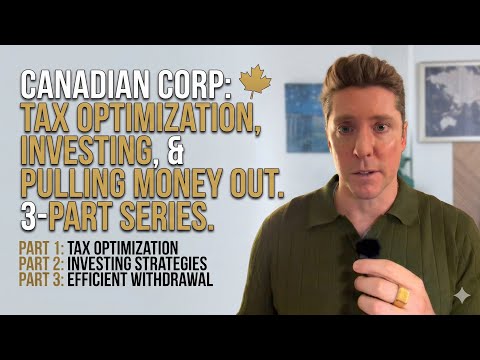
0:00 If you've ever wondered why business owners incorporate, you've probably heard a bunch of different answers. It's a tax loophole. It protects your assets. Rich people do it to hide money. Here's what's confusing is the government actually says corporations are designed so you pay exactly the same tax as everyone else. So why does it feel like every wealthy person you know has one? Let me explain something called integration theory. It sounds really boring, but to me it's actually quite fascinating. I'm Brian, CPA over 15 years in finance. And the idea is this.
0:27 Path A, you earn a dollar personally. CRA takes their cut. They keep about, let's say, 47 cents. Path B, you earn a dollar through a corporation. The corp pays tax. Then you pay tax when you take a dividend. You end up with about 47 cents. Same result. That's the theory. That's what the government wants you to believe. Anyhow, if that were true, why would anyone bother for financial reasons setting up a Corp? Obviously, there's other reasons, but let's look at the reality. If you're a high earnner in Ontario, and this applies across Canada with slightly different numbers, once you cross about 246,000, your marginal tax rate hits 53.5%.
1:02 That means every new dollar you earn above that line, you are literally working more for the government than you are yourself. More than half, gone immediately. Now, let's look at the corporate tax rate. On the first 500K of active business income in Canadian controlled private corporation, it's 12.2%. That's not a small difference. That's a 41 cent difference on every dollar. Here's what integration theory ignores. It's time. Yes, you'll eventually pay personal tax when you pull money out, but when you pay matters. If you pay 53% tax personally, you're investing with a 47 dollar. If you pay 12% tax corporately, you're investing with 88 cent dollar. It's almost double the starting capital. Now, if we compound that over 10, 20, 30 years, and that extra 41 cents isn't just sitting there, it's working. It's growing. It's compounding. By the time you retire and pull the money out, that money has generated growth you never would have had access to personally. It's this gap is where this freedom or opportunity is.
2:02 And it's the unfair advantage. But the problem is the government knows this obviously is powerful. And in 2018, they introduced rules designed to destroy this advantage if you invest wrong inside your corporation. I'm going to make two more videos on this topic. Part two, I'm going to go over the investment strategy and the trap. And then part three, I'm going to show you the extraction strategy from a corp. How you pull money out effectively. This is a bit of a game. It's not tax evasion.
2:26 It's just tax architecture. I like to refer to it as. This is part two of the corporate tax series. In part one, we learned that corporations let you defer tax and keep more money compounding for longer. But what you invest in matters just as much. This is how to invest tax efficiently inside your corporation. Quick note, this is a re-shoot. The original had an error on the CDA split. I own my mistake and fully apologize. Thank you to the person correcting me in the comments. I really, really appreciate it. Inside a corp, all investment income is passive. Dividends, interest, cap gains, all of it. And passive income gets taxed at roughly 50%. Not 12, it's 50. And it gets worse.
2:57 If your passive income exceeds $50,000, you start to lose a small business deduction. For every dollar over 50K, you lose $5 of the 500k limit. So, if you hit 150K in passive income, you lose a small business deduction entirely. So, knowing this, how do you minimize the damage? There's two buckets. the RDTO, refundable dividend tax on hand. And the capital dividend account, CDA. So, RDTOH or when your corp earns dividends or interest, some taxes refundable when you pay yourself dividends. It's messy. The capital dividend account, this is the bucket you want. So, when you sell for a capital gain, half goes into your CDA.
3:30 That's the non-t taxable portion. File a T2054. Pay a capital dividend. Zero tax. Taxfree to you. Strategy is simple. Focus on growth. Minimize dividends and interest and investments that actually grow in value over time. Defer the gains. The longer you wait, the more compounding can happen. When you sell, half comes out tax-free. 500K over 20 years taxed annually on distributions, it's roughly 1.4 mil. Defer and compound untaxed 1.9 500k extra just from deferring. So what do you buy?
4:01 Swap-based ETFs. Instead of holding stocks and receiving dividends, the ETF uses a swap contract. All returns baked into the price. No distributions. I get asked often is are these risky and swaps settled daily. So one day of trading value is ever at risk with the counterparty. They've been around since 2006. Went through the OA crash. Battle tested options look like HXS for S&P 500, HXQ for NASDAQ, HXT for TSX, HXEM for international, HXEM for emerging, HBB for bonds, HAB for cash, all global X, zero distributions. Here's some options of what a portfolio could look like. You could be more aggressive and go full equity or balanced, add a little bit of bonds or more conservative and heav he heavier on the bonds and some cash. It's one provider, no T- slips.
4:41 Very simple for admin purposes and tracking. This is part three of the corporate tax series. How to get your money actually out. So, you've deferred the gain, you've invested in swap ETFs, you've filled the CDA bucket, but none of that matters if you can't get it out efficiently. Quick recap. Corporations let you invest with an 88 C dollar instead of a 47cent dollar. Then swap ETS fill a CDA bucket instead of triggering annual passive income. Now the payday capital dividend account is the only way to get money out of your corporation completely taxfree. When you sell an investment for a gain, one half goes to the CDA. That's a non-t taxable portion. It sits there waiting for you.
5:14 Get it out. You file a T2054 election with the CRA and pay yourself a capital dividend. Tax on that money is zero. It hits your personal bank account without triggering a single cent of tax. The other half, the taxable portion, comes out as a non-eligible dividend. The court pays tax upfront, gets a partial refund through the RDTOH bucket, then you pay personal tax. In the top bracket, you're looking at roughly 47% on that portion. Let's run the numbers on a million dollar capital gain. 500K comes out of the CDA taxfree. 500K is taxable. After corporate tax, RDTOH refund, and personal dividend tax, you keep about 260,000 from that portion.
5:50 Total, you keep about 760,000. Effective tax rate about 24%. Compare that to salary at 53% you keep about 470K. That's an extra 290,000. That's the power of structuring this correctly. So beyond capital gains, you have options for pulling money out in general. You have salary, dividends, capital dividends from the CDA. Quick note on RDTO. If you do have dividend or interest income hitting your corp holds about 30% of that tax refund, you only get it back when you pay yourself a taxable dividend. So if you've got RDTOH building up, it's usually smart to pay out the dividends each year to recover that credit. Don't let it sit there.
6:24 Pure tax efficiency standpoint, salary plus maxing out RRSP plus investing the refund can be the most optimal, but it's a lot of moving pieces and you have CPP contributions, waiting for refunds, discipline to reinvest, dividends. It's a lot simpler. There's no CPP, no RRSP room, just pay personal tax and move on. Thing is, the optimal strategy might just save you a few extra percent, but if it's complicated and you don't follow through, you're worse off. Sometimes keeping it simple is best. Pick a strategy that you'll actually stick to.
6:52 Here's how I think about investing personally is max your TFSA first only truly tax-free account. Look at salaries and dividends based on your situation, how hands-on you want to be. Step two would be keep the rest in the corp. Swap ETFs, buy and hold, fill the CDA. Step three is exit. CDA is taxfree. Rest is dividends. The longer you defer, the better the arbitrage. The more compounding, the bigger the gap. This isn't a loophole. It's tax architecture.
7:14 Most business owners work hard for their money, but they lose the game on the exit. So, don't be one of them. Please like and follow for more content like this.
Summary
- Integration theory suggests that personal and corporate tax rates can lead to similar net outcomes, but this overlooks timing and compounding benefits.
- High earners face marginal tax rates over 53%, while corporate tax rates for active business income can be as low as 12.2%.
- Investing through a corporation allows for greater compounding due to lower initial tax rates, leading to significantly more capital over time.
- Passive income within a corporation is taxed at around 50%, which can diminish the benefits of corporate structures if not managed properly.
- Strategies to minimize tax damage include focusing on growth investments and utilizing the Capital Dividend Account (CDA) for tax-free withdrawals.
- Swap-based ETFs are recommended for tax-efficient investing, as they avoid triggering passive income and allow for capital gains to be transferred to the CDA.
- Efficiently extracting money from a corporation involves using the CDA for tax-free capital dividends and managing taxable dividends strategically.
- Simplifying tax strategies can often lead to better long-term outcomes than complex, optimal plans that are hard to follow.
Questions Answered
Why do business owners incorporate?
Business owners incorporate for various reasons, including tax benefits and asset protection. However, the government states that corporations are designed to ensure individuals pay the same tax as everyone else. The reality is more complex, especially for high earners facing steep personal tax rates.
How does the timing of tax payments affect investment growth?
The timing of tax payments is crucial; paying taxes personally reduces the amount available for investment. Corporations allow for a lower initial tax rate, enabling more capital to be invested and compounded over time, leading to greater wealth accumulation.
How can business owners minimize the tax impact of passive income?
To minimize the tax impact of passive income, business owners should focus on growth investments and utilize strategies like the Capital Dividend Account (CDA) to withdraw funds tax-free. Understanding the thresholds for passive income taxation is essential to maintain small business deductions.
What are the best strategies for withdrawing money from a corporation?
The most efficient way to withdraw money from a corporation is through the Capital Dividend Account, allowing for tax-free distributions. Understanding the balance between taxable and non-taxable portions of withdrawals is crucial for maximizing retained earnings.
What is the optimal strategy for withdrawing funds while minimizing taxes?
The optimal strategy for withdrawing funds involves a balance between simplicity and tax efficiency. Business owners should consider their personal tax situation, the use of tax-free accounts, and the timing of withdrawals to maximize their financial outcomes.