Section Insights
Initial Diagnosis and Symptoms
What were the early signs of Trevor's cancer diagnosis?
Trevor experienced unusual fatigue and breathlessness, prompting him to seek medical advice, which led to his diagnosis of stage four colon cancer.
- Unusual fatigue can be a significant symptom of serious health issues.
- It's important to consult a doctor when experiencing persistent health changes.
- Early detection can lead to better treatment outcomes.
Facing Cancer and Family Impact
How did Trevor's diagnosis affect his family?
Trevor had to inform his young daughters about his cancer diagnosis, which was one of the hardest moments of his life, leading to a journey filled with surgeries and treatments.
- Cancer diagnosis impacts not just the patient but also their family.
- Open communication with family is crucial during health crises.
- Navigating treatment can be overwhelming and requires support.
The Importance of Community Support
Why did Trevor start Man Up to Cancer?
Trevor founded Man Up to Cancer to help men connect and avoid isolation during their cancer journeys, recognizing that isolation can lead to worse mental health and medical outcomes.
- Community support is vital for mental health during cancer treatment.
- Men often face societal pressures that discourage them from seeking help.
- Connecting with others can improve quality of life and treatment outcomes.
Building a Supportive Community
What initiatives does Man Up to Cancer offer?
Man Up to Cancer conducts retreats, has local chapters, and provides care packages to support men undergoing cancer treatment, fostering a culture of openness and support.
- Creating a supportive environment helps men express vulnerability.
- Community initiatives can significantly enhance the cancer experience.
- Men are encouraged to support each other authentically.
Hope and Empowerment Through Testing
What message does Trevor want to convey to newly diagnosed patients?
Trevor emphasizes the importance of biomarker testing for colorectal cancer, encouraging patients to advocate for their health and seek targeted therapies.
- Biomarker testing is crucial for personalized cancer treatment.
- Patients should be proactive in discussing testing with their healthcare teams.
- Survivorship and making a positive impact are possible even during treatment.
Transcript
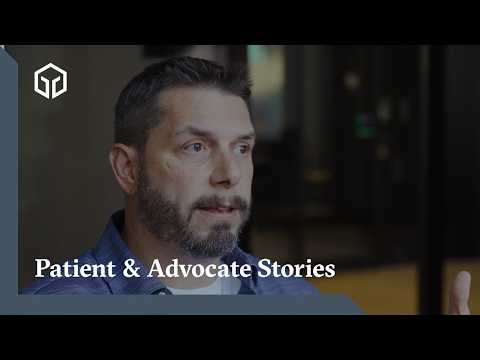
0:04 My name's Trevor Maxwell. I live in Cape Elizabeth, Maine. And I have been living with stage four colon cancer since March of 2018. so about 7 and 1/2 years ago was when I was diagnosed. In the let's say the winter of 2017 going into 2018, I started to experience a high level of fatigue. Like unusual and persistent fatigue. And it was something that, you know, I was 40-ish years old. I thought, you know, I'm in the middle of my life.
0:40 my wife and I had two young daughters at the time. They were 12 and 10 years old. And I just figured, you know, it's midlife fatigue. Like, you know, I'm just tired because of life and busy job and busy family. but it got to the point where sometimes I'd be walking up a a flight of stairs and I would be out of breath, which is very unusual for me because I'm a I'm a really physical guy. I've always been very physical. Like I like to heat our house with wood that I like split, you know, so And all of a sudden that winter it it just got really really hard for me to do anything physical. And like a lot of people, a lot of guys especially, I wasn't in touch with a primary care physician. I didn't have I wasn't going to the doctor for anything cuz I was pretty healthy. It got to the point where I had to reach out to my doctor. I did have a primary care physician, just hadn't seen her a long time. And I reached out to my doctor and I said, "I'm just having extreme fatigue. Like, what should I do?" And she said, "Let's just get some blood work done. Let's get some basic blood work done."
1:36 Well, the blood work came back and she called me and said, "You are anemic. Like, you're borderline needing a blood transfusion. you basically have no iron in your blood." She said, "Have you noticed any bleeding?" usually this is from blood loss. And I said, "No. I I haven't had any bleeding incidents or anything like that." And she said, "Usually if a otherwise healthy person is experiencing anemia, it often can happen in the gastrointestinal tract. And she said, "We really need to get you in for a colonoscopy to see if there's anything going on there."
2:06 and we got that set up within a couple weeks. she was a great advocate. But even at that time, like I remember Googling, you know, anemia, healthy person, like all the causes, and I remember seeing in one of those searches it said, you know, cancer or colon cancer. And I vividly remember thinking, well, like that's not me. that's like colon cancer is for old people or people who are sick or, you know, who don't take care of themselves and all this other stuff and it just wasn't something that I thought was a reality and so I went in for the colonoscopy and woke up from that colonoscopy and had to meet with the doctor and my wife and I sat down with the doctor and he said, " we found a very large mass in your ascending colon.
2:53 It's about 9 to 10 cm. So, we took some samples of it. We we got a biopsy. We're going to send it out, but we're going to need to you're going to need to get an appointment. I'll refer you to a medical oncologist and and a and a surgical oncologist, and you're going to have to have those appointments." And I said, like, "Are you saying that I have cancer?" And he said, "I can't say that for sure until we get the pathology back, but I'm 99% sure you have colorectal cancer."
3:21 And it was just a complete shock. just a complete shock to my wife and I remember going out to our little Subaru and sitting down and just looking at each other and we just didn't even have words. we had to go home. I started I had to make texts and phone calls to my my parents, my brother, my my friends and say, like, I had to inform them that I have colon cancer at age 41 and with young children. And then we had to go home and have that conversation with our children.
3:55 And and say to them, you know, I have cancer. I'm going to need to have surgery. I'm going to need to have treatment. and that was the hardest thing we've had to do in our lives. and so then all of a sudden I was in this it's a it's an overload of information up front. You're just all of a sudden thrust into this totally unfamiliar world of of of medicine and treatment that you know nothing about.
4:21 And within I think 2 weeks of my colonoscopy, I had surgery to remove the tumor in my colon. And I was had scans to see if it was elsewhere in my body. well, it turns out that I my my cancer had metastasized to my liver at that point. so I was a stage four patient. And that put me on a track for years of treatment to try to stay alive. so in the past 7 and 1/2 years, I've had seven major abdominal surgeries.
4:55 I've done more than 75 rounds of chemotherapy and immunotherapy. I've been mostly in the trenches of treatment for most of that time. And then in between the treatments and the surgeries, trying to live my life as a husband, as a dad, and and trying to make a living while living with metastatic colon cancer. So I first learned about biomarker testing and and genetic and genomic testing really early on in my journey.
5:26 because I had a a great surgeon. She was planning to do my surgery for my colon and she looked at me and she's like, "You're so young. Like you're otherwise healthy. Like I bet you have a genetic I bet there's some other like genetic piece of this." And so the first thing I did was genetic testing. so I did that and that came back showing that I have Lynch syndrome. Lynch syndrome is basically a glitch in your DNA that you're born with that makes you more likely to develop a cancer at some point. And for men, it's often colon cancer or colorectal cancer.
6:00 So, we we we did that right off and then when that came back, we did additional testing around biomarkers. So, I learned that I have a type of colorectal cancer called MSI-High. What it meant for me is that I'm a really great candidate for immunotherapy. most people with colorectal cancer are not good candidates for immunotherapy because of their biology, but I just happen to be in that small subset that it's really good for. So, I learned that pretty early on.
6:29 and so, actually after I I think after my second or third surgery, I started immunotherapy and it worked really well for a while. Eventually, I did progress on that leading to the other surgeries, conventional chemotherapy, different treatments. But, we always knew that I might be able to also re-challenge the immunotherapy to sort of try it again to see if it would work. And so, at first, like it it hasn't cured me. Immunotherapy has not cured me, but it's extended my life and now I'm on it again here in 2025. I'm back on immunotherapy and it's working amazing. my cancer is basically dormant. and that's that all stems from finding out what my biomarkers were and what therapies were going to work for my cancer. That is personalized medicine and really that is what everyone should have the advantage of.
7:18 so, I've been learning about that and and since really the beginning and it really biomarkers has basically informed my treatment since day one, really. and I've been fortunate that I had a great team up front that said, "We need to get these tests done." because that saved my life. I am I am here alive still being a dad and being a husband and enjoying my life because of biomarker testing. that's a big deal.
7:53 Man Up to Cancer is a is a community and nonprofit organization that our mission is is pretty straightforward. We inspire men to connect and avoid isolation going through cancer. we know that men tend to isolate at a higher rate than women when they're diagnosed. And we also know that people who isolate tend to have more problems with mental health, substance abuse, relationships, and also we know that people who isolate and are lonely also have worse medical outcomes.
8:23 So, I decided that well, I really didn't decide. It kind of just was maybe decided for me that my mission was going to be to try to help other men going through it. And so, I started Man Up to Cancer as a personal call to action right around the beginning of 2020, just before the pandemic, with this really this call to action to say, "Hey guys, if you're isolating going through cancer, there's a lot of negative consequences. what can we do, you know, and what could I do at that point to get men out of their man caves and and into socializing, learning about their disease, getting second opinions, you know, if you're just kind of hiding out and isolating, then you're really not giving yourself the best chance at at survival or even quality of life as you go through it."
9:10 And I realized this because as I was going through my own journey and getting support, especially on the emotional and social side, because I really struggled with anxiety and depression, I I had a stretch in my life the first year I was diagnosed mostly, where my mental health was really in a dark place. And it was only because I decided to with the help of my family, especially my wife's encouragement, that I really needed to seek help and really access the resources that are out there.
9:37 There's so many amazing resources out there that support cancer patients and their families and I once I started accessing that, my life changed. I had an amazing counselor named Patty who she really helped me through that that period of my life. And so, my mission kind of became how do I how do I reach more men to encourage them to sort of get the help that I got knowing how much it helped me in my life.
10:03 So, that became Man Up to Cancer. It's kind of a tongue-in-cheek name because when you think of the term man up, you typically think of get back on the saddle, you know, wipe off the dirt, you're okay. Hey, don't burden others. You don't need to talk about it. Just get back on your saddle and ride. And that that independent and that kind of that rugged individualism can be really good for some things in your life. but when it comes to dealing with cancer and this life-threatening illness, it's actually really damaging.
10:33 So, I said let's to my wife. I was like, I'm going to call my this movement Man Up to Cancer because to me, that means not just bringing your toughness, which you're going to need, but also bringing, you know, the bravery, the courage, the heart that it takes to reach out and accept help along the way. Because cancer is definitely a team sport. You need community going through it. and so, it really started with me doing a website and a podcast and just doing some communication around that idea that men are isolating. This is a problem. We need to change that culture.
11:06 And 5-year 5 and 1/2 years later, we have evolved into a nonprofit organization. We serve thousands of men across North America and beyond and we do we focus on social and emotional well-being for men going through cancer. So, these are all types of cancer, all men, all ages, all backgrounds. and we do retreats. We do local we have local chapters. We have more than 40 local chapters where men can get together in person. and then we do a chemo care backpack program where we send backpacks full of comfort items and practical items to men who are going through cancer treatment.
11:44 and really that is So our mission really is to change the way men go through cancer because I you know, I remember you know, a couple generations ago, even a generation ago that men aren't supposed to get help. Men aren't supposed to talk about it. and it's just really unhelpful. so I want to be part of of solving that that problem. Once men come into our Man Up to Cancer community, they see that we say I love you more than any other group that I've ever been a part of. Like this is men authentically supporting other men in fellowship and and in walking this road together. so you're going to see guys at our retreats just hugging the whole time, saying I love you. Like these guys are so brave and I have to say that from something to go from like a concept of like hey, we should I want to do this thing to help men with cancer to become a non-profit and to to grow and to scale, a lot of things have to go right.
12:37 The biggest thing that has to go right is you need other people to come on board and to believe in that mission and to work with you. So I may have put up the walls, but it's the members of our community who make Man Up to Cancer what it is by being brave, by sharing their open hearts, by changing the by being brave enough to change the culture because we're still kind of told in 2025 that you know, being vulnerable or even having pain or expressing it is is like a beta guy thing to do, right? It's like a that's weak, you know, I don't want to show that. even with some of the younger guys today, they're still getting that messaging.
13:14 and to me, you're never your best self on your own. You're always your best self with when you're working with others, when you're surrounded by people and you're working on a common mission. so I'm so proud of our guys for changing the culture. my hope is that when you look at right now it's probably eight right like I said 80% female to 20% male who are accessing cancer supports and resources. I would love to even you know, move the dial a little bit on that. So that you know, in 10 year, 5 years, 10 years, maybe we're seeing that creep up to 30 and 40. Where where it really should be because everyone gets cancer.
13:53 Right? this is not just a woman thing and and it's and in terms of getting that support and resources, everyone should be feel comfortable to to get that. Well, I've gone through so much over, you know, as I close in on 8 years living with metastatic cancer, like it doesn't do anyone any good if I don't share about it. my goal really in sharing my story is that other men especially who are out there and maybe they're in that dark place that I was. Maybe they're struggling with their mental health. Maybe they're feeling the the crushing weight of going through cancer with all your other responsibilities and roles and you feel like you're alone and all of a sudden you might hear you know, me speak about it or or a podcast or me you know, me when you hear me share my story, I'm hoping that that person just just really that it that it that they feel that kinship. That shared experience. That understanding that hey, there's others guys who are going through this and not only that, but look at the cool things they're doing. Like I want people to see like your cancer sometimes it you just turn away from maybe what you were doing like I did and all of a sudden you're doing something that's more aligned with your purpose. Like you can live a great life and and not everyone gets to do that, right? I'm I'm painfully aware that cancer is is a killer, right? Like I've lost in the Man Up to Cancer Community, we've lost more than 500 of our members over the past 5 years. We, you know, I've lost dear friends who who didn't get that opportunity.
15:26 But I guess my point is that I want to inspire those, especially those early diagnosed, to realize that this isn't the end of their story. And and whether no matter if their survival is going to be in the short term or in the long term, which we all hope it's going to be, that they can make an impact, that they can they can do something positive for the world. And they can be of service to others. Even if it's one person or two people, you can be of service to others while you're going through this cancer journey and have that be really really meaningful.
15:58 So, just to give them some hope and some inspiration and the idea that, you know what, good things are possible going through cancer. Biomarkers specifically are are very important in the colorectal cancer space. What my goal is is to encourage everyone to have that biomarker testing. You know, people should be doing these Foundation Medicine tests so that if there's a therapy out there that is going to help them, but it's targeted, they you don't really have the chance to really learn that unless you're taking these these tests that can show you your genetics and genomics so that you can match your disease with the appropriate therapy. That is that is crucial. It's crucial to to survival.
16:42 If you If you're get If you're diagnosed with colorectal cancer and your team is not talking to you about biomarker testing and what that means for your therapy, then I hope you get empowered to take the lead and ask for it and demand it and say, you know, what, am I getting biomarker testing? And what are we doing on that? And if the answer is no, then find a new team. Because it's it's so critical to matching your disease with the right therapy at the right time.
17:06 So, biomarker testing early, as as close to diagnosis as possible, is going to save lives. And we know that biomarker testing is not as universal as it as it should be. I advocate for universal biomarker testing for colorectal cancer across the board. My knowledge is not as specific or deep on the other types of cancers, but I believe that biomarker testing is now it's pretty much most cancer types where people are going to benefit from it. So, part of my goal as an advocate is to really empower people to learn about biomarker testing, to talk to their medical teams about biomarker testing. Patients are smart. We can understand biomarkers. You can understand that because I have this MSI-High biomarker that that matches up really nicely with this therapy that has saved my life. Like that's not super complicated.
18:02 patients have the ability to learn that and to act on it and to make sure that they're getting the right care at the right time. So, I'm I'm managing cancer as a chronic illness over a long period of time. I'm I'm here in 2025, almost eight years after diagnosis, being a dad to our girls who are now 18 and 20, being a husband, like being a friend, being part of my community, and that all goes back to biomarker testing.
18:31 None of that would have been possible without it. And also, doing this nonprofit work, building Man Up to Cancer, having that ripple effect where I can go out now and and help others who are going through it. Again, if my life without biomarker testing, my life I wouldn't be alive today and none of that would have happened. So, that's how big it can be. It's not sometimes, yeah, it's just about the person, but other times it's about the other people, the people who love them or the communities that they build and rely on them. so, I can't stress enough how important it's been in my life.
Summary
- Trevor was diagnosed with stage four colon cancer at age 41, after experiencing severe fatigue and anemia.
- He underwent multiple surgeries and over 75 rounds of chemotherapy and immunotherapy, learning about his cancer's genetic markers early in his treatment.
- He has Lynch syndrome and MSI-High colorectal cancer, making him a candidate for effective immunotherapy.
- Trevor founded Man Up to Cancer to encourage men to connect and seek support, combating the isolation often experienced by male cancer patients.
- The nonprofit has grown to serve thousands, offering retreats, local chapters, and care packages for men undergoing treatment.
- He advocates for universal biomarker testing for cancer patients, stressing its critical role in matching treatment to individual genetic profiles.
- Trevor emphasizes that cancer can be managed as a chronic illness, allowing him to continue his roles as a father, husband, and community member.
- His mission is to inspire hope and connection among men facing cancer, showing that they can still lead meaningful lives despite their diagnosis.
Questions Answered
What were the early signs of Trevor's cancer diagnosis?
Trevor experienced unusual fatigue and breathlessness, prompting him to seek medical advice, which led to his diagnosis of stage four colon cancer.
How did Trevor's diagnosis affect his family?
Trevor had to inform his young daughters about his cancer diagnosis, which was one of the hardest moments of his life, leading to a journey filled with surgeries and treatments.
Why did Trevor start Man Up to Cancer?
Trevor founded Man Up to Cancer to help men connect and avoid isolation during their cancer journeys, recognizing that isolation can lead to worse mental health and medical outcomes.
What initiatives does Man Up to Cancer offer?
Man Up to Cancer conducts retreats, has local chapters, and provides care packages to support men undergoing cancer treatment, fostering a culture of openness and support.
What message does Trevor want to convey to newly diagnosed patients?
Trevor emphasizes the importance of biomarker testing for colorectal cancer, encouraging patients to advocate for their health and seek targeted therapies.