Section Insights
Midterm Elections and Trump's Power
What are the implications of midterm elections for Donald Trump and the American public?
The midterm elections are crucial for Donald Trump, as historically, presidents lose power during these elections. Trump's low approval ratings and rising costs of living are significant factors that could lead to a shift in power in Congress.
- Midterm elections often result in losses for the sitting president's party.
- Trump's approval rating is at a historic low, increasing the risk of impeachment.
- Economic pressures are influencing public sentiment against the current administration.
Understanding the American Congress
How is the American Congress structured and what is the significance of midterm elections?
The American Congress consists of two houses: the House of Representatives and the Senate. Midterm elections are significant as they determine the control of these houses, impacting the president's ability to govern.
- The House has 435 members elected every two years, while the Senate has 100 members with staggered elections.
- Midterm elections occur halfway through a president's term and can shift congressional power.
- Control of Congress directly affects legislative agendas and presidential power.
The Stakes of Midterm Elections
What are the current dynamics in the House and Senate regarding the midterm elections?
Republicans currently hold a slim majority in both the House and Senate. The potential for Democrats to gain seats poses a significant threat to Republican control, which could lead to major shifts in policy and governance.
- Republicans need to maintain their majority in the House and Senate to retain power.
- Democrats could regain control with just a few seat gains in the midterms.
- The outcome of the midterms could influence Trump's political future.
Corporate Influence in Politics
How do corporations influence American politics during midterm elections?
Corporations utilize Super PACs to influence elections by spending unlimited money to support candidates who align with their interests, effectively shaping legislative outcomes without direct bribery.
- Super PACs allow for unlimited corporate spending in elections, raising ethical concerns.
- Corporations can indirectly control political outcomes by funding campaigns.
- The influence of money in politics blurs the lines between democracy and corporate interests.
The AI Industry's Political Battle
What is the role of the AI industry in the current political landscape?
The AI industry is becoming a significant player in political funding, with different factions vying for control over AI regulations. This competition reflects broader philosophical debates about the future of AI and its governance.
- The AI industry is investing heavily in political campaigns to influence future regulations.
- Different factions within the AI sector have conflicting views on how AI should be regulated.
- The outcome of the midterm elections could have lasting implications for AI governance.
Transcript
0:00 If Republicans win the House of Representatives and the Senate, I'm going to give all adult citizens in the United States, man and wife separately, $5,000. >> Ladies and gentlemen, the American midterm elections are about to be held and Donald Trump might just lose his power. In fact, Donald Trump himself has said >> They say that when you win the presidency, you lose the midterm. I mean, they'll find a reason to impeach me.
0:33 I'll get impeached. >> >> And if you look at the numbers, American midterm elections are so bad that US presidents have lost 20 out of the last 22 midterm elections held. Trump's approval rating has hit the lowest of his career and the Iran war has pushed up fuel prices, tariffs have pushed up prices in the shops, and seven in 10 Americans say that petrol is becoming unaffordable. >> Wallets of Americans feeling a greater pinch, a rapid surge in the price of diesel fuel is straining businesses and threatening to raise costs across the economy.
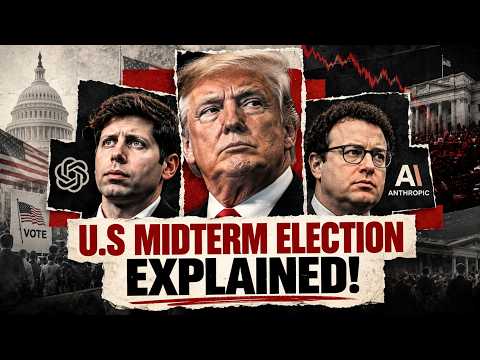
1:09 >> Some experts are warning it's about to get even worse. >> >> Most importantly, there is also a philosophical war between Anthropic and OpenAI over how AI models should be released and that could directly reshape India's IT industry. So, in this video, we will answer three important questions. What exactly is this midterm elections in the US? Why are Donald Trump and every American president so scared of midterm elections? And what do OpenAI and Anthropic have to do with American politics?
1:39 But before we move on, I want to tell you about a game-changing meeting note taker called Whisper, which is far better than other note takers for three reasons. Other note takers send a bot into your call. Everyone sees that creepy note taker has joined and it feels weird. Whisper doesn't join the call at all. It records quietly on your computer, so your meeting just feels like a meeting. Secondly, in India, we keep switching between Hindi and English, and while other note takers will turn gibberish, Whisper already knows how you talk. It understands English, Hindi, and even Hinglish. It uses your personal dictionary, your calendar, and even your Slack to understand the context of what you're saying. So, it gets the client names right, the product names right, and Hinglish absolutely on point. And lastly, while other note takers hand you a summary, with Whisper, you can say, "Hey Whisper, can you please write a follow-up email and give me a checklist for each person in this call." And it will write a beautiful email before you even blink. The best part is you can connect ChatGPT and Claude to WhisperFlow, so you don't have to keep switching between apps or copy-paste your meeting notes. Just ask your AI to pull up the notes from a specific meeting, and it already has the context.
2:44 And by the way, I have stopped using my keyboard since I got Whisper. All I have to do is tap the function button and say, "Whisper, can you please evaluate the DRHP of Zepto and help me understand if they're overvalued?" no, actually, first let's do the fundamental analysis. Help me understand the unit economics and compare them with competition, and also tell me their biggest challenges. Do you see that? It cuts out all the filler words and gives you a crisp sentence. And just like this, I have typed 148,000 words, which is practically equivalent to an entire book. In fact, Robert Greene actually used Whisper to write his book because his writing hand is paralyzed. So, skip the keyboard and get WhisperFlow from the link in the description. You get two products at the price of one, and it's a great productivity package. Check out the link in the description and download WhisperFlow now.
3:37 >> >> Chalo, let's start with the first question. Why is the American president the most powerful man on Earth always afraid of midterm elections? You see, just like India has a parliament, America has something called the Congress. And just like our parliament, the Congress is divided into two houses, the House of Representatives and the Senate. The House of Representatives has 435 seats, and just like India's Lok Sabha, they are divided among states by population. So, California with 39 million people gets 52 seats and Wyoming with about 6 lakh people gets one seat. And while our MPs are elected for 5 years, members of the House of Representatives are elected for just 2 years directly by the people.
4:21 The second house is called the Senate. Every state in the US gets exactly two senators no matter how big or small the population is. So, California and Wyoming both have two senators. Now, senators are elected directly for 6 years and 1/3 of them face elections every 2 years. So, America elects a president every 4 years and exactly halfway between them comes the midterm election. And 2026 is that year for the midterm elections. Now, during the midterm election, Americans elect all 435 members of the House, 1/3 of the Senate, or 35 of the 100 senators, and thousands of state lawmakers and governors. Now, US presidents hate this day so much that people call it the midterm curse.
5:05 >> Midterm elections are disasters for our sitting presidents and administrations. >> Midterms have humiliated some popular presidents. >> History is never kind to the party in the White House. >> But the question is, why? Because like I said, if you look at the history, in 20 out of the last 22 midterm elections, the president's party has always lost seats in the House. So, does the US president get replaced because of a midterm election? Not at all. The president still stays, but he becomes a toothless tiger. Why? Because if his party loses, the president cannot make a single law by himself. Every law has to be passed by a majority in both the House of Representatives and the Senate. So, the moment he loses a majority in the House or the Senate, his laws can get blocked, his budgets can be stalled, his appointments can be frozen, and the opposition can even drag him into investigations.
6:02 Now, look how badly this curse is stacked against Trump. In the House of Representatives, Republicans need 218 seats for a majority. Today, they have exactly 218 seats. At the same time, Democrats have 214 seats. So, if Democrats gain four seats, they can take control of the House and Republicans will lose power. Similarly, in the Senate, it's 53 Republicans to 47 Democrats, and you need only 51 seats to control the Senate. And in a 50-50 tie, the Vice President decides. This time, 35 Senate seats are up for election, and if the Democrats gain four seats, the majority will tilt towards the Democrats. And if you look at this graph, Trump has the lowest approval rating among the last 10 presidents. This is the reason why Donald Trump is scared that he might be impeached.
6:51 But the question over here is, how will the midterm elections affect India? And how will we know if the midterm elections are good or bad for India? Well, this is where American politics becomes dark. You see, while presidents are scared of midterms, large corporations absolutely love midterm elections. Why? Because if they want a law in their favor, they can legally spend unlimited money to influence who sits in the Congress. This legal method is deployed through an entity called Super PAC, and it is so confusing that it either looks like the greatest expression of democracy or the darkest thing in American politics.
7:27 Let me explain. In America, a company can never directly give money to a politician running for Congress. In fact, even a normal person can only give $3,500 per election. But what you can do is form an entity called a Super PAC. Let's call this group Maiden Group. Now, any corporation can donate unlimited money to this Maiden Group, and the Maiden Group can legally help the politician by spending money on ads. >> >> So, they can either use this money to attack his opponent, or they can flood TV and YouTube with ads to make him look like a hero. And there is no limit to this spending at all. Now, the question is, why do I call this dark?
8:04 Well, listen to this story. In 2024, Congresswoman Katie Porter was running for the US Senate in California. She, by the way, is very famous for grilling American CEOs in Congress. Katie Porter was criticizing the crypto industry for the energy that it was consuming. So, the crypto industry formed a super PAC called Fair Shake. And they decided that Katie Porter should not win the elections. So, you know what they did? They spent $10 million in campaigns just to stop her.
8:32 And the most shocking part is that their TV ads never mentioned at all. Instead, they accused her of taking money from big pharma, big oil, and big bank executives. >> Katie Porter plays us for fools, lecturing California on her values. She claims not to take corporate PAC money. No, instead, Katie Porter takes her campaign cash directly from big pharma, big oil, and the big bank executives. More than $100,000.
9:03 >> And a fact-checker, by the way, rated that claim mostly false. But even then, millions of voters were so influenced by these campaigns that they decided to vote against Katie Porter without ever knowing that those ads were run by crypto companies. So, do you realize in America, you don't need to bribe a politician. You just need to make sure that the politician who supports your business always wins, and the one who opposes your business always loses. And this happened so evidently that after making the Senate lose the elections after 18 years, the next morning the CEO of Coinbase posted a line saying, "Being anti-crypto is a good way to end your career." And this is absolutely spine-chilling because the following year, crypto got the law it wanted, and the genius act got passed in the Senate.
9:46 That is how you can use millions of dollars legally to either attack or promote a politician and get a law passed in your favor. But now the question is, why am I telling you all this, and how does it affect your life? Well, that is because as we speak, the same trick is being used by AI companies. And this could change the fate of every single person on Earth, including Indians. Look at this graph. Corporate political spending in 2026 US elections has hit a record high. As we speak, it stands at $646 million and a brand new player in that money is the AI industry.
10:19 But, why? Well, most people think this election is Republicans versus Democrats, but there is also a battle between two camps. A camp supported by OpenAI and a camp supported by Anthropic over who controls the future of AI laws. And this battle is split into three camps. Camp one is called leading the future. This super PAC is backed by OpenAI's president, Greg Brockman, and the investment firm Andreessen Horowitz. This entity has pledged over $100 million and as you can see in this chart, it supports both Democrats and Republicans who are in sync with its demands. And they have two very specific demands. Number one, they want a single law at the national level and number two, they want build and punish later philosophy to be followed, which basically means don't put harsh rules and costs on AI today, let the companies build freely and only punish if something goes wrong later. This is how internet was treated in the 1990s.
11:14 >> >> In 1996, a law called Section 230 protected websites from being sued over what their users post. So, Facebook didn't get punished for harmful user posts and Google did not get punished for showing the wrong search results. Eventually, all of them developed better tech, made money for everyone, and now they operate with regulations wherever needed. But, if they were regulated from day one, critics believe that the tech industry would have died before flourishing. So, Leading the Future wants the same thing to be followed for AI.
11:45 Let companies experiment and fix problems later. This is what camp one wants. Camp two is called Public First and camp two is backed by Anthropic, which has put in $40 million. This camp wants almost the opposite of camp one. Anthropic says that ideal is one strong national law, but until Washington acts, it supports states writing safety rules for the most powerful AI. Why? Because they believe that with AI, if things go out of control, the results could be a disaster that cannot be undone. For example, thalidomide was a sleeping pill sold in Europe in the late 1950s. But America's FDA refused to approve it until it was proven safe. People said FDA is being over careful.
12:27 But you know what? Later it was found that the pill actually caused severe birth defects in thousands of babies abroad. That is the strongest argument for checking before release. In fact, Anthropic's CEO Dario Amodei goes one step further. He wants something like an aviation regulator for AI. As in, a body that tests the most powerful AI models and can block their launch if they fail. So, just like a plane isn't allowed to fly until it is proven safe, an AI model should not be released until it is proven safe either. Now, to this philosophy, Sam Altman has suggested that this kind of fear can be a marketing tactic and it is being used to justify a few companies controlling AI. This is how two of the world's most valuable AI companies are fighting a philosophical and eventually a political battle in the American midterm elections. And by the way, the third camp is backed by Meta, which put in $65 million into super PACs targeting state elections to stop too many AI laws at the state level. These are the three camps that subscribe to three completely different philosophies, which are right now playing a very high-stakes game in the American midterm elections. And you can find all the details and research in the Substack link below.
13:33 So, do you realize for most of history a powerful technology was invented first and the society wrote rules later. Cars came before seat belts, planes came before air traffic control, and the internet came before we knew what it was doing to our children. But AI is different. This time the companies building the technology aren't waiting for the rules. They're helping choose the people who will eventually write these rules. So, the most important AI decision of 2026 may not be made in a lab in San Francisco. It may be made in a voting booth in Texas by someone who just watched an ad that never once mentioned AI.
14:07 Now, you might be thinking bro, I'm in India. I don't vote in Texas, why should I care? Well, please remember India now has 100 million weekly ChatGPT users and India is also Cloud's second largest market. So, whether these models get safety tested before release or release first and fixed later is not just an American question. The IMF estimates that AI will affect about 40% of jobs worldwide and in India about 26% of jobs are highly exposed. And remember crypto?
14:34 Once an industry learns that it can choose its lawmakers, it doesn't stop. So, on 3rd of November, Americans will think they're choosing between Republicans and Democrats, but in reality, they're also choosing whether the most powerful technology humanity has ever built gets tested like an airplane or launched like an app. And the rest of us, all 8 billion of us, will live with whatever they choose. Think about it and tell me which side you choose in the comments. That's all from my side for today, guys. If you learned something valuable, please make sure to hit the like button to support our work. And for more such insightful business and political case studies, please subscribe to our channel. Thank you so much for watching. I will see you in the next one. Bye-bye.
15:15 >>
Summary
- Donald Trump fears the midterm elections due to historical trends where the president's party typically loses seats.
- Midterm elections can render a president powerless if they lose control of Congress, affecting their ability to pass laws.
- Corporate spending in politics, particularly through Super PACs, allows companies to influence election outcomes without directly bribing politicians.
- The AI industry is increasingly involved in political spending, with different factions advocating for varying approaches to AI regulation.
- OpenAI and Anthropic represent opposing views on how AI should be regulated, impacting future laws that could affect global technology standards.
- The outcome of the midterms could shape not just U.S. politics but also international technology policies, including those affecting India.
- The video emphasizes the importance of public awareness regarding corporate influence in politics and its potential consequences for society.
Questions Answered
What are the implications of midterm elections for Donald Trump and the American public?
The midterm elections are crucial for Donald Trump, as historically, presidents lose power during these elections. Trump's low approval ratings and rising costs of living are significant factors that could lead to a shift in power in Congress.
How is the American Congress structured and what is the significance of midterm elections?
The American Congress consists of two houses: the House of Representatives and the Senate. Midterm elections are significant as they determine the control of these houses, impacting the president's ability to govern.
What are the current dynamics in the House and Senate regarding the midterm elections?
Republicans currently hold a slim majority in both the House and Senate. The potential for Democrats to gain seats poses a significant threat to Republican control, which could lead to major shifts in policy and governance.
How do corporations influence American politics during midterm elections?
Corporations utilize Super PACs to influence elections by spending unlimited money to support candidates who align with their interests, effectively shaping legislative outcomes without direct bribery.
What is the role of the AI industry in the current political landscape?
The AI industry is becoming a significant player in political funding, with different factions vying for control over AI regulations. This competition reflects broader philosophical debates about the future of AI and its governance.