Transcript
0:00 Hi, welcome back. So, it's finally here. You're saying what's finally here? The anthropic prospectus. And as a bit of a background, I am a dabbler. I tend to talk about things and move on. I very seldom stay in the same topic. It's a weakness of mine. I'm a generalist and I don't have the attention span to stay on one topic for a long period. But there are times where you keep coming back to the same topic over and over. In 2020, everything I wrote about traced back to COVID. How could you avoid it? And this year, it turns out that every topic I started talking about, AI entered the picture one way or the other. Just as a an example, in early September, I was wrestling with the question of as long-term rates, as interest rates in the US have gone up, why hasn't the stock market gone down? And as I traced out the answers, AI was part of the story. it was it was pumping up earnings in the aggregate across companies and allowing stocks to stay at a higher level. So you can go back and look at my AI post but for this particular post where I'm going to look at anthropic and value it. There are a couple of couple of earlier posts or sessions you might want to relate back to. The first is one where I looked at AI as a business because I said look we can talk about AI's promise as a technology but ultimately we're an investor investing in a business. So I looked at the total market the business economics and how that might play out. That was a couple of months ago just last week I looked at the fact that anthropic and open AI when they go public will get priced. It's not because it's enthropic or open air because that's what investors and bankers do when you take a company public. And I talked about the kinds of metrics you're likely to see when you see the enthropic pricing. You're going to see it priced against metrics you're not familiar with. Annualized run rates for instance, something you don't see with companies, but a measure of updated revenues for these companies. And finally, two days ago, Enthropic filed its prospectus. And at the time that I wrote about the pricing, I promised that when the prospects was filed, I would come back to value the company and I gave you my reason. I'm an investor and much as I respect the pricing process, I need a value for something before investing in it. So that's going to be the topic for today. So let's get the process rolling. As I looked at the prospectus, the first thing that I saw was it was 416 pages. Does that surprise me? Not at the least. It's very much the tenor of the times. You know, Airbnb, Uber, you can go back. The big IPOs of the last decade have all been 400 to 500 pages. And I think this is a problem. In fact, I wrote about this in an earlier post where I talked about what I call disclosure diarrhea. the IPO when Apple went public in 1980, its prospect is I think was 80 pages. Microsoft was 66 pages. But all of the IPOs over the last decade of much smaller, much less substantive companies with business models still in process have gone to hundreds of pages with why because some of it I think is is in force with with disclosure requirements. The rest of it I think is you know sections that have been added to these disclosures for for legal protection. The entire risk section in an IPO completely useless but designed to protect companies from getting sued. So the entropic prospect is 416 pages. And does it have information? Yes, I think it does. And as I look through the information, I'm going to set it up in terms of how you're going to approach it.
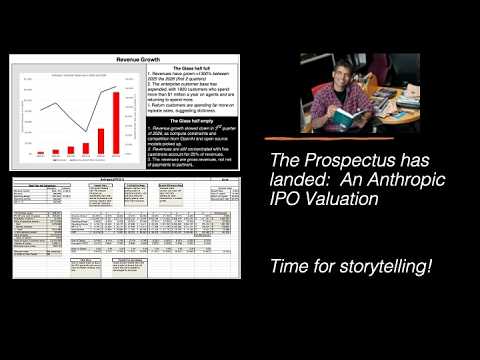
3:45 I'm going to argue that as you look at each component of the information, I'm going to break it up into four components. You will either see it as a glass half full as good news or glass half empty as bad news. The same information. So let's start with revenue growth. What do you see in the prospectus? A company that is reporting exponential growth up 1300 to,400% in terms of the revenues from last year to this year. And even on a quarter by quarter basis, you can see revenue growth has been skyhigh. This company's revenues have gone from basically nothing to 16 billion plus in the last quarter. And if you looked at annualized revenue run rates, you're looking at a company that could potentially have a hundred billion at least as a run rate by the end of the year. So let's not quibble. Clearly the company is growing fast. And there's more good news. It it has far more customers than it used to have. 11,900 and about 1,900 of these customers spend more than a million dollars in entropic agents. Furthermore, many of these repeat customers are spending more than they used to. So if you are a good news person, you're saying this is a fast growing company with customers who are spending more and more, therefore sticky will come back to spend more. What's a glass half empty story? The glass empty half empty story starts with an omission. the fact that the third quarter numbers were not fleshed out in the prospect. You're saying but the third quarter numbers might not be in it. Enthropic in its meetings with investors has kind of released at least its pri priors or its its news on the third quarter which is revenue growth seemed to have stalled in the third quarter. Now for why? Three reasons. One is if you you know anthropic argues that it ran into a compute power constraint.
5:39 it could not grow as fast as wanted to. The other two are potentially more dangerous for long-term growth. The the second is the company scaled up reporting 100% growth rate on a quarter-to- quarter basis is no longer going to be feasible and the competition is acting up. In this case, OpenAI is essentially, you know, competing on pricing power and try and that's having an effect on revenue growth. So revenue growth has been high, but maybe it's leveling off. It's still concentrated, less concentrated than it used to be.
6:12 The top five customers still account for 25% of revenues. Why does that matter? If they all left and went to OpenAI, that's going to be a big chunk of revenues. And finally, and this goes back to something I talked about in the in my pricing post, there is this difference between how different LLMs are reporting revenues. Open AI is has shifted to net revenues whereas Anthropic is reporting gross revenues. What are gross revenues? Some of Anthropic's revenues come from its partnerships with the big tech companies and those partnerships require that a portion of the revenue pretty hefty portion 15 20% go back to the partner.
6:53 Anthropic reports the total revenue but it's not being deceptive. reports the 15 or 20% that it pays to those companies as a marketing expense. So we'll come back and talk about the effect of that. But you can see glass half full, glass half empty. Let's move on to the profitability dimension. Let's start with the good news again. The glass half full. The expenses are going up, but they're going up far slower than revenues are. And you can see that in almost every single expense category.
7:22 Let's take the most critical one. Compute costs, which used to be 250% of revenue six quarters ago, is now down to less than 50%. That's a major shift. And you see that shift with every single expense. This is the essence of economies of scale, right? That the expenses grow at a slower rate than revenues. And Enthropic seems to be delivering on that. And as the expenses grow slower than revenues, the losses are not just shrinking, but at least according to Enthropics financials, they actually turn the corner at least in the very last quarter reported in operating profit. So the glass half full says look at the the trajectory here. The company is becoming profitable and it's on its pathway to deliver higher and higher profits. the glass half empty will look at the same numbers and push back. The gross margin philanthropic is skyhigh.
8:17 It's close to 80%. And the reason you might see my margin is a little lower than the outside estimates is I did take the portion of the partnership revenues that now shown as marketing cost and shown it as part of the cost of goods sold. So the margin still 80%. But that has been accomplished because Enthropic has moved its biggest single expense which is compute costs and from the variable cost category to the fixed cost category. You see this is great. Why doesn't every company do it? There's a trade-off here. We're going to come back and talk about but the compute cost is is therefore not as big a chunk of revenues as it could be if it were a variable cost. It is also true that the company will need to grow to keep its operating profits above zero. So that one quarter you saw as operating profits very dependent the company keep growing just to keep its operating profits positive. This is a growth bet. And finally I know people freak out about stockbased compensation but it's a feature at young companies and you can see it's a pretty expensive feature.
9:22 It's a a large number and it's growing. I'll be albeit at a rate lower than revenues. But if revenue growth dropped off, there's going to be a problem here on those the the stockbased compensation putting a drain on the revenues. So on the profitability front, good news is expenses are growing slower than revenues. Margins are getting better over time. The bad news is that this is a company that needs to keep growing at significant rates to keep its profits positive. Let's talk about the reinvestment. Now, the at first side when you look at the financials, the first thing that jumps out at you is it doesn't look like the company's reinvesting much. The capex is small, the invested capital is small, but it's not because the company's being deceptive. the company's actually open about the fact that this is a business where compute power is what you need to reinvest in and that the company is making a significant investment. You think why isn't it showing up? Because almost all of that investment is taking the form of compute commitments. The company's entered into contractual commitments and those commitments the contractual commitments amount to more than 450 billion. The collective commitments are more than 600 billion.
10:36 They're to big tech companies. You can see Broadcom is the biggest single beneficiary of these commitments. So glass half full will look at this and this is a good thing. If compute power is what separates the winners from the losers in this business, Anthropic is locking in compute power. In fact, it's used the last year to to play catchup with open AI that an advantage and that compute investment is going to allow them to continue growing over time. Now the other piece of good news that you might reach for is that much of that compute power investment is in chips and chips might be generally become cheaper over time. You look at history and maybe that'll make these compute commitments lower over time. Some of the compute commitments as I noticed are have flexibility built in. So maybe anthropic can back up. So the collective good news here is the company has entered into commitments that will allow you allow it to get more compute power in the future.
11:34 An essential ingredient for growth and if it keeps growing it'll have no trouble meeting these fixed costs. But the key word if it keeps growing the glass half empty is going to look at those commitments say what's wrong here a young money losing company with $600 billion in commitments. How the heck are they going to meet? And the answer is if they if they don't grow they can't make the commitment that fixed cost is going to drag them down. So growth is essential. Now and on the issue of will compute power get cheaper over time the push back will be maybe not. I mean these data centers are getting more expensive and more difficult to build and maybe the chip costs are not going to come down as quickly as you expect them to. So maybe these compute investments are not just done. a continuing investment and incrementally they're going to put more drain on the cash flows. Good news and bad news. As with the other dimensions finally on risk, let's start with the potential good news. The company is as I said the their customers seem to love their products. They're coming back. It's a looks like their revenues will not just grow but be sticky and maybe their products will become so so much of a requirement to their customers that they're they're almost non-discretionary. That makes the revenues more stable. That's at least the good news story. The company's second good news story is it has accumulated 114 billion. Accumulated is the wrong word. They've actually raised the capital fairly recently and they put into a cash balance and that cash balance is only going to get bigger after the offering perhaps another h 100red billion give you a cash balance of 200 billion that's a buffer against risk it'll allow them to meet their compute commitments in the near term and while there are regulatory risks the glass half full crowd will look at that and say that's actually a good thing because those regulations come in there might be a little drain on expenses but they're going to become the competitive mode that's going to keep you know cheaper Chinese competition in particular from entering the business.
13:32 What about the glass empty? They're going to see risks everywhere. There are operating risk because you have much higher fixed costs you got to meet and without growth you're not going to meet them. There's financial risk because those compute commitments are contractual that are like debt and if you don't make a debt payment that's the business will come to an end. And thirdly, those regulations might take quite a bite out of operating income. you know, not only might they reduce your margins, they might put you at risk as a as a business if they're stringent enough and and I think that there's truth on both sides, but again with each dimension, you can see very different reading of the prospectors. So, I'm going to summarize what I read from the prospectors and neither anthropic bulls nor bears are going to be happy with me.
14:17 On revenue growth, the plus is the company's growing fast. the people and the subset of users and that's all it is that have tried its products really like like them and are coming back for more. The minus is is that growth rate is coming down which you should expect because you're scaling up but the competition increasing is an issue because it might put pricing pressure on the company and the compute power constraints will continue into the future. Yeah. Now there is also this issue of the fact that so much of the business in this space and I'm talking about the space comes from other players in the space. It's a circularity that people talk about now as I as I'll say as I'll me know talk about this later. I don't think it's a conspiracy but it does make the numbers more opaque and creates a potential for double counting.
15:10 on the profitability front again let's start with the pluses. Expense are growing slower than revenues. margins are getting not just less negative but potentially positive. But the minus is this is a bet on growth. If the grow revenue growth does not continue the margins are going to go back to being negative because the big hits from compute cost commitments are coming to the income statements. Now it's this company is not profitable yet to deliver sustained profits. You need revenue growth to deliver you there. On the reinvestment front, the good news is Enthropic has caught up with OpenAI in terms of compute power. But that is and it has moved a variable cost that used to be variable cost and the fixed cost.
15:53 It's improved unit economics. The minus is in the process of improving its unit economics. It's created a much larger fixed cost where growth is necessary to cover those fixed costs. On the risk front, you know, I think the good news is the cash is going to act as a buffer and maybe the company is so big that people can't let it fail. It's also possible that the products of the company, the agents will become such a necessity that revenues become more stable. But the minuses are at least for the moment operating risk, financial risk and failure risk are all on the table.
16:30 Now as before I embark on the next phase I also want to caution you that as you look at this prospectus don't use it as a crutch there is there is almost no big question in AI that the prospectives will be able to answer because it's it's a it's a snapshot of a very young company now so you can take the prospectors and you can do the pluses and minuses but it to me it's you know analogous to a report card on a kindergartener, a very precocious and smart kindergartener, but a kindergartener nevertheless. Can you imagine looking at that report card and planning for college already? It might be a little too early for that, right?
17:11 This is too early in the process for the financials to answer the big questions, but they set you up for the big questions, which we will do in the next section. One final piece of advice, there are a lot of conspiracy theories, you know, spinning about anthropic and open and open AI and AI collectively. And my advice is stay away from them. Those conspiracy theories often evolve around a cabal of AI companies playing games to fool the world. So every hyperscaler is in on this cabal. Nvidia obviously they're you know open AI and and anthropic are part of this cabal and you know I and and the circularity is is the is the evidence they present for the cabal I think circularity is more self-interest than than cabal but that's just me there's also accounting fraud stories that how you know the you know one piece of evidence that's offered is this convertible the expense of 72.6 6 billion. That's just a conversion option kicking in, you know, and in fact, that's a feature, not a bug. When you pay for things with options, which is what you do when you use options with employee to pay employees or options or convertibles to pay for things is if you get if you succeed, those expenses are going to be massive because the conversion option will kick in. So much of what looks like accounting fraud is either self-interest or accountants making discretionary choices to make things look better than they perhaps really are. That's just not unique to anthropic. It's true across the board.
18:49 But the minute you go into a conspiracy rabbit hole, the problem is you can never listen to the other side anymore because it's a conspiracy. Now, how can you get yourself out? So my advice is stay away from the conspiracy theories. So all of this is a leadin to myanthropic valuation. You say have you already done that by looking at the prospectus? No. The prospectus is no matter how long it is 416 paces in this case and how detailed it is and how well done it is is still about the past. Valuation is about the future. You now have to leave the safety of disclosures and make judgments about the future. And guess what? I'm going to try to do it, but I'm going to tell you up front that I'm going to be wrong and perhaps even massively wrong on my inputs, but that's not going to stop me from trying. But along the way, I'm going to do something that you might not like rather than just listen to my story and my inputs. I'm going to try to drag you along and get you to tell your story and your inputs.
19:55 Now, no, no, not fair falling behind. I'm not a finance person. I'm not none of what I'm going to ask you to do requires you to understand valuation. But it does require you to make judgments. So let's get the show on the road and take this in four parts. Let's start with target revenues. I think looking at growth rates last year are neat, but ultimately the value of anthropic is going to come from how big its revenues will be once it gets past its growing pace. And to answer this question, I'm going to go back to a chart I created a couple of months ago and I talked about the AI business of how big the total addressable market is.
20:36 And I said there were four questions that will determine that. First is, is AI just a tool or will it replace employees? As a tool, the potential market is much smaller than if it replaces employees. The second is you know is it going to go after just highly paid employees or all employees because after all AI agents especially the powerful ones are expensive and if you say it's just highly paid the the market gets smaller than if it's all employees is it just in a subset of businesses or all businesses if it's just a subset no primarily technology and service businesses much smaller market than if it's all businesses and is it primarily going to be US and perhaps portions of Europe where people are paid more is it global and the answer there will also determine how big the market is and I said your answers to those questions will determine whether the total market is less than 2 trillion or more than 10 trillion if you're even thinking about investing in anthropic you better hope for the larger numbers right I'll give you my priors I believe that AI has the power to disrupt some but not all industries that'll go after white collar and highly paid workers more than all employees and I think a total addressable market of 5 to 10 trillion is was a pretty reasonable estimate given that we I also believe and this is my belief that based on an early reading of that AI anthropic is one of the lead players in fact it might be the lead player in the premium portion of the market and the as backup for that if you look at the prospect is they do report that 80% of their revenues come from usage not subscription models and from enterprises.
22:21 So market's going to be big. Enthropic is going to go after the premium portion of the market and perhaps be one of the key winners. So I think it's plausible that if you believe that you could get to 700 800 billion in revenues and there's an add-on if you read the prospectors and you listen to Enthropic what they talk about some businesses where they're not just supplying AI agents but they're part of the business. example is a pharmaceutical business where they argue that they could come in with their agents and take over portions of the pharma business in which case you become a player in the business not just a supplier and that gives you additional revenues. Now I you know in my story I'm going to give anthropic revenues of 1 trillion. It's true this is 10 years out and you can't compare to revenues today but today there isn't a single company in the world with revenues of a trillion or above. So before you accuse me of being, you know, too conservative in my numbers, I'm giving Enthropic revenues that no company today has. But it reflects the story of Enthropic becoming this company that serves multiple businesses and delivers agents that actually take away big subset of company's costs.
23:34 Now, as I said, I'm not going to let you get away with not making a judgment. So, I'm going to give you some choices and I'm going to structure these choices, you know, to give you to at least guide you along. So, we're talking about revenues 10 years out and I want you to do tell to make a choice on what you think the revenues will be for anthropic in 2036. And I've given you some guidance. If if it's only a two, the revenues are going to be much smaller, only 200 billion. you the the growth rate you see for years to five two to five are my the way I get you to the revenues you want in the target to me growth rates are just a pathway to an end so you could go with the target revenues lower than mine 200 500 800 or go bigger 1 1.5 trillion if you're going to go you know even bigger 2 trillion 2 and a half trillion be my guess you can just enter the number and the growth rate will have to adjust to reflect that so that's the starting point is target revenues what about the profitability story you know as I said there's good news in the prospect is about how expenses are growing slower than revenues but this is about end margins what will the target margins look like once you got get past the growth pains and here I think we have to do to divide the AI product and service market into a mass market where the products will be less powerful more commoditized where the margins are going to be closer to the margins for business services 10% and a premium segment where the agents are incredibly powerful and can do things that people might not be able to do as well. And there the margins are going to be much higher powered by client data. They're going to be stickier and there I think the margins are going to be closer to enterprise software 40%. 10% and 40%.
25:20 And those are going to be my dividing lines because for Enthropic I'm going to make the judgment that they're going to based on what they're already focused on more in the premium product and less in the mass market. 75% premium 25% mass market. I don't think they can entirely avoid ignore the mass market because it'll be a pretty big market in terms of revenues. So that'll give me an unadjusted operating margin of 32.5%. You think what do you mean unadjusted?
25:48 Later I'm going to talk about the regulatory risk overhang here that could affect margins but that's going to be my starting point here. Again you don't get to cop out. So you make your pick on what you think the mix is going to be for anthropic from all mass market. Maybe this entire business will be commoditized or maybe anthropic is going to be all premium so 10 to 40% and or you can make a choice somewhere in the middle. So we got revenues you got profitability. Let's talk about reinvestment. Reinvestment here is the compute power story, right? The nature of compute power is that the investments will age quickly. Chips are going to get outdated. So, what that's setting you up for is this is a this is not one and done. That they will have to keep upping their computing power commitments and perhaps get have more compute power in the future. So while chips may get cheaper, the power needed might increase as well as the other stuff you need for comput bar, the real estate, the the traditional, you know, the the energy you will need, the water you will need.
26:54 So I do think that you know, at least my story that the compute power crunch that we're facing now will ease up. All these data centers that are in the proc process of being built once they get online will ease it and that translates into the assumption that it in steady state once you get past the growth pains will need to reinvest about a dollar to get $3 in additional revenues going forward. Now again that's a that's a function of the story I'm telling of compute power becoming not not completely surplus and plentiful but easier to access $3 of revenues for every dollar of capital. Now before you say what does that mean? No that basically means that if they want to grow faster they will have to reinvest more. Here again you get to pick if you think compute power will remain scarce and costly. This is if data centers are you know are the construction is stopped on them chips become more expensive whatever reason then you lower the sales capital ratio require more reinvestment to get the same revenue so again numbers ranging from one to my estimates I've highlighted my estimate three and my or you might believe computer power is going to become you know surplus and cheap in which case you you might be able to grow with far less reinvestment so that's your choice that drives your rein investment which brings me to my risk story.
28:20 I think that the the the eye business is has lots of potential but it's still growing. Lots of things can go wrong and they will right now and along the way we will find out more about companies demand for AI agents which is will they cut them cut back how much they spend on AI agents in bad times. We don't know how cyclical or non-yclical the business will be. But the operating risk is is there. We just don't know much about it.
28:49 So I'm going to make the judgment that that it carthropic carries the risk of large technology companies with the burden of compute commitments and use a cost of capital that reflects their risk as a company which I computed based on their specific inputs 9.74%. You know, just for perspective, the median cost of cap for a US company in September 2026 was about 9.16%. The third quartile was 9.88%. So, I'm giving them a cost of capital close to the third quartile. So, that's the judgment you got to make. And here again, I'm going to push you to make a choice. I use 9.74%.
29:28 But you might decide to go with the technology median that's lower. You might say it's safe and go with the 7.79%. or you might put in a direct input. The only note of caution though when you put in a direct input is you got to be it's got to be bounded bounded by reality. So don't sit there saying I'd like a cost to capital of 20%. Because you got to live in the world you're in not the world you were wished you were in and given risk pre and risk-f free rates once you get past 10% you're pushing the limits on what a public company should have as a cost of capital. There's a financing risk issue which is by deciding to enter into these contracts or comput commitments anthropic faces the risk it might not be able to meet its contractual obligations. In fact its current bond rating is double B+ below investment grade that might improve after the IPO. But here are the things that make me you know more upbeat about the failure risk assumption. One is that immense cash balance close to 200 billion my estimate after the IPO and the second is it's you're you're a trillion dollar plus company you're in some ways too big to fail you have access to capital people want you to stay alive so but I still do believe that if revenue growth doesn't they don't deliver on revenue growth and it happens one year or maybe even two years there is a probability of failure which is not zero and I'm going to attach a 10% chance that that could happen. If it does happen, the value is not going to go to zero, but somebody's going to buy the agents for far less than what you think they're worth, half the value. On the failure risk assessment, as I said, I use 10%, you're welcome to disagree.
31:10 Maybe you believe that there's no failure risk. You can say you you can override the assumption in the spreadsheet. All of these choice I'm making are in a spreadsheet that I will link to after this session. You can go to the spreadsheet and enter the numbers but you can make an alternate judgment on failure risk. Finally there there is a clear regulatory risk component here right which is and in fact open athropic have invited the government to regulate them which the cynic would say that means that they want the regulations to keep the competition out but no matter what the motivation is for that ask those regulations are going to create a hit on margins. Why? I mean, think about social media. What did the regulations do? They didn't make Facebook and you know, less powerful. No, in fact, they might have made it more impregnable in terms of competition, but they did raise costs.
32:04 Facebook had to hire thousands of people to make sure that the regulations were met. So, it'll cause a drop in margins. So in my story, I think the regularatory effects are likely to be mild and lower margins from the 32 1/2% that I originally estimated down to 27 1.5% or reduction of 5%. Now your response might be you don't agree. Fine. In fact, I'll give you choices. You can assume no regulatory risk, 0% effect on margins.
32:34 My assumption was 5% drop in margin. So maybe the mar you think the margin drop will be much greater. Remember these are changes in the margin. So if your margin is 25%, you pick minus 10% your margin will go from 25 to 15%. So the regulatory risk effect in my view is going to show up more in margins perhaps even in your revenue growth assumption which brings me to my valuation. I've kind of laid out the markers on what I think about company. re a revenue growth that's going to deliver target revenues of about a trillion dollars in 10 years.
33:10 Right? Big story. Margins of 32.5% based on the mix of 75% premium 25% mass market with a 5% reduction for regulatory overlays and costs. a growth efficiency story where compute power will get easier to acquire over time, but it'll still remain a drain on the cash flows, delivering $3 of revenues for every dollar of capital invested. A cost of capital of 9.74% to start to reflect the fact that they're a pretty risky business right now, but over time as they get bigger and more profitable, that that cost of capital will converge on the cost of capital, median cost of capital for a US company, 9.13%.
33:53 You know, and I think that the risk story here shows up in three places. A high cost of capital, a failure risk of 10% that have attached to the company and the fact that there's the the that the operating leverage is very dependent on growth being delivered. So with that story, which I think is a pretty upbeat story, don't you think the value that I get for the entire operating assets is about $1.7 trillion. That's a pretty big number. You add the big cash balance they're going to have which is about you know which is especially if you count the expected proceeds from the IPO of close to 100 billion about 220 billion you subtract out the debt 4 you're saying why is the debt so big 473 billion you will not see that number on the balance sheet right now cuz I'm capturing the present value of contractual commitments as debt you're saying is that allowed in accounting I don't know and I don't care why does it matter what accounting allows this is a real contractual burden.
34:52 You have to bring that in with valuation. Now, while while you might find it odd that I've ignored the accounting, I used to capitalize traditional operating leases starting in 1992. Accountants finally got around to doing it in 2019. Doesn't mean that it wasn't debt before 2019. And I'd say the same thing here. The bottom line with my assumptions and adjusting for failure risk is a value of the equity of 1.48 48 trillion. It's pretty close to the lower end of the offering price number that you've seen band bandied around. The share count is still in process. What I've done is taken the weighted shares outstanding today, added on to it the restricted shares that are shown in a footnote right now, but are shares out there. You know I haven't counted the option shares because I value the options directly but I've also included the shares that will be offered in the IPO to get the 100 billion in cash altogether based on that share count as I said which is object I get a value of 447 I will revisit that per share number when more when the prospectus is refiled with more specific numbers about share count but that reflects where I see the company today 1.47 trillion. If you're accusing me of being conservative, this is a big number for an IPO. And I think it reflects a really upbeat story.
36:23 But if you've tracked along and you made your best choices, you can see the best cases and worst cases play out in the stories. Your worst case entropic story is that the AI market becomes a mass market, lowering margins. Revenue growth essentially reflects AI as a tool, which will be much lower. the cost of capital rises to the third quartile for US companies 9.88%. And if those things come to fruition, anthropic's value of equity is minus 373 billion. You say what? Well, the company won't exist. It'll go bankrupt. That's a worst case. And that should come as no surprise here. What's the best case story? that AI becomes a much bigger market because it replaces people across businesses and that anthropics revenues go to 1.5 trillion. They could be even larger but let's say 1.5 trillion.
37:15 Margins converge in the premium market 40%. Compute power becomes cheap which means you can use a much higher sales to capital ratio and the cost to capital moves to the first quartile. Your story might be AI agents are a necessity. You can't live without them and therefore they're non-discretionary, lower cost of capital. You do that, your best case scenario, your value is 4 trillion per equity. I mean, that's part of the reason when somebody says, I think anthropic is cheap. I'm not going to say you're wrong. They have a story and I want to know what that story is because I want to learn from their story. I might not accept that story but I would like you and the reason I pushed you is you know you will hear multiple stories for anthropic and I would suggest that if you're investing your own money you need your own story. I'll do the mechanics of converting your story into value but come up with your story and then pass it through what I call the 3P test. Is it possible? Is it plausible? Is it probable? because you need to take ownership of the story no matter what you choose to do for entropic.
38:17 Now, of course, I've kind of avoided the issue of corporate governance, but it's it's lurking here, you know, it's, you know, but I want to start with the definition of corporate governance. It's not a score you see on Yahoo Finance. It's not who sits on the board of directors. To me, corporate governance is a measure of how much power shareholders have to change the way a company is run when they don't like the way it's run. That's it. Right now you might say no having a having a stronger board makes a difference. Absolutely.
38:47 Now having insiders who can push for change makes a difference. Absolutely. All of those things are true. But ultimately it's about measuring that power. So that power to create change on the part of shareholders will be great at companies where boards are more activist and effective. We have an activist investor pushing and you could measure that if you want but ultimately this is about the power and here I think you know Google kind of created a problem that should have created push back then but since nobody pushed back has become a bigger problem until 2004 US companies did not have at least the ones that were not grandfathered did not have multiple classes of shares with different voting rights there were grandfathered companies the New York Times Ford etc companies going public had one class of shares. Google broke that precedent by having two class of shares with insiders the founders owning 10 voting rights per share and you know on their shares whereas the regular shareholders got one institutional investors did not push back and other tech companies learned.
39:52 They said okay these guys won't push back and so since then it's become the norm for many tech companies going public. Facebook did it. But you can go down the list of other companies that have done this. And once you do that, you essentially, you know, we can debate this a good thing or a bad thing. Are founders smart or not? But in terms of power for shareholders, it reduces the power for shareholders to create change when they want change.
40:18 So what's entropy going to look like? It is a corporate governance quagmire. That's the only word I can use. So, there's five classes of shares. Class A will be the shares offered to the public. One vote, one share. You're saying that's good, but hold on. There'll be employee shares with voting rights limited to changes that affect the benefit trust. You're saying what's a benefit trust? We'll come to that. Hey, and there'll be class N shares, which will be the corporate shares held by Alphabet and Amazon, where they will have no voting rights, but a share of profits and cash flows. A class T shares held by the benefit trust. the benefit trust is going to be have the power to choose and elect the board of directors. You're saying but I thought that that what that was what we as shareholders do in this company the benefit trust is going to appoint the majority of the members.
41:07 You're saying to what end? You know as I said we'll hold on that because I'm going to talk about the benefit trust more and then there's a final class of shares or one share a class F share held by anthropic seven co-founders with 50.1% of the voting rights. This is an in yourrr-face. I'm going to take power structure, right? But let me talk a little bit about the benefit trust because there's a twist to anthropic that makes it even messier. It's going to be a public benefit corporation.
41:37 Under Delaware laws, as a public benefit corporation, you're allowed to balance the interests of multiple stakeholders. I've talked about the the absurdity of stakeholder wealth maximization. Public benefit corporations make that their central theme. What does it allow these companies? It gives them legal cover. They can take decisions that make shareholders worse off and you can't sue. That's basically what this is is really protection against legal push back when the company is doing things and the other stakeholders can be anyone and no one. I know the words public benefit suggest you that this is going to be run for the benefit of society and given the concerns we have about AI being a force of destruction which Daario himself has kind of actively cultivated right this could kill this could destroy the world it's in the prospectors say this is good we don't want shareholders making those decisions because they could ruin the world it you know maybe you know it it's just me but you know I think that's naive D to think that you know taking that power from shareholders and giving it to seven people which is what the founders are and trusting them to do what's right for society when has that worked out well in fact as you look at the last 20 years and the forces of ESG and sustainability I mean you know that's effectively what we did with both those with both ESG and sustainability is gave the power to top mans that you do what's right for the You can make the judgment on whether it's actually worked out for the betterment of society, but I don't like this. And the total the the the total benefit trust that I talked about earlier is going to be composed of people that the founders picked to. So this is going to be I you know I I I hate to use the word but this is dictator level corporate governance. you know, Kim Jong-un or whatever the whoever the dictator in North Korea would love to have a structure like this. It's in perpetuity. You've given up the power to change the company.
43:47 So, that's something to worry about. Am I Does that mean I will never buy anthropic shares? No, it just means I have to have a much bigger discount to do that. Now, the IPO is going to be the offering price will be set soon. I don't know where between 1.5 and two 2 trillion it'll be you know and I would caution you that this stock will be traded it won't be valued it is that's what happens with all IPOs and anthropic that's going to happen in sales but there's a worry about lock up here if you're a trader that you know that's going to come up to the surface it already has unlike most IPOs where insiders are not allowed to sell their shares for 6 months before you unlock the shares here the shares are going to be unlocked in tranches. In fact, on the first day, insiders other than founders and certain major figures will be allowed to sell up to 10% of their shares starting on day one. And the remaining shares will be unlocked in tranches leading up through the first 180 days. And by the 180th day, insiders will be completely free to trade.
44:49 Founders and other key figures will be allowed to trade after 365 days. Does that bother me? I'm not a trader and it doesn't bother me much. And I think too much is made of this lock up and unlock up stuff that the story seem that when these shares are unlocked the stock prices. I challenge you to go back and look at SpaceX and Tesla and any any of these companies around the unlocking. The effect is never as big as people make it out to be if at all because markets know the unlock is coming. It's not like they wait for the date to adjust. So if it bothers you then don't trade. But if it does, no, I don't think even as a trade it's going to make a big difference.
45:29 So if you are going to trade the anthropic IPO, you know, you you have to trade it, which is no, you have to play the mood and momentum game. Maybe go back and look at my last session where I talked about pricing anthropic. I'm an investor. I really can't trade because I don't trust my trading skills. If it's, you know, and I I've given you my estimate of equity value for anthropic with my upbeat story, 1.48 48 trillion.
45:53 If it's priced well above, which would be my guess as to what it's going to be priced, I'm not buying the shares and it gets pushed up even further. I'm buying the shares even less because it's just too richly priced. It's not because I don't like the company or AI. If you know, but once it starts trading, the game doesn't end, right? The story is going to keep evolving. News is going to come out about whether AI agents really work. Regulations are going to come out.
46:20 This is going to be a roller coaster ride where the price is going to go up and down and maybe perhaps even drop below my 1.48 trillion. And if that happens, I'll of course have to revalue the company with the news that's come out. And if it's underpriced enough, and the reason I say underpriced enough is I don't like the governance structure. I hate the public benefit, you know, cover that they're using to essentially protect themselves. It's got to be significantly underpriced, but it'll happen. I can guarantee you it'll happen because it's happened on every company I've ever tracked. I mean, I, you know, you go back and look at the Mag 7, you know, you look at Tesla, a company that when I priced, you know, I valued from 2013 and 18 overvalued, ultimately it there was a point at which it was undervalued enough for me to buy it. And that'll that'll come with entropic. And I never say never. If it if it comes down enough, I will buy it.
47:19 But for the moment, given the stories about what it's going to be priced at, it's too rich for my taste. But along the way, you've told your own story, maybe your value is much higher than mine, which case you might be able to buy at 1.6 trillion or 1.7 trillion or even at two trillion. I hope you found this session useful and I thank you very much for listening.