Section Insights
Introduction to AI Assessments
How can someone with little experience use AI to generate income?
Individuals can sell assessments where they ask questions and let AI handle the research and report creation. The video outlines six AI assessments that can be sold for $1,000 or more.
- AI assessments can be a lucrative business opportunity.
- You can start with minimal experience by leveraging AI tools.
- The assessments involve asking the right questions to gather necessary data.
Speed to Lead Assessment
What is a speed to lead assessment and how does it benefit businesses?
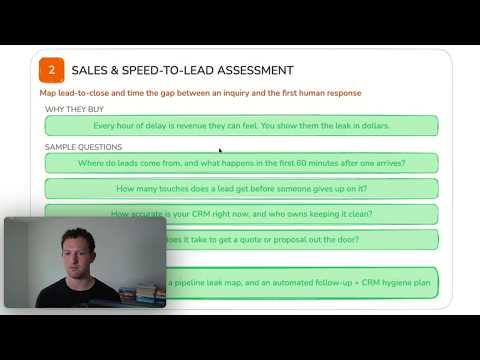
A speed to lead assessment measures how quickly a company responds to leads and identifies gaps that cost them revenue. It suggests AI tools to improve response times, ultimately increasing profits.
- Quick lead response can significantly impact revenue.
- Identifying gaps in lead response is crucial for business growth.
- AI can streamline the lead response process.
Utilizing Sales Call Recordings
How can businesses leverage sales call recordings for improvement?
Most businesses do not repurpose sales call recordings for content or training. There is a missed opportunity to extract insights and improve sales strategies from these recordings.
- Sales call recordings are underutilized resources.
- Repurposing content can enhance marketing efforts.
- Analyzing successful sales calls can improve team performance.
Data Entry and Automation Assessment
What common issues do businesses face with data entry and reporting?
Many businesses still manually enter data across multiple systems, leading to inefficiencies. An assessment can identify tasks that can be automated, saving time and resources.
- Manual data entry is a common inefficiency in businesses.
- Automation can significantly reduce time spent on repetitive tasks.
- Identifying key workflows for automation can enhance productivity.
Data and Reporting Assessment
What challenges do businesses face regarding data accuracy and reporting?
Businesses often struggle with outdated or poorly reported data. An assessment can provide peace of mind by ensuring access to accurate, real-time data for decision-making.
- Accurate data is essential for effective business decisions.
- Many businesses rely on stale data, which can misinform strategies.
- Regular assessments can help maintain data integrity and relevance.
Transcript
0:00 This is how you print money in 2026 with AI. Even if you're new, even if you have zero or very little experience, you sell somebody an assessment. Now, what is an assessment? An assessment is where you literally get paid to ask questions and then you let AI do the heavy lifting, do the legwork of finding out what you're actually going to prescribe to the client and putting together your report. So in this video, we're going to talk about six different AI assessments that you can sell for at least $1,000.
0:28 You could realistically sell these for two to $5,000 or more. And we're going to talk about the questions that you can ask during your assessment to get the feedback required to have AI go and do the legwork and do the research. And then we're going to talk about the deliverable that you actually give to the client and what they're actually buying for each of these offers. So the very first offer is going to be the AI tools assessment.
0:50 Now, I've sold about 25 of these so far in 2026. This is by far the easiest offer to sell. It's not even close. I even give away the exact template that I use to fulfill these AI tools assessments. You can get that in the description. Now, what is an AI Tools assessment? This is where you audit the workflows of a business owner and you literally just tell them where they could be using AI and where they're not yet using AI.
1:16 Like, it's literally that simple. So what they're buying is they know that AI matters, but they have no idea where to start. And this just hands them a plan that tells them, hey, you have this problem, you could be using this AI tool. Hey, you have this problem, you could be using this AI tool. It sounds so simple. Everybody complains and says, oh, couldn't they just ask Claude? Yeah, but they don't. Right? And they are willing to pay you for that.
1:38 It's the simplest offer in the entire world. So what are some sample questions you ask during an AI Tools assessment now? And even to back up when you're doing these assessments, you're doing these on Zoom and you're having an AI note taker sit in on the call so that you can get the transcript from the call and feed it to Claude and have Claude put together the deliverable. Like, that's the whole premise behind these assessments. So some sample questions that you ask during an AI Tools assessment is, what tools does your team use daily, which ones do you pay for, but ignore?
2:08 Walk me through Any tasks that eat five hours a week, who does it and in what tool? If one process got 10 times faster tomorrow, which one would move revenue the most? Where do things fall through the cracks between two systems? Now, obviously you're going to ask them more questions than this. This is just some food for thought to get you started. But you keep prodding, you keep asking questions and the answers that they give you, you're going to take that transcript, you're going to give it to Claude and you're going to have it go and do some research to put together your deliverable.
2:37 And, and in this case your deliverable is a scored what we call an impact versus effort matrix and the top three AI tools that they could be using and the ROI that they'll gain from each of those tools. Now, what that looks like in practice is let's say the client is struggling with, you know, not being able to follow up on calls appropriately. Okay, well, you could literally use a simple AI note taker like Fathom or like Fireflies to pull out the action items from each call and send that follow up for you automatically.
3:07 That's an AI tool that's literally free that most people are not using because they don't know it exists. That could fix that pain point for them. Right? There are so many pain points like that that simple off the tool, off the shelf tools can solve. And that's the deliverable of the AI tools assessment. Now, when it comes to the AI tools assessment specifically, this is what I teach people, how to sell for $1,000 as a Foot in the Door offer inside our AI Operator Academy community.
3:35 If you're interested in that, if you want to learn from me directly, if you want to make money selling assessments like these, then join at AOA community or at the link in the description below. Now the next assessment that you could sell is a speed to lead assessment. Now I really like this one because it maps directly to revenue and in this case you're going to map the amount of time that it takes for a company to close leads to.
3:58 You're going to identify the gap and explain to them how much money they're losing by not responding to leads quickly and what they can do using AI to fix it. So what are they actually buying? Right, they're actually buying the fact that they're delaying responding to leads. And you can identify some simple AI tools or some simple AI workflows that can speed to lead. Right. Increase the amount of, or I guess decrease the amount of time it takes for them to respond to Leads, which is going to lead to more dollars in their pocket.
4:27 So if we're on a call with a client and we've sold them a speed to lead assessment, what are some questions that we can ask to get the context needed to have AI go and do the research to make a qualified prescription? Well, we can ask things like, well look, where do leads come from today? What happens in the first 60 minutes after one arrives? And for most business owners they're taking hours if not days to respond to leads.
4:50 So this is some incredibly low hanging fruit. A speed to lead assessment. We can ask them things like how many touches does a lead get before someone gives up on it? For most business owners that's one or zero. You can ask them how accurate is your CRM right now? Who owns keeping it clean? For most business owners that is, it's not accurate, it's not kept up to date and it's a complete shit show. Then you can ask them how long does it take to get a quote or proposal out the door.
5:15 Again, for most business owners you're talking days or weeks, not minutes or hours, which is what's required to have a true speed to lead system and stop bleeding money. So your deliverable and a speed to lead assessment is you can mystery shop the response times of their competitors and report to them like, hey, your top three competitors on average are taking 12 hours to respond to new leads. You are taking 27 hours to respond to new leads.
5:44 That is why you are losing money to your competitors. You could also give them a pipeline leak map. So that is so easy for Claude to put together. You can hand Claude the transcript of this call, say hey, analyze all their leaks and their pipeline and put together a pipeline leak map and even have Claude scaffold a automated follow up and CRM hygiene plan. So that is the deliverable that you are offering here for the speed to lead assessment.
6:10 Now if you do this right, if they're paying you $1,000, they are getting so much value out of this. Like this is such a no brainer. That's why aside from the AI tools assessment, which is by far the easiest one to sell, this is probably the second easiest to sell, but has the highest impact to a business owner because it ties directly to revenue. Next one you can sell is a marketing assessment. So this is where you can audit what they're publishing, how long it takes them to publish marketing materials, whether that's email, that social media content and which pieces actually produce leads.
6:43 Because most business owners have no idea what parts of their Marketing are actually generating leads. They're literally just throwing things at the wall and hoping more leads come through the door, which is not a good strategy at the end of the day. So what are they buying? They're buying the fact that they're posting consistently or inconsistently, or they're marketing whether consistently or inconsistently, but they can't tie any of it to revenue. And you're going to be able to fix both of those by literally just shining a light on, on their marketing activities and telling them what's working and what's not working.
7:13 So some sample questions you can ask here is, hey, what content went out last month and how many hours did it take to produce which channel brought in your last five customers? Do you actually know? Most business owners have no idea, right? They are hoping clients come through the door and when they do, they have no idea where they came from. What happens to a webinar, a podcast, a sales call recording after it ends? For 99.9% of business owners, nothing.
7:39 The answer is nothing. They're not repurposing that into additional content. They're not using the insights from the sales calls to better train their sales team. They're not taking, you know, closed deals that came from their sales calls and seeing what they did right, so they can do more of it. There's so much opportunity in the sales call recordings and in the content they're already creating to repurpose it across more platforms. Then you can ask them things like, well, who writes your emails and your post today?
8:08 What is their bottleneck, right? What is preventing them from doing more of the marketing that might be working? So your deliverable in this case is what we call a channel ROI scorecard and a repurposing engine plan. So the channel ROI scorecard is your estimate of, hey, Mr. Business Owner, you're marketing across social media, Google Ads, Facebook ads, and referrals. Here's the breakdown of each of those channels and here's how much money you're estimated to be making from each of those channels.
8:38 And I guarantee you, a business owner has never taken the time to do that themselves, which is why they'd pay an outside consultant like you to do it for them, so that they know where to double down and where to cut effort in terms of their marketing channels. And a repurposing engine plan is incredibly valuable because you can take one podcast recording that the owner was on or one sales call that the owner had and repurpose that to a newsletter, to social media posts, to clips, to marketing emails.
9:08 To so many different assets. And again, business owners just aren't doing this because they're so in the weeds of their day to day business. Next is a back office assessment. So this is where you're going to audit their invoicing process, their accounts payable or their accounts receivable process, their expenses, their schedule, scheduling and they're reporting prep to figure out where the hours hiding in these manual tedious processes. This is one where you're probably going to find the most low hanging fruit in terms of time that you can get back.
9:38 For business owners. Now, what are they buying in this case? They're buying the fact that nobody likes this work. It costs real payroll and it's the easiest to automate. So they're basically buying a blueprint for what these processes could look like if they were automated. So some sample questions that you could ask here. How many days does it take from the work completed for the invoice to be sent and how many days does it take from the invoice to be sent to actually collecting the cash?
10:05 And the idea behind this question, and this ties directly to revenue, is if you finish the job on a Friday, but you don't get the invoice out until Tuesday and then the client doesn't pay until the following Tuesday, that's almost 10 days after you completed the job, so that it takes you to get paid. Right. We could easily implement some automated follow up systems to get the client to pay sooner. And if we can cut that 10 days to three days, for example, then you literally got your cash, you know, almost twice as fast.
10:34 So that's just an example of one particular process that would be very easy to automate that a back office assessment would uncover. Then we can ask things like who chases late payments? How many hours a month does that take? You know, if you're in a business where a lot of buyers are buying on credit, so I think like wholesale or distribution or manufacturing, most of their clients are buying on terms, meaning they're not paying their invoices for 30, 60, 90 days.
11:01 But even if the invoice is due 30 days out, they're usually not paying until 45 days. So the sales rep is having to call them on the phone and chase down that invoice. Right. There's so many opportunities to automate that follow up process. To cut the days required to collect cash from say 45 to 25, for example, we could ask them, how are expenses categorized today? Is anybody retyping data between systems? I guarantee you, especially if a business has been around for 10 years or more.
11:30 There are so many data entry duplicate processes, I can't tell you how many business owners are retyping data into QuickBooks, into Excel, into Google Sheets and to ClickUp into, you know, all these other tools. When realistically that doesn't need to be done at all, then you can ask what reports do they build by hand? Every week or month a lot of people are going in and pulling, you know, CSV files or pulling reports manually. That doesn't need to be a manual process.
11:56 A lot of times it doesn't need to happen at all. But if it needs to happen, it can be automated. So the deliverable in this case is an hours recovered estimate per task and an automation blueprint for the top three workflows. And again, if you did this on a zoom call or on a Google Meet with the client, you can literally hand the transcript to Claude and have Claude build this deliverable for you. It is that simple.
12:20 And again, I'm going to put a playbook in the description below for how you could run each of these assessments. So if you like any of these assessments in particular, get that playbook, it's in the free resources link in the description below and you can hand the playbook to Claude and have it build your business plan. All right, the next assessment that we can sell is a hiring and onboarding assessment. Now this is one that most people probably have never thought to sell, but this is for bigger, any bigger company that's hiring frequently or firing frequently or turning over employees frequently, that is a huge like that is a huge time suck.
12:57 It costs a lot of money. Multiple people are involved. There's so many inefficiencies in the hiring and onboarding of new employees. So in this case, a hiring and onboarding assessment would audit their job postings, their job screening workflows, their interviewing workflows, and the first 30 days of training. And what they're buying in this case is they're buying the peace of mind and the efficiency that comes from mitigating any bad hires and speeding up the onboarding and training process.
13:28 Right? This, this assessment is going to help them come to the realization they need to make that process a lot smoother. So some sample questions you can ask in this case. How many applicants did your last role get and who screened them? How long does a new hire take to be fully productive? Where does training live today? Is it a document? Is it a video? Is it in someone's head? A lot of times training or onboarding is just like an off the cuff process.
13:54 There's no structured process process for onboarding new hires that's going to lead to increased turnover. That's a massive efficiency gap. And that is something that this assessment can identify and help prescribe a fix. You can ask things like what do new hires ask in week one that they should be able to self serve, Right. And the deliverable in this case is you can create a hiring funnel time audit which basically tells them, hey, here's what your hiring funnel looks like today.
14:22 Here's all the gaps and the inefficiencies in that funnel and here are some suggested fixes. You could even recommend an AI screening workflow. So at least having an AI agent do the initial screening part of the applicants, the very first stage. Now building that workflow is not part of this deliverable. This is just a suggested blueprint for that particular workflow. And then you could even provide them with an onboarding knowledge based blueprint. So this really addresses that last question that I mentioned that we could ask.
14:54 So if we find that new hires are asking in week one, a lot of questions that they should be able to self serve, that business could just have a simple knowledge base with all the business information that the new hire can ask that knowledge base instead of having to bother the manager. Right? So you can give them the blueprint for that knowledge base as part of the deliverable. Here again, you're not building it because that would be the upsell after the assessment.
15:20 And then lastly would be a data and reporting assessment. So this is where you're going to find where the numbers live, who compiles them and how stale they are on arrival. You would not believe how big of a problem this is. For most businesses, data is old, it's not reported properly or it's not reported at all. So in this case, the owner is buying the peace of mind that they're getting the live numbers that are accurate as opposed to last week's numbers or last month's numbers.
15:46 So sample questions in this case could be like, hey, what numbers do you look at weekly and how do they get to you? How many spreadsheets or tools does someone open to build the monthly report? When did, when did a decision go wrong because the data was late or wrong? If you could see one metric in real time, which one would change how you run things? You'd be shocked to know how many business owners, especially a bigger businesses, are running the ship blind.
16:12 Like they don't have up to date numbers. They're running their business based on last month's numbers or 45 days ago's numbers. So the deliverable in this case is a data source map. So this is where you can show them. Hey, this is where all your data lives today. It's spread across four tools or six tools or 14 different tools. Then you can also give them an prescribe the blueprint for an automated dashboard and a weekly AI summary plan.
16:39 So this is where you could explain to them, like, look, you could put together an automated dashboard, here's a blueprint for building that and a weekly AI summary plan where the AI can go into your tools, pull out your main KPIs and populate the dashboard with those live up to date numbers so that you're never flying blind, so that you're making decisions based on real numbers and not estimates or not stale data. Right. So that is what you're offering as part of a data and reporting assessment.
17:07 Now the pattern that you're going to see here is every one of these assessments runs on the same framework. So you only have to build the machine once. Like you could offer all of these different assessments because the underlying foundation is the same. You're going to charge $999 per assessment or more if you want. Each one is going to take roughly two hours of your time because you're going to do the discovery portion of the assessment which is about 45 minutes.
17:32 Then you're going to build the report which can be automated, and then you're going to do the walkthrough which is going to be about 30 minutes. For every finding that you come up with for each of these assessments, you're going to score them on what we call the three outcomes which are effectiveness, efficiency and quality. Effectiveness means is it going to make them more money? Efficiency means is it going to save them time? Quality means is it going to improve the quality of their product or service?
17:56 And at the end of the day, the assessment is a product. But the retainer that you sell, the consulting retainer or the implementation that you can sell is the upsell after the assessment and that's the real business. So these assessments are meant to be a foot in the door, not your main income. And then you can upsell them on consulting or you can upsell them on implementation. And that is where you make your money. Now, like I said earlier, if you want to learn how to start a business that uses assessments as a foot in the door at $1,000 or more, join AI Operator Academy.
18:29 We've got 280 plus people in there selling assessments as the front end and then upselling AI concierge consulting or custom builds or a number of different offers after the fact where they're making the majority of their money. AOA community to check it out or the link in the description. And if you want the full playbook for each of these assessments, hit the link in the description next to Free resources, I give away the full playbook that you guys can use to implement this.
18:55 Hope you enjoyed and I'll be back soon.
Summary
- **AI Tools Assessment**: Audit business workflows to identify AI integration opportunities, providing a plan that highlights tools to improve efficiency.
- **Speed to Lead Assessment**: Analyze lead response times and recommend AI tools to reduce delays, directly linking improvements to increased revenue.
- **Marketing Assessment**: Evaluate marketing efforts and their effectiveness, offering a channel ROI scorecard and strategies for content repurposing.
- **Back Office Assessment**: Identify inefficiencies in invoicing and reporting processes, delivering an automation blueprint to streamline operations.
- **Hiring and Onboarding Assessment**: Assess hiring processes and training efficiency, providing insights to improve onboarding and reduce turnover.
- **Data and Reporting Assessment**: Examine data management practices, offering a data source map and a blueprint for automated reporting dashboards.
- **Framework Consistency**: Each assessment follows a similar structure, requiring minimal time investment and allowing for upselling of consulting services post-assessment.
- **Community Support**: The speaker invites viewers to join the AI Operator Academy for further training and resources on selling assessments and consulting services.
Questions Answered
How can someone with little experience use AI to generate income?
Individuals can sell assessments where they ask questions and let AI handle the research and report creation. The video outlines six AI assessments that can be sold for $1,000 or more.
What is a speed to lead assessment and how does it benefit businesses?
A speed to lead assessment measures how quickly a company responds to leads and identifies gaps that cost them revenue. It suggests AI tools to improve response times, ultimately increasing profits.
How can businesses leverage sales call recordings for improvement?
Most businesses do not repurpose sales call recordings for content or training. There is a missed opportunity to extract insights and improve sales strategies from these recordings.
What common issues do businesses face with data entry and reporting?
Many businesses still manually enter data across multiple systems, leading to inefficiencies. An assessment can identify tasks that can be automated, saving time and resources.
What challenges do businesses face regarding data accuracy and reporting?
Businesses often struggle with outdated or poorly reported data. An assessment can provide peace of mind by ensuring access to accurate, real-time data for decision-making.