Transcript
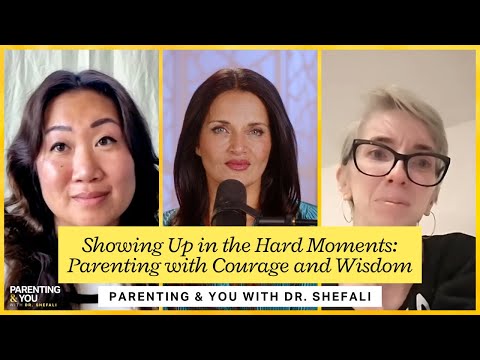
0:00 [Music] Hi everyone, welcome to a new episode of parenting and you with me Dr. Shafali. What do we do when life throws us a wild curve? What do we do when we end up in life situations that we were simply not prepared for? You know, most of us enter adulthood or our parenting journey with a vision of what it will look like. And quite often, if not most often, that vision doesn't come to fruition. Things happen. Marriages end. Health issues show up. Things happen to our children.
0:40 All of which we had not planned for. Showing up in these moments requires great courage, flexibility, and wisdom. Well, if you are someone who knows what I'm talking about and needs some guidance around how to handle unexpected life situations, you are going to learn a lot from this episode. Coming up, a mother who wants to know the best way that she can adjust to living back with her mother and break her generational patterns.
1:12 Joining me now is Vanna. She's the mother of an 11-year-old autistic boy and she wants to know how she can break generational trauma. Hi Vanna, how are you? And tell us what's going on. Hi Dr. Shafali, thank you for having me. What's happened in my life lately is that I'm a single parent. When I got divorced, I had to move back home. And in this situation, being the mother of an autistic 11-year-old boy who's wonderful, I love him. and being the daughter to my mother again. I find that the intersectionality of my identity is coming to a bit of a clash where I have to be a good daughter to my mom but also be a good parent to my son. And some of those factors are really competing against each other. I just like to know how to organize my identities so that I serve both people in my life who I love very much. But I feel like it's causing me to be inauthentic at times in the sense that with my mother, she's she grew up in the Cime Rouge era. We're Cambodian. And I know she has lots of unadressed trauma. And to add to that, you know, my parents' marriage is not, you know, idealistic, which is their business. But, you know, I find that I'm having to serve my mother in such a way that I want her to thrive. I'm also raising my son in in a way that I don't want him to have the same childhood as me where I had emotionally absent parents and somebody who I love very much. My sister-in-law, she said to me, "Oh, in a loving way, I think you've, you know, overcompensated with your son.
2:52 You're trying to give him this whole childhood that's so different from yours." and she said it in such a loving way, but it did make me think, am I somehow veering towards narcissistic parenting in the sense that I'm trying to avoid my son having my childhood so much that it's serving me and not him? And then Yeah. Do you see what I mean? I do. I do. It's okay. It's okay. So, just we'll break down a few pieces here and then perhaps you can do more work with another coach. But for this moment, you are living with your parents right now?
3:24 Yes. For the time being, yes. Okay. And is this something that you foresee happening for the next few years or is it just a temporary thing? Probably the next few years. Okay. So you're going to be here for the next few years. So that is a reality and we can one day perhaps explore why is this your reality? But for right now I'm going to just accept that it is. Now in this reality really briefly give me three words that can describe your mother's consciousness and how she acts toward you. I have three sisters. She depends on us. Mhm. For emotional regulation. Mhm. For her emotional regulation. Mhm. She's dependent and she needs us to care for her. Mhm. I can see that it's hard for you to say something about your mom. Is it bringing up guilt in you perhaps that you're not being a good daughter right now? Of course. Yes. Of course. I want to be the best for her, but I don't want my child to be in the same situation that I'm in. I can just very quickly offer you this perspective that if you want to be the best mother for your son, you need to let go trying to be the best daughter for your mother. How do I do that? It's my nature. But when you say it's your nature, we don't know for sure because you were raised this way. So sometimes the way we're raised, our conditioning we believe is our nature, but that it's not. We don't know what your nature truly is because when you're with your mother, she has conditioned you to be her mother. She has conditioned you to be there for her.
5:00 She's conditioned you to be someone who serves her needs. And this is not typical. This is not necessarily healthy for you as a daughter. You know, typically conscious mothers are like how you are with your son. You allow your son to be a child. You allow your son to look to you for help, not the other way around. And so the fact that your mother is dependent on you, this is a completely dysfunctional relationship. Do you understand? Do you see that? Or are you completely unaware of that? I do see that. And I'm trying to look at my mother as a human being rather than my mother. So I try and look at her as someone who didn't receive love from her own parents. So maybe she's owed some love. I love that you actually are seeing her as a human being who did not get love. But the solution that you have created is still coming from a beautiful daughter role. So the solution to a human being who didn't get love is not necessarily a daughter who sacrifices herself. You have created that as a solution because that's how she's raised you. She's conditioned you that your duty and obligation in life is to serve her. That is not the solution for a human who didn't get love. The solution for a human who didn't get love is for the human to learn self love. For the human to learn how to heal herself, not to predate on her child to be a surrogate parent for her. You are her surrogate parent even though you're the child. That is dysfunctional. That is actually not healthy. So how do I care?
6:38 You can care about her without taking it as your responsibility to fix her, to heal her, to cure her. You can care for her physical comfort. You can be gentle, kind, and respectful. But when you overstep that role and try to be her therapist or her mother or be a surrogate for all the love that she did not receive, you are actually overstepping your role as a daughter. And you've done this your whole life. This is your issue, right? You've been this beautiful, empathic, overly pleasing daughter who is an overfixer and probably is trying to fix her son's life, too. But you think it's your job to be, you know, this holier than thou figure in your mother's life. And as long as you do that, you will not be able to fully be your own parent, your own adult, nor a mother to your son. You have a lot on your plate, but somehow you think it's not enough and you need to take care of everybody around you.
7:41 And you've taken it on yourself to heal your mother when it's her job to heal herself. And I am saying be loving, be kind, be respectful, but it is not your job to heal her. This is a dysfunctional codependency you are creating and perpetuating in your mother. I see. Okay. I understand that in words, but I know I need to process this. You know why? Because when you're with your mother, you just fall back into the pattern. Yes, it's very difficult. But I just want you to leave with one nugget that your mother by using her daughters or her children for her emotional comfort, for her emotional safety and by her dumping on you, by her venting to you, by her looking to you to take care of her has actually limited not just you but herself. So if you allow it to continue, your mother is never going to grow up. You are enabling your mother to stay infantile and not heal herself.
8:45 Okay, I see. It's very hard though. I understand what you're saying. It's going to take a long time to sink in. So, but I will keep that in mind. But remember, you came here asking for help for generational trauma. So, you knew that it is a big thing. So generational trauma is huge and no one is asking you to fix it even in your entire lifetime. Don't worry, you can stay the same. You know, consciousness is not about necessarily making a 180 shift. The first step is awareness. And for children to become aware that, oh my goodness, my dad or my mom is actually a 5-year-old and they have been using me and pulling me into their BS and drama and their past. That awareness is all you need to have for right now because I can see you're shocked. I can see you're like paralyzed in in in just awe of this fact. Let it sink in.
9:51 This is a big revelation to for when a child realizes that they have been parenting their parent and the parent hasn't been independent. It is a shock. So I need you to just be gentle and compassionate with yourself and allow it to sink in. It's a big paradigm shift when you realize that this is not healthy. This is not functional. It's dysfunctional. And you see our parents, they do it in very subtle ways, right? Yes. They'll complain a lot. They'll cry a lot. They'll sigh a lot. They'll whine a lot. Right? They'll be babies in front of us. Gh. And you know, but that is not for a child to absorb. That is for their friends to absorb. That is for their therapist to listen to. But they dump it on us. And for a beautiful, empathic, sensitive person like you, all your life you've been her therapist. All your life you've been her sponge. Wow. I feel like I've I've not been good enough. That's the opposite. I feel like I've been the opposite. Never been good enough.
10:56 Really? I know my beautiful friend. Listen to me. Because these adults, so-called adults have so much trauma in their own lives and we have to have compassion. But because they don't take the accountability to do their own healing, they are narcissistic in a way by not healing themselves. They dump their pain, their trauma, their anxieties onto loving people around them. And because they don't take accountability to fix, to heal, to solve, to grow, the person who they dump on or the many people that they dump on who are typically empaths take it upon themselves to rescue these people. So you know you I can tell you you have been rescuing people, fixing people, saving people. This is your nature. And what you do is you try so hard, but because they haven't done the work, you will never feel like it's enough. It's like a bucket with holes because nothing you can do can fix another human being.
11:58 That human being has to do it for themselves. And in this way, even though you're a loving daughter, you are actually perpetuating her own misery. You are part of her system now perpetuating her staying wounded. You are not helping her heal. You're teaching her to outsource her healing to you. And you're a little bit delusional because you think maybe I can fix my mother. Maybe if I try hard enough and if I'm a little bit nicer and a little bit more patient, my mother will become a joyful human being. And guess what?
12:35 The next week rolls around. It's Monday morning and she's still miserable. And it takes years to realize, oh my goodness, she's not miserable because I'm not doing a good job. She's miserable because she's never wanted to change. And she's never tried to change. And here I am. I'm blaming myself. I understand that. Like I've been saying, I understand that. And I want to process this so it sinks in. So then if I'm acting as a wall, if I'm being a wall to sort of stop this from reaching my son because he sees her misery too and he has tried to comfort her and then he's starting to read books to her to make her feel better and he doesn't really understand situations that she's going through. I mean how do I break the pattern? Yeah. How do I know? Yeah.
13:23 Well, the first thing is for you to learn that she is going to be miserable even after you read her 1,000 books. She's going to be miserable until she does the inner work to heal her own inner brokenness. So, stop reading books, stop telling her stories, stop cooking for her food, stop singing songs, stop doing anything. All you need to do is go, "I understand, Mom." Uh-huh. Mhm. Mhm. Uh-huh. Mhm. Mhm. Mhm. You don't have to be a wall. You can talk, but you don't have to take any action because you think your action is solving a puzzle. It's not. It's making the puzzle stay a broken, fragmented jigsaw piece. So, when you get that light bulb moment, it's a light bulb and it takes a long time to flash that, oh my goodness, all my efforts are leading to zero because this is the person's pattern. And she's actually happy being unhappy. She's actually happy being miserable. When I say happy being unhappy, meaning she's comfortable being unhappy, it's her way. It's her status quo. Because if somebody is not happy being unhappy, if somebody's genuinely unhappy being unhappy, they will do something about it. Yes, I understand that. That that was me when I was going through my divorce. That was you, right?
14:38 So yes, I do understand that, right? So you have broken the pattern with your divorce. You can break the pattern with your mother. It's a long journey, but you can start moment by moment and you can begin tomorrow. But thank you so much, Vanna. I know I dropped a load of truth on you and a lot of bombs have exploded in your consciousness. This is the start of your liberation if you truly want to liberate yourself. Yes, I do. Yes. Thank you so much for your advice and your time. Many of you were listening to this episode and didn't see Vanna's face, but I could. It was really hard for her to assimilate all these truth bombs. And I have always maintained that when we wake up from our slumber to discover the patterns of our relationships, it is a hard pill to swallow. So whether you're realizing who your partner is or who your mother is or who you yourself are, it's never easy to become aware to our inner dynamics. When these things happened, it is really important for us to take the time to digest it and to reflect on it and not feel ashamed for having been stuck in a dysfunctional relationship or in a dysfunctional pattern. Most of us when we are unconscious, we get stuck in dysfunctional loops. So, it takes a lot of effort, a lot of consciousness to break free. So, like I said to Vanna, she needs to give herself time. You need to give yourself time and have a lot of compassion for yourself as you break free from your dysfunctional patterns.
16:13 Coming up next, a mom who's so worried that she's not able to be a good enough mother to her daughter due to her medical condition. Joining me now is Anna. She's worried she's not a good enough mom due to her health condition. Hi Anna, what's going on? Hi Dr. Shapali. I'm so glad to be here with you. So I've been diagnosed with MS a few good years back more than 10 years. But my condition started getting worse I would say during the pandemic. In that time I also got pregnant with my husband which I love very much and I had my beautiful daughter. The thing is my condition kept on getting worse and I got from being able to work and have a normal life to using a wheelchair, a frame. Oh, and uh my question was because my condition sometimes makes me snappy. Mhm. I hate that. I would like to know how to be more conscious in those moments when I'm not well cuz sometimes I just feel like I instantly need to raise my voice because she sometimes doesn't listen.
17:23 Like I would like to guide her, not to make her listen to me. How old is she now? She's just a few years old, right? three years and 10 months today. I know I'm I'm asking a lot from her sometimes like but yeah it just basically like if I say okay mommy then let's try and go pee because I know it's been nearly 4 hours and she starts to struggle with me and she says no and I feel very triggered because I know it is time to go and then are you nervous that if she doesn't go on time then you'll have to clean it up. Is that the fear? No, no.
17:57 It's just about cuz I know she doesn't really So, she just keeps it in. She doesn't really let go and I just worry like it's very uncomfortable for her. Correct. But do you see how you're trying to control something that is not in your control? If your 3-year-old doesn't want to pee and you get upset with her, you're actually telling her that she shouldn't trust her own inner knowledge. You're telling her, you know what, you don't know what your body needs. And I agree with you. You may be right, but it doesn't matter because we're trying to teach them to know their own body. So, you have to go through this phase of letting her make the mistake. Yeah. Right. And she will learn. Thing is, I always ask her, do you feel like your tummy is full? Do you feel your be in your tummy? And she says, yes. And then I say, okay, it's time to go. Let's try and go get it out.
18:52 And then we continue playing and then the fight starts. But do you see how you're trying to control her body though? It doesn't matter what she says if she's not ready to go. You're you're taking her away from her own inner autonomy. But more than that, you're driving yourself crazy. Yeah, it is very stressful. To be honest, it's very stressful. What are some other ways that you and your daughter clash? Let me try to help you. when it's time to go to bed, when it's time to sleep, she loves singing. And she would go to the Alexa and I know I need to get rid of Alexa and choose another song and I say, "Okay, it's time to go to bed. It's time to go to bed." And then she just goes back and forth, back and forth for 10 minutes, whatever. It takes like an hour to get her to get in bed, right? But then to actually fall asleep, it's sometimes another hour, another hour and a half. Right? We just cuddle and she just stings. And so I would encourage you with that one is you should take out the Wi-Fi. No Alexa after 8:00, right?
19:55 No phones. Wi-Fi is gone. Finished. It's Oh, what happened to Alexa? Ah, she'll come back tomorrow because all the Wi-Fi is off and we're going to bed. And when you're in the bed, you should just go to sleep. Go to sleep. Let her do whatever she wants. She will fall asleep. What I'm trying to tell you is that you may be trying to control things that you don't need to control. And I think it comes from your own condition where you are feeling out of control and you want order. You're trying to control a three-year-old and a three-year-old can never be controlled in that way. You're trying to get some safety in your life, some predictability, some organization because you're feeling so out of control with your MS. But I think you're over trying to control her instead of just working on your own inner zen. Right? So all the anxiety you have about her, I want you to now take it back and breathe and focus on yourself. Take all that energy. Did you pee? Let's go to sleep.
21:00 Let's go to sleep. Just go inside yourself and go and go to sleep and go meditate and relax. And if she pees in her pants, she's going to learn that way. And she may be tired for an hour, but at least you're not yelling at her. Maybe she doesn't sleep for that hour, but you're not yelling at her. You see how important it is for you to not lose your control. Yeah. Especially with your illness, you need to conserve your anger and your energy. Don't give it out. If you're getting angry every 10 minutes or every day, you are losing energy. I wouldn't even say it's getting angry.
21:40 It's just I need I feel like I need to raise my voice for her to hear me cuz she's so loud sometimes and I need to raise my voice over her so I can make myself understood and Yes. And so what you're doing is you're training her to listen to a loud voice. Right. This is where you're you're creating patterns. You're creating habits. She will listen to you if you stop talking and wait for her to come to you. She will come to you, but not if you're trying to boss her or dominate her or talk over her.
22:13 I'm actually trying not to do that, but in those moments sometimes I mess up. Sora, cuz I've been following you for two years and I need to say that you really changed a lot like in my thinking and the way I thought things should be. I'm so proud of you with parent child relationship but I'm just this moments this moments when I snap and I'm not I feel like I'm making messing up the everything I don't know it's I feel like it's my fault it's my fault for this it's my fault for that yeah I know you feel guilty you're feeling ashamed you're feeling embarrassed you're feeling like a failure so many mothers suffer from this and I always tell them that whenever you think it's always your fault kind of the same way of saying I have created everything in this universe it's like this delusion right then you start laughing right when I say you know would you feel like you created all the amazing things that she does you laugh but why do you think you created all the negative things you see it's a delusion in a weird in a different way but guilt so much guilt everything I do is wrong or it's all my fault fault. It's the same delusion that believes all the good things are because of you. So, it's a faulty way of thinking and I want you to work on that so that you don't keep building that negative thinking muscle.
23:41 It's a wrong way to think. It's a negative way to think. So, we need to change our way of thinking. Okay? you are dealing with so much that you're taking on this extra guilt because of your condition. You believe that, oh, I'm not a good enough parent now that I have MS. But it's not true that you're not a good enough parent because you have MS. You're just a very different parent. You know, I have seen parents who are the most affluent. They have five cars and six nannies and they're healthy and they're young and they are horrible parents. I'm sorry to say. So just because you have MS doesn't make you an unfit mother. Don't let that stop you in your belief that you are a good, amazing, strong mother. In fact, you're teaching your child lots of beautiful lessons that other quote unquote normal, healthy mothers will not be able to teach. Now, I'm not trying to minimize the pain, but this belief that you have that because of MS, you're a bad mother.
24:49 I'm trying to take that away because then the opposite should right because then then the opposite should be true. Everyone who doesn't have MS should be an amazing mother. And is that true? No. No. But just sometimes it's I think it's because of my mobility mainly because I I wish I could take her to the park for example and I can't. So it's I think that's where everything starts. Yes. Yes. But let's focus on what you can do.
25:15 Right. So now we know you can't do so much but don't cling to that. Oh because I can't do those things I'm destroying my daughter's life. No the thing is and because of this I think I'm trying to overcompensate so much. Yes, because I'm trying to do everything at night like only only healthy foods. I try like healthy snacks, biscuits. I make whatever. I go to bed like 3:00 a.m. every morning. Then I'm tired the next day, but I'm spending the day with her, which I'm happy for. But sometimes there's not because I'm too tired. So, it's such a vicious circle. Yeah. Can I just say no amount of healthy food is going to make a healthy child in terms of her emotions. No amount of gifts, no amount of trips to the park, none of that makes a healthy emotionally healthy child. The only thing that makes an emotionally healthy child or the main thing that makes an emotionally healthy child is an emotionally healthy mom. So, forget the biscuits. I was like you. I used to make cookies and she doesn't even remember. It didn't matter. All that did was make me feel like I was being an amazing mom. But it did not help my child at all. Children don't care if you order the cake or make the cake at home. If you do McDonald's or gourmet food, I'm not saying give her McDonald's or unhealthy food. I'm just saying that you don't have to go overboard the way you are. The most important thing is a happy mom, an emotionally present mom, a restful mom, a peaceful mom, a joyful mom. Are you being that? I'm trying to be present as much as I can. Rested. I wouldn't say I'm rested.
26:51 You know if she sees a happy mom, a joyful mom despite the MS, you have given her a gift that very few people get that you can smile in the face of adversity. You can be resilient in the face of pain. You can show up even though you're uncomfortable. You are a living breathing life lesson. She has this saying because I've been in hospital for a while last year and she's got this saying like when she goes to sleep with my husband like tonight happened, she just looks at the camera and she says, "Mommy is always coming back." She doesn't need a mother who controls her pee. She doesn't need a mother who controls her food. She needs a mother who is joyful and peaceful and happy. Yeah. The thing is I think I I try to do these things because I know I want her to be healthy. you know that yes, healthy food is good, but you can still get MS. So, you need to let that obsession go because if she's disconnected from you and you're miserable, that is going to affect her more in terms of her health than eating healthy food. Yeah. I wouldn't say, you know, don't get me wrong, we have a wonderful relationship. It's just this few episodes when this happens. I think you're overcontrolling that part to overcompensate. And I'm going to ask you to please release that.
28:17 You don't need to do that anymore. Give yourself the permission to be relaxed, to not overdo it because that's all coming out of guilt. It is probably. Yeah. Thank you, Anna. Thank you for joining us and sharing your story. Thank you, Dr. Oh my goodness. Anna's story really touched my heart. You know, when we parent our children, it's difficult enough with all the pressures we put on ourselves to be present, to be calm, to be regulated. And then if you add to that any extra stressor, but then a stressor of the health variety when something is wrong with our physical bodies like Anna is experiencing through her MS, it takes our pressure and stress to a whole other level. And what I offered Anna and what I want all our listeners to take away is that no matter what stress you're going through, no matter what physical or financial or emotional hardship you're going to remember this, our children are going to be much less affected by that than we think and much more affected by our emotional state of being. So if we are depressed about not being able to take them to Disney World or if we are depressed about not being able to take them to the park like Anna was, then that depression is going to affect them more than actually not going to the park. And when we can understand that that our children want nothing more from us than our physical attunement, connection, well-being and presence, then we can let go of trying to control everything that we cannot give them either in terms of money or you know opportunities like Anna was feeling. Our children want presence, connection and emotional well-being on part of the parent. If we can just keep that in mind, then things become all the more simple. Not easy, but a lot simpler. If you've enjoyed listening to this episode, then I hope I'll see you on the next one of parenting and you with me, Dr. Shafali.
30:37 Parenting and you with Dr. Shafali is for educational andformational purposes only. It is not intended as a substitute for professional medical, psychological, psychotherrapeutic, coaching, health care, or other qualified professional advice, diagnosis, or treatment.
Summary
- Vanna grapples with the conflict of being a good daughter to her mother while parenting her autistic son, feeling burdened by generational trauma.
- Dr. Shafali emphasizes the importance of recognizing unhealthy dependency in parent-child relationships and encourages Vanna to prioritize her own needs.
- Anna, dealing with MS, worries about being a good mother while managing her health, often feeling guilty and overcompensating in her parenting.
- The discussion highlights that children benefit more from a parent’s emotional well-being than from attempts to control their behavior or provide perfect conditions.
- Dr. Shafali advises both mothers to focus on self-care and emotional presence rather than trying to fix or control their circumstances.
- The episode underscores the significance of awareness in breaking generational patterns and fostering healthier relationships.
- Listeners are reminded that emotional connection and presence are crucial for children's well-being, more so than material or experiential offerings.