Section Insights
Career Beginnings and Transition to Investment
How did Michelle transition from public policy to investment?
Michelle initially pursued a career in public policy but shifted to investment after an unexpected opportunity at Goldman Sachs. Her experience during the financial crisis shaped her approach to portfolio management and stakeholder management.
- Career paths can change unexpectedly; be open to new opportunities.
- Experiencing a financial crisis early in one's career can provide valuable lessons.
- Preparation for worst-case scenarios is crucial in investment management.
Value Creation in Asset Management
What mindset is essential for driving value in asset management?
A constant focus on innovative thinking is necessary for asset managers to create value for clients. This involves a data-driven approach to portfolio construction and understanding the competitive landscape.
- Innovation is key in asset management to remain relevant.
- Data-driven decision-making enhances portfolio performance.
- Building a strong network is essential for idea exchange and collaboration.
Hedge Fund Strategies and Portfolio Structure
What unique strategies has Michelle adopted in hedge fund investments?
Michelle has focused on underwriting hedge fund strategies that are trading-oriented and leverage technology and manager skill. She believes in the long-term value of private markets and has increased allocations in that area despite industry trends.
- Embracing higher-risk hedge fund strategies can yield significant returns.
- Private markets still hold value despite market fluctuations.
- A strong team with expertise is crucial for effective risk assessment.
Manager Relationships and Investment Philosophy
What qualities does Michelle look for in investment managers?
Michelle values managers who have a clear process and can articulate their investment philosophy. She emphasizes the importance of understanding how individual strategies contribute to overall portfolio performance.
- A clear investment process is vital for successful portfolio management.
- Understanding the holistic view of a portfolio is critical for returns.
- Building strong relationships with managers fosters better communication.
Team Collaboration and AI Integration
How does Michelle foster collaboration within her investment team?
Michelle emphasizes the importance of regular discussions and debates among team members to share insights and challenge ideas. She is also proactive in integrating AI to streamline information management and enhance decision-making.
- Regular team discussions enhance idea generation and collaboration.
- AI can significantly improve information aggregation and analysis.
- Creating a culture of open communication is essential for team success.
Transcript
0:05 Michelle, thanks so much for joining me. >> Thank you for having me. I've been looking forward to this. >> Why don't you take me back to the start of your career and walk me through the core steps that lead you to where you are today? >> Yeah, happy to. I did not set out to become an investor. I thought I was going to go into public policy. My parents moved to Washington DC when I was in high school and I was fascinated by policy and government and my whole college career was internships on Capitol Hill, a political science major and then the fall of my senior year, I got a call from Goldman Sachs saying they had an open slot in their San Francisco office for the following fall and did I want to come interview and I remember sitting there on the phone thinking I've never taken a class in finance but why not? I had a I think a good appreciation for the role that markets play in the global economy and as somebody interested in policy that was that that was really important. So I crammed for the interview. I talked to all of my friends who had done banking internships or sales and trading internships the summer before. Long story short, I got the job. And so I graduated in 2008 into the financial crisis with a job at Goldman Sachs. And I don't think anything has shaped how I think about portfolio management or how I manage stakeholders or how I manage my career quite like starting out in the middle of a financial crisis and I learned a lot in the two years I spent at Goldman.
2:01 >> What did you take away from those two years that have carried through? I think the biggest thing is you always have to be prepared for the bad case scenario. You don't have to like the bad case scenario, but you do have to think about what it could look like and have at least the outline of a plan for what you'll do in that situation. I think a lot of that comes down to communication and expectation setting.
2:31 And when I think about our investment managers, when I think about working with our investment committee, really being able to articulate what could go wrong and what could go right, but everybody likes to think about what can go right, but what can go wrong and what is our plan for how we manage through that and do we have the necessary pieces in place to get through it is a really critical part of all of the work we do whether that's at the asset allocation underwriting individual investments or when we kind of more generally think about themes in the portfolio but it all comes back to I've seen this go really wrong and I've seen people who managed through that well and it's because they were able to take a step back and go back to the process even if they'd never seen this particular scenar scenario before and then you saw the people who didn't have a plan and making decisions on the fly when the information around you is changing really quickly is really hard.
3:43 >> Were there other key lessons you remember from that time? >> Using your network was a really critical component of of making those good decisions. One of the things I really appreciated at Goldman was you had so many smart people focusing on different things in different parts of the firm, but they were all very happy to talk to their colleagues, even if you were in a completely different group and you'd never met them. And so being able to leverage those different information sources to pull together a better picture of what was going on instead of just focusing on your small microcosm was was a really important lesson especially as I then later in my career went to smaller organizations where you didn't have that built into the firm.
4:32 And so as I've sat at whether it was at the Melon Foundation later on or now at NYU, cultivating that network more broadly across the investment industry and even beyond that is really important for having those information sources in in good times and in bad. I spent the two years really trying to figure out what I wanted to do longer term. Did I want to go back to policy? Did I want to stay in finance? And I really honed in on two things. one, I was fascinated by the markets and I wanted to learn more.
5:07 And the second piece was I didn't feel like I had a good understanding of how to underwrite an investment. And that was something I was really interested in learning. So I ended up taking a role at Partners Capital, which was a relatively small, they called themselves an institutional investment office at the time. OCIO wasn't really a term yet and I moved to Boston and started a role where I spent half of my time managing client portfolios and half of my time doing manager research. So it was a great blend of thinking about how to build a portfolio for different clients objectives. That could be high net worth individuals, it could be foundations and endowments. it could be very large pools of capital. It could be more medium pools of capital. but thinking about how you manage those portfolios and then thinking about the bottom up piece of how do you underwrite an investment and what are the criteria that you apply there.
6:11 >> You alluded to sort of three aspects of being the investment committee and then constructing a portfolio and manager selection. Would love you to take me through each of those three components across these different client types that you worked with. >> Yeah. So on the private client side, most of the clients at Partners Capital were private equity GPS, which was a really interesting subset of clients because they were highly sophisticated investors, but spent most of their time on a very particular lane of the investment world.
6:47 And our job at Partners started out with most of those clients as complenting the big private equity portfolios that they had through their through their day job. And there were a few different pieces that really came into play. One was what are the return expectations of the client? If you're competing, especially in the mid2010s, with private equity returns, what is the expectation of the client around the amount of risk that they're willing to take, the amount of liquidity or illiquidity that they're willing to to stomach, and what is a return that they're going to be happy with versus what is a return that they're going to be disappointed with. I think getting that right across all the different buckets of clients was important, but I think private having this subset of private equity clients in particular was challenging, but in the best possible way where we had to be an advisor to a very thoughtful individual who was generating massive returns investing. There was also another piece which is taxes and we talk a lot at NYU about net of fees investing. It's a whole another ballgame when you have to think about net of tax investing. but that was a really important piece and I think that was something that we got better and better at in the time I was at partners because we started to really drill down into well what is the real return that our clients are left with at the end of the day. I think that that was obviously easier when it came to those foundation and endowment clients at partners where you didn't have the tax piece, but you did often have investment committees that had different views of what a good return looked like.
8:44 and in some ways I think we found that the risk appetite of those investment committees when you're serving as a fiduciary for an institution was lower than for many of our private equity GPS. And so that was something that again filtered through to the portfolios and how we thought about volatility tolerance, draw down tolerance. If your portfolio is driving a spend level, then you're more much more sensitive to a December 31st mark that is substantially below where it was the year before. And so thinking about the stability of returns and the stability of the capital base for those clients was an even more important factor.
9:29 you I think the last piece when I think about the manager selection side of it where we were trying to build relationships with best-in-class investment managers in theory that could serve both pools of capital. it really came down to identifying the edge that a manager had and then focusing on the role that they play in the portfolio and they could play a very different role in the two portfolios. but we had to have a really clear back to expectation setting. We had to have a really clear view of how we expected the managers to perform in different environments so that we could underwrite the likely interplay between different line items.
10:18 >> In your nine years at Partners, that organization grew a lot and continues to. What changed in both your role and the investing as an organization grows and scales? >> When I started at Partners, it was about 6 billion in assets under management. I think when I left a little less than a decade later, it was 30 billion and it had gone from about 60 people globally to I think close to 300. So night and day differences.
10:51 I evolved from an analyst to at the end managing our absolute return and credit portfolios and running a New York office which didn't exist when I started at Partners. And a big part of the reason for those changes in my career was as partners grew and evolved, there was a wide open field for anybody at the firm who was willing to put their hand up and say, I have an idea or I want to work on X. And I was not shy about putting my hand up to say I want to do more. And that led to spending time on new managers. When I joined partners, we very rarely underwrote emerging managers. I think the view was our job is to take investment risk. And you're also taking on a business risk when you underwrite a new manager. But as the capital base grew, we realized that we had to get good at underwriting emerging talent and emerging funds because our existing managers were capacity constrained. And we needed to have just as good if not better investment opportunities to put new capital to work in. And that was a big part of the move to New York. the thesis when we opened the New York office was we are going to need to spend a lot of time on the ground with these emerging managers and there was a heavy concentration of them in New York City. And so the threshold can't be is this worth me getting on a plane and flying down from Boston. it needs to be yes, you know, I can go downtown or across the street and spend hours, multiple days getting to know our potential investment partners. so I think that was one big change. I think there was another change which is as I became more senior at the firm, I was spending more and more time thinking about how partners as an organization could be value added to our clients and how we could continue to maintain a level of return that was attractive and that required creative thinking. So in the later years of my time at partners, we put in place the bones of what became partners managed account separately managed account platform. We started thinking about direct co-invest portfolios and a lot of those initiatives were really designed with the goal of creating value for our clients that they couldn't get either doing it by themselves or from you know your typical raia. After nearly a decade, great success, lot of opportunities, growth, how do you go from deciding you're serving lots of clients to just one?
14:03 >> When you're serving multiple clients, you have to make compromises on the portfolio because you can't underwrite 25 different great portfolios. You need some economies of scale. and I wanted the opportunity to build the best portfolio that I could come up with and Melon offered me that. Melon was in a moment of transition and really wanted to build a best-in-class portfolio with kind of a blank sheet of paper. There was an existing portfolio there. the chief investment officer, Scott Taylor, had a view that the liquid side of the portfolio needed to be able to drive returns in an environment where someday the the party was going to stop or slow down at least in private equity because that private equity had been what was driving Melon's returns for years at that point.
15:09 And so it was just this amazing idiosyncratic opportunity to not just go from multiple clients to one client, but to go to a very specific client that had this need to transform. >> What would you say translated over from the best of what you saw partners into the Melon Foundation? partners needed to be constantly thinking about how to think differently so that they could drive value for their clients. And that was a very powerful mindset when it came to the endowment and foundation world where you have a lot of really smart people whose jobs are really stable.
16:01 when you're at an OCIO or a for-profit asset management firm, you have no right to exist. And so we constantly had to think about what our portfolio construction looked like, what our returns net of fees because we had another layer of fees that an OCIO layers on. And that translated really well into coming up with this best-in-class portfolio that was supposed to drive returns.
16:35 the also the the individual managers and the network from backing emerging managers at partners from doing really deep manager diligence that all translated really nicely. particularly I would say partners had a very datadriven approach to research and diligence and that served me very well at the Melon Foundation once I had to pretty much on my own with a lot less resources go through an underwriting process in fairly short order for a number of different managers. How did you navigate the order of magnitude less resources at the foundation than you had had at Partners?
17:19 >> In some ways, it was freeing because I could do it myself, but in other ways it really required building that network of individuals outside the foundation that I could trade ideas with, that I could debate something with. And I found a great community. I think it was one of the areas where being in New York actually was a huge benefit because there's a fantastic community of investors here whether they are other LPs or managers or or other members of the finance community. It was really easy to find individuals who were experts in the areas that I was trying to get to know better. So whether that was I called somebody that I had worked with at Goldman who was working on a MUNES now because I was trying to get deeper into treasury functions for fixed income RV strategies and he connected me with somebody at Goldman's on Goldman's desk that could help me understand it better.
18:29 it was really about finding those connections and that information outside the foundation. After a couple years at Melon, how did you find your way to NYU? >> I didn't go to NYU, and I'm not even a New Yorker by by birth. but I got a call about NYU, and it was hard not to be interested after living in New York for several years because NYU is such a massive institution that permeates the city. So, I started to do my homework and what I found was that NYU was an even more widespread institution than I realized and it was on a great trae trajectory.
19:23 It was growing. And when I combine that with the opportunity to take what at the time was a little over a $6 billion portfolio and take a blank sheet of paper approach to how to build it out to be a best-in-class investment office, it just seemed like such a fantastic opportunity to deploy all of the learning that I had gathered in my time at Partners and Goldman and Melon into building a best-in-class investment office.
19:54 What did you find when you got there? >> The endowment has been around for a while, although it's much younger than most of our peers. When I got there, the university leadership really gave me a mandate to change how the portfolio was being run. While the pool of capital at $6.5 billion was sizable, it's relatively small compared to the scale of NYU and up until 2010, it was a sub2 billion dollar pool of capital. So, a lot of that growth had actually come in the several years before I got there.
20:36 And the university leadership was ready to, I would say, look to the next level, which required more growth from the endowment. And the portfolio as it stood at that point was much more conservatively positioned. All of the investment decisions were run through the investment committee and I would say the portfolio was all flavors of bottomup fundamental mostly USbased corporate securities mostly equity some credit but because of the conservative mandate that preceded me, there was a big focus on managing volatility.
21:31 And when I came in with this mandate that was growthoriented, we had to rethink that construct really across the board. So everything from the governance structure to how we thought about asset allocation to the types of investment managers that made up the portfolio and then the team to underwrite all of that. It was all a blank sheet of paper. >> In your early days, how did you earn the trust of whether it's the committee or the board so that you could start to create a plan of action? It started with a plan of action on how to create a plan of action.
22:15 The committee and the team wanted to know that there was a plan and I overprepared for every conversation. I tried to absorb as much information as I could so that in every conversation I was going in with a very clear set of questions for whether it was a colleague or an investment committee member or an an official at the university to come up with the medium-term plan. And then we hustled. I I got in the weeds with the team and within 3 months we had a new governance structure. We had a new asset allocation framework and we had started triage triaging and re-underwriting every line item in the portfolio.
23:17 And I think when the committee and the team saw how much we could do in a short period of time, that gave them a lot of confidence in the medium-term plan. >> Let's walk through each of those. What was the governance structure that you created? It was really important to me that we be able to leverage the strengths of the investment committee and NYU has a powerhouse investment committee.
23:50 That meant making sure that we were engaging where on oversight and the risk level of the portfolio and big themes. We I also wanted to make sure that decisions were being made at the level where those who had the most information could actually do their jobs. So we shifted to a structure where the investment committee is heavily involved in setting the direction for the endowment.
24:24 The risk levels, the frameworks for things like standing up a co-investment portfolio or doing secondary sales. When it comes to manager selection, we rely on the expertise of the team who have spent their careers getting to know the managers, understanding the landscape. And so the manager selection decisions rest with the team up until a certain point because once you have a manager that's a certain size, that becomes a significant nexus of risk for the endowment. We set that level at 3%. but we said above that level, we want the committee's buy in on the manager allocation.
25:14 The committee was, I think, somewhat relieved to have their focus on the big important topics that are going to drive the future of the endowment while leaving some of the decisions on managers and day-to-day risk management to the endowment experts in the investment office. Have you run into situations where the arbitrary 3% threshold leads to some interesting conversations when you're at 2.7 2.8 2.9?
25:52 >> No, I am a very conservative person when it comes to those discussions. And so if we're starting to get close, we take it to the investment committee. And I think that that also works because we have an investment committee that has been very supportive. And so nobody's scared to take it to the investment committee. This is a good thing when we go to the investment committee. we've done it a handful small handful of times since I got here. The committee's unsurprisingly asked good questions and then deferred to the judgment of the team.
26:31 >> What are the types of questions they've asked? Everything from understanding how a more heavily levered manager factors into leverage levels across the portfolio to why this manager at this size versus this other manager at a different size. so again I would say pressure testing more the thinking of the role that the manager plays in the portfolio versus the individual manager decision >> when it comes to ass allocation and portfolio construction. How have you set up that framework to get at your growth objectives?
27:10 >> We've walked a little bit of the middle ground between a more traditional asset allocation and a total portfolio approach. So, at the core of our asset allocation, we've really tried to hone in on what are the different types of assets and the different roles that we want our assets to play in the portfolio, grouping those together, which is where the somewhat of an asset allocation framework comes in to play. but then really creating a list of criteria for every single investment in the portfolio on how it fits into that bucket.
27:50 What that's meant for us is we essentially have an equity part of the portfolio which has a private equity component and a public equity component. We have a liquidity and cash component to the portfolio and we have this big bucket called absolute return and opportunistic. We have a small allocation to real assets although I would say that is a heavily debated topic of whether that actually deserves its own allocation. But the idea really stems from my view and I think my team generally shares this that the most reliable source of return over the long term is equity market exposure and if we are going to generate a return that is going to fulfill the university's objectives of spend plus preserving purchasing power.
28:46 Anything we invest in needs to be competing with that long-term equity market return. And there are lots of reasons to move away from equity market returns, but we've got to be really clear on what those reasons are for each part of the portfolio. >> How does that break down into either asset class buckets or risk exposures? The asset class buckets that we have today on the equity side between public and private it's call it about 65% of the portfolio. Our absolute return and opportunistic bucket we're building but is expected to be about 25% of the portfolio and then a relatively small allocation across cash, fixed income and real estate. What have you tried to do similarly from what you saw in the past and what have you tried to do differently?
29:42 >> On the similarity side, there's a lot that we've retained in terms of what creates an edge for a given manager. How do we think about correlations across different asset types and return streams? Those are all commonplace assumptions. I think the thing that we try to do differently is really trying to pressure test for ourselves why a certain opportunity set exists and how we think that opportunity set is best accessed.
30:23 And that when I say opportunity set, I mean everything from why active management in this market versus passive to why does this royalty stream exist and how do you capitalize it and is that an interesting opportunity for us. we've really tried to take each one of those from a top- down perspective of why is there a return here and why should it persist and then also from the bottom up side of all right, let's put together the mechanics of how this works, how we access it and whether that's an interesting investment.
31:02 >> What are some of the areas you've leaned into that are a little different from your peers? One is on the hedge fund side where we and I this was even true when I was at the Melon Foundation. I would say we were relatively early to underwriting hedge fund strategies that are much more trading oriented that run higher levels of leverage where you don't have necessarily a single persistent source of return. It's much more down to either technology or manager skill or some insight into the data. We've leaned in really heavily there. That absolute return and opportunistic bud bucket that I described almost all of that right now is in those strategies.
31:52 And I think we're able to do that because we've built a team that has a lot of expertise in those strategies. And so we can underwrite the different types of risks pretty effectively. I think the other thing we've done is that's a little bit different is more a function of the structure of the portfolio at NYU where we have liquidity. When I got to NYU, less than 15% of the endowment was in private assets. And our team has the view that there is still a lot of value to be had over the long term in private markets.
32:33 Maybe not every private market. And so we want to be more discerning there, but we have the ability and we have been growing that portfolio pretty substantially over the last few years when many of our peers have been pulling back their allocations. I'd love to ask you on each of those. On the hedge fund side, how do you think about the potential for contagion risks and these leverage strategies across different platforms? >> We think about it a lot. When things really get tough, correlations tend towards one, right?
33:02 There's a lot of common investor risk and that's something that we model for the portfolio in that we model these stress tests where we look at those correlations increasing and that's where the risk management of our individual managers becomes really important and we try to understand the gap risk in a portfolio. We're looking at that separately from our day-to-day expectations of how the returns are going to correlate because if we only look at those stress scenarios, we won't take enough risk on the day-to-day. But this goes back to the 2008 crisis discussion of I don't have to like the downside scenario, but I have to be able to live with it. And when we think about sizing these higher octane hedge fund strategies in the portfolio, we size the total portfolio so that if we get that bad case scenario across all of our managers at the same time, we can live with it.
34:06 >> Having liquidity, lots of options. Have you decided how to deploy that scarce asset? We have done a lot in a short period of time. There was very little venture in the NYU portfolio when I got here and I thought that was an opportunity set that was really critical for the university's endowment to have exposure to if we were looking for growth over the long term.
34:36 And I joined NYU in 2024 when you know the early years of AI were kicking off and we wanted to make sure that that exposure was coming into the portfolio. So we've really put a priority on venture exposure and our investment committee and our team have been great at leveraging relationships from our prior experiences to build relationships with some of the best venture managers in the world.
35:10 so I would say that would that's been generally kind of one area of focus. I think the other piece is we do consider the concentration of the public markets when we think about the buildout of a buyout portfolio because that buyout portfolio can essentially provide us with diversification in our overall equity bucket. And so we've really looked for buyout opportunities particularly in the lower midmarket that are going to be complementaryary to what we have in our venture portfolio and in our public equity portfolio.
35:49 >> Venture has a very very long duration to get paid. So as you're thinking of ramping into that there's a bunch of latestage companies that have continued to grow to the sky. How did you think about deploying across the potential range of opportunities? We set out to build a balanced portfolio where we wanted to have allocations everywhere from the very early incubator stage of venture capital straight through to the preipo now IPOing companies that have been growing massively. And we did that by really looking at who we thought the best-in-class players were across the spectrum and then also being pragmatic about how we can build more concentrated relationships with a few players. So I would say that very early preed side of things. when it comes to you know I would say the mid to late stages of venture we've been trying to build relationships with a combination of some of the large multi-stage firms and then also some of the smaller more boutique firms that can offer exposure to not just those going to the moon huge companies but also some of the smaller companies that have great prospects ahead of them either on a standalone basis or as potential acquisition targets for those really large companies >> in some of the areas you're diving into venture private equity notoriously competitive for the best managers.
37:34 How do you position NYU in, you know, you being new in this seat for a long-standing institution as a desirable LP? >> Two pieces, the institution and then the team. On the institution side, in some ways, NYU position positions itself. It's the largest private university in the US. We have 60,000 students, 700,000 living alumni, and most of the GPS and managers that we talk to have a family member who went to NYU, were treated at NYU Langon Medical Center. The reach of the university is massive and that's very appealing for a lot of our partners especially when you combine that with the specific role of the endowment which is to provide accessibility to that institution through financial aid and that's a compelling motivator for our managers.
38:35 I think that's great in theory and then there's the reality of the day-to-day and that's where the team comes into play where our team leans in to building active partnerships with our managers and that can look like helping secure a room for a recruiting event that they're doing at NYU or debating what the appropriate pricing model is for a product that we're not even invested in. we want to be the partner of choice because managers find it valuable to have conversations with us. And I think, you know, one of the best compliments I got from a manager was they said, "When something's up, we like to call you first because we know that you'll answer the phone in a timely manner, and by the time we hang up, we'll be well prepared for all of the client calls to come.
39:44 And that's the type of value ad that we want to be able to provide to our partners." and you know I think helps the reputation of the team and the university going forward. >> What areas are you most excited about? I think the public markets are a really interesting opportunity set right now where we've seen a bit of a bifurcation between a lot of people moving to passive investment, a huge rise in systematic or quantitatively focused strategies, a big retail component, and and a cohort of investment managers who are often focused on a very long-term time horizon.
40:40 And there is an opportunity there that we're looking at to be somewhere in the middle to be a aware of the short-term movements and maybe trading around some of those short-term movements. There's so much volatility in the market today, but with an eye towards that medium to long-term potential of the individual companies and we're looking at that with asset managers who can be more nimble, which means they have to be size constrained and that's been a big area of focus for us over the last couple years. I also think that there's a huge amount of noise in the market today and when we think about our time horizon for NYU which is very long-term we have the opportunity to see through some of the short-term volatility and and take on some of those longer term opportunities.
41:45 >> What is your particular lens on manager selection? I think if I had to sum it up in a couple kind of key points and then I'm happy to dive in deeper on any of them. We're very data driven and that's across every single asset class. different asset classes have different types of data. They have different availability of data. But whenever we're looking at a manager, I want to see all of the concrete information we can find that either refutes or supports the case that we're making for how we expect that manager to behave going forward. We mix that with a very forward-looking perspective. So, a lot of that data analysis is very backwards looking.
42:36 We want to be thinking about from all of those conversations we have with the managers with their teams. We want to be able to aggregate the backwards looking information with the forwards looking qualitative and make sure we're coming up with the same story. >> What's an example of blending those two? One of the managers that we were looking at recently is a growthoriented equity long short fund. And this person spun out of a similar larger but similar strategy shop and has a vision for the fund going forward. that is you know I'd say a little bit punchier than his prior organization and certainly at a smaller scale. We also had the track record from his prior seat where we could look at what his portfolio actually did, what was in there, what drove returns, whether it was changing around exposures or individual security selection.
43:50 and we had some really interesting conversations with him around where the track record supported his vision going forward or the vision that he articulated and where it didn't. And I think that was a great opportunity for us to have a data set that is not totally relevant but is a real picture into how he invests. And it led to some really good conversations and I would say in general that's how we try to think about any backwards looking data is it should be the impetus to ask questions but not the basis on which we should make decisions.
44:33 >> If data combined with sort of forwardlooking is that first key aspect of your manager selection. What are the other ones? the opportunity set is really critical and we spend I would say more time on that than I have in some of my prior roles partly because at the size endowment we have we don't have to do anything thinking about what is the opportunity set in growth equity long short or venture capital or royalties or asset based asset back to financed, we can figure out why an opportunity set exists and then make sure the managers are positioned to take advantage of that. Some of that also comes down to the structure that the manager is offering the investment in where we've seen a lot of mismatches I think in recent years between an opportunity set maybe the duration of that opportunity set and the structure that a manager is is offering. And so we've tried to make sure that the opportunity set that we are trying to access is what we're actually getting exposure to in the fund we're investing in.
45:45 >> How do you go about underwriting the people? >> We spend a lot of time with them. it depends a lot on the type of organization. So we will partner with large investment management firms. will also partner with teams that are a couple individuals. I think when it's a couple individuals, figuring out who's in charge and how they think is a lot easier. When we get to some of those larger firms, we're spending a lot more of our time trying to understand decision-m structures and then the mindset of those different decision makers. It's a much more complicated puzzle, but in some ways it can also be more stable because the impact of one person is usually, not always, but usually buffered by the scale of the organization.
46:54 We will spend as much time with our investment managers as we can as long as we're continuing to ask questions that get us more information. we're never looking to spend time with somebody for the sake of it. I've met with PMs or CIOS of our managers at diners in small towns because they happen to be on vacation there. A lot of the managers in our portfolio have my cell phone number because if they need to talk, we're here. we want to get to know how they think, when they think. and when their thinking's changing and so we try to make ourselves really available to to each of them.
47:42 >> What type of manager do you gravitate to like a moth to a flame? >> I love process. I love process and a manager who can describe for me how they think about the world and how that translates into a portfolio is I'll listen to it all day. I think the thing I've learned over time though is process doesn't necessarily yield returns.
48:14 So I can temper my desire to to to just go straight to the process. but I think that's an important piece of the puzzle that gets discounted in some parts of endowment portfolios where there's a huge focus on the individual securities or the individual companies. And thinking about how that builds up into a total portfolio and then a line item return is really critical. as you look at the portfolio you've built, what does it look like today and how different is it from when you stepped into the seat?
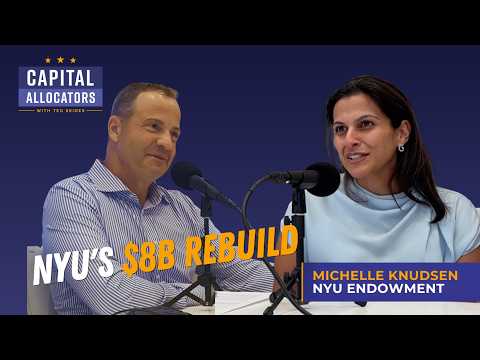
48:52 >> So, to put some quick numbers around it, NYU's portfolio today is just about 8 billion. We've turned over a little more than a third of it in the last two years and we've rewritten probably about another third of it. there's another piece of it which I think we're still figuring out what we're going to do longer term. The profile of the portfolio from a return perspective and from a risk perspective is very different. We've moved away from this pretty homogeneous bottomup fundamental approach to mixing in some quant exposure to mixing in some macro on the hedge fund side or RV strategies. We've brought in venture capital. we've brought in emerging managers. In the two years that I've been at NYU, we've backed a fund one, a new launch hedge fund, a couple fund twos, started looking at, you know, how do we build relationships with not just the current generation of great managers, but also the next generation of great managers.
50:17 How have you thought about building this ship on a sea of the market environment that is so different more volatile geopolitical issues, economic issues and sort of doing that at the same time that the the sea is moving underneath your rudder. We have a huge advantage in the longevity of NYU's endowment. We can build with that medium to long-term north star while being cognizant of what's going on around us.
50:59 When it comes to the asset allocation or the opportunity sets that we're underwriting, most of that is designed with the idea that you're going to have these periods of volatility or macroeconomic change. We're just starting in it. So, it's it's somewhat built into the thought process and it doesn't really have a huge impact on the goal. I think what it does change is it gives me a little bit more preference for flexibility and liquidity because there are so many things that are changing and some of that has to do with the volatility of the landscape. Some of it has to do with figuring out how the end of the zero interest rate environment really flows through to different asset classes, right? And that's more of a regime shift rather than temporary volatility.
52:05 We're trying to focus more on some of those strategic changes and what that means for our go forward allocations and trying to crowd out some of the noise of volatility or this small concentrated group of stocks is is driving public market returns for this six months and it's this small group the next six months. and trying to make sure that what we're focusing on is our true objective of delivering spend plus inflation for the endowment and then the long-term growth of the portfolio.
52:46 >> From your formative experience at Goldman, you talked about trying to understand what the downside could look like and that you could tolerate it. How have you thought about in the context of your portfolio today? >> We do a lot of stress testing. and maybe this goes back to the time that I've spent working with hedge funds for so long where I think it's really hard to understand the downside until you're staring at the P at the numbers on a piece of paper. And we do this with our investment committee as well where we play it through of all right if this is our portfolio and not just our portfolio today but the portfolio that we expect to have two years 3 years four years from now if that's the portfolio we start from and this shock event happens what does the portfolio look like? What do we rebalance? How do we react? And what happens if that's a multi-year period, right? What are the areas of sensitivity? What are the vulnerabilities that we have as a university endowment, as a large pool of capital? And where we don't have control over the day-to-day exposures of our portfolio. Most of our exposures you know, we have control of maybe on a month-to-month or quarterto- quarter basis. Some of it's completely illquid.
54:09 how do we react? How do we fund our liabilities? How do we make sure that the portfolio at the end of these shock scenarios is still a robust enough portfolio to serve the university longer term? >> I'd love to hear how you've built out your team to be able to do this in a competitive environment where there are other pools of capital that have been doing this and pursuing it for much longer. I think this is probably one of the things that I'm most proud of over the last couple years. The quality of our team is fantastic. And when I got to NYU, there was a small team that was already there that really, I think, did a really thoughtful job of managing the portfolio through the CIO transition. They gotten me up to speed and then really quickly I started having conversations with that with them around how we were going to manage the portfolio going forward and it helped me identify some of the critical areas where we needed expertise. So we started out on the private market side. We hired an MD who had a lot of experience building a portfolio.
55:31 We also supplemented that with two analyst hires right off the bat because we were trying to do a lot as well as some of the ops and admin hires to to help build it out. And then over the next couple years, we added a managing director on the absolute return side. again, somebody with very deep expertise in these strategies. We added most recently an investment director. We've added a few more analysts and the team today is 12. and that's across the investment team and the operations team. 10 of the 12 are new since June of 2024.
56:12 So, it's been a huge lift to bring the team on board. And then we've tried to use some of the challenges of bringing 10 people from different institutions in addition to to the team members who've been there for 10 plus years in some cases. We've tried to use that to our advantage, right? learning from the best of each of those institutions that we've come from and then where we weren't satisfied with what we've seen building our own way.
56:49 >> How did you navigate this group coming together for the first time who all have priors about how they go about research, what types of things they like, how they think about decisions. I think there were a couple threads that each person coming in had in common that really helped and the first one was really this commitment to continuous improvement. We've done a couple team conversations on values and it's a theme that comes up over and over again and it was something that I was looking for as we were hiring and I think when you find individuals who really value continuous improvement, there's a learning mindset and an openness to is there a way to do this differently or better and let me think kind of intellectually honestly about whether whether my prior is the right answer or just what I know that drove a lot of good conversations on the team and I think really helped us build some process that we've adopted now as as as our own as as a group. I think the other piece is the hustle factor. Everybody's trying to get as much done as possible to serve the portfolio and to serve the office. And I think that that served us really well as we were bringing all of these different backgrounds together because at the end of the day, everybody was working really hard. We have a pretty strong in-off culture. So people got to know each other. People could sit in a room, hash it out. We've created all of these forums for discussion and communication because I think that's how you get past that hump of hey we have different expectations or assumptions coming in and everybody's been really intentional and deliberate about it and it's worked really well.
59:04 >> What are some of the things you've added to your investment process from what you had seen before from some of the other people on the team? Everywhere that I had worked in the past, I would say there was really two main parts of the investment process. There's a piece really early on when you're trying to figure out if you want to make an investment. Then the deal team or the manager coverage team goes away and does their research. And then usually they come back at the end and they present what they want to do to the team.
59:40 And I one of the things that we've done is we've changed that where the big conversation isn't at the end. It's about call it 70% of the way through the research process where the deal team has gone away. They've done a lot of work and they've probably decided this is something that they think they want to do subject to the rest of diligence. We moved the big team discussion to that stage because that's where we want the benefit of the team's power to question some of the assumptions to find additional questions that we need to get answered. and you can really go away and do more work without people getting defensive. That was a big shift that I think has worked really well for us. And we've actually done something similar on the investment committee side where we've pulled forward where we discuss any manager names with the port with the investment committee.
60:44 We have the decision-m authority at the manager level, but we don't want to lose the committee's wealth of knowledge of individual managers or strategies. And so what we've done is we've pulled their opportunity to input to the very beginning of the research process. In each of our committee meetings, we put forward a long list pipeline. And what I tell the committee is most of these things are going to fall away. We're not going to do them. But as we're going through figuring out what we spend time on, what we're doing diligence on, I want to know now at the beginning where you might have connectivity that can help us, where you have references that can help us, where you might have concerns that we should make sure we're keeping in mind as we're going through our our diligence and lining up our questions. I think too often we wait until the last minute to get information that could have actually changed the outcome had we gotten it earlier.
61:50 >> What's an example of on that kind of team building side and communications of one of the forums you put in place so that the team could get comfortable sharing ideas with each other. >> We do two weekly team meetings. One of them is designed to be I would say much more logistics focused so that we can make sure that important information is getting out to the whole team. The other one is really supposed to be research focused where team members can come bring a topic and it can be a big topic like GPE secondaries or it can be a very specific manager topic the fees for this or the structure for this investment we're looking at or whatever it is and we have the time blocked and we never give it up. So if we don't have a topic to talk about, we use it to go through the macro environment and it creates just this mechanism for people to sit and think about, hey, what's interesting that's going on in the world today and share that with their colleagues?
63:05 because we're all taking in such different information and the power of the team is in pulling that all together. And you can send around notes or you can, you know, upload your views into our research management system, but what we really want is the discussion and debate in the room. And so doing that in the office in person every week I think is really critical for that muscle of challenging ideas and collaborating >> alongside of what you've done the last two years AI has also come onto the scene and as a new leader in this organization curious how you've tried to adopt AI.
63:47 >> I would rank ourselves pretty well on being proactive about it. We sit at the middle of a ton of different information that comes in different forms at different cadences to different members of our team and it's always been a challenge to aggregate that all effectively and AI can help us with that and so whether it's using claude or Gemini to take raw notes and put them into something that is a format we can all consume or using granola or whisperflow to capture thoughts and record them for writing for other members of the team. We're really trying to use these tools to do a better more efficient job of aggregating this information. one of the big projects that we're starting to undertake is all of the audited financial statements that we get for our managers.
64:57 We read them usually looking for specific pieces of information, but they're also really interesting time series of data. And so trying to use some of these tools to create a better picture over time of how individual funds have evolved and changed has been a really interesting project. And that's something that you know we might have had a member of the team work on on a one-off basis in the past and now we can do it much more effectively across multiple funds and see how things are are changing. So, you know, we have a lot of work to do still on using AI effectively, but so far it's been a really helpful tool, especially for a growing team that's trying to do a lot at once.
65:47 >> What's in the plan for the next two years? >> We are still restructuring the portfolio. So, we have, I would say, the foundation laid. We've made some really great investments. There is a big chunk of our absolute return portfolio and our public equity portfolio that I would say we're still moving in the direction of being more diversified and more open to new strategies. We're also looking at different mechanisms for how we structure the portfolio. We stood up a co-investment portfolio earlier this year and I would say we're we're crawling with it right now. Right. Over the next two years, I'd really like to rock to walk. I don't know if we'll get to run, but but we'd like to walk with it. We're also building out some of the features of some of our risk management, right? A lot of what we're doing right now is really important at the portfolio level, but creating much more nuanced management at the subset. So for example, for that equity sleeve or for that absolute return sleeve is is going to continue to evolve so that we can manage our investments better going forward.
67:07 >> What are the biggest risks you have your eye on? >> I think there is a very aggressive fundraising cycle in private markets that persists. And one of the things that I worry a lot about is that fear of missing out will propel us to invest in more of it than we should. And so we've been doing a lot of work on our commitment pacing models and really trying to hone in on what the critical questions are for each of the different subsectors that we're investing in to make sure that we're not investing pro and committing proylically.
68:01 When I look across the public markets, I think the risks are that we're underappreciating the impact of private markets and of AI over the medium to long term. There's obviously been some big devaluations in public markets today. unclear where the babies have been thrown out with the bathwater and and or where people haven't even realized that there are changes coming. And so we're trying to look at what our public markets exposure really is, how that factor exposure changes in a different environment, and what we can do to make the portfolio more robust regardless of what those outcomes end up being.
69:00 What's either surprised you or different from what you expected from being in the CIO seat than what you were, you know, than what you thought coming in? >> I think the biggest surprise was just how much there was to do. I knew there was going to be a lot to do. I was excited about the blank sheet of paper, but there was still just so much more. And that was it was a good surprise for the most part, but it was definitely a surprise. We've in addition to redoing the governance structure and restructuring the portfolio, we built out a whole new tech stack in the in the investment office, we're trying to really I would say button up a lot of different facets and we're trying to do it all at once.
69:49 I think that was probably one of the one of that's probably one of the things that's hardest for me is trying to pace myself on we don't have to do everything all at once. but we're certainly trying to get as much of it done as possible as quickly as possible. >> Michelle, I want to make sure I get a chance to ask you a couple of fun closing questions. What was your first paid job and what did you learn from it? Other than babysitting, which I did a lot of, my first paid job was when I was 16, I was a page in the US Senate. So, if you ever watch C-SPAN, you'll see these teenagers sitting on the floor of the Senate.
70:29 and their job is to run bills around the capital. This has probably changed in the last couple decades because everything's probably done electronically now, but we would run bills around the capital. we would, you know, help with presentations for the senators. And it was an amazing opportunity to get a glimpse into how different people's lived experiences shape their views. When you're 16, at least when I was 16, my frame of reference was pretty narrow.
71:05 And all of a sudden I was surrounded by people from all over the country from very different backgrounds whether they were urban or rural or more corporate experiences or military experiences. And you could have all these smart people who came to very different conclusions when presented with the same information because of the experiences that they've lived through. Which two people have had the biggest impact on your professional life?
71:37 >> I think the first one I have to go with is my parents and I'll treat them as one because they act like a unit. but when I was 16, right around this time where I decided that I was going to go into policy and politics, they sat me down and they said, "Great, you also need to understand how a stock works." And they bought me these books. I really, you know, didn't have much of an interest in the markets at that time, but they were adamant that understanding investing was an important life skill.
72:13 And I think that served me really well when it came to the Goldman interviews down the road. And then I would say the second person is Will Fox who was the managing partner in the US at Partners Capital when I joined after Goldman. Will taught me a lot of what I know about managing portfolios and investing also running a business. when I went to Will and said I want to understand how partners works as a business he gave me that opportunity to understand how the finances worked. and through my whole career I would say he both gave me a lot of confidence to keep doing what I was doing and also pushed me really hard to be better. and never minced words on what needed what needed work. And that really shaped both my time at Melon and then at NYU to the extent that when I initially started interviewing at NYU, one of my first calls was to Will to get his thoughts and hash through what it might look like.
73:25 >> What's your biggest pet peeve? >> Moaning or complaining without taking responsibility for fixing the problem. there are a lot of things that we can fix in the world and having a lack of proactive approach to getting something fixed really doesn't sit well with me. And you know, I think when we've built out the team at NYU, that's been a critical piece of of the character of the people that we've added in here is it's not, oh, we have this problem.
74:03 It's here's a problem. Here's what I think we should do about it. >> What's the best advice you've ever received? When I was interviewing at NYU, I met with a couple of the board members and the advice they gave me was remember that you're only ever as happy as your least happy child. And I go back to that a lot on a couple different levels. The first one being our work is important, but we're all human and we all have lives at home that drive how we show up at work every day.
74:47 And so understanding for myself, for my team, for my investment managers, you what is going on in the rest of their lives is really critical. I think the other piece of it is I very deliberately every week set aside time to think about the the metaphorical unhappy child in the portfolio in my team where I want to focus on what that component is and how I can make it better. a little bit the difference is of course it's not actually my child and so sometimes the decision is actually this is not my problem but for the most part you know I would say both across you know the portfolio and the team everything is my problem and so I want to make sure that I'm getting ahead of what those concerns might be and actively addressing them.
75:53 >> All right, Michelle, last one. What life lesson have you learned that you wish you knew a lot earlier in life? >> My dad used to say, "There are good decisions and bad decisions, and there are good outcomes and bad outcomes. And a good outcome doesn't mean you made a good decision. And a bad outcome doesn't mean you made a bad decision." And I think what I really learned is you can focus on making a good decision, but then really what you should do is drive all of your energy into creating a good outcome because at some point the decision doesn't matter anymore. It's the circumstances you're left with. And I think about that a lot with our portfolio where too often I think investors put all this work into making the decision and then they sit back and they say, "I'm done."
76:50 But the decision to say no or to exit or to not reapp or to reapp important as that initial decision. And along the way, we need to be good partners to our investment managers. We need to be gathering all of that information. We need to be proactive about forcing a good outcome. And if we stop at the decision, then we've we've we've abdicated our responsibility.
77:22 >> Michelle, thanks so much for sharing this really interesting rebuild you're in the midst of. >> Thank you very much, Ted. It was great. >>
Summary
- Transitioned from a political science major to finance after an unexpected opportunity at Goldman Sachs during the 2008 financial crisis.
- Key lessons from Goldman included the necessity of planning for adverse scenarios and effective communication with stakeholders.
- Developed a diverse investment strategy at Partners Capital, focusing on client expectations, risk tolerance, and tax implications.
- At NYU, Michelle restructured the endowment's governance and asset allocation framework to pursue growth, moving away from a conservative investment approach.
- Emphasizes a data-driven and forward-looking perspective in manager selection, blending quantitative analysis with qualitative insights.
- Advocates for a collaborative team environment, encouraging open discussions and leveraging diverse backgrounds for improved decision-making.
- Plans to enhance the endowment's portfolio by increasing exposure to venture capital and alternative strategies while managing risks associated with private market investments.
- Stresses the importance of continuous improvement and proactive problem-solving within her team and investment processes.
Questions Answered
How did Michelle transition from public policy to investment?
Michelle initially pursued a career in public policy but shifted to investment after an unexpected opportunity at Goldman Sachs. Her experience during the financial crisis shaped her approach to portfolio management and stakeholder management.
What mindset is essential for driving value in asset management?
A constant focus on innovative thinking is necessary for asset managers to create value for clients. This involves a data-driven approach to portfolio construction and understanding the competitive landscape.
What unique strategies has Michelle adopted in hedge fund investments?
Michelle has focused on underwriting hedge fund strategies that are trading-oriented and leverage technology and manager skill. She believes in the long-term value of private markets and has increased allocations in that area despite industry trends.
What qualities does Michelle look for in investment managers?
Michelle values managers who have a clear process and can articulate their investment philosophy. She emphasizes the importance of understanding how individual strategies contribute to overall portfolio performance.
How does Michelle foster collaboration within her investment team?
Michelle emphasizes the importance of regular discussions and debates among team members to share insights and challenge ideas. She is also proactive in integrating AI to streamline information management and enhance decision-making.