Transcript
0:00 you know, the um I think one of the the first use cases that I would love to see a humanoid robot is is really take care of uh you know, grandma and grandpa. A lot of times um as as our our folks get older, there's a couple of things that are pretty common among all of it. One of them is general accessibility. It becomes really hard to go through life when um when you're kind of limited in and out of physical capability or mental capability. The struggle was not making the car work. We already had a working car. The struggle was trying to get the computer into the car and making sure that it was able to, you know, adapt to whatever task that we were trying to give it. Robotics and especially humanoid robotics is struggling from both at the same time. It's when we started being able to create experts. Experts are what becomes valuable to us.
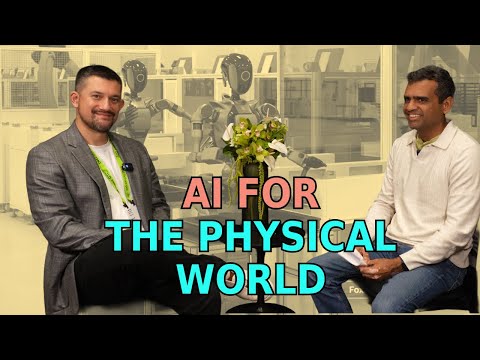
0:45 And so even in robotics, a generalist baseline is just the start. And so we're all kind of fighting with a with a data challenge just trying to get there. And so once we get to a baseline, we can start working on some really really complex and and valuable problems. The other thing is over time we'll be able to start giving these robots personalities and the benefit of a personality is it also solves for things like loneliness. I'm at Nvidia GTC in Washington DC and I'm joined by Spencer Huang. Nice to you. How are you doing? Thanks for having me.
1:15 So you're a product lead at NVIDIA for robotics. Yes. I wanted to start with what was your favorite part of Jensen's keynote. you know the I think my favorite parts, and this is because I'm always biased towards the robotics, is the physical AI section. I think ⁓ it's not that it's a favorite because it was this keynote. I think it's a favorite because if you watched the last couple of keynotes, let's go back a couple of years, you see the progression of the narrative of where physical AI is going. And it started with autonomous vehicles. And then we announced Project GR00T and you start seeing ⁓ the dream, if you will, of what we want to accomplish for humanoid robotics. And as we start coming in today, you start seeing things really becoming ⁓ into fruition, right? All the work that our teams are doing are finally starting to materialize into these fundamental technologies that are going to unblock us in the future. And the other thing is...
2:18 There's a lot of amazing technology that he showcased, not only for the software side, but the infrastructure side. One of the biggest challenges that we're going to run into for robotics, and we're already running into it, is how do you develop the infrastructure? that is required for physical AI because it's actually inherently different than the type of infrastructure that you might need for LLM. And the reason for that is large language models are running across homogenous hardware. They don't need to be necessarily running across heterogeneous compute at the same time. Whereas for robotics, for autonomous vehicles, we have this concept of hardware in the loop. And so at some point, you need to be able to test and evaluate the policies that we train. and then be able to put them onto the hardware and you want to test that before you go into reality. And so we do need to have a somewhat different architecture for the infrastructure that allows us to do this type of simulation and testing. And so all of the infrastructure fundamentals that he is revealing today in terms of how we're building out these data centers, we get to leverage those and use it as a launch pad for how we're going to start building out the infrastructure for tomorrow's physical AI use cases as we start getting further and further along on the scaling. And I love that he mentioned humanoid robots a lot. ⁓ maybe in last one year, there has been this explosion of humanoid robot demos on sim to real using reinforcement learning. Robots are dancing, like walking confidently, doing athletic moves.
3:50 So what has been the unlock in last maybe one or two years that was not possible before that? Sure. It's been a few things. The first is just like AI, when we think of AI, we've known the algorithms that we wanted to run. We just didn't have the compute for it. so the AI winner was more of a hardware issue than it was a software issue because the math was there, but the hardware wasn't. In a similar sense, when we think of how we're actually starting to see really impressive achievements in these trained policies across a condensed period of time. A lot of it comes down to the hardware is now available and so the software is now learning to be optimized for it. The other thing that that gives us is the faster that you can start running these RL training, these RL workloads on top of the hardware, it allows us to start thinking of how are we optimizing or developing new algorithms that are going to solve for these things. And so two big things really came out. One of them is flow matching.
4:54 And so if you're unfamiliar with flow matching, the idea is that you start from a state, and I need to be able to do a task. And so instead of saying, I need to pick up my arm and actuate my joint this way and angle it this way, you're trying to create a path. And so you create this flow that gets you from some noisy state where you start to some end state. And so that allows you to be dynamic in the sense that it's not always going to be in some static environment. So that's one. ⁓ And it's a high level description. Sorry if I'm a No, no. Terrorizing it. On the other side, there's also deep mimic, which is something that we've seen very heavily across ⁓ Unitry and Boston Dynamics. And this one is extremely important. It's the same concept as warm starting when you're training a model. You take a human demonstration and then you have the algorithm trying to find the optimal reward function that is going to allow for this agent to be performing the same type of action. And you're trying to adjust for those deltas and get them as close as possible.
5:53 And so what you end up seeing is you could take a human demonstration and then train a robot to break dance or to run or to do parkour like you've seen with ⁓ Skild AI lately. And that type of research is really starting to push the boundaries on what we know in terms of how do we warm start these? Because if you start with RL basic, it's a huge search space. You define a reward function. You say, OK, trial and error. I'll give you a cookie the closer you get.
6:22 The problem with that is it takes forever. And so just like LLMs where you want to bootstrap it, you can warm start RL. That's kind of bootstrapping RL. How do you take known demonstrations and then allow the RL agent and define a reward function that's able to start taking in these demonstrations and then to be able to perform these types of tasks? And so those are two of the techniques that have really come out in the last couple of, ⁓ I time flies. I want to save months. Maybe it was a better part of a year.
6:50 but these are things that are coming out at exponentially greater speeds. Because once you get an inkling of success, then the further research really starts to come out quicker because now people have access to the hardware and they're more accessible. And so they can start doing more more experiments. And so that's definitely what I believe is probably one of the key factors. And we seeing these techniques being used for manipulation as well. Do you see reinforcement learning combined with simulation getting adopted for manipulation? yeah.
7:24 Yeah, So one of the paradigms and relative, one of the paradoxes of robot learning is that we have two kind of trains of thought. You've got behavior cloning or imitation learning where I show you exactly what I want it to do and it's gonna learn to perform that task, but it'll be brittle, right? It'll be good enough in an environment where there might be slight perturbation, slight. dynamic elements to it, but it won't be something that's relatively generalized. On the other hand, you have these reinforce learn policies where the search space is so large and the reward functions are so hard to define. When you hear that someone trained a policy in 15 minutes but it took them six months to deploy, a lot of it's tuning. And so the problems that...
8:10 you run into for RL is that the search base is so large, but the limitations you run into for imitation learning are that they become brittle and really specialized and overly focused to a single set of tasks. And so when you combine them together, especially in simulation, you can start seeing quite a bit of improvement. And now it's not the only way to train these, but we do see that, for instance, we have a policy that we trained at NVIDIA called Compass.
8:33 And it originally started from a model called X-Mobility. And the pipeline for that was we will take a ton of demonstrations of navigating an AMR ⁓ or quadruped. And so it's a cross-embodied mobility model. ⁓ These different embodiments navigating through spaces, gathering all the data, training it up so that way they could do it with imitation learning. And then we fine-tuned it with RL so that way the policy itself became more robust. And so now let's apply this to manipulation. One of the things that we often think about is We want to get to an end-to-end model. We want to have fully generalized autonomy for these types of manipulation tasks. it's very difficult the more dexterous the task becomes. And so we like to split it up. You have gross manipulation where I pick something up and I put it down. And these are the tasks that we see today. But the tasks that are highly valuable, the ones that are really going to move the needle in the future, are to be things, well, how do I take a flex cable for a microelectronics assembly and start attending these? How am going to take really small things and start assembling them. ⁓ I have multi-step contact-rich assembly where I have a bunch of gears I need to put in a certain order and make sure that they're all working like these are things that you can't do with general pick and place. But they are things that we can use either traditional ⁓ tamp methods, So tamp being: task and motion planning.
9:52 Or you could use these learn methods. So how do we combine all of them together? And so simulation actually gives us the benefit of learning how we can combine them together, how can we start training these policies. And to some extent, even if we don't use RL explicitly, all of these other methods become data that we can then use as, again, for these other learning methods. And so it all kind of comes together. so we're fully believe in RL and simulation for dexterous manipulation. I see.
10:18 ⁓ So you are a big proponent of open source. You have opened Isaac Lab, open sourced it. You also have a lot of models that are open source. So how do you decide which part of the ecosystem should be open source and which part of it should be proprietary? Sure, that's a good question. ⁓ think, so I can answer very specifically for robotics. think that the strategy might be different across other parts of the company, of course. But in general, we want open source as much as possible because we want people to be able to build off of these technologies. Not everyone is going to have the capability or the resources to pre-train a model. And so by providing pre-trained models and platforms that they're able to post-train on, obviously this is great for the... the ecosystem because it means that it's not only held within the hands of a few. So you can democratize this. For robotics, we treat it very much like I look at like the Linux ecosystem. It's very much similar players.
11:17 And one of the things that's really beneficial about the open-source ecosystem is people have a lot of different applications that need to be built and they have a lot of different operating domains that they want to deploy into. And so unlike an autonomous vehicle where it's typically on a street and we know that the operating domain that even though it changes between regions and you know, there's a lot of variation there, of course, but it's not as much as we have completely different worlds that we're going to be working with inside of robotics. You have industrial manufacturing, you have warehousing, you have sub-aquatic, we're going to have aerial, you have ⁓ space, right? There's just tons of different domains that we couldn't possibly cover by ourselves. And so by open sourcing, all of this. It allows the community to both contribute to the platforms that we can uniquely add value to. And so we choose the, we like to choose at Nvidia the problems that are extremely hard that we can uniquely add value to. And we don't try and compete with the ecosystem on things that they're doing because we want people to succeed. And so if we can help them succeed, we're extremely, extremely happy about that. And so we want to build these base platforms, open source them as much as we can, allow people to contribute, allow people to let us know what can be improved and then allow other people to help each other. And so that's the only way that we could actually solve for general robotics autonomy, just general robotics in general. Anything that moves is likely going to be a robot. And so how am I going to, as an individual, be able to contribute to all these domains and then even as a company or even a single country, how are we able to cover all these? And so it definitely is something that we believe truly is an open source problem. You're breaking records with GR00T models on hugging face and you also have opened the Cosmos model world models. ⁓ How do you get people to break records on Cosmos? What kind of data they can contribute with to accelerate the development of Cosmos? Yeah, I think for both Cosmos and GR00T, there's a mix of data, but it's not necessarily been contributed to the pre-training. It's really about post-training. And like I said, if we can provide a really great base model, and we provide the means by which you can go and post-train it yourself, and then we give you as many references and as many examples as we can, and tons of data sets, right? So we're trying to constantly the world's largest. physical AI data set. And the reason for that is because if we use it in our work, then we know that it's high quality. And it also means it gives people a reference for how do you capture data? How do you consider, how do you quantify quality of data? And so all of this together allows people to take ⁓ a model like Cosmos or like GR00T N1.5 and be able to post-train it for their tasks. Now, Cosmos is more commercially viable because the license is less restrictive. And it really comes down to the fact that it is, you pre-trained on commercially viable data. On the other hand, GR00T is, it's really fascinating and it's really exciting that the ecosystem is adopting it so quickly. And they're adopting it even though we're a company that doesn't build robots and we didn't even have a data collection farm. And so we used open source data. And what we realized through open source data, some of it's really good, some of it's medium quality, some of it's not such great quality. But either way, the majority of it was research license only. ⁓ This leads me back to why open source. Well, if we can open source in a way that becomes commercially viable, then we're able to start pre-training a model that people can then deploy in commercial and enterprise and in real professional applications. And from there, they can start collecting more and more data and then post-train these for their tasks. And it can create a data flywheel within the ecosystem.
15:00 So that way, we can have a good baseline. And one way to think of it is if chat GPT 1.0 was so, it was actually, it was very good. No one is gonna deny it. It was an extremely good 1.0. I not many 1.0s come out that strong, but it came out that strong because the corpus of data existed. The VLAs that we're putting out and that most of the community is trying ⁓ to, they're all doing amazing work. It's not to speak ill of any of the work. This is hard and amazing work that our teams are doing. However, everyone knows that we need more data. And the more data that we can have in the ecosystem, the better that baseline becomes.
15:36 And then we can start training for more useful tasks. And so the adoption rates that we've seen are really, it's an indicator that the ecosystem and the partner network and the professional enterprise and commercial customers, they all want to be using these engine models because they see the value in it and so they're all kicking the tires. But when they kick the tires, they also realize here's some fundamental limitations. And so to me, it's a wonderful way of trying to get the community to rally together to start collecting data and start contributing it back so that way we could have a shared baseline because it doesn't actually benefit one person or the other. A baseline like ChatGPT 1.0 didn't make any one company more useful than the other if they brought it into their company. It's when we start being able to create experts.
16:21 Experts are what becomes valuable to us. And so even in robotics, a generalist baseline is just the start. And so we're all kind of fighting ⁓ with the data challenge, just trying to get there. And so once we get to a baseline, we can start working on some really, really complex and invaluable problems. Okay. And so, Nvidia has quite a comprehensive stack for AI for robotics. And ⁓ there are a lot of companies on the application layer. Where do you see those companies creating most unique value so that they can become more competitive in this space? And just so I understand the question, at the application layer there's an ecosystem and a competitive marketplace. And so how are they leveraging these technologies to become, to add value or...
16:49 I would say what kind of, so on application layer also there are pieces of the puzzle like data collection, manufacturer robots, operator robots, and there are various types of applications. So where should the robotics company focus more on so they can create more differentiation and be more competitive leveraging your platform. Sure, I see, First, let's bucket the ⁓ robotics customers. think broadly, let's do rough justice. Broadly, you have companies that are building the hardware, companies that are building the brains, and companies that are building both. And depending on which one they are, they have their own set of challenges, their own set of opportunities. I think the ones that are building the hardware.
17:38 the ones that are really trying hard to get the mechatronics as converged as possible, as mature as possible. Because remember that when we started with autonomous vehicles, we already knew how to build a car. The struggle was not making the car work. We already had a working car. The struggle was trying to get the computer into the car and making sure that it was able to adapt to whatever task that we were trying to give it. Robotics, and especially humanoid robotics, is struggling from both at the same time. We have hardware. where we are not quite sure what is the appropriate or really the most effective ⁓ morphology or even mechatronic configuration.
18:17 Even the sensor configuration can change. ⁓ And it really depends on which environment you're going to deploy them into. And so they have to focus very, very heavily on being able to narrow their scope so that way they're not trying to create an overly generalist robot. Some of them might be an overly generalist robot. they're not quite overly generalist. so, for instance, ⁓ figure, right? They're able to start thinking of both industrial and consumer, but the way they're thinking of it is actually the types of tasks between these two are similar enough that the morphology is ⁓ relatively convergent. So they can build some really, really great hardware. The ones that are gonna be going after really hard industrial problems are gonna have different morphologies. And so because of that, they have different struggles. And then, the brains, the Skild's of the world. They're generating a lot of ⁓ skills within a ⁓ single model that can deploy across multiple embodiments. And their challenge is how do they find the beachhead within an industry where they can start applying this to a very specific set of tasks across a known set of robot embodiments that are acceptable within that task, that environment.
19:30 And then of course you have the ones that are doing a full stack. And so that's also, you know, figures doing that as well. And so they'd be a good example where not only are they thinking of what the brain should be, but they're also what the hardware should be and how to pair it. And we see this across many of these companies where they're building up the pipeline and the frameworks for which they can develop the brain as well as all the mechatronics bit and how they can test it. But it's always coming down to how do we find like the right use cases in the right order? And when I say the right order, You have to rethink of it as we're training, let's think of it as synthetic humans in some regard. And this is kind of how we think of it.
20:11 A baby is going to learn at X speed and then if we go up through high school and through college, we have some knowledge of skills and then we go into the marketplace and we still have to post train ourselves. You hire someone out of college and they're smart, but they don't know anything about how to do it in the business because each business is unique. And so it's definitely a... compound, ⁓ it's a skills tree. How do you start with the atomic skills? And then how do you start building a method by which you can compound those skills to do longer, more complex tasks, longer horizon tasks, and then be able to evaluate how well those skills are being performed. so identifying the right market and the right ⁓ application space that allows you that type of growth allows you to build out your skills tree. That's very cool. I want to wrap it up with a question. What would be the one reason you would want a humanoid robot in your home?
21:02 You know, I think one of the first use cases that I would love to see a humanoid robot is really take care of, you know, grandma and grandpa. A lot of times, as our folks get older, there's a couple of things that are pretty common among all of it. One of them is general accessibility. It becomes really hard to go through life when you're kind of limited in physical capability or mental capability. having an assistant that is there to make sure that you're cared for. so having perceptive models that are able to understand emotional states and pain states, physical states, the ability doesn't have to carry 100 pounds, but enough to carry ⁓ medicines and food and blankets, things to keep them comfortable. The other thing is ⁓ over time, we'll be able to start giving these robots personalities. And the benefit of a personality is it also solves for things like loneliness. And so I would say, That's that's one of it in the house, but you could also say that that extends very much into the hospitals where nurses you know I've I've been using this example a bunch this trip ⁓ Nurses are extremely overworked. They have too many patients too many tasks, and they don't have enough bandwidth And so how can we use robots to? Alleviate some of those tasks that could be sued you know just you can give it off to robots not that it's gonna be replacing a human It's that it's augmenting so that way the human can go and do better work on the patients they do have so that way they can focus and give better quality care. And so the outcome is much more positive. And I believe that these are two of the most valuable initial use cases because it's not superhuman dexterity. It's things that you can imagine happening in just a few short years.
22:50 That's awesome. Thank you so much for chatting. Thank you. This was fun. Thanks, Spencer.
Summary
- Humanoid robots could significantly assist in elder care by improving accessibility and reducing loneliness.
- The development of physical AI is progressing, with a focus on creating robust infrastructure for testing and simulation.
- Recent advancements in hardware have enabled more effective training of reinforcement learning algorithms for robotics.
- Techniques like flow matching and deep mimic are enhancing robots' ability to learn complex tasks through human demonstrations.
- Open-source initiatives are crucial for democratizing access to robotics technology and fostering community contributions.
- Companies in robotics should focus on specific use cases and applications to differentiate themselves in a competitive market.
- The integration of robotics in healthcare could alleviate the workload of nurses, allowing them to provide better patient care.
- The future of humanoid robots includes the development of personalities to improve emotional connections and interactions.