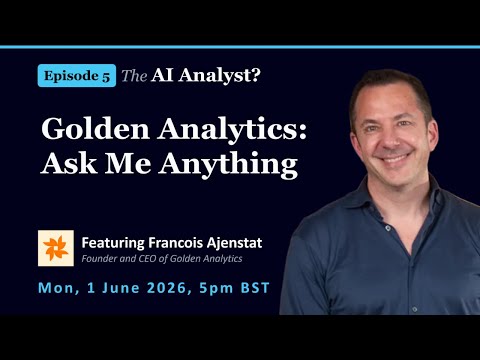
Transcript
0:01 Okay, good morning, good afternoon, good evening. Welcome to episode five of the AI analyst with me Andy Cogre and some other guy called Francois. We'll introduce him in a moment. Uh if you are new to the channel, welcome along. Uh my name is Andy. I worked with Tableau with Francois at Tableau for a long time, 15 years. But since then, I've I've written books about dashboards and data applications. I write on Substack and write about all things data analysis, the impact of AI on it or what about charts you find in the movies, basically data communication, all themes. And I also stream uh obviously you found the AI analyst. So, thank you. And uh I also do chart chat with my book co-authors where we talk really nerdily about whether pi how to make a pie chart work and whether y-axis should ever be truncated. So, uh, join in. You You can subscribe to my Oh, I've got the wrong widget there. Let's just, uh, put my newsletter. That QR code is to my newsletter. So, do go subscribe if you want already. But today is not about me.
1:12 It's about a new kid on the data analytics block, a new kid called Golden. Uh, so, and I'm delighted to be joined by Francois. Francois, tell me who is what is what is your role, Francois, who are you? >> Hey, Andy, I can't believe you called me a new kid on the block. It feels like retro now. I should be doing a little dance. >> Please feel free. This is you. >> Uh, nobody nobody wants to see that.
1:43 Well, hi everybody. Uh, it's great to be here with you, Andy, and it's great to have my first ever AMA. Uh my name is Tronis and I'm the CEO and founder of a brand new company called Golden Analytics. But before Golden uh I was the chief product officer of Amplitude. I was also the chief product officer of Tableau and one of the early uh product managers way in the early days when nobody knew Tableau. It was Tabahoot. Uh and prior to that I was at another small company called Microsoft on the Excel team, the SQL server team and prior to that at Cognos. So just a long time in the analytic space and you know I've had the privilege of seeing data evolve from you know ITdriven analytics that was like gen one of uh analytics then self-service analytics ushered by Tableau and click and powerbi and now I believe we're in gen three of analytics which is the AIdriven analytics >> uh and we are innovating we are inventing uh and we are all learning together uh what is possible in this new era.
2:59 >> All right. Well, that's what a great intro. So, this is an ask me anything. Some people have already been uh submitting questions to a slido. Uh if you want to ask a question um this QR code wherever it is, yeah, point to it. Uh that is there. If you want the URL then you can go to dtdbook.com/golden. It's all lowercase and we can ask Francois. Well, actually we haven't discussed what is the limit of what we can ask Frantois. So we have he has contractually agreed to ask him anything.
3:35 >> I think it said anything. So there are no limits as long as it's PC. >> Yes. PC, right? Uh so use the slido or just use the comments. We can certainly if you're on LinkedIn and YouTube we can see those. So the first question and I'm the first question I had because I think it's a great one to start with is so Francois what is golden analytics and why in 2026 do we need another new BI platform? Are you even a B analytics platform? BI what is it? Yeah.
4:05 >> Well I just think of it as we're building experiences for data. The market might be called business intelligence but it's really about experiences for data. Um so Golden Analytics is an AI native analytics platform. I use the word AI native uh deliberately because if you think of the technologies that were born prior to the LLMs you know they're bolting on AI it's you know the way the test to look at it is if the LLM were to go away with the application continue to work and with Golden we are building on the LLM. The LLM is our silicon and that means that we have tremendous new capabilities that we can take advantage of. But it's not about delivering just another chatbot.
4:52 It's about delivering experiences tailored for data. So the whole premise of it is what does AI native analytics looks like? But there's another aspect of it which is that a lot of times when you're doing analytics you're spending so much time formatting the data, presenting the data and you know you've written this a lot in your books is how do you communicate data uh so we thought well what if you could also combine the idea of data storytelling or what we call canva for data integrate into here.
5:22 But finally, the the key thing is if you think about what these AI tools are doing, they're all about making analysts the heroes. It's about making an analyst be a 10x analyst, 100x analyst. It's about empowering people uh giving them new superpowers. And so we think about that not in terms of AI replacing the human, but really augmenting the human. It's about giving them what we call a slider of autonomy. Uh, and that's that's a term that I love to use because it allows you to say, "Look, AI is not replacing everything. You're always in control. You can do things manually. You can let the AI do a thing and you can modify its results or you can let it go completely and automate it all. You're always in control.
6:08 >> So, I I before we started, I said I had a question that was going to come last and actually you've now just brought it to the F. So this slider slider of autonomy that was going to be the last question. Explain more whether what does that mean? It sounds exciting. Is it is you just got a big slider on the interface that >> No, there isn't. The slider is more of a design principle than a physical slider.
6:34 And actually I'm not the one that invented that term. It actually comes from the AI community. If you've heard of Andre Kaparthy, one of the founders of OpenAI, now at Entropic, he came up with this idea of autonomy sliders and we're applying it to data. But let let me give you a couple of examples, a really really simple one. Let's say you want to write a calculation. >> Well, you can write the calculation manually. Simple. You can say, "Hey AI, can you suggest calculations for me to use?" Boom. It creates it. You can still modify it. or if you don't even know what it is, you can just type what you want the calculation to be and it'll write it for you, but you can still modify it. So, it's a really simple example where, you know, you have all the control and you can choose what you want. So, another example might be think of self-driving cars or or just cars.
7:28 You can drive. You can go in cruise control where it'll adjust the speed. You can have lane assist where it'll kind of drive along or you can say, "Look, I'm going to be fully hands off and it's going to have a level of autonomy." >> But at any time, you can always take the steering wheel and recontrol. It's the same spirit adopted to data >> that Oh, there's so many follow-up questions, right? Uh I I'll go uh Oh, Steve Wexler. Very good. Hi, Steve. Um, is it a good name for a band? I was I was thinking more of an album. It sounds like an album. Uh, but certainly that's a good starting point. We want to see if anybody wants to compose and write uh slider autonomy.
8:08 >> Well, you know, our our demo data set is called Golden Records. So, maybe we need to have some Easter eggs in there or golden eggs with album names that we choose. I like that, Steve. >> I love it. Um so this uh right I want to talk about because I've played a lot with golden full disclosure I'm one of uh Franis's advisers and I I think one of the challenges we faced in this AI analytics and application world is where should the AI appear right I think for the first few years everything is just in a co-pilot somewhere off to the left right now you and I know from our knowledge of how we work and where we're looking in attention blindness that if I'm looking at a chart, I don't want to then look over here to have to then deal with the AI, right? I want to do it in place. And that's something that I mean that that's built in, right? You you you tell me about how you've tried to achieve that.
9:08 >> Well, the AI isn't a mode that you go to. It is just infused everywhere. So when you you know interact with the application maybe behind the scenes it's going to use AI but it's exposed in a natural way. So it can happen when you click directly on the chart it can happen in menus it can happen all over. Uh a related question to that I often get is well what models do you use or you know what's the prompt and the reality is we use a constellation of models. We use all the models. We use the best one for the job at hand and we use not one prompt behind the scenes. We use hundreds of prompts. Each one tuned to the specific task. And so that's it's it's just kind of another different approach to using AI is again it's not a mode on the side. It is just everywhere omniresent in the application helping you move forward.
10:07 Does that I hear a lot or I read a lot more they're much more people are more sensitive to token cost. Is that is that a challenge because hundreds of prompts equals possibly thousands of tokens and >> suddenly your build's gone huge? That happened to me last week. >> It's crazy, isn't it? Uh I mean yes it's it's a huge problem in this industry and uh one of the questions we often get is well can I just vibe code dashboards?
10:35 Of course you can. Uh but what happens at scale when you do that? Well, you have your token cost because every question you need to bring all that context into memory. It's a it can be expensive. We had one customer who ended up spending $100 for one dashboard and then they had 300 analysts doing the exact same thing across the organization. They just said like this is crazy. >> Wow. What ends up happening is when you're doing your vioda dashboard, let's say you're using claude, you're probably using sonnet for everything.
11:09 >> Oh, just change the color to to green. Great. Sonnet, the most expens like actually opus is the most expensive model, but an expensive model. What we do is because we know all the tasks, I can optimize every single part of every single query for what we need. Some tasks need to be fast. Sometimes tasks need to be deep and thoughtful, but they but I can use different models and essentially arbitrage the price based on quality, >> speeds, right, and costs.
11:42 >> Yeah. >> So for us, we can actually be when you're a tailored application versus a generic application, we can use the right tool for the job, >> right? If you have a a hammer, everything looks like a nail. >> Yeah. We actually have a whole tool belt >> to use. >> Did uh I'm going to get on to the questions that have been submitted in a minute. Uh are we are you are you at a stage to talk about pricing yet? So is is pricing >> Sure.
12:09 >> So yeah. So so does pricing does heavy usage lead to more price pricing based on AI usage? >> No. We went with a really really simple model uh which is per user per month. That's simple. We don't care how many tokens you use. That's included. Uh we don't care whether you're a creator or a viewer. It's all included. It's that that simple, right? Any questions? >> Yeah. Well, yeah. Keep keep the questions coming in on Slido or on chat.
12:41 Let's go to uh so MP's submitted a question. Why should we be an early adopter of Golden? what is the incentive for us to use this rather than all any other of of any other of all the AI tools and I think you've sort of you've touched on that already but you know we we've all I we've all got access to Tableau PRI PowerBI Claude Looker Thoughtspot oh my god here's another one right uh so why why yeah tell me >> I mean it's the same thing for any technology it's not tied to golden is when you're early a few things happen.
13:21 Number one is you actually have more influence on the future direction of the product because as you use it you can actually provide feedback directly in the product about things that you think would be good. Second is it gives you an advantage in the future. If this becomes successful you now have built a set of skills that differentiate you in the marketplace. But I think ignore the product and ignore the vendor for you. If this is a tool that helps you be more productive, deliver more value. That's the reason, right? It has nothing to do with Golden or the tools. It's is it solving your needs? And we believe that from what we see from our early customers, we can solve it so much faster with less frustration that you're going to save time. You're going to be more productive. you're going to be more of a hero at work and that's what makes it worthwhile.
14:18 >> Uh I I'll so so I I think you gave me access to golden maybe in January and >> you got it very early when it was very buggy. >> Yeah. But but there was one piece of feedback I gave you and you know should it be dashboard or communicate on that final pane and that and that changed and I I felt amazing. I was like, "Wow, I've influenced the product." Because I can tell you the last three years at Tablet or at Salesforce, I was not in a position to influence anything and it was very frustrating. Um, so, okay, so MP, thanks for that question. Um, Jason asked, "Some departments simply want an export to Excel. Uh, many BI tools offer limited features in this in this area.
15:03 We've lived it for 20 years together, Francois. You can build that pretty dashboard, but there's still >> I've lived it for 30 years. The number one feature of every BI tool is still export to Excel. And guess what? We have it too. We have export to PowerPoint, PDF, Google Sheets, uh, Google Slides. We also have export to Excel and CSV and Google Sheets. >> Our goal is not to prevent people from doing things. we will allow them to do whatever they want. Uh and that I think is really important. It builds trust.
15:40 Like here's another thing we did. Uh a big questions people ask is, "Hey, can I see the underlying SQL behind the chart?" >> Yep. You can do that. You can do it on a sheet or whatever you call it, an analysis, or you can do it on a dashboard. We want to be as transparent as possible. So yes is the answer. >> That's fantastic. And how do people connect to data? What what can people connect to in Golden? And is it is it like a traditional BI approach or does it live in Golden or Tell me tell me how that works.
16:14 >> Um so there's some nuance to it, but it's actually really simple. If your data is in a cloud data warehouse, so Snowflake, Data Bricks, BigQuery, Redshift, the data stays in the cloud data warehouse. We don't create extracts. We don't import the data into the tool. we just query it in place and that's really important because it keeps the data live uh it's always up to date all the security rules apply. Now, if you don't have one of those things and you have data in CSV, Excel, parquet, JSON, we can just connect to it and then it imports it into behind the scenes. We basically use duct DB as our engine and we can query it and then the entire experience is browser based. There's no thick clients, there's no desktops, just runs in the browser and it is fast as hell. Like it feels so different. Uh, and it's fast.
17:11 >> Um, I agree. I just can Can I draw a scatter plot with more than three and a half thousand data points on it? >> Uh, you can. It gets slow. There's still things that like when you still try to render a million points or 100,000 points, it can get slow. >> I I I mean that that was always one of the one of our things in Tableau, wasn't it? It's like, you know, you can you can show all the data in Tableau will render it, right? browser based rendering has limitations is that >> but the technologies have improved significantly and I think that's part of the advantage is if you were to shed all the things that you used to do I mean part of you take a tool like Tableau was born in 2003 think about that 2003 >> there was no AI there was no cloud there was no big data no snowflake none of that stuff and so they made decisions at the time which were the right decisions But if you can do it for today's technology, I think it opens up a lot of opportunities. And it's not just a Tableau comment. PowerBI has the same.
18:17 Looker, I think, took it slightly different approach to be more browserbased. But I think that gives us a lot of flexibility. >> Excellent. Uh, some comedy comments coming in. Somebody said, "Boo export to Excel." But then another LinkedIn user said, "I love that it's not just Excel. Google Sheets for the win." So I mean therein is the is the challenges of this business is like there is no fit for all is there and >> there isn't and I always like to say well why do you have to export to Excel is there something the tool did it do and sometimes yes and that's a feature for us to build but sometimes it's just trust I want to see the data I'm familiar with Excel and I just want to validate it's right >> great awesome >> it was it was an amazing journey going through that through the sort of 20 years I was involved with Tableau and then the academic research is just all about supporting just the reasons why people like that trust in seeing be able to touch every single cell of a table.
19:12 So, uh good one. All right. Uh what did we get with let's oh yes we got some industry comparisons on. So an anonymous user asked how is this better than Omni and another anonymous user asked how is this better than Hex? I suspect that was the same person asking two questions but um just yeah so omni hex golden and industry position >> uh so somewhat apples and oranges between all of those so let me try to tackle in different ways um first off is just from an architecture standpoint you know we are AI native right so if you think about that it gives you a lot of capabilities uh that aren't necessarily available in other tools the speed, the flexibility that you get all integrated in one platform is where I think Golden really shines, pun intended. Um, if I look at something like Sigma, uh, Sigma is a phen phenomenal tool. What, you know, they really built as a connected spreadsheet in the browser, that's its forte. Uh, if that's what the use case is, Sigma is better than Golden for sure. But if you want more than a connected spreadsheet, I think this is where a tool like Sigma may go down.
20:27 It's not to say it's not a great tool. You'll see me I actually praise the competition quite a bit. Uh but that is just a different point of view. We have much more of an integrated uh experience. So that's Sigma. Omni is much more of a modern looker, right? It's a semantic model. That's their forte. That's their strength. If you need a semantic model, you know, that's not one where we are trying to go compete with. But what we're trying to do is embrace the semantic models that people have. So if you do have one say in se in snowflake or in dbt we will leverage it versus other tools like a powerbi that's actively said we do not embrace anybody else's semantic models right they've created a closed ecosystem we are an open ecosystem >> and then tools like hex I'm a huge fan of hex I think they've done an amazing job uh it's a really great product but really their origin story is around data science and data engineers. It's a modern notebook. So if you like to write Python and you know you know what a pandas is, hex is a great tool for that.
21:33 That's not who we're targeting. We're trying to target everybody else in the organization that needs data but doesn't necessarily have the technical skills. And I think that today with a lot of the advancements in AI, right, more and more people are going to be more capable without requiring that technical necessary foundation that's there. >> Yeah. Cool. That's good. Yeah. I mean, the I think that goes back to something you said right at the start is learning together.
22:03 I mean, you know, we've been around a while, right? It it's it's so disruptive. Nobody really has a clue what the right end what the end point is going to be. Um, which is in fact, right? So I see that as being obviously exciting for you as developing a new tool, but it's pretty scary for a chief data officer, right? You know, how how do you advise somebody trying to make a strategy when the sand when the stability is gone really from the industry?
22:34 >> I think predictability, maybe not stability. >> Well, my view is it's moving so fast. You have to lean in. You have to have a learning mindset >> versus a closed mindset because that's how you learn what makes sense for you and your organization and where the break points are. >> We had the same thing at the beginning of the cloud. Do you remember that people are like the cloud? No, we'll never do it. I must physically touch the thing. I don't trust it.
22:58 >> But leaning in and understanding it will give you an advantage to go build for the future. and those that didn't, you know, maybe like a good example in the vendor space, terod data versus Snowflake. Well, Terodata was the core vendor back in the day, right? They had the best technology and then Snowflake just made cloud a core advantage and they grew. We saw the same thing in other spaces, data dog versus Splunk. Data dog was cloud native and it got inherent advantages.
23:29 But there's other places where um you have and I use technology changes. Mobile's a good example. When mobile came out, everybody's like, I don't need a PC anymore. I'll do everything on my phone or on my tablet. Like that's the future. >> We live in an omni world, right? You live in a world where you have different technologies, but you can't imagine not having a mobile app today. >> You have to have one to be relevant.
23:55 So I I think you know the these worlds where we say A is dead or this is changing. It's really about how do you lean in to learn because the market is going there anyways. >> Yeah. >> Now in this case with the models because we're built on the models we get to learn first and put it into your hands faster. >> I remember when you showed me visible. You were like Andy let me show you something we're working on. So some of the people watching will know what visible was but what's visible Andy?
24:27 >> Visible was a mobile only data exploration product that Tableau built and uh it had some cool mobile. It made great use of mobile interfaces but alas it it came up it shone and it died. U golden so is golden optimized for mobile as well? So, I mean, just how's how's that working? >> Uh, today we haven't done that yet. It'll eventually happen, >> right? >> We just haven't built mobile yet. We want to make sure that it works great on desktop.
25:01 >> Yeah. Fine. Uh, okay. Next one. Uh, what's your switching cost? Why do I have to move from amplitude with everything to golden? What do you offer to beat the amplitude AI? Um, I would say I think we're talking apples and oranges in this case. If your use case is a product analytics use case, Amplitude's to It's the best solution out there. Use that.
25:32 >> Yeah. >> Simple as that. >> I Well, I think you Yeah. And as some somebody said, you know, I think I think it's a really good I think it's a really good position to be use case, you know, you know, find a use case. Um, once Golden has grown to be a 10 billion dollar enterprise and you're now selling enterprise, at that point you might start going we do everything. Maybe >> of course well over time you always add more capabilities. But I >> I like to say you got you you have to go figure out where you're 10x 100x better than the alternative.
26:07 >> Yeah. >> In that use case, >> it's clear, you know, the dedicated apps are better. There are exceptions to that where maybe it's not a product analyst use case. It's a business use case that needs data from product analytics. I'm looking at revenue data that I want to connect to usage data. Well, that data is probably in the warehouse. You're not going to move it all into an Amplitude to do that, right? Right. And that you doing it in a analytics tool is probably a better solution.
26:35 >> Cool. >> And this where like the warehouse native uh terminology becomes pretty interesting. >> Yeah. Got it. Uh okay. Let's take one from LinkedIn. So Celia asks from an administrative point of view is there a way to view the questions that are being asked for the sake of consolidation, auditing, needs assessment, etc. Great question, Celia. Great question, Celia. So, that is something that we will be adding in the enterprise plan where you can see all of those things. Uh, what's interesting about it is some of the questions are not that helpful. Uh, because of the fact that it's AI native, uh, it's not chat everything. It's chat when appropriate.
27:18 So, I may create an artifact and they I might say make it blue. Great. Okay. you know that make it blue is the chat that was added. So that's where uh we have to think about the right way of expressing it. What we also want to do is provide uh feedback that comes in. So you know even if you say make it blue, did it do the right operation? I mean, if in order to really be able to log and understand and make it blueprint, I mean, then you'd have to be logging and saving literally every single context of every single interaction and that would be expensive.
27:59 >> But, you know, Andy, you remember in Golden we have this history? >> Uh, yes. I I realized as I was asking the question, I was like, but you implemented one of the best features I've ever seen. currently >> wanted in Tableau for 20 years >> but that is by by design. So, so what are we talking about for those of you that haven't seen >> Sorry, sorry. >> Uh, a lot of analytics tool have this idea of unlimited undoss and redoss, right? That's great. But they never expose what the history stack is. They never show you how you navigated the app through that. So, what we've done is we've essentially created time machine in the product that allows you to say, "Oh, I want to go back to this moment in time or that moment or I want to save this because I want to play it back in the future."
28:44 Um, so all of that is essentially captured in every session. So I can actually know when you said make it blue, these are the 10 steps they did beforehand and the 50 steps they did afterwards. I I I mean I wanted that for so long in Tableau, it's so good because when you're doing exploratory data analysis, you don't you don't know what your endpoint is. And when you get to your end point, you then just like, well, let's look what what did I do? What did I do? And oh, that was a good point. That was a good point.
29:13 And that was a good point. And then you can cons. I'm happy with that. Right. Um Jonathan Drum, we know him ask a scenario we're seeing is how do I go from the dashboard to a chat with the data and then share out the chat results? How does Golden address that use case? So going from dashboard to a chat and then share the chat results.
29:44 So, it's uh it's going to be a longer answer. Uh Johnson said, uh I just want to call you drum me. Um it there's there's some nuance to that because sometimes you go in the dashboard and then you want to have a side chat say great that result I want to add that back into the dashboard. You can bring the result of your chat in the dashboard if you want to. And that's a thing or you can say actually I want my chat answer. I want to copy that, bring it somewhere else or send it to Slack. So again, it's not a separate experience.
30:19 It's part of the experience. And that's that's part of the nuance is I think we've all been accustomed to they're separate. When you start saying they are in fact interrelated, there's new things that you that become available as a result of it. >> All right. Fantastic. Uh, and Jonathan, if you want a longer answer to that, we I'm sure you know how to reach me or I can provide. Yeah. Uh, all right. Um, there's a couple of questions about token cost and LLM as well. So, I'll do I'll do two of these. Um, so if token cost is absorbed by golden, can you bring your LL own LLM? And then there's another question on well and then there's another question on slido about >> uh well you talked about using claude to vibe code your own dashboard but what about claude with the MCP technology into different technologies right so I mean actually they're quite different questions but anyway I'm throwing them both in at the same time >> okay so first question on costs yes we absorb the token costs you do not pay for the token costs that is my problem to optimize your price stays fixed >> benefit.
31:31 Uh if you use a ton of it, great. I have to optimize it more because it's going to cost me more. That is my problem to solve, not yours. >> Uh second is can you bring your own LLM? Today the answer is no because we use all the LLMs and we optimize each one. I think at some point in the future we may need to especially in the enterprise scenarios where people want to consume that. Hey, that might mean you're going to pay for the token cost in that case because you're bringing your key. I love that for my margins. That would be a great thing to build, but I have to optimize for the experience first and make sure that we're not compromising what's possible for the customer because now we're using, you know, an older version of Sonnet for instance or Gemini because we're not using the best and latest.
32:22 Uh there's a second question which I think was consuming MCPS. So let me >> Yeah. Yeah. Compare using golden on top of an LLMs or using LLM on top of technology like via MTP. >> So again there's three parts to answer. So first off is when you use cloud on top of your own data it's pretty phenomenal what you can do. However there's no governance, there's no sharing. It's you're ba basically building artifacts that are standalone and every time you ask a question you consume tokens. So that just creates more and more costs and it tries to please you. Are you are they trusted answers? Will it lie to you? Will it hallucinate? Those are real issues that you have to deal with. Um but I think that in many cases what happens is this turns into the modern spread.
33:17 So remember the old everybody exports the data to Excel and they create their own presentations and you know you have silos of data everywhere everybody's just frustrated because the numbers don't match. >> It's basically the same thing but you call it cloud instead of Excel. >> So I think there's some real problems there and the trust and governance is probably the biggest one followed by cost because the cost can be out of control number one. Second part of the question I'll say is can golden be consumed by an MCP and the answer is yes we will have an MCP for golden so you can be in cloud and say explore my metrics great it'll do that and then third because we are an AI native application we we golden will be able to consume any MCP that you have so any application that is exposed as an MCP becomes a data source and context source for golden.
34:14 >> Is that available now or is that a road map? >> Hey Andy, for everybody everything I'm sharing is road map because they haven't seen any of it. >> Sorry, I forgot. >> I know you're just an early >> No, but this is something that that we have and it's pretty incredible. >> But you can't do that if you're not AI native. Yeah, we will at the end be talking about how you can get on the wait list and go in get involved with Golden as and when it goes um GA. Uh right, where are we at? Uh one more from Slido and then I've got a bunch of comments on LinkedIn and on the live stream. So, uh can custom visuals be created in Golden and are these similar to PowerBI and Tableau? Uh so today the short answer is no but we ship with 40 plus visuals out of the box with a lot of formatting options. Uh what I tried to do is to make sure that anytime you had to go write a hack. It required an article to explain how to create the thing. I think that's a failure of the software. So we just built those in. One of my favorite hacks was Andy's lollipop charts.
35:30 Hey, do you know how to create a lollipop chart in Golden? >> You press a lollipop button and you're done. Oh, >> I'm very flattered. I didn't invent the lollipop chart. I did invent the name. I named the lollipop chart and >> Well, you know what? I have gladly put lollipops in the product in your honor. >> Well, that's awesome. All right. Uh, okay. Uh, let's go to some of the comments. There's great questions coming in, by the way. And we've got 25 minutes. So, keep them coming. Nate, who are the users daytoday?
36:06 >> Uh, well, user one is the analyst. We wanted to make the analyst extraordinary with data. We want the analyst to feel like they're 10x, 100x analyst. Like that's user one. And the more that we make them productive, the better. However, uh we are not limited to the analyst. We expect the business users to be consuming things whether they're consuming dashboards, documents, slides, asking chat questions, consuming it through MCPS. I think any anyone that has questions and data is a target user, but not everyone will consume it in the same way.
36:41 >> All right. So, so and there's two follow-up questions which link to that. Mr. Mark Bradborn, CBIP, no less. I don't know if you know what CBIP stands for, Mark, but I'm very impressed. Uh, do you see this as a department departmental solution at this point or are there pl plans to push to enterprise scale? Um, so you you've elaborated on some of this, so maybe yeah, expand. >> We're absolutely going enterprise scale and as fast as we can. In fact, our early early adopters are primarily enterprise customers uh with massive massive deployments that are coming to Golden. Uh there's definitely more functionality we have to go build uh to fully get there, but absolutely we're we're there. But just like we've seen in previous generation of tools, the land and expand motion is extremely powerful.
37:32 >> You can get started with one user. Amazing. You can scale that to five to 10, two departments, five departments, it doesn't matter. So unlike some tools that come in, you know, they're the enterprise. you must buy everything or don't use at all. We just basically believe in our customers. Use what you need. >> Yeah. >> If you want more, it'll give you more. Great. >> Success is more important than the license.
38:02 >> If So, if Enterprise is a gorilla, what's what's the land and expand animal? What What are we? >> Uh, a monkey. A cheetah. Actually, it's a cheetah. It goes really fast. >> All right. Brilliant. There you go. Love it. Uh Henry, I I've got >> Henry from family. >> Yeah. >> Family from NC. >> Yeah. >> Right. Okay. Um again, right. So, I think this goes back to who is using uh Golden. Um so, what what is storytelling within Golden? And to me, that question also demands the answer. How do I I've created something. How do I share that with the world?
38:44 >> Uh, bonjour, thank you for joining. It's always good to have family in here. Does it make me embarrassed at all? >> Was that Have you just gone red? >> I've gone red. I think it's the lighting in this room. >> The lighting. So um storytelling is actually a core part of the product and you see it in the product where we say connect, discover, prepare, analyze and communicate and we communicate not build dashboards. Dashboards is one form of communicating your stories and people want to communicate in lots of different ways. Dashboards being one, documents, slides, etc. being others. Uh so we want to make that really easy. Within the product, we have a story generator as well. So, the AI can suggest different stories that exist in your data uh that you can pull together. Uh, in fact, I posted on LinkedIn a couple weeks ago, a story with my wife where she gave me data that she was playing with and it pulled out some really compelling stories that she had no idea even existed in there and then it built a fullyfledged dashboard that she started using. It's incredible. So I think that is key. How you share? Well, you can share directly in Golden. You can share as a static artifact in PowerPoint and Google Slides, PDF. You can also share directly with Slack with one click. Say great, share it with my team and it'll go in a channel or a DM and you're good to go. So sharing just should be easy.
40:20 >> Will there be a golden public? >> Uh at some point, yes. Uh I say and I said at some point the the first task is we have to make it great for customers that pay, >> right? And if we can prove that >> then of course >> a public is is an incredible thing because sharing and community is absolutely uh amazing but you want to do at the right moment not too early uh and when there's enough demand to want to do it.
40:54 Awesome. We will all wait uh in with baited breath. Uh Mark tells me it's a certified business intelligence professional, which sort of I feel embarrassed. I probably should have known that. Uh >> Mark, did you get that in the 90s? >> That feels old. >> Well, he does say it's an old, right? You know, you've got a grift on LinkedIn, haven't you? Uh but Steve says certified badass in progress, so probably probably a little better. All right, back to the questions. um hang right I've lost my track. Uh how is sharing handled across the org if individuals are asking similar questions? All right.
41:36 Yeah. Well, I guess yeah, is there an efficiency or a methods that go sort of tracks what's hot and what isn't? >> Uh well, so the there's nuance in this question. I think first like sharing across the org. The way sharing works is we have a concept, we call them spaces, but they're really like channels you have in Slack. Just take that same approach. That's how you share. You have public channels, you have private channels. >> Mhm.
42:03 >> As really simple as that. There are uh facets in there where do you want questions that span these channels to be part of the reuse or not? So, we haven't tackled that yet. Currently we say if you're in a space or channel right that is what's limited in there. Uh but the idea is that over time this is not a static solution. It's a stat it's a solution that continues to improve the more you use it. Uh and so this idea of leverage and learning is going to be built into the to the app.
42:36 >> Again we're starting with the individual analysts that will then scale pretty quickly over time. >> Fantastic. Uh, okay. And can you back to price? Did you do can you announce pricing yet? >> Uh, I'll announce it in a week, but I'll tell you that it's very affordable. I'll tell you that it is uh if you're familiar with PowerBI pricing, which has gone up significantly over time. Uh, we are in the same ballpark of being quite affordable, especially at scale.
43:10 >> Very good. And what what did you just say about a week? What was what was that? >> Yeah, I said in about a week, we'll tell you what the price point is. >> All right. Okay. >> Just >> just, you know, read the tea, >> right? Okay. All right. Excellent. Yeah. Uh >> yeah. Um All right. We still got we still got time for more questions if you've got any. I mean, one qu one question, let's sort of go away from the actual product.
43:35 >> Uh Fran, you and I have had a great working relationship for many years. You've been CPO in lots of places. Just what what's it like? Just tell me a bit about the the personal moment when you're like, you know what, I'm going to make my own. And what's it been like being CEO and founder? >> Uh, it's been amazing. It's been truly incredible. Uh, what has happened as I think about everything I've been building. It feels I mean I've never worked as hard as I have which I've worked hard my whole life. Uh but it almost feels like an out-of- body experience like seeing this all come to life. Um I talk about the the defaults like in the past the defaults were always like no or here are the reasons we can't. Now the defaults are yes how can we make it happen? And all of the problems that I've seen over 30 years we can just make them go away. like I can finally solve the things I've always wanted to solve. Um, and that is just so rewarding. And I remember at the beginning of this, I wasn't planning on building a company. I wasn't planning on actually I don't I don't know even what I was planning. Was I retiring or was I going to go work somewhere else? And uh I started playing with cursor and claude at the time and I was like, "Oh my god, this is amazing. Finally, an AI that empowers people, that makes people feel like 10x engineers, that makes non-engineers feel like engineers. Like, holy crap. Uh, that's amazing. But why doesn't the same thing happen to data people? Why do data people have to have the crappy tools where everybody else has the better tools? Like, that just sucks. And out of that frustration, I said, "Well, what would it look like if they had better tools?" like instead of just being frustrated, let me go solve it. And as I was working on it, I started sharing it with people. I think I shared it with you, a few friends, a few investors. Everybody's like, "Wow, this is amazing." Like, nobody else is approaching it the way you have. Like, this feels magical.
45:44 This is a gap. Like, why isn't anybody building this? I said, "Fuck it. I'm gonna build it myself." And that and that was it. And I just started working on it. And uh it has been one of the most rewarding things that I've ever done. And we're still very early, very early, but the feedback has been spectacular. Uh the weight list, which I know some of you are on the wait list still. We're going through it, but we want to make sure that, you know, we're we're working with AI, like we want to make sure it's good, it's trusted, that you have a great experience. Um, holy crap. The number of people on this thing is >> Yeah.
46:27 >> mindboggling. >> So, I I still want to What was the moment where you're like you had to go and have breakfast with your wife and say, "This is what I'm doing." And then have that conversation, you know, was was there a specific moment or did it did it sort of because it's a big commitment, right? >> It is. Um, she just said, "Do what you love." I see the passion in you. >> I see what it looks like when you're just not into it. And here I was like every day I was like yelling at her going, "Hey, come here. Check out what I built. It's incredible." She's like, "Well, like what?" And I just like that enthusiasm is is amazing. And so she has been extremely supportive um you know, helping me go through all of this. And I have to say I'm not necessarily the easiest to deal with in this world where I'm working 20 hours a day. Uh and I wake up at 3 in the morning with ideas and I have to get them done before 7 a.m. Like it's it's amazing.
47:34 >> That's brilliant. Um I I think that this is probably the right place to begin wrapping up, right? There are a couple more comments, but I think we France, you can go answer those directly on LinkedIn. So my last question again, tell me tell me about the team you're assembling, right? You know, is this Avengers reassemble or is it a new Avengers and and what's it been like finding the people to fit this moment for this application?
47:58 >> Uh, another part of the rewarding thing and like the team and the culture and the company building is it's so cool. So I brought on people like Andrew Beers who was one of the first engineers of Tableau as CTO and you know he has been an incredible partner uh on this. I brought in uh an early Snowflake developer who helped build Snowflake is now helping us build Golden. I brought in people that worked at Grammarly and Atlin and Apple on the team. So just a nice diverse set of people. But I think that part of what I'm trying to do is to bring people that have this different mindset is yes um uh by the way my frozen um yes like we're building AI like I want people who are leaning into the future >> not recreating the past. We're not recreating the past. We're inspired by the past. There's an homage to the past but we're leaning in to the future.
49:00 >> Uh we want people who think differently. uh who aren't just trying to follow the herd and you know just do the status quo is really lean in and uh I think this is where our cultural values really come in. So we're being very picky about who we bring in but we're bringing people who have done incredible things and are ready to take on another challenge and many of them don't need to do this. >> Yeah. Many of them have had successful careers, >> but they're seeing this and saying, "Wow, this is >> this is it." Like, this is special. We can go create the next special company, the special product, but the light people in a way that we've always dreamed of.
49:42 >> Yeah. I I mean, I I I think the team you've got are great. You've got like the wisdom, you know, the the long beards, right? But then these young enthusiasm like the they're just like any we can do anything. You're you're like actually that's you, right? We could do anything. So, uh that's fantastic. All right. Um so Trevor hands uh don do we want to go lightning fire? >> Uh lightning fast. Yeah. Here we go.
50:08 Right. >> Can Golden consume Tableau PDS's? >> Uh today no. >> Right. How do you ensure propriety data is not leaked via the training LLMs? >> We do not train on data. We do not send your data to the LMS. We only use metadata in statistics. Period. >> All right. Uh GDPL, >> we don't do it yet. Someday we will have to. >> Yeah. Uh UTF8.
50:39 >> Yes, >> there's a UTF8 thing there. I there's a lot of data nastiness that we still have to go address. I think we do UTF8 UTF-16 already. Uh, but I'm sure that there are bugs in the product that we will have to address, right? But thankfully, we ship fast. You don't have to wait a quarter for a bug fix. You normally get it pretty damn quickly. >> I tell you what, being involved behind the scenes is so much more fun than working for a big enterprise piece of software. You're like, "This isn't working." Oh, now it is. Great.
51:08 Fantastic. Uh, all right. Uh, so to steal the uh first fee style, look into the camera, Francois. Um, tell people what's going on and where should they go to find out more. >> All right. Well, go to goldenanalytics.com, sign up for the weight list. Uh, we are soon going to be getting more and more people off the wait list. Uh, but that's the best place to be. And then if you're at events like the Snowflake event, data bricks events, you can come and meet us there in person. We will do demos and answer all your questions. And of course, you can follow us on LinkedIn or at Golden Analytics or on Twitter at data rockstar.
51:55 >> Oh gosh, you're still on that right. Excellent. Yeah. All right. Well, uh I think our time is up. So, there's also the QR code there if you want to go. That'll take you to Golden. Um Francois, it's been absolutely fantastic. Uh it's been really it's been a pleasure to be involved behind the scenes for a few months. I'm really glad we've been able to bring this live to the AI analyst. So to Francois, thank you. And to everybody who's signed in today or watching on demand, go check out Golden. Uh it's built to make everyone extraordinary with data. What a great thing. Brilliant.
52:36 >> What a great tagline. >> Yeah. Thank you everybody. >> The best the best. Yeah. Take care everybody. See you all soon. Thank you.
Summary
- Golden Analytics aims to redefine analytics by being AI-native, integrating AI capabilities directly into the user experience.
- The platform emphasizes a "slider of autonomy," allowing users to control the level of AI assistance in their data analysis tasks.
- Golden focuses on making analysts more productive, positioning them as "10x" or "100x" analysts through enhanced tools and features.
- The application is designed for seamless data connectivity, querying data in real-time from cloud data warehouses without creating extracts.
- Users can share insights easily through various formats, including dashboards, documents, and direct messaging on platforms like Slack.
- The platform is built with a focus on transparency, allowing users to view underlying SQL queries and maintain trust in their data.
- Golden Analytics is targeting both individual analysts and enterprise-level deployments, with plans for scalability and user feedback integration.
- The team behind Golden comprises experienced professionals from leading analytics and tech companies, fostering a culture of innovation and responsiveness.