Section Insights
The Cost of AI vs. Universal Basic Income
What if the $1 trillion invested in AI was distributed as universal basic income?
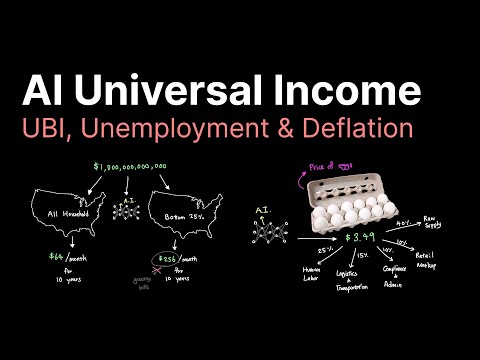
The investment in AI could have been distributed as a monthly basic income of $64 per household over ten years, which raises questions about the economic value generated by AI compared to direct financial support for households.
- Investing in AI raises questions about its economic returns compared to universal basic income.
- The proposed basic income from AI investment is surprisingly low.
- The potential benefits of AI must be weighed against the immediate needs of households.
Perspectives on AI's Economic Impact
What are the differing views on AI's impact on the economy?
Opinions on AI's economic impact range from optimism about job creation and economic flourishing to pessimism about job losses and the need to reallocate investments to more promising industries.
- Optimists believe AI will create significant economic growth.
- Pessimists argue that AI investments may not yield sufficient returns and could exacerbate inequality.
- Current trends show rising unemployment linked to AI advancements.
AI's Role in Deflating Costs
How does AI affect the cost of goods and services?
AI has the potential to significantly reduce the costs of goods and services by automating tasks, leading to a scenario where products become ubiquitous and affordable.
- AI can drastically lower the costs of services, as seen in web development.
- The automation of jobs could lead to a deflationary economy.
- Taxing AI-generated wealth could provide a means for universal basic income.
The Economic Impact of Automation on Pricing
Can AI automation significantly reduce the price of everyday goods?
Through automation, the costs associated with goods like eggs could potentially drop significantly, demonstrating how AI could disrupt traditional pricing structures.
- AI could automate labor costs, drastically reducing prices of goods.
- The potential for lower prices raises questions about the distribution of wealth.
- Historical patterns suggest that technological advancements often benefit the wealthy disproportionately.
The Future of Work and Wealth Distribution
What are the implications of AI on wealth distribution and human needs?
AI could either lead to a society where jobs are obsolete due to abundance or necessitate universal basic income to address the wealth gap, highlighting the need for a balanced approach to AI's integration into society.
- AI could create abundance, reducing the need for traditional jobs.
- The wealth gap may widen if AI benefits only a select few.
- Human needs will evolve, necessitating a focus on psychological and social aspects as AI advances.
Transcript
0:00 We spent around $1 trillion in AI since OpenAI was formed in 2015. But, what if instead of investing that trillion dollars into AI, we simply sent them out as monthly basic income made out to every single US household instead? The US has 130 million households. So, if we made out $1 trillion to 130 million people over 10-year period and paid out monthly, the math works out to be around $64 a month in basic income. Surprisingly low. And even if we only allocated the basic income to the bottom 25%, that's still only about $256 a month for 10 years, which is not enough to cover grocery bills every month. So, here's the ultimate question. Does investing in AI actually produce more economical value than otherwise where we distributed them as universal basic income? Welcome to Caleb Wright's Code where every second counts. Now, let's first address the uncomfortable truth.
0:57 It's not like the $1 trillion investment made in AI so far is something that we are entitled to get in the form of a monthly basic income. These funds are fronted by public companies like Google, Meta, Amazon, Microsoft, as well as private funds like venture capitals and banks. So, what we're hoping for is the excess in value that this $1 trillion investment brings that can be distributed in the form of universal basic income. In other words, does AI really have the potential to first make enough return on investment in the first place? And second, does AI create enough residual value for the rest of humanity to also benefit from them? Now, there different camps when it comes to how all of this will pan out. Starting all the way to the right are the optimists who believe that AI will have so much revenue generation that it will flourish the economy to the point of rendering jobs useless. Somewhere in the middle, people are bullish that AI will generate excess revenue, but the profits will only remain in the rich who invest in AI. And the wealth gap will increase even more while unemployment rate will continue to rise, leaving the poor poorer. And all the way to the left are pessimists that say that AI is over-invested and the trillion-dollar investments should be reallocated to a different industry that generates a higher rate of return than artificial intelligence. So far, the short-term outlook doesn't look that great. And evidence seems to tilt more pessimistic where the impact of AI is not looking so green. Layoffs are happening in the figures of thousands, mostly from large corporations. And not only that, AI companies like Anthropic and OpenAI are saying that entry-level to mid-level software engineers will be replaced by AI soon. Amazon is also pushing to replace more than 500,000 jobs with robots, and Jeff Bezos seems to be doubling down on it seeing their new AI startup focusing on this domain. So, it almost appears that everything that AI ends up touching leads to higher unemployment rate for humans. And universal basic income doesn't even seem that close to what we have now. So, does that mean AI universal income is just a pipe dream? There's got to be a silver lining in this, right? This is where theory meets practice. In theory, job automation should lead to higher economic gain. Let's look at ATM as an example. When ATM was first invented, it took away huge portions of bank teller's responsibilities. This meant banks can actually now hire less bank tellers to operate since ATM took away a huge portion of the bank teller's responsibilities. But, what we ended up seeing is that banks actually opened up more branches as a result since the margin worked in their favor. In other words, automating a large portion of bank teller's responsibilities led to meeting more demands from their customers. And a similar note has been made by Sam Altman in a podcast where he said that abundance of intelligence would actually lead to higher demand.
3:57 Basically, deflecting that the cost of intelligence being cheaper could actually be a good sign. And there's also an idea that says AI is deflationary by nature, meaning everything that AI touches ends up deflating its intrinsic value of creating it. For example, web development five years ago probably required hiring a freelancer for about $1,000 to develop and host a simple website for mom-and-pop shop. And now, AI deflated this down to few dollars because you can mostly write code it yourself, and the cost of this service went from $1,000 to a few dollars. And if you apply this principle outwards, an argument can be made that the products and services will be so ubiquitous and cheap that even in the absence of universal basic income, everything will be affordable since scarcity is essentially deprecated. Another idea that's being entertained is by essentially taxing AI and transferring them into some form of monthly income.
4:57 Personally, I think ratifying how AI will be taxed will be a bit challenging since you can find so many loopholes around it, but taxing AI is at least one form of generating universal basic income. Marc Andreessen has said that what cost $100 will soon cost pennies in the future, signaling the ubiquity of products and services that AI will make. Now, obviously, this is a pretty broad claim since in the real world, resource scarcity actually does exist, and we're bound by supply and demand of physical things. But, his point stands that whatever AI can touch will naturally bring down the cost to near nothing.
5:36 Elon Musk made similar claims saying that AI and robotics will solve the US debt crisis, and the pace of innovation will take 3 years until productivity in AI will start to cause deflation because it'll outpace the money supply. And even though Elon didn't specifically claim when and how AI will actually cause deflation, he's referring to the inflection point where the abundance that AI generates will outpace inflation and will have a surplus that can actually go towards reducing the national debt that's close to $40 trillion now. Let's look at the price of eggs, for example. Right now, a dozen eggs in the US cost around $3.49.
6:16 And here's a brief estimate to frame our thinking. Let's say about 25% of the cost is from human labor, 15% is from logistics and transportation, 10% is from compliance and administration, 10% is from retail markup, and the rest 40% is from the actual raw supply like feed, hens, and water. Let's say we want AI to bring the price of eggs to fall from $3.49 to $1.50 for a dozen. We'll need to do some mental gymnastics to get our numbers there. So, the lowest hanging fruit is labor, which is at 25%. And if AI completely automated all jobs in this industry and the cost of labor is removed, now we're at $2.62.
6:59 And let's say logistics and transportation is reduced to 3%. So, now we're at $2.20. And let's go ahead and remove the 10% for compliance and administration, so that's $1.85. And at the point that the industry is fully automated, the markup is likely going to be bare minimum. So, if we remove that also, it puts us at $1.50 for a dozen of eggs. Now, obviously, this is back of the napkin math that needs more thorough analysis, but at least there's some simple trajectory we can make on how AI could completely disrupt in each category that typically goes into pricing goods like eggs or even services like building a website from earlier.
7:38 But, not everyone shared the same optimism about AI because you can be bullish about AI, but also be realistic about history, meaning the rich will only get richer. For example, Geoffrey Hinton, the godfather of AI that popularized deep learning in 2012, said that AI will make few people richer and most people poorer. So, even though he believes in the power of AI to change a lot of things, the reality of how this gain will be distributed will most likely benefit only those who are positioned to be successful. And a good example to use as a parallel is by looking at the Industrial Revolution that led to huge boom in the US economy that ended up furthering the chasm between the rich and the poor. And the argument being made is that AI is no different than what we've always seen in the past in all the technological advancements we've made. In a recent podcast that Jensen Huang, the CEO of Nvidia, did on Joe Rogan Experience, his take on this position was that it's one or the other. Quoting him directly, he said, "There will be so much abundance of resources that nobody needs a job or we'll all be wealthy. On the other hand, we're going to need universal basic income." Both ideas don't exist at the same time. So, if the underlying premise of AI is that if abundance of resources is in fact true, then the wealth gap starts to matter less because at that point, AI has essentially deprecated the bottommost layer in Maslow's hierarchy of needs. In such scenario, the entire humanity has practically mastered the psychological needs, and now our bottleneck is the next layer, which is safety and security. Now, just because humanity has graduated from Maslow's hierarchy of needs in the psychological needs, that still doesn't take away the middle and the upper layer. And in many ways, AI has also a negative effect in some areas that need to be laid out here where it creates lack of human dependency, and human-to-human interaction, sense of purpose, and harmful misuse of AI to manipulate the masses. All of these are still something that we all need to address as AI continues to advance its way up to the hierarchy of needs. And with all of that said, we're back to square one. Since 2015, we invested $1 trillion in AI. If we received that amount in basic income per household, we would only be receiving $64 a month and most likely without creating any long-term wealth.
10:05 But, if we invested in AI and in the off chance that AI really does make out to what it's hoped to be, we could be seeing a value that's worth way more than $64 a month in the form of basic income. What do you think?
Summary
- $1 trillion investment in AI could yield only $64/month per household if distributed as UBI over ten years.
- Optimists believe AI will create vast wealth, while pessimists argue it may deepen economic divides and lead to job losses.
- Historical parallels suggest that technological advancements often benefit the wealthy disproportionately.
- AI has the potential to deflate costs of goods and services, making them more affordable.
- The idea of taxing AI to fund UBI is proposed, though implementation may be complex.
- Critics, including AI pioneers, caution that AI's benefits may not be equitably distributed.
- The impact of AI on employment could mirror past technological revolutions, leading to higher unemployment.
- The conversation highlights the need to address the psychological and social implications of increased automation.
Questions Answered
What if the $1 trillion invested in AI was distributed as universal basic income?
The investment in AI could have been distributed as a monthly basic income of $64 per household over ten years, which raises questions about the economic value generated by AI compared to direct financial support for households.
What are the differing views on AI's impact on the economy?
Opinions on AI's economic impact range from optimism about job creation and economic flourishing to pessimism about job losses and the need to reallocate investments to more promising industries.
How does AI affect the cost of goods and services?
AI has the potential to significantly reduce the costs of goods and services by automating tasks, leading to a scenario where products become ubiquitous and affordable.
Can AI automation significantly reduce the price of everyday goods?
Through automation, the costs associated with goods like eggs could potentially drop significantly, demonstrating how AI could disrupt traditional pricing structures.
What are the implications of AI on wealth distribution and human needs?
AI could either lead to a society where jobs are obsolete due to abundance or necessitate universal basic income to address the wealth gap, highlighting the need for a balanced approach to AI's integration into society.