Section Insights
The Importance of Boredom
Why is boredom necessary?
Boredom is essential as it allows our minds to engage in deeper thinking and reflection, which can lead to insights about our lives and meaning.
- Boredom can trigger the default mode network in our brains.
- Engaging with boredom can lead to important existential reflections.
- Avoiding boredom may contribute to feelings of depression and anxiety.
Experiments on Boredom
What do experiments reveal about people's aversion to boredom?
Experiments show that people often prefer to inflict discomfort on themselves rather than sit in boredom, indicating a strong aversion to the state of being bored.
- Many participants chose to give themselves electric shocks rather than endure boredom.
- This highlights a societal discomfort with stillness and introspection.
- Boredom is often seen as worse than physical pain.
Consequences of Avoiding Boredom
What are the risks of constantly avoiding boredom?
Avoiding boredom can lead to a cycle of meaninglessness, making it harder to find purpose and increasing feelings of anxiety and depression.
- Constant distraction can prevent meaningful self-reflection.
- This avoidance can exacerbate mental health issues.
- Finding meaning in life requires confronting uncomfortable thoughts.
Embracing Boredom
How can embracing boredom improve life?
By allowing ourselves to be bored, we can cultivate creativity, discover new ideas, and gain insights into our lives.
- Boredom can lead to more interesting ideas and creativity.
- Practicing periods of boredom can enhance appreciation for everyday experiences.
- It encourages deeper exploration of personal meaning and purpose.
Strategies to Manage Device Use
What strategies can help reduce device dependency?
Implementing a no-device policy during certain times, such as meals and before bed, can help reduce reliance on screens and encourage more meaningful interactions.
- Establishing device-free times can foster better family connections.
- Regular social media cleanses can help reset our relationship with technology.
- Being present without devices can enhance mental well-being.
Finding Meaning in Life
How can we cultivate a sense of meaning?
Engaging with boredom and allowing ourselves to reflect can lead to a greater understanding of our life's purpose and significance.
- Confronting boredom can lead to insights about personal values.
- Exploring existential questions is crucial for mental health.
- A deeper understanding of meaning can lead to increased happiness.
Addressing Fears of Missing Out
How can we overcome the fear of missing out?
Understanding that not every moment needs to be filled with stimulation can help alleviate the fear of missing out, allowing for more meaningful experiences.
- Recognizing that constant connectivity is not necessary for fulfillment.
- Learning to be okay with not being updated on everything.
- Focusing on present experiences can enhance life satisfaction.
Encouraging Mindfulness in Daily Life
What practices can promote mindfulness?
Incorporating mindfulness practices, such as being device-free during meals and engaging in quiet reflection, can enhance overall well-being.
- Mindfulness can improve relationships and personal insights.
- Simple practices can lead to significant mental health benefits.
- Creating device-free zones encourages deeper connections.
Transcript
0:00 You need to be bored. You will have less meaning, and you will be more depressed. If you never are bored, I mean, it couldn't be clearer. Let me give you the, the good side of boredom in general. Boredom is a tendency for us to not be occupied otherwise, cognitively, which switches over our thinking system to use a part of our brain that's called the default mode network. That sounds fancy. It's really not. The default mode network is a bunch of structures in your brain that switch on when you don't have anything else to think about.
0:35 So you forgot your phone and you're sitting in a light, for example. That's when your default mode network goes on. We don't like it. My colleague in the psychology department here at Harvard, Dan Gilbert, he did experiments where people had to sit in a room for 15 minutes with instructions to do absolutely nothing. And there was nothing in the room to do except there was a button in front of them that they could push. And if they did, they gave themselves a painful electric shock.
1:01 Sit there bored or get a shock. A big majority of the participants gave themselves shocks instead of thinking about nothing. We don't like boredom. Boredom's terrible. Why is boredom so bad? Well, because the default mode network makes us think about things that might be kind of uncomfortable. When you think about nothing while your mind wanders and thinks about, for example, big questions of meaning in your life. What does my life mean? You go to kind of uncomfortable existential questions when you're bored.
1:29 That turns out to be incredibly important, incredibly good. One of the reasons we have such an explosion of depression and anxiety in our society today is because people actually don't know the meaning of their lives, much less so in previous generations. Tons of data show this. And furthermore, we're not even looking. Why not? I'll tell you why not. We figured out a way to eliminate boredom. We've been able almost completely to shut off the default mode network in our brains.
1:59 How? The answer is that thing in your pocket with the screen, which you take out even when you're standing on the street corner waiting for the light to change is like, I might have to wait here for 15 seconds. What are you doing? You're actually trying to not be bored. Because the default mode network is mildly uncomfortable. Because it sends you to the types of questions that you can't get your mind around, you can't get your arms around.
2:21 Well, that's a big problem. That's a doom loop of meaning. If every time you're slightly bored, you pull out your phone, it's going to get harder and harder for you to find meaning. And that's the recipe for depression and anxiety and a sense of hollowness. Which, by the way, are all through the roof. I get it. You don't want to be bored. You need to be bored. Be bored more. Tomorrow when you go to the gym in the morning after you wake up, don't take your phone.
2:51 Can you handle it? Not listening to a podcast while you're working out, just being in your head. I promise you, you'll have your most interesting ideas while you're working out without devices. It's probably been a long time since you've done that commute with nothing, not even the radio, can you do that. Start getting better at periods that are 15 minutes and longer of boredom and watch your life change. Number one, you'll be less bored with ordinary things in your life.
3:19 If you get better at the skill of boredom. You'll be less bored with your job, you'll be less bored with your relationships. You'll be less bored with the things that are going on around you. But more importantly, you'll start digging into the biggest questions in your life. Purpose, meaning, coherence, significance. And who knows, might just get happier. People ask me all the time, is the doctor taking his own prescriptions? And the answer is yes. Yes, I am.
3:46 I'm prone to the same pathologies as anybody else because I have the same brain chemistry as everybody else. So what do I do to fight that? And the answer is, well, I do a number of things. I have a no device policy after seven in the afternoon. I don't sleep with my phone. We don't have devices when we have meals in my family because we're there for each other. We're not there for people who aren't there.
4:10 3. I have regular social media and screen cleanses where I don't use my device for longer periods of time. First is like children screaming in my head because that's how, you know, dopamine is saying, get the phone, get the phone. That's addiction. But it calms down and I feel better and I feel sort of blessed by the end. And, you know, I pick the phone up by the end because I have to check my emails and I have to be a normal, functioning, connected person in the world.
4:40 But it does remind me that my life doesn't have to revolve around these devices. These protocols are really, really helpful and I recommend them to anybody and everybody. Don't sleep with your phone. No phones during meals. Regular social media fasts. You'll get better. People worry that if they do these things, they're going to miss something. There are ways that you can remedy that. One of the things that you can do is you can have your phone on.
5:03 You're just not looking at it. And there's only one or two numbers that can reach you in case of emergencies. Phones can do that. By the way. If you don't know how to do that, ask your kid. But don't use emergencies. And as an excuse, here's something that's not an emergency. What's going on on Twitter? That's not an emergency. Not answer. Nothing. It doesn't matter. The news can wait. Seriously. Your grandparents didn't know what was going on every single second in Washington, D.C.
5:30 you're. You're killing yourself with this stuff. Are you kidding me? It's bad for you. So let me say it straight to my kids. Put down your phones. You need more meaning in your life and so do I.
Summary
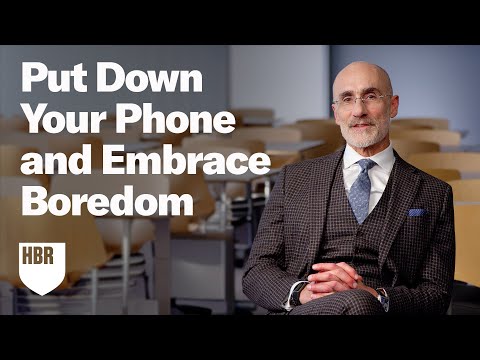
- Boredom activates the brain's default mode network, encouraging introspection and self-reflection.
- Avoiding boredom by using devices can lead to a lack of meaning in life and increased feelings of depression and anxiety.
- Experiments show that many people prefer painful shocks over sitting in boredom, highlighting our aversion to it.
- Embracing boredom can enhance appreciation for everyday experiences and relationships.
- The speaker advocates for practical strategies to reduce device dependency, such as no phones during meals and regular social media breaks.
- He emphasizes the importance of allowing oneself to be bored to explore significant life questions.
- The speaker shares personal practices to combat device addiction and improve mental well-being.
Questions Answered
Why is boredom necessary?
Boredom is essential as it allows our minds to engage in deeper thinking and reflection, which can lead to insights about our lives and meaning.
What do experiments reveal about people's aversion to boredom?
Experiments show that people often prefer to inflict discomfort on themselves rather than sit in boredom, indicating a strong aversion to the state of being bored.
What are the risks of constantly avoiding boredom?
Avoiding boredom can lead to a cycle of meaninglessness, making it harder to find purpose and increasing feelings of anxiety and depression.
How can embracing boredom improve life?
By allowing ourselves to be bored, we can cultivate creativity, discover new ideas, and gain insights into our lives.
What strategies can help reduce device dependency?
Implementing a no-device policy during certain times, such as meals and before bed, can help reduce reliance on screens and encourage more meaningful interactions.
How can we cultivate a sense of meaning?
Engaging with boredom and allowing ourselves to reflect can lead to a greater understanding of our life's purpose and significance.
How can we overcome the fear of missing out?
Understanding that not every moment needs to be filled with stimulation can help alleviate the fear of missing out, allowing for more meaningful experiences.
What practices can promote mindfulness?
Incorporating mindfulness practices, such as being device-free during meals and engaging in quiet reflection, can enhance overall well-being.