Section Insights
Introduction to Artificial Analysis
What is Artificial Analysis and what do they do?
Artificial Analysis is an independent AI benchmarking company that evaluates various AI models across different layers of the AI stack, including coding agents, language models, and hardware.
- Artificial Analysis benchmarks AI models across the entire AI stack.
- They focus on trade-offs between different AI layers.
- Understanding model selection involves considering inference decisions and costs.
Current AI Models and Their Evaluation
What is the significance of evaluating different AI models?
Evaluating various AI models helps developers make informed decisions for their use cases. While Opus 5.5 is currently leading, there are over 500 models available, and it's important to consider models beyond just the most intelligent ones.
- Opus 5.5 is a leading AI model, but many alternatives exist.
- Developers should consider a range of models for their specific needs.
- Individual evaluation results are shared for deeper insights into model performance.
Cost Differences Among AI Models
How do costs vary among different AI models?
There are significant cost differences among AI models, with some tasks costing as little as 5 cents. This highlights the importance of making informed decisions regarding model selection based on both cost and capability.
- Cost can vary by orders of magnitude between AI models.
- Less intelligent models can still perform well and be cost-effective.
- Understanding the cost-performance trade-off is crucial for developers.
Factors Influencing Model Performance
What factors should be considered when evaluating model performance?
Key factors include the number of steps required to complete a task, the types of tokens used in model calls, and the proportion of cache hits, which can significantly affect performance and cost.
- The number of input tokens and cache hits are critical for performance.
- Understanding the steps involved in task completion is essential.
- Evaluating models requires a comprehensive look at various performance metrics.
Trade-Offs in Model Selection
How should developers approach trade-offs in model selection?
Developers should assess their tasks against a Pareto curve of intelligence versus cost, determining whether to prioritize higher intelligence or lower cost based on their specific needs.
- The Pareto principle can guide decisions on model selection.
- Understanding where a task fits on the intelligence-cost spectrum is vital.
- Developers must balance budget constraints with performance requirements.
Transcript
0:12 Hey everyone, thanks for coming. I'm George, I'm one of the co founders of Artificial Analysis. Today I'll be talking through optimizing the cost of intelligence to give a quick background to who we are at Artificial Analysis. We're an independent AI benchmarking company. We benchmark across the AI stack, so the agent layer with our coding agent benchmarks and other agent benchmarks, language models for their intelligence, image, video, speech and music models as well as the hardware and inference layers so that we can benchmark the trade offs between all these layers.
0:52 When you're making decisions, you're not just choosing a model, you're also choosing, you're making an inference decision. How do I access the model? How much am I paying for it? What's the speed that I'm, that I'm getting? What's the cache hit rate? We believe strongly that all of the kind of layers of the stack are interrelated. We're all making decisions across them and so that's why we benchmark the full stack of AI leading companies kind of reference artificial analysis and our results I think.
1:21 But what we're most proud of here, when we take a look at these references from OpenAI, from Anthropic, from Google and, and Nvidia, they're not just referencing our raw intelligence benchmark numbers, it's not just the bar chart. We, we're big fans of our Intelligence index but we're kind of most interested in talking through the trade offs that we're making between these technologies. And so that's why we're proud that all of these are kind of two by two charts showing trade offs between choices that developers need to make.
2:03 Sometimes not when they're, when they're getting things working, but really when they're rolling it out in production. We're also quite widely referenced by kind of traditional and new media. We are based in San Francisco, we've got a team of 50 and we are hiring so we're hiring across for deployed engineers, AI research staff as part of our member of technical staff team and ML engineers and so catch me after or please reach out if you might be interested in joining the world of AI benchmarking.
2:47 I think before we understand cost, we need to understand the kind of landscape of AI and the metrics to, to understand and to optimize. And so starting with understanding the AI landscape, I'll first introduce our Intelligence Index. It's we view it as the best single number to understand the general, general intelligence of language models. It's a synthesis metric of 10 different evaluations covering different capability areas of AI.
3:21 That includes knowledge work, it includes scientific reasoning, it includes coding and terminal use, and it includes other capabilities including kind of knowledge hallucination and other relevant capabilities and considerations regarding intelligence that people use use. When choosing between language models, what we say is for the current use cases being built and the next use cases, it's not necessarily to measure and benchmark progress towards AGI, it's really to help developers make decisions for the next use cases that they're building using AI.
4:05 And so of course Opus 5.5 from Anthropic is currently leading the index. I think to many in this room that won't be a big surprise, but also to discuss today is that there's, as you can see here, many other models. We have over 500 models on the artificial analysis website and many kind of current and presented on this chart. And I think what we'll be talking through today is a bit the kind of takeaway that there's also reason to use models other than the most intelligent model in the world.
4:39 We also public individual eval results. So we released AA analyst agent which is a finance and accounting focused, focused benchmark. Thought I'd share that, this being New York, and we share the individual results for those wanting to go to the next layer of specificity when thinking about their model selection and selection of other technologies. because it's not always the case that models exactly follow the generalist view of the intelligence index.
5:12 And so here we kind of highlight that the Gemini series of models actually very good at navigating complex, complex spreadsheets. Of course, the Anthropic series model is of course as well to step back a bit looking at our intelligence index and the leading model over time from the top 12 or so labs here, firstly, I think big takeaway, it's kind of hectic, there's many dots and I think probably that resonates for a lot of us in the room who have kind of felt this over the past few years where there have been huge number of model releases and the number of model releases is increasing and in a sense kind of the pace of progress in our view is also accelerating.
5:56 And I think that is shown in this chart here. And so I think the takeaway here is that AI is moving quickly, progress is moving quickly and so kind of we might feel exhausted trying to keep up with it, but it makes sense to, to, to invest that time and energy because if you want to stay on top of AI and what AI is capable of, then staying on Top of releases is a big part of that.
6:25 And next view won't deep dive. This could be a whole talk. But open weights models continue to keep within three to nine months of the leading proprietary models. And so open weights models remain an option. And so I think that's, that's the takeaway for the talk today. And it flows through to a lot of kind of cost implications, which sometimes open weight models can have favorable characteristics. Next, let's dive into cost and how to think about cost.
6:56 And I want to discuss talking about cost from the perspective of being kind of mid, late 2026, because I think if we were doing that, if I was doing this talk even six or nine months ago, I think it would be a different talk. I has moved a long way and so we'll go into the drivers, but to kind of start with a little bit, kind of the answer of why we're so conscious of cost is because these models are costing many dollars to complete individual tasks.
7:29 That wasn't the case 12 months ago. People are spending more than ever on AI and can spend more than ever on a single task on AI. And so here we present Opus and fable costing above $5 to complete a task. But on the other side there's also models that cost 5 cents and less to complete a task. And so what we're seeing is there's orders of magnitude, multiple orders of magnitude difference in cost between the, between the models.
8:02 And that means that the cost decision and the model decision matters. And what I would say is that, yes, you might say, oh, the, the models on the left here are less intelligent. And that's totally true, but they're still very good. A lunar here, GBD5, sorry, GPT6 Luna is $0.07 per task. And it's much better than GPT4 was originally, right, which kind of. And way better than GPT 3.5 Turbo, which really kind of like opened up this wave of kind of language models.
8:38 And so I would say that there's two orders of magnitude difference between the leading proprietary models and much cheaper, but still very good, very capable models. And next way to kind of consider looking at cost is from a time perspective. And what we've done is we've bucketed models by their intelligence and looked at when that intelligence tier was first reached.
9:08 And then how did the kind of cost of trying to access the intelligence with the cheapest model develop over time? And what we see here is within one year accessing that level of intelligence, a 30 on the intelligence index or a 50 on the intelligence Index. Essentially reduces by an order of magnitude kind of 10x within around a year. So picking the, the light purple here, Once we reached a 30 cost a bit over a dollar a year later it fell to around 10 cents and then now we're well below the 10 cent.
9:45 We're in the kind of 1 cent to 10 cents territory. And so I think it's, there's also a time dimension here whereby we should be, you know, know, making choices for now, but also conscious that that is going to change very quickly in terms of the intelligence that we can achieve and that maybe $1 million spent for a big agentic workload is likely. We can access that level of intelligence at 100k and then in 2 years potentially around 10k.
10:18 Now here we have a buildup of the cost per task. This is a lot more complex than where we were 12 months and definitely 24 months ago. I think 12 months ago we're talking about reasoning models. We're saying that we have to pay for reasoning tokens. And you know, the, the labs were just talking about the output token price. And so we needed to do analysis as a, as a community to really understand the cost because we had to count reasoning tokens.
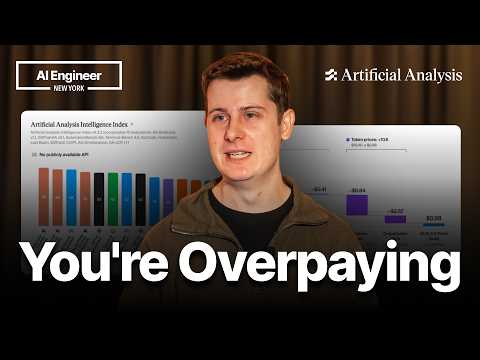
10:45 Now with agents it's become way more complex, way more complex. So to understand the buildup of a cost per task here we use our AA briefcase Agentic knowledge work benchmark. It looks like agents in an environment of thousands of files completing knowledge work tasks like creating reports, creating PowerPoints, creating marketing videos. And what we can see here is on average, opus is costing $21 to complete a task and it does a great job. No arguments there.
11:15 Focusing on cost though, what we can see here is that answer tokens cost around 16 cents. Reasoning tokens, oh, sorry, it's like 2 cents. And then we have reasoning tokens a bit more. But then really where the building up to the single language model call, the first kind of column that hits the ground of a second there. So each call is 13 cents. Right. But with agentic trajectories we're having to think about the number of steps, of course.
11:47 And so it took 165 steps to complete the task. And so that's where that's a new dimension that we need to think about when it comes to agents and then thinking to kind of what goes into a single language model call. You can see there's answer tokens, reasoning tokens, input tokens, and input tokens. You need to think about how many of those input tokens are kind of cash hits and so get that roughly 10x discount on an input token price.
12:15 And what we can see with the build up is the biggest driver of the kind of input into what a single language model calls is the number of input tokens. And then secondly the amount or proportion of those input tokens that are cache hits. And then the third biggest driver after that is of course, well, it's actually the biggest, but is the number of turns per task. And so we were talking a year ago around the number of output tokens, how much reasoning the reasoning verbosity.
12:45 I think today we really need to be talking about input tokens, cache hit percentage and then the number of turns per task is the key metrics that we should be thinking about when thinking about the cost of running, of running agents. And I think just to really emphasize the number of cache hits, if we don't have that, then, and we don't have any cache hits, right, cache hit percentage zero. Caching isn't working. Maybe we've got our own setup with VLM, we haven't enabled prompt caching.
13:15 Then instead of $21 per task, this costs over $200. So that's just to really emphasize how much caching matters here when we're talking about agents and also we're talking about inference providers, how much you really need to care about that. We started recently publishing benchmarks around cashier percentage on our website. And next consideration is, you know, different reasoning efforts. And so here we have kind of column, column charts showing the different reasoning efforts for Opus 5.5 and the implications on these metrics.
13:51 And so I think pretty much the key takeaway here is when we're talking about reasoning efforts, we're not just talking about kind of reasoning. The number of reasoning tokens for a single agentic call, it does impact the number of turns. And of course then you have reasoning tokens and then those reasoning tokens feed throughout the agentic trajectory into kind of much more input tokens because of the way that like message histories work when it comes to comes to using agents.
14:24 And so even when using the same model, very important to think about the reasoning effort because here we can see that at low, Opus 5 can cost 5.5, can cost a dollar per task and at max it can cost $21. And here's kind of a breakdown going from Opus 5.5 to GLM 5.3 flash, a much cheaper but still extremely good, very capable model. That's, that's open weights.
14:55 And I think when we look at this, when we look at this breakdown, this is really just to show that one, there's big differences between, as we saw, between the leading models and the and much cheaper models. And two, is that all of the different drivers that I was talking about play a role in driving cost differences between models. And then thirdly, of course that input token prices and your cache hit percentage are the biggest driver of cost when doing Long Horizon agent tasks.
15:30 So we've talked about the cost and I think there's no points for knowing that that GLM 5.3 flash is cheaper than Opus 5.5. I think a lot of people in this room know that Lunar is cheaper than, than Astra. Great. So the challenge for us as builders is making the trade off decision. That's the hard thing. How do we understand our trade off curves for our tasks? And I think a starting point that we think is useful to use is the generalist view of intelligence versus cost per task.
16:05 And starting with the Pareto. So starting with, okay, my task, where does it sit across this, this intelligence Pareto in terms of the model that's needed? If I'm able to spend more or wanting leading intelligence, I want to look to the right of the Pareto. If I want cheaper, then I should look to the left of the Pareto. The Pareto being this, this line depicted in this, in this chart here.
16:35 And when choosing and wanting a cheaper model, let's take a look at the, at the Pareto and seeing okay, I'm willing to my budget is less and so what's the model that at that point offers the best intelligence for that, that dollar or from the other perspective of I want this level of intelligence, what's the cheapest way I can get it? How to think about navigating that decision and asking yourself those questions. A way that we think is helpful is to bucket tasks into two categories.
17:07 So first is unlimited intelligence tasks whereby more intelligence can always deliver a better result. An example being analyze drivers of the costs in my business and how do I optimize them kind of smarter will always deliver a better result there. Next, the second bucket is limited intelligence tasks. And here is when more intelligence won't give you a better result. So the question how much did I spend on subscriptions last month? I think a cheaper like Luna will answer that question.
17:39 As long as it's set up with the right MCPS currently it'll tell me $80. Using Astra will also tell me $80. I'm not getting any benefit from more intelligence. And so then I should focus on what's the cheapest way what's the level of intelligence needed, the ceiling and what's the cheapest way that I can get that level of intelligence? So that's limited intelligence, unlimited intelligence. The question is what's my budget? How much am I willing to pay for increased intelligence?
18:12 In terms of how we suggest using artificial analysis, we suggest to kind of and how to navigate these decisions, I think it's understand the landscape, the metrics, then compare models based on priorities, shortlist models, and then for kind of smaller prototyping workloads, use the shortlist test on your own, you know, in your own context, in your own agents. For more advanced users, particularly when rolling out in production, we recommend creating your own benchmark to take that short list of 5 models and try and make the decision, optimize for the decision because of the kind of magnitudes of costs that we're dealing with now.
18:54 We recently released a product called Optima that allows users to come to artificial analysis, upload their context and we will together with you use, using a lot of our knowledge that we've distilled into this kind of Optima agent, we generate you a benchmark and give you your own trade off curves between your view of intelligence for your task and the cost to help you make these trade offs. So that's the cost of intelligence.
19:25 Thanks very much for listening. Come check us out our website at ArtificialAnalysis AI and as mentioned at the start where we're hiring quite broadly across roles. So thank you very much.
Summary
- Artificial Analysis benchmarks across the entire AI stack, including models and hardware.
- The Intelligence Index synthesizes multiple evaluations to help developers choose language models based on their capabilities.
- There are significant cost disparities among AI models, with some costing over $5 per task while others are under $0.10.
- Cost and intelligence are rapidly changing, with cheaper models achieving comparable capabilities to leading proprietary models within a year.
- Key cost drivers include input tokens, cache hit rates, and the number of turns per task.
- Developers should categorize tasks into "unlimited intelligence" and "limited intelligence" to make informed model choices.
- Artificial Analysis offers tools like Optima to help users create benchmarks tailored to their specific contexts and needs.
- The importance of caching is emphasized, as it can drastically reduce costs in AI task execution.
Questions Answered
What is Artificial Analysis and what do they do?
Artificial Analysis is an independent AI benchmarking company that evaluates various AI models across different layers of the AI stack, including coding agents, language models, and hardware.
What is the significance of evaluating different AI models?
Evaluating various AI models helps developers make informed decisions for their use cases. While Opus 5.5 is currently leading, there are over 500 models available, and it's important to consider models beyond just the most intelligent ones.
How do costs vary among different AI models?
There are significant cost differences among AI models, with some tasks costing as little as 5 cents. This highlights the importance of making informed decisions regarding model selection based on both cost and capability.
What factors should be considered when evaluating model performance?
Key factors include the number of steps required to complete a task, the types of tokens used in model calls, and the proportion of cache hits, which can significantly affect performance and cost.
How should developers approach trade-offs in model selection?
Developers should assess their tasks against a Pareto curve of intelligence versus cost, determining whether to prioritize higher intelligence or lower cost based on their specific needs.