Transcript
0:00 The World Cup. Finally. A little master of the World Cup. Um, which may not have as many people at all of its early stage games as well as it will. >> Exactly. Yeah, we're talking about 250,000 people at the derby. Well, there's a fair few people that they'd like to transition into the US for for some World Cup games. Um, on current data. Look, this people have been saying to me, it's interesting, how you going to deal with the World Cup? Because, you know, it's very performance driven, isn't it? And I think that is true to an extent. You know, there's there's a lot of uh what will happen over the next few weeks that will be very much driven on results. However, with this World Cup in particular being in the US, there are some really interesting underlying stories that have been a huge part of the build-up and I would imagine will play a continued part actually during the tournament. Normally, I don't know how you feel. Normally, I feel like uh particularly with the last few when we've had them in Russia and we've had them in Qatar, uh even South Africa, I remember in 2010, there was a lot of conversation around stadiums not being ready and the political environment.
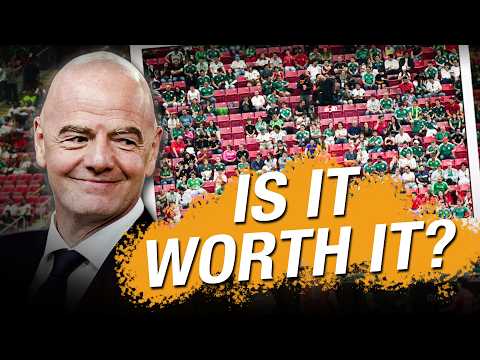
0:55 That quite often has stopped to an extent once the football starts. This feels like it could continue and I fear a huge part of that is going to be because there's going to be a fair few stadiums that are far from full. And if you've ever watched foot- well, if you ever watched the Club World Cup in the US last summer, sorry. >> Was that exactly? Yeah, the incredible trophy that you piece of trophy. >> Chelsea.
1:19 >> [laughter] >> Piece of trophy. Yeah, they're not Johnson's paint, yeah. Um, you know, it was an extraordinary sight when you had these massive teams playing in virtually empty stadiums in the US. I have >> Which Which massive teams? >> Uh well, Paris Saint-Germain. >> [laughter] >> Uh Real Madrid, Man City, the biggest of all, obviously, Palmeiras. >> [laughter] >> But um, look, there's a huge amount to uh to to unpick from this World Cup commercially from a business perspective. So, I picked out a few of them just for us to have a quick discussion in now before the tournament starts and they're things that I imagine we'll be coming back to.
1:51 Some top line numbers that are interesting for us to have a look at just on the the total World Cup. So, the revenue target for this World Cup for FIFA is between 9 to 13 billion. And that was a seven billion dollars. So, let's say 10 or 11 billion. >> Call it 11. Call it 11 billion. A median outcome. Yeah. >> Qatar was 7.5 billion dollars in 2022. >> looking at a at a three and a half billion dollar uplift on 7.5. So, you're looking at a 50% increase on revenue being targeted from FIFA. Keep that in mind cuz we're going to come back to that.
2:23 >> Breaking that down, how do they achieve that? Right. So, broadcast rights. And again, these are reported numbers. So, you know, go bear with us, but reported numbers, broadcast rights now 3.8 to 4.3 billion. So, a 22% increase on Qatar. Excellent. >> Yeah. 1/5. >> Well done. Brilliant. Well done. Sponsorship. Key one. Particularly in the US with the value of this market and the appeal of this World Cup. >> in Qatar, wasn't it? Because there was certain category there was certain brand categories that for local reasons couldn't really stretch their legs.
2:49 >> Absolutely. So, the 2.7 billion dollar commercial income here again, anticipated, is a 37% uplift on 2022. Again, excellent. Well done. >> Tickets and hospitality. Now, I I'll emphasize reported because there's so much in and around this, but three billion dollars is the reported target for FIFA on tickets. >> And that's up and that's up from about 700 million, 750 million, right? So, you're talking about a 200 million dollar increase on ticket revenue. Is that fair, Charlie? Is that right?
3:27 >> 2.3 billion increase. >> Sorry. >> Sorry, that's >> It's what happens when you go from 750 >> No, but it also shows the extremity of that number, right? We're talking about seven I think it was about 7 750 million on tickets in Qatar >> Yeah. >> going to a targeted three billion. >> Yeah. >> So, a two point two and a half three billion increase on tickets. And who stumps the cost for the majority of tickets.
3:52 Fans. So, you leverage your exposure for sponsorships. Great. B2B, generally. Broadcast rights, B2B, sell it in. Can we extract value out of that? Great. Tickets and hospitality, the pockets of the people that you need most. >> Yeah. >> And this ticketing theory, we've had we've had quite a few people comment on the show asking us to look into this. So, I'm going to give you a quick um story of this. It's probably the most interesting part of the whole business story. So, just bear with me, but I'm going to run you through a little bit of what's happened. I And I want to start with a quote from Gianni, our favorite Gianni Infantino, who in February said the following, "Every match is already sold out."
4:27 We keep some tickets back for some last-minute sales, of course, but every match is sold out. February 2026. Now, it was interesting, some FIFA officials quickly walked back a a little bit of that and said that the holding some tickets back, I think it was about 5 million tickets and 6 and 1/2 they said were available. So, let's say they held back 1 and 1/2 million. Anyway, that was a very strange um thing to say when even the numbers of tickets that had been sold at the time didn't suggest that the tickets had been sold out. And what's the real issue with all of this?
4:55 Where's this come from? Well, it started with the information that they gave up front. So, normally, uh let's use Russia 2018, right? Russia 2018, FIFA gave 2 years worth of time to to to allow people to understand how the ticket process would work, from buying tickets to planning their travel, and they gave that information with plenty of time for the fans to get on board with it. In this World Cup, they started in September. They announced the first bits in September, and I think they went on sale on October the 1st. The World Cup starts in June. So, 8 to 9 months of time to plan, book travel, accommodation, everything in here.
5:28 It's quite stressful for a fan. The ballot therefore that you went into at the start was also it was kind of like a blindfold, what they call a blindfolded ballot. So, you'd have this demand generated, and people would get on the site, but you'd only see the price of some of these tickets when you got to check out. So, you may have gone in there expecting it to be $60, and suddenly it was 300. >> Mhm.
5:48 >> So, the point at which you're making that transaction, you could see you've been cornered into that to an extent. Now, the most expensive World Cup tickets ever, the justification for that was North American market maturity. One, I.E. This is a region that's used to paying a lot of money for these types of events, so it'll be absolutely fine. Comment on that in a second with the value of the domestic audience versus the international. They also had it as that the old gem reinvestment into the game. The more money we make from this tournament, the more we can put back into the game. And then there was another one, which you know is more corporaty, which was their lack of ability to regulate the secondary market. [clears throat] So, what do I mean by that? They feared if they put tickets too cheap, then a lot of people would buy them up and they would stick them straight on secondary markets and make a huge amount of money selling them at $400 rather than the $100 that they bought them off FIFA for.
6:35 So, they decided, "Hey, well, we'll just change that. We'll just put them at $400 in the first place ourselves. >> We'll act like ticket touts ourselves. >> Exactly. What do you Firstly, on those justifications for very high ticket prices. So, you said something to me earlier on the market maturity. >> Yeah, let's go back on the market maturity. So, basically what they're saying is Americans are really rich, so let's sting them. >> Yeah. >> Yeah. Mhm.
6:55 I think that was just strategic, massive strategic mistake. Why? America is a mature sports market that is very used to paying very large sums of money for sports, which it has a deep passion for. So, you can charge whatever you want for Super Bowl because tens of millions, in fact, I think we even worked out hundreds of millions of Americans desperately want to watch it live. Um and therefore there's a supply and demand imbalance. You can only fit It doesn't matter how big the stadium is, you could never come close to fitting in all the people who wanted to watch Super Bowl. And you know, that drips down into NFL in general and other leading sports, etc. And again, NBA can be very, very popular, sometimes a bit less. So, yes, there is a American sports market that has got its head around paying an awful lot lot money to watch American sports franchises.
7:43 >> Right. >> Right? Does that translate yet to having a mature soccer market? I use the word advisedly cuz we're talking about America, who are used to the idea of paying a lot of money to watch soccer matches. No. Absolutely not. MLS matches are cheap. Not many people watch them anyway. Going to watch the US men's national team is cheap. Going to watch women's matches in the in US is cheap. Football is an immature product in a mature market, right? So, that's the first point I want to make. It's a misjudgment on the American market.
8:16 >> Yep. >> The second point is that World Cups are not actually about the domestic market. What makes the whole ecosystem go round is that effectively the host country pays a lot for hosting the event knowing it's going to recoup a lot of that money by attracting huge numbers of fans from all all around the world to come to that country and spend lots of money in that country, not just on ticketing, but on hotels, on food and drink, on clothes, on all these other types of things. And that's how the whole thing at least supposedly works on an economic basis. And some of those people who come once will love the country and decide to go back again. Funny enough, the last time I was in the Middle East, I bumped into some people in the airport who were transferring to Doha.
8:58 And um I said, "Where where you going?" We know we have we have we had a bit of time. And um they said, "Well, we're we're going to Qatar." I said, "Why are you going to Qatar? On on holiday?" I said, "All right, why is that?" He goes, "Well, we came to the World Cup and you know what? We absolutely loved it." And they now they now take their holidays in Qatar cuz they love Qatar, right? They just thought the whole thing was terrific. So, there's also that in South Africa. That was very much a part of the of the thought from South Africa's point of view. Let's drive it as a tour tourism destination. So, effectively what they've done is they priced out the international market who have to think not just about the ticket prices, but also very high hotel prices, flight prices, all of those types of things as well.
9:34 And then they've misjudged their own domestic demand, not their own American domestic demand, thinking that that's a mature market for football, soccer, when it's actually not a mature market for soccer. It's a mature market for other US sports. And the And the And the amount of dollar that they're willing to spend on soccer is relatively limited. So, the the net of all of that is that they've ended up with a the wrong kind of supply-demand imbalance, where they've got huge amounts of supply and limited demand on their own website. So, as of about 3 weeks ago, Charlie, you're about to tell me cuz you've got the detail, as of about 3 weeks ago, if you went on to FIFA's own website, you would find huge numbers of tickets available for lots of the group games, but still at very fancy prices.
10:13 >> Completely. And I'll give you some context on those prices now that we'll talk about before actually going into that because you you need to actually hear a few numbers on this, right? We have three three tiers that we really put. You had a value tier, a standard tier, and a premium tier, in those orders of price. So, firstly, this is the first World Cup that's employed dynamic pricing. Dynamic pricing being a change in price based on the demand for tickets to an event. Very simple. If there's high demand, the price rises. If it's not and you need to shift the tickets, you'll get it at a better value. But generally, that happens much closer to the actual event.
10:41 They've also priced games differently depending on who's played in them. Some people that's all got very upset about this. Um you know, they think there should just be a standard price for all tickets regardless of who's playing. Other people again understand that. But for England's match against Croatia on the 17th of June, let's just use that. Tickets cost in the value tier 198 pounds, standard tier 373 pounds, premium tier 523 pounds. >> So, let's just leave the premium tier to one side and just look at the the other the other two tiers and say that by the shouting, it's 250 quid to go and watch one England game.
11:10 >> Yeah. 800 pounds for a family. >> Which is not By the way, not far off, you know, a season ticket in the Championship, >> Yeah. >> right? So, it's one match and it's about the same as watching 25 matches of a very high-quality division back home, right? So, that's the level we're talking at here. 250 to 300 quid for one match ticket. And as you say, if you're going with two or three members of your family, you're talking about, and we've spoken about this before, you're talking about 1,000 quid on the tickets, then you're talking about another several thousand quid on the flights. This is for one match. Then you're talking about another couple of thousand quid on the hotels.
11:45 You're probably talking about, just to go and watch one match, you're probably talking about a total cost of 10,000 quid. >> Incredible, isn't it? Scotland's first two group games, if you look in comparison, a little bit cheaper. Scotland against Haiti, for example, 134, 298, and 372. Still 134 pounds a ticket. >> And how many Haitians can afford to go and do that? Now, of course, people who are actually currently in Haiti won't be allowed in the US in any case, but there's a significant Haiti population within the US, and I'm saying that very few of them would be able to afford to go to that game. So, then you're going to lose that carnival effect that you get. Do you remember that wonderful game in the last World Cup when Saudi Arabia played against Argentina? Right, it was terrific. Saudi turned over Argentina in the game itself, but the atmosphere in there, cuz the Argentines have got a big support, big traveling support, but of course, Saudi was local, so they had a lot of Saudi fans there as well. It was really colorful, really loud. So, if you That makes World Cup It does. It makes World Cup, exactly right, Charlie. So, if if you look before the start of the World Cup, and you say, "Okay, what are the games I'm really looking forward to?" Saudi Arabia-Argentina would not have been one of them, and yet it was one of the most memorable games that World Cup for the fiesta. Yeah. The whole sight and the sound and the smell and everything of it.
12:50 >> It's the first game I think of when I think of Qatar. >> Really? I obviously I think of the final, cuz it's you know. >> But but as in just literally, I I can picture that stadium exactly as you described >> And what a triumph for the Qatar World Cup. What a triumph the Qatar World Cup to be for the memory to be fixed on such a wonderful occasion as a group game. As a group game, that was somehow symbolic of what actually, as you say, once the tournament started, for me, that was one of my favorite World Cups from a football perspective. From a football perspective, I thought it was terrific.
13:17 There were lots of great games. I thought it was really passionate crowds. They kept the ticket prices low, and this time they just totally misjudged it. >> And I mean, you know, then then the knockout games, just to give you an I'll move it on, but 500 as the as the standard sorry as the value tier for quarters and 700 pounds nearly for the semi-final and then you get to the >> Try the description that's on value on that one.
13:35 >> 3,119 pounds for a standard basic supporter ticket for the final. So, all of this right so this just commercial commercial we talked about that 3 billion dollar target at the beginning. It's not hard to see now where they're putting some of that dream and and numbers on. However, you referenced really importantly the fact that if you go on to the sites now, you'll actually find that despite Gianni's attempt to say that this is absolutely unprecedented demand and we're all sold out. Well, the sites say something different.
14:04 >> Because >> FIFA's own site and the well, a few others like SeatGeek like StubHub big secondary ticket sales >> touting websites >> touting websites touting >> Let's call them. >> Let's call them uh >> What they are. >> What they are. Uh Biggest games of course will be sold out right but we're not talking about those but just over a week ago Ticket data which is an independent site which tracks kind of the major sporting events in the US.
14:28 That paints quite an intriguing picture as what they reported week ago on Saturday was that there are still 74,000 tickets available across 86 of the 104 matches. >> That's only part of the story there. >> So, FIFA's own resale site has been an interesting look at value creation because any ticket bought on that site has a 15% fee for the buyer and a 15% fee for the seller. This is the secondary site. So, naturally FIFA wanted to have all the people that were going on a secondary market going on to the FIFA website where they can make off that transaction.
15:00 Now, that really wasn't working that well. >> No. >> Because they still had a huge amount of inventory unconfirmed but a huge amount of inventory. Within hours basically Ticket data reported that the number of tickets on FIFA's face value site for the secondary market suddenly went to about half of that to the 32,000. Then that fell to just a few hours later. So, either you've had a sudden flurry of tickets on that secondary FIFA website market or encouraging people to go and buy through the FIFA market has failed and they've gone and had to dump a load of tickets on other secondary websites.
15:42 >> Yeah, to touting websites. Right. So, so effectively what's happened here now FIFA have not come out and no comments denied. They they they they basically have just absolutely straight batted it, refused to comment on this. >> This is people speculating based on figures they've got in front of them and understanding where these tickets could possibly have gone. >> These are ticketing experts who are making the judgement that a large number of tickets have disappeared from FIFA's website and have ended up on a touting website. And they are making the judgement, these ticketing experts, that that is FIFA dumping tickets onto the market cuz they themselves FIFA could not be seen to be lowering the prices by that much or else they would open themselves up to difficulties with those who they've already charged vast amounts of money to for for for these tickets. Now, interestingly, the touting websites themselves have said we don't have a direct relationship with FIFA. So, in my view, this is my speculation, Charlie. I think there's been an intermediary here who has gone to FIFA and has said "You've got a lot of unsold inventory.
16:40 How about if we block buy a lot of those off you at a B2B price which you don't have to declare cuz it's a group discount for tens of thousands or whatever it might be and we will then try and dispose of those at a profit to ourselves in the way which which we see fit, right? But we effectively have been the we actually have bought them. We actually have bought them for for you and we're now it's now down to us to try and sell them however, but at least you can wash your hands of of it, right? So, even if it means you end up not making as much money as you might have hoped to from the ticketing side. A, you won't have quite such empty stadiums and secondly, you will at least be getting some money for them. You'll be getting some money for them because every event's worst nightmare is obviously a ticket going to zero.
17:19 Exactly. These touting agencies are the experts at selling tickets. It's what they do. It's their trade. Good little thing about FIFA being they only have one tournament every four years. They are not ticketing experts. This is not their expertise, right? They are commercial experts, not ticketing experts. >> interestingly, just for some numbers that you could now get tickets for if you go onto the site today and have a look Jordan versus Algeria. >> Jordan Algeria. >> Jordan Algeria in Santa Clara.
17:40 Big fall. Two tickets >> Yeah. >> available on face value at 171 pounds can now be bought on FIFA's own site for 171 pounds. That's 64% cheaper. So that's two tickets. So you're talking per ticket under 100 pounds. >> Yeah. >> Excellent. Coming back into where people may have >> any of those made their way onto SeatGeek? >> On SeatGeek, those tickets were listed at 192 pounds and 172 pounds on StubHub. So, you're getting a very similar price on those sites, but what you're seeing is two tickets now affordable for a game that wouldn't have been at the top of people's must-go-to list.
18:14 >> Yeah. >> Similar for Czech Republic South Africa, those were down um to about 190 pounds for the same. Now, I just had a look interestingly last year just to see what some of the tickets on those empty stadiums in the Club World Cup games. I mean, what they you know, you could see up in Chelsea Palmeiras tickets went down to $8 for the Club World Cup quarter-final just to get people in that stadium. >> what you have to sell to get people to watch Chelsea.
18:34 >> It's amazing, isn't it? And it would be but so it'd be really interesting to see how far those numbers now actually will drop down. >> It'll be fascinating. It'll be absolutely fascinating. But Charlie, there's a big story emerging >> here. A big story. >> That's the I I thought I thought it was already a pretty big story. >> Well, it is, but there's a bigger one, I think. Which is the New York and New Jersey Attorneys General have a couple of weeks ago subpoenaed FIFA over the manipulation of World Cup ticketing, basically creating what they say is fake scarcity to drive up price.
19:07 We love a good statement. So, Jennifer Davenport, the New Jersey Attorney General, said the following. FIFA has turned buying a ticket for this World Cup into a gauntlet of confusion, fake scarcity, and impossibly high prices, all at the expense of consumers and hard working New Jerseyans. There is also, on top of this, been accusations of those that bought tickets getting tickets that were not represented in the purchasing process. I.E., they think they've bought a good ticket with X view, and it's turned out to be one that is far less good.
19:41 Because since those tickets came out in the beginning, FIFA added two new sections of like exclusive high value tickets at the front of stands. And so, some people have basically been pushed backwards or moved sideways in stadium. So, the AG's had two elements. One, creating fake scarcity. One, selling and misrepresenting a product. >> And how much are the host cities paying for the for the privilege, by the way? >> About About $250 million, right? Per city to host the game.
20:05 >> Per city, right? So, for you to be one of the World Cup host cities, as a city, you're already paying 250 million bucks. And then you find that FIFA allegedly screwing your own local voters on even their access, let alone, you know, foreign fans coming in, their access to it. Now, I want to bring this back to what what's really happened here. Let's look at the big picture, right? Let's accept the fact that it's a mess, right?
20:26 I don't think that's controversial, is it? And say, why why has it landed up here? So, they did 7 and 1/2 billion of revenue in Qatar. And because the commercial environment was always going to be much better in the US, and because things like hospitality sells will be better, they've also got more matches, right? So, that in theory should do do better. And you've just got a country which a lot of people want to travel to in any case, etc. So, it it was always going TV rights as well, likely to do better. So, for all sorts of reasons, that 7 and 1/2 billion was probably always going to rise to 9 billion. Is that fair? Definitely. Right? 7 and 1/2 So, 7 and 1/2 to 9 billion, and Gianni could have stood up and gone, "Record World Cup. We've We've, you know, increased revenues by 20%, okay?" And everyone goes, "Whoa, well done, Gianni."
21:13 Now, his determination to drive it from the 9 billion, which probably it should have been, to 11 billion, that is the 2 billion that is attempting to be extracted from fans. And it's that 2 billion that is causing the problem here, right? Which is if they'd simply gone, "Look, the commercial sponsors are going to pay big bucks. The TV companies may pay big bucks. The one thing that we now need to do is to make sure it's a great event. We need to safeguard the brand of the World Cup cuz we need to make sure that other countries want to host it. We need to make sure that when there's another World Cup, that lots of fans want to go and all this type of stuff." What they've done is an absolute medium-term strategic disaster, which they've basically brought shame on the World Cup to try and screw an extra couple of billion dollars out of it.
21:57 Really, because that's how Infantino props up his own power base by being able to hand out money to all the little federations around the world. And the more he hands out to them, the more they want to keep Gianni Infantino in position. And we've said this before with with our friend Kirsty at the IOC. In a way, it's it's almost a bit unfair to blame them, although I do blame Gianni in this case, because the way the system is set up, where each one individual country, rather like the minor race courses, each one has one vote, means that countries for whom an extra couple of million here or there really makes a big difference to them, their vote is going to swing depending on whichever candidate promises them the biggest handout.
22:39 >> talk about this at another time. That has increased this year. Each team is getting 12 and a half million dollars guaranteed, right? With even if they go out of the group stages. >> But look look look at the payments to the ones who don't turn up. That's the critical one, because don't forget the ones who are most important in the voting process aren't the ones who qualify. >> Yes. >> They're the ones who don't qualify.
22:57 >> But you you hit the point, really, which is look at the ones that you don't mind going up, I mean the categories you don't mind going up. Sponsorship. >> Yeah. >> Broadcast. >> Yeah. Absolutely. >> Okay. Increase. But why are those Why are those two groups? Why are they paying more? Because they're buying an amazing experience with a brilliant reputation that is a prestige >> And and Qatar was a big success. >> And and Qatar was a Yeah. And And the success of the last one. So, they can go right. That was a That was brilliant for us. That was exactly what we wanted to buy. We had those moments of absolute incredible fandom.
23:23 >> You've raised 37 and a half percent on um sponsorship. You've raised 22 and a half percent on broadcast. >> Really? Then now all the minute this sends you right into that next cycle, right? And you're going to be looking at how to increase that. If there's been a experience for the fans, which is going to dominate a lot of the press in that, your association that comes into this being really positive and is worth all of that increase, that's going to become really challenging for you to justify. So, you're not increasing it.
23:47 You may be even start looking to reduce it cuz you realize that if this is going to be the operational model of this organization, it's not probably the one that's going to get us the best exposure. >> And now when competition we talked about Charlie last week, Formula 1 and you know, top brands There's now more competition than ever for these dollars. So, in this kind of very short-term targeting, >> Yeah. >> they have completely missed, to me, the long-term value. And they've turned what should be the the the biggest fan-driven event into a commercial outcome.
24:16 >> Except that it works in the short medium term to get Gianni Infantino reelected to his position at FIFA. And I think that's where we have to leave it. That is the point of this whole exercise, okay? And that is the structural problem with FIFA is that the president gets reelected based on the votes of individual small countries. And the more money you give them, the more likely they are to to to vote for you again.
24:37 Correct? >> That's so interesting. I mean, look, we we've just said it's going to be a lot about the performance side. I think there's some interesting business pieces. Ticketing's one huge one. We'll cover a couple of others that we've identified in the coming weeks. So, we'll save them for that.
Summary
- FIFA targets $11 billion in revenue for the World Cup, a 50% increase from Qatar's $7.5 billion.
- Broadcast rights and sponsorships are expected to contribute significantly to this revenue, with increases of 22% and 37% respectively.
- Ticket prices have surged, with some tickets costing upwards of $500, leading to concerns about accessibility for fans.
- There are allegations of "fake scarcity" in ticket availability, prompting legal scrutiny from New York and New Jersey Attorneys General.
- FIFA's ticketing strategy has been criticized for creating confusion and misrepresenting ticket quality.
- The US market is deemed immature for soccer, complicating FIFA's pricing strategy.
- The potential for empty stadiums looms large if ticket prices remain high and demand does not meet expectations.
- The discussion emphasizes the need for FIFA to prioritize fan experience over short-term financial gains to maintain the World Cup's reputation.