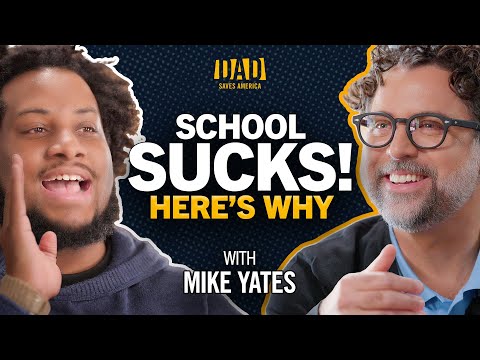
Transcript
0:00 - Let's face it, for most of our kids school really sucks. - Bueller. Bueller. Bueller. - The question we should ask ourselves as dads and parents alike is why. Why does it suck? Does it have to suck? And what can we do about it? When it comes to the school experience for kids, the parts that suck haven't changed much and what has changed has generally made things worse. - Students are taking between 10 and 20 standardized tests depending on the grade, a total average of 113 different ones by graduation.
0:36 - It's high pressure, low reward and completely uncreative. On top of all that, school can be an unhealthy social environment that burns kids out, promotes mindless conformity and punishes outside-the-box thinking. And that's in our so-called best traditional schools. At the other extreme, poor performing schools, even when they're well funded, are often unsafe places that fail to instill the most basic academic skills in their students. - [Reporter] In this school, security guards watch for razor blades and tin foil, knives.
1:08 - [John] It has been reported that up to 85% of incarcerated youth are functionally illiterate. - [Narrator] It's called the school to prison pipeline, and it's a national trend where children are funneled out of public schools and into the juvenile and criminal justice system. - The results speak for themselves. Students, parents and even many teachers agree that our K-12 system is a mess, and that's before COVID threw the whole thing into complete chaos. - I definitely feel very stressed.
1:37 - I probably get around like four to five hours of sleep. - I've never felt so much stress in one school year. - My guest today, Michael Yates, is determined to change the way we think about the classroom. Mike knows the system inside and out. - I think I know why today so many people, especially today's students hate school. - [John] He was raised by a teacher and has spent years distilling his outside-the-box approach in both public and private schools alike.
2:05 - I am the provocateur. I am the imagineer. I show up with wild, crazy ideas. - He was instrumental in developing the innovative Alpha school here in Austin, Texas which boldly promises that kids will love school, learn twice as fast and learn real-world skills in the process. That's no small task. (dramatic music) He's also a leader in Teach For America's Reinvention Lab, the very place he got rejected from early in his career for radical ideas on how to make classrooms work better for students.
2:35 - Got a thought that teachers should not speak for more than seven minutes because if I'm talking, the student's not talking. (upbeat pop music) - Layout like what is it that you do? What is your job right now, 'cause it's really interesting? - Yeah, yeah. So my job title is I'm the Senior Managing Director of Network Strategy at what's called the Reinvention Lab. The Reinvention Lab is a small like startup ask group inside of a large non-profit, Teach For America, and Teach For America trains teachers and puts them in low-income schools.
3:09 Well, we exist to change the way the organization works because of an ineffective, like inefficiencies in the model. And so I am the provocateur, I am the imagineer. I show up with wild, crazy ideas and execute on those ideas to make people think differently about learning and education and what it should be. - What is TFA? What is that? - Yes, TFA is Teach For America. About 30 years ago it was an attempted solution to a problem which was massive teacher shortage that we're still experiencing today in the US.
3:42 You couldn't find enough quality teachers to fill positions, particularly in low-income neighborhoods and low-income schools. So the idea was that you'd find a college student who's really talented and really good at school. When they graduate, you train them, you put them in the classroom, they stay there for two years and then they go somewhere else and advocate for education, whether it's in the legal sphere or entertainment or whatever. - Are these people who are studying education?
4:09 Are they people who are studying a subject matter like math and physics or history or law or economics? Who are these students that TFA is, or was originally reaching out to enter the classroom? - It's certainly not just for education majors. As a matter of fact, TFA is considered sort of like an alternative certification program for a lot of folks. So like if you're not majoring in education, it's a way into the field if you wanna become a teacher, so.
4:36 - How does TFA find me, like, how does that happen? - Oh, they recruit. They show up. They pop up on the college campus, and today there's even sort of more creative ways to recruit, like standing up a tutoring program where you get college freshman and sophomores to do the tutoring and they're like, "Oh, well, I love doing this." And you're like, "Well, hey, you can be a teacher at that school too." So, I mean, they have an aggressive, like large recruiting department and effort every year.
5:04 - You said that you were brought in because there was a feeling that, actually not only was it not necessarily working as well as it could, but that, as you said, I think you said harm was even being done. - [Michael] Yeah, yeah. - So what does that mean? Like how could an organization that's trying to bring the best and brightest into school districts like Newark, how could you do harm? Like that's kinda crazy. Like I would think that that's an all upside proposition.
5:29 - Yeah, so in some communities, TFA works better than others. For example, in Austin, Texas, you say Teach For America out loud and people will be like, "Get outta the room." - Really? - Yeah, because for whatever reason it didn't respond well to TFA. But if you go to Houston and you say Teach For America, they say, "Please give us more," because in Houston and in Miami, Teach For America saved the public schools, like the influx of talent and the influx of people who just wanted to be there even if it was two years or five years, like it transformed the schools in some of those neighborhoods.
6:04 - Where does the innovation lab come in? Where does Mike Yates come in to start tracking scores at TFA? (both laughing) - You partially said it. It is like one size doesn't fit all. It's like TFA will say that and then they create this standardized formalized system to becoming a teacher. TFA decided we have a profile and we know who's gonna be a great teacher. Well, I'll tell you, I was rejected from Teach For America. I applied to Teach For America.
6:28 I had taught in a private school and I had a blast. I was a basketball coach, I was a speech coach, I taught speech. I was there from 4:00 AM to like 11:00 PM every day 'cause I just loved it. I loved being with students. And I said, "You know what, this is the career I wanna pursue." I didn't care that I got paid pennies on the dollar. As a matter of fact, I was being paid so little at the school that going to public school was like a $10,000 increase like just keep that in perspective.
6:57 So I applied to Teach For America, and by that time I had what most people would consider, especially seven years ago, very radical beliefs about school, like I thought that teachers should not speak for more than seven minutes, because if I'm talking, who's not? The student's not talking. And so I designed my sample teach at my interview where I only spoke three words, and they were piecing together this experience and it looked like they were having fun.
7:24 It looked like it was engaging and interactive, but then my interview was stopped short, and my interviewer said, "There's somewhere for you in education, but is not here." - I wanna make sure I understand this. You're in your interview and they're like, "Get out?" - Yeah, add insult to injury, I was supposed to interview in Dallas, so I drove 3 1/2 hours. It snows in Dallas, they canceled the interview. And so I look at my wife said, "Well, they said I could go to San Antonio."
7:54 So we drove on the ice and snow to get out of Dallas in the middle of the night so that we can be at this interview in San Antonio, and then I was kicked out of the interview. - Great experience. - Right, great. So I just remember, I went out on the river walk and I put my hands in my pocket and I said, "I've gotta be right. That went well." And maybe I was delusional, but I was convinced at that point that like I knew something that they just couldn't see, and that's a good example of like the harm that TFA did, because I wanted nothing to do with that organization.
8:29 I spoke out against them publicly every chance that somebody asked me. Then one point it was, you could describe it as a visceral hatred for TFA and organizations like it, because I started to peel back the layers of like what had happened in that interview. And what it was, it was the institution in part funded by the government telling somebody who's doing something different that's arguably better for kids that you don't belong here. And so when TFA is deciding who does and does not belong, is where they did a lot of harm in a lot of communities.
9:04 There are a lot of adults today that are like, "I don't wanna talk to them." - I think about the challenge of doing things at certain scales- - Right. - When I hear what you're describing. Is that avoidable or is it like you can't deliver school at scale, teachers at scale and not have a certain amount of like bureaucratic, like bell curve stuff. Well, we get most of the good stuff and then there's all these rackie people like Mike Yates who come in and I don't know what to do with him, so get lost.
9:37 - In the defense of Teach For America, they've gotta answer for the dollars that they spend, and so if they're like, "Yeah, this dude says that software can replace direct instruction," they gotta go tell somebody like, "Yeah, we put this guy through," but I think it is that, like it's the standardization of process in like how do we turn out great teachers at scale, because I don't know that anybody would say this in these words, but they had no option but to build for scale, because that was the problem that the organization chose to tackle.
10:12 - Let's talk about that education radicalism, that got you kicked out of your interview. Where does this education journey start for you? And maybe just go back to even as a kid, what was school like for you? - So my mom was a teacher. And when I was eight years old, I came home one day and my mom had these like brochures lining the table of universities. She was like, "You need to pick one." And I was like, "Why?"
10:41 - Eighth grade? - No, when I was eight years old. - Eight years old! - Yeah, she's like, "You need to pick one of these 'cause you're gonna go to one of these schools." So I was like, "All right." So I picked Duke. I had no idea what it meant and my mom goes, "Yeah, they have a good basketball team." And I was like, "Oh great, I like basketball. This is good." And so I was a Duke basketball fan and didn't really know why my whole childhood, but that story I always go back to it because my mom did not always know the right answers, but there was this thing inside of her where she knew that education was the key to unlocking whatever our situation was because as a single mom, well, I didn't grow up with a father.
11:27 I had one parent who was taking care of three, young, crazy boys. And now that I have my own children, I often call my mom and I'm like, "I'm sorry that we ate so much and we broke stuff, like-" - Three boys is basically like three monsters. - Exactly. - That you've invited into your home. - And I have so much gratitude for her and respect for my mom now that I'm raising my own children. And she did it all by herself, but she knew that there was something special about education.
12:01 She also knew that there was something special about doing it differently. She had this friend named Ms. Beam. And Ms. Beam was this crazy science teacher, but I loved this teacher, I loved her. Every day at lunch, she would put this, like a skinned, dead cow head and ice chest in the hallway 'cause she thought it was so funny to grow students out. And she was like, "Oh, we're gonna learn volume," like this volume formula, wield in a fish tank, run a water hose through the window and starts filling up the fish tank, and she's like, if somebody doesn't figure out how much water can fit in this tank, the room's gonna flood.
12:35 I just, I was like, "I don't know if those are effective teaching techniques." They probably aren't. (John laughs) But I was hooked to come to that class every day just 'cause I was like, "What is this crazy lady gonna do?" - What kind of Houdini nonsense is gonna arrive? - Exactly. And I see that as my earliest training ground, because it was at the time, I never said this out loud, but being a teacher to me at that moment was enormous.
13:02 It meant something to me because all of my mom's friends who were teachers, like I swear to this day, she doesn't admit to this, but I don't think, I just think if a person was a bad teacher, she just didn't talk to them. Like all the teachers I hated, my mom also hated them. (John laughs) And all the teachers that I thought were really awesome, it just happened to be they were really good friends with my mom, so I just had this roster of incredible teachers at this school.
13:29 And our school was, middle school was also a very tough environment, because in Houston you have these massive zones where every school really is a melting pot, different ethnicities, different socioeconomic statuses. I went to middle school with Josh Gordon who is an NFL wide receiver who has had lots of trouble with drugs. And our middle school game plan was real simple in football. And so we all looked like we were better to give Josh the ball.
14:00 (John laughs) And those guys, I mean, Josh and some of the other elite athletes, I watched them flock to my mom's classroom in the hallway. Like, "Oh, your mom's so awesome. She's so funny. She does this. Like I was supposed to fail this test, she let me retake it." Just like all of these little things that I was sort of learning and just taking with me. Beyond her, though, I had, particularly when I got to high school, I had almost given up on school.
14:27 I was just like, "This just doesn't work for me, I hate it." Like I'm probably gonna go to college 'cause I had to pick the brochure. And I was like, "I hope it's gonna be Duke." Like I was a big JJ Redick fan at the time, the shooting guy at Duke. And my sophomore year, I walked into a homeroom class and a teacher named Heath Martin who changed my life, because he was the first teacher outside of my mom that was able to like not just like believe in me, but saw things about me that I could not have seen or like I couldn't have developed.
15:05 I was convinced, like I said, it was like I'm going to get a scholarship to play basketball at Duke. I was 5'9 in the ninth grade. That was not happening. (John laughs) But he was the first person to look at me and say, "That ship is sailed for you." (John laughs) He's like, "If you were gonna go to Duke, we would've known that two years ago." We would've known. He's like, "But what you are is an exceptional communicator."
15:28 He was like, "What you are is a passionate person." And he was like, "So you will be," he told me this in those words, he was like, "You will be one of the greatest teachers on planet earth because you have the skillset." And I was like, "Dude, I'm not gonna teach. I hate school." And he was like, "That's fine. For the time being, you're gonna be on the speech team." He was like, "I'll see you at practice."
15:48 And I was like, "I'm not, it's speech for nerds." And I ended up, I don't know why I came, but I showed up on a Tuesday afternoon at 4:00 PM. I showed up after school and just like the mentorship, I'll say the things that I think make teachers great are all the things that happen outside of the classroom, outside of the instruction and the techniques and stuff like that. We were at a speech training at once.
16:12 One of my teammates got disqualified for a reason that he shouldn't got disqualified for. We couldn't find our coach, Mr. Martin, this teacher, and we see students running out of this cafeteria like just, we're like, "Oh, somebody fighting?" And they're rushing to the window of this library where Heath Martin is standing on a table yelling at the other adults telling them like, "You know this is wrong." He's like, "But that's fine, 'cause we're gonna pull out of this tournament and we'll see y'all at nationals."
16:44 And storms out, sees every, he's like, "Move, let's go." So we're like, "Yeah, we'll see y'all at nationals." (both laughs) It was like one of the, it was a television movie moment. But I will never, for the rest of my life, forget that and how I felt like even though he wasn't on the table specifically for me, I was like, "That guy has my back." When I wanted to drop out of the race for student body president, he literally slammed his fist on the table.
17:16 And was like, "No, you're gonna write a speech. You're gonna deliver the speech." And the other faculty sponsor was like, "Well, he can," he was like, "You don't know him, stop." Right, like I gave the speech, I won. I was class president. Like I owe a lot of my success and mindset to that guy because he chose to go the extra mile, do the extra work, so. - The thing that I always like to keep in mind when we get into conversations about what's wrong with education is that people like that shape our lives.
17:46 - That's right. - Right. And I think the thing that complicates our discourse is Mr. Martin is a great teacher. - Right. - But he's a great person. - Right, exactly. - And I think there's this desire that we can't, we have to put teachers on a pedestal for the simple fact of doing that job. I think every job has people that are great at it and people that aren't. - Right. - And when we sort of venerate a job instead of venerating individuals like Heath, I think that gets things confused.
18:21 Tell me more about him. - Yeah. If you put together all the identity markers, you would never guess that this would be the guy that influenced my life. So Mr. Martin was a middle-aged, gay, white male who he says he's born Catholic, he's gonna die Catholic. He's from Louisiana. Just kinda, like honestly, he's kinda like this ordinary figure, like sometimes you get the sense that he's always bothered by something and you don't know what it is.
18:52 He's not really bothered by anything. It's just his demeanor. He just cared deeply for every single human being and he used to say this to me. He used to say, "I don't hold any part of my identity too close, because if I hold one part too close I miss the fact that I'm a whole amalgamation of people." I learned from him about cultures that I had never considered. I remember in high school he fought for two things; to form a black student alliance and he fought for a Holocaust studies course.
19:23 And one of the things that he challenged us on, he was like, "Okay, if we pull this black student alliance thing off, I dare you to go learn about somebody else's culture." And I was like, "Okay, well, I'll take that bet." At that point in my life, I had had so many positive interactions with him that I trusted that whatever he was challenging me to do was like, well, there's probably gonna be something cool on the other end.
19:46 And that small interaction, whether right or wrong or effective or ineffective, the in between is what matters. The in between of him building trust for years and sticking close and fighting for kids, it really describes who he was. It was one of the few classes I remember from school. It was my video tech class and that one, so. - So you obviously, in Mr. Martin, you have like a model of like how a teacher can change your life, right? - Yeah.
20:17 - Where does that take you next in this road to being someone that's devoting your life to education and to different, I mean, you've got a podcast called "School Sucks," you have TED talk called "School Sucks." - Yeah. - So unwrap the seeming contradictions there for someone who sees that stuff and just like, they see like, "Mike Yates, school sucks, that's why I love school." - Right. - Wait, what? - Yeah. I think there's two things that happen.
20:47 So the inverse is also true about Mr. Martin. If he represents sort of, if he's the prototype for a great teacher, then there's Ms. McGowan. I hated her. (John laughs) Like she was- - She's still alive? - Yeah, yeah. - Okay, okay. - Oh yeah, yeah. I've had a great revenge story with her. Ms. McGowan was my seventh grade English teacher. And I had gone to this writing camp at Rice University and I had an instructor there who said to me, he was like, "You are a phenomenal writer."
21:18 And I didn't know much about the world or anything, but I knew that people felt really good about Rice and if a student from Rice who was getting his PhD is telling me that I'm a good writer, that meant something to me. And it made me take writing a little more seriously. And to this day, I still, I love writing. I had written this paper in Ms. McGowan's class. I used a lot of techniques that I learned from this camp.
21:44 And when it was time to return the papers, I mean, you know what it means if a teacher gives you a folded, if she folds it with her hand like- (both chuckles) - It's like uh-uh! - Yeah, like- - Uh! - And she folded the paper and it had nothing on it. And I went to her after class. I was like, "Hey, I don't have a grade." And she says, "Oh yeah, we need to talk about this."
22:03 And she accused me of plagiarism. And I remember, I've read the words I was hot with anger, and I never knew what that meant until that moment. Like I was boiling over. I was ready to like kick a desk over because I worked so hard on that, like I knew it was my work. Well, fortunately education technology had come along at that point and there was Turnitin.com. I calmed down and I said, "You know what, let's use Turnin.com."
22:33 And she says, "Oh yeah, okay let's do it." - Did she give you attitude like, "Oh, you just hung yourself, son." That's it. You're done, your toast. - We ran it through Turnitin.com and this is what soured school for me. The originality report came back and it confirmed that I wrote the paper. And she said, "The technology's gotta be too new. In my professional opinion, you did not write this paper." A seventh grader cannot write like this."
23:03 In that little sentence it said to me immediately, "Oh, Mike, it's not that she recognized the words, she just thinks you're too stupid to have written this." I went to my mom I said, "Hey, this is what's happening. You know that I wrote this paper. You saw me writing this paper. We only have one computer in this house. How would I have done this anywhere else?" There's no way that I could have. And my mom said, "Yeah, and you have a choice.
23:28 You can fight or you can just take the zero. What do you wanna do?" And I hated that 'cause it was like, "I just want you to go fix it." - Right, well, this is some good parenting. This is like parenting lesson, numero uno. - It was the best parenting. Because I said, "Okay, what are my options?" And she was like, "Well, you've already talked to her twice. You've done Turnitin.com. Now you have to go above her."
23:53 So I was like, "Who's above her?" She was like, "Well, go to the principal." I was like, "All right." And my mom said, most importantly, like she said, "Don't tell them I told you to go." And I didn't know why she said that until I was much older. If I would've walked in there, "My mom told me to come here." When the principal failed me as a student because he said, "We're gonna side with the professional opinion of our staff member."
24:18 That was when the system became tainted to me. That was when I was like, "Oh, there's a whole little process where they protect each other." And the only thing that restored my faith in the profession was that my mom then said, "Gimme the paper. "Go sit in the car." And she just unloaded on Ms. McGowan. And one of the greatest professional moments of my career was going back to Houston, giving a training on student engagement and telling that story with her sitting in the front row.
24:50 - That is an epic. - Yeah. What's most interesting about that story is that, and this is also, sort of goes back to the question you asked me about sort of like the paradox of me like hating school but also loving the profession, is with all the cancel culture and everything, I remember thinking to myself, "Do you want her to be fired?" And my honest answer was, "No I don't." But I wanted her to live with that moment every day of her professional career so that she doesn't do it again.
25:20 - I'm gonna transition us, because you in a very real sense wanna cancel traditional school. - Yes, yeah. - Tell me about what you've done to see that come about? And what I mean by that is not like at the political level, but I mean, you developed a program as part of being at a school that is quite radical, so that was a chance for you to sort of express what you think it means to teach and learn and what those things are.
25:47 How did you get at Alpha, and what did you do and why were you doing it? - Yeah, it was a singular moment for me. My second year of teaching, I was in Fort Worth ISD, which is one of the worst public school districts in the state of Texas. The average reading level of high school junior in Fort Worth is third grade. - Wow! - Like it's really bad. - And to digress for a minute on that, how does that happen?
26:15 - It's a total system failure. - Like, yeah, how does a kid stay at a third grade reading level and be allowed to continue to high school? - Part of it was public policy. I mean, like it's part of what no child left behind did and the application of it. You can go talk to enough kids who are in public school they'll tell you, like, "If you fail the class, just go do the packet in the summer and they'll pass you."
26:36 You also have teachers who are met with impossible situations. Now there's something called inclusion classes in public schools. Inclusion classes are normally reserved for first-year teachers because veteran teachers, there's no way that they would teach an inclusion class because that's basically where they dump every child that has emotional disturbance or behavior issue or individual learning plan. So if they're learning disabilities and differences, like that's where they are.
27:08 - So here's all the kids that are kind of inside the bell curve and all misfit toys can all be together. - In one class. - Where actually the divergence is between you or actually probably even further. - It's educational malpractice, is what it is. And it should be illegal. I was teaching that in Fort Worth, and I had every behavior problem in the school. The American teaching force is 80% white, middle-aged women. And so when you have trouble, particularly with black boys, you find the first coach and you send them to the coach.
27:42 And so I just had people just sending kids to me, but I had student, I just decided, I was like, "You know what I can do? I can create an environment that kids love." There were days where I was like, "You know what we're gonna do? We're gonna watch the "Golden State Warriors."" 'Cause they would come in there and they're like, "We're tired. We don't wanna do this work." And then like, "I'm not fighting with you.
28:02 So let's watch the warriors." I had the great fortune of, and I knew this because I had a mother who's a teacher, I knew advice to anybody going into teaching, do not teach a tested subject ever, because it's just not the same pressure. Nobody was coming to look at me for standardized test scores. So I had so much flexibility. I had a kid who couldn't read in the sixth grade. He lived in a house with no running water.
28:27 He had watched his father murder his mother. - Oh! - This was one of the hardest situations I've ever heard about. I loved having this kid in my class. - What was his name? - His name is Angel. And like me, Angel knew one thing about the world and that was that education could lift him out of that situation. He loved being at school. And so he came to my class, and he said, "Hey, I didn't really know, probably you shouldn't call on me to read out loud 'cause I'm not really good at that."
28:55 I talked to him after class. I said, "Look man, I've never taught anybody how to read, but you're not leaving this class not knowing how to read. And so everything that we're doing, you're not doing that anymore. And he was like, "What am I gonna do?" And I was like, "I need to go home and Google it." And I literally, I went home that night and I Googled how do you teach kids how to read? The first thing I found, I found- (John laughs) - Can I just stop you for a second?
29:20 Because I think one of the things that is so great about that is it's like here is this- - I was a trained in degree teacher. - Yes. (both laughs) Your mom is like a world class, public school teacher, and you're like, "Okay, and I got these problem kids-" - Yeah. - "I better Google how to teach kids how to read." - [Michael] Yeah. - Now, okay, so what did Google tell you? - I said, okay, well apps that teach kids how to read.
29:45 I found this app called Newsela. Back then it is not what it is today. Props to Newsela for what they've done. But it was basically articles on everything, and they adjusted it based on K-12 reading levels. And so the next day I showed up, and I said, "Hey Angel, I have no idea if this is gonna work. But you're gonna read these articles or try to read them and do whatever activities they have in this program on this computer while we do this other stuff."
30:15 And he was like, "Okay, cool." And I was like, "So what do you like?" He was like, "I love soccer." I was like, "Cool. Who's your favorite soccer player?" He's like, "Cristiano Ronaldo." Said, "Great." So we pulled up seven articles of that, and he just starts going through it and doing the little exercises and- - Oh! - I know. This is the greatest moment- - I'm gonna have to hold it back 'cause I'm blabbly Italian and I'm prone to tears.
30:40 - Wait 'till you hear, I mean, this is the greatest moment in my teaching career. Three months go by and I'm, I kid you not, I was just not checking on him. Like I did not. (John laughs) - I Googled it. I got some crazy article thing, kid likes soccer. All right, I'm out. - Yeah, I mean, yeah. And I would ask him, I was like, "Hey, you feel like you're getting better?" He's like, "Yeah, no, this is cool.
30:59 This is good." And I'm like, "All right, cool (mumbles)" About three months goes by and he just screams. He's like, "Yes." And they all know what's going on. Like they know and they were, credit to those kids, they were so supportive of him. And I'm like, "Angel, what happened?" And he's like, he stands up. He's like, "I just read this article seven times, and I didn't mess up once." And then he starts reading it out loud, and the kids are cheering, and my, I'm like, "He can read!"
31:32 Like it's three months of him every day, and he was reading. That day was the day that it was cemented for me that I didn't need to be talking to teach kids. 'Cause he said, "You taught me how to read." And I was like, "Hey man, I don't know if you, like I was not talking to you ever." And there was wonderful student named Ivan who like took nothing from anyone. She is going to transform the way that politics are done in the United States 'cause she's no nonsense and she don't care what line you sit.
32:10 She's like what, I always sit on, she's calling you out. And she was very clear like, "Yeah, he didn't teach you how to read. He just gave you the right tool. You just need to recognize that." And she was trying to be funny, but in my heart I was like, "Dang, that's true, that's right." That's like she just gave me all of the teacher education I needed. And it was just in my brain in that moment, my whole class shifted, where I was like it's where I found videos, like I've come now to realize that you were making on YouTube.
32:41 I realized that there were tools around me that nobody told me existed that were better and faster and able to individualize learning for these students who had highly individualized needs that I couldn't meet by myself. And I had two assistant teachers. And so I told them it's like the three of us are not enough for these 25 kids at a time. And the classroom changed from that to stations. We called them learning pods.
33:12 So it was just these small groups of students who were interested in the same sort of segment or same sort of thing and we started building what I didn't know at the time, but it was like a mini version of Alpha. What was shocking to me is how much more content we got through when you sort of flatten out the stair step that they give you in the curriculum guides which is like do this first, then do this step, then do that one and you let kids go at their own pace.
33:39 Also when I wasn't spending time talking, it was more time for them to practice and to learn. And I was using lots of Google searches. We launched this assault on our English department about Wikipedia because they learned to use Wikipedia. They learned to use the sublinks on Wikipedia, and you had students that were just figuring things out at a pace that was faster than what a traditional classroom would allow. Like one of the most interesting epiphanies is Ken Derek White who was always in trouble with everybody.
34:15 And he was like, "Yeah, some people say Wikipedia is not real research because you can change it." He was like, "But I gotta be real, I don't know anybody who would take the time to go change anything on Wikipedia." I was like, "That's actually a fantastic point," like who is taking the time to change to make them wrong. But we then like deep dove on Wikipedia and found out that it used to be Nupedia, and they were peer-reviewed articles, but they couldn't turn out enough of them and they were just armed and ready.
34:42 So when their English teacher said, "You can't use Wikipedia," they said, "Well, here's what we found out." I just loved that they were soaking up so much knowledge that it turned them into these rebels in the school, which they kind of already were, but now they were equipped with like real knowledge and they were impressing people. And all of a sudden the district superintendent and these district officials started showing up and taking notes on the class because what was happening there was truly special, and for me, that was it.
35:14 That was the school year that I was supposed to be at Teach For America where I was rejected and I had to go through another program. In that moment where was on the river walk saying to myself, "I'm right." I was back there standing in the middle of this classroom with the desk literally turned upside down and students doing all kind, like laying on the floor. I remember looking at it and I remember thinking about the river walk.
35:36 And I said it out loud this time. I was like, "I'm right." I'm right. I know I'm right." And the rest of my education career has been spent trying to do school radically different, because I saw firsthand what it did for the kids that no one wanted. - So break down for me the pieces as you understand them now about why that worked. I mean, 'cause I think we can go into what became some of the things you did at Alpha.
36:08 - Yeah. - But I think even more important than that for a parent, for a dad who's watching and listening to our conversation is not, like what about this school, 'cause they, unless you're in Austin, Texas, you're not going to Alpha probably yet. - That's a good point. - But what were the pieces? So, and here's what I'm hearing and I'm gonna necessarily bring my own mentality into something. - Sure, yeah, yeah. - But is, well, one is Angel part of what seems to me like worked about that reading app that you gave him was he was getting to engage material he actually cared about.
36:50 - Yep. - So instead of like, "We're all gonna read this boring textbook," because it's like by definition it's a textbook, so it sucks and it's boring and it's terrible and it's like, "Let's talk about war and make it seem boring." - Right. - So that's one piece, right? Follow your passions, follow your interests. You learn what you're interested in. What other sort of pillars, like first of all, do you agree with that? And like what other pillars have emerged for you as like the building blocks?
37:16 - Yeah. The major lesson with Angel, there's two, was one of them was about him following his passion and the other one was that I never actually had to motivate him to do it. I believe that he was motivated by like wanting to, like he knew reading was a gateway to a better situation for him, but I think that the motivation for him became the passion. It was just like, I just love this. I already love it and I get to do it in school.
37:45 And I think that was the other thing. It was so different to them. This was only one hour of their day where they felt like they got to relax and they got to be themselves. And literally talking is one of the points, like their voice being heard. So I started, I had always had these classroom procedures that other teachers hated. They made us write them on the wall. And so my first procedure was infinite retakes on any test.
38:13 My second was no test. And they hated it because I was hell bent on finding a different way to show knowledge. And when we sort of switched to this model, it was even more imperative that I found a different way because everybody was doing something different at that point. So I couldn't just give them a test or a quiz or anything. And so I had to find a different way to assess their knowledge. So we used lots of presentations.
38:40 We used a lot of debate. We used a lot of like creative projects. So it was like, I would go to the computer lab and I would rent computers and I'd rent these old, like iPads that they had, and we'd use the iPads for like filmmaking. Like we were trying to make rap videos. They loved flocabulary, which was this, it turns history into rap. - That sounds awesome. - And they were like, okay, so we used to use flocabulary.
39:07 They're like, "We should make flocabulary now." And I was like, "Brilliant idea." So that's the other pillar, to speak, is really like listening to the voices of students as the experts on education and their experience. Like they'll tell you what they wanna do. - One way you could interpret this is say, "Oh no, look, this is great. This is the system working, like this is a public school and here's Mike Yates doing this." If there's a little bit of sarcasm in voice there, it's because you're obviously like the 0.0001% of experiences kids are having in these standardized systems.
39:45 When we talk about trying to customize the education experience for kids, we get into this issue of there's a lot of kids. - Yeah. - So how's that gonna work, and how do we know that some of these customizations aren't gonna be like a disaster? What is your sense of like the potential to have more kids getting what they need? - So I think the most important lesson that I learned, it actually came at the end of the year when I had like all of my students were like, "Hey, can you come to the next grade with us?"
40:14 And I was like, "I can't. and if I do, who's gonna teach sixth grade?" But I realized in that moment the saddest thing, which is that they're gonna have to go back to regular school next year. And even that year, they had to go back to regular school- - The rest of the day. - The rest of the day. And for them, the trade off was worth it. And so I couldn't stomach it, and I left the public school system, and I set out to try to build something.
40:44 I wanted to try to build a whole school. And in the process, that's how I got connected with the team at Alpha and ended up there. So I think the most direct answer to the question is for a dad who's trying to provide this sort of experience, it is to do something that schools hate, and it's to be really engaged, like not lording or hovering over your kid, but understanding deeply what happens in the building and how your student can take advantage of it.
41:14 Involvement is not just showing up to the class presentation. Involvement is like when a decision doesn't make sense, it's having the conversation. It's, yeah, you're going to the top. And even though schools hate this. I encourage it because your child will never ever get everything they can out of the school if it's not a real partnership. And so I don't mean beat your school over the head, but I mean establish partnership and establish yourself as a presence in the school.
41:47 They should know you and you should know what's going on. You should be able to, at Alpha there's a parent that when some people saw him coming, they would just sigh. And I came to love talking to him. Right or wrong, he would tell you how he felt about what was going on. And he would ask the hard questions. He told us when we were doing a bad job, and when we did a great job, oh, he would sing the praises of people who are doing, I'll never forget, he was standing in a group of parents, and he was like, "That guy over there, Mike, he's the greatest public speaking teacher."
42:21 And he's like, "I'm telling you, there's no one better." And I was like, "Man, I feel so good right now." And I used to roll my eyes when I'd see him coming until I realized that John's showing up at the building or John's email made me better 'cause I knew that when it came to his kids, I should know where they are at all times, not like physically in the building, but like, if he's like, "Hey, how are they doing in math?"
42:43 I should know. I should know how they're doing in math. And then I realized, oh, well, if I would do that for them, I should be doing that for every kid. And so one parent choosing to be involved and say, "Yes, I wanna understand. Yes, I will tell you when I don't think it's right, and yes, I will tell you when you're doing a great job." Those three things, for me, pushed me to be so much better.
43:06 - In a way what you just said is sort of at the heart of learning, right, because it's that confrontation and criticism, is how you come to understand something. It's, is it John Stuart Mill that said the person that knows only their own position, but doesn't even really know that. - Right. - I'm paraphrasing, but that's such an essential thing, like you wanna stretch your brain out past the routes that are already ingrained there. - The line that I always tell people is from James Baldwin.
43:37 He said, "I love America more than any other country in the world." And it is for that reason that I insist on the right to criticize her perpetually. That's how I feel about education, and that's how I feel every parent should feel about the school. - One of the things that I really believe is dangerous, that's being pushed, and that is this notion of being a victim. - [Michael] Right. - And that, because I don't know anyone that embraced being a victim and that was their path to achievement.
44:09 - Exactly. - Except maybe certain book authors, which I don't know, but that you can kinda see like who monetized victimhood into a kind of like celebrity status. But as like a mentality, it just seems, as a parent and as an educator, like the worst possible choice you can make is to say, "You have no agency over your life. You are a victim of a system that is rigged against you," even if it's true. - Right, right.
44:37 Like I believe that institutional racism is real. Like I do. I believe racism's very real. I believe that there are different starting points for people based on their race. Like I believe that there are racist people. It's honestly so difficult to know a man's heart, so I take a very nuanced stance on almost everything because I really try to look at human beings as like 360 total figures, like people are flawed, and I really, I'm a Christian, so I believe that no one is righteous, and at the same time, I believe that human beings, there is a mechanism by which we are capable of good, and so that's also why I don't subscribe to cancel culture.
45:18 - For me it's weird because I'm so in it about the fundamental, like universality of human dignity, it's partly because I believe that we have a soul, it's partly because the philosophical framework of treating every individual as equal works, from what I could see, from everything I've looked at and read. It's like, now, when you treat everybody as an equal human being, that works, that works. When you start to divide them up along these lines, it's an experiment we've run over and over.
45:55 We've run it with kids. We've run it with nations, it's like the Nazis. It's like, okay, well, these people are bad just because of their characteristics, just because of what they are. Stuff that you could tell when you look across a room. Like, oh, I know what that person's all about. It's like I don't even know what I'm all about. So how are you across the room gonna tell me what I'm all about? I think that that's one of the biggest lessons that I've learned for myself over time, is how much I don't know what I'm capable of at any given time.
46:27 I don't know whether or not I can do a thing I set out to do. And so if I don't know whether I can achieve this goal I've set for myself, how could somebody else know that? - But there's so many situations that we just don't apply that same victimhood mentality to, the thing that I hate about it for education is because I look at all these other areas of our life where we don't apply them, it makes me question the motive immediately.
46:52 And I'm like, "Who's making y'all rich?" The conspiracy theorist to me says that if there is somebody who's trying to win a culture war, they're doing it in school for a reason, because every time you wanna do something nefarious in any culture, you get the young people. - What I hear you saying is you look out there and you see, pull it from the headlines, like young elementary school stuff doing crazy things, like having the kids all line up based on the amount of melanin in their skin.
47:25 - Which is such a weird exercise. - And it's like is this a snapshot from a David Duke conference? - Right. - No, it's like a Portland elementary school or something. - Yeah. - Are you saying that you think the person that put that in that school is not well-intended? - They're just wrong. - [John] They're just (laughs). - That's how I feel. - Yeah, I think they're wrong, but they're not like twirling their mustache like (indistinct). - Right.
47:53 I struggle to answer the question because I actually do know decision makers in education who genuinely believe that they're doing right by people. The reason why I said they're wrong is because when I have the conversations I say, "No, no, no, I know you care. I just think you're wrong." I look at what's going on in the media and how this conversation is a distraction to progress, especially in education. This is my number one role I feel like at work, is redirecting us from this specific distraction.
48:27 Teaching victimhood, there's a lot of people they really don't mean to do it. It's mainstream now. It's where the brownie points come from. If you can quote Kendi and if you can quote Robin DiAngelo, you'll get the speaking spot at the conference, like I will never get those speaking spots 'cause they know. Like they're not gonna call me at those educational equity conferences because they know what I'm coming with, and it's the truth, which is like, yeah, it's unfair, but what does that change for you?
48:58 Either you spend all of your time and all of your effort, all of your money trying to destroy that system which in turn will destroy you or you put in the work that it takes. I always go back to my favorite football coach who is Nick Saban. I'm gonna put this phrase on the wall so my kids can see it when we have this talk. He says to every one of his players, "It takes what it takes."
49:23 And for me it might be something different than you, but I'm also not concerned with that. Like I'm not counting your money, I'm not counting your footstep 'cause at the end of the day you're doing what you have to do for your family and you're not an axe murderer as far as I know. Most people aren't, we have places for those people. We're pretty good at finding those people. Like the people who truly wanna do harm to others, we're pretty good at finding them and locking them away.
49:49 - Maybe too good. - We are too good. (John laughs) - Pretty yeah, no, agreed. - The thing I always tell people, especially when you start talking about oppression, privilege, victimizing people or accepting victimhood, it's funny because we don't extend that to every single area of our life, and I think sports just works nicely, but like whoever's the underdog every week in football should just not play the game on Sunday, right? Like why are we playing the game?
50:21 - My son's basketball team would not play any games right now on the basis of- - Basketball is a great example. I coached at a private school with some, these kids were not athletic. They weren't very good. And we were playing against another school that had a kid who looked like he was out of a Nike magazine. And in the eighth grade, this kid's dunking on people, he's got, and then you look around, there's shooters. His team was great.
50:52 They were really good. And I rounded my guys up and I said, "This is why we play the game. The game hasn't started yet. This is why we play the game." And they were, I mean, they were defeated. They were like, "Look at that, like we're not." And I was like, "Guys, this is why we play." We beat that team by like 30 that night. - What? - Because we had it, one thing, and we had, there's a legendary coach from LBJ High School named Harvey Rhodes, and Harvey Rhodes has a defense that almost nobody can beat.
51:26 And the only way to beat this defense is if you were one of the coaches on his staffs. And I know because I was undone by another coach, and he was like, "Oh, you know Harvey Rhodes, huh?" I was his assistant coach when he put that in. So I was like, "Hey, we're putting in the defense." After the game I was like, "Do you see what that did to you?" I was like, "You played the game.
51:48 You didn't make yourself a victim." I said that word. I was like, "You didn't make yourself a victim of circumstance." And I was nearing a point of like paralyzing depression and fear with the police violence in the country. And I said out loud at home, "Sometimes I feel like it's too much and I don't even know why we live here." And my wife, for some reason brought up that basketball game. She was like, "You remember when you said that?"
52:14 She was like that's like kind of, like if you just take your own advice, and maybe don't give up and maybe play the game, maybe you'll break through the fear and the anxiety and this person at your job doesn't like you, maybe you should just play the game. - So your mom is a public school teacher. - [Michael] Yeah. - You work for Teach For America. - Mm-um. - And you have four kids that you are homeschooling?
52:46 - Yeah, yep. This discussion is one that my wife and I have had my whole career. She's been at homeschool from day one. And for her, it's about nurture. It's about, "Hey, these are our kids and I wanna be the one to teach them about how the world works. I wanna be the one to show them where to find that learning." And I'm fortunate in that that's my wife's dream job. This is the high level, NCAA division I, not just a division I track athlete, a record holding, which she's got six all time NCAA records at SMU, right.
53:25 So, I mean, she's a daughter of an NFL athlete, like she has this stuff- - She's a high performance machine, your wife. - Right, and she's only ever wanted to have a family and stay at home and love her kids and teach her kids and see them grow in that way. And it got to the point where I was like, "I just can't take this from you." Then my wife said, "Let's not just homeschool, let's build our own program."
53:52 And as a person who likes to work on education as a problem, that was where I was all in. And I was like, "Oh yeah, you're right." - She was like, "Let's clear the table." I've got some LEGO sets here." - Exactly, that's exactly what she did. - Now do you wanna do this? - Right. - She's like, "Ooh." - Yeah, that's exactly what happened, yeah. - In this conversation, you've talked about where you came from as far as your family and your upbringing.
54:17 Your dad wasn't really around. So paint a picture of what, like your childhood was like. - Yeah, I don't have the profile of somebody that you would expect to go off and do anything great. I was raised by a single mother. At one point we were homeless. My mother and my brother and I we had nowhere to go. And I watched my mom pull us up by her bootstraps. And I intentionally say it that way. They were her bootstraps, and she was like, get on my bags, let's go.
54:46 My father was not around. He was in and out of prison since 1992 my whole life. He's effectively a stranger. And in some ways, it's a fear that I parent with, 'cause it is like I don't need my kids to have that relationship with me, so. I was also a kid who didn't complain about the way things were. I just accepted, like this is life. I just don't remember being very sad about it. I just remember thinking like I have everything I need.
55:10 There were moments in my childhood where like I didn't know I was poor. And what it did for me is it gave me tremendous respect for my mother and a lack of respect for my father because he made choices that forced him into a life of not taking care of his family. And so I sit with those chips on my shoulder, right, wrong or otherwise, they're there. And I carry that in the school decisions and anything else.
55:40 When my wife told me that we were having a child, I just remember not saying anything. She was mad at me for a while, but I didn't say anything. I just grabbed my laptop and I started looking for a different kind of job because I felt like, yeah, there was a risk that I had to take. There was a risk that I now could take 'cause with every child, my career, like what I feel about it has minimized.
56:07 I've not been bothered by not hitting these goals, these lofty goals that I had for myself to the point where now I've been practicing leading with I'm a dad and I do these other things in education, because to me like the courage to say that in public, when you know people are like, "What do you do," 'cause they're asking you to assess how much money you make and how valuable you are to society, like the freedom to take risk and knowing that you get to be the hero of the story, like if you show up for your kids, you get to be the freaking hero of the story.
56:48 When you get your joy from that, that's a beautiful place to be for me. And so like for aspiring fathers or if like you're about to have a kid, get ready for the flip man, that switch is gonna get flipped, and I love it gives you a boldness to go out and do things. And I talk to people a lot in like career seminars when they ask me what is the key to my success in education, and I say that I'm unafraid to be fired, and it's not because I hold something that's valuable where like people won't fire me.
57:20 I think that is true too. I try like set things up that way, but it's really because I just know, like you said, like if we have to sell our house and live in a trailer, my wife always tells my kids, "If you decide you want nothing to do with us, and you're like, 'I'm leaving,' you'll see us behind you with packed bags, like where are we going?" Like, we're gonna follow you to the end there.
57:42 Like just as long as I got my family together and they're good, I'm good. And, yeah. - We call this channel "Dad Saves America" for a very particular reason and that is that I believe that the big issues of the country are probably best solved in the area of your own life where you actually make a difference. And so for me and for our team here, if you're a dad or if you're thinking about being a dad, there really isn't a bigger playing ground for you to make a difference.
58:18 How do you think about what America is and your role as a dad in the American story? - This is gonna sound weird, but it is my chance to feel American. Just the reality of being a black man in the United States, you don't always feel American. And part of it is because our community pulls us in such a way we become pretty insular. We look for each other in public. And for me, when I'm able to put everything aside and focus on my house, it gives me a shot at feeling the most American I ever can because all these things that we've talked about, when it comes with race and all these things, people have asked me before, "Do you want your kids to be reading theory like you did?"
59:10 And I say, "No. That tortured me." Listening to the Pledge of Allegiance and asking myself, "Is that for me?" It was not a comfortable feeling. And it's not that I want them to be ignorant of history or anything like that, but I want them to be bold and brave enough to feel like I can do whatever I work for because I'm blessed to live in a country that makes that possible. It's not possible everywhere.
59:41 I want them to be proud of who they are. I want them to live the American dream, whatever that may be, however they define it. And so my role in my house is to cover and to shield and teach and help grow. And so, yeah, I think that is the most essential role in the development of this country. I believe in that deeply. - Amen, man. It's been so fun having you participate in this conversation.
60:12 I know we're gonna have a lot more. Thanks, Mike. - Yeah, thank you. This was awesome. - I hope you enjoyed this conversation with Mike Yates as much as I did. I think the biggest take away from everything we talked about is that learning is driven by our passions. If you wanna educate someone, you've gotta unlock the thing that they're excited about in a subject so that they can drive the process for themselves. If this has been valuable to you, please share it with other people you know.
60:38 And the best way you can help us is to like, subscribe and hit that notification bell. We believe that dads are heroes in play an important part in saving America from the biggest challenges that we all face together. And at the end of every show, we like to celebrate a dad out there on the Internet doing something awesome. (air whooshing) - Okay. - All right, so you have to get the $5 bill without moving the hand sanitizer.
61:01 - Okay. - Or knocking it over. - Gotcha. - [Curly-haired woman] And if you can't do it, then I get the $5. - Okay, but I can't do it, because that's glued to the federal bill. - No, it's not. - Yes it is. (woman gasps) - Wait, that's not how you do. (air whooshing)
Summary
- Many students find school unengaging due to excessive standardized testing and a rigid curriculum.
- The "school to prison pipeline" reflects systemic failures in education, particularly affecting marginalized youth.
- Michael Yates emphasizes the importance of passion-driven learning, where students engage with material that interests them.
- He shares his experiences as a teacher, illustrating how personalized approaches can lead to significant improvements in student outcomes.
- Yates believes in the necessity of parental involvement in education, advocating for parents to establish partnerships with schools.
- He discusses the importance of mentorship and positive teacher-student relationships in fostering a love for learning.
- Yates critiques the victimhood mentality prevalent in discussions about education, advocating instead for personal agency and resilience.
- He highlights the role of family and personal experiences in shaping his educational philosophy and approach to teaching.