Section Insights
Introduction to Simile and Founders
What is Simile and who are its founders?
Simile is a company focused on creating a foundation model of human behavior to simulate individuals and populations for major companies. The founders have a strong background in computer science and generative AI, having developed a project called Smallville that showcased agentic workflows.
- Simile aims to simulate human behavior for companies like CVS and Amex.
- The founders' background in Stanford research enhances their credibility.
- The concept of agentic workflows is central to their technology.
Advancements in Multi-Agent Simulation
How does Simile's technology evolve to simulate human experiences?
Simile's technology has advanced to include temporal dimensions, allowing agents to have experiences with products and interact with each other, leading to emergent phenomena. This includes simulating earnings calls for Fortune 500 companies.
- The technology allows agents to simulate real-world experiences.
- Multi-agent systems can reveal emergent phenomena.
- Simulations can be used for practical applications like earnings call preparation.
Breaking into Fortune 500 Companies
How did Simile gain trust and contracts with large enterprises?
Simile gained trust by partnering with forward-looking organizations that had significant pain points. They demonstrated the ability to replicate extensive studies quickly, which appealed to companies that were bottlenecked by time and resources.
- Partnerships with forward-thinking organizations were crucial for trust.
- Simile can replicate lengthy studies in a fraction of the time.
- The technology addresses significant pain points for large enterprises.
Expanding Use Cases Beyond Market Research
What are some surprising use cases for Simile's technology?
Simile initially focused on market research but quickly found applications in product development and other areas. Customers realized they could use simulations for product testing and even earnings calls, expanding the technology's use cases.
- Simile's technology is versatile and applicable beyond market research.
- Customers are discovering new uses for simulations in product development.
- The initial wedge in market research has led to broader applications.
The Future of Simulation and Ethical Considerations
What are the implications of Simile's technology for society?
Simile's technology has the potential to make decisions at unprecedented rates, raising concerns about human values and representation. The company aims to ensure that societal values are integrated into the decision-making processes of AI agents.
- The technology could significantly impact decision-making processes.
- There are ethical concerns regarding the representation of human values.
- Simile is focused on shaping the foundational norms of the industry.
Transcript
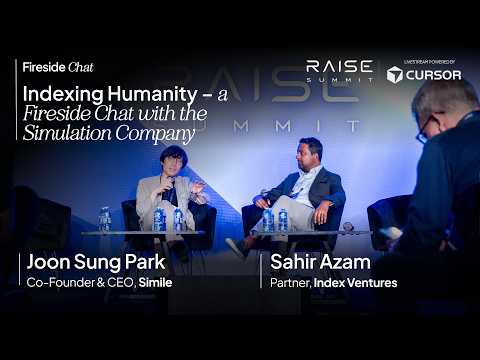
0:04 >> Good afternoon late on day two everyone. Thank you for joining. I'm sure it's been a hectic week for everyone as it has been for the both of us. But I am super excited to have a chat with June from Simile. It's one of the most exciting companies in the Index portfolio. We were fortunate to team up in the series A recently out of California. But June, I think one of the things that attracted us at Index to working with you and your co-founders is really the quality of the team and the unique way you came at the industry. So, maybe let's start there. Really more about you and your co-founders and then we can absolutely get to the really interesting vision that our introduction was in terms of simulation.
0:45 >> That sounds great. Really excited to be here. Hi everyone. so, I'm June. I'm the CEO of Simile. really quick context of Simile. We are a company that is creating foundation model of human behavior to simulate individuals of populations for companies like CVS, Amex of the world. now, the way we came together, so we do have a background from Stanford research in the computer science department. So, I led research back in 2023 called generative agents that basically created this small game town called Smallville where we basically plotted in this game town 25 agents that would actually wake up in the morning, do their routines, go to work, have relationships.
1:24 And it was sort of interesting for a couple of reasons. Back in 2023, we used text inventory and this actually was the first instance of agentic workflow and agentic architecture in the field of generative AI. So, one of the ways that many of our colleagues then reached out to us and then leveraged this was basically to create coding agents, browsing agents, automation agents. But then, I personally got much more interested in the latter piece of this contribution which was to create simulation of our society.
1:52 And this was in part driven by my personal of my personal fascination with simulation, but also many of the enterprise partners who are partnering with Stanford Soter ML, and they thought, "Well, right now we go to McKinsey, BCG, Bain's of the world, and pay them millions of dollars, but if we can run everything in simulation, and that would change everything about their operational cadence." So, my team at Stanford spent about a year demonstrating that we can predict people's behavior 85% as accurately as they would replicate their own.
2:22 And we put that paper out at the end of at the end of 2024. The team came together to to basically bring this technology to the field. And right now, the industry here is around simulations, synthetic panel. The co-founders are myself, Michael Bernstein, Percy Liang, Linyuan. The former three are all researchers from Stanford. So, we contributed to ImageNet, foundation model. We actually coined the term foundation model in this field. So, that's sort of the research background, but it's now paired with a really exciting product and go-to-market team that's led by Mihika, Linyuan, and so forth.
2:56 >> Awesome. So, the idea of indexing humanity, no no pun intended, is a pretty broad, but also can be potentially abstract kind of concept of, you know, simulating human systems. I'd love to give you get a sense of, like, over the long term, what is the implication of the work you're doing, and then we'll narrow down into sort of what are the wedges that you've found in the market today? >> Absolutely. So, the core primitive of our technology is very straightforward.
3:22 You tell us who you want us to model. We are going to train that model that can predict their behaviors and attitudes. That's the core primitive. Then you can basically layer this to create more and more complex simulation. I see this happening in four distinct stages. The first stage is what I would consider to be the individual-level static simulation. So, you're basically conceptually you're asking individual agents what they think about X one at a time. So, think surveys, experiments, AB testing can now be automated in model.
3:55 Then this goes to individual level dynamic simulation. You're basically now adding a temporal dimension. You can now ask the agent, "Go use this product for 10, 15 minutes, and tell us what you think." You're basically asking them to have experiences. And then you graduate onto multi-agent simulation, where now you have many agents interacting with each other, and what you're trying to get out of that experience is basically the emergent phenomena. The kind of things that we have already served in the market is we sometimes simulate earnings call for Fortune 500 companies for their CEOs to prepare for their earnings call. This has been one of the core use cases that we have we have served in the past. And then the final stage here, where this all goes up to, is actually simulating an entire society. So you have multi-agent system living on top of a rich environment or a world model, so that you can simulate the market, all their downstream implications, and so forth.
4:49 >> Yeah, it's fascinating to me over the long-term what the even public policy implications of a technology like this could be in terms of, you know, figuring out it something innovative, trying to get the variations of the different outcomes. You know, I don't think there's been a real technology at scale that besides a lot of humans running around trying to guess at it. So >> Absolutely. >> you know, there are a lot of companies here at RAISE this week. Almost, I'm sure, a majority of them are building agents of some type, and you know, some level of frontier models behind that or open source models, et cetera.
5:21 What makes the type of models that you're building for this problem distinct from, say, what the foundation model labs that we all see, you know, as big players in the market? And And how do you view that as a different domain? Are you threatened by them? How do you think about that? >> Yeah, so this is a great question. So as I mentioned, SimuLy is a company that is training its own foundation model of human behavior. The way to think about this space is if you look at OpenAI or Anthropic's of the world. They're fundamentally trying to create models that are amazing at reasoning, objective, rational tasks. So, they focus a lot on coding, they focus a lot on automation, they focus a lot on natural sciences, mathematics. That's what we have seen. And then they would actually get data that actually represent that, too. They would get data from our course of the world to get these kind of expert data. Similarly, does not care about any of that. We want models at Similarly that are as dumb as I am, right? If I make certain mistakes, I want the model to make the same kind of mistake as the person that it's trying to represent, have the same kind of biases that I the person that it's trying to represent would have. So, fundamentally, the way we see it, Similarly's model is trying to create models that can be representative of people's values, preferences, and taste.
6:37 And we, to make that happen, we work actually with a representative panel partners. So, we have a strategic partnership with Gallup, which has many panel members that is actually across the US and the globe. We also work with Dynata. So, around the globe, we have about 20 million human individuals who are our panel partners so we can get this kind of data, and that's a core differentiation. >> So, the technologies we alluded to earlier in the four kind of layers you explained is very broadly applicable.
7:07 But you're seeing very strong early commercial traction. How did you map out the pain point to try to go after first, especially coming from a research background to then try to find your way into what your ICP is, who and how to focus? Walk us through that kind of entrepreneur journey. >> So, it was a little bit more serendipitous. the way it happened was when we released our initial set of papers, there was actually a lot of inbound interest. So, because perhaps because we were in a fairly well-established labs, many of the Fortune 500 CEOs, their board members, would actually come to to the demos. And they saw the demo, and their mind went to, "Well, we have to bring this into our company." So, there was a lot of inbound interest from Fortune 500s and from those who ended up becoming our customers.
7:52 So, that got us intrigued. So, what ended up happening was that became the initial starting point of conversation, and then we got connected to different orgs within these organizations like CMO, CTO, who are already running so many of these studies. But, they were basically able to test right now a tenth of the studies they actually want to run because they're bottlenecked by actually human resources, they're bottlenecked by the amount of time they have, they do not have like months to spend on the study. If they can simulate, then that's amazing. So, the kind of use cases that we need to we initially saw was during the first call with some of these conversations, some of these companies had like McKinsey study they spent three to six months creating and spent many millions of dollars. We could replicate the finding of these studies in one sitting in during the first demo. And that became a very compelling reason for these companies to go and say, "Okay, we would love to take a look at this technology."
8:49 >> So, I've spent the last 15 years of my career working with large enterprises. And in my maybe perhaps now dated mindset, you know, a lot of these Fortune 500 companies are quite risk-averse. You know, they aren't necessarily the fastest technology adopters versus a digital native or startup type ecosystem customers. But, you've done an incredible job breaking into kind of mainstream global 2000 Fortune 500 accounts. I'd love for you to explain how you got the trust to break in and get, you know, meaningful usage and sizable contracts and already this early in the company's life cycle.
9:25 >> For sure. So, I think there's two contributing factors here. One is the partners that you work with on the other side actually does matter a lot. And the partners that we were fortunate to work with were very forward-looking, but at the same time they had very deep pain points. That there were so many studies they actually had to run that they could not do, or they were very much limited by the human panels. So, one thing that I realized coming into the field was I knew there would be pain, but the pain was much more acute than even what I would have expected coming in. So, that was one.
10:00 Another piece here is we're talking about simulation. By definition, you're trying to simulate a world that has not happened yet. So, the trust and the formation of trust actually matters a tremendous amount for this particular field. And one thing that I realized is it's easy to think about simulation and gaining trust in simulation as a task of us predicting the future correctly. Now, that is important and Simily does that well today. However, that is not the end of the story.
10:31 What you need to At least what I found in simulation is you need to be ex- extremely transparent about the way the data is collected, what kind of input goes into simulation, and at least help the users form a clear mental model of how the data is leveraged to output the results. And if you think about how they right now operate with consulting companies, these companies they certainly do understand that the advice that consulting companies give you might not be perfect. I mean, if they were, they would be hedge funds, not consulting companies. But, the reason why they trust these companies is there is a very difficult decision they have to make, and at least these companies will basically do a very thorough job and basically leave no rock unturned. And that is the kind of confidence that these companies want to have. And that's what Simily provides today. We basically show them, "Here's all the set of data that we considered. This is how that data gets used in simulation, and this is the output." Showing them that end-to-end loop and bring them along in that process matters a tremendous amount.
11:36 >> Yeah, so not giving them a black box, but using transparency as a way to bring them along to a new way of of solving this painkiller problem, not vitamin problem. >> That's right. >> I'd love to make that a bit more concrete in terms of some of the early use cases and some of the customers that you're seeing. I'm I'm sure you're able to share some of it as public references, some of it is abstracting the name. You know, what are some of the most exciting, maybe surprising use cases that you've won so far?
12:03 >> So, Simile has found our initial wedge in the broader field of market research. So, there a lot of the use cases does range from AB testing, concept testing is actually very common, or if they want to do product testing, that's also very common. So, our customers usually come in with these very concrete studies they want to run, or focus group is another one that's very common. And then they very quickly they realize that simulation actually can be applied outside of market research. So, product development is not usually a division that lives within market research, but they realize, "Oh, wait, we can actually show the product to these agents and have them use the product for 10 minutes and tell us what you think." And that's a product test.
12:45 And very quickly they realize, "Hey, if we can simulate people, can we actually create simulations of earnings call?" So, the use cases expand horizontally is our experience, but the first wedge has been in market research. >> Yeah, as a former chief product officer, when I first saw the the idea behind Simile, I was like, "Oh, that could totally apply this to product development in terms of, you know, trying to figure out which capabilities are most important to our end customers in a way that's way more objective and scalable, perhaps, than the traditional ways that are done in most organizations.
13:19 So, just I guess to shift a little bit in the last couple minutes here, a lot of the discussion in the, you know, ecosystem in the media today is about like, is AI going to replace humans? And is it going to displace labor? Is it going to be additive and create abundance? Simile is quite interesting to me cuz it's coming from a very different angle, which is all about accurately representing us as humanity, societies, whether at the individual level all the way up to complex, you know, systems. So, I'm curious just to get your take on a more broad-based as you're such in the center of the room in AI research and now AI productization, how you think about where we are in the arc of not only Simile, but just broadly AI impacting not only business, but society as a whole.
14:06 >> For sure. I do come from tradition where I fundamentally believe that technology is a tool for augmenting humans and not replacing them. And that is very much the philosophy that I follow and the Simile follows. So, in a way, now obviously there's a lot of automation tasks that are going on. The thing that I do foresee is the cost of developing and creating is basically going down to zero. You can now ask agents, "Hey, go create this." And our agents will do it and I think that capacity will get better and better.
14:38 What I do see coming, however, is what they are going to create, will they actually be aligned with the expectation, values, and taste of the end users? That I do think is a gap. And in a way, simulation is sort of an interesting technology where the reason why I got imported and interested in simulation was if you look at any science fiction, I am a big fan of science fiction. There's always twin pillar of advanced technology, some form of AGI and some form of simulation. This latter piece, if done right, can actually be seen as a mechanism that can represent people at scale.
15:16 There is so many rooms where decisions are being made for the sake of the stakeholders, whether it's in government, in product development spaces, where the stakeholders, we want to say we listen to them, but we do not have the ability, we do not have the means to actually go out and listen to the people, get their data. If we can actually create models of individuals and then represent the population, this can be the mechanism to inject our voices into the rooms where the most important decisions are being made. That is an opportunity that I see.
15:50 This opportunity I actually do think it's going to be even more important in the age of AI, especially agent, where so many of the decisions that will be made will be made by agents at a rate that was unimaginable in the past. And many of those decisions are likely not going to take into consideration the human values and what we as a society and as individuals would care about. This is a way to inject ourselves into that process to make sure that we are represented.
16:19 >> Yeah, that coherence between taste, human preference, and democratizing that information for some of the biggest societal questions we have is really just super not only interesting, but inspiring comparatively to a lot of just the okay, we're going to automate away the boring work that happens manually today. So, it's it's really inspirational. I guess what's top of mind for you? I know you're busy recruiting, you know, serving customers. I know you you're getting a lot of inbound interest, but what's the most top of mind thing in terms of how you're thinking about serving your customers and taking similar to the next level?
16:55 >> The way I see it, simulation in this particular area is nascent. In that, the way I sometimes describe this particular technology is it feels a lot like we are in GPT 3.5, GPT 4 era, where the technology that we have now developed is powerful enough to do serious damage on the verticals that we are attacking as a company. However, really the the norms and the initial foundation for this industry is getting shaped right now. And setting the right foundation, I think really is important, not just for a company, but the way the technology gets adopted by the society. I do think like any powerful technology, there are clear cases of misuse that I get concerned about. And this is where upholding the right principles and making sure that those principles actually held by the company that is leading the charge, I do think matters a lot. So, this is one of the things that Simility cares deeply about. The way we see it, I personally believe deeply in two principles. One is that do people have informed consent? When people are represented by simulation, do they know they are represented by it? And do they have autonomy? Do they actually have the ability to say, "I do not want myself represented in the simulation?" And I think setting the right foundation in this way, I do think matters.
18:16 >> Really responsible in the way you're thinking about it. Much appreciate it. So, I know you are more demand than your team can handle, but if if anyone here is interested in learning about Simility or perhaps applying it to their organization, what's the best way to get in touch? >> you know, it's simility.ai. if you find us, please feel free to email me. I'm just Joon, j o o n at simility.ai. we right now serve interestingly many verticals. Now, as a startup, we are very much mindful that focus is the name of the game.
18:51 Simulation in particular, however, has been a very interesting industry in that as a technology, it is very generalizable. So, we found ourselves serving some of the largest retailers, some of the largest finance companies, but also CPG companies, telcos, and so forth. And what I found as we built simulation company was focused does not mean for us focus on vertical, but it's on who do we want to model. Many of the companies that we work with go after the same kind of target population. For instance, CVS will serve the same population as Amex or Walmart. Right? That matters a lot.
19:32 But that's how we think about the market. So, if you're interested in any of these markets or working in one of these markets, please get in touch. >> Awesome. That was great. Thank you, June. It's great to see you. We're obviously very excited to be part of the journey as you solve simulation for humanity in a way that's very aligned with the way we want things to go as humans. It's great to see you. >> And thank you for having us.
Summary
- Simile focuses on simulating human behavior for enterprises, leveraging generative AI to predict behaviors and attitudes.
- The technology has evolved from individual static simulations to complex multi-agent simulations that can model societal interactions.
- Simile's initial market traction is in market research, automating processes like AB testing and product testing for Fortune 500 companies.
- The company differentiates itself by creating models that reflect human biases and values, contrasting with traditional AI models focused on objective reasoning.
- Trust and transparency are crucial in gaining acceptance from clients, with a focus on clear data usage and simulation processes.
- The potential applications of Simile's technology extend beyond market research, including product development and public policy implications.
- June emphasizes the importance of ethical considerations, such as informed consent and autonomy, in the use of simulation technology.
- Simile is actively seeking partnerships across various industries, including retail, finance, and telecommunications, to broaden its impact.
Questions Answered
What is Simile and who are its founders?
Simile is a company focused on creating a foundation model of human behavior to simulate individuals and populations for major companies. The founders have a strong background in computer science and generative AI, having developed a project called Smallville that showcased agentic workflows.
How does Simile's technology evolve to simulate human experiences?
Simile's technology has advanced to include temporal dimensions, allowing agents to have experiences with products and interact with each other, leading to emergent phenomena. This includes simulating earnings calls for Fortune 500 companies.
How did Simile gain trust and contracts with large enterprises?
Simile gained trust by partnering with forward-looking organizations that had significant pain points. They demonstrated the ability to replicate extensive studies quickly, which appealed to companies that were bottlenecked by time and resources.
What are some surprising use cases for Simile's technology?
Simile initially focused on market research but quickly found applications in product development and other areas. Customers realized they could use simulations for product testing and even earnings calls, expanding the technology's use cases.
What are the implications of Simile's technology for society?
Simile's technology has the potential to make decisions at unprecedented rates, raising concerns about human values and representation. The company aims to ensure that societal values are integrated into the decision-making processes of AI agents.