Transcript
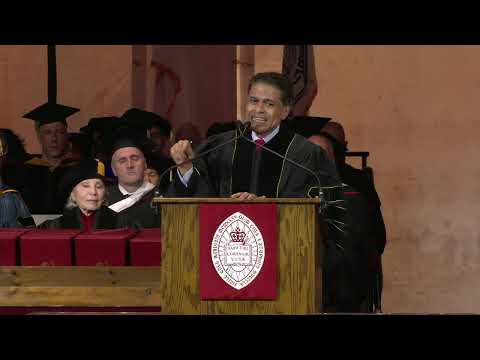
0:00 [applause] >> President Botstein, faculty, graduates, families, friends, and especially the remarkable class of 2026. >> [applause and cheering] >> Thank you for inviting me here. Uh I know Bard College from its extraordinary reputation, but also as a neighbor, since I have spent a good bit of time in this area, especially in Rhinebeck, which is just down the Hudson. Uh in fact, uh one of my Saturday morning routines is actually to bike here.
0:39 Uh and I will tell you my my entry this Saturday morning was considerably grander than my usual Saturday morning entry. Though, what I do love to do on a hot summer day is to go to Holy Cow uh and get one of their soft-serve ice creams. >> [applause] >> Now, I know Bard, and I know that to hit the right notes here, I need to be intellectually provocative, politically aware, artistically sensitive, historically informed, ecologically conscious, emotionally authentic, and most importantly, brief.
1:25 >> [applause] >> I will I will do my best. Actually, I'm not that nervous. This is my third graduation this year. My daughter Lila graduated from college last week. She's here. >> [applause] >> My daughter Sofia will graduate from high school in 2 weeks, and you can imagine for a father compared to the swirl of emotions those graduations have produced, I think this one is going to be a breeze. So, now Bard has a certain reputation.
1:58 Other colleges promise to prepare students for the world as it is. Bard to me has often seemed more interested in preparing students to question why the world is the way it is in THE FIRST PLACE. >> [cheering] [applause] >> WHAT a remarkable rise this place has had. 50 years ago Bard was a small struggling liberal arts college overlooked by most. Today it is one of the most distinctive educational institutions in America, perhaps in the world.
2:36 >> [applause] >> It's a place that has combined intellectual seriousness with civic engagement, artistic and experimentation, and public purpose. You are not just graduating from a college, but from a movement. One that stretches from music conservatories to prison prison education programs, to partnerships across the world. My congratulations on this remarkable transformation. >> [applause] [applause] >> At this point I need to give you a trigger warning.
3:15 I have noticed in this commencement season some graduation speeches have provoked a few boos from some students. So I should probably warn you that I am about to utter the two most provocative letters in the English language today. AI Feel free to get the get the booing out of the way. >> [cheering] >> Who knew right that the most charged phrase in 2026 would not be about race, gender, or colonial exploitation, but a software program.
3:47 But here's the twist. I actually do not want to talk about AI. I want to talk to you I want to talk to you about HI, human intelligence. >> [applause] >> Because while artificial intelligence is indeed arriving with astonishing speed and power, we humans are not going anywhere. And at this moment, paradoxically, we have the opportunity to better understand what is essential and unique about being human.
4:20 Every generation has confronted transformative technologies that seemed destined to overwhelm humanity. The printing press, the steam engine, electricity, the internet. Each inspired wonder and panic in equal measure. And now comes the mother of them all, AI, able to write essays, compose music, diagnose diseases, do high-level math, generate videos, pass exams, and converse with alarming fluency. So, people naturally ask, "What will be left for human beings to do?" But perhaps that's the wrong question.
4:55 The better question is what does AI tell us about all the things we humans already do and that are distinctive and irreplaceable? The answer, I think, is profoundly helpful. First, consider the sheer miracle of the human brain. A human brain weighs about 3 lb. It runs on roughly 20 W of power, about the amount of energy you need to dimly light a refrigerator bulb. 20 W. Now, training some of the most advanced AI systems in the world requires data centers consuming hundreds of millions of watts of electricity, enough to power entire cities. These facilities stretch across hundreds of acres filled with giant servers, massive cooling systems, miles and miles of cables. Meanwhile, your 3-lb brain is sitting quietly inside your skull using less energy than a laptop charger.
5:56 >> [applause] >> And yet, it can do things that still baffle machines. A toddler can recognize a face instantly in poor lighting, understand tone and emotion, navigate a crowded room, learn language socially, infer intentions, and grasp context, all effortlessly. We can understand irony, ambiguity, affection, embarrassment, love, shame, humor.
6:27 We can read a room, we can sense tension in silence, we can detect insincerity in a smile. Machines are astonishingly good at analysis, but we humans do more. We live in a complex world inhabited by other humans. Human beings are social animals, Aristotle told us 2,000 years ago. The computer scientist Yann LeCun has pointed out that human intelligence is not just computation.
6:57 It is embodied experience, social understanding, emotional cognition layered over millions of years of evolution. So, perhaps we should stop imagining human beings as inferior computers. We are not computers at all. >> [applause] >> We sometimes reduce intelligence to narrow forms of analytic reasoning, the kind of things machines can optimize. But as the author Michael Pollan reminds us, human consciousness is richer and more mysterious than that.
7:33 A machine can write a sad poem, but it cannot weep at a funeral. It can generate a love letter, but it cannot fall in love. It can describe fear, but it cannot lie awake at midnight worrying about whether it has wasted its life. And this matters because the most important dimensions of being human are the experiences that we live. The more powerful AI becomes, the more we may discover how much we value the distinctly human.
8:05 Already, AI-generated novels and essays and paintings and songs and videos are proliferating online by the millions. Technically, they're impressive, but most people don't care very much about them. Look at the sales. Why? Because art is just as much about the human being behind it than about the final product. We relate to art because it comes from another human being. When we read a novel by Dickens or Toni Morrison or Márquez, we do more than consume words arranged elegantly on a page. We enter their consciousness. We care that another human being has struggled, imagined, doubted, hoped, and somehow transformed all this into language.
8:50 These writings are moving because in some sense, they're imperfect. The greatest poet of the English language, John Keats, spoke of negative capability, meaning the ability for humans to live with uncertainty, doubt, and mystery without the irritable reaching after fact and reason. In Japan, there's this concept of wabi-sabi, which celebrates imperfection, incompleteness, roughness, irregularity. Handmade ceramics are treasured precisely because they bear the mark of the human maker, with asymmetries, uneven glazes, and distortions that reveal individuality and craftsmanship.
9:30 Broken pottery sometimes repaired with veins of gold, a practice called kintsugi. The crack shines instead of being hidden. The resulting surface is rough, but what moves us is the visible evidence of frailty and repair. Think about clothing. Machines can mass-produce garments with astonishing precision. But the most expensive clothes are often hand-stitched. Artisanal products are less smooth and polished than machine-made ones, but they are increasingly valued because they were made by the shaky, irregular human hand.
10:06 We humans don't always seek perfection. Sometimes we seek authenticity. Sometimes we seek soul, a term we can barely define, but we know when we feel it. Sometimes we just want a connection with another human whom we want to know deeply, intimately, warts and all. For decades in society encouraged us to think of human beings primarily as analytic. But perhaps the AI is forcing us to rethink that framework. Because if machines become vastly better than us at pure analysis, calculation, memorization, and pattern recognition, then what remains uniquely human becomes more visible, not less.
10:48 And what is that? Empathy, wisdom, judgment, courage, friendship, compassion, humor, love. Pascal once wrote, "The heart has its reasons which reason does not know." That line feels pretty relevant today. We're entering an age in which rational analysis may increasingly belong to machines, but human beings are gloriously irrational creatures.
11:19 Think about it. We fall in love with the wrong people. We cry over pretty stupid, sappy songs. We sacrifice for others. We stay loyal to friends. We create religions, nations, poetry, jazz, democracy and abstract expressionism. No algorithm would have ever invented the blues steeped in pain and sorrow. No hyper-efficient program would have designed Venice, an absurdly impractical city on stilts.
11:53 No machine would have ever produced Bard College, and thank God for that. >> [applause] [applause] >> The danger of the AI age is not that machines will become too human, it's that we humans will start trying to become too machine-like. We already see this happening. People increasingly speak about optimizing every dimension of their life, sleep, productivity, networking, branding, performance.
12:24 Students feel the pressure to turn themselves into perfectly curated resumes. Workers fear being measured against algorithms that will never tire and sleep. But human flourishing is not about optimization. In one of my favorite novels, Kazuo Ishiguro's The Remains of the Day, the butler Stevens spends his entire life trying to become perfectly efficient, controlled, rational, professional, machine-like. And the tragedy of the novel is that in becoming a perfectly functioning human being, he becomes less human. He loses love, intimacy, authenticity, and moral clarity.
13:04 The novel makes the reader wonder, what is the value of a perfectly optimized human life if it lacks emotional and moral truth? In fact, a meaningful life is often messy, non-linear, contradictory, emotional, totally inefficient. The people who shape our lives most profoundly are rarely the most optimized. They're the most human. Like the teacher who inspired you because she cared deeply. The friend who sat with you for hours during your heartbreak.
13:35 The parents who here have sacrificed for decades for their children. The activist who refuses to surrender even on pain of death. The scientist whose curiosity overcomes failure after failure. Human greatness emerges from struggle. That's why the great works of literature endure. They don't portray flawless human beings. Hemingway once wrote, "The world breaks everyone. And afterward many are strong at the broken places." Leonard Cohen put this inside in the lyrics when he sang, "There is a crack.
14:10 A crack in everything. That is how the light gets in." Our imperfections are not flaws to eliminate. They're sources of empathy, creativity, wisdom, resilience, beauty. A machine may someday write a technically flawless symphony. But it will never know the anguish of Beethoven who composed his Ninth Symphony, one of the greatest pieces of music ever written, when he was almost completely deaf. When we listen to the Ninth Symphony, what moves us is not the arrangement of notes. It is the sorrow, perseverance, and triumph of a composer determined to create transcendent sounds that he would never hear.
14:51 That is why human intelligence matters. Not because it's faster than AI. It's not. Not because it's more efficient. It's not. Because it is embedded consciousness, emotion, morality, memory, relationships, lived experiences. Machines may help solve problems, but human intelligence still decides what is worth solving, valuing, protecting, building, sacrificing for. Your generation will live through extraordinary technological change. AI will transform medicine, science, education, transportation, perhaps every profession represented here today.
15:30 Some jobs will change, entire industries will evolve. But through all of this disruption, humans will still hunger for what only humans can provide. People will still want human beings to teach their children, to help them overcome illness and pain, to console them in moments of grief, to lead them in times of crisis, to make art that is about our human condition. And perhaps most importantly, people will still want to matter to one another.
16:01 At life, human life is relational. We We engage with other humans for better or worse. We seek recognition, dignity, affection, and love from other human beings. We cannot get that from a computer, no matter how powerful. Sometimes we think we can, but the data is now overwhelming and clear. Too much engagement with computers and phones makes us lonely and sad. As the scholar >> [applause] >> As the scholar Sherry Turkle notes in her book Alone Together, great title by the way, we have embraced technology and received the illusion of companionship without the demands or rewards of true friendship.
16:52 So, my hope for you is that instead of competing with AI on its own terms, AI prompts you to become more fully human. So, cultivate judgment, not just information, wisdom, not expertise, courage, not just confidence. Cultivate friendships and community. Learn how to build trust, how to forgive, how to laugh. Because in the end, what we will treasure most may not be flawless intelligence but imperfect humanity.
17:22 So of course let's all use AI to cure diseases, expand knowledge, improve productivity, solve problems once thought unsolvable. But let's also use AI to illuminate the astonishing distinctiveness of the human mind. That 3-lb organ capable of mathematics and music, logic and love, memory and ambition. Compassion. And so graduates of Bard as you leave this extraordinary institution and enter a world transformed by AI, I hope you will also become champions of HI, human intelligence, human imagination, human inspiration, human interconnection.
18:05 Celebrate the gloriously imperfect human minds because our imperfections are not bugs in some system's code. They are the cracks that let the light come in. To the class of 2026, congratulations and Godspeed. >> [cheering] >> Thank you. Thank you. >> [applause] [applause]
Summary
- Bard College is recognized for its commitment to questioning the status quo and fostering civic engagement.
- The speaker contrasts AI's capabilities with the unique qualities of human intelligence, highlighting the human brain's efficiency and complexity.
- Human experiences, emotions, and imperfections are portrayed as essential to creativity and connection.
- The dangers of becoming overly machine-like in pursuit of optimization are discussed, using literary references to illustrate the value of emotional and moral truths.
- The importance of relationships and community in human life is emphasized, noting that technology cannot fulfill these needs.
- Graduates are urged to champion human intelligence and creativity in a world transformed by AI, celebrating the imperfections that make us human.
- The speech concludes with a call to recognize the distinctiveness of human experience and to use AI as a tool to enhance, rather than replace, our humanity.